[Prefatory Note: The post below was published in a modified form as an opinion piece by the Andalou Agency in Turkey on February 27 with the title Trump’s Riviera Proposal for Gaza’s ‘Day After. Trump’s brazen imperial outreach, articulated with neither qualifications, embarrassment, nor some claim of benevolence. In similar evasions of the sovereign rights of Panama, Greenland, Canada, and Mexico Trump early in his second term as the US President has shaken the stability of the Westphalian world order, at least as it emerged from World War II..
This rebirth of overt Western imperial expansionism seems part of a geopolitical shakeup that looks also to bypass the long Atlanticist partnership with Europe, denigrates alliance diplomacy, implements anti-immigrant exclusionary policies, as well as pursues a regressive form of economic nationalism that wields tariffs as a weapon and tacitly aspires to be a market-driven economic superpower that either challenges or eclipses a state-guided Chinese economic superpower, while these rivals each engage openly in anti-democratic patterns of domestic governance.
Against this background, the removal of the rubble and the people of Gaza and in their place create a new fantasy playground for affluent (and insensitive) tourists is a metaphor for the crassest imaginable human sensibility that avows banishing a people decimated by genocide from their homeland, a shock display of human cruelty when empathy is absent and greed takes over. However enacted, Trump’s plan inflicts a permanent punishment on the survivors of the Gaza death camp in collaboration with the main perpetrator of a transparent genocide.
The wider Trump plan for Palestine can be summed up in a single word: erasure. it was recently signified by the mandatory US adoption of the biblical name for the West Bank long in use in Hebrew discourse within Israel–Judea and Samaria. This together with other signals from Washington suggesting that Israel’s annexation of part or even all of the West Bank would be endorsed by the US Government in defiance of the international and UN understanding of the legal and political status of the Occupied Palestinian Territories (OPT).]
The US President, Donald Trump, surprised the world with his proposal for the reconstruction and development of Gaza after the Israeli genocide subsides. The main features of the plan were forced transfer of the surviving Palestinian population to foreign countries and the takeover of the Gaza Strip by the United States to manage the formidable reconstruction effort, with financing mainly extracted from the Arab governments in the region, especially the rich Gulf countries, as the price of sustaining the geopolitical protection services provided for decades for regimes isolated from their own citizenry. As the Saudi ruler, Mohamed bin Salman put it succinctly some months ago, “I don’t care about the Palestinians, but my people do.”
Since its issuance on February 4, 2025 at a White House press conference at which Trump was standing next to the visiting Israel Prime Minister, Benjamin Netanyahu, the global response to the plan was largely one of shock unaccompanied by awe. Even the Israelis seemed initially puzzled by how to respond, Netanyahu displaying a soft form of support, likely pragmatically driven, for the general contours of the proposal, but with an explicit endorsement only of its most objectionable feature–the clear commitment to the ethnic cleansing of the entire Palestinian population of Gaza, which currently numbers over two million severely traumatized Palestinians. How could it be otherwise? To date, Israel has officially refrained from responding to the real estate and imperial aspects of the plan, that is, this bizarre vision of a Middle Eastern Riviera and an imperial US grab of land over which they had neither a prior claim nor a present connection.
From the perspective of human rights and international law population transfer was the characteristic of the plan that unsurprisingly generated the most opposition, first of all from the Palestinians, but also from persons and governments of minimal conscience all over the world. A weak form of justification was offered by Trump and his most loyal supporters, mainly in the US, in the form of insisting that no approach to Israel’s Gaza problem has previously had worked, so it was time to try something different. Yet an outlandish, one-sided proposal that serves Israel’s interests by depopulating the Occupied Palestinian territory in a manner that would exceed the largest and most dramatic previous forced removal of Palestinians since the nakba(catastrophe) of 1948 when upwards of 750,000 Palestinians were coerced and terrorized to leave their homes, many soon to discover that their villages were being demolished, and learn that their right of return bestowed by international law and human decency was to be forever denied.
These days Palestinians disagree about whether this phase of massive ethnic cleansing should be treated as a second nakba or the nakba be viewed as a continuous process of the denial of the most basic rights of the Palestinian people and is continuing. It commenced in 1948 (or earlier) and continues into the present, denominated by Ilan Pappe as ‘incremental genocide.’ Both perspectives have merit. A focus on the most traumatic events is illuminates the high points of oppression and abuse while giving attention to the continuity of abusive denial of rights in apartheid structures and genocidal policies and practices of the Israel occupation also captures the essence of the Palestinian narrative of ethnic repression, exploitation, and resistance in their own homeland.
No abuse is more continuous in this tragic history of the Palestinian people than is the denial of their most basic right of all, the right of self-determination, a legal entitlement of all peoples, enshrined as common Article 1 in both the International Covenant on Civil and Political Rights and the International Covenant on Economic, Social, and Cultural Rights that both entered into force in 1966, and were preceded by expressions of international consensus that stressed the affirmation of a right of resistance against colonial rule that included armed struggle.
It is also significant that the UN, often the target of Israel’s defamation due to its record of symbolic support of Palestinian rights over the years, was itself responsible for a crucial denial of Palestinian human rights by its proposed solution of the emergent struggle for the future of Palestinian in 1947 by way of decreeing partition of mandate Palestine, which amounted to a continuation of British colonizing tactics of ‘divide and conquer.’ The Zionist movement accepted the partition proposal, as set forth in General Assembly Resolution 181, while the Arab governments and the representatives of the Palestinian people rejected it leading to the 1948 War. Such a division was to be expected as all along the Zionist Project was opportunistic in taking what it could get in various political climates but never abandoning its ambition to have all of Palestine. The Palestinian refused to go along with a sequel to the quasi-colonial administration of Palestine after World War I that was couple with the British pledge in the Balfour Declaration to support the Zionist Project at least to the extent of a Jewish homeland in Palestine. It is important to recognize that this encroachment on Palestinian basic rights preceded by more than a decade the rise of Hitler in Germany.
This tactical ploy by the leadership of the International Zionist Movement of pretending to be satisfied by an improvement of their position in relation to their goals was a master stroke of international public relations. In this sense ‘partition’ was an improvement on the UK colonialist Balfour Declaration that pledged support for a Jewish homeland in Palestine but not a state, while partition offered the Jewish people a state of their own. From a Palestinian perspective the UN was furthering the colonialist goals of Britain, which sought to neutralize Palestinian nationalism by the counterweight of Jewish immigration, and its competing nationalist vision, which indeed backfired by producing a Zionist phase of anti-colonial struggle seeking the removal of British hegemonic presence in Palestine under the guise of being the mandatory power with a supposed ‘sacred trust’ from the League of Nations to promote the wellbeing of the people under its protective control.
Trump’s proposal is an extremist version of this practice of denying Palestinians any agency over their own future as a people or a nation. The initiative issuing from the White House presumes an imperial prerogative and a reminder that Orientalism persists in the 21st Century here taking the form of self-proclaimed superior Western civilizational management and entrepreneurial skill when if comes to global problem-solving. As if to be unashamed of such an approach Trump makes not the slightest claim that he has consulted with respected Palestinian leaders or even sought genuine Arab or Turkish advice, much less their overt endorsement, although he did claim with evidence or concrete references enthusiasm for the plan among those had previously discussed these intentions.
The only possible saving grace is to suggest that this is an application of Trump’s preoccupation with deal-making in international relations. Seen in this transactional light, he purpose of the Riviera proposals is to agitate other political actors to put forward alternative plans of their own. It was not so implausible as it might at first seemed. The Gulf governments held a meeting prior to an Arab Summit in Cairo with Gaza on the top of the agenda, both in relation to assuming some economic responsibility for restoring viability to the social existence in the Gaza Strip and offering to allow substantial number of Gazans to be transferred to their respective countries. Even if this dynamic produces a more plausible plan for Gaza its evolution seems to exclude Palestinian participation or consent, and if anything, will likely stir a new cycle of militant resistance. The Palestinian people, more generally, have suffered too severely and too long to swallow an arrangement devised by others that does away with its long deferred legal and moral entitlement to self-determination, although it is wrong to be too sure, given the deep trauma, the extension of genocidal tactics to the West Bank and several of Israel’s neighbors, and an undoubted Palestinian ‘realism’ in adjusting to the obstacles standing in the way of liberation.
Subtly embedded in the Trump proposal are valuable ‘get out of jail’ cards for Israel. It is notable that Israel is not even held accountable for reparations or bearing any of the economic or ecological burdens of the multiple challenges of social reconstruction in Gaza, much less are Israeli leaders made accountable for the commission of genocide and related crimes. Instead, the core perverse idea prevails in the West that the victims should pay for the crimes of the perpetrators, yet again prolonging the underlying injustice inflicted for more than a century on the Palestinian people, and certainly not acting in accord with the moral imperatives of law. human dignity, and justice, or even the prudential virtues of regional stability. If anything resembling the Trump Riviera Plan becomes the sequel to the Gaza Genocide, it will most likely produce a range of Palestinian resistance strategies, including forms of armed struggle. Despite the dark shadows hovering over the current situation of the Palestinian people, either long confined to refugee camps or now traumatized by genocidal agendas of forced dispossession, including in the West Bank, the future of Israel is not assured, nor is the Palestinian struggle for liberation and self-determination foreclosed.
[Prefatory Note: This post is modified version of a keynote presentation at Boğaziçi University in Istanbul at the start of an excellent two-day conference entitled :Rethinking International Law After Gaza on August 3-4, 2024.]
Israel’s Recourse to Genocide: Overt Yet Denied
Friends, colleagues, ladies and gentlemen:
It is my great privilege to take part in this important gathering. This conference promises to be the most comprehensive and perceptive attempt to understand the relationship of international law to the horrific happenings in Gaza over the last 10 months. It is most unfortunate for the people of Gaza that the theme of this conference, ‘after Gaza’ was far too optimistic and premature. It’s really during this prolonged ordeal experienced by the whole of Gaza that makes it more appropriate for us to speak of the successes and failures of international law, ‘in light of Gaza’, or ‘with reference to Gaza’ but not wait until “after Gaza” becomes a reality to make a final assessment of ‘international law after Gaza.’
It is with extreme regret that an objective observer is compelled to acknowledge that the genocide continues even during the ceasefire, posing increased threats of wider destructive political violence in the region, which is directly linked to Gaza, and has become an increasing concern and worry as genocide approaches a culminating phase. Before I get to the topic I had been asked to talk about, which is the dismissal of international law as a misleading and useless deception in circumstances of this sort, let me mention a widely circulating misconception, which is an understandable cynicism about the value of international law arises because Israel has so flagrantly disregarded authoritative judgments without adverse consequences. Had Israel complied it would have stopped the genocide in its tracks, and as well, would have ended the occupation of not only Gaza, but the West Bank and East Jerusalem as a near unanimous majority of the International Court of Justice decreed in its historically important Advisory Opinion July 19, 2024.
The international community reflecting the documented views of the leading international Human Rights NGOs had concluded several years ago that the Israeli administration of the Occupied Territories of Palestine commencing after the 1967 War had the adopted the policies and practices of an apartheid regime, and thus the Occupation constituted an international crime associated with racist domination and subjugation. This apartheid assessment suggests further that Palestine and its peoples were being victimized by a form of settler colonialism, suggesting comparisons with the experience of the breakaway British colonies: the United States, Canada, Au\stralia, New Zealand, which had premised their state-building processes and societal stability on systemic racial domination in relation to the resident native peoples, which amounted to apartheid before the crime existed, in effect, ‘apartheid before apartheid.’ .
To the extent that patterns of control didn’t succeed in overcoming resistance to the colonizing project, each of these colonial undertakings increased the severity of their efforts to displace the native population and take advantage of its economic resources. This dynamic generally led to increased resistance, generating a cycle of action and reaction that led to a harsher form of apartheid, and after that if resistance persisted, to a systemic inflection point that in rare instances gives up its criminal path as South Africa surprisingly did, or the regimes supersedes apartheid by recourse to genocidal tactics of dehumanization and mass killing as Israel has done after the Hamas expression of armed resistance that occurred on October 7, and was accompanied by its own commission of war crimes..
In other words, in situations of settler colonialism genocide often becomes a sequel to apartheid in a situation such as existed in Palestine. The historical context has changed. Unlike many earlier genocides, including the Holocaust, the Palestinian experience occurs in a post-colonial, historical atmosphere in which both apartheid and genocide have been criminalized, and a series of anti-colonial wars have brought victory to the resisting native or national population. This historical contextualization is crucial conceptually to enable adequate appreciation of how this reversal of outcomes in encounters between the natives and the colonizers has come about. It also explains the emergent critical reinterpretation of the initial mainstream Western decontextualized interpretations supportive of Israel after the Hamas attack of October 7 with the effect of obscuring the settler colonial dimensions of events on that fateful day.
It was widely observed in the West that the Netanyahu coalition government that took over in January of 2023, was called the most extreme government in Israel’s history. What made it extreme was that it made no secret of its commitment to displace Palestinians from the West Bank by whatever means necessary, and subsequently from Gaza, as well. Always, the West Bank was the prize that the Zionist Project coveted. It never gave up the objective of eventually incorporating the West Bank into Israeli sovereignty. This makes it important to observe the reaction of Israel and the West to October 7 through a settler colonial optic. It also makes relevant an assessment of why the Israeli government ignored the reliable warnings from multiple sources, including the US Government and the Egyptian intelligence services. It also almost impossible to believe that Israel’s sophisticated surveillance capabilities would not have detected the signs of an impending Hamas attack, strengthening still further the conclusion that Israel let October 7 happen so as to have a sufficient rationale for its genocidal response.
It seems reasonable to conclude that Israel let the attack happen or chose to respond in a very tepid way and/or feeble responses on the day of the attack. And what followed cannot be justified by appeals to self-defense or Israeli security, which could have been upheld more efficiently with much less devastation of Gaza’s infrastructure and far fewer Palestinian deaths, injuries, disease, and traumatizing of survivors. So, in other words, what I’m suggesting is that October 7 provided a pretext for what this Netanyahu government already prior to the attack wanted to achieve by way of ethnic cleansing, forcible evacuation and unregulated settler violence, which was given a green light from the day that Netanyahu resumed control of the Israeli government. Settler violence in this pre-October 7 period was often accompanied in by a message pinned to Palestinian cars on the West Bank, ‘leave or we will kill you.’ This is a chilling message for Palestinians already living under an abusive occupation to receive. Such toxic sentiments were given additional credibility by ferocity of settler violence, burning a village and making life miserable for the Palestinians who were supposed to be protected by international humanitarian law against Occupier abuse.
The proper contextualization of what happened in this period preceding Israel’s recourse to genocidal violence is, in my view, very relevant. It gives a territorial rationale for the dehumanizing the Palestinian people as a people. Throughout history there has rarely been such an explicitly undertaken genocide in which the leaders themselves supplied overwhelming evidence of specific intent by their own political language, including its grisly confirmation by Israel’s Minister of Defense, Yoav Gallant, in the form of formally and publically ordering a total embargo on all Gaza imports of food, fuel, and electricity. Netanyahu’s approving reference to the Amalek passage in The Bible, which proposed killing an adversary of biblical Israel, including every adult, child, and even the animals that were possessed by The Amalek people. This amounts to invoking a genocidal precedent to serve as both a justification for and confession of the nature of the Israeli response.
The Performance of International Law: Disappointing Yet Significant
Turning to what is widely believed in response to the very natural concern as to how one can accept any serious role for international law in this area of global security, war prevention, and international crime after observing how systemically it has been disregarded during this period of time after October 7. This disregard was exemplified by the behavior of the leading Western liberal democracies that profess a fundamental commitment to extending the rule of law to international relations. In the case of Gaza, despite authoritative rulings of the most respected international institutions, leading governments and influential media in the West have refused to grant validity to authoritative judicial rulings by the most respected international tribunals. If you compare the response of complicit countries. especially my own, the US, to Israel’s onslaught against Gaza, with the outraged Western reaction to the Russian attack on Ukraine that relied on a self-righteous invocation of international law in relation to the UN Charter. This appeal to international law in the Ukraine context was reinforced by a Western attempt to involve the International Criminal Court from day one In bringing coercive action against Russian leaders.
Such a position contrasts with the effort to argue that reliance on international law on behalf of the Palestinian people being subjected to this kind of genocide was ‘without legal merit,’ to recall the cavalier dismissal of South Africa’s recourse to ICJ by the American Secretary of State, Antony Blinken. Such double standards is not only an expression of moral hypocrisy, but also represents an irresponsible tendency to convert international law into a policy instrument useful against adversaries, but unacceptable if invoked against friends. In a very real sense, this amounts to the distinction in the influential fascist jurisprudence developed by Carl Schmitt who denigrated international law unconditionally, and forthrightly conceived of international relations as determined by interactions between ‘friends and enemies.’ Such an outlook viewed norms of moral and legal restraint as applicable only to relations among friends. In dealing with enemies, there are no rules, but only tactics designed to gain victories or avoid defeats. Conflict of a serious kind are resolved by superior displays of hard power.
To be sure, this is a very nihilistic view of international society and the way in which its normative order operates. If there is to be an effective law in the domain of security, it has to have an imperative principle of treating equals equally. The practice of double standards in judgment and action is just the opposite, that is, treating equals unequally based on strategic and geopolitical priorities. This tension between contradictory roles of international law is in the background of statecraft. Reliance on the primacy of geopolitics and disregard of international law is most troubling in this most explicit challenge of this kind faced since the end of World War II. Having so concluded and adding that what however authoritative the judgments and opinions of the International Court of Justice are, there is a near zero prospect that Israel will comply, or that sufficient political will is present to enforce the judgments. It is a critical situation where there exists a first-order humanitarian emergency, and yet the organized international community fails to respond despite the clarity of the law. This failure constitutes “a crisis of implementation.” A clear legal path exists alongside the equally clear geopolitical path, and the latter path has been chosen despite the humanitarian disaster that unfolded.
Despite All, International Law Matters
The dismissal of international law that results from the US and Israel choosing the geopolitical path has been a disaster for the reputation of the liberal democracies of the West, highlighted by the disgraceful welcoming of Netanyahu in 2024 to a joint session of Congress openly honoring one of the worst war criminals since Hitler. So far, I have highlighted the negative experience in the course of the Gaza genocide with respect to the role of international law. It tempts an acceptance of the cynical view that international law doesn’t matter, or it has no positive role to play in international life. I reject this nihilistic interpretation. I want to insist very briefly that despite these serious disappointments and failures, deficiencies, international law continues to matter. It matters for several reasons.
First of all, during the Gaza genocide it was demonstrated that trust in the professionalism of the International Court of Justice can be depended upon in even politically sensitive cases. And further, that ICJ interpretations of the relevance of international law are not subject to political manipulation by backroom interference. In this way, the ICJ can be contrasted with the operational realities of the Security Council and General Assembly, which are explicitly political institutions. Also impressive was the size of the majority at the ICJ that condemned the genocide, calling it ‘a plausible genocide’ in its Interim Judgment and additionally ordering Israel to cease all acts that have a potential genocidal impact. Particularly impressive was the composition of the majority vote that included several Western judges who voted against their country’s political positions on the issues. In other words, the ICJ in this historically important moment demonstrated both professional competence and independent identity, earning widespread public respect as a preferable way of resolving even the deepest international conflicts. This greatly helps establish the ICJ as an important resource for the future and for international juridical development overall.
Furthermore, and particularly with reference to the July 2024 Advisory Opinion on the legality of Israel’s occupation that commenced in the aftermath of the 1967 War the ICJ delivered an authoritative legal assessment. This highest and most revered international judicial tribunal concluding that Israel was systematically and flagrantly in fundamental violation of the Fourth Geneva Convention and International Humanitarian Law with respect to its legal duties as the Occupying Power. It called upon the UN and international member states to ensure Israel’s conduct should result in the termination of its administrative rights in the West Bank, Gaza, and East Jerusalem and its legal obligation to withdraw its presence from Occupied Palestine as rapidly as possible.
A third level of positive contribution by international law in this kind of situation that is often overlooked. It is that such an authoritative rendering of international law lends legitimacy to solidarity initiatives such as the Boycott, Divestment, and Sanctions Movement and other forms of civic action putting pressure on Israel to change its ways. International law condemnation of Israel lends a legal foundation for the advocacy of an arms embargo and gives symbolic support to ways of civil society chooses to give policy effects to a growing delegitimation of Israeli behavior. This kind of global civil society activism proved instrumental in the South African context of the successful struggle against apartheid and helped sway the engagement of the US government in the Vietnam War, bringing peace and victory to the militarily weaker military side.
A fourth reason for adopting a more positive view of international law is, what I would call, its pedagogical value in teaching students and concerned citizens around the world what international law prescribes in situations of this kind and why it is important to shape foreign policy by law rather than by military power. And, it builds, in my view, a political consciousness that is much more responsive to law-governed behavior and the future increased influence of a world order perspective that displaces geopolitics in favor of law.
A Concluding Remark
Depending on subsequent developments, Gaza could prove to be a turning point from adherence to a Schmittian worldview of friends and enemies using international law strategically and generate a much stronger effort to make international law an effective regulative framework. Such effectiveness in global security policy domains would then become similar to the manner in which law has long operated in many other sectors of international life, including international diplomacy, the maintenance of stability in the oceans and space, and high levels of compliance in most economic relationships. So, it’s wrong to think of this dismissal of international law extends beyond the boundaries of its supposed role in war prevention, human rights, and the management of global security.
Leaving war prevention and the management of global security to the discretion of winners of World War II is something that was decided back in 1945, and perhaps the biggest mistake in the peace-building approach that prevailed in the aftermath of that most significant of international wars. What we are observing in Gaza is part of the deferred legacy of leaving world peace and the observance of human rights within domain of geopolitics rather than seeking to accept an international law framework binding on the strong as well as the weak.
d Tokyo at the end of World War II. The losers were held accountable by punishing through the judicial processes those accused political, military, and corporate figures that physically survived. while giving impunity to the crimes of the winners, including Hiroshima and Nagasaki. This whole post-1945 normative order was built on a solid foundation of double standards and moral hypocrisy. We must promote international law as a regulative instrument that binds all members of international society, regardless of the outcome of wars, and repudiate this kind of flirtation with the fascist insistence on linking justice to power. Universities around the world have a momentous potential opportunity to motivate engaged citizenship, and a vocational dedication for justice through law in this time of unprecedented jeopardy for the human species.
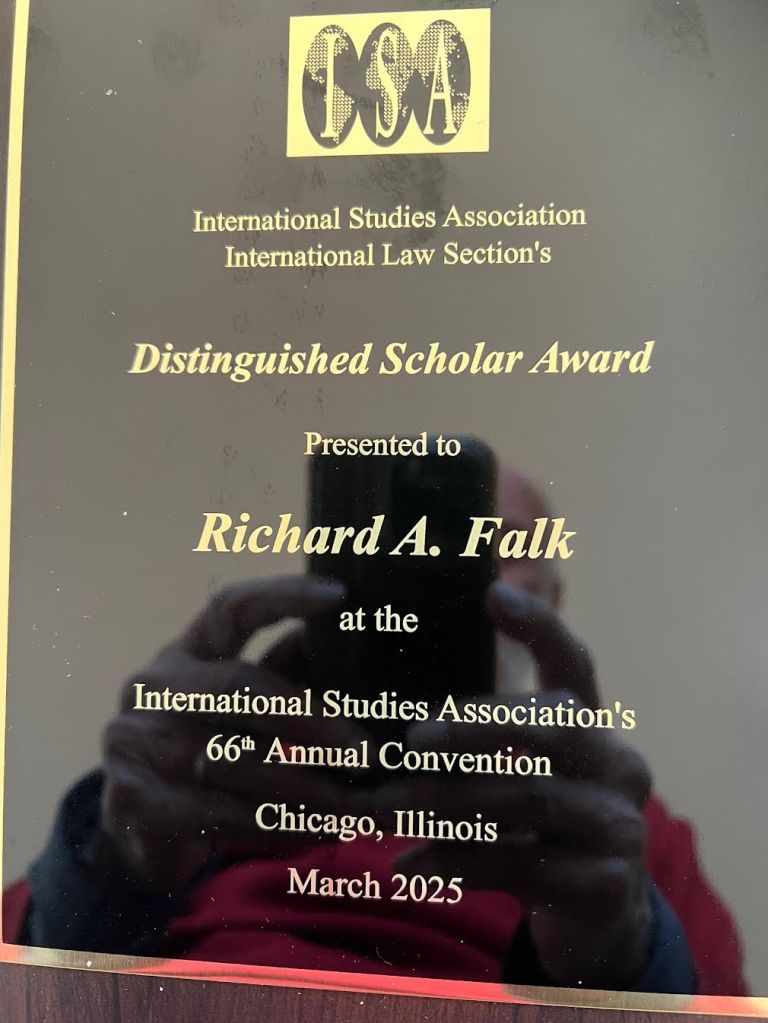
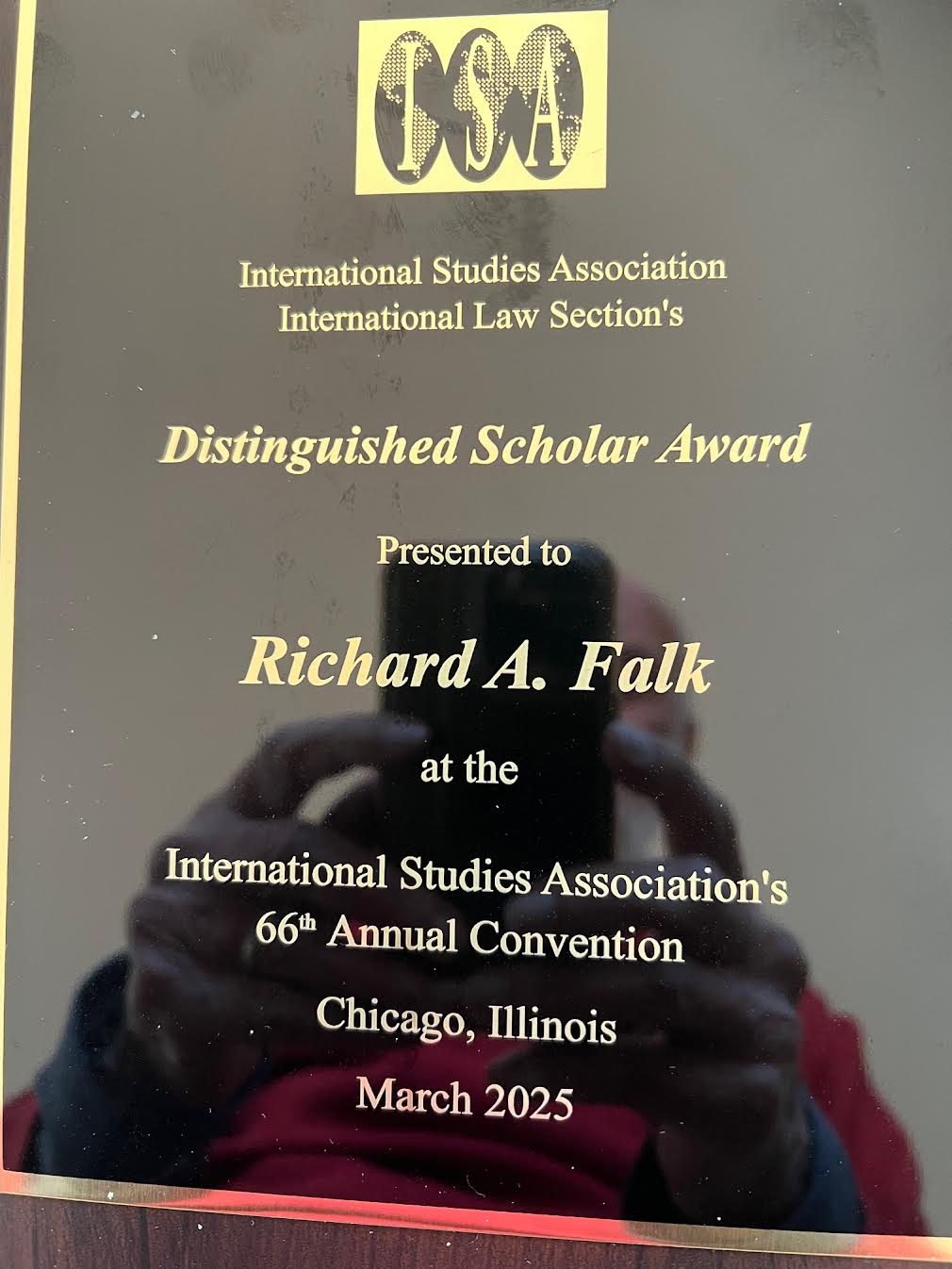
(Prefatory Note: I was surprised pleasantly by this award not often bestowed these days on a faculty member who writes and speaks in a critical voice on core issues of US foreign policy, especially in the context of Middle East politics, and above all with regard to Palestine/Israel, and particularly with someone who like myself early on named Israel’s response to October 7 in Gaza as ‘genocide.’ It is awkward to call such attention to myself but irresponsible not to take note of signs of academic freedom defying a repressive atmosphere in many venues of higher education. This hostility to the traditions of freedom of expression is recently becoming overtly punitive (e.g. terminating $400,000,000 in Federal Grants to Columbia University science programs for its supposed tolerance of antisemitism, itself a manipulated allegation that actually encourages what it claims to be opposing.]
Richard Falk is an international law and international relations scholar who taught at Princeton University for forty years. Since 2002 he has lived in Santa Barbara, California, and taught at the local campus of the University of California in Global and International Studies and since 2005 chaired the Board of the Nuclear Age Peace Foundation. He initiated this blog partly in celebration of his 80th birthday.


 Global Justice in the 21st Century