
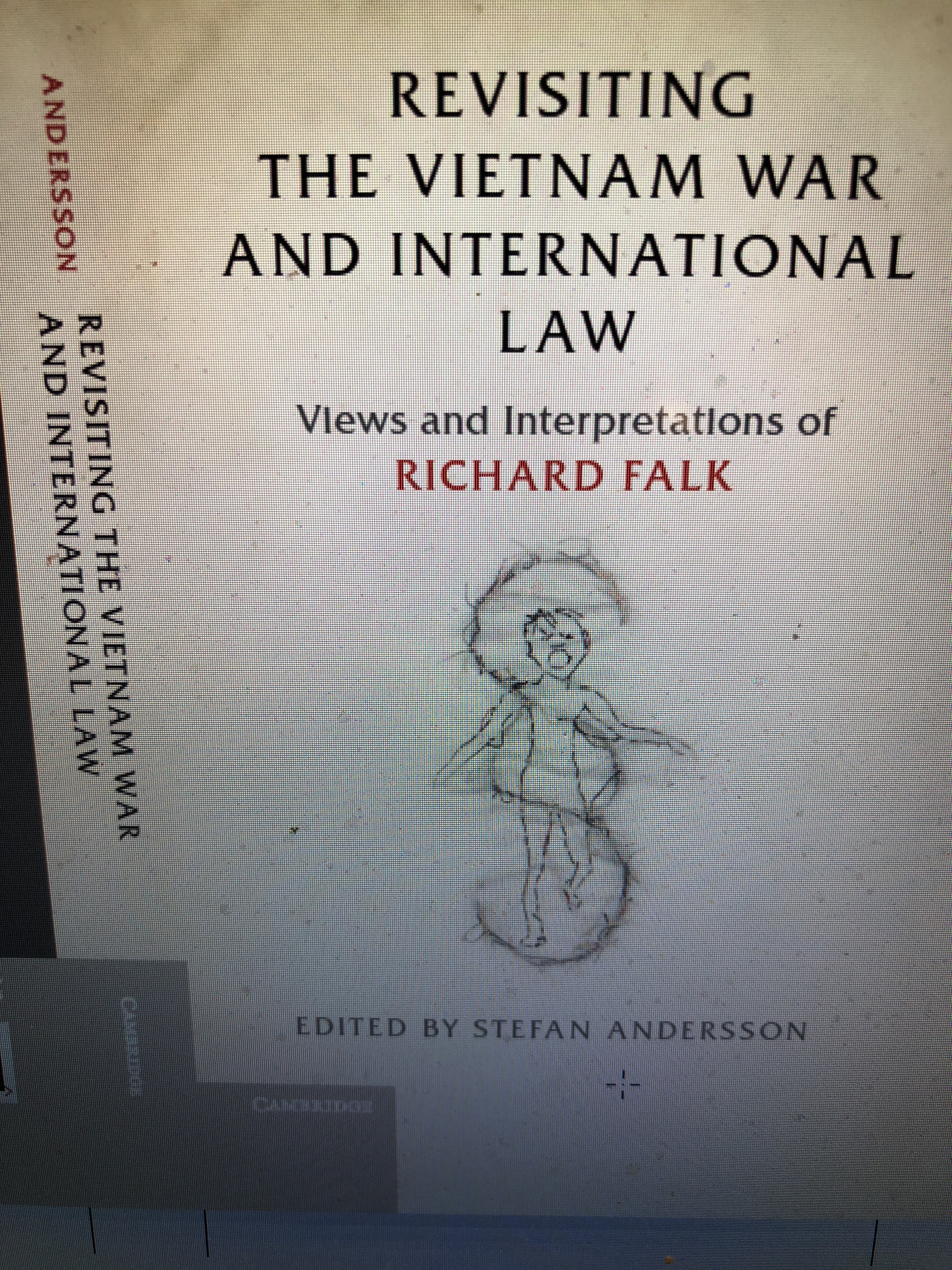
Book Launch: Revisiting the Vietnam War: The Views and Interpretations of Richard Falk, edited by Stefan Andersson, Cambridge University Press, 2017.
Why the Legal and Political Debate on the Vietnam War Still Matters
[Prefatory Note: There has been recently a revival of interest in the Vietnam War, perhaps most notably as a result of the quite extraordinary Ken Burns & Lynn Novick’s ten-part, eighteen hour documentary film as aired on PBS, which although somewhat ideologically slanted toward an American audience has much illuminating footage, especially bearing on various Vietnamese perceptions of the war experience. I would also call attention to a series of articles by Matthew Stevenson describing his recent visit to Vietnam, which combines acute journalistic observation with impressive commentary on the war experience and the problematics of contemporary Vietnam. Stevenson’s valuable contributions are being serially published in Counterpunch, so far two of a promised eight.
I visited Vietnam in November of 2017 for ten days, and met with some Vietnamese officials I had known during the war, as well as with journalists and friends, seeking, especially, to understand whether the present generally harsh criticisms of suppression of dissent and authoritarian governance were justified, and came to mixed conclusions.
On human rights my suspicions of Western bias seemed entirely vindicated, that is, by reducing the effective scope of international human rights criteria to civil and political rights, and completely ignoring successes or failures in social and economic rights. Vietnam is illustrative of this pattern of claiming the high moral ground for the West in the post-colonial era by pointing to their human rights failings, completely overlooking Vietnam’s remarkable achievements of poverty reduction resulting from the pursuit of a needs based development strategy up to this point. With tens of millions of Americans and Europeans enduring varying degrees of material deprivation relating to food, health care, shelter, and jobs, their boastfulness about human rights has an increasingly hollow, even macabre, sound. Indeed, given the wealth of these societies and the scandalous disparities between rich and poor, it would be more reasonable to single out these countries for censure as notable laggards when it comes to human rights provided that economic and social rights are included in the mix. I am not minimizing the importance of civil and political rights, but for the majority of the population these rights pale in day to day significance if compared to failings in the domain of economic and social rights.
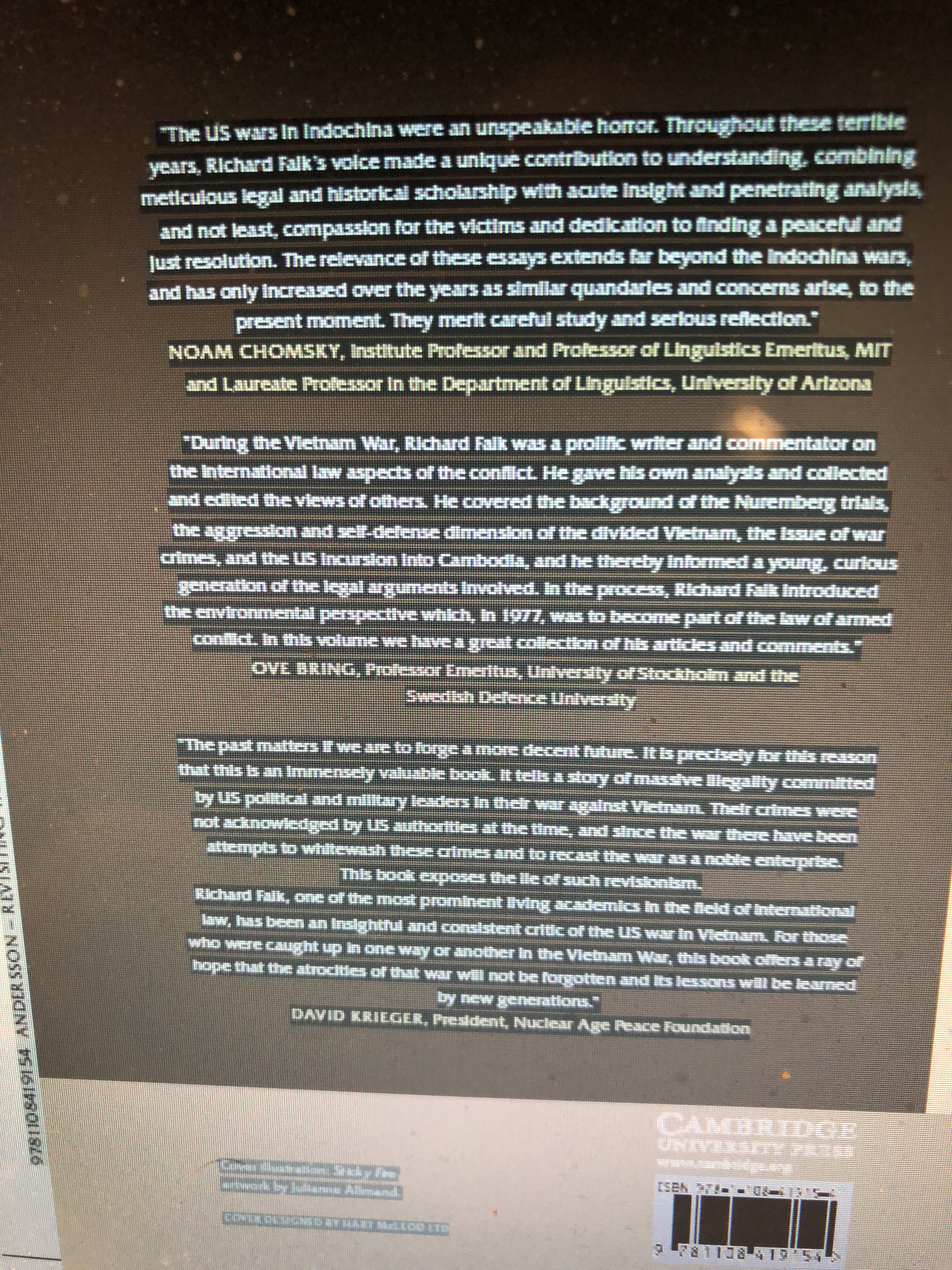
These comments introduce an online launch my own book, Revisiting the Vietnam War: The Views and Interpretations of Richard Falk, published by Cambridge University Press at the end of 2017. In fact, it is not really my book, but as much or more the work of my friend and colleague, Stefan Andersson who edited the text, supervised the production process, arranged for the blurbs, and above all, overcame my own lethargy. I add the newly written preface that I contributed to this collection of my past writings. After the post the back cover containing blurbs is shamelessly included to induce readers to rush to order the book from Amazon or your bookseller of choice.
The preface essentially expresses my view that the wrong lessons have been learned by the United States from its failure in Vietnam, and thus the cycle of regressive violence continues to torment vulnerable peoples in the non-Western world. This geopolitical and normative learning disability is at its core an effort to particularize the Vietnam experience, and allowing policy planners and think tank analysts to propose a series of tactical adjustments that will ensure that future Vietnams result in successful outcomes. Such a (mis) reading of Vietnam has contributed to the more recent counterinsurgency failures as in Afghanistan and Iraq, confirming the my central assessment that the real lessons of post-colonial world order are resisted because their proper interpretation would substantially discredit American reliance on global militarism as the foundation of its grand strategy around the world. Perhaps, most troubling to me, especially in light of this commentary on the evasion of international law throughout the Vietnam War, is the new more drastic set of evasions of international law that have followed ‘the war on terror’ initiated in response to the 9/11 attacks on the World Trade Center and the Pentagon.
In any event, my book, as well as the current flurry of interest in Vietnam, seeks to encourage citizens pilgrims throughout the world to remember Vietnam as a culmination of the anti-colonial wars and as the basis for a revisionist view of the agency of hard power in the 21st century. I ask indulgence for my miserable attempt to add a photo of the cover below, which is an injustice to the talented Canadian artist, Julianne Allmand. who created it under the title, ‘Sticky Fire.’ I am painfully aware that I could have done far better as a photographer had I entered the digital age twenty years earlier.]
The Harmful Legacy of Lawlessness in Vietnam
More than 40 years after the defeat of the United States in Vietnam the central lessons of that war remain unlearned. Even worse, the mistakes made and crimes committed in Vietnam have been repeated at great human, material, and strategic cost in several subsequent national settings. The central unlearned lesson in Vietnam is that the collapse of the European colonial order fundamentally changed the effective balance of power in a variety of North/South conflict situations that reduce the agency of military superiority in a variety of ways.[1]
What makes this change elusive is that it reflected developments that fall outside the policy parameters influential in the leadership circles of most governments for a cluster of reasons. Most fundamentally, governmental geopolitical calculations relating to world order continue to be based on attributing a decisive causal influence to relative military capabilities, an understanding at the core of ‘realist’ thinking and behavior. Within this paradigm military superiority is regarded as the main driver of conflict resolution, and the winners in wars are thought to reflect the advantages of hard power differentials. The efficiency and rewards of military conquest in the colonial era vindicated this kind of realist thinking. Europe with its dominant military technology was able to control the political life and exploit the resources of populous countries throughout Asia, Africa, and Latin America with a minimum of expenditure and casualties, encountering manageable resistance, while reaping the rewards of empire. The outcomes of World War I and II further vindicated the wider orbit of the realist way of thinking and acting, with military superiority based on technological innovation, quantitative measures, and doctrinal adaptation to new circumstances of conflict receiving most of the credit for achieving political victories.
The Vietnam War was a dramatic and radical challenge to the realist consensus on how the world works, continuing a pattern already evident in nationalist victories in several earlier colonial wars, which were won against earlier expectations by anti-colonial forces. Despite these illuminating results of colonial wars after World War II the American defeat in Vietnam came as a shock. The candid acknowledgement of this defeat has been twisted out of recognition to this day by the interpretive spins placed upon the Vietnam experience by the American political establishment. The main motive of such partisan thinking was to avoid discrediting reliance on military power in the conduct of American foreign policy and to overcome political reluctance in the American public to fund high levels of military spending. Until the deceptive military victory in the First Gulf War of 1991, the policy community in the United States bemoaned what it described as ‘the Vietnam Syndrome,’ which was a shorthand designation for the supposedly unfortunate antipathy among the American citizenry to uses of hard power by the United States to uphold American geopolitical primacy throughout the world.
The quick and decisive desert victory against the imprudently exposed Iraqi armed forces massed on the desert frontier compelled Iraq to withdraw from Kuwait, which it had recently conquered and annexed. This result of war making was construed to vindicate and thus restore realist confidence in American war making as a crucial instrument of world order. On closer examination, this enthusiasm for war generated by the almost costless victory in the desert terrain of the First Gulf War involved a category mistake on the part of American leaders, or so it seems. It confused the continuing relevance of military capabilities in conventional war encounters between sovereign states with the declining utility of military supremacy in wars of intervention or counterinsurgency wars, that is, violent conflicts between a foreign adversary and a national resistance movement. It should have been clear to expert commentators that the Vietnam War was an example of a massive foreign intervention being defeated by a skillfully mobilized and efficiently led national movement, and in this respect totally different from First Gulf War with respect to terrain of battle and what was at stake politically for the two sides.
Comprehending why the United States mishandled not only the war in Vietnam but misconstrued its result, is associated with earlier unlearned lessons that involved a misinterpretation of the lost colonial wars, most relevantly, the French defeat in the Indochina War despite the long and deep French presence. In retrospect it was evident to all that the French had failed to grasp the extraordinary resolve that informed the nationalist motivations of the Vietnamese and more than compensated for their military weaknesses, empowering Vietnamese society to endure severe and prolonged suffering to achieve eventual political independence and national sovereignty, and the accompanying collective sense of national pride. Under the inspirational leadership of Gandhi, India achieved independence and recovered sovereignty through a militant nonviolent struggle that by heroic perseverance overcame the grim and unscrupulous determination of 10 Downing Street to retain ‘the jewel’ in the crown of the British Empire whatever the costs of doing so might turn out to be. Whether articulated as the rise of ‘soft power’ or explained by reference to the imbalance between imperial commitments and nationalist perseverance and local knowledge, the story line is the same. The intervening foreign or alien power has lower stakes in such struggles than does an indigenous population effectively mobilized as a movement of national resistance. Colonial powers were slow to recognize that moral and political resistance to their presence was growing more formidable as the ideology of nationalism spread around the world. Resistance become more credible, and withstood a series of prodigious colonial efforts to retain control over colonized peoples, but as these struggles proceeded the former colonial overlords were at varying stages forced to recalculate their interests, and mostly decided that it was better to give up their colonial claims and withdraw militarily than further commit to what had become a lost cause.
We can also interpret this historical turn as reflecting the disparities between the political will of a people fighting for self-determination and a foreign government linked to private sector interests that are trying to retain the benefits of control over a distant country for the sake of resources, prestige, settler pressures, geopolitical rivalry, or a combination of these factors. From the end of World War II onwards, this imbalance of political wills seems to offer the best predictor of the outcome of colonial wars or military interventions in counterinsurgency struggles. In this regard, the French defeat in Indochina should have delivered a cautionary message to the Americans. In fairness, it should be pointed out that the French themselves didn’t learn much from their Indochina defeat, going on to wage and lose an even more damaging colonial war in Algeria eight years later. The noted French journalist, Bernard Fall tried hard to warn the Americans of the great difficulty of achieving a reversal of the French experience in its Indochina War.[2] The French had higher than normal stakes in Indochina. It was to a significant extent ‘a settler colonial’ state, meaning that the French human and cultural presence had sunk deep roots that raised the stakes of withdrawal for France, an experience repeated on a larger scale in Algeria, but producing the same outcome but only after inflicting massive suffering on the native population. The American intervention in Vietnam was primarily motivated by the ideological rivalry of the Cold War, and did not have the high level of material and human interests that led the French to fight so hard to crush the Vietnamese and Algerian challenges to their colonial rule.
The ‘settler colonial’ situation of Algeria, and even more so, South Africa and Israel, complicate the overall analysis. In the event of settler control of the colonial state, the issue of foreign or alien rule becomes blurred, and the question of the identity of ‘the nation’ is itself contested in ways that are very different from the situation of a colonial administration governing on behalf of a European home country or metropole without any pretension of belonging to the occupied nation as if it was one’s own. Each situation has its own originality. For Jews in Israel who claim a biblical and ancestral mandate, and lacking a default homeland option in a distinct territory possess an intense political will to preserve their control of Palestine. The indigenous Arab population of Palestine also has a near absolute will to resist dispossession from their native lands, and are unwelcome elsewhere in the region, having experienced vulnerability to changes in local circumstances and discrimination in neighboring Arab countries. For this reason, as reinforced by the special relationship of Israel with the United States, the Palestinians are waging an uphill battle in which their supposedly inalienable rights of self-determination have been for decades squeezed almost beyond recognition.[3]
Against this background, American reasoning about the Vietnam War displayed what later would be called ‘the arrogance of power,’ that is, the blind faith in the efficacy of its hard power superiority in conflict situations, whether nuclear, conventional, or counterinsurgent.[4] The United States emerged from World War II as the dominant geopolitical actor in the world, having turned the tide of battle against Germany and Japan, as well as developing and using its monopoly over the ultimate weapon against Japan at the end the Pacific war by dropping atomic bombs on Japanese cities. If Germany and Japan could not resist the American juggernaut, who could expect a country that Lyndon Johnson and Henry Kissinger called ‘a fourth rate Asian power’ to resist and repel the American military machine? In the end, it was the greater Vietnamese will to persevere and their cultural resilience that overcame American firepower, as well as the unsurpassed anti-colonial legitimacy of the Vietnamese struggle, which contributed to the rise of a robust worldwide anti-war movement of solidarity, including within the United States. By the mid-1960s it had become increasingly evident that the side that won the legitimacy war would prevail politically even if compelled to endure devastating losses on the battlefield and throughout the country.[5]
The most serious blind spot of the realist paradigm is its inability to take account of its weaknesses with respect to legitimacy as a dimension of political life. This became manifest in the Vietnam setting. The American claims with respect to its presence in Vietnam were essentially ideological and geopolitical, the importance of avoiding the spread of Communism and thus containing the expansionist challenge being allegedly mounted by the Soviet Union and China. In opposition to such reasoning were the historically more influential claims in support of nationalism and the right of self-determination, especially in contexts involving struggles of a colonized people against their colonial masters. Vietnamese legitimacy claims with respect to the United States were further validated by the flagrant disregard of international law constraints and the impact of this disregard on world public opinion, which contributed to mounting American domestic opposition to continuing the war.[6]
This collection of essays written in support of the relevance of international law to the shaping of American foreign policy during the Vietnam Era remains instructive as the 21st century unfolds. The United States has continued to pursue a dubious diplomacy punctuated by military interventions in distant countries, fighting a series of losing counterinsurgency wars after Vietnam, remaining unresponsive to the constraints on recourse to war and war fighting embodied in international law and the UN Charter. The realist consensus, regarding law and morality as dispensable and marginal impediments to sustaining geopolitical effectiveness in world politics, continues to govern the policymaking entourage that shapes war/peace decisions, and has produced a string of costly defeats (especially, Afghanistan and Iraq) as well as badly damaged America’s reputation as a global leader, which in the end depends far more on its legitimacy credentials than on its battlefield prowess, but suffers most when it both loses on the battlefield and should lose if law and morality are taken into account. It is the contention of these essays that adherence to international law is vital for world peace and in the national interest of all countries on all occasions, and this includes the United States.
So-called ‘American exceptionalism’ operates as a free pass in Washington to disregard the rules applicable to other sovereign states, but as the recent history of international conflicts reveal, it does no favors to the United States or its people, although it may further the careers of diplomats and enhance the profits of special interests. Further, it seems evident that the continuing exercise of discretion to ignore legal constraints on the use of international force will be accompanied by repeated disappointments in the conduct of foreign policy for this most mighty country in all of world history and will also continue to erode its legitimacy credentials.
The 9/11 attacks gave the United States a chance to start over, undertaking a response to mega-terrorism within the framework of the rule of law that would have been a great contribution to building up the global rule of law and charting a new path toward sustainable global governance. Instead, a ‘war on terror’ was immediately launched that amounted to a declaration of permanent warfare, undermining the authority of international law and the UN, and perversely leading to the spread and intensification of terrorist activities. The defaming scandals of Guantanamo, Abu Ghraib, and ‘enhanced interrogation’ together with the failure to prosecute those responsible for authorizing and perpetrating ‘torture’ during the presidency of George W. Bush confirm the deeply entrenched refusal of the U.S. Government to self-enforce minimum standards of international criminal accountability, and its obvious endorsement of a flawed international criminal law regime that currently rests on the major premise of geopolitical impunity as interpreted by way of American exceptionalism. The emergence of ISIS, as had been prefigured in Afghanistan by the rise of Al Qaeda and occasioned by American occupation policies in Iraq, is the ultimate blowback experience betokening an erroneous hard power opportunism in Washington misleadingly chosen as the best approach to national and global security.
The essays in the volume also explore the failure to abide by the experience after World War II, which included imposing criminal accountability on those surviving German and Japanese military and political leaders responsible for the commission of state crime centering on the recourse to and prosecution of aggressive warfare, as well as the mass atrocities epitomized by the death camps. By now it is confirmed that the Nuremberg and Tokyo Judgments although respectful of defendants’ rights and substantively justified were in a larger sense ‘victors’ justice’ by exempting the crimes of the winners from legal scrutiny.[7] The principles of law applied to the losers at Nuremberg and Tokyo were never intended to be applied to the winners, or to those who would after 1945 control the geopolitical dimensions of world politics and dominate its various episodes of warfare.[8] Criminal accountability in relation to warfare was cynically applied to the losers and those in subordinate positions of state power throughout the world, and still is.
Into this normative vacuum stepped the rising activism of civil society, and this became initially disclosed as part of the rising opposition to the Vietnam War. The great British philosopher and political activist, Bertrand Russell, convened a tribunal of conscience composed of moral and cultural authority figures with international stature to gather the best evidence available of American criminality in the ongoing Vietnam War. This bold initative filled the institutional vacuum created by the lack of political will among governments or at the UN to carry forward the Nuremberg impulse with respect to accountability of individuals.[9] In effect, the project of imposing criminal accountability on the strong has become an exclusive undertaking of global civil society, although with some collaboration from moderate governments that do not enjoy the status of being geopolitical actors. It was this transnational collaboration between governments and civil society actors that generated the momentum leading to the unexpected establishment of the International Criminal Court in 2002, but as yet this new institution has given little indication that it possesses the capacity and even the mandate to extend the logic of accountability to geopolitical actors, above all the United States and its closest friends.
Reviewing the international law debates that took place during the Vietnam War remains critically relevant to any reform of American foreign policy relating to these war/peace issues. As in Vietnam, adherence to international law would have been consistently beneficial normatively (upholding law, protecting the vulnerable, avoiding casualties), geopolitically (respecting support for the ethos of self-determination and human rights as evidenced by the flow of history since 1945), and ideologically (recognizing that ‘terrorism’ is a law enforcement issue, not an occasion for war making; realizing that nationalist ideology does not translate into neighbors becoming ‘falling dominos’).
The lesson that most needed to be learned in the Vietnam Era, and remains unlearned 40 years after the ending of war, is the practical and principled desirability of adherence to international law in war/peace situations. Systemic violations of international law lead to geopolitical disappointment, human suffering, societal devastation, and a nihilistic atmosphere of international lawlessness. In contrast, habits and policies of adherence to international law, especially with respect to war/peace issues and matters of national and global security, privileges an emphasis on diplomacy, international cooperation, law enforcement, UN authority, as well as generates the self-confidence of political communities to be respectful of prudent restraint and develop greater reliance in pursuit of national goals on international procedures, norms, and institutions. Such a shift away from lawlessness is, of course, by no means a guaranty of peace and justice, but it provides the crucial foundation for creating better prospects for human wellbeing in the 21st Century.
In my preoccupation during the years between 1963 and 1975 I became obsessed with the Vietnam War, and how I might act as a scholar and citizen to bring this imprudent, unlawful, and immoral war to an end. My writing in this period reflects a process of deepening engagement, and an evolving shift of focus and orientation. In my initial articles on the war I was seeking to demonstrate the unlawfulness of the underlying intervention in Vietnam, with a special emphasis on the American expansion of the war from a struggle for control of the state in what was then treated as ‘South Vietnam’ to a conflict that included then ‘North Vietnam,’ which altered the nature of the war from an internal war in the South to a war between the two political communities that comprised Vietnam after the French defeat in 1954, and persisted until the American defeat in 1975. In the early selections represented here, the international law arguments were underpinned by a realist assessment that rested on the informed belief that this was an ill-considered commitment of U.S. military forces for the sake of a very dubious conception of national interests, which centered on an imprudent opposition to the anti-colonial and pro-nationalist flow of history.
My attitudes toward the war, while never losing the central conviction that the United States was engaged in Vietnam in a manner that violated the most fundamental norms of international law, shifted in the direction of viewing the tactical conduct of the war as increasingly raising questions of international criminal accountability. This shift is reflected in the later selections from my writing that emphasize the relevance of the Nuremberg Principles to the American involvement in Vietnam.[10] I became convinced that a one-sided war in which high technology weaponry was deployed against a totally vulnerable peasant society was an intrinsically criminal enterprise, and additionally almost inevitably gave rise to battlefield atrocities as mythified through treating the My Lai massacre as a singular event.[11] I was also struck by the degree to which the geopolitical status of the United States marginalized the United Nations and limited the relevance of international law to a domestic debate within the United States between the government and its critics in Congress and throughout American society.
One enduring effect of this debate was to give the American anti-war movement the confidence to challenge government policy despite the inhibitions of the Cold War that made any seeming sympathy for the Communist side in the Vietnamese struggle grounds for suspicion and media hostility, particularly in the early years of the war. It is only toward the end of the Vietnam War when the government lost the trust of a large portion of the citizenry and split the foreign policy establishment, as well as becoming clear that the sacrifice of young American lives was not going to end in a military victory, that the prudential arguments against continuing the war began to outweigh the ideological case for its prosecution. This development also had the effect of pushing public opinion in an anti-war direction.[12]
[1] In the midst of the Vietnam War I edited a four volume series on the relevance of international law to the policies guiding decision makers and policy advocates on both sides of the debate that raged throughout the war.
[2] See Bernard Fall, Street Without Joy: The French Debacle in Indochina (Mechanicsburg, PA: Stackpole Books, 1961).
[3] For a range of views see Jeremy R. Hammond, Obstacle to Peace: The U.S. Role in the Israeli-Palestinian Conflict (Worldview Publications, forthcoming 2015); Rashid Khalidi, Brokers of Deceit: How the U.S. Has Undermined Peace in the Middle East (Boston: Beacon Press, 2013); Peter Bauck & Mohammed Omer, eds., The Oslo Accords, 1993-2013 (Cairo, Egypt: American University in Cairo Press, 2013); For the U.S. /Israeli spin on the peace process see Dennis Ross, The Missing Peace: The Inside Story of the Fight for Middle East Peace (New York: Farrar, Strauss & Giroux, 2004).
[4] J. William Fulbright, The Arrogance of Power (New York: Random House, 1966).
[5] As argued in Richard Falk, Palestine: The Legitimacy of Hope (Washington, D.C.: Just World Books, 2014).
[6] In the Name of America (New York: Clergy & Laity Concerned About Vietnam, 1968).
[7] An important early account along these lines in the Japanese context is Richard H. Minear, Victors’ Justice: The Tokyo War Crimes Tribunal (Princeton, NJ: Princeton University Press, 1971).
[8] Justice Robert Jackson, the American prosecutor, did argue to the tribunal in Nuremberg that the legitimacy of the judgment against the German defendants depended upon the victors in the future accepting the same framework of accountability, but such words fell on deaf ears in the capitals of the world powers.
[9]The proceedings of the Russell Tribunal can be found in John Duffett, ed., Against the Crime of Silence: Proceedings of the Russell International War Crimes Tribunal, Stockholm-Copenhagen (New York: Bertrand Russell Peace Foundation, 1968).
[10] These issues were fully explored in Richard Falk, Gabriel Kolko, and Robert Jay Lifton, eds., Crimes of War: A legal, political-documentary, and psychological inquiry into the responsibility of leaders, citizens, and soldiers (New York: Random House, 1971).
[11] For the initial expose see Seymour M. Hersh, My Lai 4: A Report on the Massacre and its Aftermath (New York: Random House, 1970). See also Kendrick Oliver, The My Lai Massacre in American history and memory, (Manchester: Manchester University Press, 2006).
[12] The release of the Pentagon Papers was a milestone along the path that led from a pro-war consensus to a rising tide of opposition. See interpretation by Daniel Ellsberg, Secrets: A Memoir of Vietnam and the Pentagon Papers (New York: Penguin Books, 2002).



A Debate on Peacemaking: Ending Occupation or Apartheid
9 MarA Debate on Peacemaking: Ending Occupation or Apartheid
[Prefatory Note: This post consists of an exchange of views prompted by my talk at a United Methodist Church in Culver City (Los Angeles) published by Tikkun’s online magazine, March 6, 2018. The core disagreement is whether to retain the emphasis on ending occupation as still the best, and some say, the only path to peace, and my view that a sustainable peace can only be obtained by a process of eliminating the apartheid structure by which Israel currently subjugates the Palestinian people as a whole (that is, including those living as a minority in pre-1967 Israel or in refugee camps spread across neighboring countries or as involuntary exiles in the Palestinian global diaspora). I regard this difference of views as of analytical, political, and normative importance, but as always, defer to authoritative Palestinian views as to the attainment of peace and self-determination.]
Ending the Occupation is the Path to Peace
By Jeff Warner and Yossi Khen, Feb. 27, 2017, Revised & submitted to Tikkun
Peace has alluded the parties in Israel-Palestine for decades. Israel, the stronger party economically, militarily, and diplomatically, has effectively prevented peace from emerging. That sad fact has not changed, even though Palestinian nationalism is stronger than ever and the Palestinian cause is gaining international recognition. In frustration, some Palestinian solidarity advocates are pursuing desperate but futile paths.
An example was promulgated by Richard Falk in a public speech in Los Angeles on February 7, 2018, while discussing his well-researched U.N. report on Israeli apartheid. Falk said that to end the occupation is not good enough; the proper goal should be to end the structure of apartheid.
The Falk-Tilley Report
“Israeli Practices towards the Palestinian People and the Question of Apartheid” by Richard Falk and Virginia Tilley was published by the U.N. Economic and Social Commission for Western Asia in 2017. The report examines the lives of Palestinians who live under four legal domains, and shows that each constitutes apartheid, a crime against humanity, according to the 1973 United Nations Convention on the Suppression and Punishment of the Crime of Apartheid and the 2002 Rome Statute of the International Criminal Court.
In summarizing the report in The Nation, Falk wrote (https://www.thenation.com/article/the-inside-story-on-our-un-report-calling-israel-an-apartheid-state/), “that Israel has deliberately fragmented the Palestinian people in relation to these four demographic domains, relying on systematic discrimination, including ‘inhuman acts,’ to maintain its control, while continuing to expand territorially at the expense of the Palestinian people.”
In discussing the report in the above cited speech, Falk went beyond the report’s conclusion that Israel has imposed apartheid on the Palestinian people to discus how, in light of the report’s conclusion, peace must be pursued. He said that the Palestinian side could not fairly negotiate with Israel [when] it was under apartheid. He said that the path to peace starts with ending the structure of apartheid.
That is an idealistic goal, but it is impossible. The only path to end apartheid is through negotiations between Israel and the Palestinians. Falk did not suggest how to end apartheid without negotiations. South Africa provides a counter example—the ANC and the government negotiated while the blacks, who the ANC represented, were still under apartheid [clarify the reference to ending apartheid in SA; it was the signal sent by the release of Mandela from prison that indicated the readiness of the SA elite to give up racist political rule, while receiving reassurances as to rights, including property rights]
When questioned, Falk said that just ending the occupation is not good enough because we (civil society) cannot allow Israel to fragment the Palestinian people.[as Israel divided the Palestinians to impose a structure of subjugation, it must reverse this reality to establish a lasting peace] To understand what Falk meant, we turn to the Falk-Tilley report that examines the condition of the Palestinian people in four demographic groups, each living under a different legal domain: The domains are:
Falk seems to worry that ending the occupation will focus solely on Palestinians living under direct occupation (domain 3), while abandoning the majority of the Palestinians people living under other domains. [‘seems to worry’ it is a near certainty that Israel will deem its security and promised land requirements as limiting its ‘concessions’ to w/drawal from parts of the WB]
The Way Forward
By advocating that position, Falk is rejecting the stated positions of almost all major Palestinian political organizations which is to end the occupation and seek a Palestinian state alongside Israel. These include the PLO (the sole legal representative of the Palestinian people), the Palestinian Authority, the Palestinian Israeli Joint List (representing 87% of Palestinian Israelis in the Knesset), and likely even Hamas (https://www.ynetnews.com/articles/1,7340,L-3972646,00.html) if supported by a consensus of the Palestinian people (https://www.ynetnews.com/articles/1,7340,L-3972646,00.html). Falk is abandoning the international consensus to end the occupation which includes almost every state in the United Nations and international organizations including the Arab league, the United Nations, and the European Union. Even after Trump’s Jerusalem decision, the United States is still part of this international consensus.
While the international consensus has not stopped Israel from deepening its apartheid control over the Palestinian people, it has stopped Israel from annexing large sections of the West Bank. More important, the international consensus, through government sanctions, will surely be the agent that eventually pressures Israel to make peace.
Falk did not specify or even hint at what is required to end the structure of apartheid. Maybe because it is fairly obvious. For Palestinian Israelis (domain 1), it means ending the de jure and de facto discrimination. For Palestinian residents of Jerusalem (domain 2), it means citizenship. For Palestinians under direct occupation (domain 3), it means ending the occupation. And for diaspora Palestinians, mostly refugees in Lebanon, Syria, and Jordan (domain 4), it means the right of return.
The most straightforward of the above is ending the occupation. We suggest that ending the occupation is key to bringing relief to the groups of Palestinians not under direct occupation. [not at all clear, probably the reverse is true]
When the occupation eventually ends, it will be via a formal, bilateral agreement between Israel and the PLO that creates a Palestinian state alongside Israel (2SS). The agreement will be based on the 1967 Green line likely modified by land-swaps. It will specify the pace and extent of the withdrawal of the Israeli army and police, and the future of the Israeli settlements and settlers that will end up in the Palestinian state.
Proponents of a single democratic or bi-nation state (1SS) suggest the occupation would end with an agreement that specifies the characteristics of the unitary government and the pace and character of a transition from separate to unified security and other civic services.
If we thought any of these 1SS were possible, we would work hard to make it happen because they will promote Jewish-Arab cooperation. But considering the strong nationalism of Israelis and Palestinians, the lack of any significant political support for a single democratic state among Palestinians (except in the far diaspora), and the fierce opposition of Israelis (likely even with a guaranteed Jewish homeland rule), a 1SS seems less likely to emerge than a viable Palestinian state.
Michael Lerner proposed (https://www.tikkun.org/nextgen/still-immoral-still-stupid-lets-end-50-years-of-israels-occupation-of-the-west-bank-one-personone-vote) a type of 1SS he calls the One Person/One Vote strategy (1P/1V). He sees it as a temporary transition from the present intransigent Israel to a 2SS. 1P/1V is similar to the Scottish situation in which Scots are voting citizens of the United Kingdom, up to the time they vote for separation. This has been discussed in the Israel-Palestine context by Tony Klug (https://read.dukeupress.edu/tikkun/article-abstract/32/2/41/129722/It-s-the-Occupation-Stupid-If-that-is-the-answer). Lerner’s version is based on a constitution that that guarantees the 1P/1V state will be a homeland for any Jew who is under anti-Semitic threat.
1P/1V would require a Knesset vote to grant citizenship to Palestinians in the occupied territory, and that seems impossible given the political positions of the several parties. The Jewish parties, from Meretz on the left to Jewish Home and Yisrael Beiteinu on the right, are Zionist and committed to a Jewish state; the Joint List Arab coalition opposes anything that would promote the occupation of annexation. [what is ‘impossible’ now is not a guide to what is ‘necessary’ for real peace to result; without a fundamental recalculation of Israeli mainstream interests, there will only be frustration]
The 2001 Israel-PLO Taba summit (http://www.pij.org/details.php?id=32) is instructive in anticipating that an end of occupation agreement will include all aspects of the Israel-Palestine issue, including:
Such an end of occupation agreement would end apartheid for all Palestinians except Palestinian Israelis. [true, if implemented]
Palestinian Israelis will still have their lives constrained by tens of laws that discriminate against them—what Falk calls apartheid. But the Palestinian Israelis are not abandoned. The Joint List (the united Palestinian political parties that were supported by about 87% of the Palestinian Israeli electorate in the last election) support a 2SS as the first step to a more egalitarian Israeli society. They believe that once there is peace, Palestinian Israelis will no longer be seen as a potential fifth column that is sympathetic to the enemy. They believe that peace will create a different environment in Israel where reforms will be easier to enact. [yes, if real peace, no if a peace that is one-sided in Israel’s favor, including settlers and Jerusalem]
We understand that eliminating the 50 plus Israeli laws that discriminate against Palestinian Israelis will take many years. That said, we note that Palestinian Israelis, even under discrimination, are integrating themselves into Israeli’s academic, medical, commercial, technical, and entertainment life, and anticipate that as integration expands, repealing discrimination laws will be easier. [adapting to second-class status is not an assurance that deep discrimination will ever happen]
Can it Happen?
Some might say that assuming that an agreement will be as comprehensive as outlined here is unrealistic. They would say that Palestinian leaders will capitulate to Israeli dictates under pressure from the United States. But the history of Palestinian-Israeli negotiations is that Palestinian leaders have not agreed to sub-standard agreements. Two examples are the 2000 Camp David and the 2008 Olmert-Abbas talks. In neither case, or any other, has a Palestinian leader sold-out the Palestinian people.
Others might say that Israel will act unilaterally, withdrawing its army and police with no coordination with the Palestinians. This is what happened during the 2005 disengagement from Gaza when Israel removed its settlers and army and essentially threw the keys on the ground. [not really; borders hardened, incursions frequent]
But Israel will not unilateral withdraw from the West Bank and East Jerusalem without making arrangements for its 550,000 settlers. Even if Israel annexes the land between the 1967 Green Line and the separation wall, it must still make arrangements for 100,000 settlers living east of the wall, many of whom may want to remain living in the biblical West Bank. [legalizing the settlements is incompatible with real peace; settlements unlawful, and their persistence must not intrude on a Palestinian state]
Another factor is that even though many Israelis blame the post disengagement unrest with Gaza completely on Hamas, there are key Israelis who understand that it was withdrawing from Gaza without coordination, opened the door for Hamas’ takeover. [written from a very Israeli point of view; the corruption & collaboration of Fatah is closer to the explanation of the rise of Hamas
We think Richard Falk created a strawman when he said that ending the occupation is not enough. In fact, ending the occupation goes a long way to ending the structure of apartheid. By saying ending the occupation is not enough, Falk is destroying the international political movement that unifies world-wide opinion to end Israeli oppression of Palestinians by ending the occupation and promoting a Palestinian state alongside Israel. [we can debate who has created ‘a strawman’; I believe the kind of ss2 that the authors propose is as remote from present credibility as is the kind of integrated dismantling of apartheid that I believe to be the necessary and desirable prelude to a sustainable peace] [I welcome this exchange of views as it helps clarifies the obstacles to real peace and how to overcome them]
Author bios:
Jeff Warner is the Action Coordinator for LA Jews for Peace; he visited the West Bank and Gaza Strip as part of four humanitarian missions, most recently the 2017 Jewish Center for Nonviolence 9-day mission to Bethlehem and Hebron.
Yossi Khen is an Israeli-born, long-time citizen of the United States. He was a Refusenik in the 1970s to avoid serving in the occupied territories and has consistently worked for a Palestinian state alongside Israel, first in Israel and for almost 35 years in the United States.
Response to “Ending the Occupation is the Path to Peace” by Jeff Warner and Yossi Khen” (5 March 2018)
Richard Falk
Jeff Warner and Yossi Khen have written a sharp critique of a talk that I gave at a United Methodist Church in Los Angeles on February 7, 2018, sponsored by several groups including the LA Branch of The Jewish Voice for Peace. They object most strongly to my insistence that the only path to peace between Israel and Palestine involved ‘ending apartheid’ as imposed upon the Palestinian people as a whole. It particularly disturbed Warner and Khen that an acceptance of my line of advocacy meant abandoning the international consensus to the effect that the only key to peace remains ending the occupation as the essential feature of any realistic prospect of peace, consisting of establishing a Palestinian state alongside Israel.
Let me say at the outset of my response that debate and discussion of these fundamental issues of peacemaking is constructive, even vital, considering that the Palestinian search for some kind of just and sustainable peace has been stymied for decades, and in fact has lost ground due to settlement expansion, construction of the separation wall, the consolidation of Israeli control over Jerusalem, adverse shifts in regional politics, and the advent of Trump and Trumpism. Despite these developments, Warner and Khen continue to believe that the international two-state consensus on peace diplomacy remains the only realistic approach, offering cogent criticisms of my support for an alternative understanding of a peaceful future based on ending apartheid.
As I read their critique, it does not challenge the allegations of apartheid contained in our controversial ESCWA Report to the effect that the policies and practices of Israel toward the Palestinian people appear to be a criminal violation of the International Convention on the Suppression and Punishment of the Crime of Apartheid (1973) and an instance of a Crime Against Humanity as delimited in the Rome Statute governing the International Criminal Court. Their main contention is rather that my views are politically impossible to implement, and for this reason alone, are irrelevant, and hence, an irresponsible from any serious effort to end the conflict.
Warner/Khen believe it fanciful to think that Israel would ever dismantle its apartheid regime prior to engaging in a comprehensive diplomatic process that established peace between these long embattled peoples. In their view, if I understand them correctly, the gradual elimination of apartheid by Israel will occur, if at all, in the aftermath of a carefully coordinated process of ending Israel’s occupation of Palestine in a manner that raises Israeli confidence in their future security as well as their trust in the good faith of Palestine in following through on their acceptance of Israeli sovereignty and legitimacy. Their criticism of my approach also suggests that I misinterpret the way in which apartheid was ended in South Africa, not as a precondition preceding diplomacy, but as the core of what was being negotiated between the two sides.
Acknowledging Political Impossibility
On the issues of ‘political impossibility’ I essentially agree with Warner and Khen, but I would also suggest that their analysis applies as strongly to ending the occupation, a position that they endorse as the best way forward. Ever since 1967, despite the existence of UN Security Council Resolution 242, Israel has given every indication of a deeply embedded refusal to follow the central imperative of withdrawal from the territories occupied. It is hardly news that the settlement phenomenon initiated almost at soon as the occupation began 51 years ago sent a clear message of Israel’s intention to pursue expansionist territorial and security goals that could not be convincingly reconciled with 242. Beyond this, the West Bank and Jerusalem were treated in Zionist ideology as forming an essential part of the promised land, a biblical mandate as to the enlarged scope of Israel that took precedence over contemporary international law for many Israelis and in Zionist thought, and was reflected in the internal discourse in Israel that invariably refers to the West Bank as ‘Judea and Samaria.’ Israel’s political will to withdraw even partially has never been really tested, despite some intimations to the contrary in the course of the peace diplomacy associated with the 1993 Oslo Framework of Principles.
My point is this—that political impossibility applies across the board when it comes to peacemaking between Israel and Palestine. But additional to this, I believe that even should conditions drastically change in the future, ending the occupation would not produce peace, but would be much more likely to initiate a new cycle of Palestinian frustration and disappointment. With such a mood, renewed violence and oppositional politics would return, producing a total disillusionment on both sides as to achieving peace. I believe that peace cannot come to either Israelis or Palestinians without dismantling the existing structures of subjugation, and repudiating their ideological infrastructure, that currently affect, and afflict, those Palestinians living in refugee camps, as a minority in Israel, and enduring involuntary exile, as well as those who have endured an oppressive occupation since 1967.
Here, I do have an analytical disagreement with Warner and Khen, assuming that I have understood their position correctly. I read them as arguing that the best way to eliminate the discriminatory structures affecting those Palestinians not living under occupation is to first end the occupation, and then work and hope for a gradual softening of other forms of Israeli control. In their words, “[w]e suggest that ending the occupation is key to bringing relief to the groups of Palestinians not under direct occupation.” Their underlying belief seems to be that as peace between the two peoples becomes more firmly grounded it will dissipate Israeli fears, and create an atmosphere more conducive to creating conditions of equality and peaceful relations between Israelis and Palestinians. I find this line of reasoning to be unconvincing for two major reasons: first, any peace diplomacy that achieves an Israeli withdrawal (even if partial) will almost certainly be accompanied by an unconditional Israeli demand that the Palestinians explicitly pledge to give up any further claims as to grievances or rights, that the peace agreement is the absolute end of the conflict, and no subsequent or unresolved grievances will be admissible; secondly, if Israel retains its identity, as would certainly be the case, of being ‘a Jewish state’ it would, in effect, reaffirm the basis for discriminatory laws designed to ensure a permanent Jewish majority population and a dualist regime that grants Jews an unrestricted ‘right of return’ while denying the Palestinians any such right.
What I am arguing is that given the political impossibility of any path to peace at the present time, it is desirable to opt for a solution that is at least capable of removing fundamental grievances. In this regard, ending the occupation does not even pretend to do this. It basically ignores the plight of those millions of Palestinians who are not living under occupation, and thus almost certainly sows the seeds of future conflict. Ending apartheid is, of course, not a guaranteed solution, but at least it purports to address the entire agenda of Palestinian grievances, and is premised on the resolve to reach political outcomes that give expression to the formal and existential equality of the two peoples.
Warner and Khen criticize me for supposing that Israel would ever agree to eliminating apartheid structures as a precondition to peace, and point to the fact that the even ANC in South Africa was forced to negotiate the dismantling of apartheid in the course of their peace diplomacy. I admit to being unclear on this point in my oral presentation. I agree that ending Israeli apartheid, unless undertaken unilaterally, would almost certainly, require extensive negotiations and a phased plan of implementation. To the extent that I implied that ending apartheid was a precondition for credible peace negotiations, I acknowledge that such a formulation is misleading. Nevertheless, I would assert that the question of ending apartheid must be understood by both parties to be at the center of any future credible diplomatic effort that seeks a sustainable peace, likely constituting the most challenging aspect of such a peacemaking process as undertaken by Israelis and Palestinians.
By unexpectedly releasing Nelson Mandela in 1990, the symbol of the anti-apartheid movement led by the ANC, the white governing elite of South Africa sent a clear signal of their readiness to negotiate the end of legalized racism. This is instructive, suggesting that Israel must also signal its change of heart toward the subjugation of the Palestinian people before a real ‘peace process’ can go forward. In this sense, returning to the Warner/Khen criticism, it is the signal of Israel’s altered outlook on peace, not the dissolution of apartheid, which should be regarded as a precondition for an authentic peace process.
A final question seems to be whether ‘ending apartheid’ is more ‘politically impossible’ than ‘ending occupation.’ I believe the honest answer is that we cannot know. Given this circumstance of radical uncertainty my view is that it is preferable to be committed to a path to peace that both ends the conflict and embodies relevant precepts of international law and morality. As should be obvious, I believe ending the occupation would be, at best, nothing more than a somewhat more politically acceptable and inevitably temporary reframing of subjugation and victimization, while ending apartheid would be a decisive move toward adopting a law-based solution to the conflict responsive to contemporary standards of international human rights and consistent with the expectations of global justice.
Debating Solutions
Warner and Khen suggest their own view of political prospects and preferences by their strong endorsement of a two-state solution, and corresponding rejection of a one-state solution. In effect, Zionism can live, in theory at least, with an independent Palestinian sovereign state as a neighbor, but would lose its ideological birthright as a biblically entitled state beholden to the Jewish people, if it accepted to become a single binational state based on the equality of Jews and non-Jews. I appreciate the coherence of their position, but feel that it inscribes an inherently unjust solution based on an unwarranted deference to the underlying Zionist project. The claim to be a Jewish state, however justly and understandably motivated by the Jewish experience, was flawed from the outset due to its disregard of the rights and wellbeing of the majority non-Jewish population residing in Palestine up to the time of the Partition War in 1947-48.
What kind of polity can we expect to emerge if Israel were to dismantle the apartheid structures that now oppress the Palestinian people? It is here that Warner and Khen assume that the outcome would be a single, secular, binational state, and are critical of my failure to offer a clear idea of what such a post-apartheid Palestine and Israel would be.
While we are in the domain of the impossible, it seems more useful to imagine the unimaginable than to project what seems obvious. In this regard, I would not prejudge the political sequel to a process that effectively dismantled Israeli apartheid structures of control. Such a context would be so different than what seems presently plausible that we should indulge visions of the desirable rather than be confined to what seems from the outlook of the moment to be most plausible, which is a single secular state that reestablished Palestine as a state with the borders possessed before the British mandate, although possibly with a new, neutral name.
What if we are daring enough to envision and propose ‘a stateless Middle East’ that involved a reversal of the Sykes/Picot imposition of Westphalian territorial states on the region a hundred years ago to satisfy the anachronistic colonial ambitions of Britain and France? Instead of European style states with arbitrary and artificial boundaries held together by a strongman, the new political framework of the region would be constructed of political communities that better reflect natural ethnic, religious, and historical affinities, resembling in some ways the Ottoman system of governance based on the millet system, in other ways, the idea of ethnic self-determination as envisioned by Woodrow Wilson, and in still other ways the unified Arab nation that the British misled Arab leaders to believe would be allowed to happen in exchange for their support in opposing the Ottoman Empire in World .
The Ottoman political framework was discarded after World War I, Wilson’s vision overridden by European colonial maneuvers, and the wartime pledge to the Arabs cynically broken. As a result the peoples of the region have endured conflict, corruption, chaos, and coercion over the course of the last century, and have been a site of geopolitical rivalry and neoliberal exploitation since 1945. I realize that it must be strain credulity to place any hope whatsoever in a political process that yielded a stateless Middle East.
In contrast, I would suggest that only the articulation of utopian aspirations offer the only constructive refusal to accept the strictures imposed on creative thought when speculating about the future of the politically impossible. That is, we are trapped in the vortex of the impossible, but to yield to its logic is to give up the quest for true peace altogether.
Tags: apartheid, ending apartheid, ending apartheid, ending occupation, Israel-Palestine, Peacemaking, South African apartheid, the crime of apartheid, Virginia Tilley