[Prefatory Note: The following post, was previously published as a co-authored two-part article by Akbar Ganji and myself in AlJazeera English on August 20-21, 2014; its basic premise is that the persistent defiance of international law by a sovereign state should carry delegitimizing consequences; the geopolitical grant of impunity to Israel evident throughout the aggressive military operation being carried out against an essentially helpless civilian population in Gaza suggests that neither the UN, nor governments in the region, nor leading governments in the world possess the political will to challenge such a frontal assault upon the authority of international law. We write from two very distinct backgrounds as members of civil society devoted to human rights and the global rule of law, and invite others to join in reflecting upon how civil society can bring law to bear more effectively on the behavior of the Israeli government, and in the process, help empower the people of Palestine in their quest for national self-determination and the fulfillment of their rights under international law so long denied. We try to make this central argument by positing the idea of ‘Outlaw State’ as a descriptive designation that might have some influence in civil society mobilizations of the sort associated with the global solidarity movement backing the Palestinian struggle and supporting such militant nonviolence as animating the BDS Campaign.]
The United State and the Outlaw State of Israel
Richard Falk and Akbar Ganji
Israel has become an outlaw state. In his book, The Law of Peoples, John Rawls defines (pp. 5 and 90) an outlaw state as one that systematically violates the universal principles of human rights, and commits aggression against other nations. Israel is guilty of repeated such violations as well as several massive acts of aggression, making it reasonable and responsible to identify it as an outlaw state. Such a pattern of behavior also contradicts the most basic principles of international law as embodied in the UN Charter pertaining to the use of international force, and obstructs the fundamental promise in the Preamble of the Charter “to save succeeding generations from the scourge of war.
It has become appropriate for the international community and global civil society to act accordingly
Israel’s military aggressions against other countries
Israel was born in 1948. Resolution 181 of the United Nations General Assembly is widely regarded as the most convincing legal basis for founding the State of Israel. We should recall that the Palestinians were awarded 45% of the historic Palestine, while 54% was allocated to Israel, and 1% was set aside as a special zone to be used for the internationalized city of Jerusalem. After the 1948 War with the neighboring Arab nations, Israel’s territorial gains reduced the Palestinian share to only 22%. In the 1967 War Israel proceeded to occupy the Palestinian territorial remnant that had been temporarily administered since 1948 by Jordan and Egypt, and since that time has encroached on Occupied Palestine in several unlawful ways—by establishing and expanding large and numerous Israeli settlements, constructing a network of settlers-only roads, building a separation wall deep in Occupied Palestine declared illegal by a 14-1 majority of the International Court of Justice in 2004, keeping the 1.8 million people of Gaza under siege since mid-2007 in ways that constitute collective punishment, and annexing and enlarging the metropolitan area of Jerusalem. These actions called ‘facts on the ground’ have been accepted as new “realities” by the U.S. Government and by several European governments, making the establishment of a viable Palestinian State virtually impossibility. Present trends in Israel make permanent the denial of fundamental Palestinian rights, above all, the right of self-determination, and accompany this with a unilateral “validation” of Israeli expansionism. Furthermore, Israel has attacked Gaza three times in the last six years (2008-09, 2012, 2014) in a manner that constitutes aggression under international law and the UN Charter and involves numerous violations of the law of war
This denial of Palestinian rights and deviation from the rules of international law and norms of global justice should not be interpreted in isolation from a wider pattern of unacceptable Israeli behavior. In this regard, it is highly relevant to take note of various acts of aggressions committed by Israel against several other sovereign states as well:
Military attacks on Iraq in June 1981 that destroyed Osirak nuclear reactor that was under construction, with the apparent purpose of disrupting an Iraqi program to develop nuclear weapons and to preserve Israel’s undeclared, yet clearly existent, regional monopoly over nuclear weaponry
Invasions of Lebanon in 1978, and 1982, coupled with the Israeli occupation of southern Lebanon until 2000. In September 1982 Israel was charged with complicity in the Sabra and Shatila massacre carried out by Maronite Phalangist militia units in which between 1500 and 3000 Palestinian civilians were murdered in cold blood. The Kahan commission, established by the government of Israel to investigate allegations involving Israeli complicity associated with the 1982 Lebanon War, found that then Defense Minister Ariel Sharon “bears personal responsibility” as the military commander on the scene who facilitated Phalangist entry into the camps and watched the massacres unfold.
Military attack on the PLO Headquarters in Hamman, Tunisia in October 1985, killing 60, which was condemned by the UN Security Council.
Invasion of southern Lebanon in 2006 that resulted in the 33 days warfare directed at Hezbollah, the destruction of residential sections in the southern Beirut associated with the formulation of the ‘Dahiya Doctrine’ rationalizing and justifying Israeli reliance on disproportionate uses of military power.
Attacks on October 2, 2007 on Syria destroyed its nuclear reactor in Deir ez-Zor region.
The attack of May 2010 in international waters on the Turkish passenger ship Mavi Marmara that was part of the Freedom Flotilla bringing humanitarian assistance to the people of Gaza in defiance of the international blockade, killing nine Turkish nonviolent peace activists.
At least three additional military attacks on Syria during 2013 and 2014 that involved bombing of targets to stop weapons from going through the country to reach Hezbollah in Lebanon, targets associated with location of Syrian Army units to lend assistance to the anti-Assad insurgent forces, and in retaliation for causing the death of an Israeli Arab in the Golan Heights.
Repeated military attacks in Sudan in 2009, 2011, and 2012, supposedly to disrupt the supply of weapons to Hamas in Gaza, causing many deaths.
In addition, Israel has occupied Syria’s Golan Heights since 1967, built unlawful settlements, and established a permanent presence. Israel has refused to withdraw from the West Bank and East Jerusalem, as called for by unanimous Security Council Resolution 242.
Add to these infringements on the sovereignty of Arab states the destabilizing fact that Israel secretly and illegitimately acquired and has continued to develop an arsenal of an estimated 300 nuclear warheads, the only state in the Middle East that has a nuclear arsenal, and the only country in the world that refuses to acknowledge its possession of nuclear weapons.
Systematic violations of human rights and the apartheid regime
Israel has always declared that it is the only democratic state in the Middle East. As pointed out by former U.S. President Jimmy Carter in his book, Palestine: Peace not Apartheid, Israel’s occupation regime in the West Bank has systematic discriminatory features of an apartheid regime. Further, the Palestinian minority resident in Israel is subject to as many fifty discriminatory laws that greatly restrict their individual and collective rights.
Recall that the South African regime also had a nominally “democratic” government, but it served only the white minority. The African black majority population was governed by a different set of laws, a cruel and exploitative apartheid regime in which the majority’s human rights were violated systematically. Palestinians in the West Bank have been living without the protection of law or the possession of rights since 1967, being subject to military administration and the oppressive practices of the Palestinian Authority, while the unlawful settler population enjoys the full protection of Israel’s rule of law.
As Gideon Levy, the progressive Israeli journalist writes Israel is “really only a democracy for its Jewish citizens who are quick to fall in line with the mainstream every time Israeli tanks roll across the border,” because even Israeli citizens that are opposed to their country’s aggression are attacked and threatened. A large number of Israelis are relatively recent immigrants, particularly from the former Soviet Union and Easter Europe, who enjoy a far more protected status than the several millions of Palestinians live under an apartheid regime in which they cannot vote in Israeli elections, do not have passports, cannot own property in many parts of Israel, and do not enjoy the social mobility that every human being is entitled to possess. The Palestinian people are also denied the right of self-determination, do not have any prospect of having an independent sovereign state of their own, or to join with the Israelis in the shared existence of a bi-national state in which the two peoples seek to live together on the basis of balanced unity, equality, with distinct spheres of autonomous administration and governance that is organized within the framework of a single sovereign state.
Israel’s war crimes against Palestinians
Not only does UN Security Council 465 speak twice of “Palestinian or Arab territories occupied since 1967,” but also declare and affirm that the Jewish settlements in the Palestinian territories represent a violation of 4th Geneva Convention. Grave violations of this Convention – as for example the defiant refusal to dismantle the settlements as unlawful under Article 49(6), or to dismantle the separation wall as mandated by the International Court of Justice – appear to be war crimes of great severity.
Israel removed its military forces and settlers from the Gaza Strip in its ‘disengagement’ initiative in 2005, but in actuality kept effective control of Gaza, and remained bound by the obligations contained in international humanitarian law as applicable to an Occupying Power. In effect, Israel transformed the conditions of life in Gaza from direct military administration to life imprisonment of the population in the largest open-air jail on earth. Israel retained its total control of Gaza’s entrances and exits, of its airspace and offshore waters, disrupting life within the prison walls by lethal periodic violent incursions Most Palestinian people living in Gaza have effectively been locked in there ever since 1967, and more unconditionally since 2007. At the same time, Israel has periodically launched massive military operations against Gaza, imposed and maintained an illegal blockade, committed frequent acts of cross-border violence, and committed numerous grave war crimes there over a period of many years:
Israel attacked Gaza in 2008-2009, killing 1417 Palestinians, injuring 5303, creating 51,000 internal refugees, destroying 4000 homes, inflicting $2 billion economic damage, and disallowing the delivery of materials needed for reconstruction efforts.
Israel’s attacks on Gaza in 2012 killed 105 and injured 971, provoked by the Israeli targeted assassination of the Hamas military leader, Ahmed Jabari, as he was delivering a signed truce document.
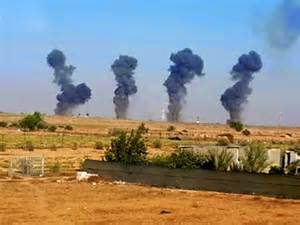
Israel’s 2014 aggression against Gaza launched on July 8 has so far killed 2130 Palestinians , injured nearly 11,000, with 75-80% of the casualties being civilians. This massive Israeli military operation has caused more than 660,000 Gazans to be internally displaced, highlighting the denial of any right of Palestinians to leave the combat area throughout the military onslaught that has terrorized the entire population of Gaza. 577 Palestinian children are estimated to have been killed and as many as 3300 injured. In contrast, Israel’s losses in this attack have led to 68 Israeli deaths, of whom 65 were soldiers. The casualty disparity and the ration of both sides as between military and civilian deaths are both very significant indicators of relative moral responsibility of the carnage caused.
Israel has carried out 59,000 attacks on Gaza, dropping 15,000 tons of explosives on Gaza, which amounts to about 30% of the explosive power of the atomic bomb dropped on Hiroshima.
The United States as Israel’s servant
The United States has supported Israel without reservations since its founding in 1948. According to an agreement between the two countries, that has become a law in the U.S., The United States has committed itself to preserve Israel’s strategic and military superiority in relation to other countries in the Middle East. From 1949-2014 the U.S. has provided Israel with nearly $122 billion in aid, calculated by reference to fixed dollars. Counting the aid to Israel in 2003 dollars, from 1949 – 2003 the U.S. has provided Israel with $140 billion worth of military assistance, which has been increasing since 2003. The basic annual commitment to Israel is $3.1 billion, which is far more than military aid that has been given to any other country in the world, and this figure is an understatement, hiding a variety of supplemental appropriations and other benefits accorded uniquely to Israel. In effect, the United States has been subsidizing Israel’s aggressions, and ignoring American military assistance legislation that seeks to withhold such aid to countries that are not acting defensively and in accordance with international law.
The Obama administration has even increased the aid to Israel through its reliance on various special appropriations. Most recently Congress appropriated an additional $225 million for further development of the Iron Dome defensive weapons system.
The U.S. Senate has even approved a resolution according to which if Israel attacks Iran’s nuclear sites in the future defying international law, the U.S. is obligated to help Israel. It reads in part, “If the Government of Israel is compelled to take military action in legitimate self-defense against Iran’s nuclear weapons program, the United States Government should stand with Israel and provide, in accordance with United States law and the constitutional responsibility of Congress to authorize the use of military force, diplomatic, military, and economic support to the Government of Israel in its defense of its territory, people, and existence.” Of course, the language as written of ‘legitimate self-defense’ is understood to mean any action taken by Israel that is alleged to be ‘defensive,’ whether or not in conformity to international law, which limits such claims to situations of response to prior armed attacks. (See Article 51, UN Charter).
Among the many UNSC resolutions that seek to criticize or condemn Israel for its actions against the Palestinians, almost all have been vetoed by the United States. In fact, the U.S. government opposes virtually every resolution approved by any UN organ, including UN Human Rights Council (UNHRC), if it is deemed to be critical of Israel, and this includes even initiatives to establish fact-finding commissions of inquiry to determine whether charges of war crimes are well-founded. When Israel attacks the defenseless and completely vulnerable Palestinian people, the U.S. justifies such high-intensity and disproportionate violence as ”self-defense,” obstructs the issuance of a UN call for an immediate ceasefire, and gives diplomatic and material aid and comfort to Israeli aggression from start to finish.
After a fact-finding report on Israel war crimes in Gaza in 2008-2009 was approved by UNHRC, the U.S. and Israel successfully intervened with the Secretary General to prompt him to urge the non-implementation of the report in relation to Israeli accountability for war crimes. The US Government also used its leverage to prevent even the discussion of this important report, generally known as ‘the Goldstone Report,’ in the UNSC. When recently, the UN HRC approved a resolution to investigate Israel’s possible was crimes in Gaza, the U.S. cast the only negative vote.
Amnesty International has reported that the evidence of systematic attacks by Israel’s military forces on schools and hospitals in Gaza during the current warfare is overwhelming. It includes targeting those civilians seeking to escape the worst ravages of the Israeli attack by seeking shelter in United Nations schools and other buildings marked with the UN logo.
Human Rights Watch has reported on evidence of intentional shooting of Palestinians who were fleeing their homes, even after they had been ordered to do so by Israel’s military, and has declared such behavior to be a war crime.
We can only comprehend this partisan pattern of U.S. policy toward Israel by taking account of the leverage exerted on the government by the formidable lobby working on behalf of Israel known as AIPAC. Former President Jimmy Carter and the former President of Ireland and prior head of the UN HRC Mary Robinson have condemned this one-sidedness of American policy toward Israel and Hamas, insisting that as a first step Israel immediately ends without conditions the blockade of Gaza, allowing the long suffering people of Gaza to have finally some semblance of a normal life.
Consequences
The U.S. policy toward Israel has had dire consequences:
It has completely discredited the claim of United States to act as an impartial arbitrator between Israel and the Palestinians.
Hatred and resentment toward the United States has been increasing throughout the region, not only because of the blind support of Israel by the U.S., but also due to the military onslaughts directed against Iraq, Libya, and Afghanistan, and by drone attacks in Pakistan, Yemen, Somalia, and elsewhere.
According to a poll right before the current war, 85% of Egyptians and Jordanian, 73% of the Turks, and 66% of the Palestinians view the U.S. unfavorably, while 84% of Israelis have a positive view of the U.S.
What Israel has done in the region with the support of the U.S. has contributed greatly to the growth of extremism and discord throughout the Middle East. If such policies are not reversed even more chaos, extremist violence, bloodshed, and devastation are likely to emerge in the future.
The Middle East and North Africa have been unstable for decades, and the consequences of the intensifying instability are spreading to other regions and endangering world peace.
These policies of unconditional support for Israel have long been against the national interests of the United States. The Israel-Palestinian conflict is the mother of all problems in the Middle East. Israel has undermined all efforts to find a peaceful solution by way of diplomacy. It has rejected both the Arab Initiative of 2002 and ‘the roadmap proposed by the Quartet – the U.S., Russia, the European Union, and the UN – which require that Israel to withdraw to its pre-war green line borders of 1967 with the expectation that a sovereign and independent Palestinian state would emerge. This view of what is required of Israel as a precondition for peace have been consistently endorsed by the United Nations and enjoy wide support of world public opinion, already set forth in Security Council Resolution 242 that has been frequently reaffirmed since its unanimous adoption in 1967. It should be understood that ending the occupation of Palestinian territories is not by itself sufficient to achieve a sustainable peace. Of paramount relevance is also some arrangement that acknowledges the rights of several million Palestinian refugees who were forcibly expelled over the course of many years from Israel, most dramatically in 1948, as part of the catastrophe of national dispossession known to Palestinians as the nakba.
There are also serious questions at this time as to whether the two-state solution is any longer a viable and desirable goal, if it ever was. The question of Palestinian self-determination as the proper foundation for a sustained just peace is more open to debate and reflection in 2014 than ever before. Israel’s expansionism has put the international two-state consensus under a dark storm cloud, and the international community, along with representatives of the Palestinian people must now consider new ways to achieve a just peace for both peoples, which cannot be realized without upholding Palestinian rights.
We believe that a crucial step in this direction is the widespread acknowledgement by civil society, by governmments, and by the UN that Israel has become an outlaw state, and that appropriate adjustments to this reality must be made.
Tags: International Crimes, international law, Israel, Outlaw State



 Global Justice in the 21st Century
Steven Salaita and Zionist McCarthyism
9 SepI have been following the controversy swirling around the dehiring of Steven Salaita by unilateral fiat of the Chancellor of the Urbana Champaign campus of the University of Illinois, Phyllis Wise. As is now widely known, Steven was a tenured professor at Virginia Tech until he resigned his position some months ago to accept a tenure offer in the Department of American Indian Studies from Illinois. By past practice and reasonable expectations, it seemed a done deal until the Chancellor shocked the community by invoking her rarely used prerogative to withhold formal approval before forwarding the appointment for rubber stamping by the Board of Trustees, but was it her prerogative? It would seem that she did have some ill-defined authority to act, yet university governance procedures assume that any initiative of this sort be exercised in a consultative manner. This would have required the Chancellor to discuss her misgivings about forwarding the appointment with relevant faculty committees and administrators, as well as with the appointee. She has more recently acknowledged that she acted unilaterally, contending that she was acting unilaterally to avoid the embarrassment of having the Board reject the appointment.
Steven’s sole offense was to use his Twitter account to send our numerous tweets highly critical of Israel, especially during its military operations Gaza in July and August that killed over 2100 Palestinians, mostly civilians, including about 500 children. Steven is Palestinian-American born in the United States, but his grandparents were dispossessed by the nakba in 1948. According to unconfirmed reports his tweets angered some donors and alumni of the University of Illinois and several Jewish organizations to such an extent that they threatened to withhold funding if Salaita became a member of the faculty. Apparently, it was this kind of pressure that led the Board and the Chancellor to sacrifice Saleita, along with the principles of academic freedom and faculty participating in the hiring process.
Steven’s tweets were not gentle, and did express his abhorrence over Israel’s behavior in the strongest language at his disposal. Among the most frequently quoted of these tweets are the following:
By eagerly conflating Jewishness and Israel, Zionist are partly responsible when people say anti-Semitic shit in response to Israeli terror.
Zionists: transforming ‘anti-Semitism’ from something horrible to something honorable since 1948.
If Netanyahu appeared on TV with a necklace made from the teeth of Palestinian child, would anybody be surprised
I should make several assertions to explain my view of the issues at stake: 1) I would never adopt this kind of language even in the venue of social media, although I share the sentiments and the accompanying moral passion that prompted such tweets; 2) it is highly inappropriate to take tweets into account in appraising the appropriateness and wisdom of an academic appointment; 3) I share Steven Salaita’s outrage over Israel’s unchecked violence toward Palestinians, and identify especially with what he calls the conflation of ‘Israel’ and ‘Jewishness’ so as to treat people who criticize Israel as if they are by this alone ‘anti-Semites,’ and made to pay a heavy price in career and reputation; 4) I believe that Salaita’s appointment should be reinstated, and that Chancellor Wise should make a public apology, offer compensatory damages, and provide an assurance that his performance at Illinois will not be adversely affected by this incident; 5) my own examination of Salaita’s record as a classroom teacher and scholar confirms the judgment of the University of Illinois’ faculty process that his appointment was highly deserved, and that his presence in the Department of American Indian Studies would be a positive development for both students and the university community.
Steven is a productive and talented scholar and a charismatic teacher, and any university should be thrilled to have him on their faculty. It is a sad commentary on the times that such an appointment should even be viewed as ‘controversial.’ It is also a regrettable indication that pro-Israeli forces are playing the anti-Semitic card to shield Israel from critics. This not only punishes a citizen’s right to speak freely but it tends to send a chilling message of intimidation throughout the academic community that it is better to be silent about Israel’s crimes than face the calumny and punitive effects of a Zionist backlash.
The main rationale for questioning the Salaita appointment was hidden beneath the umbrella of ‘civility.’ The recently notorious anti-boycott activist, former AAUP President, Cary Nelson, who happens to be a professor of English at the University of Illinois, unsurprisingly applauded the Chancellor’s move on these grounds. Somehow someone who sends around tweets that would likely be viewed as offensive by some Jewish students and might make them feel uncomfortable in his classes provides ample ground for the university to reverse what had the appearance of being a consummated appointment. In other words, the typical ‘bait and switch’ tactic of hiding the real grievance of anti-Israel fervor behind the pseudo neutral rationale of civility was relied upon. More than a decade ago Ward Churchill was similarly disciplined by the University of Colorado for the text of an undelivered speech (“On the Justice of Roosting Chickens”) that seemed to provide a justification for the 9/11 attacks, yet he was actually sacked not for the offending remarks that were clearly protected speech but for faulty footnotes in scholarly articles conveniently uncovered after more than a decade of distinguished service at the university (also ironically enough in a program devoted to ethnic studies and indigenous peoples that he headed).
This theme has now been echoed by a sudden outpouring of enthusiasm for civility on the part of university administrators, most prominently by University of California at Berkeley Chancellor, Nicholas Dirks, who had the audacity to applaud the 50th anniversary on his campus of the Free Speech Movement, one of the enduring glories of the 1960s, with a concern about the anti-Semitic overtones of criticism directed at Israel. Granted for the sake of discussion that Salaita’s social media tweets can be reasonable regarded as uncivil, should that provide grounds for banishment, or even censure? Of course, not. If a lack of civility is severe, and exhibited in relation to staff, colleagues, and students, it would raise relevant concerns. In Salaita’s case, his experience at Virginia Tech reveals an opposite profile, one of popularity and respect among students and an admirable reputation as a promising young and engaged teacher/scholar among colleagues. At this stage the final disposition of the case is up to the Board of Trustees, which has already swung strongly to the side of the Chancellor’s decision to stop the appointment.The Chair of the Board is Christopher Kennedy, son of Robert Kennedy and born on the 4th of July. This adds an Americana dimension to the ongoing battle of values. So far, this particular Kennedy offspring seems to be determined to bolster the illiberal side of the family legacy.
The battle lines have been drawn, and the war goes on. For the first time since the Chancellor’s decision became known, Steven Salaita is speaking today in public, holding a press conference in Champlain, Illinois where the university is located. There are rumors that he has been offered a settlement by the university, presumably in the hope that the storm unleashed by his rescinded appointment will abate. There are uncertainties as to whether he will be offered a comparable academic post elsewhere, which will show us how wide the net of Zionist influence is cast. It is not encouraging to recalling the case of Norman Finkelstein, who despite scholarly excellence and productivity, has not been offered an academic job elsewhere after being denied a permanent position at DePaul University. This denial was supposedly due to the administration being persuaded by defamatory ‘anti-Semitic’ allegations evidently contained in a letter and media blitz by that redoubtable Zionist stalwart, Alan Dershowitz.
Under these circumstances, then, it seems likely that the outcome of the Salaita case will clearly exhibit the current balance of influence as between Zionist McCarthyism and academic freedom in American universities. That such a struggle should be taking place is itself a national disgrace that suggests the worrisome fragility of academic freedom in relation to the potency of money and the baneful impact of well-funded and unscrupulous pressure groups. Steven Salaita’s own public statement at the start of a press conference admirably sets forth his own response to the crisis, is definitely worth reading: <http://mondoweiss.net/2014/09/commitment-teaching-american>
Tags: anti-Semitism, Christopher Kennedy, Israel, Palestine, Phyllis Wise, Salaita, tweets, University of Illinois