
I will re-post this blog on Friday after it has appeared online in Germany to
accommodate my distinguished co-author. Please forgive any inconvenience.
RF
I will re-post this blog on Friday after it has appeared online in Germany to
accommodate my distinguished co-author. Please forgive any inconvenience.
RF
The Loss of Two Unsung Heroes of International Relations: A Tales of Two ‘Bobs’
In the recent past two giants of International Relations (IR) scholarship died,
leaving behind a corpus of work and a legacy of influence, especially among their talented and devoted followers in the academic world. I was fortunate to have enjoyed the friendship of both Robert Gilpin and Robert W. Cox, learning from both of these masters of the field despite their seemingly divergent worldviews. My connection with the two Bobs’ was quite different, Bob G. being my departmental colleague at Princeton for almost 40 years, while Bob C. more am intellectual and political comrade with whom I only rarely interacted with personally. This greater intimacy with scholarship than the person mainly reflects living and working so distantly from one another.
Why I pair these two academic figures is because for me their similarities, additional to their births and deaths being so close together, outweigh their differences, making the comparison intriguing for me. For many their stark differences in intellectual style, ideological stance, and political lineage would strike the inquiring eye first, and the similarities would be unnoticed.
Gilpin was a self-proclaimed conservative, holding an endowed chair honoring Dwight Eisenhower, and somewhat expressive of his moderate Republican, rural Vermont outlook that valued individual integrity and family closeness above all else. When it came to his scholarly approach Bob self-identified with ‘classical realism’ viewing hard power and economic capabilities as the forces dominating the annals of world history. His mission was to understand how the world order works in relation to its two key dimensions—war and political economy. His books War and Change in World Politics (1981) and The Political Economy of International Relations (1987), along with Global Political Economy (2001) will deservedly be long remembered and actively studied. Their conceptual clarity, lucid prose, and soft erudition make these scholarly contributions enjoyable to read, itself a rarity for such subject-matter. Gilpin was in many ways an American analogue to Hedley Bull, and not surprisingly they were friends and shared a common frame of reference that went against the pretensions of social scientific approaches to IR. To validate the claim of being ‘classical’ realists Gilpin and Bull both regarded history and philosophy as more instructive than social science when it came to understanding international relations. Later in his career Gilpin became conversant with the work of economists, and even applied rational choice theory to his effort to grasp the essence of war and change in international society.
Gilpin’s central linkage between war-proneness and hegemonic decline could be published today to acclaim as it casts a bright light on the seemingly irrational belligerent behavior of the United States. This hegemonic actor seems to be inviting the outbreak of war with an almost mindless disregard of its catastrophic dangers in the nuclear age. In War and ChangeGilpin develops an illuminating set of explanations for why hegemonic powers almost always decline, and resort to war in a vain effort to halt their slide. Gilpin’s political economy writing delineated a new sub-field for mainstream IR, drawing on contemporary economic thought and an Enlightenment confidence in the rationality of human behavior, while at the same time being informed by the Marxist line of critique of capitalism. It was illuminating without in any way challenging the established world economic order, which he praised as having produced unprecedented prosperity and stability since established after the Second World War.
Cox’s concerns and experience were was different. Working with the International Labor Organization (ILO) as a senior civil servant for 25 years, living in the vicinity of Geneva, and developing a feeling for the formative historical agency of people mobilized for change and behaving in ways that reflect their material conditions. His books, Production Power and World Order: Social Forces in the Making of History (1989)and Approaches to World Order (with Timothy J. Sinclair, 1996)contain the essential pillars of his critical theory of international relations and his assessment of the current global situation. While Gilpin devoted his energies to understandingthe way the world of sovereign states and geopolitics works, Cox wanted to devote his understanding to the challenge of transformingthe world. In a rather profound sense, were the legitimate children of revolution: Cox being a child of the French Revolution while Gilpin of the American Revolution. These contrasting influences continue to work their way into practice and expectations of the West two centuries later.
Drawing heavily on the thought of Antonio Gramsci, it was Cox’s mission to demonstrate that the state system was presently entrapped, which presaged regression, and even collapse, unless popular energies could be mobilized around an appropriate transformative vision. While Gilpin observed change, Cox was intent on identifying the social forces that might achieve emancipatory change. Neither was hopeful about the future, Gilpin because of hegemonic decline, Cox because of the absence of a clear alternative to disastrous patterns of hegemonic governance.
Once Cox left the ILO late in life he embarked upon an academic career yet attained almost instant prominence. He became a professor at York University in Toronto, which provided a supportive progressive setting. His work there on international political economy, was definitely in the critical tradition associated with neo-Marxist thought, and was often associated with Susan Strange’s contributions. They were viewed often as co-founders of the British School of Political Economy.
Both Cox and Gilpin deserve our admiration as among the most significant thinkers that international relations has produced in the period since the end of World War II. While many insiders are attuned to the value of their contributions, the wider world has given greater attention to the intellectually flashy, and policy relevant, of such academic writers as Henry Kissinger and Zbigniew Brzezinski. These ambitious individuals gave the impression of marking time while waiting for a call to Washington. They were well vetted by the Council of Foreign Relation, the informal headhunting undertaking that was effective until recently in staffing the higher echelons of the State Department. Perhaps, making the point too strongly, whereas Cox and Gilpin lasting contributions are located in the sphere of knowledge, Kissinger and Brzezinski will be remembered primarily as controversial academic superstars in the sphere of power.
Bolton’s Game: Not Sovereignty, Not International Law—Clearing the Path for U.S., Geopolitical Primacy
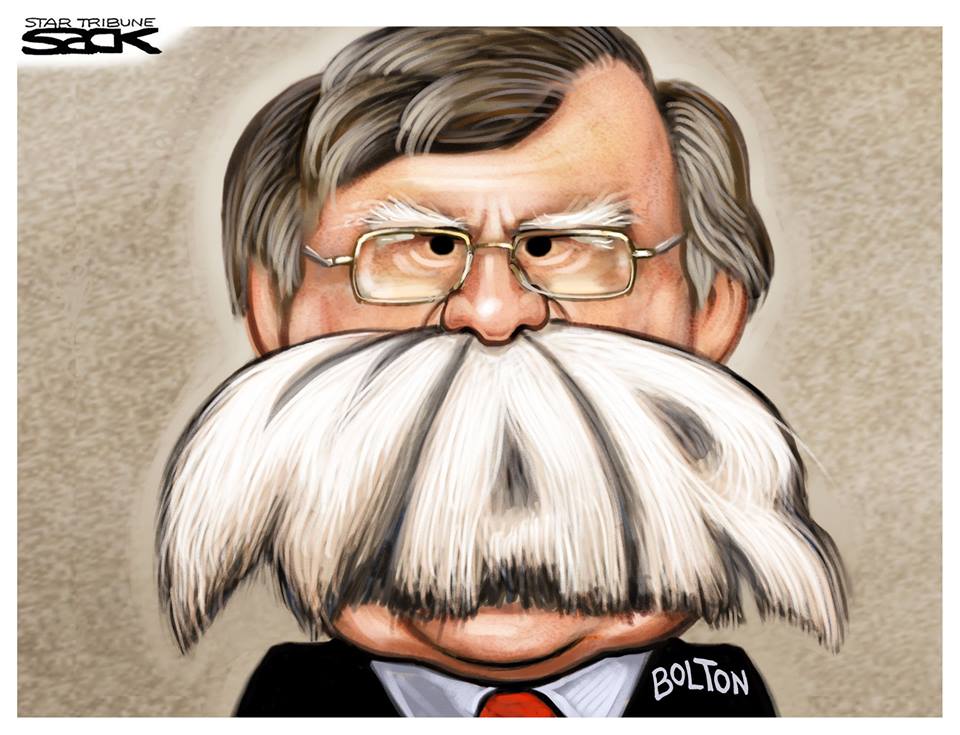
To be sure, on September 10thJohn Bolton, Trump’s National Security Advisor, pushed all the thematic buttons that might beexpected of a luncheon speaker invitedto address the Federalist Society, long known asthe ideological home of rabid advocates of the so-called ‘new sovereignty.’ The hallmark of this pre-Trump neocon law bastion of Scalia worshippers was their role in the career nurturing of such jurisprudential embarrassments as John Yoo and Jack Goldsmith. Yoo the notorious author of the torture memos and Goldsmith the public servant usually give credit forcrafting an expert approval text validating ‘extreme rendition’ of CIA suspects to notorious ‘black sites,’ known around the world as safe havens for torture, surely acrude instance ofex parte criminal legalism. It should be noted that both of these individuals are senior faculty members at two of America’s finest law schools, UC Berkeley and Harvard, both of which exhibit institutional pride in the fact of treating legal ethics as integral part of professional education.
John Bolton was the safest of choices as a featured speaker, having earned his Federalist Society credentials many times over. He seems perversely proud of leading the unprecedented effort on behalf of George W. Bush in 2002 to ‘unsign’ the Rome Statute, the treaty that brought the International Criminal Court (ICC) into force in 2002, and now has 123 sovereignstates as parties, including all NATO members except the U.S. and Turkey. At the talk, Bolton paused to boast of orchestrating this unusual move to highlight and underscore this repudiation of the ICC by the Bush presidency, and in the process, of the crusading success of a transnational civil society movement and a coalition of moderate governments around the world to institutionalize individual accountability of political leaders and military commanders for war crimes and crimes against humanity. It should be humiliating that such a global undertaking to strengthen international criminal law enforcement is regarded as posing a direct threat to Americans and governmental policy. It puts a preemptivetwist on the previous reliance on ‘victors’ justice’ to ensure that none of the Allied crimes during World War II would be subjected to legal scrutiny while the crimes of German and Japanese political leaders and military commanders were being prosecuted.
Actually, even if Bush had not bothered to have the Clinton signature removed, the U.S. would never in this dark period of anti-internationalism have joined the ICC. To become a party to the treaty would have needed the additional step of ratification of the Rome Statute, and that would require an affirmative vote of 2/3rds of the U.S. Senate. A favorable outcome would have been even more unlikely than for Donald Trump to nominate Anita Hill or Robert Mueller as his next choices for the U.S. Supreme Court. In this sense, only the up tempo language of Bolton is notable for its willingness to denigrate and even smear the ICC.
Slick Willy Clinton had his own reservations about the treaty and never took the normal step following an official signature of a negotiated inter-governmental agreement of submitting it for ratification. Indeed, it is a technical violation of customary international law that imposes a good faith obligation on governments to seek formal adherence of signed treaties in accordance with constitutional procedures of the particular state. In other words, even the supposedly liberal side of American political life has opted out of its earlier tradition of supporting the institutional development of the Rule of Law on a global level as an aspect of its commitment to the role of law and institutions as essential ingredients of a peaceful and just world order.
Congress removed any doubt as to its hostility toward the ICC when in 2002 it passed the American Service-Members’ Protection Act, authorizing the President to use all necessary means, even force, to prevent prosecution at The Hague of Americans accused of war crimes or crimes against humanity. What is especially disturbing about such a slap at criminal accountability is the absence of slightest show of concern as to whether the allegations in a particular case were well grounded in evidence or not. When Bolton alluded to this bit of ultra-nationalism he appropriately noted that the legislation enjoyed bipartisan support, which suggests that the American posture of claiming ‘lawless geopolitics’ for itself is a fixed feature of world order for the seeable future no matter who occupies the Oval Office. It is ironic that while criminality is ensured of impunity, the practice of impunity, a dubious encroachment on the logic of legality, is not only claimed but offered that most unusual feature of international enforcement.
Bolton implied that the problems of criminality in world affairs are associated with the leaders of the foreign adversaries of the United States, identifying such individuals as Saddam Hussein, Hitler, Stalin, and Qaddafi. His assertion implied that the good behavior of the United States and its allies was such as to be inherently benevolent and the bad behavior of its adversaries would require more than law to deter: “The hard men of history are not deterred by fantasies of international law such as the International Criminal Court.” We can only meekly ask, “Are the supposedly soft men of history, such as Trump or G.W. Bush, any less undeterred?” “And why should we ever expect these hard men to be deterred if the ICC and international law are but ‘fantasies.’
Getting back to Bolton’s luncheon remarks, his own summary of his feverish assault on the audacity of the ICC to consider investigating Israel’s international crimes, and the alleged crimes of the Taliban and the United States in Afghanistan reads as follows:“This administration will fight back to protect American constitutionalism, our sovereignty, and our citizens. No committee of foreign nations will tell us how to govern ourselves and defend our freedom. We will stand up for the US constitution abroad, just as we do at home. And, as always, in every decision we make, we will put the interests of the American people first.”
These are predictable sentiments, given the occasion and taking into account Bolton’s long advocacy of a militarist foreign policy that disregards the restraints of law, morality, and political prudence. It isthe ethics and politics of this disregard that is Bolton’s realmessage. We should be attentive to this real message hidden within the fiery ‘sovereignty, first’ verbiage, which is that the geopolitical practices of the United States will not be subject to legal accountability no matter how flagrant the violation of fundamental norms might be in the future. Bolton may overstep the bounds of the liberal order when he attacks the ICC as an institution, which had not been previously treated as a threat to American foreign policy. Only recently did it dawn on Washington policymakers that the ICC might at some point actually challenge what the U.S. and its allies, most notably Israel, are doing in the world.
Previously, the U.S. was a supporter of criminal accountability of foreign leaders, especially if they were adversaries of the U.S.. It should be remembered that even during the Bush presidency, the government sent dozens of government lawyers to Iraq to help prepare a war crimes prosecution of Saddam Hussein and his entourage after their capture. This capture occurred in the course of a war of aggression initiated against Iraq in 2003 without any prior provocation. The U.S. attack, regime change, and long intrusive occupation took place, it should be recalled, despite the failure of the U.S. Government to secure the support of the UN Security Council despite a feverish attempt to gain authorization.
In other words, so far as even the Boltons of this world are concerned, there is nothing wrong with criminal accountability of leaders and military personnel so long as the indictments, prosecutions, and punishments are confined to enemies of the United States. Such a self-serving geopolitical appropriation of international criminal law should not be confused with legitimate law, which presupposes that the rules, norms, and procedures apply to all relevant actors, the strong as well as the weak, the victors as well as the defeated, geopolitical wrongdoers as well their adversaries.
What is sad about the Bolton worldview, and indeed the new sovereignty ideologues that shape the public image of the Federalist Society, aside from its influence in the Trump Era, is that it completely misunderstands the relevance of international law in this period of global interdependence and planetary challenge. State-centric world order as beset by geopolitical rivalries is a blueprint for civilizational collapse in the 21stcentury, and probably represents the worst possible way to uphold core sovereign rights and national interests over time.
What is still sadder is that the Bolton/Trump worldview, which seems so outlandish and anachronistic is not that extremist, compared to Democratic establishment approaches, when it comes to behavior. It represents a surreal rhetorical extension of the bipartisan consensus that is complacent about the failures of the neoliberal international order, including especially the destructive impacts of predatory globalization on democratic forms of governance, on safeguarding of social and economic rights, and on ecological sustainability.
As many have noted Hilary Clinton’s push toward a confrontation with Russia was more in keeping with Bolton’s preferred foreign policy than the more accommodationist proposals of Trump during his presidential campaign. It is against such a background that I reach the lamentable conclusion that when it comes world peace and global justice the Democratic Party establishment has little to offer when it comes to foreign policy, and may be more inclined to initiate wars and raise geopolitical tensions than even their reactionary and militarist Republican rivals. Bernie Sanders, although international affairs is not his strong suit, at least gestured toward a less militarist and dysfunctional foreign policy. For the Democratic Party to generate enthusiasm upon American youth and the deeply discontented in the country it must reinvent itself by embracing progressive and forthcoming policies than in the recent past and positions that are more constructive and programmatic than even the Sanders foreign policy. Without such bold moves there will be a loud sigh of relief when Trump loses control of Congress in November, and even louder one when Trump leaves the White House, but the American ship of state will still resemble the maiden voyage of the Titantic.
As if to confirm the analysis above we should take account of Bolton past warmongering toward North Korea including advocating a preemptive strike, and recently articulating grossly unlawful threats of force directed at Iran. It should be appreciated that contemporary international law, as embodied in Article 2(4) of the UN Charter forbids threatsas well as uses of aggressive force.
Such a prohibition underlines the criminality of Bolton’s recent formulations of military threats directed at Iran: “I might imagine they [“the mullahs of Tehran”] would take me seriously when I assure them today: If you cross us, our allies, or our partners; if you harm our citizens; if you continue to lie, cheat and deceive, yes, there will indeed be hell to pay.” Such chilling words must be understood in the context of Bolton’s past advocacy of bombing Iran and of the Trump approach to the region that can be summarized in a few words: ‘do what Netanyahu wants.’
Even if war and aggression do not actually occur, and we must pray that they do not, this kind of geopolitical bullying by a leading official of a country that has up to one thousand military bases spread around the world should be criminalized, and not just criticized as intemperate.
The Future of NATO: An Interview with Daniel Falcone
[Prefatory Note: An interview with Daniel Falcone on the future of NATO that considers Trump’s brazen challenges and the tepid responses of European political leaders, and what this interplay signifies for the future of world order. At least, Trump’s approach has so far avoided the drift toward Cold War 2 that might have happened had Hillary Clinton become president, but Trump’s trade war mentality may hasten the advent of a different kind of second Cold War, with China and Europe at its epicenter, that is, if the Trump presidency is not undermined in the November elections or otherwise. We should be puzzled by the seeming passivity of the deep state in the U.S. Does it not exist after all?]
Q1. What are the reasons for Trump’s insistence that NATO is just another extension of corruption and an institutional burden for the United States?
It is difficult to evaluate Trump’s particular moves from coherent rational perspectives. He seems driven by narcissistic motivations of various sorts that have little to do with any overall grand strategy, and a diplomatic style that he has managed to impose on the conduct of American foreign policy that consists of provocative bluster and insults of respected foreign leaders, a continuation of the sort of vulgar irreverence that brought him unexpected success on the presidential campaign trail in 2016 and earlier celebrity in the deal-making world of real estate, gambling casinos, beauty pageants, professional boxing, and reality TV (“The Apprentice”). Explaining Trump’s recent confrontational focus on financial contributions by NATO members seems as simple as this at first glance, but of course, such assessments based on personality never tell the whole story in the complex unfolding political narrative. Undoubtedly, another part of the story can be associated with the insistence during a Trump’s interview that Europe is a trade rival of the United States. A further conjecture may be a geopolitical ‘peace’ framework based on Russia, China, and the U.S..
With regard to NATO, Trump has a clear target related to two things he seems to love, and admittedly such affections were not alien to the foreign policy he inherited from his predecessors: money and weapons. By showing that he can gain what Obama failed to achieve with respect to meeting the agreed 2% of GDP goal set for NATO members, he can, and certainly will, boast of his greater effectiveness in protecting America’s material interests than prior presidents. As suggested he measures foreign policy success by reference to monetary returns and America, First (and Me, First) criteria, and tends to put to one side the solidarities of friendship among countries sharing a common cultural identity and mutual respect that have been at the core of the alliance ethos over the decades, especially in relations with Western Europe since World War II. For Trump it appears that alliances, including even NATO, are to be treated as nothing more than business arrangements that are only worthwhile so long as their profit margins hold up. This means that financial contributions become the clearest test of whether cooperative frameworks makes sense in present settings. Interests and values are put to one side while the bundles of cash are counted. In such a process, the circumstances that brought the alliance into being, or justify its continuation, are ignored. Actually, Trump could make a credible case for withdrawing from or greatly downsizing the alliance, given present world conditions, which would help reduce the U.S. fiscal deficit, as well as easing the burdens of security that fall to Washington.
In the end, Trump could credibly claim a narrow victory for himself at this recent NATO summit in the transactional sense of gaining assurances from the European governments that they will be increasing their defense budgets.In return Trump reaffirmed continuing U.S. support for the NATO alliance. Like a Mafioso family gathering when the cash flow is restored, friendship between European governments and Trump’s America becomes again possible, providing foreign leaders are prepared to continue absorbing the insults Trump delivers along the way, and then when they create awkward moments, as with Teresa May in Helsinki, are curtly dismissed as his own ‘fake news.’ When ‘fake’ is used to discredit the truth, trust vanishes, and one of the pillars of a healthy democracy is destroyed. We gradually lose our understanding of what is truth, and worse, no longer care or hold leaders accountable by reference to reality.
There is no indication of any attention given by Trump to the crucial question: whether NATO serves sufficient useful purposes in the post-Cold War world to be worth the economic costs, let alone the political costs associated with spending on weapons rather than the wellbeing of people and their natural surroundings. Would not the long overdue transition to a real peacetime security posture have many positive advantages for the U.S. and Europe, including exploring prospects for a mutually beneficial cooperative relationships with Russia and China? We have reached a stage in world history where we should be asking whether NATO might be abandoned altogether or drastically redesigned in light of the current agenda of actual global policy challenges. If NATO were converted into a vehicle for the realization of humansecurity, setting its new agenda by reference to the wellbeing of people, it would be a genuine triumph for Trump and the global public interest, but such an orientations seems well outside the boundaries of his political imagination. In fairness, no American leader has dared to adopt the discourse of human security, or questioned the continued viability of Cold War alliances and accompanying strategic doctrine, and it would be pure wishful thinking to expect such demilitarizing words to issue from the lips or mind of Donald Trump. At least those of us who watch the Trump spectacle in bemused fear should more than ever put forward our own hopes and beliefs in broad gauged cooperation between North America and Europe based on a commitment to peace, justice, and security, and demand that discussion of the future of the relationship between Europe and North America not be reduced to a demeaning debate about how to raise the level of military spending or keep obsolete alliances in being by the artifice of worrying only about whether particular governments are meeting the 2% goal, which seems like an arbitrary number that is unrelated to the actuality of security challenges..
Q2. How do you forecast the European reaction to the Trump commentary on NATO and could you explain how this might impact key portions of US foreign affairs?
Europe’s governmental response to the Trump onslaught so far has been very disappointing, while recent civil society responses in Europe has been generally encouraging. On the one side, NATO leaders seem to pout like aggrieved children, angered and humiliated, but too frightened of the uncertainties associated with confronting Trump to raise their objections above the level of a whisper. On the other side, their acquiescence to the Trump insistence that NATO viability is to be measured in dollars or maybe Euros, unaccompanied by even a pretense of putting forward a relevant substantive rationale for Cold War levesl of spending. Such passive aggressive behavior by European leaders is likely best understood as a sullen endorsement of Trumpism. In effect, the Europeans are muttering “yes, we in Europe should be allocating more of our resources to the defense budget and begin to live up to our 2% commitment” so as to keep a renewed watchful eye on Russia and go along with the slouch toward a Second Cold War. There is no justification given for supposing that Europe will be safer if more heavily invested in military equipment, and my view is that Europe would be far safer, more secure, and more serene if it instead invested these additional funds in helping alleviate the refugee challenge at both the asylum end and at its various sources where combat and climate change have made some national habitats virtually unlivable. It might be emphasized that these habitants from which people are escaping to Europe most commonly at great risk to themselves, have been rendered uninhabitable partly by industrialization in the West and by the bloody aftermath of European colonialism that left behind arbitrary borders that did not correspond to natural communities.
Responding to the root causes of refugee and migration pressures should be seen as a matter of long deferred collective responsibility, and not as charity or as exercises of discretion. Furthermore, if NATO were responsive to real threats to the security of Europe, including to its democratic way of life, it would focus its attention with a sense of urgency on these issues instead of implicitly preparing the continent for a new Cold War that an anti-Russian weaponized foreign policy will, ironically, help bring about, initially no doubt in the form of a destablizing arms race, and calls for raising defense spending to even higher levels.
Here Trump seems to have his priorities confused. At times, for instance in supporting Brexit, and now endorsing a hard Brexit and the Boris Johnson approach, Trump seems to be furthering Moscow’s prime aim of weakening the unity of Europe, while at the same time by rallying NATO members to increase military spending Trump seems to be lending credibility to Russian worries of a new Cold War.
Whether for personal reasons associated with his shady financial dealings and his vulnerability to blackmail or a sense that the way to bring stability to the world is to have strong leaders work together, and establish a grand alliance of autocrats, Trump’s soft spot for Putin may be preferable to what a hard-edged, NATO enthusiast like Hilary Clinton would have brought to the White House had she won the election. A Clinton presidency would almost certainly have gone easy on NATO when it comes to the economics and politics of burden-sharing while insisting on the adoption of a hardline on such geopolitical issues as Crimea and eastern Ukraine. Given the recent show of timidity by NATO leaders scared to cut the umbilical cord that has tied their security policies to the diktats of Washington ever since 1945 (with the notable exception of DeGaulle’s ‘France, First’/. leadership). We sometimes forget that aspiring to the role of global leader has always come with a high price tag, but the expense involved is more than offset by the benefits of status, heightened influence in global arenas, and a favorable positioning in the world economy, or so it seemed to the political elites of both parties until Trump through handfuls of sand into the intricate machinery of the national security state..
Q3. In the past US led and authorized NATO bombings are criticized rather easily and justifiably from the left, but what is the danger of the Trump mentality to foster a disregard for global order from the reactionary right wing? And does resistance to Trump cynicism put NATO skeptics on the left in a difficult position in your view?
I think that the ideological discourse has definitely been altered by Trump’s alt-right approach to NATO. The left, such as it is, has refocused its energies on resisting what it believes to be a slide toward fascism at home arising from its correct perceptions of the Trump presidency as racist, ultra-nationalist, chauvinist, Islamophobic, subverting constitutionalism, and haunted by demagogic leadership. Those most upset with the attacks on the alliance underpinnings of NATO are not the left, but rather the more centrist liberalconstituencies encompassing moderate Republicans as well as mainstream Democrats. These are persons likely as upset by the challenge mounted by the mildly insurgent left-leaning politics of Bernie Sanders as by Trump, perhaps more so. Trump is ardently pro-business, pushed through Congress tax reform that mainly benefits those, like himself, who are part of a tiny billionaire class. What remains of the liberal establishment, whether on Wall Street or situated in the dark inner and hidden recesses of the deep state, is on the verge of tears in the aftermath of Trump’s assault on the NATO anchoring of the Atlanticist approach to American foreign policy that became so iconic for the political classes comprising the bipartisan American establishment ever since 1945.
Q4. Trump was elected partly because of what amounts to his “Me First” Doctrine as well as his “Make America Great Again” slogan. Does he in your estimation fully intend to utilize NATO in the background while appeasing his rabid anti institution base?
Trump and his fanatical base in the U.S. never seem far apart. Even in pursuing trade wars around the world, especially with China, that harm many of those who voted for him, his rationalizations, invoking the ‘America, First’ language and jobs rhetoric whether or not the evidence supports such claims. Apparently, so far, a relentless demagogue can fool many of the people all the time, especially by the rants of a populist politic that takes delight in scapegoating outsiders and arousing rage against the insiders who are portrayed as reaping the benefits of the international liberalism that gave us both the Cold War world economy and produced a neoliberal predatory aftermath identified in the 1990s as ‘globalization’, a view of political legitimacy that combines a private sector economy with some minimal form of democracy.
,;
’
How NATO will eventuallu fit within this Trump scheme is not yet clear, and may never be so. It seems a blustery sideshow at this point as NATO does not seem to have clear missions in post-Cold War Europe except to be a rallying center for counterterrorist tactics, which operationally depend on national policing and paramilitary capabilities. It seems that Europe is willing to pay up to sustain the NATO status quo, allowing Trump to laugh his way to the bank. NATO’s leading members are most worried these days about keeping the EU together in the face of various stresses associated with Brexit, refugees, a far right anti-immigration resurgence, and some loss of confidence in the EURO and austerity fiscal discipline. Handling Trump is an unpleasant additional chore for European leaders, but it is so far treated more in the spirit of the London protesters’ giant baby balloon, a matter of parenting, lacking real substantive weight, or so it seems. Aside from Turkey no European government seems to be considering alternative alignments now.
On the broader posture of anti-institutionalism and anti-multilateralism, Trump has kept faith with his pre-Fascist base by bullying tactics at the UN, repudiating the Nuclear Agreement with Iran, and withdrawing from the Paris Climate Change Agreement. These are big ticket items that represent extremely serious setbacks for responsible efforts to address challenges of regional and global scale that pose severe threats to peace and ecological stability.
Q5. Trump likes to portray himself as a populist alternative to the Bushes and Clintons and their reckless foreign policy while questioning our “exceptionalism.” In reality however we have broadened and expanded our presence around the world under Trump. Can you talk about the Trump foreign policy and how’d you categorize it?
Trump foreign policy, such as it is, seeks to diminish engagement with international institutions, including treaty regimes, and retain greater freedom of maneuver for the U.S. Government in international relations. It seems also to deny the reality of such global challenges as climate change, global migrations, genocidal behavior, and extreme poverty. It is definitely statist in outlook, both because of a belief in nationalism as the best guide to policymaking and problem solving, and because the United States as the richest and most powerful of states can supposedly gain greater advantages for itself by reliance on its superior bargaining leverage in any bilateral bargaining process. Borrowing from his deal-making past, Trump seems convinced that the U.S. will get more of what it wants when it deals bilaterally than in hemmed in my multilateral frameworks as in trade relations or environmental protection.
Beyond this kind of transactional search for material advantages, oblivious to substantive realities that make cooperative approaches more likely to achieve beneficial results, Trump has been consistent in promoting reactionary issues at home and abroad whenever given the chance, whether by tweeting or issuing executive orders. While in Europe he gave public voice via TV to an anti-immigration screed, telling Europeans that immigrants were ruining Europe, bringing to the continent crime and terrorism, a malicious argument similar to the slander of undocumented Hispanic immigrants present in the United States, some long in the country, and making laudable contributions.
Trump’s silences are also important. He seems determined to ignore crimes against humanity if committed by states against people subject to its authority, whether the Rohingya in Myanmar or Palestinians in Gaza. American support for human rights, always subject to geopolitical manipulation, is now a thing of the past so long as Trump hangs around, although such considerations may be cynically invoked when helpful to strengthen arguments for sanctions and uses of force against adversery states.
Whether wittingly or not, Trump seems determined to shatter the legacy of the Bushes and Clinton built around an American led liberal international order, but without any real alternative conception of global governance to put in its place. So far this has produced an ad hoc approach, beset by contradiction, which one day can veer in the direction of confrontation as with Iran or North Korea, or on another day seem to seek some sort of long-term accommodation with Russia and North Korea, and sometimes even China. Also evident is the extent to which Trump’s foreign policy initiatives are designed to please Israel, as with the move of the American Embassy to Jerusalem announced last December, or the heightened tensions with Iran, or have no justification other than to uphold the expectations of billionaire domestic donors of his presidential campaign. And finally, there is the search for the grandiose, ‘the deal of the century,’ a breakthrough that will make Trump great for once and for many, but when more closely considered the deal, as the one in the offing to end the Israel/Palestine struggle turns out to be a house of cards, so one-sided that it effectively collapses before its absurdly pro-Israeli contents have been officially disclosed.
Whether by his blunt actions sowing discord or his silent acquiescence in the face of atrocities, we have reason to fear the trajectory of the Trump presidency. In this sense, the NATO performance was just a tip of a dangerous iceberg imperiling world order, but also the future of responsible and responsive governance in a period of grave danger and intense turmoil. As with the weak response of European governments to Trumpism, there is reason for disappointment about the resilience of republican institutions within the United States, including such stalwarts as separation of powers and the constitutional integrity of political parties. Alarm bells should be ringing through the night at maximum volume, but so far the silences outweigh the noise as the world slouches toward catastrophe, chaos, and cruelty.
[Prefatory Note:This post is a slightly edited and corrected text of what was published on this blog site a few days. I owe particular thanks to my distinguished collaborator, Virginia Tilley, for pointing out several shortcomings and misleading formulations in the earlier version. Of course, the essence of the indictment of the U.S. rationale for withdrawal stands as before.]
The U.S. Withdraws (Again) from the UN Human Rights Council
Explicitly focusing on alleged anti-Israel bias the U.S. withdrew from further participation in the UN Human Rights Council until it reforms itself in accord with the liking of the Trump Administration. The only internationally credible basis for criticizing the HRC is its regrettable tendency to put some countries with the worst human rights records in leading roles, creating genuine issues of credibility and hypocrisy. Of course, I would have expected Ambassador Nikki Haley to refrain from such a criticism as it could only embarrass Washington to admit that many of its closest allies in the Middle East, and elsewhere have lamentable human rights records, and, if fairly judged, the U.S. has itself reversed roles since the year 2000, having itself slipping into the category of the most serious human rights offenders.
In this regard, the U.S. ‘withdrawal’ could be most constructively viewed as a self-imposed ‘suspension’ for falling short when it comes to the promotion and protection of human rights, absenting itself until it can protect human rights in its own society at a high enough standard as to make it less laughable than when it lectures the world about the human rights failures of others, naturally America’s current list of adversaries. But Haley is not someone intimidated by reality. In her fiery withdrawal speech she has the audacity to say that the first objective of the U.S. is “Improving the quality of Council membership.” She adds, “(w)hen a so-called Human Rights cannot bring itself to address the massive of abuses of Venezuela and Iran..the Council ceases ceaces to be worthy of its name.” Making such an argument, politically charged at best, raises eyebrows of scorn if one takes note of the deafening silence of Washington with respect to Saudi Arabia, Israel, and Egypt to mention just three Middle Eastern allies.
Undoubtedly, the U.S. was frustrated by its efforts to ‘reform’ the HRC according to its views of the UN agency should function, and blamed its traditional adversaries, Russia, China, Venezuela, Cuba, along with Egypt, with blocking its initiative. It also must not have welcomed the HRC High Commissioner, Zeid Ra’ad al-Hussein, for describing the ‘zero tolerance policy’ of separating children from their immigrant parents at the Mexican border as an ‘unconsciounable’ policy.
In evaluating this latest sign of American retreat from its prior role as global leader, there are several considerations that help us understand such a move that situates the United States in the same strange rejectionist corner it now shares with North Korea and Eritrea:
–the fact that the U.S. withdrawal from the HRC occurred immediately after the Israeli border massacre, insulated from Security Council censure and investigation by a U.S. veto, is certainly part of political foreground. This consideration was undoubtedly reinforced by the HRC approval of a fact-finding investigation of Israel’s behavior over prior weeks in responding to the Great Return March border demonstrations met with widespread lethal sniper violence;
–in evaluating the UN connection to Palestine it needs to be recalled that the organized international community has a distinctive responsibility for Palestine that can be traced all the way back to the peace diplomacy after World War I when Britain was given the role of Mandatory, which according to the League of Nations Covenant should be carried out as a ‘sacred trust of civilization.’ This special relationship was extended and deepened when Britain gave up this role after World War II, transferring responsibility for the future of Palestine to the UN. This newly established world organization was given the task of finding a sustainable solution in the face of sharply contested claims between the majority Palestinian population and the Jewish, mainly settler population.
This UN role was started beneath and deeply influenced by the long shadow of grief and guilt cast by the Holocaust. The UN, borrowing from the British colonial playbook, proposed a division of Palestine between Jewish and Palestinian political communities, which eventuated in the UN partition plan contained in the 1947 General Assembly Resolution 181. This plan was developed and adopted without the participation of the majority resident population, 70% non-Jewish at the time, and was opposed by the then independent countries in the Arab world. Such a plan seemed oblivious to the evolving anti-colonial mood of the time, failing to take any account of the guiding normative principle of self-determination. The Partition War that followed in 1947 did produce a de facto partition of Palestine more territorially favorable to the Zionist Project than what was proposed, and rejected, in 181. One feature of the original plan was to internationalize the governance of the city of Jerusalem with both peoples given an equal status.
This proposed treatment of Jerusalem was never endorsed by Israel, and was formally, if indirectly, repudiated by Tel Aviv after the 1967 War when Israel declared (in violation of international law) that Jerusalem was the eternal capital of the Jewish people never to be divided or internationalized, and Israel has so administered Jerusalem with this intent operationalized in defiance of the UN. What this sketch of the UN connection with Palestine clearly shows is that from the very beginning of Israeli state-building, the role of the international community was direct and the discharge of its responsibilities was not satisfactory in that it proved incapable of protecting Palestinian moral, legal, and political rights. As a result, the majority of Palestinian people have been effectively excluded from their own country and as a people exist in a fragmented ethnic reality that is sustained by Israel’s apartheid regime of control. This series of events constitutes one of the worst geopolitical crimes of the past century. Rather than do too much by way of criticizing the behavior of Israel, the UN has done far too little, not mainly because of a failure of will, but as an expression of the behavioral primacy of geopolitics and naked militarism;
–the revealing stress of Ambassador Haley’s explanation of the U.S. withdrawal from the HRC gives almost total attention to quantitative factors such as the ‘disproportionate’ number of resolutions compared with those given to other human rights offenders, making no attempt whatsoever to refute the substantiveallegations of Israeli wrongdoing. This is not surprising as any attempt to justify Israeli policies and practices toward the Palestinian people would only expose the severity of Israel’s criminality and the acuteness of Palestinian victimization. The U.S. has also long struggled to be rid of so-called Item 7 of the Human Rights Council devoted to human rights violations of Israel associated with the occupation of Palestinian territories, which overlooks the prior main point that the UN is derelict in its failure to produce a just peace for the peoples inhabiting Mandate Palestine, and the least that it can do is maintain a watchful eye.
–withdrawing from international institutional arrangements, especially those positively associated with peace, human rights, and environmental protection has become the hallmark of what be identified as the negative internationalismof the Trump presidency. The most egregious instances, prior to this move with regard to the HRC, involved the repudiation of the Nuclear Program Agreement with Iran (also known as the JCPOA or P5 +1 Agreement) and the Paris Climate Change Agreement. As with these other instances of negative internationalism this departure from the HRC is likely to hurt the U.S. more than the HRC, reinforcing its myopic willingness to do whatever it takes to please Netanyahu and the lead American Zionist donor to the Trump campaign, Sheldon Adelson. Only the provocative announcement of the planned unilateral move of the American Embassy to Jerusalem last December was as explicitly responsive to Israel’s policy agenda as is this rejection of the HRC, both initiatives stand out as being contrary to a fair rendering of American national interests, and hence a show of deference to Israel’s preferences. Despite this unabashed one-sidedness the Trump presidency still puts itself forward as a peacemaker, and promised to produce ‘the deal of the century’ at the proper moment, even enjoying the cynical backing of the notorious Crown Prince of Saudi Arabia, who seems to be telling the Palestinians to take what the Trump team offers or forever shut up. Knowing the weakness and shallow ambitions of the Palestinian Authority, there is no telling what further catastrophe, this one of a diplomatic character, may further darken the Palestinian future. A diplomatic nakbamight be the worst disaster of all for the Palestinian people and their century-long struggle for elemental rights.
It should also be emphasized that the U.S. human rights record has been in steady decline, whether the focus is placed on the morally disastrous present policies of separating families at the Mexican border or on the failure to achieve acceptable progress at home in the area of economic and social rights despite American affluence (as documented in the recent report of Philip Alston, UNHRC Special Rapporteur on Extreme Poverty) or in the various flagrant violations of human rights committed in the course of the War on Terror, including operation of black sites in foreign countries to carry on torture of terror suspects, or denials of the most fundamental tenet of international humanitarian law (Geneva Conventions) in the administration of Guantanamo and other prison facilities;
–it is also worth noting that Israel’s defiance of internatonal law and international institutions is pervasive, severe, and directly related to maintaining an oppressive regime of occupation that is complemented by apartheid structures victimizing the Palestinian people as a whole, including refugees, residents of Jerusalem, the Palestinian minority in Israel, and the imprisoned population of Gaza. Israel repudiated the authority of the International Court of Justice with respect to the ‘separation wall’ that back in 2004 declared by a near unanimous vote of 14-1 (U.S. as the lone dissent) that building the wall on occupied Palestinian territory was unlawful, that the wall should be dismantled, and Palestinians compensated for harm endured. There are many other instances concerning such issues as settlements, collective punishment, excessive force, prison conditions, and a variety of abuses of children.
In conclusion, by purporting to punish the Human Rights Council, the Trump presidency, representing the U.S. Government, is much more punishing itself, as well as the peoples of the world. We all benefit from a robust and legitimated institutional framework for the promotion and protection of vital human rights. The claim of an anti-Israeli bias in the HRC, or UN, is bogus diversionary politics. The truer focus would be upon the daily violation of the most basis rights of the Palestinian people. This is the tragic reality that the UN has been unable to overcome. This is all we need to know.
The Private and the Public in Trump’s America on New Year’s Day 2018
I realize how insensitive I have been in sending messages to a few friends in which I suggested that we should look forward in the year ahead to private satisfactions, while being wary of public hopes given the looming storm clouds of Trumpism. The assumption I glibly made was that the private and public were distinct domains, which is true to some extent for those of use who are not Hispanic, Muslim, African-American, poor, homeless, or somehow vulnerable.
Of course, the slogan ‘the personal is political’ is in some profound sense true for all of us, however privileged and shielded from public abuse we happen to be. How we choose to treat others is always a political act for better or worse, and radiates beyond our personal actions, thoughts, and feelings. Yet there is a blandness about such a perception if it does acknowledge the more impinging effects of the political for all those who are forced to live, in some way, at the edge. What Trump has done is to push millions more, who were already experiencing the pains of vulnerability, marginality, and inequality, closer to falling from the precipice. Trump’s Muslim bans, hostility to immigrants, anachronistic nativism, white supremacist and alt-right sympathies create air to toxic to breathe, especially for those already living with daily fears and uncertainties.
A related clarifying thought: Trump and Trumpism are only viable because of the opportunistic cowardice of the Republican Party, which has struck the most lamentable of Faustian Bargains—selling their conservative souls for a reactionary social and economic agenda that accentuates the existing distortions evident in American society: nurturing the greed of the wealthy and turning a blind eye to the poor and vulnerable.
Additionally, Trumpism gives us ample occasion to weep on behalf of an abused nature, a threatened habitat, even ecological collapse.
This leads me to this conclusion on New Year’s Day 2018: the most worthy political resolution of this new year is to resist Trumpism in every way we can, and do so in compassionate solidarity with those whose private spaces have been so darkly encroached upon by the punitive policies and practices of the current political leadership in this country.
I have been perplexed by the intense divergences of perception when it comes to the Syrian reality, and the allocation of blame and responsibility for the havoc that has been experienced by the Syrian people.
In ‘the fog of war’ there are many ambiguities that allow ideological predisposition to color what we believe is happening. There is very little basis for trust, and the extraordinary complexity and shifting priorities of the many participants precludes a simple diagnosis.
This makes it all the more crucial not to succumb to explanations that confirm our political outlook, especially by doubting the conclusions that have been confirmed by multiple generally reliable sources of information. George Monbiat, a prominent and respected Guardian columnist supports the view that the main element of the anti-Assad narrative are true, and truer than the contrary interpretations offered by a variety of anti-imperialist commentators and dissident journalists:
[Prefatory Note: I have been persuaded to remove the words ‘otherwise promising’ before the name of Macron. I paused while writing those words, but in view of his condemnation of France’s conduct in Algeria, I thought I would give him the benefit of the doubt, now obviously a premature gesture. And so, belatedly, I censor myself both to express my true feeling and to acknowledge my earlier slip of the digital mind!]
I suggest that Zionists fond of smearing critics of Israel as ‘anti-Semites’ take a sobering look at the VICE news clip of the white nationalist torch march through the campus of the University of Virginia the night before the lethal riot in Charlottesville. In this central regard, anti-Semitism, and its links to Naziism and Fascism, and now to Trumpism, are genuinely menacing, and should encourage rational minds to reconsider any willingness to being manipulated for polemic purposes by ultra Zionists. We can also only wonder about the moral, legal, and political compass of ardent Zionists who so irresponsibly label Israel’s critics and activist opponents as anti-Semites, and thus confuse and bewilder the public as to the true nature of anti-Semitism as racial hatred directed at Jews.
There must be less incendiary ways of fashioning responses to the mounting tide of criticism of Israel’s policies and practices than by deliberately distorting and confusing the nature of anti-Semitism. To charge supporters of BDS, however militant, with anti-Semitism dangerously muddies the waters, trivializing hatred of Jews by deploying ‘anti-Semitism’ as an Israeli tactic and propaganda tool of choice in a context of non-violent expressions of free speech and political advocacy, and thus challenging the rights so elemental that they have long been taken for granted by citizens in every funcitioning constitutional democracy. It is worth recalling that despite the criticisms of BDS during the South African anti-apartheid campaign, militant participants were never, ever smeared, despite being regarded as employing a controversial approach often derided as counterproductive in politically conservative circles.
And of course it is not only Zionists who have eaten of this poisonous fruit. As a result of Israel’s own willingness to encourage such tactics, as in organizing initiatives seeking to discredit, and even criminalize, the nonviolent BDS campaign, several leaders of important Western countries who should know better have swallowed this particular cool aid. A recent statement by President of France, Emmanuel Macron: “Anti-Zionism…is the reinvented form of anti-Semitism,” and implicitly such a statement suggests that to be anti-Zionist is tantamount to criticism of Israel as a Jewish state.
After grasping this tortured reasoning, have a look at the compelling Open Letter to Macron, written in response by the famed Israeli historian, Shlomo Sand, author of an essential book, The Invention of the Jewish People. In his letter Sand explains why he cannot himself be a Zionist given the demographic realities, historical abuse of the majority population of historic Palestine, and the racist and colonialist overtones of proclaiming a Jewish state in a Palestine that a hundred years ago was a national space containing only 60,000 Jews half of whom were actually opposed to the Zionist project. This meant that the Jewish presence in Palestine represented only about 7% of the total population, the other 700,000 being mostly Muslims and Christian Arabs. The alternative to Zionism for an Israel that abandons apartheid is not collapse but a transformed reality based on the real equality of Jews and Palestinians. Shlomo Sand gives the following substance to this non-Zionist political future for Israel: “..an Israeli republic and not a Jewish communalist state.” This is not the only morally, politically, and legally acceptable solution. A variety of humane and just alternatives to the status quo exist that are capable of embodying the overlapping rights of self-determination of these two long embattled peoples.
To avoid the (mis)impression that Charlottesville was most disturbing because of its manifestations of hatred of Jews it is helpful to take a step backward. Charlottesville was assuredly an ugly display of anti-Semitism, but it only secondarily slammed Jews. Its primary hateful resonance was its exhibition of white supremacy, American nativism, and a virtual declaration of war against Black Lives Matter and the African American and immigrant struggle against racial injustice. Jews are doing better than all right in America by almost every indicator of economic, political, and social success. African Americans, Hispanics, and Muslims are not. Many of their lives are daily jeopardized by various forms of state terror, as well as by this surge of violent populism given sly, yet unmistakable, blessings by an enraged and unrepentant White House in the agonized aftermath of Charlottesville. Jews thankfully have no bereaved victims of excess uses of force by American police as have lethally victimized such African Americans as Treyvon Martin, Michael Brown, Freddie Gray, Eric Garner, and Tamir Rice. Jews in America do not fear or face pre-dawn home searches, cruel family disrupting deportations, and the mental anguish of devastating forms of uncertainty that now is the everyday reality for millions of Hispanic citizens and residents.
What Charlottesville now becomes is up to the American people, and to some lesser extent to the reactions and responses throughout the world. The Charlottesville saga has already auditioned Trump and Spence as high profile apprentices of white nationalism. Whether an array of Republican tweets of disgust and disapproval gain any political traction remains to be seen, or as in the past they dissolve as bubbles in the air and soon seem best regarded as empty tropes of political correctness. What counsels skepticism about this current cascade of self-righteous pronouncements is the awareness that many of these same individuals in the past quickly renewed their conniving habits behind closed doors, working overtime to deprive the racially vulnerable in America of affordable health insurance, neighborhood security, and residence rights. As is so often the case in the political domain these days disreputable actions speak far more loudly than pious words.
If the majority of Americans can watch the torch parade and urban riot of white nationalists shouting racist slogans, dressed for combat, and legally carrying assault weapons, in silence we are done for as a nation of decency and promise. If the mainstream does not scream ‘enough’ at the top of its lung it is time to admit ‘game over.’ This undoubtedly means that the political future of this country belongs to the likes of Trump/Spence, and it also means that a national stumble into some kind of fascist reality becomes more and more unavoidable. The prospect of a fascist America can no longer be dismissed as nothing more than a shrill and desperate ploy by the moribund left to gain a bit of attention on the national stage before giving up the ghost of revolutionary progressivism once and for all.
So we must each ask ourselves and each other is this the start of the Second Civil War or just one more bloody walk in the woods?
[Prefatory Note: The following article was initially published in The Nation on June 15, 2017. It was written jointly with my friend and longtime collaborator, Phyllis Bennis. As suggested in the text below we both worked with Farther Miguel D’Escoto on several occasions in relation to different international issues involving matters of peace and justice. I was especially appreciative of his strong commitment to the Palestinian national struggle, not an easy position to adopt by a prominent UN official living in New York City. Father Miguel was particularly helpful to me during the early years (2008-09) of my work as Special Rapporteur on Israeli Violations of Human Rights in Occupied Palestine. He was a rare example of a top UN diplomat and official who combined religious dedication with progressive politics and governmental service of the highest order.]
Remembering a Priest, a Diplomat, and a Voice for Palestine
Father Miguel D’Escoto Brockmann was a man who spoke truth to power and expected others to do the same
Phyllis Bennis and Richard Falk
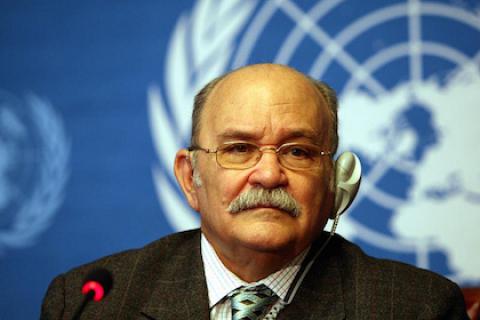
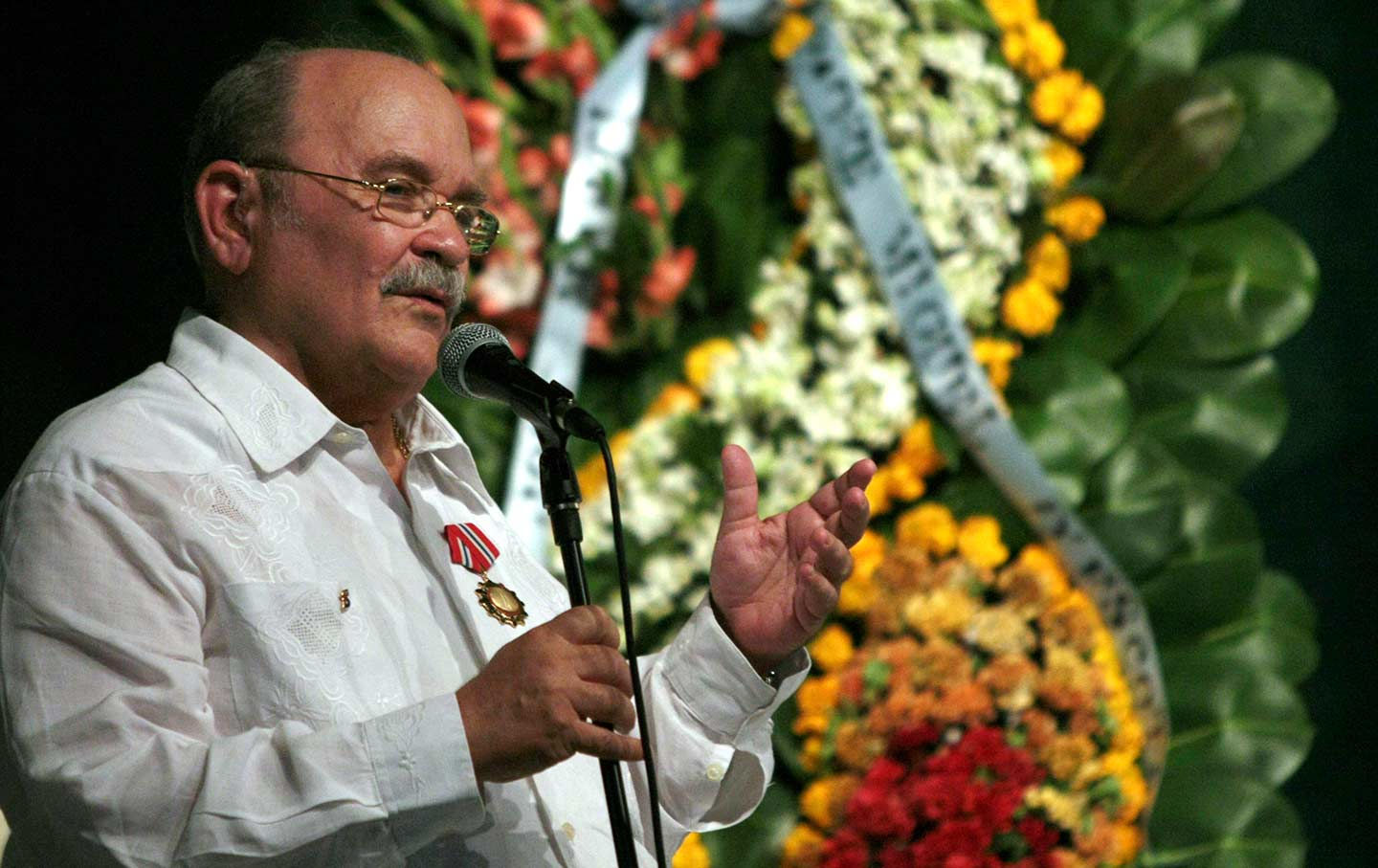
UN General Assembly President Miguel D’Escoto Brockmann speaks after being awarded the solidarity medal by Cuba’s government in Havana, September 3, 2009. (AP Photo / Ismael Francisco, Prensa Latina)
Father Miguel D’Escoto Brockmann, who died a few days ago, was a Catholic priest and former president of the UN General Assembly. The Nicaraguan diplomat was also a leading voice of conscience on Middle East peace—as well as a cherished friend, loved and admired by both of us, who became an inspirational figure to many around the world.
As much as anyone we ever encountered, Father Miguel lived as he preached. He worked and lived among the poor and struggled for years against dictatorship and injustice in his country. We want to pause not only to mourn this personal loss, but also to call attention to his public role both in his native Nicaragua and as a citizen of the world—an identity expressed most powerfully by way of his devotion to the United Nations.
A PRIEST AND A DIPLOMAT
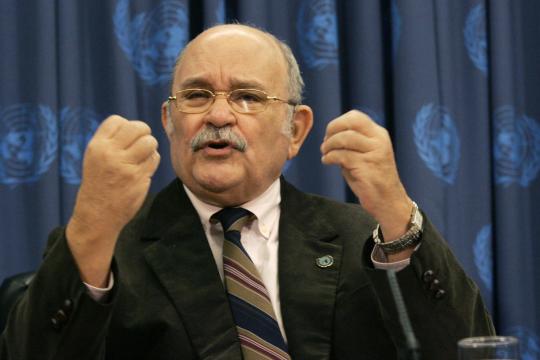
A Maryknoll priest, Father Miguel became an early and impassioned practitioner of liberation theology. He later gained international fame as Nicaragua’s foreign minister in the Sandinista government during the 1980s, a period during which his small country was plagued by the notorious Contra guerrilla insurgency that had been funded, equipped, and trained by the US government.
Years later he was elected president of the UN General Assembly—just weeks before Israel’s Operation Cast Lead began in late 2008. He quickly moved to become perhaps the world’s leading spokesperson for Palestinian rights.
Richard first encountered Father Miguel in the mid-1980s, when he was preparing a historic case before the International Court of Justice against the United States for its role in aiding the Contras and otherwise committing acts of aggression, including the mining of Nicaragua’s harbors. He worked closely with Father Miguel in a New York townhouse on how to proceed at The Hague with a legal argument that might produce a level of international accountability for Washington’s flagrant violations of Nicaraguan sovereign rights under international law.
In a stirring decision reached by the World Court in 1986, the main grievances put forward by Nicaragua were upheld, and although the United States boycotted the proceedings, it ended up complying with major findings of the decision. It was not only a moral and political victory, but a vindication of Miguel’s underlying belief that international law, not violence, was the basis of peace and justice in the relations among nations.
After retiring from official life in 1991, Father Miguel was only pulled away from his religious ministry on behalf of the poor when he was elected to head the General Assembly—as an individual, not as a representative of his government.
Miguel took on that role, traditionally considered a largely ceremonial position leading a too-often marginalized organ of the UN system, and almost immediately emerged as an influential global voice who spoke powerfully in support of Palestinian rights under international law. He courageously opposed Israel’s brutal Cast Lead military operation, defying the always present geopolitical pressures mounted by Washington on behalf of Israel. In his defense of Palestine throughout those weeks of war, and in his later commitment to forcing the UN to take environmental justice seriously, he aimed to transform the General Assembly into a potent force for global justice.
He never gave up this dream, collecting his thoughts in a widely distributed booklet bearing the title Reinventing the UN: A Proposal. The subtitle was a transparent summary of the text: “How to make the UN a functional organization capable of dealing effectively with the great XXI century challenges confronting Mother Earth and humanity.”
THE STAKES ARE HIGHER NOW THAN EVER. GET THE NATION IN YOUR INBOX.
A VOICE FOR GAZA—AND INTERNATIONAL LAW
Within hours of the first airstrikes against Gaza, Father Miguel condemned Israel’s actions as “wanton aggression by a very powerful state against a territory that it illegally occupies.” He insisted it was time for the General Assembly “to take firm action if the United Nations does not want to be rightly accused of complicity by omission.”
In following days, the UN Security Council—which under the UN Charter is supposed to take primary responsibility for peace and security issues—discussed and debated and consistently failed to respond to the growing Gaza crisis, mostly because the veto-wielding United States was active in blocking action. Then–Secretary of State Condoleezza Rice, in the midst of the slaughter of Gazan civilians, famously remarked, “We don’t need a cease-fire yet.”
Some urged Miguel to wait, hoping that the Security Council would eventually act and the General Assembly could meekly fall in line. But such a cynical suggestion outraged the priest. As the airstrikes turned into a full-scale ground invasion, he called Israel’s war “a monstrosity.”
We were both working with Father Miguel during that frantic time. As the days passed without an Assembly initiative, his patience waned, and he asked for help drafting a speech to respond to the urgent moment. Afterward he convened a special session of the entire General Assembly and delivered a stirring address condemning the assault, which had already killed over 1,000 Palestinians—a third of them children. “If this onslaught in Gaza is indeed a war,” he said, “it is a war against a helpless, defenseless, imprisoned population.” The small territory “is ablaze,” he lamented. “It has been turned into a real burning hell.”
As the “unlawful” but internationally recognized explained, Israel owed Gazans protection—along with “food, water, education, freedom of religion, and more.” Instead, “Gaza’s civilians find themselves locked inside a lethal war zone behind a wall surrounding their densely populated territory.” Under assault and hemmed in by an illegal Israeli blockade, “they have no means of escape.”
In such circumstances, the priest insisted, “it becomes the responsibility of the international community as a whole, represented here in the United Nations, to provide that protection.” Yet he charged that “some of the most powerful members of the [Security] Council”—like the United States—were bent on “allowing the military action to continue” while the façade of a diplomatic process unfolded. That, not coincidentally, “matched perfectly the unambiguous goal of the occupying power.”
To that end, Father Miguel urged an uncompromising General Assembly resolution calling for both an immediate cease-fire and an end to Israel’s blockade. Remarkably, he linked those demands not only to international law, but to the international social movements that had emerged to support the same calls under it:
Our obligation is clear. We, the United Nations, must call for an immediate and unconditional ceasefire and immediate unimpeded humanitarian access. We, the United Nations, must stand with the people around the world who are calling, and acting, to bring an end to this death and destruction. We must stand with the brave Israelis who came out to protest this war, and we must stand with those in the frightened city of Sderot who called for “Another Voice” to answer the fear of rocket-fire with reconciliation and not war.
We must stand with the hundreds of thousands of people who have stopped the trains, petitioned their governments, poured into the streets around the world, all calling for an end to war. That is our obligation, our responsibility, our duty, as we work, mourning so many deaths, for an immediate ceasefire.
Father Miguel will be long remembered and deeply missed by friends and the many lives that he touched forever. He was not only a religious figure, but a truly spiritual presence. So many times we were told at the UN that Father Miguel was not a politician or diplomat, but something far more valuable and rare at the UN, a man of unquestionable integrity and spirituality who fearlessly spoke truth to power and rather innocently expected others to do the same.
Richard Falk is an international law and international relations scholar who taught at Princeton University for forty years. Since 2002 he has lived in Santa Barbara, California, and taught at the local campus of the University of California in Global and International Studies and since 2005 chaired the Board of the Nuclear Age Peace Foundation. He initiated this blog partly in celebration of his 80th birthday.


In Time of Pandemic Praise for the UN
3 AprIN TIIME OF PANDEMIC PRAISE FOR THE UN:
The UN Secretary General Promotes Global and Human interests
(Diirector General of WHO Guides Us)
Points of Departure
In recent years, the UN has seemed weak, almost irrelevant to many of the most disturbing global developments. It failed to stop genocide in Rwanda (1994) and Myanmar (2017-19), it has failed over several decades to end Israeli apartheid that is victimizing the Palestinian people and find peace for Israelis and Palestinians, it authorized a limited humanitarian protective use of force in Libya that immediately turned into an unauthorized and unlawful regime-changing intervention by NATO in Libya that brought ongoing chaos to the country, it has unacceptably stayed on the sidelines throughout Syrian and Yemeni ordeals as strife, massive civilian displacement, intervention, along with repeated crimes against humanity, were making a mockery of international humanitarian law, and it watched while disastrous fires burned out of control in the Amazon rainforest and Australia.
The UN is not an autonomous organization, and cannot be faulted for its failures, but its members can. The UN is essentially a political club run for the almost exclusive benefit of its member sovereign states, themselves largely controlled by its most powerful members. This control is exercised by way of funding, voting procedures, and informal modes of exerting influence within the Organization. The UN Charter provides a constitutional framework, which if it could engender compliance, would produce major, desirable, and fundamental global reforms, but the Charter says one thing, while international relations continue to operate according to the logic of militarism and geopolitics. As well, there are some internal tensions written into the Charter, which contains unworkable procedures for taking account of changes in international life, including amending the text. This has given the UN a partially frozen image responsive to the realities of 1945, but increasing out of sync with the world of today.
During the Cold War the inability of the UN to fulfill its promises with respect to peace and security were largely explained by reference to paralyzing encounters between ‘the free world’ and ‘the Soviet bloc.’ Yet, after the collapse of the Soviet Union when a new consensus emerged among Permanent Members of the Security (P-5) not much changed. Many governments showed that they wanted to uphold sovereignty rights rather than be held internationally accountable according to standards set by human rights treaties or by reference to international law. The United States, in particular, insisted on freedom of geopolitical maneuver for itself and its allies, while pushing hard for accountability when dealing with adversaries. It became clear that a weak UN was consistent with the political priorities of almost all of its members, some sovereignty-oriented, a few geopolitically-oriented. At the same multilateralism, based on mutual benefit and global bargains gave the UN a useful role in facilitating global cooperation for the first fifty or so years of it existence, yet surprisingly not in the last 25 years up to the present.
These structural explanations of UN weakness were reinforced by cyclical political changes in the governing style of many important states. The rise of ultra-nationalist reactions to the failures of neoliberal globalization as post-Cold War and post-industrial capitalism revealed its predatory characteristics if not somewhat tamed by countervailing forces accentuated the state-centric framework of international relations that was implicitly hostile to any sources of authority external to the national political order. The kind of political leaders that were elected in dominant countries (U.S., UK, Brazil, India, Japan) exemplified this inward autocratic turn that was particularly opposed to global governance that accorded prominence to the United Nations. It reinforced autocratic trends in middle power democracies (Philippines, Turkey), as well as the embrace of ultra-nationalism by important non-democratic autocracies (Russia, China, Saudi Arabia, Egypt).
The UN Speaks for the Peoples of the World
Against such a background, it might come as a surprise that the UN has played an important role since a crisis awareness unfolded as the COVID-19 challenge became global in scope and severe in depth. The first sign of UN significance was the extent to which governments, the media, and the public looked to and depended upon the World Health Organization (WHO) for information and guidance. Although the WHO was not one of the political organs whose work is generally regarded as indicative of the success or failure of the UN as a world organization, it was ‘a specialized agency’ within the UN System that long had gathered and disseminated information about health issues, and performing vital roles for countries that lacked sophisticated national health services of their own.
What the COVID-19 experience made clear was the importance of information to virtually every person and governmental body on the planet, and the degree to which the WHO and its Director General were quickly established as a valued source of reliable and trustworthy information. The geopolitical rivalry between the U.S. and China, as well as a variety of conspiracy theories explaining the outbreak of the disease cloud our understanding of origins and nature of threat, and what to do about it. This sense of confusion is heightened by lots of huckstering claims being made on behalf of exotic products that purport to strengthen immune systems and resistance to the disease, as well as calls to adopt untested preventive tactics and unconventional treatments. Given such considerations, establishing public trust and informational reliability become paramount goals, and WHO and Tedros Adhanan Grebreyerus, its Director General, have risen to the occasion, gaining media credibility and worldwide respect.
The dramatic highpoint of WHO came on March 11th when this expert UN body officially declared that the Coronavirus disease causing a worldwide health crisis was a pandemic. Such a declaration was quickly adopted by governments, media, and publics around the world, escalating preventive efforts in the form of lockdowns, travel restrictions, self-isolation, and social distancing overnight. It was a tribute to the quasi-authoritative status on such matters that WHO achieved along with the recognition that no other comparable source of guidance or pronouncement existed in the world. What is more, the WHO determination came after a persuasive show of reluctance to alarm the world prematurely by invoking the incendiary word ‘pandemic.’ In retrospect, it is obvious that pandemic is to health what genocide is to human rights. Where the language of pandemic is appropriate, it is crucial to have such conditions authoritatively identified, and where conditions do not warrant arousing global alarm it is as important to refrain from inflammatory language. Also, relevant is that despite the diversity of perspectives in the world, no serious effort has been made to challenge the WHO’s pronouncement. This is an impressive defiance of the ultra-nationalist mood that has previously dominated policymaking in the last five or so years, and exhibited distrust and disrespect for the UN and its pronouncements.
A second reason that the UN has achieved an enhanced reputation during this period is that the voice of António Guterres, the UN Secretary General, has seemed to articulate proposals that transcend statist and geopolitical orientations, and take their cue from ideas about the wellbeing of humanity, as well as in support of global interests, rather than put manifest nationalistic approaches involving exclusions, walls, and militarized boundaries. So far national and geopolitical leaders have responded to the Guterres call for the suspension of economic sanctions or even more radically, for ‘a global ceasefire’ with silence. Geopolitical actors, especially the U.S. are unwlling to acknowledge the inappropriateness of maintaining sanctions and coercive diplomacy during the pandemic, but neither are such governments likely to criticize the Secretary General openly for speaking out, although arguably his reselection for a second term may have been placed in doubt. In this sense, Guterres has given renewed credibility to the idea that the head of the UN is the world’s leading moral authority figure, a position previously probably most widely accorded to Pope Francis, but with less global outreach as speaking on behalf of the Catholic Church.
What this pandemic has already made clear to many persons is the need for a normative global discourse when it comes to health, which as suggested here, means trust, reliability, and comprehensive and useful information, as well as moral leadership that is not being provided by either states or geopolitical actors. The UN stepped forward to fill this discursive gap in a manner that has already had an impact. Of course, whether a health crisis of pandemic proportions is a stepping stone to normative globalism on other issues can be hoped for, but is far from assured. In fact, there are reasons to be skeptical. Despite the magnitude of the pandemic crisis, the most geopolitical tinged organ of the UN, the Security Council, has not even spoken out to date, much less responsibly performed its cardinal role as guardian of the peace and security of the peoples of the world. If global governance reflected rationality and humane values, rather than hegemonic and nationalistic values, this Coronavirus authoritative discourse at the UN should be directly transferable to climate change, the overall ecological agenda, and fashioning a humane response to migrations flows. Such UN learning and adaptations outside the health domain seems doubtful at this point as doing so would amount to mounting successful challenges to the geopolitical discourse that has controlled the UN since its inception.
If for Health, Why Not Climate Cnage, Biodiversity, Migration?
It had been previously evident that global cooperation was needed to address climate change and related ecological issues, and the UN did provide auspices for the Paris Climate Change Agreement in 2015, which has lagged subsequently, being a casualty of ultra-nationalist dismissal of global policy priorities and Trump’s withdrawal of the United States from further participation in the agreement, the leading per capita source of carbon emissions. There is no doubt that the pandemic has demonstrated the pragmatic benefits of a cooperative approach, as opposed to reliance on competitive national interest approaches to addressing problems causing serious harm and threats of truly global scope. The same benefits of cooperation evident in relation to a pandemic exist with respect to climate change and biodiversity, and to some extent more dramatically, as the dangers of such scientifically established trends are more knowable and menacing, while becoming less reversible than are singular events such as an outbreak of the COVID-19 disease.
Despite this, health is more amenable to a global approach than climate change or biodiversity even though the latter concerns possess a global reach that is beyond reasonable doubt. Perhaps the most salient difference relates to time/space characteristics. The pandemic is here and now, with people dying the world over on a daily basis digitally portrayed in real time, while the impacts of climate change and biodiversity, although certainly having present impacts, are perceived as being largely situated in the future or in mostly geographically remote and limited locales, thus remaining abstract and without mobilizing capability to aarouse the general public, and for this reason tend to become controversial, scorned and rejected by those whose material interests or religious outlook might suffer from timely adjustment. Perhaps, even more explanatory than reference to the interests at stake, is the related issue of the psychological relevance of concreteness. A Coronavirus infection threatens with lethal immediacy the body of every individual inhabiting the planet, and by now most persons know someone who has suffered from the disease. COVID-19 is not a matter of a dispersed threat such as arises from global warming or the seemingly remote threat that arises from the destruction of rainforests or a lessening of biodiversity. Finally, the authority of the UN with respect to health does not encroach upon traditional spheres of territorial sovereignty as is the case with peace and security and with the regulation of private and public sector activity that does harm to the environment. Even the Paris Agreement did not attempt to regulate military causes of carbon dissemination or impose remedies for non-compliance with national pledges to reduce carbon emissions.
Concluding Observations
In conclusion, there is much to learn from the pandemic even at this early stage, and possibly, as time passes a more impressive learning curve will become evident in reaction to the spread and prolonged character of this health crisis. There is little doubt that many governments will learn the lessons of the last war, and be better prepared with respect to the availability of adequate medical facilities to address future large-scale epidemics, including pandemics. And maybe, if civil society activism is alert to the opportunity, some spillover effects will occur leading to a renewed readiness of governments to cooperate for the sake of promoting global interests and protecting global public goods, and in the process reinvigorating the UN as a necessary site of authority, information, cooperation, and institutional legitimacy. It is also quite possible that the UN will be quickly remarginalized as private sector and governmental energies are focused on economy recovery in forms that benefit big constellations of capital and finance.
One additional cautionary observation seems appropriate. What the WHO and the SG of the UN have so far done during the health crisis, while worthy of headlines, posed no direct challenge to sovereignty or geopolitics. It is discursive with no behavioral or direct policy claims, although investing the crisis with the stature of a pandemic did have distinct, and perhaps profound effects, on national responses and public awareness. The grounds for low expectations is strengthened by the failure of the Security Council to step forward with initiatives or even commentary. The Security Council’s discursive silence is rather startling under the circumstances, failing even to encourage recourse to global mechanisms fostering regional and global cooperative responses. The fact that this most statist dimension of the UN had nothing to offer in the face of a global emergency of unprecedented globality and severity offer a guide to what the UN can and cannot do. Such a failure is less that of the UN as an institutional matrix than it is of the nature of geopolitically managed global governance, which has used the Security Council as a subsidiary instrument of control. Furthermore, health has an apolitical essence that is associated with the widespread belief in the sacredness of life, and thus offers resistance to the kind of cost/benefit thinking that is much weaker when the concerns are about economic activity or the sovereignty and security priorities of militarized states.
Tags: Coronavirus, global ceasefire, global cooperation, pandemic, Secretary General, Ultra-Naationalism, UN, WHO