Tag Archives: Middle East

The Nakba: 2012

17 May


            The recent parallel hunger strikes in Israeli prisons reignited the political imagination of Palestinians around the world, strengthening bonds of ‘solidarity’ and reinforcing the trend toward grassroots reliance on nonviolent resistance Israeli abuses.  The crisis produced by these strikes made this year’s observance of Nakba Day a moral imperative for all those concerned with attaining justice and peace for the long oppressed Palestinian people whether they be living under occupation or in exile. The Palestinian mood on this May 14th, inflamed by abuse and frustration, but also inspired by and justly proud of exemplary expressions of courage, discipline, and nonviolent resistance on the part of imprisoned Palestinians who are mounting the greatest challenge of organized resistance that Israel has faced since the Second Intifada.


            The agreements ending the strikes were reached as a result of Israeli concessions, pledges to reduce reliance on administrative detention, abandon solitary confinement, and allow family visits, including from Gaza. Whether these pledges will be honored remains to be seen. Past Israeli behavior whether with respect to Israeli settlement activity or with respect to softening the impact of the blockade on Gaza that has been maintained for five years suggest that only careful monitoring will determine whether Israel abides by its commitments. The experience of Hana Shalabi is not encouraging. In an agreement that ended her hunger strike after 43 days in exchange for her release from administrative detention, she was not allowed to return to her West Bank home but sent to Gaza and ordered to remain there for three years.

Whether she was told about this condition at the time of her release has not been satisfactorily clarified, but it does strongly suggest that it is important to

Remember that there are two devils: one hangs out in the details, the other in the degree to which behavior corresponds with the pledges.


            As of now, the outcome of these hunger strikes have been justly celebrated as a victory for Palestinian resistance, and a further demonstration that at this stage the political struggle against Israeli occupation depends on the will and creativity of the people, and not on the diplomatic skill of the leadership.  Inter-governmental diplomacy of the sort associated with ‘the Oslo peace process’ and ‘the Quartet’s road map’ have provided a smokescreen to divert attention from Israeli expansionist ambitions for the past twenty years without moving the two sides one inch closer to a sustainable and just peace.


            Perhaps, the other good news for the Palestinians is the further decline of Israel’s global reputation. According to a BBC poll only Iran and  Pakistan are viewed more unfavorably than Israel among the 22 countries ranked, suggesting the utter failure of the expensive Israeli propaganda campaign. Even if Europe the unfavorable ratings associated with Israel are strikingly high: 74% Spain, 65%, France, 69% Germany, 68% Britain. What calls for explanation is why these European governments and the European Union ignore such a mandate from their own citizens, and continue to pursue policies that are unconditionally pro-Israeli.


            There are other signals of a shift in the diplomatic balance of forces. According to another new poll 61% of Egyptians want to cancel the 1979 Treaty with Israel. This is reinforced by the resentment of Egyptians toward  the United States’ role in their country in the Middle East generally. 79% of the 1000 Egyptians interviewed expressed their unfavorable view of the United States.


            Where are the Israeli ‘realists’ hiding? Instead of loose talk about attacking Iran isn’t time to give weight to such recent developments? The writing is on the wall. Military superiority and political violence do not ensure security in the early 21st century. Legality and legitimacy matter more than ever. It is Turkey that exerts regional influence, not because it throws its weight around, but because it has, despite some serious flaws, pursued a path that has brought greater prosperity at home, acted independently and effectively in fashioning its foreign policy, and achieved a governing style reflective of its cultural identity. These achievements generate a Turkish Model that is attractive, overlooking unresolved acute problems with minorities and a clumsy kind of unwillingness to respect dissenting voices.     


            Reverting to the Palestinian epic hunger strikes that continue to deserve our attention and admiration. It all started when a lone prisoner, Khader Adnan initiated a hunger strike to protest his abusive arrest and administrative detention on December 17th, which happens to be the exact anniversary of the day that the Tunisian vendor, Mohammed Bouazizi, set himself on fire, his death leading directly to a wave of uprisings across the region that became known throughout the world as the Arab Spring. Adnan gave up his strike after 66 days when Israel relented somewhat on his terms of detention, and this was the same length of time that Bobby Sands maintained his hunger strike unto death so as to dramatize IRA prison grievances in North Ireland. It is not surprising that the survivors of the 1981 Irish protest should now be sending bonding messages of empathy and solidarity to their Palestinian brothers locked up in Israeli jails.


            What Adnan did prompted other Palestinians to take a similar stand. Hana Shalabi, like Adnan a few weeks later experienced a horrible arrest experience that included sexual harassment and was sent to prison without charges or trial four months after she had been ‘released’ in the Shalit prisoner exchange in October 2011. She too seemed ready to die rather than endure further humiliation, and was also eventually released, but punitively, being ‘deported’ to Gaza away from her West Bank village and family for a period of three years. Others hunger strikes followed, and now two types of hunger strike under way, each influenced by the other.


            The longer of the strike involves six protesting Palestinians who are in critical condition, with their lives at risk for at least the past week. Bilal Diab and Thaer Halahleh who have now refused food for an incredible 76 days, a sacrificial form of nonviolent resistance that can only be properly appreciated as a scream of anguish and despair on behalf of those who have been suffering so unjustly and mutely for far too long. It is a sign of Western indifference that even these screams seem to have fallen on deaf ears.


            The second closely related hunger strike that has lasted almost a month is an equally an extraordinary display of disciplined nonviolence, initiated on April 17th Palestinian Prisoners Day. By now there are reported to be as many as 2000 prisoners who are refusing all food until a set of grievances associated with deplorable prison conditions are satisfactorily. The two strikes are linked because the longer hunger strike inspired the mass strike, and the remaining several thousand non-striking Palestinian prisoners in Israel jails are already pledged to join the strike if there are any deaths among the strikers. This heightened prisoner consciousness has already been effective in mobilizing the wider community of Palestinians living under occupation, and beyond.


            This heroic activism gives an edge to the 2012 Nakba observance, and contrasts with the apparent futility of traditional diplomacy. The Quartet tasked with providing a roadmap to achieve a peaceful resolution of the Israel/Palestine conflict seems completely at a loss, and has long been irrelevant to the quest for a sustainable peace, let alone the realization of Palestinian rights. The much publicized efforts of a year ago to put forward a statehood bid at the United Nations seems stalled indefinitely due to the crafty backroom maneuvers of the United States. Even the widely supported and reasonable recommendations of the Goldstone Report to seek accountability for Israeli leaders who seemed guilty of war crimes associated with the three weeks of attacks on Gaza at the end of 2008 has been permanently consigned to limbo. And actually the situation is even worse for the Palestinians than this summary depiction suggest. While nothing happens on the diplomatic level other clocks are ticking at a fast pace.  Several developments adverse to Palestinian interests and aspirations are taking place at an accelerating pace: 40,000 additional settlers are living in the West Bank since the temporary freeze on settlement expansion ended in September 2010, bringing the overall West Bank settler population to about 365,000, and well over 500,000 if East Jerusalem settlers are added on.


            Is it any wonder then that Palestinians increasingly view the Nakba not as an event frozen in time back in 1947 when as many as 700,000 fled from their homeland, but as descriptive of an historical process that has been going on ever since Palestinians began being displaced by Israeli immigration and victimized by the ambitions and tactics of the Zionist Project? It is this understanding of the Nakba as a living reality with deep historical roots that gives the hunger strikes such value. Nothing may be happening when it comes to the peace process, but at least, with heightened irony, it is possible to say that a lot is happening in Israeli jails. And the resolve of these hunger strikers is so great as to convey to anyone that is attentive that the Palestinians will not be disappeared from history. And merely by saying this there is a renewed sense of engagement on the part of Palestinians the world over and of their growing number of friends and comrades, that this Palestinian courage and sacrifice and fearlessness will bring eventual success and, in contrast, it is the governmental search for deals and bargains built to reflect power relations not claims of rights that seems so irrelevant that its disappearance would hardly be noticed.


            By and large, the Western media, especially in the United States, has taken virtually no notice of these hunger strikes, as if there was no news angle until the possibility of martyrdom for the strikers began at last to stir fears in Israeli hearts and minds of a Palestinian backlash and a public relations setback on the international level. Then and only then has there been speculation that maybe Israel could and should make some concessions, promising to improve prison conditions and limit reliance on administrative detention to situations where a credible security threat existed. Beyond this frantic quest by Israel to find a last minute pragmatic escape from this volatile situation posed by both hunger strikers on the brink of death and a massive show of solidarity by the larger prison population, is this sense that the real message of the Nakba is to underscore the imperative of self-reliance and nonviolence and ongoing struggle. The Palestinian future will be shaped by the people of Palestine or nothing. And it is up to us in the world, whether Palestinian or not, to join in their struggle to achieve justice from below, sufficiently shaking the foundations of oppressive structures of occupation and the exclusions of exile to create tremors of doubt in the Israeli colonial mindset. And as doubts grow, new possibilities suddenly emerge.


            For this reason, the Nakba should become important for all persons of good will, whether Palestinian or not, whether in Israel or outside, as an occasion for displays of solidarity. This might mean a global sympathy hunger strike as is being urged for May 17th or an added commitment to the BDS Campaign (Boycott, Divestment, and Sanctions) or signing up to join the next voyage of the Freedom Flotilla. Certainly the Nakba is a time of remembrance for the historic tragedy of expulsion, but it is equally a time of reflection on what might be done to stop the bleeding and to acknowledge and celebrate those who are brave enough to say “this far, and no further.”   

Historic Hunger Strikes: Lightning in the Skies of Palestine

8 May


There is ongoing militant expression of Palestinian resistance to the abuses of Israel’s 45 years of occupation and de facto annexation of the West Bank and East Jerusalem, and five year blockade of Gaza taking the form of a series of hunger strikes. Recourse to this desperate tactic of courageous self-sacrifice is an extreme form of nonviolence, and should whenever and wherever it occurs be given close attention. Palestinians have protested by hunger strikes in the past but failed to inspire the imagination of the wider Palestinian community or shake the confidence of Israeli officialdom. Despite the averted gaze of the West, especially here in North America, there are some signs that this time the hunger strikes have crossed a historic threshold of no return.


These strikes started by the individual exploit of a single person, Khader Adnan, at the end of 2011. Dragged from his home in the village of Arraba near Jenin by a night raid by dozens of Israeli soldiers, humiliated and roughed up in the presence of his two and four year old daughter, carried away shackled and blindfolded, roughly interrogated, and then made subject to an administrative decree for the eighth time in his young life, Adnan’s inner conscience must have screamed ‘Enough!’ and he embarked on an open-ended hunger strike. He continued it for 66 days, and agreed to take food again only after the Israeli authorities relented somewhat, including a pledge not to subject Adnan to a further period of administrative detention unless further incriminating evidence came to the surface. Upon release, Adnan to depersonalize his ordeal insisted on visiting the families of other Palestinians currently under administrative detention before returning to his own home.

He has spoken out with firm gentleness and invited persons of conscience everywhere to join in the struggle to induce Israel to abandon administrative detention, and the accompanying violations of Palestinian human rights. Khader Adnan’s open letter to the people of the world is reproduced below to convey the tone and substance of his struggle.


Following Adnan, and inspired by him, was Hana Shalabi, a young Palestinian woman subject to a similar abusive arrest, accompanied by humiliations associated with her dress and sexual identity. Shalabi was from the villange of Burqin also near Jenin, and had been released a few months earlier in October 2011 as part of the prisoner exchange that was negotiated to obtain the release of the sole Israeli captive, Gilad Shalit. She had seldom strayed from her family home prior to the re-arrest on February 16, 2012, and her life was described as follows by her devoted sister, Zahra: “The four months between October and February were trouble-free days, bursting with dreams and ambitions. Hana loved to socialize and meet with people. She was busy with getting her papers in order to register for university, with her eyes set on enrolling at the American University in Jenin. She wanted to get her driver’s license, and later buy a car. She went on a shopping spree, buying new carpets and curtains for her bedroom…and she dreamed of getting married and of finding the perfect man to spend the rest of her life with.” It is little wonder that when arrested in the middle of the night she reacted in the manner described by Zahra: “She was panicking, and kept repeating over and over again that she was not going with the soldiers because she didn’t do anything.”


As with Adnan, Shalabi was released after she was in critical condition, but in a vindictive manner, being sent to live in Gaza for three years, thereby separated from her family and village, which were her places of refuge, love, and nurturing. She also made it clear that her experience of resistance was not meant for herself alone, but was intended to contribute to the struggle against prison abuse and the practice e of administrative detention, but even more generally as engagement in the struggle for Palestinian rights, so long denied. The example set by Adnan and Shalabi inspired others subject to similar treatment at the hands of the Israelis arrest and prison service. Several Palestinians detained by administrative detention decrees commenced hunger strikes at the end of February, and as many as 1650 others, and possibly more,  initiated a massive hunger strike on Palestinian Prisoner’s Day, April 17th that is continuing, and has been named ‘the battle of empty stomachs.’ The main battlefield is the mind of the oppressor, whether to give in and seem weak or remain firm and invite escalating censure, as well as Palestinian militancy, should any of those now in grave condition die.     


The latest news suggests that Bilal Diab and Thaer Halahleh, continuing their hunger strike that started on February 28th of this year, are clinging to life by a thread. A few days ago they were both been finally transferred to civilian hospitals. Mr. Halahleh after the 70th day without food announced that he was  no longer willing even to drink any water or accept further medication.


As might be expected the voices of concern from the international community have been muted and belated. The International Committee of the Red Cross has finally expressed in public its concern for the lives of these strikers. The UN Envoy to the Middle East, Robert Serry, never someone outspoken, acknowledged a few days ago in a brief and perfunctory statement that he was ‘deeply troubled’ by the danger to these hunger strikers, as if such a sentiment was somehow sufficient to the outrages being inflicted.


More persuasively, several human rights NGOs, including Physicians for Human Rights–Israel have been reminding Israel of its obligation to allow family visits, which prison authorities have repeatedly denied, despite it being an accepted tenet of medical ethics that is affirmed in Israel’s Patient’s Rights Law.


On May 7, 2012 the Israel’s High Court of Justice denied urgent petitions for release from administrative detention filed on behalf of Mr. Diab and Mr. Halahleh. The Court in a classic example of the twisted way judges choose to serve the state rather than the cause of justice declared: “Hunger strikes cannot serve as an element in a decision on the very validity of administrative detention, since that would be confusing the issue.” Would it be so confusing to say that without some demonstration of evidence of criminality rejecting such a petition amounts to imposing a death sentence without even the pretensions of ‘a show trial’ that relies on coerced confessions? Israel’s highest judicial body leaves no doubt about their priorities by invoking anti-terrorism as a blanket justification, saying that Israel “should not have to apologize for securing its own safety.”


Other reports that the Israeli government has yet to feel pressure from European governments to act in a more humanitarian manner in response to these hunger strikes, but is worried that such pressure might come soon. After

remaining silent for a long time, Robert Serry, the UN Envoy to the Middle East, a few days ago timidly issued a public statement saying that he was ‘deeply troubled’ by the near death condition of the Mr. Diab and Mr. Halahleh.


On a wider canvas, the hunger strikes are clearly having some effect on Israeli prison policy, although it is not clearly discernible as yet. The Israeli Public Security Minister, Yitzhak Aharonovitch, convened a meeting in which he voiced the opinion that Israeli reliance on administrative detention was excessive, and should be reduced. There is also some discussion with officials of the Israeli Prison Service and a committee representing some of the April 17th prisoners on a series of demands relating to prison conditions.


The following demands have been articulated by the April 17th hunger strikers, under the banner of ‘The Prisoners Revolution’:


1. Ending the Israeli Administrative detention and solitary confinement, in which Palestinians were imprisoned for more than ten consecutive years, in solitary cells that lack basic human necessities of life.

2. Allowing family visits to those from the Gaza Strip due to political decisions and unjust laws, such as the so-called “law of Shalit.

3. Improving the livelihood of prisoners inside Israeli Jails and allowing basic needs such as a proper health treatment, education and TV channels and newspapers.

4. Putting an end to the humiliation policy carried by the Israeli Prison Service against Palestinian prisoners and their families, through humiliating naked inspection, group punishment, and night raids.   

 ***********


Khader Adnan’s Open Letter to the Free People of the World


In the name of Allah, Most Compassionate, Most Merciful,*


 * Praise be to Allah, and peace and blessings be upon the Messenger of

 Allah.*


 Dear free people of the world. Dear oppressed and disenfranchised around

 the globe. Dear friends of our people, who stood with me with a stern belief in     freedom and dignity for my people and our prisoners languishing

in the Occupation’s prisons.


 Dear free women and men, young and elderly, ordinary people as well as

 intellectual elites everywhere – I address you today with an outpouring of

 hope and pain for every Palestinian that suffers from the occupation of his

 land, for each of us that has been killed, wounded or imprisoned by the

 state of terror, that denies anything beautiful in our lives, even the

 smile of our children and families. I am addressing you in my first letter

 following my release – praying it will not be the last – after Allah

 granted me freedom, pride and dignity. I was an “administrative detainee”

 in the jail of occupation for four months, out of which I have spent 66

 days on hunger strike.


 I was driven to declare an open-ended hunger strike by the daily harassment

 and violation of my people’s rights by the Israeli Zionist occupation. The

 last straw for me were the ongoing arrests, the brutal nighttime raid on my

 house, my violent detention, during which I was taken to the “Mavo Dotan”

 settlement on our land occupied 1967, and the beatings and humiliation I

 was treated to during arrest interrogation. The way I was treated during

 the interrogation at the Jalameh detention center, using the worse and

 lowest verbal insults in the dictionary. After questioning, I was sentenced

 to imprisonment under administrative detention with no charges, which

 proves mine and others’ arrests serve only to maintain a quota of

 prisoners, to harass us, to restrict our freedom and to undermine our

 determination, pride and dignity.


 I write today to thank all those who stood tall in support of my people,

 with our prisoners, with Hana al-Shalabi and with myself. I call on you to

 stand for justice pride and dignity in the face of occupation. The assault

 on the freedom and dignity of the Palestinian people is an assault on free

 people of the world by a criminal occupation that threatens the security,

 freedom and dignity of all, no matter where.


 Please, continue in exposing this occupation, boycotting and isolating it

 internationally. Expose its true face, the one that was clearly exposed in

 the attack of an Israeli officer on our Danish cohort. Unlike that attack,

 the murder our people is a crime that goes by unspoken of and slips away

 from the lens of the camera. Our prisoners are dying in silence. Hundreds

 of defenders of freedom are on hunger strike inside the prisons, including

 the eight knights, Bilal Diab and Thaer Hlahalh, who are now on their 61st

 day of hunger strike, Hassan Safadi, Omar Abu Shalal, Mahmoud Sarsak,

 Mahmoud Sarsal, Mohammad Taj, Jaafar Azzedine (who was arrested solely           for standing in solidarity with myself) and Ahmad haj Ali. Their lives now are

 in great danger.


 We are all responsible and we will all lose if we anything happen to them.

 Let us take immediate action to pressure the Occupation into releasing them

 immediately, or their children could never forgive us.


 Let all those free and revolutionary join hands against the Occupation’s

 oppression, and take to the streets – in front of the Occupation’s prisons,

 in front of its embassies and all other institutions backing it around the

 world.


 With deep appreciation,


*Khader Adnan *


++++


Having followed these hunger strikes for several months, I am convinced that these individuals subject to administrative detention are ordinary persons living a normal life, although chafing under the daily rigors and indignities of prolonged occupation. Israeli commentary tends to divert humanitarian concerns by branding these individuals as ‘terrorists,’ taking note of their alleged affiliation with Islamic Jihad. Adnan who is obviously preoccupied with his loving family, a baker by profession, working in his village, does not seem a particularly political person beyond the unavoidable political response to a structure of domination that is violent, cruel, and abusive. The language of his Open Letter is one that exhibits moral intensity, and seeks support for the Palestinian struggle for a sustainable peace with justice. It has none of the violent imagery or murderous declarations found in Al Qaeda’s characteristic calls for holy warfare against the infidels.


I was impressed by Hana Shalabi’s sister’s response when asked about the alleged connection with Islamic Jihad. Zahra responded to the question with a smile saying, ‘She’s not really Islamic Jihad. She doesn’t belong to any faction. When Israel imprisons you, their security forces ask which political faction you belong to. Hana chose Islamic Jihad on a whim.’ Even if it was than a whim, for a religious person to identify with Islamic Jihad it does not at all imply a commitment to or support for terrorist tactics of resistance. Zahra asks rhetorically, ‘Does she have missiles or rockets? Where is the threat to Israel? ..Why can’t we visit her? She has done nothing.’ And finally, ‘I would never place my enemy in my sister’s position…I would not wish this on anyone.’


Israel has by vague allegations of links to terrorist activities tried its best to dehumanize these hunger strikers, or to dismiss such actions as the foolish or vain bravado of persons ready to renounce their lives by their own free will. But their acts and words if heeded with empathy, their show of spiritual stamina and sense of mission, convey an altogether different message, one that exhibits the finest qualities that human beings can ever hope to achieve. Those of us who watch such heroic dramas unfold should at least do our best to honor these hunger strikers, and not avert our eyes, and do our utmost to act in solidarity with their struggles in whatever way we can.


We cannot now know whether these hunger strikes will spark Palestinian resistance in new and creative ways. What we can already say with confidence is that these hunger strikers are writing a new chapter in the story line of resistance sumud, and their steadfastness is for me a Gandhian Moment in the Palestinian struggle.  

Why not get the Law and Politics Right in Iran?

23 Mar


In his important article in the New York Times, March 17, 2012, James Risen summarized the consensus of the intelligence community as concluding that Iran abandoned its program to develop nuclear weapons in 2003, and that no persuasive evidence exists that it has departed from this decision. It might have been expected that such news based on the best evidence that billions spent to get the most reliable possible assessments of such sensitive security issues would produce a huge sigh of relief in Washington, but on the contrary it has been totally ignored, including by the highest officers in the government. The president has not even bothered to acknowledge this electrifying conclusion that should have put the brakes on what appears to be a slide toward a disastrous regional war. We must ask ‘why’ such a prudent and positive course of action has not been adopted, or at least explored,


Given that the American debate proceeds on the basis of the exact opposite assumption– as if Iran’s quest for nuclear weapons is a virtual certainty.  This contrary finding that it is a high probability that iran gave up its quest of nuclear weapons almost a decade ago is quite startling. Listening to the Republican presidential candidates or even to President Obama makes it still seem as if Iran is without doubt hell bent on having nuclear weapons at the earliest possible time. With such a misleading approach the only question that seems worth asking is whether to rely on diplomacy backed by harsh sanctions to achieve the desired goal or that only an early attack to stop Iran from crossing the nuclear threshold.


It seems perverse that this public debate on policy toward Iran should be framed in such a belligerent and seemingly wrongheaded manner. After all the United States was stampeded into a disastrous war against Iraq nine years ago on the basis of deceptive reports about its supposed stockpile of weapons of mass destruction, trumped up exile allegations, and media hype. I would have assumed that these bad memories would make Washington very cautious about drifting toward war with Iran, a far more dangerous enemy than Saddam Hussein’s Iraq. It would seem that at present the politicians are distrustful of reassuring intelligence reports and completely willing to go along with the intelligence community when it counsels war as ‘a slam dunk.’


Reinforcing this skepticism about Iran’s nuclear intentions is a realistic assessment of the risk posed in the unlikely event that the intelligence community’s consensus is wrong, and Iran after all succeeds in acquiring nuclear weapons. As former heads of Mossad and others have pointed out the existential threat to Israel even then would still be extremely low. It would be obvious that Iran’s few bombs could never be used against Israel or elsewhere without producing an annihilating response. There is no evidence that Iran has any disposition to commit national suicide.


There is a further troubling aspect of how this issue is being addressed. Even in the Risen article it is presumed that if the evidence existed that Iran possesses a nuclear weapons program, a military attack would be a permissible option. Such a presumption is based on the irrelevance of international law to a national decision to attack a sovereign state, and a silent endorsement of ‘aggressive war’ that had been criminalized back in 1945 as the principal conclusion of the Nuremberg Judgment.


This dubious thinking has gone unchallenged in the media, in government pronouncements, and even in diplomatic posturing. We need to recall that at the end of World War II when the UN was established states agreed in the UN Charter to give up their military option except in clear instances of self-defense. To some extent over the years this prohibition has been eroded, but in the setting of Iran policy it has been all but abandoned without even the pressure of extenuating circumstances.


Of course, it would be unfortunate if Iran acquires nuclear weapons given the instability of the region, and the general dangers associated with their spread. But no international law argument or precedent is available to justify attacking a sovereign state because it goes nuclear. After all, Israel became a stealth nuclear weapons state decades ago without a whimper of opposition from the West, and the same goes for India, Pakistan, and even North Korea’s acquisition of weapons produced only a

muted response that soon dropped from sight.


There are better policy options that are worth exploring, which uphold international law and have a good chance of leading to regional stability. The most obvious option is containment that worked for decades against an expansionist Soviet Union with a gigantic arsenal of nuclear weapons. A second option would be to establish a nuclear weapons free zone for the Middle East, an idea that has been around for years, and enjoys the endorsement of most governments in the region, including Iran. Israel might seem to have the most to lose by a nuclear free zone in the Middle East because it alone currently possesses nuclear weapons, but Israel would benefit immensely by the reduction in regional tensions and probable economic and diplomatic side benefits, particularly if accompanied by a more constructive approach to resolving the conflict with the Palestinian people. The most ambitious option, given political credibility by President Obama in his Prague speech of 2009 expressing a commitment to a world without nuclear weapons, would be to table a proposal for complete nuclear disarmament on a step-by-step basis. Each of these approaches seem far preferable to what is now planned, are prudent, accord with common sense, show respect for international law, a passion for the peaceful resolution of conflict, and at minimum deserve to be widely discussed and appraised.


As it is there is no legal foundation in the Nonproliferation Treaty or elsewhere for the present reliance on threat diplomacy in dealing with Iran. These threats violate Article 2(4) of the UN Charter that wisely prohibits not only uses of force but also threats to use force. Iran diplomacy presents an odd case, as political real politik and international law clearly point away from the military option, and yet the winds of war are blowing ever harder. Perhaps even at this eleventh hour our political leaders can awake to realize anew that respect for international law provides the only practical foundation for a rational and sustainable foreign policy in the 21st century.

Nuclear Free Middle East: Desirable, Necessary, and Impossible

28 Jan

Nuclear Free Middle East: Desirable, Necessary, and Impossible

            Finally, there is some argumentation in the West supportive of a nuclear free zone for the Middle East. Such thinking is still treated as politically marginal, and hardly audible above the beat of the war drums. It also tends to be defensively and pragmatically phrased as in the NY Times article by Shibley Telhami and Steven Kull (I.15..2012) with full disclosure title, “Preventing a Nuclear Iran.” The article makes a prudential argument against attacking Iran based on prospects of a damaging Iranian retaliation and the inability of an attack to destroy Iran’s nuclear program at an acceptable cost. The most that could be achieved for would be a short delay in Iran’s acquisition of weaponry, and maybe not even that. An attack seems likely to create irresistible pressure in Iran to everything possible to obtain a nuclear option with a renewed sense of urgency.

            This argument is sensibly reinforced by pointing to respected public opinion surveys that show Israeli attitudes to be less war-inclined than had been generally assumed. According to a Israeli recent poll, only 43% of Israelis favoring a military strike, while 64% favored establishing a nuclear free zone (NFZ) in the region that included Israel. In effect, then, establishing a NFZ that includes Israel would seem politically feasible, although not a course of action that would be entertained by the current Tel Aviv governmental political climate. We can conclude that the silence of Washington with respect to such an alternative approach to the dispute with Iran confirms what is widely believed, namely, that the U.S. Government adheres to the official Israeli line, and is not particularly sensitive to the wishes of the Israeli public even to the extent of serving America’s own strong national interest in finding a peaceful solution to the conflict.

            A variant of NFZ thinking has recently been attributed to Saudi Prince Turki Al-Faisal, former Saudi ambassador to the United States and once the head of Saudi intelligence. He too argues that NFZ is a better alternative than the military option, which he contends should be removed from the table. Prince Turki insists that sanctions have not altered Iran’s behavior. His proposal is more complex than simply advocating a NFZ. He would favor sanctions against Iran is there is convincing evidence that it is seeking nuclear weapons, but he also supports sanctions imposed on Israel if it does not disclose openly the full extent of its nuclear weapons arsenal.  His approach has several additional features: extending the scope of the undertaking to all weapons of mass destruction (WMD), that is, including biological and chemical weapons; establishing a nuclear security umbrella for the region by the five permanent members of the UN Security Council; and seeking a resolution of outstanding conflicts in the region in accordance with the Mecca Arab proposals of 2002 that calls for Israeli withdrawal from Palestinian territories and the Golan Heights occupied in 1967, as well as the political and commercial normalization of relations between Israel and the Arab world.

            Prince Turki warns that if such an arrangement is not soon put in place, and Iran proceeds with its nuclear program, other countries in the region, including Turkey, are likely to be drawn into an expensive and destabilizing nuclear arms race. In effect, as with Telhami and Kull, Prince Turki’s approach is designed to avoid worst case scenarios, but is framed mainly in relation to the future of the region rather than confined to the Israel/Iran confrontation.  

It concretely urges establishing such a framework with or without Israeli support at a conference of parties to the Nuclear Nonproliferation Treaty scheduled for later in the year in Finland. Israel, not a party to the NPT, has not indicated its willingness to attend the conference at this point. As long ago as the 1995 NPT Review Conference the Arab countries put forward a proposal to establish in the Middle East a WMD free zone, but it has never been acted upon at any subsequent session. Israel, which is not a member of the NPT, has consistently taken the position over the years that a complete peace involving the region must precede any prohibition directed at the possession of nuclear weapons.

            The NFZ or WMDFZ initiatives need to be seen in the setting established by the NPT regime. An initial observation involves Israel’s failure to become a party to the NPT coupled with its covert nuclear program that resulted in the acquisition of the weaponry with the complicity of the West as documented in Seymour Hersh’s 1991 The Samson Option.  Such a pattern of behavior needs to be contrasted with that of Iran, a party to the NPT that has reported to and accepted, with some friction, inspections on its territory by the Western oriented International Atomic Energy Agency. Iran has consistently denied any ambition to acquire nuclear weapons, but has insisted on its rights under Article IV of the treaty to exercise “..its inalienable right..to develop research, production and use of nuclear energy for peaceful purposes without discrimination..” Iran has been under constant threat of an attack by Israel, the target for several years of Israel’s dirty low intensity war, the target of a Congressionally funded destabilization program of the United States reinforced by a diplomacy that constantly reaffirms the relevance of the military option, and operates in a political climate that excludes consideration of Israel’s nuclear arsenal. What is surprising under these circumstances is that Iran has not freed itself from NPT obligation by exercising its option to withdraw from the treaty as it entitled to do by Article X provided only that it gives notice to other treaty parties and an explanation of its reasons for withdrawing.

            Comparing these Israeli and Iran patterns of behavior with respect to nuclear weapons, it is difficult not to conclude that it is Israel, not Iran, that should be subjected to sanctions, and pressure to participate in denuclearizing negotiations. After all, Israel acquired the weaponry secretly, has not been willing to participate in the near universal discipline to the NPT, and has engaged in aggressive wars repeatedly against its neighbors resulting in long-term occupations. It can be argued that Israel was entitled to enhance its security by remaining outside the NPT, and thus is acting within its sovereign rights. This is a coherent legalistic position, but we should all realize by now that the NPT is more a geopolitical than a legal regime, and that Iran, for instance, would be immediately subject to a punitive response if it tried to withdraw from the treaty. In other words geopolitical priorities override legal rights in the NPT setting.

         The NPT is shaped by its geopolitical nature. This is best illustrated by the utter refusal of the nuclear weapons states, above all the United States, to fulfill its obligation under Article VI “to pursue negotiations in good faith on effective measures relating to the cessation of the nuclear arms race at an early date and to nuclear disarmament, and on a treaty on general and complete disarmament under strict and effective international control.” The International Court of Justice in its 1996 Advisory Opinion on The Legality of Nuclear Weapons unanimously affirmed in its findings the legal imperative embodied in Article VI: “There exists an obligation to pursue in good faith and bring to a conclusion negotiations leading to nuclear disarmament, and on a treaty on general and complete disarmament in all its aspects under strict international control.” This finding that has been completely ignored by the nuclear weapons states (who had earlier made a furious failed effort to dissuade the UN General Assembly from seeking guidance from the ICJ with respect to the legal status of nuclear weapons and the obligations of the NPT). The refusal to uphold these obligations of Article VI would certainly appear to be a material breach of the treaty that authorizes any party to regard the treaty as void. Again the international discourse on nuclear weapons is so distorted that it is a rarity to encounter criticism of its discriminatory application, its double standards as between nuclear and non-nuclear states, and its geopolitical style of selective enforcement. In this regard it should be appreciated that the threat of military attack directed at Iran resembles reliance on the so-called Bush Doctrine of preventive war that had been used to justify aggression against Iraq in 2003.

            In summary, it is of utmost importance to avoid a war in the Middle East arising from the unresolved dispute about Iran’s nuclear program. One way to do this is to seek a NFZ or a WMDFZ for the entire region that includes the participation of Israel. What has given this approach a renewed credibility for the West is that it seems the only way to avoid a lose/lose war option, that it possesses some prudential appeal to change minds in Tehran and Tel Aviv, and also to engage Washington in a less destructive and self-destructive course of action. Whether this prudential appeal is sufficiently strong to overcome the iron cage of militarism that guides policy choices in Israel and the United States remains doubtful. Thinking outside the militarist box remains a forbidden activity, partly reflecting the domestic lock on the political and moral imagination of these countries by their respective military industrial media think tank complexes.

            I would conclude this commentary with three pessimistic assessments that casts a dark shadow over the regional future:

(1)  an NFZ or WMDFZ for the Middle East is necessary and desirable, but it almost certainly will not placed on the political agenda of American-led diplomacy relating to the conflict;

(2)  moves toward nuclear disarmament negotiations that have been legally mandated and would be beneficial for the world, and for the nuclear weapons states and their peoples, will not be made in the current atmosphere that blocks all serious initiatives to abolish nuclear weapons;

(3)   the drift toward a devastating attack on Iran will only be stopped by an urgent mobilization of anti-war forces in civil society, which seems unlikely given other preoccupations.  


Stop Warmongering in the Middle East

20 Jan


            The public discussion in the West addressing Iran’s nuclear program has mainly relied on threat diplomacy, articulated most clearly by Israeli officials, but enjoying the strong direct and indirect backing of Washington and leading Gulf states.  Israel has also engaged in covert warfare against Iran in recent years, somewhat supported by the United States, that has inflicted violent deaths on civilians in Iran. Many members of the UN Security Council support escalating sanctions against Iran, and have not blinked when Tel Aviv and Washington talk menacingly about leaving all options on the table, which is ‘diplospeak’ for their readiness to launch a military attack. At last, some signs of sanity are beginning to emerge to slow the march over the cliff. For instance, the Russian Foreign Minister, Sergei Lavrov, commented harshly on this militarist approach: “I have no doubt that it would pour fuel on a fire which is already smoldering, the hidden smoldering fire of Sunni-Shia confrontation, and beyond that [it would cause] a chain reaction. I don’t know where it would stop.” And a few days ago even the normally hawkish Israeli Minister of Defense, Ehud Barak, evidently fearful of international panic and a preemptive response by Tehran, declared that any decision to launch a military attack by Israel is ‘very far off,’ words that can be read in a variety of ways, mostly not genuinely reassuring.


            It is not only an American insistence, despite pretending from time to time an interest in a diplomatic solution, that only threats and force are relevant to resolve this long incubating political dispute with Iran, but more tellingly, it is the stubborn refusal by Washington to normalize relations with Iran, openly repudiate the Israeli war drums, and finally accept the verdict of history in Iran adverse to its strategic ambitions. The United States has shown no willingness despite the passage of more than 30 years to accept the outcome of Iran’s popular revolution of 1978-79 that nonviolently overthrew the oppressive regime of the Shah. We need also to remember that the Shah had been returned to power in 1953 thanks to the CIA in a coup against the constitutional and democratically elected government of Mohamed Mossadegh, whose main crime was to nationalize the Iranian oil industry. This prolonged unwillingness of Washington to have normal diplomatic contact with Iran has been a sure recipe for international tension and misunderstanding, especially taking into account this historical background of American intervention in Iran, as well as the thinly disguised interest in recovering access to Iran’s high quality oil fields confirmed by its willingness to go along with Israel’s militarist tactics and diplomacy.


            This conflict-oriented mentality is so strong in relation to Iran than when others try their best to smooth diplomatic waters, as Brazil and Turkey did in the May 2010, the United States angrily responds that such countries should mind their own business, which is an arrogant reprimand, considering that Turkey is Iran’s next door neighbor, and has the most to lose if a war results from the unresolved dispute involving Iran’s contested nuclear program. It should be recalled that in 2010 Iran formally agreed with leaders from Brazil and Turkey to store half or more of its then stockpile of low enriched uranium in Turkey, materials that would be needed for further enrichment if Iran was truly determined to possess a nuclear bomb as soon as possible. Instead of welcoming this constructive step back from the precipice Washington castigated the agreement as diversionary, contending that it interfered with the mobilization of support in the Security Council for ratcheting up sanctions intended to coerce Iran into giving up its right to a complete nuclear fuel cycle. Such criticism of Turkey and Brazil for its engagement with peace diplomacy contrasts with its tacit endorsement of Israeli recourse to terrorist tactics in its efforts to destabilize Iran, or possibly to provoke Iran to the point that it retaliates, giving Tel Aviv the pretext it seems to seek to begin open warfare.


Iran is being accused of moving toward a ‘breakout’ capability in relation to nuclear weapons, that is, possessing a combination of knowhow and enough properly enriched uranium to produce nuclear bombs within a matter of weeks, or at most months. Tehran has repeatedly denied any intention to become a nuclear weapons state, but has insisted all along that it has the same legal rights under the Nonproliferation Treaty as such other non-nuclear states as Germany and Japan, and this includes the right to have a complete nuclear fuel cycle, which entails enrichment capabilities and does imply a breakout capability. In the background, it should be realized that even the 1968 Treaty on the Nonproliferation of Nuclear Weapons contains a provision that allows a party to withdraw from the obligations under the treaty if it gives three months notice and ‘decides that extraordinary events..have jeopardized its supreme national interests.’(Article X) Such a provision, in effect, acknowledges the legal right of a country to determine its own security requirements in relation to nuclear weapons, a right that both the United States and Israel in different ways have implicitly exercised for decades with stunning irresponsibility that includes secrecy, a failure to pursue nuclear disarmament that is an obligation of the treaty, and a denial of all forms of international accountability. The real ‘threat’ posed by a hypothetical Iran bomb is to Israel’s regional monopoly over nuclear weapons. As three former Mossad chiefs have stated, even if Iran were to acquire a few nuclear bombs, Israel would still face no significant additional threat to its security or existence, as any attack would be manifestly suicidal, and Iran has shown no such disposition toward recklessness in its foreign policy.


            To be objective commentators we must ask ourselves whether Iran’s posture toward its nuclear program is unreasonable under these circumstances. Is not Iran a sovereign state with the same right as other states to uphold its security and political independence when facing threats from its enemies armed with nuclear weapons? When was the last time resorted to force against a hostile neighbor? The surprising answer is over 200 years ago! Can either of Iran’s antagonists claim a comparable record of living within its borders? Why does Iran not have the same right as other states to take full advantage of nuclear technology? And given Israeli hostility, terrorist assaults, and military capabilities that includes sophisticated nuclear warheads, delivery style, and a record of preemptive war making, would it not be reasonable for Iran to seek, and even obtain, a nuclear deterrent? True, the regime in Iran has been oppressive toward its domestic opposition and its president has expressed anti-Israeli views in inflammatory language (although exaggerated in the West), however unlike Israel, without ever threatening or resorting to military action. It should also be appreciated that Iran has consistently denied an intention to develop nuclear weaponry, and claims only an interest in using enriched uranium for medical research and nuclear energy. Even if there are grounds to be somewhat skeptical about such reassurances, given the grounds for suspicion that have been ambiguously and controversially validated by reports from International Atomic Energy Agency, this still does not justify sanctions, much less threats backed up by deployments, war games, projected attack scenarios, and a campaign of terrorist violence.


            So far no prominent advocates of confrontation with Iran have been willing to acknowledge the obvious relevance of Israel’s nuclear weapons arsenal. Is not the actuality of nuclear weaponry, not only an Iranian breakout potential but a substantial arsenal of Israeli weaponry secretly acquired (200-300 warheads), continuously upgraded, and coupled with the latest long distance delivery capabilities, the most troublesome threat to regional stability and peace? At minimum, are not Israel’s nuclear weapons stockpile highly relevant both to bring stability and for an appraisal of Iran’s behavior? The United States and Israel behave in the Middle East as if the golden rule of international politics is totally inapplicable, that you can do unto others, what you are unwilling to have them do unto you!


            We need, as well, to remember the lessons of recent history bearing on the counter-proliferation tactics relied upon in recent years by the United States. Iraq was attacked in 2003 partly because it did not have any nuclear weapons, while North Korea has been spared such a comparably horrific fate because it possesses a retaliatory capability that would likely be used if attacked, and has the capability to inflict severe harm on neighboring countries. If this experience relating to nuclear weapons is reasonably interpreted it could incline governments that have hostile relations to the West to opt for a nuclear weapons option as necessary step to discourage attacks and interventions. Surely putting such reasoning into practice would not be good for the region, possibly igniting a devastating war, and almost certainly leading to the spread of nuclear weapons to other Middle Eastern countries. Instead of moving to coerce, punish, and frighten Iran in ways that are almost certain to increase the incentives of Iran and others to possess nuclear weaponry, it would seem prudent and in the mutual interest of all to foster a diplomacy of de-escalation, a path that Iran has always signaled its willingness to pursue. And diplomatic alternatives to confrontation and war exist, but require the sort of political imagination that seems totally absent in the capitals of hard power geopolitics.  


            It should be obvious to all but the most dogmatic warmongers that the path to peace and greater stability in the region depends on taking two steps long overdue, and if not taken, at least widely debated in public: first, establishing a nuclear free Middle East by a negotiated and monitored agreement that includes all states in the region, including Israel and Iran; secondly, an initiative promoted by the United Nations and backed by a consensus of its leading members to outline a just solution for the Israel/Palestine conflict that is consistent with Palestinian rights under international law, including the Palestinian right of self-determination, which if not accepted by Israel (and endorsed by the Palestinian people) within twelve months would result in the imposition of severe sanctions. Not only would such initiatives promote peace and prosperity for the Middle East, but this turn to diplomacy and law would serve the cause of justice both by putting an end to the warmongering of recent years and to the intolerable denial of rights to the Palestinian people that goes back to at least 1947, and was later intensified by the oppressive occupation of East Jerusalem, West Bank, and Gaza that resulted from the outcome of the 1967 War.


            These manifestly beneficial alternatives to sanctions and war is neither selected, nor even considered in the most influential corridors of opinion-making. It is simple to explain why: world order continues to be largely shaped by the rule of power rather than the rule of law, or by recourse to the realm of rights, and no where more so than in the Middle East where the majority of the world’s oil reserves are located, and where an expansionist Israel refuses to make real peace with its neighbors while subjugating the Palestinian people to an unendurable ordeal. Unfortunately, a geopolitical logic prevails in world politics, which means that inequality, hierarchy, and hard power control the thought and action of powerful governments whenever toward strategic interests are at stake. Perhaps, a glance at recent history offers the most convincing demonstration of the validity of this assessment: Western military interventions in Iraq and Libya, as well as the intimidating threats of attacks on Iran, three states in the region with oil and regimes unfriendly to the West. Egypt and Tunisia, the first-born children of the Arab Spring, were undoubtedly politically advantaged by not being major oil producing states, although Egypt is not as lucky as Tunisia because Israel and the United States worry that a more democratic Egyptian government might abandon the 1978 Peace Treaty and show greater solidarity with the Palestinian struggle, and are doing what they can to prevent Cairo from moving in such directions.


            Fortunately, there is a growing, although still marginal, recognition that despite all the macho diplomacy of recent years, a military option is not really viable. It would not achieve its objective of destroying Iran’s nuclear capabilities, and it would in all likelihood confirm the opinions among Iranian hawkish factions that only the possession of nuclear weapons will keep their country from facing the catastrophe brought on by a military attack. Beyond this, attacking Iran would almost certainly unleash retaliatory responses, possibly blocking the Straits of Hormuz, which carry 20% of the world’s traded oil, and possibly leading to direct missile strikes directed at Israel and some of the Gulf countries. Given this prospect, there is beginning to be some indication that the West is at last beginning to consider alternatives to hot war in responding to Iran.


            But so far this realization is leading not to the peaceful initiatives mentioned earlier, but to a reliance on ‘war’ by other means. The long confrontation with Iran has developed its own momentum that makes any fundamental adjustment seem politically unacceptable to the United States and Israel, a sign of weakness and geopolitical defeat. And so as the prospect of a military attacked is temporarily deferred for reasons of prudence, as Barak confirmed, but in its place is put this intensified and escalating campaign of violent disruption, economic coercion, and outright terrorism. Such an ongoing effort to challenge Iran has produced a series of ugly and dangerous incidents that might at some point in the near future provoke a hostile Iranian reaction, generating a sequence of action and reaction that could plunge the region into a disastrous war and bring on a worldwide economic collapse.


            The main features of this disturbing pattern of covert warfare are becoming clear, and are even being endorsed in liberal circles because such a course of action is seen as less harmful to Western interests than an overt military attack, proceeding on the assumptions that are no better alternatives than confrontation in some form.  Israel, with apparent American collaboration, assassinates Iranian nuclear scientists, infects Iranian nuclear centrifuges used to enrich uranium with a disabling Stuxnet virus, and recruits Iranians to join Jundallah, an anti-regime terrorist organization in Iran, to commit acts of violence against civilian targets, such as the 2009 attack on the mosque in Zahedan that killed 25 worshippers and wounded many others. The New York Times in an editorial  (January 13, 2012) describes these tactics dispassionately without ever taking note of their objectionable moral or legal character: “An accelerating covert campaign of assassinations, bombings, cyber attacks and defections—carried out mainly by Israel, according to The Times—is slowing..[Iran’s nuclear] program, but whether that is enough is unclear.” The editorial observes that “a military strike would be a disaster,” yet this respected, supposedly moderate, editorial voice only questions whether such a pattern of covert warfare will get the necessary job done of preventing Iran from possessing a nuclear option sometime in the future.


            It should be obvious that if it was Iran that was engaging in similar tactics to disrupt Israeli military planning or to sabotage Israel’s nuclear establishment liberal opinion makers in the West would be screaming their denunciations of Iran’s barbaric lawlessness. Such violations of Israel sovereignty and international law would be certainly regarded by the West as unacceptable forms of provocation that would fully justify a major Israeli military response, and make the outbreak of war seem inevitable and unavoidable.


            And when Iran did recently react to the prospect of new international sanctions making its sale of oil far more difficult by threatening to block passage through the Straights of Hormuz, the United States reacted by sending additional naval vessels to the area and warning Tehran that any interference with international shipping would be ‘a red line’ leading to U.S. military action. It should be incredible to appreciate that assassinating nuclear scientists in Iran is okay with the arbiters of international behavior while interfering with the global oil market crosses a war-provoking red line. These self-serving distinctions illustrate the dirty work of geopolitics in the early 21st century.


            There are some lonely voices calling for a nuclear free Middle East and a just settlement of the Israeli/Palestine conflict, but even with credentials like long service in the CIA or U.S. State Department, these calls are almost totally absent in the mainstream discourse that controls debate in the United States and Israel. When some peaceful alternatives are entertained at all it is always within the framework of preventing Iran doing what it seems entitled to do from the perspectives of law and prudence. I am afraid that only when and if a yet non-existent Global Occupy Movement turns its attention to geopolitics will the peoples of the Middle East have some reason to hope for a peaceful and promising future for their region.    

Criminalizing Diplomacy: Fanning the Flames of the Iran War Option

11 Nov


            How many times have we heard in recent weeks either outright threats to attack Iran mainly emanating from Israel or the more muted posture adopted by the United States that leaves ‘all options’ on the table including ‘the military option’? What has Iran done to justify this frantic war-mongering in a strategic region that is sorting out the contradictory effects of the long Arab Spring and is the contested site of energy geopolitics that has replaced territory and minerals as the core issue of world politics?


            As a matter of historical context, it is worth observing that the Western military interventions of recent years, Iraq and Libya, were both in oil-producing countries, devastating the country to achieve regime change, which remains the central tenet of the neocon/Netanyahu vision for a reconfiguration of power in the Middle East. It follows that Iran remains the only oil producer in the region that refuses to play nicely with West, and has been sanctioned to some degree ever since it achieved an anti-Western regime change back in 1979. In this setting of pre-war hysteria—pouring the fuel of rumor and threat on the fire of belligerent diplomacy—I have no intention of discounting the grievances of those who bravely opposed the theocratic regime from within after the fraudulent elections of June 2009 in the shape of the repressed Green Movement, but it is beside the point in the present debate.


            Why talk of oil if the war momentum is explicitly preoccupied with the alleged effort by Iran to obtain nuclear weapons? Let the facts speak for themselves. Where there is oil and an anti-Western government in power, recourse to the military option follows, or at least an insistence on sanctions that aim to be crippling and regime-changing. Just as in Iraq, the smokescreen in 2003 were its stockpile of weapons of mass destruction, and when that war justifying scenario was discredited, democracy and human rights abruptly took over as the strategic rationale. Not to be overlooked, of course, was backroom Israeli pressures to destroy the Baghdad regime of Saddam Hussein,  as well as the oil, involving both favorable access to the oil fields and some leverage over pricing. We all need to be reminded over and over again that Western prosperity rested on cheap oil, and its future prospects crucially depend on reliable supplies of oil at moderate prices. We need to be reminded because as Donald Rumsfeld once reassured the world, ‘America doesn’t do empire.’ Really! Concerns about oil security in the future are the real unacknowlegeable threats to the security of the West!


            Such illicit interventionary diplomacy should be unmasked. For once we can look to Moscow for a benign clarification. The Russian Deputy Foreign Minister, Gennady Galitov, was quoted as follows: “The world community will see additional sanctions against Iran as an instrument of regime change in Tehran. We cannot accept this approach.” The plausibility of this interpretation is given further credibility by Iranian exile voices calling for targeting Iran’s central bank and currency with the avowed intention of bringing such hardship to the people of Iran as to mount destabilizing pressures from below on the Tehran government. The leader of the Green Movement, Mir Hossein Mousavi, has repeatedly spoken against international sanctions, insisting that they hurt the people of Iran and strengthen the hold of the government on the population. The struggle for Iranian self-determination must be waged by the Iranian people, not their self-interested patrons from without. Such patrons heeded in the Iraq case, and recently influential in the Libyan case as well, contribute to a war making process that leaves their country in shambles. True, the West is at first ready, but not able, to pick up the pieces. The result is continuous unresolved violent conflict, acute and widespread human insecurity, followed by eventual abandonment of the post-war reconstructive commitment. Iraq is tragically illustrative.


            As has been pointed out by some opponents of this war fever, Iran has not attacked another country in 200 years. As President Ahmadinejad recently informed Iranians in the city of Shahr-e Kord: “The Iranian nation is wise. It won’t build two bombs against the 20,000 you have.” The former heads of Israel’s Mossad, Meir Dagan and Efraim Halevy, confirm the view that Israel would not be seriously threatened even if it should turn out that Iran does come to possess a few nuclear weapons in the future. Their contention would be that such a nuclear capability would only pose a threat for Iran’s Sunni rivals, especially Saudi Arabia and Bahrain, as Israel would retain an overwhelming deterrent even without American backing. Of course, it is true that the Western alliance does not want any regional developments to destabilize its regional friends, no matter how autocratic and repressive. So much for the supposed Western embrace of the democratizing spirit of the Arab Spring! For hypocritical William Hague, the pro-Israeli Foreign Secretary of Great Britain to say that Iran’s nuclear program is threatening ‘to undermine’ the Arab Spring by ‘bringing about a nuclear arms race in the Middle East of the risk of conflict’ is obviously to point his finger in the wrong direction. There are also murmurs in the background, perhaps to shift attention away from Israeli war-mongering, to the effect that the real danger associated with Iranian acquisition of nuclear weapons is that Turkey and Saudi Arabia would follow suit.


            If these were the serious concerns of this kind there are other far better ways to proceed. Why is there no mention of Israel’s nuclear weapons arsenal, of Western unlawful assistance in helping Israel to cross the nuclear threshold covertly, of Israel being one of three important states in the world that has refused to become a party to the Nonproliferation Treaty, and of Israel’s refusal to discuss even the idea of a nuclear free zone in the Middle East that Iran has announced its readiness to join? If oil is the foremost reality of which we must not speak, then Israeli nuclearism is a close second. We understand that the Obama presidency has been reduced to silence, but why are no regional and global voices speaking on behalf of nuclear sanity?  Is Israel’s status as a nuclear weapons state as untouchable a feature of a dysfunctional system of global governance as the retention of Britain and France as two of five permanent members of the UN Security Council? Such sacred cows of an entrenched world order are dooming the 99% as much as the demons of Wall Street!


            And then there is a third reality of this deepening crisis of which we are blinkered by a compliant media not to notice: the total disregard in the public policy debate of international law that prohibits all non-defensive uses of force, including threats to do so. This core norm of the UN Charter set forth in the language of Article 2(4), reinforced by the International Court of Justice in the Nicaragua case in 1986, was built into the idea of Crimes Against Peace that served as the basis for indicting and convicting surviving German and Japanese leaders at the Nuremberg and Tokyo trials after World War II. There is not even a lawyerlike attempt to argue that Bush’s discredited doctrine of preemptive war applies to Iran, there is instead a presumed total irrelevance of international law to the policy debate. To discuss the military option as if not circumscribed by solemn legal commitments, while building the case that Iran is subject to attack because it has violated its NPT obligations as a state pledged not to acquire nuclear weapons, is double think emblazoned on the sky of hard power geopolitics. Accountability for the weak and vulnerable, discretion for the strong and mighty. It is this woeful message of street geopolitics that is being transmitted to the peoples of the world in this crisis-building moment.


            There is one final point. If ever there was an argument for the acquisition of nuclear weapons by Iran, the diplomacy of Israel and the West has fashioned it in a strong form. After all Iran is being constantly threatened with attack by states for more powerful than itself, and although it possesses retaliatory capacity, it is vulnerable to devastating attacks from sea, air, and land. Can we imagine a better set of conditions for acquiring nuclear weapons so as to deter an attack? If deterrence legitimates nuclear weapons for the West, why not for Iran? Would Iraq have been attacked in 2003 if it had a stockpile of nuclear weapons accompanied by delivery capacities? These questions point in two directions: the unacceptable two-tier structure of governance with respect to nuclear weaponry that the world has endured since the atomic bombs were dropped on Hiroshima and Nagasaki in 1945 and the imperative urgency of rejecting nuclear hegemony and oligarchy, and moving toward a negotiated nuclear disarmament treaty. There is no morally and legally acceptable or politically viable alternative to the abolition of all nuclear weapons as a global policy priority of utmost urgency.

An American Awakening?

5 Oct


             The exciting presence of protestors on Wall Street (and the spread of the #OccupyWallStreet protests across the country) is a welcome respite from years of passivity in America, not only in relation to the scandalous legal and illegal abuses of comprador capitalists, but also to the prolongations of wars in Iraq and Afghanistan, a shocking disregard of the impinging challenges of climate change, a rising Islamophobic tide at home, and a presidency that seems less willing to confront hedge fund managers than jobless masses. But will this encouraging presence be sustained in a manner that brings some hope of restored democracy and social wellbeing at home and responsible law-oriented leadership abroad?


            There is little doubt that this move to the streets expresses a deep disillusionment with ordinary politics based on elections and governing institutions. Obama’s electoral victory in 2008 was the last hope of the young in America who poured unprecedented enthusiasm into his campaign that promised so much and delivered so little. Perhaps worse than Obama’s failure to deliver, was his refusal to fight, or even to bring into his entourage of advisors some voices of empathy and mildly progressive outlook. From his initial appointment of Rahm Emmanuel onwards, it was clear that the Obama presidency would be shaped by the old Washington games waged by special interests, as abetted by a Republican Party leaning ever further to the right, a surging Tea Party that is pushing the opposition to the outer extremes of irrational governance, and a Democratic Party that is trying to survive mainly by mimicking Republicans. If such a portrayal of ordinary politics is more or less correct it is a wonder that a more radical sense of America’s future took so long to materialize, or even to show these present signs of displeasure with what is and engagement with what might be.


            For those of us with our eyes on the Middle East two observations follow. The extraordinary falling back from Obama’s speech in Cairo of 2009, which was, contrary to how it was spun by the pro-Israeli media, a very cautious approach to the Israel/Palestine conflict, but at least forward looking in its realization that something more had to be done if negotiations were ever to be more than a charade. The speech contained lots of reassurances for Israel, especially it treated the dispute as essentially territorial (withdrawal to 1967 borders, which deliberately pretends that refugee and exile rights of Palestinians are irrelevant to a just peace), and only seemed to project balance when it insisted on a suspension of settlement expansion as a confidence-building step toward a new cycle of negotiations. It really was a most modest request to insist that Israel temporarily stop expanding settlements that were almost unanimously seen as flagrant violations of Article 49(6) of the Fourth Geneva Convention and posing a real threat to the viability of an independent Palestinian state. When Israeli leaders and their zealous American backers indicated ‘no go,’ the Obama administration back peddled with accelerating speed, gradually isolating the United States on the global stage by the unconditionality of its support for Israel even in situations where Israel is seen by virtually the entire rest of the world as defiant toward international law. Besides this, a few months ago the leaked Palestine Papers underscored Israel’s disinterest in a negotiated solution to the conflict even in the face of Palestinian of huge Palestinian Authority concessions behind closed doors. Of course, Obama should not take the whole blame as Congress has outdone him when it comes to support for partisan positions that often seem to outdo the Knesset.


            The latest phase in American foreign policy in relation to the conflict is associated with the American threat to veto the statehood bid of Palestine in the UN Security Council, coupled with its arm-twisting efforts to induce others to vote with the U.S. against statehood or at least abstain, so that Palestine will not get the nine affirmative votes it needs to receive a positive recommendation and the U.S. will be spared the embarrassment and backlash of casting a veto. The shrillness of the sterile call by Obama in his 2011 speech to the General Assembly to the parties to resume negotiations after almost twenty years of futility, and for the Palestinians the effects were far worse than mere failure    (the ordeal of occupation, loss of land to settlements, annexation wall, road infrastructure).  It should finally be understood. Time is not neutral. It helps Israel, hurts Palestine.


            Disavowing American party and institutional politics and situating hope with the arousal of progressive forces in civil society is different from concluding that the Wall Street protests is more than a tantalizing flash in the pan at this stage. Even this cautionary commentary should make it obvious that the events owe their primary inspiration to Tahrir Square (with a surprising initial push from the Canadian anti-consumerist organization Adbusters, previous mainly known for its irreverent and vaguely anarchistic magazine by the same name), especially the ethos of a nonviolent leaderless, programless spontaneous rising that learns day by day what it is about, who it is, and what is possible. Of course, the stakes for activists are much lower than in Egypt or elsewhere in the Middle East, as there is little risk of death at this point on American streets. At the same time, the monsters of Wall Street are not quite as potent a unifying target for an militant opposition as was the grim personage of Hosni Mubarak, cruel autocrat of more than three decades, and so it may be harder to transform the protests into a sustainable movement.


            In the end, we must hope and engage. The beginnings of hope are rooted in the correctness of analysis, and so we can be thankful that this initiative places its focus on financial and corporate structures, and not on the state. Further along these lines, if the struggle will gain momentum it will be totally thanks to politics-from-below. The implicit not so subtle point is that the center of power over the destinies of the American people has shifted its locus from Washington to New York, and from the penthouse to the the basement!!  We’ll see!!

Interpreting the AKP Victory in Turkey

13 Jun


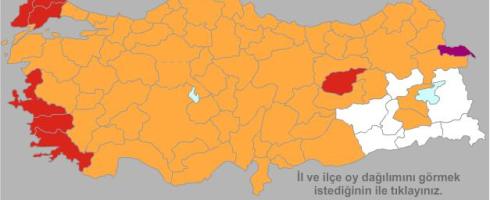
            The following post was written jointly with Hilal Elver, who is a Turkish scholar and public intellectual. It offers commentary on the recent AKP victory, which is viewed as a significant and hopeful development in Turkish, and regional, politics. The map above shows the electoral results by reference to party affiliation and place. Orange on the map indicates areas won by the AKP, red by the CHP, White designates areas where independent candidates representing Kurdish minorities were victorious.

**************** 

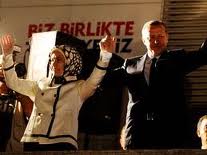
            It is the first time since the founding of the republic by Kemal Ataturk that such widespread international interest was aroused by Turkey’s June 12th elections. Naturally it is a time for celebration by the AKP in view of its landslide victory, a vindication of its overall economic and political approach over the past nine years. It is also an endorsement of its creative foreign policy that had given Turkey such a prominent place on regional and global diplomatic maps for the first time in its republican history.


            This afterglow of electoral victory should not obscure the challenges that lie ahead for the AKP. The most important of these involve finally providing the large Kurdish minority with secure cultural and political rights that to be trusted, would need to be vested in a new constitution. There is wide agreement in Turkey that the existing 1982 constitution, reflecting the approach taken by oppressive leaders of a military coup, needs to be replaced, but there are serious divisions among Turks with respect to the substantive content of such a new constitution. The secular opposition, as represented by the CHP, remains particularly worried about an alleged danger of the Putinization of the Turkish government if a switch is made from a parliamentary to a presidential system. More concretely, the AKP opposition believes that Recep Tayyip Erdogan’s harbors authoritarian dreams that could be fulfilled if Turkey were to follow the French presidential model.


Yet there should be less worry for two main reasons. Firstly, the AKP while winning 325 seats in parliament fell well short of securing the 367 seats needed for the parliamentary supermajorities that would have allowed it to decide on its own the contents of a new constitution or even of the 330 seats necessary for it to be able to write a constitution that would become the law of the land after it received approval in a national referendum. Without this degree of parliamentary control, the AKP will not be able to produce a constitution without the cooperation of the other parties represented in the parliament, especially the CHP, and that bodes well, particularly if the opposition acts responsibly by offering constructive cooperation.


And secondly, Erdogan in his victory speech went out of his way to reassure the country that constitutional reform would be a consensual process protective of diverse life styles and framed so as to achieve acceptance and justice for the entire society. At the moment of victory Erdogan seemed unexpectedly sensitive to criticism of his supposedly arrogant political style, and took the high road of moderation and humility. He seemed intent on convincing the Turkish public as a whole that he respected the secular principles that had dominated political life since the time of Ataturk, and that the country would become more pluralistic than ever in an atmosphere of mutual respect.


            It is not just Turks who should welcome this AKP victory. The electoral outcome provides the Middle East with an extremely positive example of dynamic democracy at a time of unresolved internal struggles throughout the region. The steady and helpful diplomatic hand of Turkey offers an attractive alternative to anxieties and memories associated with American and European interventions and alignments in the region. Turkey is a vibrant society with a flourishing economy that has managed to follow a democratic path to political stability and an independent course in foreign policy, and that offers an inspiring example for others to follow according to their various national circumstances.


            There are many uncertainties that cloud prospects for the future. Turkey faces the consequences of an unresolved bloody conflict in neighboring Syria, including the challenge of managing a massive inflow of refugees fleeing the killing fields. There are also the risks of an escalated confrontation with Iran arising from the Israel/United States hard power response to Iran’s nuclear program. This could ignite a war that engulfs the entire region with a variety of disastrous effects. In addition, the tense relations between Ankara and Tel Aviv are likely to be further stressed in coming weeks as preparation for a Second Freedom Flotilla go forward.


            Yet the sun shines brighter on the morning after these Turkish elections. Voters have affirmed an approach to Turkey’s internal and international policies premised on an inclusive approach to peace, justice, and rights. To build on this mandate, and to do so in a manner that is convincing to the majority of Turkish citizens, will create progress in the country and hope for the region. There will be mistakes and setbacks, but the orientation and vision of the AKP leadership is one of the most encouraging political developments of this still young 21st century. 


            The Prime Minister’s victory address from the balcony of AKP headquarters, what he calls a “mentorship speech” was the culmination of the long and steady rise of the AKP over the past decade– from 34% of the vote in 2002 to 47% in 2007, and now almost 50% in 2011. With some irony, this latest result did not give the AKP more seats in the Parliament due to recent changes in the electoral system of representation that had been decreed by the Higher Election Board, a part of the state bureaucracy known to be hostile to the AKP. While this restructuring that had hardly been noticed when it took place, hurt the AKP (326 rather than 341), while it helped to the CHP (rising from 112 to 135), and the BDP (Peace and Democracy Party) that helped elect Kurdish independent candidates. As well, the rightest party, National Movement Party (MHP), cleared the 10% threshold, winning 13% of the vote, which produces 53 seats in the new parliament.


            The Prime Minister interpreted these results sympathetically, telling the public that he heard the voice of people as demanding consensus rather than a bestowal of unitary power on one party. In his words: “Our nation assigned us to draft a new constitution. They gave us a message to build the new constitution through consensus and negotiation..We will seek the broadest consensus.” The word ‘compromise’ was mentioned three times in the speech.


 Erdogan also tried to calm the political waters roiled by inflamed campaign rhetoric when he declared that “[i]ncendiary speeches given during the campaign should be forgotten.” This is an encouraging start for the next phase in the process of constructing a democracy that responds to the realities of the dive rse peoples living in Turkey. At one point he promised that the constitution “will address everybody’s demands for freedom, democracy, peace and justice, and each identity and each value.” It is the last phrase that is most relevant as an indication of a resolve to move beyond the unitary ideas of Kemalist Turkey that still animate the ultra-nationalist MHP that during the election campaign reaffirmed its unshakeable belief in “one identity (Turk), one state (Turkey), and one language (Turkish).” Such a rigid position seems impossible to reconcile with the Erdogan consensus approach that was explicitly directed at the quest for distinct cultural and political rights by a series of Turkish minorities, most significantly, the Kurds. Also mentioned by Erdogan were Arabs, Circassians, Georgians, Roma, Alevis, and Laz. The Prime Minister insisted that hereafter “all citizens will be first class,” which seemed to be making an historic commitment to equality between Turks and non-Turks in all phases of national life.


There are additional hopeful signs for Turkey’s future. 78 women were elected to the parliament, significantly more than ever before. Perhaps, finally, the headscarf issue will be resolved in the direction of freedom of religion and the rights of women. Turkish religiously observant Muslim women have suffered the punitive effects of the headscarf ban in public sector activities, including institutions of higher learning, for far too long. The discriminatory nature of the current policy is dramatized by the unassailed freedom of the AKP men who lead the government despite being as religiously observant as their wives.


Moreover, this parliament will be robustly diverse because of the many new faces, including the former left student leader who spent many years in jail( Ertugrul Kurkcu), several CHP members who are in prison, being accused of anti-state activity in the Ergenekon case, and Leyla Zana, the internationally known Kurdish parliamentarian who was originally elected in 1991 and arrived in Parliament wearing a Kurdish flag bandana and refusing to take an oath of loyalty to the Turkish state. After many years, some of them in jail, Zana is again in parliament. A few days ago on TV she joked: “Perhaps this time I will come with a headscarf,” implying that the individual rights of everyone should be protected, and those who wear headscarves should not be excluded.


As the most popular and admired leader in the region, Erdogan did not forget to send a message to peoples of the Middle East, mentioning several cities and countries by name, including places in occupied Palestine, suggesting rather dramatically that these places will be considered under the same banner of concern as Turkish cities. In a rhetorical flourish Erdogan insisted that the outcome of the elections in Turkey was a victory “for Bosnia as much as Istanbul, Beirut as much as Izmir, Damascus as much as Ankara.” While somewhat hyperbolic, such a display of internationalism was new in Turkish politics, and signifies the rise of Turkey as a diplomatic force beyond its borders.


            Erdogan somewhat unexpectedly also recalled a dark episode in Turkey’s past, specifically what happened in 1960 when a military coup not only ousted a democratically elected government headed by the Democratic Party, but executed three of its political leaders, including the Prime Minister, Adnan Menderes, because it dared to challenge the supremacy of the military by reducing its budget.  As with the AKP, the Menderes leadership had governed Turkey for three consecutive terms, winning elections by overwhelming majorities. Erdogan was conveying his sense that the struggle to achieve Turkish democracy was long and painful.  He was also indirectly reminding his audience that the ‘deep state’ was no longer in a position to frustrate the will of the people. All in all, the message was upbeat as befits an electoral victory of this magnitude.


            A final observation takes note that June 12 was also the day on which Iranian elections were held two years ago. What is so startling is the contrast between the joyful expectations of the majority of the Turkish people after the electoral results were announced as compared to the anger and despair of the Iranian majority who believed for good reason that the regime in Tehran had fraudulently deprived them of an electoral victory. This difference between a governing process that periodically legitimates itself through free and fair multi-party elections and a governing process that lacks the consent of the public and must rule by fear and force may be the most basic fault line in domestic politics, and serves as the litmus test of the Arab Spring in the near future.

Obama’s Flawed Approach to the Israel/Palestine Conflict

21 May

            There is no world leader that is more skilled at speechmaking than Barack Obama, especially when it comes to inspiring rhetoric that resonates with deep and widely held human aspirations. And his speech on Middle East policy, symbolically delivered to a Washington audience gathered at the State Department, was no exception, and it contained certain welcome reassurances about American intentions in the region.  I would point to his overall endorsement of the Arab Spring as a demonstration that the shaping of political order ultimately is a prerogative of the people. Further that populist outrage if mobilized is capable of liberating an oppressed people from the yoke of brutal and corrupt dictatorships, and amazingly to do so without recourse to violence. Obama also was honest enough to acknowledge that the national strategic interests of the United States sometimes take precedence over this preferential option for democracy and respect for human rights. Finally, his proposed $1 billion in debt relief for Egypt was a concrete expression of support for the completion of its revolutionary process, although the further $1 billion tied to an opening to outside investment and a free trade framework was far more ambiguous, threatening the enfeebled Egyptian economy with the sort of competitive intrusions that have been so devastating for indigenous agriculture and industry throughout the African continent.


            But let’s face it, when the soaring language is taken away, we should not be surprised that Obama continues to seek approval, as he has throughout his presidency, from the hawks in the State Department, the militarists in the Pentagon, and capitalist true believers on Wall Street. Such are the fixed parameters of his presidency with respect to foreign policy and explain why there is so much disappointment among his former most ardent followers during his uphill campaign for the presidency, who were once energized and excited by the slogan “change, yes we can!”  Succumbing to Washington ‘realism’ (actually a recipe for imperial implosion), the unacknowledged operational slogan of the Obama presidency has become “change, no we won’t!”

Obama’s Pro-Israeli Partisanship

           With these considerations in mind, it is not at all surprising that Obama’s approach to the Israel/Palestine conflict remains one-sided, deeply flawed, and a barrier rather than a gateway to a just and sustainable peace. The underlying pressures that produce the distortion is the one-sided allegiance to Israel (“Our commitment to Israel’s security is unshakeable. And we will stand against attempt to single it out for criticism in international forums.”). This leads to the totally unwarranted assessment that failure to achieve peace in recent years is equally attributable to Israelis and the Palestinians, thereby equating what is certainly not equivalent. Consider Obama’s words of comparison: “Israeli settlement activity continues, Palestinians have walked away from the talks.” How many times is it necessary to point out that Israeli settlement activity is unlawful, and used to be viewed as such even by the United States Government, and that the Palestinian refusal to negotiate while their promised homeland is being despoiled not only by settlement expansion and settler violence, but by the continued construction of an unlawful barrier wall well beyond the 1967 borders. Obama never finds it appropriate to mention Israel’s reliance on excessive and lethal force, most recently in its response to the Nakba demonstrations along its borders, or its blatant disregard of international law, whether by continuing to blockade the entrapped 1.5 million Palestinians locked inside Gaza or by violently attacking the Freedom Flotilla a year ago on international waters while it was carrying much needed humanitarian aid to the Gazans or the ethnic cleansing of Palestinian neighborhoods in East Jerusalem.


            At least in Obama’s Cairo speech of June 2009 there was a strong recognition of Palestinian suffering through dispossession, occupation, and refugee status: “..it is also undeniable that the Palestinian people—Muslims and Christians—have suffered in pursuit of a homeland. For more than sixty years they have endured the pain of dislocation. Many wait in refugee camps in the West  Bank, Gaza, and neighboring lands for a life of peace and security that they have never been able to lead. They endure the daily humiliations—large and small—that come with occupation. So let there be no doubt: the situation for the Palestinian people is intolerable. America will not turn our backs on the legitimate aspiration for dignity, opportunity, and a state of their own.” Of course, this formulation prejudges the most fundamental of Palestinian entitlements by confining any exercise of their right of self-determination as a people to a two-state straight jacket that may no longer be viable or desirable, if it ever was. And throughout the speech in Cairo there was never a sense that the Palestinians have rights under international law that must be taken into account in any legitimate peace process, taking precedence over ‘facts on the ground.’

             But at least in Cairo Obama was clear on the Israeli settlements, or reasonably so: “The United States does not accept the legitimacy of continued Israeli settlements. This construction violates previous agreements and undermines efforts to achieve peace. It is time for the settlements to stop.” Even here Obama is only pleading for a freeze (rather than dismantling what was unlawful). In the new speech settlement activity is blandly referred to as making it difficult to get new negotiations started, but nothing critical is said, despite resumed and intensified settlement construction in the West Bank and East Jerusalem. This unwillingness to confront Israel on such a litmus test of a commitment to a negotiated peace is indicative of Obama’s further retreat from even the pretense of balanced diplomacy as measured against Cairo.

             And there were other demonstrations of pro-Israeli partisanship in the speech. On the somewhat hopeful moves toward Palestinian Authority/Hamas reconciliation as a necessary basis for effective representation of the Palestinian people at the international level, Obama confines his comments to reiterating Israeli complaints about the refusal of Hamas to recognize Israel’s right to exist. What was left unsaid by Obama is that progress toward peace might be made by at last treating Hamas as a political actor, appreciating its efforts to establish ceasefires and suppress rocket attacks from Gaza, acknowledging its repeated acceptance of a Palestinian state within 1967 borders buttressed by a long-term proposal for peaceful co-existence with Israel, and lifting a punitive and unlawful blockade on Gaza that has lasted for almost four years. It is possible that such an approach might fail, but if the terminology of taking risks for peace is to have any meaning it must include an altered orientation toward the participation of Hamas in any future peace process.

 A Disturbing Innovation

             Perhaps, the most serious flaw in the Obama conception of resumed negotiations, is the separation of the territorial issues from the wider agenda of fundamental questions. This unfortunate feature of his approach has been obscured by Israel’s evident anger about the passage in the speech that affirms what was already generally accepted in the international community: “The borders of Israel and Palestine should be based on the 1967 lines with mutually agreed swaps, so that secure and recognized borders are established for both states.” If anything this is a step back from the 1967 canonical and unanimous Security Council Resolution 242 that looked unconditionally toward “withdrawal of Israel armed forces from territory occupied in the recent conflict.”

              Obama’s innovation involves deferring consideration of what he calls “[t]wo wrenching and emotional issues..the future of Jerusalem, and the fate of Palestinian refugees.” Leaving Jerusalem out of the negotiating process is in effect an uncritical acceptance of Israel’s insistence that the city as a whole belongs exclusively to Israel. What is worse, it allows Israel to continue the gradual process of ethnic cleansing in East Jerusalem: settlement expansion, house demolitions, withdrawal of residency permits and deportations, and overall policies designed to discourage a continued Palestinian presence.  It must be understood, I believe, as an unscrupulous American acceptance of Israel’s position on Jerusalem, which is not only a betrayal of legitimate Palestinian expectations of situating their capital in East Jerusalem but also a move that will be received with bitter resentment throughout the Arab world.

            Similarly, the deferral of the refugee issue is quite unforgivable. As of 2010 4.7 million Palestinians are registered with the UN as refugees, either living within refugee camps under conditions of occupation or in precarious circumstances in neighboring countries within camps or as vulnerable members of the host country. This refugee status has persisted for more that 60 years despite the clear assertion of Palestinian refugee rights contained in General Assembly Resolution 194 adopted in 1948 and annually reaffirmed: “The refugees wishing to return to their homes and live at peace with their neighbors should be permitted to do so at the earliest practicable date.” This persistence of the Palestinian refugee status six decades later is one of the most notorious denials of human rights that exist in the world today. To remove it from the peace process, as Obama purports to do, is to consign the refugees to an outer darkness of despair, and as such, is a telling disclosure of the bad faith embedded in the most recent Obama rendering of his approach to peace. Those who are dedicated to achieving a just peace for the two peoples—Israelis and Palestinians—are doomed to fail unless the refugees are treated as a core issue that can neither be postponed nor evaded without a grave betrayal of justice.

 Legitimacy Confusions

               And finally, Obama does his best to dash Palestinian hopes about their one effort to move their struggle a step forward, gaining their acceptance as a state by the United Nations in September of this year. In a perverse formulation of this reasonable, even belated, Palestinian effort to enlist international support for their claims of self-determination and statehood, Obama resorts to deflating and condescending language: “..efforts to delegitimize Israel will end in failure. Symbolic actions to isolate Israel at the United Nations in September won’t create an independent state.” This language is perverse because the Palestinian diplomatic initiative is meant to legitimize itself, not delegitimize Israel. And the BDS campaign and other international civil society initiatives carrying on the ‘legitimacy war’ being waged against Israel by way of the Palestinian solidarity movement are not aimed at delegitimizing Israel, but rather seek to overcome the illegitimacy of such Israeli unlawful policies and practices as the Gaza blockade, ethnic cleansing, wall building in defiance of the World Court, settlement expansion and settler violence, excessive violence in the name of security.

               In many respects, Obama’s speech, aside from the soaring rhetoric, might have been crafted in Tel Aviv rather than the White House. It is a tribute to Israel’s extraordinary influence upon the American media that has been able to shift the focus of assessment to the supposed Israeli anger about affirming Palestinian statehood within 1967 borders. It is hardly a secret that the Netanyahu leadership, aside from its shrewd propaganda, is opposed to the establishment of any Palestinian state, whether symbolic or substantive. This much was confirmed by the release of the Palestinian Papers that established rather conclusively that behind closed doors even when the Palestinian Authority made concession after concession in response to Israeli demands, the Israeli negotiating partners seemed totally unresponsive, and appeared disinterested in negotiating a genuine solution to the conflict.

             Underneath the Israeli demand for recognition of it character as a Jewish state is the hidden reality of a Palestinian minority of more than 1.5 million living as second class citizens within Israel. The Obama conception of “a Jewish state and the homeland for the Jewish people, and the state of Palestine as the homeland for the Palestinian people; each state enjoying self-determination, mutual recognition, and peace” seems completely oblivious to the rights of minority peoples and religions. Such ethnic and religious states seem incompatible with the promise of human dignity for all persons living within a political community. Homelands for a people are fine provided they do not encroach on pre-existing rights of others and do not claim exclusivity at the level of society or state. The Jewish claim in Palestine has the force of history behind it, but so Christians and others, and the Balfour certification should not mean much in a post-colonial era. It needs also to be acknowledged that the realization of a Jewish homeland in historic Palestine has long been abusive toward the resident population, and now to consign the Palestinians to a homeland behind the 1967 borders sends a regressive message. It offers Israel a covert way to invalidate the claims of refugees expelled in 1948 from Palestine, as well as overlooks the rights and wellbeing of the Palestinian minority living within Israel at present.


American Irrelevance and Palestinian Populism

               In a profound sense, whatever Obama says at this point is just more words, beside the point. He has neither the will nor the capacity to exert any material leverage on Israel that might make it more amenable to respecting Palestinian rights under international law or to strike a genuine compromise based on mutuality of claims. Palestinians should not look to sovereign states, or even the United Nations, and certainly not the United States, in their long and tormented journey to realize a just and sustainable destiny for themselves. Their future will depend on the outcome of their struggle, abetted and supported by people of good will around the world, and increasingly assuming the character of a nonviolent legitimacy war that mobilizes moral and political pressures that assert Palestinian rights from below.  In this regard, it remains politically significant to make use of the UN and friendly governments to gain visibility and legitimacy for their claims of right. It is Palestinian populism not great power diplomacy that offers the best current hope of achieving a sustainable and just peace on behalf of the Palestinian people. Obama’s State Department speech should be understood as merely the latest in a long series of disguised confessions of geopolitical impotence, but of one thing we can be sure, it will not be the last.       

Is the Arab Spring a Black Swan?

6 May

             Understanding the Western response to the Arab Spring, a colorful designation of the democratizing movements of varying character that have rocked the foundations of the Arab world, is an ongoing process.  These movements are also seen as posing possibly serious threats to the structure of economic and strategic interests associated with long standing American and European influence in the region.  On the surface after some obvious hesitation, even ambivalence, the liberal democratic governments of the West, headed by the United States, declared their support for the Arab Spring, and even mounted a ‘humanitarian intervention’ (disguised as a No Fly Zone to protect the Libyan civilian population so as to discourage Russian and Chinese vetoes in the UN Security Council) to help the rebels prevail in their civil war against the Qaddafi regime. Everywhere in the region the political outcome of these unfinished uprisings remain shrouded in multiple doubts.


Having just visited Egypt for a week I came away with this dual sense that the revolutionary dynamics have produced remarkable results that form a glorious chapter of Egyptian history, but also that there are a variety of dark forces that are working under the radar to contain if not reverse this exhilirating democratizing momentum. In the foreground was the widespread acknowledgement by all sectors of public opinion in Cairo that the more reflective governing policy is of popular sentiments the more likely is a definite adjustment of diplomatic stance with regard to the Israel/Palestine conflict. This stance is already evident in the opening of the Rafah Crossing and in the robust Egyptian encouragement of Palestine Authority/Hamas reconciliation.


Looking from outside, I encountered one brief insight into real American thinking about the Arab Spring that was for me particularly revealing. It was published in the comment section of the May/June 2011 online website of Foreign Affairs, the most influential voice on foreign policy in the United States. It was written by Nassim Nicholas Taleb and Mark Blyth, and opened with this rather startling sentence: “The upheavals in the Middle East had much in common with the recent financial crisis: both were plausible worst-case scenarios whose probability was dramatically underestimated.” What an odd comparison! The equivalence was premised on the negative character of both occurrences, which led the authors to identify the emancipatory movements in the Middle East with the perjorative label of “upheavals,” thereby ignoring the manifest revolutionary and reformist challenges being directed at the established repressive political order. At their worst, these movements could be downgraded to ‘uprisings,’ rather than the image of ‘upheavals’ that mainly suggests purposeless disorder.


The most remarkable aspect, by far, of the Taleb/Blyth comment was to treat these Middle Eastern events as illustrative of unanticipated “worst-case scenarios.” Worst-case? Such a perception only makes sense if it unintentionally reflects the undisclosed underlying strategic consensus that the Arab Winter was far better for the West than the Arab Spring. In effect, that authoritarian government in the region was a necessary correlate of Western grand strategy long built around petropolitics, and more recently extended to the containment of political Islam and sustaining Israeli

regional security goals. Netanyahu and other political leaders in Israel acknowledged as much by their outspoken admission that they were sorry to see the Mubarak regime collapse.


             Nissam Nicholas Taleb is a financial risk analyst who made a wider stir when he published his book Black Swan  a couple of years ago. It has as its central and compelling thesis that there is a pervasive tendency for history to be shaped by unpredicted events, and especially by occurrences that have not taken place in the past. His vivid central metaphor is the assumption that all swans are white because no other color had been seen until the black swan variety was discovered in Australia. This is an interesting alternative approach to what I have been calling ‘the politics of impossibility,’ a phrase meant to suggest that the impossible repeatedly happens, making future studies based on past trends and statistical projections almost certain to be wrong.


            I am not contesting the idea that implausible happenings should be taken into far greater account when contemplating the future. What I am remarking critically upon is the bland classification of the Arab Spring as ‘a worst-case scenario,’ and the fact that such a comment could survive scrutiny from the normally very adept gatekeepers at Foreign Affairs. Is it to be explained as an accidental political oversight or more darkly as a revelation of the mindset so ingrained within the American foreign policy establishment as to be unnoticeable? If the latter, then, it is not surprising that such a phrasing would not even be noticed because it was accurately expressive of the private discourse among foreign policy elites on the impact of these developments. Supportive of this latter interpretation is the fact that this Black Swan comment has remained featured on the Foreign Affairs website.


            It is possible that I am exaggerating a flourish that is nothing more than a slip of the pen! At the very least, however, it should serve as a reminder, if not a warning, that there is not only pro-democracy cheering going on in the Washington situation rooms that shape the foreign policy of Western countries, especially the United States, with respect to what to hope for in the Middle East. As the Chinese supposedly believe: “two persons sleep in the same bed but they have different dreams.”