Neighborly Crimes of Complicity in Gaza
[Prefatory Note: my post below, an earlier version of which was published in AlJazeera English as an opinion piece. It was written before I had the opportunity to read an illuminating assessment of the regional and global turmoil that culminated for now in the massacre carried out by Israeli armed forces in Gaza. I highly recommend “The Tragedy of Great Power: The Massacre of Gaza and the Inevitable Failure of the Arab Spring” written by the learned Islamic jurist and scholar, Khaled Abou El Fadl, a distinguished professor at UCLA School of Law, with the link to the article below:
http://www.abc.net.au/religion/articles/2014/08/08/4064106.htm
What makes Professor El Fadl profound essay particularly valuable is his ability to fit the regional pieces together in a convincing manner, showing how and why governments that rule in Saudi Arabia and the UAE, encouraged the overthrow of Egypt’s elected government headed by Mohamed Morsi in mid-2013 and more recently encouraged Israel to destroy Hamas. He also shows that Hamas is not accurately perceived as a byproduct of the Egyptian Muslim Brotherhood, but has its own “very distinct pedagogies, objectives and methodologies.” In depicting the forces of resistance and transformation as opposed to the geopolitics of counterrevolution as constituting the core struggle taking place throughout the region it becomes clear why the alignments in the Middle East are assuming their current configurations.
It is telling and provocative for Professor El Fadl to situate the Palestinian Liberation Organization (and by implication, the Palestinian Authority) as de facto allies of Sisi’s Egypt, Saudi Arabia, and the UAE as well as being existential partners of the United States and Israel in subjugating the region to Western goals. What has developed further since the end of the Cold War rivalry that long dominated the region should be considered a geopolitical protection racket that gained political salience in the aftermath of the Arab Spring. The upheavals of 2011 shook the foundations of the old order, and led to renewals throughout the region of Faustian Bargains by which various authoritarian regimes receive protection, including help with the destruction of any political actor, whether Islamic or not, that dares to challenge this established order composed of ultra-rich native elites claiming dynastic privileges conferred by colonial powers then seeking native collaborators to manage exploited and oppressed populations. While these elites appease Israel, the masses in the same political space remain passionately and symbolically dedicated to the Palestinian struggle as became evident in the September 9, 2011 attack by several thousand Egyptians on the Israeli Embassy shortly while the heroic memories of the overthrow of Hosni Mubarak were still fresh.]
Of all the complexities surrounding the reaction of the world to the horrifying spectacle of Israel’s severe criminality in Gaza none is more perplexing than the complicity of most governments throughout the Arab world. What makes their political posture particularly bewildering is the degree of ethnic, religious, cultural, and historical commonality that creates such close ties of identity among the peoples of the region. And no single issue has been as unifying over the decades for these people than has their long intensely felt opposition to the injustice, suffering, and exploitation that the Palestinian people have endured for the past century as a result of the encroachments of the Zionist movement on their lands. It should be recalled that at earlier stages of the Palestinian ordeal, the governments of the neighboring Arab countries did exhibit strong, if ineffectual, solidarity with the Palestinian struggle. Several Arab states jointly attacked Israel, initially in 1948 to prevent the establishment of Israel, and later in the failed wars of 1967 and 1973 that challenged Israel’s existence. These defeats together with Egypt’s accommodation via the peace treaty of 1979 was a defining moment at which the Arab neighbors of Israel abandoned the Palestinians politically, but not yet diplomatically or economically. At this time any tangible form solidarity at the level of Arab governments is now a distant and ironic memory, and has been supplanted in the main by active hostility to Palestinian aspirations and implicit sympathy with, or at least acquiescence in Israel’s regional ambitions in conjunction with U.S. grand strategy in the region .
Some official formal hostility to Israel and sympathy for the Palestinian struggle persists at rhetorical levels, but rings hollow. It is true that many Arab countries to this day refuse entry to anyone with an Israeli entry or exit stamp in their passport. Anwar Sadat’s assassination in 1981 was widely interpreted at the time as a populist response in Egypt to his willingness to sign a peace treaty with Israel without simultaneously securing justice for the Palestinians, thereby crossing what was then a red line of betrayal. It was observed by the Western media that few Egyptians bothered to leave their apartments as a show of respect as Sadat’s funeral procession as it passed through the streets of Cairo because the slain leader was so reviled for shamelessly appeasing the enemy of the Palestinian people.
Above all, the ongoing struggle for Palestinian self-determination is understood by the peoples of the Middle East, and indeed the world over, as a struggle for the empowerment and liberation of the Palestinian people in the face of severe injustices done unto them over a long period of time, and involving such crimes against humanity as apartheid and massacre, verging on genocide. Increasingly, and never more than in reaction to this recent Gaza horror show, the Palestinian struggle will have to be waged not only against Israel, and its American and European allies, but also against the Arab collaborationist governments in the region that have betrayed their own larger religious and cultural identities, and more revealingly, the most fundamental ideas of justice and compassion associated with ideals of humanity and the ethical underpinnings of Islamic unity.
It is notable that only non-Arab Turkey and Qatar have acted responsibly in response to the Israeli attacks that commenced on July under the IDF code name of Protective Edge. The Turkish Prime Minister, Recep Tayyip Erdoğan, has spoken movingly, without hiding his condemnation of Israeli behavior behind the euphemisms of diplomacy, in characterizing Israel’s behavior in Gaza as criminal. Even a group of distant Latin American countries, including Brazil and Chile, have at least shown the depth of their disapproval of Israel’s conduct by withdrawing their ambassadors from Israel. This symbolic expression of disapproval is something that not one government in Europe or North America, the self-proclaimed centers of world civilization, has yet done. The countries of the South have by and large also turned their backs to the Palestinians and the confrontation in Gaza, with the exception of South Africa.
Taken together these considerations make it morally distressing and politically mystifying to observe that almost every Arab governments has seemed either to be flashing a green light in Israel’s direction or pointedly looking away. Given the criminality of the Israeli attack and the tragic suffering inflicted on the Palestinian people, complicity by way of such diplomatic endorsements, or even stony silent acquiescence, is at the very least a breach in Arab and Islamic identity, and worse, seems to be an unimaginable case of aiding and abetting genocidal political violence directed at the Palestinian people. Such a diplomacy of indifference is especially notable as expressed toward Gaza, which is governed by a Moslem-oriented leadership. Israel’s persistence in a massacre mode despite the near universal calls for a responsibly negotiated ceasefire was widely attributed to the fact that the Netanyahu government was being encouraged behind the scenes by Egypt and Saudi Arabia ‘to finish the job,’ not of the tunnels and rockets that served as the security pretext, but of Hamas itself as ‘the head of the snake,’ the one Palestinian actor that continued to believe in a politics of resistance. For these Arab governments to act so opportunistically, particularly given the frequency and magnitude of Israeli atrocities is shocking to all but the most numbed of political imaginations.
To be sure, the behavior of these Arab governments as mystifying, legally and morally unacceptable, and politically self-destructive warrants condemnation, but it also needs to be understood and explained as clearly as possible. What quirks of political realism led these Arab regimes to so calculate their future?
The Enemy of my Enemy
The core explanation of Arab complicity (excepting Qatar) has to do with the Arab governments hating and fearing the Muslim Brotherhood (MB) far more than they resent Israel. This logic is then extended to Hamas, which is misleadingly treated as nothing other than a branch of this supposedly poisonous tree. This hostility to an Islamic movement authenticated from below overshadows Israel’s encroachment on their region, and even its appropriation and control of Muslim sacred places in Jerusalem. In effect what is going on in these top heavy monarchies is a passionate search for protection from possible uprisings by their own populations, which are feared as potential adversaries. Such an initial assessment pushes the question one step further but it does not give us any insight into why this should be so.
What are the sources of this hatred of the MB? The MB is perceived as the essential expression in the Arab world of bottom up political Islam that is viewed as toxic by the established order because of its grassroots legitimacy. This reality has induced panic among these Arab regimes that goes back at least as far as the explosive regional reverberations unleashed by the revolution that overthrew the Shah’s supposedly secure imperial rule in Iran (1979). This revolutionary process caused high intensity tremors, especially throughout the Arab world, and especially among the monarchies nurturing privileged and unscrupulous elites that have long kept their populations cruelly repressed and in backward conditions of mass misery. These regimes, generally aligned with the United States, remain obsessed with the maintaining stability of their own rule, and seem to feel that stifling all voices calling for change is a vital ingredient of their own survival.
Hamas as an active resistance movement is in this sense perceived as an acute threat to the kind of future that these Arab governments are intent of achieving no matter what the costs in lives and societal wellbeing. First of all, Has has historical ties to the Egyptian MB, the older organization of Muslim activists that has kept the flame of political Islam burning despite enduring harsh suppression dating back to decades before Israel came into existence. Secondly, Hamas demonstrated its legitimacy, and credibility as a voice of the Palestinians living in Gaza by its electoral victory in 2006, and more recently by its resilience (sumud) and resistance to Israeli tactics of aggression and massacre. Thirdly, Sunni Hamas crossed sectarian boundaries by having its closest political ties with Shiite Iran and Hezbollah, and the Alawite regime in Syria, and although these relationships have grown weaker as a result of recent regional developments, their very existence further alarms the Sunni supremacists in Riyadh whose second source of anxiety is associated with a sectarian/nationalist struggle that pits Saudi Arabia and its allies against Iran and its allies. The terrible carnage in Syria is one expression of this sectarian dimension of the regional struggle that complements efforts to crush any expression of political Islam with a strong societal base of support.
Egypt’s Betrayal
Of course, in the foreground is the experience of the Arab anti-authoritarian upheavals in 2011, especially the dislodging of Hosni Mubarak in Egypt, followed by expressions of far greater popular electoral support for the Muslim Brotherhood and Salafi candidates throughout Egypt than had been expected by the anti-Mubarak liberals and progressive youth who had earlier dominated the crowds in Tahrir Square. The Gulf countries made no secret of their disappointment with Washington’s refusal to do more to beat back this populist tide that swept over the Mubarak regime, who like the Shah in Iran 30 years earlier, had seemed to offer leaders of these Arab monarchies a model of invulnerability in relation to popular upheavals.
And so two years later in 2013 when the chance came, as it did during the faltering presidential term of Mohamed Morsi, it is no secret that the counterrevolutionary coup led by General Ahmed Fattah el-Sisi was most warmly welcomed by Israel and Saudi Arabia. The Sisi coup won immediate aid bestowed in huge quantities (at least $8 billion) from Saudi Arabia and the UAE, hoping that such a large infusion of cash would create a soft economic landing for the new regime, and set up a contrast with the economic failures of the Morsi government. It was hoped that a rapid economic recovery would reassure the majority of Egyptians that they were experiencing a change for the better even if there was little effort by the new leaders to hide the return to the methods and style of the previously despised Mubarak rule that had prompted the earlier upheaval. What is startling is that these Arab supporters never blinked in the face of the crimes of Sisi’s military leadership in Cairo, which featured a bloody crackdowns of anti-government demonstrations in Cario, including even the killing of many MB members while they were at prayer. Sisi proceeded to move against the MB as an organization, having it criminalized and defined legally as ‘a terrorist organization,’ encouraging judicial action that included imposing mass death sentences on many of its members, and generally engaging in state crime on a scale that far exceeded the abuses of the Mubarak period. Even Washington was embarrassed by these excesses, although it maintained a pragmatic silence that overlooked the tensions between its calls for democracy and its actual strategic goal of restoring the regionalstability of the pre-Arab Spring status quo.
Iran Explodes the Myth of Regional Stability
Until this pattern became evident I didn’t appreciate the relevance of some remarks made to me by Ayatollah Khomeini while in Paris just as he was about to return to Iran from exile to lead the new Islamic Republic in January 1979. This austere religious leader was very clear about rejecting the then prevailing idea that a national revolution was taking place in Iran. He said again and again during the meeting, “This is an Islamic revolution, not an Iranian revolution.” He went on to observe that the dynastic regime in Saudi Arabia was decadent and oriented toward the West. In his view it was as illegitimate a source of governance as was the Shah’s regime that had just been overthrown in Iran, and a justifiable target for further political initiatives by those societal forces that were infused with Islamic values.
The revolution in Iran, whether understood as a national or ideological phenomenon, was deeply threatening to political stability of the region. It was a political movement from below that shattered a monarchic power structure in Iran that was viewed in the region and by the West as invulnerable to internal challenge, once described by Kissinger “as that rarest of things, an unconditional ally.” In other words, it was not just that the foundations of the status quo gave way in Iran, but that their crumbling was brought about by populist tremors that enjoyed widespread cultural legitimacy. It was this cultural legitimacy that again surfaced in the immediate aftermath of the Arab upheavals in 2011, and sent tremors of fear throughout the region, and could not be dismissed on sectarian grounds.
The explosive emergence of the Islamic State of Iraq and Levant (ISIS) reinforces Ayatollah Khomeini’s central message. Its proclamation of a new caliphate is precisely in line with this type of thinking. The whole carving up of the Arab world into a series of sovereign states is seen from these perspectives as an imposition of European civilization, destroying and destabilizing the only true political community, that of the Islamic uma.
Israel’s Parallel Universe
Israeli strategists over the years have been divided about their regional priorities, but agreed on the general contour of principal goals. Israel’s preferred Middle East would consist of governments that were both friendly and stable, which made Iran a favorite until it unexpectedly fell apart in 1978-79. Next best, were governments that were formally cool, or even hostile, but remained mostly on the sidelines in relation to the conflict of with the Palestinians, such as King Hussein’s Jordan, Mubarak’s Egypt, and the Gulf states, especially Saudi Arabia. If such stability was not attainable, then strife in a country that was politically hostile was viewed as next best, which is the story of Syria, and to a degree Iraq, in recent years. In other words, Israel could live with regional actors that were rhetorically hostile, as with passport exclusions or UN speeches, but not with states that were politically hostile, and perceived as allies of Palestinian resistance struggle. In that sense, Israel pushed behind the scenes for the American attack on Iraq after 2001 and has done its best to push the United States into a belligerent encounter with Iran in recent years.
When it comes to Gaza, and Hamas, the convergence of the Israeli approach and the Arab governmental consensus is an invaluable political blessing for Tel Aviv. It gives Israel unlimited space to push its militarist agenda, however great the carnage and devastation, and even if much the rest of the world may lament the assault upon international law and morality. Even the United States, and its ‘subaltern’ UN Secretary General, have felt the pressure to use their influence to establish a ceasefire, although without daring to lift a critical finger in Israel’s direction and following an Egyptian-oriented peremptory diplomacy that seems more concerned about PR dimensions than achieving an end to the violence. This skeptical reflection was confirmed by the initial ceasefire proposal that was presented to Hamas on a take it or leave it basis, and quite incredibly, that its leaders were informed about only through its media publication. The newer ceasefire approach, based on a sequence of 72 hour truces, follows the same pattern with Israeli and American negotiators refusing to sit at the same table as the representative of Hamas, and yet claiming to seek an agreement that would end the violence.
While Israel talks about rockets and tunnels, its massive military operation is being increasingly interpreted by knowledgeable commentators as punitive, and directed not only at Hamas but at Palestinians generally. Some Israeli leaders and their prominent supporters seem to believe that Gazans deserve to die because they voted for Hamas back in 2006, although many Gazans who are dying didn’t back Hamas then or now, and certainly not the Palestinian children who were not even born when Hamas won the elections. A second punitive motivation, and more explicitly endorsed, is a punishment directed at Palestinians in general for daring to form a unity government back in early June, thus challenging ever so slightly the illusion that Israelis had successfully crushed Palestinian political ambition to pursue self-determination by any means other than the futile charade of periodic spurts of diplomacy. Crushing Hamas is seen as a way to make Palestinians submit to the permanence of occupation, the annexation of most of the West Bank, the realities of apartheid administrative and detention policies, and the burial of any prospect of an independent Palestinian state. The Palestinian Authority had been awkwardly docile until it timidly went forward with the unity government, and now must be disciplined by Israel for getting out of line, being taught a lesson once and for all that if it has any future it is to collaborate with Israel, as it had done in the past, with the suppression of Palestinian resistance, above all Hamas, as a telltale sign of its political outlook.
A Concluding Word
More than anything else, these terrible happenings in Gaza should lead to a realization that the future of the Palestinian people and of the region as a whole depends on finding a just solution of the conflict. The abysmal failure of the Kerry induced talks showed definitively that Israel has lost all interest in a diplomacy that promises the Palestinians a viable and independent sovereign state at the end of the road. With a show of self-confidence the Knesset made clear its own rejection of the two-state diversion by choosing an ardent Likud one-stater, Reuven Rivlin, to replace Shimon Peres, as President of Israel. It is past time for the peoples of the world to wake up to the real nature of the challenge and support a more militant international campaign of solidarity with the Palestinian struggle, and insist on boycott and divestment in all venues, working to support arms embargoes and sanctions on the part of as many governments as possible.
Tags: Egypt, Gaza, Hamas, Israel, Middle East, Palestine, Saudi Arabia, Turkey


 Global Justice in the 21st Century
Assessing Prime Minister Ahmet Davutoglu’s Departure from Government
26 May[This post was published in modified form a week ago in Al Jazeera Turka. Since then Binali Yildirim has been selected as the new prime minister of Turkey, reflective of a choice made by President Erdogan. Mr. Yildirim had served for many years in the AKP Government as Minister of Transport, Maritime Affairs, and Communications. He was successful in this post, given credit for the great improvement in the public transport systems in Turkish cities and for modernizing Turkey’s network of inter-city roads and highways. Yildirim is widely regarded as an Erdogan loyalist with a pragmatic approach to politics. Of course, only the future will allow us to discern whether this shift in governmental leadership exerts a discernible influence on the domestic policy agenda and on the regional and global role of Turkey. Issues to watch closely include the approach taken to Syria and ISIS, and whether possibilities for reconciliation with the Kurdish political movement are explored, or are abruptly rejected.
There are two disturbing developments. The first is the parliamentary move to deprive members of their legislative immunity from criminal prosecution, which was explicitly aimed at Kurdish parliamentarians who are members of the Peoples’ Democratic Party (HDP), and accused of lending support to PKK terrorism. The other initiative is a call for a constitutional amendment that would end the nonpartisan character of the presidency by allowing the president to be the head of the governing political party, in effect, making Erdogan head of the AKP as well as President of the country. Of course, Erdogan has been indirectly playing this kind of partisan role on a de facto basis, thus the authorization would merely be regularizing a practice that currently violates the spirit, and probably the letter, of the current constitution]
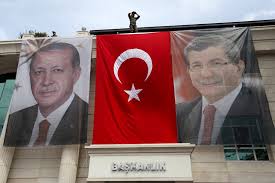
The resignation of Davutoglu seems to be enveloping Turkey in mists of partisan speculation, which opposition forces contend has taken the nation a big step closer to the abyss of autocratic rule. The move does seem clearly dictated by President Recip Tayyip Erdogan’s determined effort to replace the Turkish parliamentary system with a presidential system as legalized through a process constitutional reform.
To some extent the confusion surrounding the departure of Davutoglu’s departure from the heights of governmental rule is a reflection of the public posture adopted by the two leaders. On Erdogan’s side we encounter the assertion that “Prime Minister Davutoglu’s decision will be for the better of Turkey and the nation.” This seems at variance with the spirit, if not letter, of Davutoglu’s stark declaration that his resignation “..is not my wish, but it is a necessity.” Possibly, the common ground here is the recognition that the AKP (Justice and Development Party) and the governing process need one clear and undisputed leader for policy purposes, and that explains the apparent downgrading of the prime ministerial post as connected to the overt assertion of the univocal primacy of Erdogan’s presidency.
Of course, there are more elaborate speculations and partisan spins, mostly difficult to evaluate, about whether the true explanation of these unsettling events has been friction between these two towering figures who have dominated Turkish politics in the 21st century is a matter of substantive disagreement on any number of issues. Or is this event better explained by reference to the tensions that had developed between Davutoglu and the AKP Parliamentary leadership on more prosaic questions of procedures and appointments. In this latter interpretation, the resignation of Davutoglu, and his replacement by a political figure lacking his international prominence, are enabling Erdogan and the AKP to coordinate their common effort to put the Turkish ship of state in efficient running order from the point of view of the presidency.
While Erdogan portrays this dramatic move as ‘Davutoglu’s decision,’ the opposition, always relentless in their often exaggerated criticisms of AKP governance ever since 2002, describes what has happened as a ‘palace coup.’ Reflecting on such an extreme presentation of Davutoglu’s departure suggests its opportunism. The opposition has long decried Erdogan’s takeover of government, portraying Davutoglu during his 20 months of service as head of government as nothing more than being ‘a shadow prime minister,’ sometimes even portraying him unflatteringly as ‘a puppet.’
And yet, if Erdogan was actually in full control all along, the resignation, whether voluntary or forced, is merely an outward acknowledgement of the de facto hierarchy that had already made the president the supreme leader of the country. Under these circumstances to treat what happened as a coup is deeply misleading as the resignation creates no alteration in the previously operative structure of political power in Ankara. Additionally, Davutoglu with seeming spontaneity indicated that he would never give voice to criticisms of the president, insisting that he leaves office continuing to have a ‘brotherly’ feeling toward Erdogan. This is hardly the language of someone who has been ousted from power as a result of a coup!
What may be really at stake in the course of this reshuffling is streamlining the constitutional restructuring process that seems so high on Erdogan’s agenda. It is to be expected that next prime minister, presumably reflecting Erdogan’s choice, will be a person that possesses sufficient clout with Parliament to push the process through quickly and in accordance with the sort of presidential system that Erdogan favors.
There is some reason to suppose that Davutoglu preferred what might be called ‘a republican presidency’ that sacrifices a measure of executive control for the sake of ‘checks and balances’ and ‘separation of powers[ while Erdogan is insistent upon ‘an imperial presidency’ that allows the president to run the show with minimum interference from other branches of government. Assuming that constitutional reform will bring some variant of the presidential system into being, this choice of model is crucial to the sort of political future that awaits the Turkish people. It is hard to imagine an imperial presidency, especially with Erdogan at its head, that manifests sensitivity to human rights, including freedom of expression and the human rights of dissenting individuals. The arrest and prosecution of journalists and academicians in recent months even prior to the adoption of a presidential system does seem to vindicate the worst fears about the fate of Turkish democracy.
At the same time maybe the issue is being inflated beyond its true importance. Many informed observers have observed that Erdogan had long since transformed the presidency as set forth in the 1982 Constitution into a vehicle for his unchecked authority. If this is a correct interpretation of the way the Turkish government has been operating in recent years, at least since Erdogan became the first popularly elected president in 2014, then the issue of institutionalization of this style of leadership has mostly to do with the future, and especially with the structure of governance in a post-Erdogan Turkey.
However, if the opposition is exaggerating Erdogan’s curent power and governing style, then it is possible that a new constitution, which requires a two-thirds supermajority in Parliament, will enhance the actual, as well as the legal role of the office of president in Turkey. By placing such stress on this move from a parliamentary to a presidential system Erdogan appears to believe that his role would be solidified as well as legitimated if the sort of constitution that he seeks is properly adopted as a reality. This may be the most consequential question bound up with Davutoglu’s resignation, and yet it is sometimes downplayed because of public fascination with the dramatic interaction of these two Turkish political figures, which pushes to one side the question of restructuring the constitutional architecture of the Turkish government.
Finally, there is the question of foreign relations. The US State Department has formally avowed that Davutoglu’s resignation is an internal Turkish issue lacking any significance for U.S.-Turkish relations. Of greater concern is Turkey’s far more complex relationship with Europe, and particularly the possible impact on Syrian refugee containment, Turkish visa-free travel rights in Schengen Europe, European promises of a fast track approach to Turkish accession negotiations, and European demands that the Turkish anti-terrorism law be amended so that it cannot be used to pursue journalists and professors.
There are also many indications that European leaders were comfortable dealing with Davutoglu on such matters, and are far less willing to cooperate with Erdogan. It also seems that Erdogan on his part is disinclined to satisfy European preconditions for an effective working relationship or speeded up accession talks. At the same time, Turkey and the EU are tied together by the presence of strong interests. 40% of Turkish international trade is with EU countries, and European tourism is a vital source of foreign exchange earnings and sustains the tourist sector in Turkey that was already hurting due to the upsurge of tensions with Russia. Besides, the large Turkish minorities in Germany and elsewhere makes these diplomatic tensions have unsettling domestic ramifications in Europe, including an upsurge in Islamophobia.
It should be realized that these questions arise in an historical context where a series of security concerns pose dangerous challenges to Turkish stability and development. These issues of leadership and constitutional structure, although serious are clearly secondary to the great challenges facing the Turkish nation at this point, above all the renewal of Kurdish civil strife and horrific urban warfare, but also the spillovers from the Syrian civil war in the form of ISIS and refugee flows, as well as tensions with Russia and Iran. It is to be hoped that people of good will throughout Turkey can find common ground on the urgency of these matters, and not remain distracted by trying to solve the puzzle of the leadership shakeup that has followed Davutoglu’s forced resignation.
Tags: AKP, Constitutional Reform, Davutoglu, Erdogan, Presidential System, Prime Minister, Turkey, Turkish leadership, Turkish-EU relations