
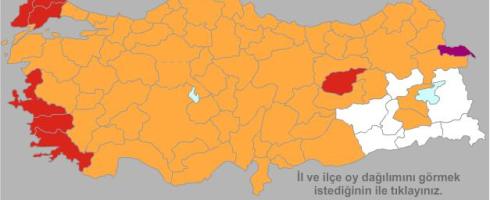
The following post was written jointly with Hilal Elver, who is a Turkish scholar and public intellectual. It offers commentary on the recent AKP victory, which is viewed as a significant and hopeful development in Turkish, and regional, politics. The map above shows the electoral results by reference to party affiliation and place. Orange on the map indicates areas won by the AKP, red by the CHP, White designates areas where independent candidates representing Kurdish minorities were victorious.
****************
It is the first time since the founding of the republic by Kemal Ataturk that such widespread international interest was aroused by Turkey’s June 12th elections. Naturally it is a time for celebration by the AKP in view of its landslide victory, a vindication of its overall economic and political approach over the past nine years. It is also an endorsement of its creative foreign policy that had given Turkey such a prominent place on regional and global diplomatic maps for the first time in its republican history.
This afterglow of electoral victory should not obscure the challenges that lie ahead for the AKP. The most important of these involve finally providing the large Kurdish minority with secure cultural and political rights that to be trusted, would need to be vested in a new constitution. There is wide agreement in Turkey that the existing 1982 constitution, reflecting the approach taken by oppressive leaders of a military coup, needs to be replaced, but there are serious divisions among Turks with respect to the substantive content of such a new constitution. The secular opposition, as represented by the CHP, remains particularly worried about an alleged danger of the Putinization of the Turkish government if a switch is made from a parliamentary to a presidential system. More concretely, the AKP opposition believes that Recep Tayyip Erdogan’s harbors authoritarian dreams that could be fulfilled if Turkey were to follow the French presidential model.
Yet there should be less worry for two main reasons. Firstly, the AKP while winning 325 seats in parliament fell well short of securing the 367 seats needed for the parliamentary supermajorities that would have allowed it to decide on its own the contents of a new constitution or even of the 330 seats necessary for it to be able to write a constitution that would become the law of the land after it received approval in a national referendum. Without this degree of parliamentary control, the AKP will not be able to produce a constitution without the cooperation of the other parties represented in the parliament, especially the CHP, and that bodes well, particularly if the opposition acts responsibly by offering constructive cooperation.
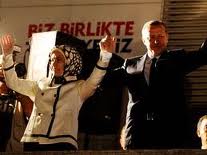
And secondly, Erdogan in his victory speech went out of his way to reassure the country that constitutional reform would be a consensual process protective of diverse life styles and framed so as to achieve acceptance and justice for the entire society. At the moment of victory Erdogan seemed unexpectedly sensitive to criticism of his supposedly arrogant political style, and took the high road of moderation and humility. He seemed intent on convincing the Turkish public as a whole that he respected the secular principles that had dominated political life since the time of Ataturk, and that the country would become more pluralistic than ever in an atmosphere of mutual respect.
It is not just Turks who should welcome this AKP victory. The electoral outcome provides the Middle East with an extremely positive example of dynamic democracy at a time of unresolved internal struggles throughout the region. The steady and helpful diplomatic hand of Turkey offers an attractive alternative to anxieties and memories associated with American and European interventions and alignments in the region. Turkey is a vibrant society with a flourishing economy that has managed to follow a democratic path to political stability and an independent course in foreign policy, and that offers an inspiring example for others to follow according to their various national circumstances.
There are many uncertainties that cloud prospects for the future. Turkey faces the consequences of an unresolved bloody conflict in neighboring Syria, including the challenge of managing a massive inflow of refugees fleeing the killing fields. There are also the risks of an escalated confrontation with Iran arising from the Israel/United States hard power response to Iran’s nuclear program. This could ignite a war that engulfs the entire region with a variety of disastrous effects. In addition, the tense relations between Ankara and Tel Aviv are likely to be further stressed in coming weeks as preparation for a Second Freedom Flotilla go forward.
Yet the sun shines brighter on the morning after these Turkish elections. Voters have affirmed an approach to Turkey’s internal and international policies premised on an inclusive approach to peace, justice, and rights. To build on this mandate, and to do so in a manner that is convincing to the majority of Turkish citizens, will create progress in the country and hope for the region. There will be mistakes and setbacks, but the orientation and vision of the AKP leadership is one of the most encouraging political developments of this still young 21st century.
The Prime Minister’s victory address from the balcony of AKP headquarters, what he calls a “mentorship speech” was the culmination of the long and steady rise of the AKP over the past decade– from 34% of the vote in 2002 to 47% in 2007, and now almost 50% in 2011. With some irony, this latest result did not give the AKP more seats in the Parliament due to recent changes in the electoral system of representation that had been decreed by the Higher Election Board, a part of the state bureaucracy known to be hostile to the AKP. While this restructuring that had hardly been noticed when it took place, hurt the AKP (326 rather than 341), while it helped to the CHP (rising from 112 to 135), and the BDP (Peace and Democracy Party) that helped elect Kurdish independent candidates. As well, the rightest party, National Movement Party (MHP), cleared the 10% threshold, winning 13% of the vote, which produces 53 seats in the new parliament.
The Prime Minister interpreted these results sympathetically, telling the public that he heard the voice of people as demanding consensus rather than a bestowal of unitary power on one party. In his words: “Our nation assigned us to draft a new constitution. They gave us a message to build the new constitution through consensus and negotiation..We will seek the broadest consensus.” The word ‘compromise’ was mentioned three times in the speech.
Erdogan also tried to calm the political waters roiled by inflamed campaign rhetoric when he declared that “[i]ncendiary speeches given during the campaign should be forgotten.” This is an encouraging start for the next phase in the process of constructing a democracy that responds to the realities of the dive rse peoples living in Turkey. At one point he promised that the constitution “will address everybody’s demands for freedom, democracy, peace and justice, and each identity and each value.” It is the last phrase that is most relevant as an indication of a resolve to move beyond the unitary ideas of Kemalist Turkey that still animate the ultra-nationalist MHP that during the election campaign reaffirmed its unshakeable belief in “one identity (Turk), one state (Turkey), and one language (Turkish).” Such a rigid position seems impossible to reconcile with the Erdogan consensus approach that was explicitly directed at the quest for distinct cultural and political rights by a series of Turkish minorities, most significantly, the Kurds. Also mentioned by Erdogan were Arabs, Circassians, Georgians, Roma, Alevis, and Laz. The Prime Minister insisted that hereafter “all citizens will be first class,” which seemed to be making an historic commitment to equality between Turks and non-Turks in all phases of national life.
There are additional hopeful signs for Turkey’s future. 78 women were elected to the parliament, significantly more than ever before. Perhaps, finally, the headscarf issue will be resolved in the direction of freedom of religion and the rights of women. Turkish religiously observant Muslim women have suffered the punitive effects of the headscarf ban in public sector activities, including institutions of higher learning, for far too long. The discriminatory nature of the current policy is dramatized by the unassailed freedom of the AKP men who lead the government despite being as religiously observant as their wives.

Moreover, this parliament will be robustly diverse because of the many new faces, including the former left student leader who spent many years in jail( Ertugrul Kurkcu), several CHP members who are in prison, being accused of anti-state activity in the Ergenekon case, and Leyla Zana, the internationally known Kurdish parliamentarian who was originally elected in 1991 and arrived in Parliament wearing a Kurdish flag bandana and refusing to take an oath of loyalty to the Turkish state. After many years, some of them in jail, Zana is again in parliament. A few days ago on TV she joked: “Perhaps this time I will come with a headscarf,” implying that the individual rights of everyone should be protected, and those who wear headscarves should not be excluded.
As the most popular and admired leader in the region, Erdogan did not forget to send a message to peoples of the Middle East, mentioning several cities and countries by name, including places in occupied Palestine, suggesting rather dramatically that these places will be considered under the same banner of concern as Turkish cities. In a rhetorical flourish Erdogan insisted that the outcome of the elections in Turkey was a victory “for Bosnia as much as Istanbul, Beirut as much as Izmir, Damascus as much as Ankara.” While somewhat hyperbolic, such a display of internationalism was new in Turkish politics, and signifies the rise of Turkey as a diplomatic force beyond its borders.
Erdogan somewhat unexpectedly also recalled a dark episode in Turkey’s past, specifically what happened in 1960 when a military coup not only ousted a democratically elected government headed by the Democratic Party, but executed three of its political leaders, including the Prime Minister, Adnan Menderes, because it dared to challenge the supremacy of the military by reducing its budget. As with the AKP, the Menderes leadership had governed Turkey for three consecutive terms, winning elections by overwhelming majorities. Erdogan was conveying his sense that the struggle to achieve Turkish democracy was long and painful. He was also indirectly reminding his audience that the ‘deep state’ was no longer in a position to frustrate the will of the people. All in all, the message was upbeat as befits an electoral victory of this magnitude.
A final observation takes note that June 12 was also the day on which Iranian elections were held two years ago. What is so startling is the contrast between the joyful expectations of the majority of the Turkish people after the electoral results were announced as compared to the anger and despair of the Iranian majority who believed for good reason that the regime in Tehran had fraudulently deprived them of an electoral victory. This difference between a governing process that periodically legitimates itself through free and fair multi-party elections and a governing process that lacks the consent of the public and must rule by fear and force may be the most basic fault line in domestic politics, and serves as the litmus test of the Arab Spring in the near future.

 Global Justice in the 21st Century
Turkey, the Region, and the West after the Elections
23 Jun[This post is co-authored with Hilal Elver]
There has been a dramatic shift in critical international responses to the current Turkish political leadership that has been recently highlighted by reactions to the resounding AKP electoral victory of June 12th. The earlier mantra of concern was expressed as variations on the theme that Turkey was at risk of becoming ‘a second Iran,’ that is, an anti-democratic theocratic state in which sharia law would dominate. Such a discrediting approach has itself been discredited to the extent that it is all but abandoned in serious discussions of the Turkish governing process.
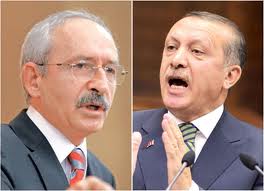
The new mantra of criticism is focused on the alleged authoritarian goals of the Prime Minister Recip Tayyip Erdogan. He is widely accused of seeking to shift the whole constitutional order of Turkey from a parliamentary to a presidential system, and coupled with a little disguised scheme to become Turkey’s first president under the new constitution, and then look forward to being reelected the leader of the country for a second five year term. Some of these anxieties have receded since the AKP did not win the needed 2/3s majority in the parliament that would have enabled a new constitution to be adopted without needing to gain the consent of the citizenry through a referendum. In his victory speech on the night of the elections Erdogan went out of his way to reassure Turkish society, including those who voted against the AKP, that he will heed the message of the voters by seeking the widest possible participation in the constitution-making process with the aim of producing a consensus document that will satisfy a wide spectrum of Turks. It might be expected that such a process would likely preclude any shift to a presidential system, and would certainly make politically impossible the adoption of the strong French version, which does give a president extraordinary powers.
From outside of Turkey the new line of criticism seems to reflect American and Israeli priorities and perspectives, and is not too closely related to Turkish realities. The tone and substance of this line was epitomized by a lead NY Times editorial published the day after the Turkish elections. After acknowledging some AKP achievements, including giving it credit for the flourishing Turkish economy and a successful reining in of the deep state, the editorial moved on to criticize “Mr. Edgogan’s increasingly confrontational foreign policies, which may play well at the polls, but they have proved costly for the country’s interests.” Such a comment by the supposedly authoritative and balanced NY Times is quite extraordinary for its display of ignorance and slyly disguised bias. After all, the hallmark of Turkish foreign policy during the Erdogan years, as developed under the inspired diplomatic leadership of the Foreign Minister, Ahmet Davutoglu, has been ‘zero problems with neighbors’ as manifest in a series of conflict-resolving and reconciling diplomatic initiatives, and a broad conception of neighbor to include the Balkans, Central Asia, and the Caucuses, as well as the entire Arab world. It is possible to argue that this direction of non-confrontational foreign policy went too far in some instances, most notably Syria, and possibly Libya, and as a result have generated some serious challenges for Turkey.
The only exception to this pattern of zero problems has been Israel, but here the NY Times once again displays an uniformed and opinionated outlook when it writes “Once-constructive relations with Israel have yielded to tit-for-tat provocations and, if they continue, could threaten Turkey’s substantial trade with Israel.” It would be hard to compose a more misleading description of the deterioration of Turkish/Israeli relations. It should be remembered that prior to the Israeli attack on Gaza at the end of 2008, Turkey was doing its best to promote peace between Israel and Syria by acting as an intermediary, a role at the time appreciated by both parties. It is also quite outrageous to speak of “tit-for-tat provocations” when it was Israeli commandos that boarded in international waters a Turkish ship, Mavi Marmara, carrying humanitarian goods for the long blockaded people of Gaza, and killed in cold blood nine Turkish citizens. Even here in responding to Israeli unlawfulness in this Flotilla Incident of May 31, 2010, Turkey has subsequently tried its best to calm the waters, asking Tel Aviv only for an apology and compensation paid to the families of the victims, as preconditions for the restoration of normal relations with Israel. It has been Israel that has up to now defiantly refused to make even these minimal gestures in the interest of reconciliation. And recently Davutoglu has gone further, perhaps too far, in his dedication to peaceful relations by openly discouraging Turkish participation in plans for a second Freedom Flotilla at the end of June, asking activists to wait to see if the blockade is broken due to changes in the Egyptian approach at the Rafah Crossing. The latest indications are that the Mavi Marmara will join the second freedom flotilla.
The NY Times goes even further in its Orientalist approach to Turkey, writing that “Ankara must discourage private Turkish groups from initiating a second blockade-running Gaza flotilla..” Why must it? Is it not the blockade, approaching its fourth anniversary, that is widely condemned as cruel and unlawful, a flagrant violation of the legal prohibition on collective punishment set forth in Article 33 of the Fourth Geneva Convention? Should not putting such a demand to Turkey at least be balanced by a call on Israel to end the blockade? Given the failure of the UN or neighboring governments to protect the people of Gaza, should not members of civil society feel a duty to do so, and in democratic societies should not be hampered by their governments?
The other foreign policy complaint in the Times’s editorial on Turkey deals with Iran. Here, of course echoing complaints from Washington as well as Tel Aviv, Turkey is blamed for playing “cozy games with Iran” that have “only encouraged Iran’s nuclear ambitions.” Perhaps wrongheaded, but hardly an example of Erdogan’s allegedly confrontational style! What NY Times obviously favors, not surprisingly, is confrontation, urging the Turkish government to “press Turkish companies and banks to enforce international sanctions against Iran.” What is at stake here is the foreign policy independence of Turkey. Its efforts to find a peaceful resolution of the dispute surrounding Iran’s nuclear program are clearly designed to lessen the tensions surrounding the present coercive diplomacy of the U.S. led coalition, and backed by the UN, that is based on sanctions and military threats. It is in Turkey’s clear national interest to avoid a military encounter that could eventuate in a damaging regional war that would be disastrous for Turkey, as well as dashing the hopes raised by the Arab Spring, while also using its diplomatic leverage to discourage Iran from developing nuclear weapons, thereby producing an exceedingly dangerous situation for itself and others.
Another Western criticism of the Erdogan’s approach is to blame Turkey for a diminishing prospect of accession to membership in the European Union. The Financial Times in their far more reasonable post-election editorial nevertheless appears to blame Turkey for “strained relations with the EU.” On what basis is not disclosed. What was not even discussed, but should be mentioned as the main explanation of the strained relations, is the rise of Islamophobia throughout Europe and reflected in public attitudes of governmental skepticism in Paris and Berlin, as well as elsewhere on the continent, about whether Turkey is a suitable candidate for membership, given its large Muslim population. It needs to be appreciated that Islamophobia in Europe while resurgent is not new. Recently, it had been associated with Turkophobia, in reaction to the Turkish guest workers that stayed on, and became a strong presence, often unwanted, in Germany. In the two earlier centuries prior to the 20th there existed European fear and loathing of an invading Ottoman Empire, and even earlier, of course, The Crusades with their marauding militarism.
What emerges overall is this American led reluctance to accept Turkey as an independent regional force in the Middle East that has achieved enormous influence in recent years by relying on its own brand of soft power diplomacy. A dramatic indicator of this influence is the great popularity of Erdogan throughout the region, including among the youth who brought about the uprisings against authoritarian rule throughout the Arab world. It is an encouraging sign of the times that these new Arab champions of democracy are coming to Ankara and Istanbul, not Washington, Tel Aviv, or Paris, for guidance and inspiration. Whether through the NATO intervention in Libya or the crude efforts to intimidate Iran, the West under faltering American leadership remains addicted to hard power statecraft, which no longer achieves its goals, although it continues to cause great suffering on the ground. It is time that the West stops lecturing Turkey, and starts to learn better what succeeds and what fails in 21st century foreign policy. A good place to start learning and listening might be Ankara!
Tags: Ahmet Davutoğlu, Gaza flotilla raid, Israel, Justice and Development Party, Politics of Turkey, Tel Aviv, Turkey, Turkish government