Archive by Author

Probing the Depths: Roots of Unspeakable Crimes in Gaza–Criminality and Complicity

10 Jan

[Prefatory Note: the following interview with an Iranian journalist was completed on 1/9/24, during the week when South Africa puts forth its legal argument before the International Court of Justice in The Hague, seeking ‘provisional measures’ designed to stop the Israeli genocide in Gaza. Even if Israel refuses to comply should the World Court respond favorably to this emergency request as I expect it will, the decision will have an historic importance: drawing the West into the orbit of legal accountability by indirectly implementing its complicity with the Israeli attack, by an almost certain escalating effect on pro-Palestinian solidarity initiatives around the world, and by conferring on Israel the labels of ‘rogue state’ or ‘pariah state.’]

  1. At first, there’s a need to contextualize for our readers Israel’s urge to silence pro-Palestinian voices and the voices of the critics of Israel, both in the US and globally. As someone who has experienced it firsthand, can you please explain that urge?

Israel is very sensitive to international criticism, especially by critics associated with its base of support in the colonial settler and European colonial states, which together comprise the White Global West. It is also sensitive to pro-Palestine lawfare associated with international institutions, especially the UN, International Court of Jusstice (ICJ), International Criminal Court, and the UN Human Rights Council (HRC) because its legitimacy as sovereign state partly rests partly claim to be the only democratic state in the Middle East, a (mis)perception reinforced by US at the highest levels of governments pointing to ‘shared values’ that were at the core of ‘the special reliationship,’ overlooking the crimes against the indigenous majority Arab population of Palestine involving massive expulsion in 1948 and exploitative dominance since at least 1967 over the Occupied Palestinian Territories of East Jerusalem, West Bank, and Gaza.

I was the target of Israeli smears and defamatory attacks during the period I served as Special Rapporteur on Israeli Violations of Human Rights in Occupied Pallestine in the period of 2008-2014. The attacks involved slanderous accusations of antisemitism on my part, and also sharp criticism of the UN as biased due to its disproportionate attention given to alleged Israeli wrongdoing. The UN responded defensively doing whatever it could to distance itself from me, especially during the time that Ban Ki Moon was Secretary General. He explained my remaining as Special Rapporteur by reminding Israel and the world that I, as an unpaid appointee of the Human Rights Council, was not part of the UN civil service and hence beyond his disciplinary reach. This was a virtuall admission that the Israel defamatory criticism were justified. Attacking its critics became a policy tool used by Israel and its Zionist support structure in Global West countries with increasing frequency for two reasons: the weakness of Israel’s substantive position creating an incentive to shift the conversation from a focus on its severe violations of law and morality to the credibility of the critics a process that I have called ‘the politics of deflection’ in which the attention of the media is diverted to the messenger rather than the substantive message about Israel’s violations, and the related intimidation directed at activists and others who dare promote nonviolent solidarity initiatives such as BDS (boycott, divestment, and sanctions). No comparable effort was made to stifle such criticism or activism of South Africa during the apartheid period even though the governments of the US and UK were strategically aligned with apartheid South Africa during the Cold War years. The presence of a pro-Israeli Zionist network that shields Israel from criticism by ‘weaponizing antisemitism’ in varying ways that cause imbalances in the media and infringements upon academic freedom within educational institutions of the West.

  • How can we explain Israel’s tight grip on public discourse on Israel-Palestine issue for so long? How could it accumulate so much power and influence within different states and international entities? If there is a financial aspect to it, how powerful is it?

This is a complex, fundamental question. Israel established its legitimacy as a new state shortly after World War II in the twilight of the European colonial order, imposing its sovereign claim on a resident majority Arab majority that identified as belonging to the nation of the Palestinian people. The Zionist project of establishing a Jewish state in Palestine was a dream of a small dedicated movement in late 19th century Europe that became a political project when the UK pledged its support in the Balfour Declaration (1917) for a Jewish Homeland in Palestine, a purely colonial interference with the self-determination rights of people. The statehood of Israel became an attainable goal during the British mandate period in which the UK administered Palestine as an International Mandate on behalf of the League of Nations, and encouraged Jewish immigration, a process accelerated in response to the rise of fascism in Europe, climaxism of lethal antisemitism in the Holocaust that put to death as many as six millions Jews in Europe, and caused a sense of guilt on the part of Western liberal democracies for their meager efforts to oppose such genocidal behavior.

The British ended their mandate, partly in reaction to Zionist anti-British terrorism dumping on the newly formed UN the daunting challenge of finding a solution to the surging internal conflict in Palestine between settler Jews and indigenous Arabs. The UN relied on British experience with its divide and rule style of colonialism. It established a commission that made recommendations centering on a proposed partition of Palestine into two states with Jerusalem as both their common capital and an international city. The Zionist Movement accepted partition, the representatives of the Palestinian people rejected it. Against this background Israel was established in the aftermath of a war internal to Palestine between Jewish militia forces and the armed forces of neighboring Arab countries, ending with an agreed ‘green line’ that was treated as a provisional internal boundary between the two peoples that enlarged Israel beyond the UN partition territorial allocations, giving the Jewish state 78% of Palestinian territory rather than the 45% contained in the UN plan, and dividing Jerusalem between the two peoples, leaving the control of Palestinian side of the green line to Jordan and Gaza to Egypt.

Even with its military victory and Western diplomatic and economic support, Israel was founded in a context that contained challenges to its legitimacy as a state from its region and indeed from most of the Global South. From the outset Israel realized that its security and status in international life would be greatly helped if it could control the public discourse that shaped international public opinion. Its fragile security was highlighted by the fact that in its early years it was surrounded by hostile larger states that perceived the establishment of Israel in their midst as a territorial, racial, and religious intrusion, a colonialist solution of a European problem at the expense of the Islamic, Arab bloc of countries.

Israel’s success in discourse control was greatly aided by the extent of Jewish influence in the large media platforms of the West, especially in the US and UK, as facilitated by the wealth of Diaspora Jews mobilized after Hitler to support the establishment and development of a Jewish state as a place of secure sanctuary in the event of future outbreaks of lethal antisemitism. This propaganda tool was used in sophisticated ways to create great admiration for Israel as liberal democracy in the Western mold and a modernizing success in contrast to the supposedly backward, stagnant, impoverished Palestinian society. In contrast, Israel was portrayed as socially progressive, economically successful, and even managed to make ‘the desert bloom.’ At first, there were tensions in the West between support for Israel and maintaining reliable access to the huge oil and gas reserves of the region. Israel was able to resolve these tensions with its victory over its Arab adversaries in the 1967 War, as well as occupying the territories allocated to the Palestinians in 1948. And most symbolically important it unilaterally incorporating Jerusalem as the eternal capital of Israel, an initiative that to this day is not accepted by many governments. After 1967 Israel shifted its relationship to the US from that of strategic burden to strategic partner, and became a militarily significant actor throughout the region. Israel was allowed to acquire nuclear weapons in defiance of the non-proliferation treaty arrangements. After the Iranian Revolution of 1978-79 Israel becaame even more valuable as the fall of the Shah meant the loss of the only other strategic ally of the West in a region strategically important for energy and control of major trade routes. 

At the same time as Israel’s apartheid regime engaged in dehumanizing modes of controlling Palestinian resistance and Israel became increasingly clear about its unwillingness to reach a political compromise achieved by bilateral negotiations, resulting in new assaults on its legitimacy became more widely questioned even in Western societies, but not by governments. This process was recently further intensified when the Netanyahu coalition government with Regligious Zionism party took over in January 2023, and immediately greenlighted settler violence on the West Bank, violated the sanctity of Muslim sacred sites (especially Al Aqsa Mosque), and displayed maps at the UN and elsewhere with only Israel present between ‘the river and the sea.’ Throughout this period Israel’s control of the discourse, reinforced by the Zionist well funded network in the Global West used its discourse dominance to demonize its critics. It was helped by the adoption of the IHRA (International Holocaust Remembrance Asssociation) definition of antisemitism, which treated any sharp criticism of Zionism or Israel, however justified by evidence and reasonable, as antisemitism. With possibly tragic irony such false branding seems to be producing real antisemitism in the world in its authentic form of hatred of Jews as an expression of hostility towards the behavior Zionism and Israel.

  • We hear or read a lot these days about the fact that Israel is an apartheid regime; what is apartheid, and how does Israel qualify as an apartheid state?

Most understandings of the nature of apartheid accept the definition set forth in Article II of the 1973 Convention on the Suppression and Punishment of the Crime of Apartheid, which reads as follows:

Article II

For the purpose of the present Convention, the term “the crime of apartheid”, which shall include similar policies and practices of racial segregation and discrimination as practised in southern Africa, shall apply to the following inhuman acts committed for the purpose of establishing and maintaining domination by one racial group of persons over any other racial group of persons and systematically oppressing them:

(a) Denial to a member or members of a racial group or groups of the right to life and liberty of person:

(i) By murder of members of a racial group or groups;

(ii) By the infliction upon the members of a racial group or groups of serious bodily or mental harm, by the infringement of their freedom or dignity, or by subjecting them to torture or to cruel, inhuman or degrading treatment or punishment;

(iii) By arbitrary arrest and illegal imprisonment of the members of a racial group or groups;

(b) Deliberate imposition on a racial group or groups of living conditions calculated to cause its or their physical destruction in whole or in part;

(c) Any legislative measures and other measures calculated to prevent a racial group or groups from participation in the political, social, economic and cultural life of the country and the deliberate creation of conditions preventing the full development of such a group or groups, in particular by denying to members of a racial group or groups basic human rights and freedoms, including the right to work, the right to form recognized trade unions, the right to education, the right to leave and to return to their country, the right to a nationality, the right to freedom of movement and residence, the right to freedom of opinion and expression, and the right to freedom of peaceful assembly and association;

d) Any measures including legislative measures, designed to divide the population along racial lines by the creation of separate reserves and ghettos for the members of a racial group or groups, the prohibition of mixed marriages among members of various racial groups, the expropriation of landed property belonging to a racial group or groups or to members thereof;

(e) Exploitation of the labour of the members of a racial group or groups, in particular by submitting them to forced labour;

(f) Persecution of organizations and persons, by depriving them of fundamental rights and freedoms, because they oppose apartheid.

It was made clear in the understanding of the crime that although South African racial system of exploitative subjugation of the African indigenous population was the model for declaring apartheid to be a Crime Against Humanity, it is applicable to any arrangement that satisfies the treaty definition. It is so regarded by the International Criminal Court, see Article VII(1)(j). In Article VII(2)(h)) the nature of the crime is clarified: (h)  “The crime of apartheid” means inhumane acts of a character similar to those referred to in paragraph 1, committed in the context of an institutionalized regime of systematic oppression and domination by one racial group over any other racial group or groups and committed with the intention of maintaining that regime”;

In the years since 2017 a series of reports sponsored by the UN and issued by widely respected human rights NGOs have confirmed the credibility of earlier allegations that the treatment of Palestinians qualifies in various ways as apartheid. (See detailed reports of UN ESCWA; Human Rights Watch; Amnesty International; B’Tselem). To some extent, the criminality of Israeli apartheid has been temporarily subordinated to allegations of genoicide following the Hamas attack of October 7, 2023. If Israel’s falls short of its current genocidal effort to coerce Palestinians to leave their homeland, then concerns about Israel’s policies and practices of apartheid would undoubtedly be renewed.

  • Given the recent momentum that the pro-Palestinian movement has gained, especially in the US, do you see any chance for a change in the essence or form of the US support for Israel in the short-term?

There has definitely been a shift in public opinion among the citizenry in Global West countries, but the governments, above all the US and UK continue their support of Israel despite spreading opposition to the devastation of the civilian population of Gaza, making the small crowded region totally unlivable without a massive reconstruction and relief effort.

The governments that continue to support Israel even after its recourse to genocide are influenced by a mixture of strategic interests and what might be called identity politics. The strategic and identity issues converge in relation to Israel as it combines strong military capabilities with a civilizational identity as a high-tech modern society with principal ties to the West, and having a series of hostile Islamic countries and non-governmental movements as its adversaries. If a wider war breaks out it will be viewed as ‘a clash of civilizations’ recalling Samuel Huntington’s 1993 prediction of the world after the end of the Cold War. Part of this overall picture of stability of Israel’s relationship with the liberal democracies of the West despite its unabashed endorsement of genocide in addressing the Palestinian people is best explained by the effectiveness of Zionist funding of political opponents of elected officials critical of Israel, and financing of Israel friendly politicians in these countries where donor leverage that remains strong at the national level. Also important, is the absence of organized Palestinian lobbying capabilities in the West that could somewhat diminish pro-Israeli foreign policy biases.

If Israel succeeds in implementing its population transfer scenario in Gaza, forcing surviving Palestinians to become refugees in the region, ethnic cleansing will be added to the criminality of genocide in the form of a Crime Against Humanity. This would almost surely lead to mobilization of anti-Western forces throught the Middle East, adding dangerous new stresses to the fraying bond tying the Global West to Israel. Also, uncertainties as to Israels reaction to being treated as ‘a pariah state’ subject to boycotts and even sanctions, and surging militancy among global solidarity groups dedicated to a humane future for the Palestinian people, including the 7+ million refugees and exiles living nearby and around the world.

  • As you’ve mentioned in your preface to the book, ‘We Will Not be Silenced’, in Israel’s war against Gaza, “’the people’ become the enemy,” and, therefore, to legitimize such a war, one has to dehumanize that people. How has Israel gone on about doing so from 1948 onwards?

As Edward Said pointed out in his book, Orientalism, the colonial intellectual portrayal of the Arab is a prelude to dehumanization and a sense of Western civilization superiority, especially as assessed through an optic of technocratic modernity. As earlier discussed, Israel was established as the European colonial order was collapsing and in the aftermath of a monstrous genocide that the liberal democratic countries in the West did little to stop until Germany and Japan committed aggression imperiling their overall global hegemony. The early Zionist anticipated the current attempts to erase the Palestinians from their homeland as expressed by the dehumanizing saying: “a land for a people without land for a land without people.”

What has complicated life for Israel is that the indigenous nationalism of the Global South as well as the defeat of European colonialism created a sense of the legitimacy of resistance, even armed resistance that has been incorporated to a controversial extent into contemporary international law. The recognition of the inalienable right of a people to national self-determination results in the settler colonial authority movements as being lawless undertakings, the overt enemy of indigenous populations as denigrated as backward or non-existent. If such tactics do not remove such obstacle, then the settler colonialist move by stages until reaching the genocidal conclusion that unless the indigenous population is utterly marginalized, exterminated, or expelled it will prevail over time. In this sense the settle colonial failed projects of South Africa and Algeria are instructive on the central point that superior military capabilities will not bring the settler regime reliable security, nor  will its cruelty and exploitative policies exhibited by its imposed dominance. Despite the darkness of the skies over Palestine at present, it has never been closer to an achieving some kind of victory and liberation that was unimaginable just a few months ago.

  • As my last question, I want to know, in your opinion, what hope is left for Palestinians? They are witnessing, on a daily basis, what seems to be a deadlock, created by the US’s unconditional support for Israel, and they have no recourse to the international law.

The best hope for Palestine at this time is the escalation of civil society activism to stop the genocide, as sought by South African application to International Court of Justice, and to isolate Israel in meaningful ways through cultural, sports, and all types of boycotts. Within the foreign policy of the Global West and in relation to Israel itself there is no basis for a just and sustainable peace being promoted diplomatically and strategically by leading governments or effectively by the UN. Geopolitical primacy in situations of strategic priority, as is the case for the US and Israel, overrides the guidance of international law and the morality of inter-governmental co-existence. This, short of geopolitical reassessment there is no realistic prospect for any sufficient change in the commitment of the West to Israel’s security as it seeks to pursue it.

As mentioned above, only civil society activism can change the calculus of strategic interests in the West and Israel in the short run of 5-10 years. As the transformation of South Africa made clear, the impacts of becoming a pariah state in a variety of international arenas made it willing to transform the state from an apartheid regime to a constitutional democracy that facilitated transition by outstanding African leadership, a sympathetic world public opinion, and a focus on racial issue and political rights, which respecting the economic rights and social status of the displaced white settler elite. While Israel for all sorts of reasons cannot be compared to South Africa, there exists a zone of uncertainty that may generate some comparable solution that is above all able to find a framework based on racial/religious equality and a coexistence based on respect for the rule of law and human rights for all.
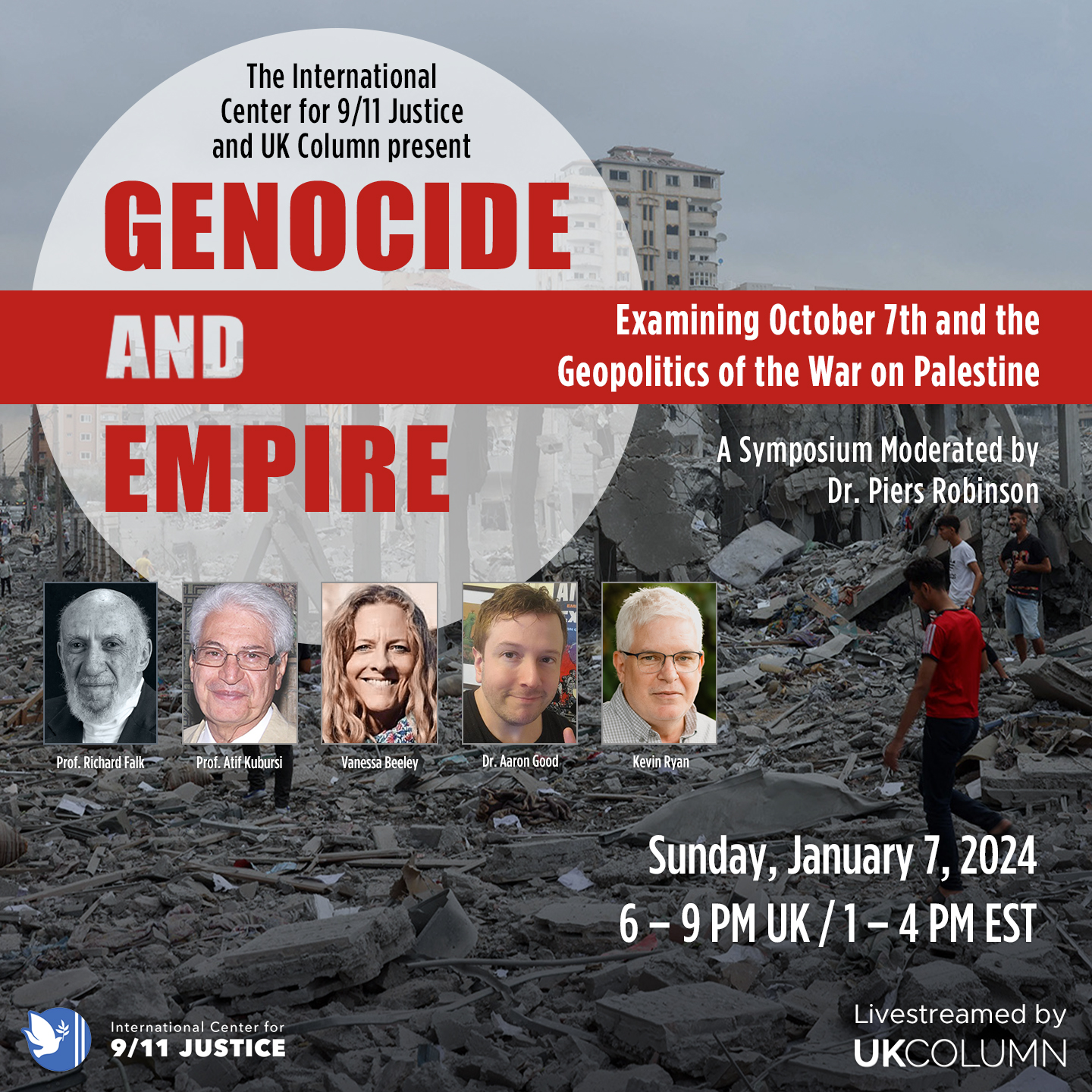
Gaza & Empire: Webinar

4 Jan

In this time of humanitarian emergency and criminality, the enraged voices of the people must be heard above the tsunami of state propaganda controlled by Israel and its geopolitical supporters in the Global West. It is no longer necessary or useful to debate whether this spectacle of horror satisfies the legal definition of ‘genocide.’ Lawyers and bureaucrats can indefinitiely prolong debate while children daily die and homes of previously abused persons continue to be destroyed. We are all responsible to act now to stem the high tide of Palestinian blood flowing across a still passive human terrain.

Gaza Webinar: Is Israel Cornered?

2 Jan

Israel despite a transparent genocidal onslaught in Gaza that has gone on for more than three months may find itself cornered: unable to prevail, unable to accept defeat. What then?

Wed., Jan. 10 at 7 PM EasternThe Gaza War, Short & Long-Term Diplomatic Imperatives, & Implications for the Middle East and Geopolitics, with panelists Richard Falk, Irene Gendzier, and Assaf Kfoury. Discussing: What must be done to end the war? To prevent escalation to a still more catastrophic regional war? To begin the difficult diplomacy to ensure the rights, dignity, and security of both the Palestinian and Israeli peoples? To create U.S. policies that defuse rather than exacerbate militarism, divisions, and tensions across the Middle East?

Sponsored by: Campaign for Peace, Disarmament, and Common Security

* Richard Falk is Albert G. Milbank Professor Emeritus of International Law at Princeton University

* Irene L. Gendzier isProfessor Emerita at Boston University, Dept. of History and Political Science

* Assaf Kfoury is a professor in the Computer Science Department at Boston University

>>> To register, click at https://us02web.zoom.us/webinar/register/WN_3bx1nQUoQrGAV__F9ZqEkw#/registration

Linking to the Declaration of Conscience of Global Intellectuals and Meeting the Challenges of 2024

24 Dec

Several blog readers have requested information about the link to the Declaration of Conscience and Concern of Global Intellectual to Stop Genocide in Gaza. Here is the link that can be used to endorse or by anyone in your network to endorse:

https://www.change.org/p/declaration-of-conscience-and-concern-of-global-intellectuals-on-gaza-genocide

Let me take the opportunity at this time of Christmas to wish all a better year in 2024 when glimpses of light penetrate the darks skies above many sites of suffering throughout the world. If ever the combined energies of ethical concern for human wellbeing joined with the ecological imperatives of an enhanced stewardship with the natural habitats of the human species needed the active engagement of persons and movements of good will and spiritual energy it is now. With prayer, witnessing, and sacrifice it remains possible to dream of a humane future, but only if enough of us are awakened from prolonged complacency.

We might start the awakening process by acting on the realization that we are united the world over as indigenous peoples of the earth, and what that means in how we feel, act, and hope.

David Krieger (1942-2023): A Life of Dedication to the Abolition of Nuclear Weapons

21 Dec

[Prefatory Note: My In Memorium essay honoring David Krieger’s notable life was published in the December 21 Santa Barbara weekly newapaper, The Independent. Although David devoted his professional life to anti-nuclear scholarship and activism, his underlying motivationa were guided by fervent hopes for a world anchored in dignity for all and respect for the authority of international law and a robust United Nations]

Remembering my long, close, cherished friendship reinforces my sense of loss resulting from the death of David Krieger.

Our primary interests were unusually congruent. We were devoted to a world in which nuclear weapons and the danger of a nuclear war had become an unpleasant recollection rather than an existential menace. We both found great satisfaction as well as a sense of personal liberation playing competitive tennis as often as our schedules would allow. And we both expressed our deepest feelings about the world through poetry, both reading and writing poems.

David excelled in each of these spheres while I struggled, but despite this hierarchy of relative achievements, we managed to find pleasure through sharing much that seemed happily uncorrupted by the pressures of normal professional life.

David was well-known in Santa Barbara. He was the founding president of the Nuclear Age Peace Foundation in 1982 until his reluctant retirement in 2020. He managed to sustain this nongovernmental organization (NGO) through the support from an array of donors, many drawn from local sources. He put together a Board of Directors and staff that shared his single-minded dedication to the abolition of nuclear weapons, which for him was the darkest cloud overhanging the future of humanity.

David firmly believed that reliable knowledge conveying the drastic havoc of a nuclear war would awaken both the citizenry and its governmental representatives to the menace that threatened the future, ever since the atomic bomb was dropped on Hiroshima in 1945. The spirit of the Nuclear Age Peace Foundation was well captured by its website adages: “For the human race, Not the arms race” and “Abolish nuclear weapons before they abolish us.”

David never lost his hope for such a peaceful future for the country and the world, despite his knowledge of how deeply embedded nuclearism was in the political and economic consciousness of the nation, through the arms industry, a subservient Congress and media, and militarist foreign policy.

In lectures of invited peace luminaries and awards for life achievements, the Nuclear Age Peace Foundation honored those who contributed to realizing its goals, including Daniel Ellsberg, Noam Chomsky, and Robert Jay Lifton, celebrated activists such as Nobel Laureate Mairead Maguire and Helen Caldicott, and notable personalities such as Queen Noor and Oliver Stone.

For such prolonged anti-nuclear efforts, it is hardly surprising that David and the Peace Foundation were nominated on several occasions for the Nobel Peace Prize. In the recent book, The Real Nobel Peace Prize: A Squandered Opportunity to Abolish War, the renowned Norwegian expert on this most coveted of peace prizes, Fredrik Heffermehl, writes convincingly that David deserved the prize more than many of its recipients because his life’s work and that of the foundation he created. Heffermehl believed that the foundation’s contributions were in keeping with what Alfred Nobel had in mind when he established the prize to realize a vision of a world without war. David’s focus on nuclear weaponry was the vital first step in achieving this goal.

If nuclearism was what David hated, what he loved, besides his family, was poetry. It was a great joy for me to exchange haiku with David on a regular basis. Here are two examples of his haiku that should be read in relation to the profound impact the Hiroshima experience had on David’s life:

There, in the dark sky
through the sycamore leaves
the full moon

A rare good fortune —
to awaken from dreaming
in the moonlight

Although disease made him unable to speak, David remained alert until the end of his life, undoubtedly mourning the terrible wars in Ukraine and Gaza, but I also imagine him glimpsing glimmers of light, none brighter than knowing that the foundation his life was built around would continue to thrive under the sway of its inspirational new president, Ivana Hughes. She shares David’s passion, exhibiting a nurturing energy far and wide that spreads the message of nuclear disarmament, effectively introducing the Nuclear Age Peace Foundation abolitionist perspective into the practical activities of the United Nations and many other global venues around the world.

A second glimmer of light is the entry into force of the Treaty for the Prohibition of Nuclear Weapons in 2021. Although the treaty is opposed by NATO countries, including of course the United States, as well as by the other eight nuclear states, it is supported by governments representing a majority of the world’s peoples. David never lost his faith in respect for international law as the pathway to a peaceful world. This new treaty gives peace activists a powerful instrument by which to work toward a denuclearizing world, but it will not happen without a robust worldwide movement of people. That alone, with the capacities to mobilize sufficient democratic pressures, will lead governments — above all, ours — to finally do the right thing.

Above all, David believed in the transforming potential of love and beauty. His life was memorable for more than being a warrior for nuclear abolition. He was blessed by the love and the extraordinary support of his life partner, Carolee; children who made him proud; and grandchildren who kept him young as he grew old. It was Carolee who was so steadfast in her loving vigil of recent years as to make David’s transition from life to death as bearable, even mostly joyful, as it appeared to be.

Declaration of Conscience and Concern of Global Intellectuals on Gaza Genocide

20 Dec

[Prefatory Note: What follows is a Declaration of Conscience of Global Intellectual on Gaza Genocide prepared by Ahmet Davutoglu and myself, with the assistance of Abudllah Ahsan and Hilal Elver. It sought to enlist an initial list of signatories from around the as representative as possbile, and gender balance. We invite others to join by sending their endorsement to <change.org> listed under the heading of Declaration of Conscience. I will post a link as it is available. We view the virtual annihilation of Gaza as a societal grouping and its people as an imminent possibility. As of 12/20.23 it is reported that 88% of the population has insufficient food, and potable water is 90% less that minimum needs for sustainable health.]

On November 30, the Government of Israel resumed the genocidal onslaught it inicted on Palestinians in Gaza after a much overdue but brief “humanitarian pause.” In doing so, Israel has ignored the worldwide protests of people as well as the fervent pleas of moral, religious, and political authority gures throughout the world to convert the hostage/prisoner exchange pause into a permanent ceasere. The overriding intention was to avert the worsening of the ordeal of the Gazan population. Israel was urged to choose the road to peace not only for humanitarian reasons but also for the sake of achieving real security and respect for both Palestinians and Israelis. Yet now the bodies are again piling up, the Gaza medical system can no longer offer treatment to most of those injured, and threats of widespread starvation and disease intensify daily.

Under these circumstances, this Declaration calls not only for the denunciation of Israel’s genocidal assault but also for taking effective action to permanently prevent its repetition. We come together due to the urgency of the moment, which obliges global intellectuals to stand against the ongoing horric ordeal of the Palestinian people and, most of all, to implore action by those who have the power, and hence the responsibility, to do so. Israel’s continuing rejection of a permanent ceasere intensies our concerns. Many weeks of cruel devastation caused by Israel’s grossly disproportionate response to the October 7 attack, continues to exhibit Israel’s vengeful fury. That fury can in no way be excused by the horrendous violence of Hamas against civilians in Israel or inapplicable claims of self-defense against an occupied population.

Indeed, even the combat pause seems to have been agreed upon by the Israeli government mainly to ease pressures from Israeli citizens demanding greater efforts to secure the release of the hostages. The United States government evidently reinforced this pressure as a belated, display to the world that it was not utterly insensitive to humanitarian concerns. Even this gesture was undercut before the pause started by the deant public insistence of Prime Minister Netanyahu to resume the war immediately after the pause. It is more appropriate to interpret these seven days without combat as a pause in Israel’s genocidal operations in Gaza rather than as a humanitarian pause. If truly humanitarian, it would not have crushed hopes of ending the genocide and conjointly resuming efforts to negotiate the conditions for an enduring and just peace between Israelis and Palestinians.

The revival of this military campaign waged by Israel against the civilian population of Gaza amounts to a repudiation of UN authority, of law and morality in general, and of simple human decency. The collaborative approval of Israel’s action by the leading liberal democracies in the Global

West, particularly the United States and the United Kingdom, accentuates our anguish and disgust. These governments pride themselves on adherence to the rule of law and yet have so far limited their peacemaking role to PR pressures on Israel to conduct its exorbitant actions in a more discreet manner. Such moves do little more than soften the sharpest edges of Israel’s genocidal behavior in Gaza. At the same time continuing to endorse Israel’s false rationale of self-defense, which is inapplicable in a Belligerent Occupation framework established by the UN in the aftermath of the 1967 War, shielded this brazenly criminal conduct from legal condemnation and political censure at the UN and elsewhere.

We deplore the reality that these governments continue to lend overall support to Israel’s announced intention to pursue its combat goals, which entail the commission of severe war crimes that Tel Aviv does not even bother to deny. These crimes include the resumption of intensive bombing and shelling of civilian targets, as well as reliance on the cruel tactics of forced evacuation, the destruction of hospitals, bombings of refugee camps and UN buildings that are sheltering many thousands of civilians and the destruction of entire residential neighborhoods. In addition, Israel has been greenlighting settler-led violence and escalating ethnic cleansing efforts in the West Bank. Given these developments we urge national governments to embargo and halt all shipments of weapons to Israel, especially the United States and the United Kingdom, which should also withdraw their provocative naval presences from the Eastern Mediterranean; we urge the UN Security Council and General Assembly to so decree without delay.

We also support the Palestinian unconditional right as the indigenous people of the land to give or withhold approval to any proposed solution bearing upon their underlying liberation struggle.

The deteriorating situation poses an extreme humanitarian emergency challenging the UN system to respond with unprecedented urgency. We commend UNICEF for extending desperately needed help to wounded children as well as to children whose parents were killed or seriously injured every continuing effort. We also commend WHO for doing all in its power to help injured Palestinians, especially pregnant women and children, and to insist as effectively as possible on the immediate reconstruction and reopening of hospitals destroyed and damaged by Israeli attacks. We especially commend UNRWA for continuing the sheltering of many thousands of Palestinians in Gaza displaced by the war and for providing other relief in the face of heavy staff casualties from Israeli repeated bombardment of UN buildings. Beyond this, UNESCO should be implored to recognize threats to religious and cultural sites and give its highest priority to their protection against all manner of violation, especially the Masjid al-Aqsa; the Israeli government should be warned about its unconditional legal accountability for protecting these sites.

We also propose that the UN Human Rights Council should act now to establish a high-profile expert commission of inquiry mandated to ascertain the facts and law arising from the Hamas attack and Israel’s military operations in Gaza since October 7, 2023. The commission should offer recommendations in its report pertaining to the responsibility and accountability of principal perpetrators for violations of human rights and humanitarian norms that constitute war crimes and genocide.

We also view the desperation of the situation to engage the responsibility of governments, international institutions, and civil society to act as well as to speak, and use their diplomatic and economic capabilities to the utmost with the objective of bringing the violence in Gaza to an end now!

As signatories of this Declaration, we unequivocally call for an immediate ceasefire and the initiation of diplomatic negotiations under respected and impartial auspices, aimed at terminating Israel’s long and criminally abusive occupation of Gaza, the West Bank, and East Jerusalem. This process must be fully respectful of the inalienable right to self-determination of the Palestinian people and take proper account of relevant UN resolutions.

SIGN THE PETITION

Declaration of Conscience and Concern of Global Intellectuals on Gaza Genocide

Signatories

  1. Ahmet Davutoğlu, Former Foreign Minister and Prime Minister, Türkiye;
  2. Richard Falk, UN Special Rapporteur on the Situation of Human Rights in the Palestinian Territories Occupied since 1967 (2008-2014), Professor of International Law Emeritus, Princeton University;
  3. Dr. Moncef Marzouki, Former President of Tunisia;
  4. Mahathir Mohamed, Former Prime Minister of Malaysia;
  5. Georges Abi-Saab, Professor Emeritus, Graduate Institute Geneva and Cairo University, Former UN Advisor to the Secretary Generals of the UN; Former Judge of the International Court of Justice, Egypt;
  6. Mairead Maguire, Nobel Peace Laureate (1976), Member of Russell Tribunal, Northern Ireland;
  7. Amr Moussa, Former Secretary General of the Arab Leauge, Former Foreign Minister, Member of the UN’s High Level Panel on Threats, Challenges and Change for International Peace and Security, Egypt;
  8. M. Javad Zarif, Professor, University of Tehran, Former Foreign Minister, Iran;
  9. Hamid Albar, Former Foreign Minister, First Chancellor of the Asia e University, Malaysia;
  10. Brigette Mabandla, Former Minister of Justice and anti-Apartheid Activist, South Africa;
  11. Judith Butler, Professor, University of California at Berkeley; Feminist Studies, USA;
  12. KamalHossein,FormerForeignMinister,Bangladesh;
  13. PauloSergia,ProfessorofPoliticalScience(USP)andFormerMinisterofHuman Rights, Brazil;
  14. ChrisHedges,Pulitzer-prizeWinningReporterandFormerMiddleEastBureau Chief for The New York Times, USA;
  15. TuWeiming,MemberofUNGroupofEminentPersonsfortheDialogueAmong Civilizations, Professor Emeritus, Harvard University, USA; Founding Director of the Institute for Advanced Humanistic Studies, Peking University, China;
  1. JohnEsposito,ProfessorofInternationalRelationsandtheFoundingDirectorofthe Center for Muslim-Christian Understanding, Georgetown University; Member of High Level Group of the UN Alliance of Civilizations, USA;
  2. Arundhati Roy, Author of God of Small Things, Human Rights Activist, India;
  3. SusanAbulhawa,PalestinianNovelist,AuthorofMorningsinJenin,USA;
  4. HansvonSponeck,FormerUNAssistantSecretary-General,FacultyMemberat Conict Research Center, University of Marburg, Germany;
  5. Angela Davis, Berkeley, USA;
  6. HilalElver,ProfessorofInternationalLaw,UNSpecialRapporteuronRighttoFood (2014-2020), Türkiye;
  7. Abdullah Ahsan, Professor of History International Islamic University Malaysia and Istanbul Şehir University, USA;
  8. Phyllis Bennis, Journalist, Author and Social Activist, Institute of Policy Studies, USA;
  9. Noura Erakat, Activist and Professor, Rutgers University, New Brunswick, Co-founder of Jadalliyah, USA;
  10. Jomo Kwame Sundaram, Former UN Assistant Secretary-General for Economic Development; Deputy Director UN FAO, Malaysia;
  11. Victoria Brittain, Former Foreign Editor of the Guardian, worked closely with anti-Apartheid Movement, Founder of the annual Palestine Festival of Literature, UK;
  12. Gayatri Chakravorty Spivak FBA, Professor, Columbia University, received Kyoto Prize in Arts and Philosophy 2012, India;
  13. Ali Bardakoğlu, Professor of Theology, Former President of Directorate of Religious Affairs, Türkiye;
  14. Mustafa Ceric, Grand Mufti Emeritus of Bosnia, President of the World Bosniak Congress, co-recipient UNESCO Felix Houphouet-Bougny Peace Prize, Bosnia and Herzegovina;
  15. Maung Zarni, Human Rights Activist, Member of the Board of Advisors of Genocide Watch, Co-founder of Free Burma Coalition, Free Rohingya Coalition and Forces of Renewal Southeast Asia, Myanmar;
  16. JosephCamilleri,EmeritusProfessor,LaTrobeUniversity,Co-ConvenerofSHAPE Melbourne, Australia;
  17. Mahmood Mamdani, Herbert Lehman Professor of Government Columbia University, Chancellor of Kampala University, Uganda;
  18. Dayan Jayatilleka, Former Ambassador to UN (Geneva), France; Journalist, Sri Lanka;
  1. Elisabeth Weber, Professor of German Literature and Philosopy, University of Califor-nia at Santa Barbara, Germany/USA;
  2. Marjorie Cohn, Dean of the Peoples Academy of International Law, Professor Emerita, Thomas Jefferson School of Law, USA;
  3. Jan Oberg, Chairman of the Transnational Foundation for Peace and Future Research, Sweden;
  4. Ramzy Baroud, Author, Academic, Editor of The Palestine Chronicle, Palestine/ USA;

33. Saree Makdisi, Professor of Comparative Literature at the University of California, Author of Palestine Inside Out: An Everyday Occupation, USA;

  1. Roger Leger, Retired Professor of Philosophy at the Military College of Saint-Jean, Québec, Canada;
  2. Usman Bugaje, Professor, Former Adviser to the Vice President of Nigeria, Nigeria;
  3. ChandraMuzaffar,President,InternationalMovementforaJustWorld(JUST), Malaysia;
  4. Avery F. Gordon, Professor Emerita University of California Santa Barbara, USA;
  5. Arlene Elizabeth Clemesha, Professor of Contemporary Arab History at the University of São Paulo (USP), Brazil;
  6. Ömer Dinçer, Professor, Former Minister of Education, Former President of Şehir University, Türkiye;
  7. Fethi Jarray, Former Education Minister, current Chairperson of the National Mechanism on Torture Prevention, Tunisia;
  8. Alfred de Zayas, Former UN Independent Expert on the Promotion of a Democratic and Equitable International Order, USA;
  9. Walid Joumblatt, Member of Lebanese Parliament, Leader of the Progressive Socialist Party, Lebanon;
  10. Elmira Akhmetova, Professor at the Institute of Knowledge Integration in Georgia, Russia;
  11. Sami Al-Arian, Professor, Director of Center for Islam and Global Affairs (CIGA) at Istanbul Zaim University, Türkiye;
  12. George Sabra, Signatory of the Damascus Declaration (2005), Former President of the Syrian National Council, Syria;
  13. RayMcGovern,Activist,VeteransforPeace,Supporteroftheanti-wargroupNotin Our Name, USA;
  14. Juan Cole, Professor of History, The University of Michigan, Former Editor of The Internatioanl Journal of Middle East Studies, USA;
  1. Penny Green, Professor of Law and Globalization, Director, International State Crime Initiative Queen Mary University of London, UK;
  2. Bishnupriya Ghosh, Professor of English and Global Studies, UC Santa Barbara, USA/India;
  3. Nader Hashemi, Professor, Director of the Alwaleed Center for Muslim-Christian Understanding, Georgetown University, USA;
  4. Ahmed Abbes, Mathematician, Director of Research at the Institut des Hautes Etudes Scientiques Paris, France, Tunisia;
  5. Bhaskar Sarkar, Professor of Film and Media, UC Santa Barbara, USA/India;
  6. AkeelBilgrami,ProfessorofPhilosophyatColumbiaUniversity,USA,India;
  7. Assaf Kfoury, Mathematician and Professor of Theoretical Computer Science, Boston University, USA;
  8. Helena Cobban, Journalist, Author, President of Just World Educational, USA;
  9. BilijanaVankovska,ProfessorandHeadoftheGlobalChnagesCenter,Cyriland Mehtodius University, Skopje, Macedonia;
  10. David Swanson, Author, Executive Director of World BEYOND War, USA;
  11. Radmila Nakarada, Professor, Faculty of Political Science, University of Belgrade; Spokesperson of the Yugoslav Truth and Reconciliation Committee, Serbia;
  12. Fredrick S. Heffermehl, Lawyer and Author, Norway;
  13. Anis Ahmad, Emeritus Professor and President Riphah International University Islamabad, Pakistan;
  14. Lisa Hajjar, Professor, University of California, Santa Barbara, USA;
  15. Dr. Sayyid M. Syeed, President Emeritus , Islamic Society of North America, USA;
  16. Muhammed al-Ghazzali, Professor, Judge Supreme Court of Pakistan, Pakistan;
  17. Syed Azman Syed Ahmad, Former Member of Malaysia Parliament, Chairman of Asia Forum for Peace and Development (AFPAD), Malaysia;
  18. Osman Bakar, Al-Ghazali Chair of Epistemology and Civilisational Renewal, International Institute of Islamic Thought and Civilization, Malaysia;
  19. IbrahimMZein,ProfessorofIslamicStudies,QatarFoundation,Qatar;
  20. Engin Deniz Akarlı, Professor of History Emeritus, Brown University, Türkiye;
  21. Francesco Della Puppa, Ca’ Foscari University of Venice; Italy;
  22. Julio da Silveira Moreira, Professor, Federal University of Latin-American Integration, Brazil;
  1. Nabeel Rajab, Founder and former president of the Gulf Center for Human Rights; Former Deputy Secretary-General of the International Federation for Human Rights, Recipient of the Ion Ratiu Award for Democracy and Human Rights, Bahrain;
  2. Feroz Ahmad, Emeritus Professor of History and Internatiıonal Relations, Harvard University, USA, India;
  3. Serap Yazıcı, Professor of Constitutional Law, MP, Turkish Parliament, Türkiye;
  4. Natalie Brinham, Genocide and Statelessness Scholar, UK;
  5. Ayçin Kantoğlu, Author, Türkiye;
  6. Dania Koleilat Khatib, ME Scholar and President of RCCP TrackII Organisation, UAE;
  7. Imtiyaz Yusuf, Assoc. Prof. Dr., Non-Resident Research Fellow Center for Contemporary Islamic World (CICW), Shenandoah University, USA/Vietnam;
  8. Kamar Oniah Kamuruzaman, Former Professor of Comparative Religion, International Islamic University, Malaysia;
  9. Ümit Yardım, Former Ambassador of Türkiye to Tehran, Moscow and Vienna, Türkiye;
  10. Ahmet Ali Basic, Professor, University of Sarajevo, Bosnia and Herzegovina;
  11. Kani Torun, Former Ambassador of Türkiye to Somalia, Former Head of Doctors Worlwide, Member of Parlament, Türkiye;
  12. Ermin Sinanovic, Center for Islam in the Contemporary World at Shenandoah University, USA/ Bosnia and Herzegovina;
  13. Nihal Bengisu Karaca, Journalist, Türkiye
  14. Alkasum Abba, Emeritus Professor of History, Abuja, Nigeria;
  15. Hassan Ahmed Ibrahim, Professor of History and Civilization, Former Dean, Faculty of Arts, University of Khartoum, Sudan;
  16. Anwar Alrasheed, Khiam Rehabilitation Center, The victims of Torture (KRC), Representative of the International Council for Fair Trials and Human Rights in the State of Kuwait and the Gulf Cooperation Council Countries, Kuwait;
  17. MohdHishamMohdKamal,Assoc.Prof.Dr.,AhmadIbrahimKulliyyahofLaws, Malaysia/ Indonesia;
  18. Syed Arabi Bin Syed Abdullah, Former Rector, International Islamic University, Malaysia;
  19. Yusuf Ziya Özcan, Former President of Council of Higher Education, Türkiye;
  20. Mohamed Jawhar Hassan, Former Chairman and Chief Executive, Institute of Strategic and International Studies (ISIS) Malaysia;

95. Shad Faruqi, Professor of Law, University of Malaya, Malaysia;

  1. Mohammad Ahmadullah Siddiqi, Professor Emeritus of Journalism and Public Relations, Western Illinois University, Macomb IL USA/India;
  2. Mohamed Tarawna, Judge at the Cassation Tribunal, Jordan;
  3. Etyen Mahcupyan, Author, Former Chief Advisor to Prime Minister of Türkiye;
  4. Khawla Mattar, the Director of the United Nations Information center in Cairo, Former UN Deputy Special Envoy for Syria, Bahrain;
  5. Aslam Abdullah, Senior Journalist, USA/India;
  6. Stuart Rees, Professor Emeritus, University of Sydney, Australia;
  7. Hatem Ete, Academic, Ankara Yıldırım Beyazıt University, Department of Sociology, Türkiye;
  8. Karim Makdisi, Professor of Political Science, American University of Beirut, Lebanon;
  9. Camilo Pérez-Bustillo, National Taiwan University, Taiwan;
  10. Bridget Anderson, Professor of Migration, Mobilities and Citizenship, University of Bristol, UK;
  11. William Spence, Professor of Theoretical Physics, Queen Mary University of London, UK;
  12. Mohammad Hashim Kamali, Professor of Law, Founding CEO of the International Institute of Advanced Islamic Studies, Malaysia/Afghanistan;
  13. Ferid Muhic, Prof of Philosophy, Krill Metodius University, Macedonia;
  14. Frej Fenniche, Former Senior Human Rights Ofcer/UN, OHCHR, Switzerland;
  15. Sevinç Alkan Özcan, Associate Professor, International Relations Department, Ankara Yıldırım Beyazıt University;
  16. Sigit Riyanto, Professor, Faculty of Law Universitas, Indonesia;
  17. Khaled Khoja, Former President of Syrian National Coalition;
  18. Tarık Çelenk, Former Chairman of Ekopolitik, Türkiye;
  19. M. Bassam Aisha, Human Rights Expert, Libya;
  20. Naceur El-Ke, Academician and Human Rights Activist, Tunisia;
  21. Jean-Daniel Biéler, Former Ambassador, Special Advisor, Human Security Division, Federal Department of Foreign Affairs, Switzerland;

117. Fajri Matahati Muhammadin, Faculty of Law, Universitas Gadjah Mada, Indonesia;

  1. Ahmet Okumuş, Chairman of The Foundation for Sciences and Arts (BİSAV), Türkiye;
  2. Khan Yasir, Dr., Director In-Charge, Indian Institute of Islamic Studies and Research, India;
  3. Mahmudul Hasan, Md., Professor, International Islamic University Malaysia/ Bangladesh;
  4. Tara Reynor O’Grady, General Secretary for Human Rights Sentinel, USA;
  5. NurullahArdıç,ProfessorofSociology,IstanbulTechnicalUniversity,Türkiye;
  6. PharKimBeng,FounderandCEOofStrategicPan-PacicArena,Malaysia;
  7. Dinar Dewi Kania, M.M, .M.Sos, Trisakti Institute of Transportation and Logistics. Jakarta, Indonesia
  8. MulyadhiKartanegara,ProfessorofIslamicphilosophyat,UniversitasIslamNegeri Syarif Hidayatullah Jakarta, Indonesia;
  9. Habib Chirzin, Academic and Human Rights activist, IIIT, Indonesia
30 Nov
a Call by Palestinian Universities on Gaza and the future that is calm, clear, strong, persuasive, and sensible, but will not be heeded in Tel Aviv or Washington without an unrising by people representing civil society/

https://www.birzeit.edu/en/news/unified-call-justice-and-freedom-palestine

Gaza: After Genocide What Future?

29 Nov

[Prefatory Note: Responses to questions posed by ODVV (Organization for Defending Victims of Violence). The ODVV website is www.odvv.org. At the moment many prayers call fervently for a permanent ceasefire, but the future is suspended in doubt, and the pre-pause Israeli genocidal onslaught casts a dark shadow over all of humanity. Many innocent lives in Gaza stilll remain in jeopardy if the pause or truce is not converted into a ceasefire and emergency relief on a large scale. My responses waver between fears of a resumed Israeli military operation and hopes of confronting day after issues of post-genocidal economic reconstruction and scenarios of political transformation.]

1.Horrible media outlets focus on the access to food and other essential items for the Gaza civilians. What do you think of the starvation of civilians and children as a tool for war?

Policies of war combatants that deliberately focus on starvation or denial of access to food as a tactic or tool of war are guilty of war crimes. It is usual for such tactics to be disavowed by their perpetrators as collateral damage with no intention to target civilians of any category. If the targeting appears deliberate, continues in similar patterns disregarding predominant civilian targeting, and inflicts heavy civilian casualties, as has been the case with respect to the Israeli attacks in Gaza since the October 7 Hamas attack, it is viewed as criminal activity. The fact that the October 7 itself included severe war crimes does not in any way justify Israeli conduct in a retaliatory mode that is disproportional or criminal. Starvation intentionally directed at civilians is unconditionally prohibited by the Geneva Conventions and an inherent war crime, which if repeated or continuous can be prosecuted as a Crime against Humanity or even Genocide if the instrument of starvation seems to be used for the purpose of destroying a racial, ethnic, or religious group in whole or in part.

2.How do you see the limitation of access to electricity, water, medicine, and hygiene items to be affecting people’s and children’s lives?

In the context of Israel’s ‘war’ on Gaza such restrictions, applied to an impoverished population without qualification, are genocidal examples of aggravated war crimes explicitly prohibited by provisions of the 4th Geneva Convention on Belligerent Occupation. Israel as the Occupying Power does not right enjoy any right of self-defense against an Occupied People, and is under a pervasive duty to protect the civilian population under all circumstances. Israel’s implementation of its government order totally cutting off Gaza’s access to food, fuel and electricity has contributed to the destruction of medical system, imperiling the entire population of Gaza, killing many children and women, as well as men, and the cause of widespread suffering of all Gazans, including children at women. 

Specific provisions are found in the Geneva Convention that confirm this assessment. Article 6 indicates the full reach of the protective legal duties of the Occupying Power to the civilian population under their control. The text of this provision underlies the commitment of International Humanitarian Law to the protection of civilians:

ART. 6. — “The present Convention shall apply from the outset of any conflict or occupation mentioned in Article 2.

In the territory of Parties to the conflict, the application of the present Convention shall cease on the general close of military operations.

In the case of occupied territory, the application of the present Convention shall cease one year after the general close of military operations; however, the Occupying Power shall be bound, for the duration of the occupation, to the extent that such Power exercises the functions of government in such territory, by the provisions of the following Articles of the present Convention: 1 to 12, 27, 29 to 34, 47, 49, 51, 52, 53, 59, 61 to 77, 143.”

Protected persons whose release, repatriation or re- establishment may take place after such dates shall meanwhile continue to benefit by the present Convention.”

In addition, because so responsive to inquiry as to the status of starvation under international humanitarian law, the partial texts of Article 55 & 56 is reproduced below:

ART. 55. — “To the fullest extent of the means available to it, the Occupying Power has the duty of ensuring the food and medical supplies of the population; it should, in particular, bring in the necessary foodstuffs, medical stores and other articles if the resources of the occupied territory are inadequate.”

ART. 56. — “To the fullest extent of the means available to it, the Occupying Power has the duty of ensuring and maintaining, with the co-operation of national and local authorities, the medical and hospital establishments and services, public health and hygiene in the occupied territory, with particular reference to the adoption and application of the prophylactic and preventive measures necessary to combat the spread of contagious diseases and epidemics. Medical personnel of all categories shall be allowed to carry out their duties.“3.Over the decades, the world has witnessed a multitude of various rounds of attacks on Gaza, with no achievements, in your opinion, what is the reason for the inability of the international community to address the gross violations of human rights by Israel?

3.We have witnessed the dreadful attack on Gaza Hospital, what do you think of the air raids that seem to be indiscriminately targeting the places that are supposed to serve as civilians’ sanctuary in wartime?

The wording of the question suggests the confusion surrounding this important dimension of the most serious allegations of ‘indiscriminate targeting’ when contrary to the literalness of the alllegations, the targets are obviously being selected and targeted by Israel’s precision weaponry against just such legally protected sites and civilians, including hospitals, refugee camps, sick and wounded patients, forced civilian evacuees compelled by Israel mandatory order to leave their homes in the north of Gaza for the southern portion of the strip. The entire military operation against Gaza is seemingly intended to create an ethnic cleansing phenomenon comparable to the forced dispossession of more than 700,000 Palestinians. This happened in the final phases of the 1948 War known to Palestinians as the Nakba (or catastrophe)

4.The message that the Palestinians were receiving from pressure against them by Israel including building settlements and killing civilians in Gaza is that Israel is against the two-state solution question. So, it’s a big question mark on the two-state solution. Do you think that a two-state solution is still a valid solution and can be a way to get out of this deadlock and war? or do you believe that these current incident events have also brought this solution to a dead end?

This is a puzzling time for those thinking about a benevolent future for both Palestinians and Israelis. At the moment external voices that are seeking a permanent ceasefire, including the UN Secretary-General, as well as many longtime Jewish supporters of Israel, continue to act as if a two-state is the best and only feasible solution despite seemingly formidable obstacles that are being overlooked. The first set of obstacles is the extensive and militant settler phenomenon, which has been consistently viewed at the UN and most international venues as being in direct violation of Article 49(6) of Geneva IV. There are currently about 250 settlements spread around the West Bank and as many as 500,000 settlers who would resist by force any arrangement calling for their relocation in pre-1967 Israel (as did the 2005 ‘Disengagement’ from Gaza). The second obstacle is the known opposition of Likud leadership, including Netanyahu, to meaningful forms of Palestinian statehood, most dogmatically and openly by Netanyahu’s coalition partner, the Religious Right Party, as most prominently represented in the current so-called ‘uniity government’ by Ben Gvir and Smotrich. A possible third obstacle relates to the likelihood of a Palestinian refusal to accept an inferior form of statehood involving permanent demilitarization, Israel’s retention of West Bank settler enclaves, and some West Bank land transfers to Israel.

A sustainable peace depends on political arrangements based on equality between the two peoples as well as upholding the dignity of other minorities (Druze, Bedoin). If this skepticism about a two-state solution seems to imply a single state it would highlight the principal obstacle that would doubtless come from Zionists who remain deeply committed to a Jewish supremist state and to a lesser extent from Palestinians demanding the full right of return of the five million or more Palestinian refugees and involuntary exiles living in camps or spread around the world. Given the depth of resentment that is associated with events since October 7 even a confederal union of the two peoples is hardlly even thinkable under present conditions. At the same time, to restore the former status quo seems impossible given the devastation of Gaza, underscored by the lingering prospect of mass homelessness affecting the entire populaton of northern Gaza. Innovative solutions involving federation or confederation with either Lebanon or Egypt seems also non-viable at this point, although given the absence of a feasible peace arrangement are making the advocacy of innovative solutions the least bad of plausible day after options.

5.Considering the scope and intensity of the destruction of the civilian infrastructure and the blockade which is imposed on Gaza, in your opinion, what strategy should be implemented to firstly end the siege of Gaza (permanently and not return to the pre-conflict situation that practically turned Gaza a prison) and secondly, what should be done to heal this 75-year-old wound which was created since the establishment of Israel?

These are difficult questions for which there may no satisfactory answers to long as Israel is governed by such an extreme government and continues to enjoy the support of the US and strongest members of the EU. I think that even these governments supporting Israel throughout the horrifying genocidal spectacle feel increasing pressure from their own citizenry to find a more humane future for the people of Gaza and all of occupied Palestine, and in this sense, that the devastation wrought by Israel has backfired as a strategy that coupled security concerns with expansionist ambitions, although it is too soon to be confident of such an assessment.

I think the first priority after a permanent ceasefire is established would be to secure the withdrawal of Israel armed forces from Gaza, followed by an emergency international relief effort that gave priority to rebuilding destroyed residential neighborhoods and family residences, as well as the despatch of some form of international peacekeeping force, whether under UN auspices or otherwise. The forced evacuations together with intensity of bombardment has destroyed over 76% of the residences in northern Gaza. Of course, the rebuilding of hospitals and the repair of damage to UN structures, mosques and churches, and refugee facilities should also be included by international donors in their effort to meet this gigantic challenge of devastation at a time of cold weather and overcrowding.

More difficult by far is to end the iron grip on Gaza that has been maintained in different cruel forms ever since 1967. A first step would be a demand by the UNSC, and possibly such other intergovernmental groupings as the BRICs, to lift the blockade imposed in 2007 and agree with a Palestinian unity governance council on mutually administered border controls and an international protection force to monitor arms inputs ideally to both Gaza and Israel. It is virtually certain that these steps could not be taken until the certain political preconditions were met. Of vital political, perhaps indispensable, importance in day after contexts would be the replacement of the Netanyahu government by a new coalition with a commitment to a sustainable peace.. Hopefully a new Israeli leadership committed to finding a neutral framework for negotiating a genuine political compromise that must finally give recognition to the basic rights of the Palestinian people.

These ideas may seem utopian at present, but they represent the only practical alternative to the sort of exterminist politics that Israel has so far relied upon in responding to the October 7 attack, which were immediately seized upon as an opportunity by the Israeli government to carry out the expansionist final phases of the Zionist Project, which included sovereign control and Palestinian dispossession in the West Bank and overall international erasure of the Palestinian people and extinguishing any remaining statehood expectations. Destroying Hamas was never the entire, and perhaps not the main, rationale for the disproportionate Israeli response, and may have also been motivated by the perceived need of the Tel Aviv leaders to divert attention of Israelis and the world from the inexcusable security failures of the Israeli government that allowed Hamas to plan and carry out its October 7 attack. For Israel to achieve the political space required to fulfill the maximalist Zionist vision required several development: the demonization of Hamas, the exaggeration of future security threats facing Israel, and the genocidal onslaught that inflicted undeserved and horrifying punishment upon 99% innocent and previously victimized Gaza civilians while distracting attention of the world to the wider policy agenda of the Tel Aviv leadership. In thinking about the future it is helpful to separate the humanitarian urgency of funding livable conditions for the people of Gaza from a politics that aimed at the transformation of the underlying conflict. Yet to leave the political track to the parties would invite future tragedies arising from the contradictory goals inherent in settler colonialism and those of a national movement of resistance in a post-colonial setting.

You Tube: 2023 AUC Lecture on Gaza/Edward Said

26 Nov

In response to inquiries I am providing the link to my lecture honoring the legacy of Edward Said on Nov. 4, a time of genocide in Gaza.

Interrupting Genocide: Humanity Challenged as Never Before

25 Nov

[Prefatory Note: The post below is a modified version of an opinion piece published in CounterPunch on November 24, 2023. The ‘pause’ or ‘truce’ as it frequently called, in Western media is detached from the genocide that preceded and closely linked to the Hamas Attack of October 7th, which is characterized as ‘terrorism’ whereas Israeli genocidal violence is treated as Israel defending itself or less approvingly as an excessive and disproportionate recourse to violence that seemed to focus its fury on target inflicting massive casualties on Palestinian civilians. Sustained warfare almost inevitably produces suffering for the innocent, often minimized as ‘collateral damage,’ but the Israeli campaign has seemed to aim at maximize acute suffering of the whole of civilian Gaza. If this is not ‘terrorism,’ public language serves as a tool to validate the priorities of the powerful while casting the actions of its adversary as pure evil, distorting expectations about a reasonable outcome.]  

The ‘humanitarian pause’ started on November 24 after elaborate negotiations between adversaries who must interact despite an atmosphere of intense hostility and bitter resentment. The pause now often referred to as a ‘truce’ is supposed to last for four days, but is thought likely to be extended if Hamas can be induced to release additional hostages. Israel’s Prime Minister, Netanyahu, and leaders of Israel’s unity government repeatedly pledge to renew their ‘war’ when the pause ends, and resume pursuing its earlier objectives in Gaza until all are achieved.

We in the public, are not told very clearly about the attitude of Hamas toward the pause but we can imagine that any relief from Israel’s devastating 24/7 attacks brings welcome relief, yet is accompanied by a sense a continuing resolve on the part of the Hamas leadership to resist Israel’s oppressive occupation of Gaza, and its preferred outcome that seems to include substantial ethnic cleansing in the form of permanent forced evacuation of more than half of the 2.3 million Palestinians from northern Gaza leaving what remains of the Palestinian in the previously overcrowded southern Gaza to be utterly dependent on UN relief efforts for the necessities of life including housing and daily needs. If funding becomes available on more that a subsistence level of ‘bare existence’ it will undoubted come, not from Israel, but  from those ‘humanitarian’ governments,  guilt-ridden by their positive entanglement with Israel’s genocidal onslaught, especially if it resumes in a few days.

We know something about ‘the fog of war,’ the hidden motivations and the confused perceptions, the devious methods and justifications, and the subtle unacknowledged change of goals, but most of us trust the specious clarity of mainstream media and ‘never-wrong’ leaders despite the ‘discourse fog,’ that is, the partisan use of language and ‘facts’ by opinion-maker twist ‘the hearts and minds’ of viewers and readers. Even when, as during this period since October 7th, the events and images are so rending and so extreme if regarded from a humane angle, there is a deliberate, unacknowledged, perhaps automatic tendency, to create perceptions of ethical symmetry between antagonists and indulge ‘war is hell’ reactions in which both sides are locked in a death dance.

In all respects, going back to before the establishment of Israel as a state and member of the United Nations in 1948, Israel has worked hard to neutralize criticism based on law and morality, by itself occupying the high moral ground based on empathy for the victimization of Jews, on the myth of ‘a land without people for a people without land,’ on the romanticizing of the kibbutzim and ‘making the desert bloom,’ on the Orientalist reductive distortions of ‘the dirty Arab’ or the Arab mind that only can be tamed to behave properly by ‘pressure,’ a coded word that acts as a synonym for genocide in the context of the Israel Operation of Iron Swords (Biden implicitly chooses these tropes and partial truths to cast Hamas into a realm of outer darkness while staying mum about moral and legal accountability on the Israeli side), on the master premise of modernist world order that deifies the state and demonizes its victimized adversaries that is in denial about the minor premise of rights of resistance that rose up to defeat the superior military forces at the disposal of the imperial Global West. The Palestinian ordeal epitomizes the confluence of these and other adverse features of political life during the last hundred years to produce an appalling human catastrophe made worse because it has unfolded so transparently and exposed the pathetic weakness of moral scruples if clashing with strategic interests of onlooking political leaders.

The rhetoric of ‘humanitarian pause’ is illustrative of a media disinformation campaign designed to affirm certain attitudes and stigmatize others. For instance, the Israeli pledge to resume the war after this brief interlude of relative calm rarely includes critical comments on the sinister nature of this commitment to reengage Hamas by recourse to genocidal warfare victimizing the entire population of Gaza. In contrast, when released hostages report humane treatment by their captors this is either belittled or altogether ignored, whereas if released Palestinian prisoners were to make analogous comments about how they enjoyed Israeli prisons their words would be highlighted. We can only imagine the harsh response of Western media outlets to Russia’s participation in a comparable pause in the Ukraine War, dismissing any humanitarian pretensions by Moscow as cynical state propaganda, and insisting with righteous indignation that the pause be transformed into a ceasefire unless the war was going well for the Ukrainians. A critical media would feast over the double standards and moral hypocrisy, but that presupposes what doesn’t any longer exist, an independent media on global issues.

Unless properly addressed the whole provenance of ‘humanitarian pause’ is misunderstood. Remember that Israel’s political leaders went ahead with such an alternative only when it was made clear that Israel had no intention of converting the pause into a longer-range ceasefire, to be followed by ‘day after’ negotiations as to the viability of continuing occupation and a new agreement as to governance arrangements for Gaza and the role to be played by Hamas. Rather than sustaining their statist cult by dismissing Hamas as ‘terrorists’ the security of Israel would almost certainly be dramatically enhanced by treating Hamas as a legitimate political entity, which although guilty of violations of international law, is far less guilty than Israel if an objective comparative evaluation is made, and some account is taken of Hamas’ long-term ceasefire diplomacy summarily rejected by Israel, although a preferable security alternative than the decades of cross-border violent eruptions that kill, deepen enmity, and solve nothing.

In retrospect, I understand better the rationale behind this apparently genuine Hamas efforts, which I received first-hand contact with as a result of my extended conversations with Hamas leaders living in Doha and Cairo while I was UN Special Rapporteur for the Occupied Palestinian Territories a decade ago. Israel could not take seriously what appeared to be beneficial from its security perspective of such Hamas initiatives or the 2002 Arab Peace Proposal issued in Mecca. Both Hamas and the Arab proposal conditioned peace on withdrawal from the Occupied Territory of the West Bank, which has long been in the gun sights of the settler wing of the Zionist Project, and consistently privileged over Israeli security by its leaders, long before Netanyahu’s Coalition Government made this unmistakably clear when it took over in January of 2023. Israel never convincingly accepted the internationally presumed notion that a Palestinian state would include the West Bank and have its capital in East Jerusalem, despite gesturing at various times in such a direction, but always framed in a manner that was so one-sided as to ensure Palestinian rejection, although the Palestinian leadership did their cause no good by failing to put forward a counter-offer or make a stronger effort to achieve unity as between the PLO and Hamas so long as the liberation struggle was not resolved.

It is this unwillingness to take account of the master/slave structure of a prolonged, abusive occupation that renders plausibility to the both sides’ narratives embodying the delusion that Israel and Occupied Palestine are formally and existentially equal as profoundly misleading. Such narratives equate, or invert, the Hamas attack with the Israeli genocidal onslaught that followed, regarding the former as ‘barbaric’ while the latter is generally sympathetically or at least neutrally described as Israel’s reasonable and necessary entitlement to defend itself. Variations of such themes are integral to the apologetics of former US mediating officials such as Dennis Roth or liberal Zionist casuists such as Thomas Friedman.

A final observation relates to the inappropriateness of the word ‘humanitarian’ if the object is to understand and express the motivations of Israel. Of course, Israel seeks both security for its Jewish citizens, including the settlers, but when forced to choose between security and territory it has consistently opted to pay the costs associated with fulfilling the territorial goals of the Zionist Project. The current unity government of Israel only accepted the pleas of the hostage families and succumbed to pressures from Washington after its several security services and military commanders gave reassurances that Hamas could not take tactical advantage of the pause, and that the Israel campaign could resume within the pre-pause unrestrained parameters after it was over. In other words, the pause was politically motivated as a way of allowing Israel to seem responsive to domestic and external humanitarian pressures without the slightest show of responsiveness to the governments throughout the Global South that called for a ceasefire to halt genocide and by the enraged protesters in city streets in all parts of the world. The ‘humanitarian pause’ as the deal has been presented is totally an initiative rooted in the Global West, admittedly with support from a scattering of autocratic governments elsewhere. We do not know why Hamas went along with such a plan, but a safe conjecture is that it sought some days of relief from Israel’s tactics of devastation and may have wanted to reduce its responsibilities of caring for children and injured or elderly hostages under such dangerous circumstances.

As the ‘humanitarian pause’ goes into effect, it is bound to create surprises and impart a greater understanding of the ‘fog of humanitarianism.’ What it should not do is to induce complacency among those who honor the fundamental commitment of the Genocide Convention to do all in their power to prevent the onset or continuation of the crime of crimes and to take steps to punish its most prominent perpetrators.