Archive | Global Governance RSS feed for this section

Turkey’s Brilliant Statecraft: The Achievement of Ahmet Davutoglu

15 Nov

   This post is a significantly modified version of an article published by Al Jazeera English  a week ago.

*********************************************************************************************************************************

            By a happy quirk of personal destiny I happened to be in Istanbul recently when the Turkish Foreign Minister Ahmet Davutoglu gave a talk at the opening dinner session of the Istanbul Forum. His theme was the Arab Spring as a defining  historic moment of the post-Cold War era of world politics. In the past I have made no secret of my admiration for the thought and creativity of Mr. Davutoglu’s diplomacy. Since appointed as Turkish foreign minister on May 1, 2009 he has already made in this short period an indelible impact on regional and world affairs. I believe that his exceptional contributions to the statesmanship of our time flow directly from his academic studies carried out prior to his entry into government service, as well as the experience he gained during several years of prominent apprenticeship as Chief Advisor to both the Foreign Minister and Prime Minister. Rarely in my knowledge has a major country allowed its foreign policy to be shaped by a non-politician whose public stature and morally attuned sensibility are based on his intellectual accomplishments. Mr. Davutoglu’s authority rests on an impressive mastery and blending of history, politics, law, ethics, and culture as providing the necessary components for a coherent strategic outlook.

One struggles for contemporary comparisons, finding a few similarly qualified and constructive figures that served their country well by directing its foreign policy. Perhaps the most obvious comparison is with the great Chinese Communist Foreign Minister between 1949-1958, Chou En-lai, who was renowned for his learning and pragmatically sound insights into the foreign policy challenges facing his country at a difficult time of transition. Yet the comparison falters because Chou’s thought and action were derivative from a totalizing ideology, lacked freedom of maneuver in policy given Mao’s stern overall control of the Chinese state, and devoted most of his career to navigating with great skill a turbulent revolutionary struggle within China.

Another comparison that might be the intellectually formidable Dean Acheson who served as the American Secretary of State in the period immediately following World War II, and presided over the formation of efforts to respond both to its role as leader of the West and to the Soviet challenge. His was an articulate and generally sensible pragmatic leadership that deserves generally high praise, but it was anchored in a starkly realist worldview that rejected any mention of normative perspectives based on law, ethics, and justice when contemplating the future of world order. It is precisely this receptivity to the normative foundations of human identity that gives Davutoglu’s worldview its uplifting historical relevance. I would observe that without such an appreciation of law, ethics, and justice Davutoglu would be just one more intelligent realist who spent his time devising how best to manipulate the power configurations confronting his government. At the same time Davutoglu is not a dreamy legalist or moralist in the tradition of Woodrow Wilson; he has a firm grasp of the strategic dimensions of world politics, and his untranslated volume on ‘strategic depth’ is undoubtedly his greatest intellectual contribution up to this point.


Comparing Kissinger

In all probability the only recent political figure that possesses an influence and academic credentials comparable to Davutoglu is Henry Kissinger, but having proposed the comparison I need immediately to subvert it mainly for reasons just indicated. Before doing so, it needs to be acknowledged that Kissinger has at this point far exceeded Davutoglu both by his length of tenure at the pinnacles of state power, and by his historical impact, have served a government that possessed the role and status of being the global leader. In contrast, Davutoglu is a relative newcomer, and Turkey is a rising middle power on the global stage, although increasingly a dominant regional presence.

Yet still positive and negative comparisons with Kissinger seems useful. To begin with, Kissinger was a facilitator, not an architect or even an innovator. He was an adept amoral foreign policy entrepreneur who successfully sought and gained entry to the domains of the powerful, and while not a politician, always was prepared to make himself available to do the dirty work of politics. Both Kissinger and Davutoglu share an uncommon ability to think about and explain clearly the most complex international challenges, and both seem endowed with inexhaustible reserves of superhuman energy to implement almost singlehandedly a multi-faceted foreign policy, and neither exhibits great sophistication or appreciation of the economic dimensions of foreign policy, but here the recitation of similarities ends.

Kissinger is stained by his many prevarications and unprincipled approach: extending the war in Vietnam to Cambodia in a manner that allowed, almost coerced, the extremist Khmer Rouge to abandon the countryside, and take over the cities and then harshly impose its will on the entire country by perpetrating one of the worst genocides in history; in the course of diplomatic negotiations to end the Vietnam War, threatening the North Vietnamese with nuclear weapons if they did not give in to American demands in the course of what were supposed to be peace talks; encouraging the military coup in Chile, ironically carried out on 9/11 (although in 1973,) and then backing the notorious dictator, Pinochet, even endorsing Operation Condor, a pre-drone assassination program that inflicted torture and terror on the people of Chile, especially its most idealistic and dedicated youth. Despite his intellectual stature, formidable diplomatic skills, and public recognition, Kissinger is far too compromised ethically and legally to be regarded in a positive light. In this regard, the criticism of Kissinger goes beyond his arch embrace of political realism, and extends to his complicity in the commission of crimes against humanity and war crimes.

Davutoglu has served his government without making any such Faustian Bargains that would suggest that his foreign policy activities are part of an unacknowledged agenda of ambition, international opportunism, and political subservience rather than a reflection of prudence, wisdom, and above all, moral integrity. This quality of principled behavior is what sets Davutoglu permanently apart from the Kissingers of this world, and as unusual as it is for someone of such qualities to rise to such governmental heights, it is probably rarer still, for the presiding politicians in government to seek, welcome, and reward such principled guidance. In this respect, the citizens of Turkey, and really all of us of in the region and the world, should be grateful for the confidence and trust bestowed on Davutoglu by Prime Minister Erdogan and President Gul. It is they who have lifted him from relative academic obscurity to diplomatic eminence, and obviously shared, appreciated, and rewarded his growing number of contributions to Turkish security and influence, as well as to regional peace and justice. This principled consensus was dramatically displayed by the recent visit of the Turkish leadership to Somalia followed by major financial assistance to this most ravaged of African countries. Turkish acceptance of responsibility to lead UN policy toward the 49 Least Developed Countries, beginning with the UN mega-conference held in Istanbul this May is a further demonstration that Turkey’s identity as a principled global actor is more than a reflection of its foreign policy.  

The Republican Inheritance

Perhaps, in this case, the fusion of private religious devotion and public service are connected in ways unique to Turkey that create political space needed for this show of benevolence in government. And here, I think, but it is no more than a conjecture on my part, that some credit needs to be given to the republican legacy of Kemal Ataturk. I say this hesitantly, as an outsider peering inside Turkey through the narrow window slit of my limited knowledge and experience, but it does seem that Turkish secularism, despite its unfortunate excesses, has allowed (for men at least) an effective fusion of religion, morality, and politics at the highest level of the Turkish governing process. Such a fusion has not happened elsewhere in the region. For instance in Iran the Shah tried to mimic the West without establishing a sustainable republicanism. The Shah’s brand of authoritarian rule undermined the moral and religious traditions that derive from the great Persian heritage in the course of embracing a form of modernity that privileged only a small internationalized Iranian elite while consigning the mass of Iranians to seemingly permanent squalor. In the process the Shah left nothing behind by way of constitutionalism on which to build a better Iranian future. Of course, significant blame for Iran’s trials and tribulations is deservedly given to the British/CIA interventions, especially covert moves in 1953 that helped overthrow Iran’s most encouraging democratic movement led by Mohammed Mossadegh, a passionate nationalist. This intervention led to restoring the Iranian monarchy, which established an oppressive police state with the help of its foreign friends. Mossadegh’s sin had been to challenge Western interests by claiming the right to pursue an independent foreign policy, especially through asserting Iranian sovereignty over natural resources by way of the nationalization of the Anglo-Iranian Oil Company. To understand the pattern of Western interventions in the Middle East, follow the oil! Consider in this regard, the current war talk directed at Iran, but also the recent destructive wars fought in Libya and Iraq.

The Iranian Revolution of 1978-79 spun out of this moral and spiritual vacuum that resulted from the Shah’s rule, but without having the benefit of a secular tradition that was both populist and principled. Unfortunately, the new Iran went on to reproduce in theocratic form many of the deformities of power that had precipitated the downfall of the Pahlevi monarchy despite its extensive apparatus of oppressive political rule and its unconditional support in Washington. Kissinger for good reason praised the Shah of Iran in his memoir “as that rarest of things, an unconditional ally.” The concrete embodiments of this submissive Iranian role meant selling oil to apartheid South Africa, as well as opening up its national oil fields to mainly American energy companies and allowing a huge U.S. military presence in the country that included surveillance operations carried out in the Soviet Union from bases in Iran. These comments on Iran are intended to point up how different has been the evolution of modern Turkey, and why someone of Davutoglu’s outlook could not possibly have risen to a position of influence in post-1979 Iran, and if somehow given such an opportunity, would likely have quickly lost the backing of the political leaders of the country, and been forced to return to the sidelines of power.

Before the Arab Spring

The relevance of this detour is to underscore the likely inadequacy of a foreign policy that is either cast adrift from the traditions of a society or that insists on embodying those traditions in a rigid form that is not flexible and normative (respectful of law and morality) enough to address effectively the complexities of the modern world. What Davutoglu possesses as a result of his extraordinary combination of religious devotion and cosmopolitan education is a sophisticated capacity to navigate the waters of global society without getting drawn into power games at home and abroad that are by their nature cut off from principle. In this respect, Davutoglu will never receive or wish for Kissinger’s compliment of being an unconditional ally. A principled ally must always retain the option to act independently, even oppositionally, as the occasion requires. In fact, Davutoglu has been chastised by Big Brother and his think tank minions for taking Turkey out of ‘its lane’ or chided for designing a foreign policy that was premised on the durability of the established order in the Middle East that existed in the region prior to Tahrir Square.  In this respect, Davutoglu was evidently taken as much by surprise as the rest of us by the awakenings throughout the Arab world of this year, not only by their abruptness but also by their originality.

Davutoglu has also been criticized for allowing the relationship with Israel to move from friendship to hostility. If this deterioration is looked upon objectively it becomes clear that Israel was not willing to accommodate the new Turkey that was not just another poodle in the White House kennel. What Turkey did under Davutoglu’s influence, including while he was advising rather than devising Turkish foreign policy included trying to have Hamas after its electoral victory in 2006 treated as a political actor rather than as an ostracized ‘terrorist’ organization, criticized the attacks of Gaza at the end of 2008, and allowed a Turkish NGO to have a prominent role in the Freedom Flotilla that was so crudely attacked by Israeli naval forces in May 31, 2010. This latter attack that resulted in the death of nine Turkish citizens represented a shockingly provocative set of moves by Israel that included executing several of the Turkish humanitarian activists. In response, Turkey sought an apology and some compensation for the families of these victims, but Israel has been unwilling to do either. If Israel were to be capable of pursuing its interests, no more than in the manner of prudent realists, it would seize the olive branch that Turkey has been dangling before its eyes.

To be on occasion controversial in geopolitical circles is almost inevitable whenever a non-Western government seeks to forge its own path, to make its formal political independence into a foundation for the exercise of existential sovereignty. If a Turkish foreign minister were never being criticized in either the West or East he would not be doing his job for Turkey or the world, and should be regarded as inconsequential.

Without entering into a detailed examination of Turkish foreign policy in the Davutoglu years, it is essential to draw a line distinguishing a ‘before’ and ‘after’ in relation to the Arab Spring. Before it was obviously economically beneficial and politically stabilizing to pursue engagement with all countries in the Middle East. Such engagement was premised also on the importance attached to mutual respect for sovereignty, and ultimately, for self-determination, and presupposed what almost all informed observers believed, that the regimes in power were there to stay for the foreseeable future. In this period of ‘zero problems of neighbors’ Turkey raised its foreign policy profile in a positive manner that probably also reflected the heightened difficulties and frustration for Turkey that seemed to negate their strenuous efforts to gain entry to the European Union. The result of these policies seemed to promise over time a mutually beneficial regionalism that also sought to minimize disruptive conflicts. In this regard Turkey made itself available to negotiate peace between Israel and Syria, encouraged peaceful resolution of the Israel/Palestine conflict, attempted to calm the buildup of war threats directed at Iran, and experimented with peace building initiatives to the Balkans and in the Caucasus. Each attempt seemed worthwhile even in retrospect, was done with tact, and produced an inevitable mixture of successes and failures, although overall the economic gains in trade and investment and the diplomatic gains in conflict resolution remain valuable.

After the Arab Spring

Then in January 2011 came the Jasmine Revolution in Tunisia and the effective challenge to the Mubarak autocracy in Egypt. These were remarkable uprisings with still indeterminate revolutionary possibilities, but also containing grave counterrevolutionary risks. What happened in Tunisia and Egypt began happening elsewhere to varying degrees with very different responses: the fires of populist discontent burned brightly in Yemen, Bahrain, and then Syria, Libya, and less so in Morocco and Jordan. Turkish reactions were measured, and Ankara initially used its diplomatic leverage to encourage compromises shaped to avoid bloodshed, especially in Libya and Syria, but as it became clear that the regimes would not accommodate democratic demands, Turkey shifted sides, openly aligning its interests and hopes with the popular struggles. More specifically, this even led to Turkish support for the UN mandated NATO intervention in Libya and increasingly confrontational relations with Syria. As Davutoglu explained when a government shoots and kills its own unarmed citizens so as to retain power, then Turkey will side with such an opposition. In effect, at such a point Turkey’s respect for self-determination shifts its locus from the government to the people.

In my judgment these Turkish realignments were entirely appropriate so long as they did not crossed the line of military intervention. In this regard, I would endorse the Turkish response to Syria while criticizing its support for NATO’s regime-changing military intervention in Libya. These ‘hard choices’ involve difficult decisions of policy in settings of extreme uncertainty as to the effects of deciding to intervene or not to intervene. Put differently, non-intervention can be a form of intervention in some settings, and there is no escaping from a responsibility to act. I would not agree with Davutoglu’s approach in every instance of Turkish foreign policy in the confusing and differentiated national unfoldings after the Arab Spring, but I would strongly affirm the consistency of his principled approach based on this dramatic recalibration of foreign policy tactics and goals in response to the regional turmoil that upset the earlier diplomatic calculus highlighting the benefits of stability and interaction.

 

Criminalizing Diplomacy: Fanning the Flames of the Iran War Option

11 Nov


            How many times have we heard in recent weeks either outright threats to attack Iran mainly emanating from Israel or the more muted posture adopted by the United States that leaves ‘all options’ on the table including ‘the military option’? What has Iran done to justify this frantic war-mongering in a strategic region that is sorting out the contradictory effects of the long Arab Spring and is the contested site of energy geopolitics that has replaced territory and minerals as the core issue of world politics?


            As a matter of historical context, it is worth observing that the Western military interventions of recent years, Iraq and Libya, were both in oil-producing countries, devastating the country to achieve regime change, which remains the central tenet of the neocon/Netanyahu vision for a reconfiguration of power in the Middle East. It follows that Iran remains the only oil producer in the region that refuses to play nicely with West, and has been sanctioned to some degree ever since it achieved an anti-Western regime change back in 1979. In this setting of pre-war hysteria—pouring the fuel of rumor and threat on the fire of belligerent diplomacy—I have no intention of discounting the grievances of those who bravely opposed the theocratic regime from within after the fraudulent elections of June 2009 in the shape of the repressed Green Movement, but it is beside the point in the present debate.


            Why talk of oil if the war momentum is explicitly preoccupied with the alleged effort by Iran to obtain nuclear weapons? Let the facts speak for themselves. Where there is oil and an anti-Western government in power, recourse to the military option follows, or at least an insistence on sanctions that aim to be crippling and regime-changing. Just as in Iraq, the smokescreen in 2003 were its stockpile of weapons of mass destruction, and when that war justifying scenario was discredited, democracy and human rights abruptly took over as the strategic rationale. Not to be overlooked, of course, was backroom Israeli pressures to destroy the Baghdad regime of Saddam Hussein,  as well as the oil, involving both favorable access to the oil fields and some leverage over pricing. We all need to be reminded over and over again that Western prosperity rested on cheap oil, and its future prospects crucially depend on reliable supplies of oil at moderate prices. We need to be reminded because as Donald Rumsfeld once reassured the world, ‘America doesn’t do empire.’ Really! Concerns about oil security in the future are the real unacknowlegeable threats to the security of the West!


            Such illicit interventionary diplomacy should be unmasked. For once we can look to Moscow for a benign clarification. The Russian Deputy Foreign Minister, Gennady Galitov, was quoted as follows: “The world community will see additional sanctions against Iran as an instrument of regime change in Tehran. We cannot accept this approach.” The plausibility of this interpretation is given further credibility by Iranian exile voices calling for targeting Iran’s central bank and currency with the avowed intention of bringing such hardship to the people of Iran as to mount destabilizing pressures from below on the Tehran government. The leader of the Green Movement, Mir Hossein Mousavi, has repeatedly spoken against international sanctions, insisting that they hurt the people of Iran and strengthen the hold of the government on the population. The struggle for Iranian self-determination must be waged by the Iranian people, not their self-interested patrons from without. Such patrons heeded in the Iraq case, and recently influential in the Libyan case as well, contribute to a war making process that leaves their country in shambles. True, the West is at first ready, but not able, to pick up the pieces. The result is continuous unresolved violent conflict, acute and widespread human insecurity, followed by eventual abandonment of the post-war reconstructive commitment. Iraq is tragically illustrative.


            As has been pointed out by some opponents of this war fever, Iran has not attacked another country in 200 years. As President Ahmadinejad recently informed Iranians in the city of Shahr-e Kord: “The Iranian nation is wise. It won’t build two bombs against the 20,000 you have.” The former heads of Israel’s Mossad, Meir Dagan and Efraim Halevy, confirm the view that Israel would not be seriously threatened even if it should turn out that Iran does come to possess a few nuclear weapons in the future. Their contention would be that such a nuclear capability would only pose a threat for Iran’s Sunni rivals, especially Saudi Arabia and Bahrain, as Israel would retain an overwhelming deterrent even without American backing. Of course, it is true that the Western alliance does not want any regional developments to destabilize its regional friends, no matter how autocratic and repressive. So much for the supposed Western embrace of the democratizing spirit of the Arab Spring! For hypocritical William Hague, the pro-Israeli Foreign Secretary of Great Britain to say that Iran’s nuclear program is threatening ‘to undermine’ the Arab Spring by ‘bringing about a nuclear arms race in the Middle East of the risk of conflict’ is obviously to point his finger in the wrong direction. There are also murmurs in the background, perhaps to shift attention away from Israeli war-mongering, to the effect that the real danger associated with Iranian acquisition of nuclear weapons is that Turkey and Saudi Arabia would follow suit.


            If these were the serious concerns of this kind there are other far better ways to proceed. Why is there no mention of Israel’s nuclear weapons arsenal, of Western unlawful assistance in helping Israel to cross the nuclear threshold covertly, of Israel being one of three important states in the world that has refused to become a party to the Nonproliferation Treaty, and of Israel’s refusal to discuss even the idea of a nuclear free zone in the Middle East that Iran has announced its readiness to join? If oil is the foremost reality of which we must not speak, then Israeli nuclearism is a close second. We understand that the Obama presidency has been reduced to silence, but why are no regional and global voices speaking on behalf of nuclear sanity?  Is Israel’s status as a nuclear weapons state as untouchable a feature of a dysfunctional system of global governance as the retention of Britain and France as two of five permanent members of the UN Security Council? Such sacred cows of an entrenched world order are dooming the 99% as much as the demons of Wall Street!


            And then there is a third reality of this deepening crisis of which we are blinkered by a compliant media not to notice: the total disregard in the public policy debate of international law that prohibits all non-defensive uses of force, including threats to do so. This core norm of the UN Charter set forth in the language of Article 2(4), reinforced by the International Court of Justice in the Nicaragua case in 1986, was built into the idea of Crimes Against Peace that served as the basis for indicting and convicting surviving German and Japanese leaders at the Nuremberg and Tokyo trials after World War II. There is not even a lawyerlike attempt to argue that Bush’s discredited doctrine of preemptive war applies to Iran, there is instead a presumed total irrelevance of international law to the policy debate. To discuss the military option as if not circumscribed by solemn legal commitments, while building the case that Iran is subject to attack because it has violated its NPT obligations as a state pledged not to acquire nuclear weapons, is double think emblazoned on the sky of hard power geopolitics. Accountability for the weak and vulnerable, discretion for the strong and mighty. It is this woeful message of street geopolitics that is being transmitted to the peoples of the world in this crisis-building moment.


            There is one final point. If ever there was an argument for the acquisition of nuclear weapons by Iran, the diplomacy of Israel and the West has fashioned it in a strong form. After all Iran is being constantly threatened with attack by states for more powerful than itself, and although it possesses retaliatory capacity, it is vulnerable to devastating attacks from sea, air, and land. Can we imagine a better set of conditions for acquiring nuclear weapons so as to deter an attack? If deterrence legitimates nuclear weapons for the West, why not for Iran? Would Iraq have been attacked in 2003 if it had a stockpile of nuclear weapons accompanied by delivery capacities? These questions point in two directions: the unacceptable two-tier structure of governance with respect to nuclear weaponry that the world has endured since the atomic bombs were dropped on Hiroshima and Nagasaki in 1945 and the imperative urgency of rejecting nuclear hegemony and oligarchy, and moving toward a negotiated nuclear disarmament treaty. There is no morally and legally acceptable or politically viable alternative to the abolition of all nuclear weapons as a global policy priority of utmost urgency.

Global Revolution After Tahrir Square

9 Nov


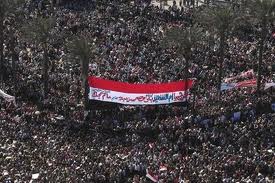
            This history-making global Occupy Movement with a presence in over 900 cities would not have happened in form and substance without the revolutionary awakening of the world’s youth that resulted from the riveting events culminating in the triumphal achievement of driving Hosni Mubarak from the pinnacles of Egyptian state power. We need also to acknowledge that the courage exhibited by those gathered at Tahrir Square might not have been exhibited to the world if not for the earlier charismatic self-immolating martyrdom of an unlicenced street vendor of vegetables, Mohamed Bouazi, in the interior Tunisian city of  Sidi Bouzid on December 17, 2010. Perhaps, as well, the eruptions would have stopped at the Tunisian border were it not for the readiness of Egyptians to erupt after the Alexandria death of Khaled Said on June 6, 2010. This brutal police murder ignited the moral passion of Egyptians, best expressed and widely disseminated through a Facebook campaign, “We are all Khaled Said.” We also must not overlook the mobilizing talents and social networking of digitally minded younger urban Egyptians without whom the movement might never have taken off in the first place, or the later encouragement provided by TV portrayals of the encounters between gangs of Mubarak hooligans and the demonstrators.


            History is always over-determined when transformative events are analyzed in the aftermath of their occurrence and so it is, and will be, with Tahrir Square, which has quickly become a shorthand to signify the hopes, fears, and methodology of the 21st century’s first revolutionary moment, both narrowly conceived as an Egyptian happening or more broadly as the inspirational foundation of this revolutionary impulse that has expanded to be a phenomenon of genuine global scope.  What is beyond doubt is that the world Occupy Movement proudly and credibly claims an affinity with Tahrir Square, although not without celebrating their important particularities.  It is reasonable to believe that these numerous protest movements around the world would either not have occurred, or taken a different form without the overall inspiration provided by the several dramas encompassed beneath the banner of the Arab Spring, and not only by Tahrir Square understood in isolation from its regional setting.


            I want to stress the unique South-North character of this inspiration as the core of its originality, and relatedness to a broader realignment of the political firmament that is slowly taking account of the collapse of the Euro-centric imperial order that started happening more than half century ago with the collapse of the British rule in India. This decolonizing process still has a long way to go as recent military operations in Libya, threats to Iran, colonialist defiance of Israel to international law daily reminds us. The interventionary currents of transnational political violence continue to flow only in one direction North-South. After World War II the United States militarily replaced the European colonial powers as the principal global custodian of Western interests. This anachronistic West-centricism continues to dominate most international institutions, especially evident in the UN Security Council that constitutionally endows the Euro-American alliance with a veto power used to block many efforts to promote global justice and prevents such emergent political actors as India, Brazil, and Turkey from playing a role commensurate with their stature and influence.


            What is exciting, then, about this resonance of Tahrir Square is that the youth of the North looked Southward found inspiration when engaging in their incipient struggle for revolutionary renewal of the world economic and social order, as well as equity in their immediate circumstances. Not only because of its priority in time, but for its conception of how to practice democratic politics outside of governmental structures, this political learning process was evident in the various Occupy sites. The ethos of revolution in Tahrir Square, and elsewhere in the region, with the partial exception of Libya, was nonviolent, youth-dominated, populist, leaderless, without program, demanding drastic change of a democratizing character. On its surface such a revolutionary orientation seems extremely fragile, subject to fragmentation and dissolution once the negatively unifying hated ruler is induced to leave the stage of state power, and if the challenge from below turns out to be more durable, possibly vulnerable to a violent counter-revolutionary restoration of the old regime. The irony of ironies associated with the Arab Spring is that only in Libya does the old order seem gone forever, and there the uprising was tainted in its infancy by its dependence on thousands of NATO air strikes and its reliance on a leadership that seemed mainly contrived to please the West.  When in Egypt a few months ago, in the still exalted aftermath of what was achieved by the January 25th Movement, there was a self-aware and wide chasm between those optimists who spoke in the language of ‘revolution’ and those more cautious observers who claimed only to have been part of an ‘uprising.’ At this moment, these latter more pessimistic interpretations seem more in line with an Egyptian process that can be best described as ‘regime stabilization,’ at least for now.


            What happens with the Occupy Movement is of course radically uncertain at present. Is it a bubble that will burst as soon as the first cold wave hits the major cities of the North? Or will it endure long enough to worry the protectors of the established order so that state violence will be unleashed, as always, in the name of ‘law and order’? Are we witnessing the birth pangs of ‘global democracy’ or something else that has yet to be disclosed or lacks a name? We must wait and hope, and maybe pray, above all acting as best we can in solidarity, keeping our gaze fixed on horizons of desire. What is feasible will not do!

Rejecting Neoliberalism, Renewing the Utopian Imagination

8 Nov


            When the Berlin Wall fell in 1989 two dismal consequences followed that have been rarely acknowledged:

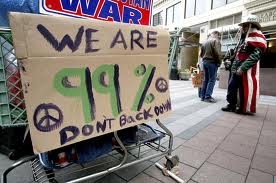
                         –neoliberal orthodoxy became unchallenged and unchallengeable in the formation of global economic policy; the World Economic Forum, convening annually in Davos, became the true capital of world order after the ending of the Cold War. Global policy priorities were set at Davos as capitalist materialism infused what became known as ‘globalization,’ a predatory consumerist that was capital driven rather than people-oriented. The Occupy movement is seeking to reverse this ordering of priorities, insisting on an economy for the 99%, insisting on governance that is accountable, participatory, transparent, and ecologically and ethically responsible, insisting on ‘real democracy.’


                        –the utopian imagination was repudiated as inevitably leading to the sorts of demonic politics that was associated with Stalinist rule in the Soviet Union. Not only was utopian politics linked to Stalinism but also to any promise of social and economic justice premised on human equality, and specifically, of course, to the socialist tradition. Instead, what emerged as dominant was a new brand of realism that encouraged accommodation with injustice, a delegitimation of any politics of aspiration, and an extremely alienating and demoralizing political atmosphere that rewarded the ethics of the casino and punished the energies of the workplace. The Occupy movement, whether consciously or not, is restoring the utopian imagination to its rightful role as the patron goddess of desire, the essential spiritual core of any restorative planetary politics of sufficient gravitas. Such a goddess has contempt for what ‘realists’ call realism, and aligns herself with a militant politics of impossibility.


            This is not meant to be a lament for the end of the Cold War or the collapse of the Soviet internal and external empire. After the historical achievement of overcoming colonialism, the greatest advance in the struggle for a more humane world was ending Communist rule in Eastern Europe and freeing the various subjugated republics and nationalities that made up the Soviet Union. Two further positive legacies also can be connected with this ending of the Cold War: the lessening of the threat of a major nuclear war and the emergence of a new geopolitical landscape that was the scene of the gradual dismantling of the Western architecture of world order in the early years of the 21st century.

             Critique and reshuffling the relations among states and regions, while necessary is hardly sufficient. The adjustments that have been made are hemmed in by the statist preoccupation with horizons of feasibility that lack will and capacity to meet such globally constituted challenges as climate change, nuclear weapons, global disease and poverty, governmental criminality, and militarism. These fundamental deficiencies of our current circumstance are only perceived in their fullness of menace if we indulge the utopian imagination that alone is able to illuminate distant horizons of necessity and desire.


Libya After Muammar el-Qaddafi’s Execution

30 Oct


The death of the despised despot who ruled Libya for forty-two years naturally produced celebrations throughout the country. Muammar el-Qaddafi’s end was bloody and vindictive, but we should remember that his rants against his own people—and his violent repression of what was initially a peaceful uprising—invited a harsh popular response. Recalling W.H. Auden’s famous line, “Those to whom evil is done/do evil in return,” it is almost inevitable in the absence of strong moral and political discipline, which was not present, that when a leader refers to his opponents as “rats” and pledges to hunt them down house by house, the stage is set for the unacceptable kind of retribution that played out recently in Sirte where NATO air strikes leveled the city and anti-Qaddafi forces executed at least 53 Qaddafi loyalists. It is an ominous warning sign for the future that this massacre at Sirte along with the execution and burial of Qaddafi should have exhibited such vengeful and undisciplined behavior, raising renewed doubts about the character and approach of Transitional National Council leadership, although there still exist possibilities for redeeming this loss of confidence.


These unfortunate happenings make overall accountability for war crimes an early test of whether the TNC will yet prove capable of managing the formation of a political and morally acceptable governmental structure. Will the TNC undertake investigations of the alleged wrongdoings of its own forces in a manner that corresponds with international standards, or will such inquiry be avoided because such an international confidence-raising process would clearly internal factionalism in which any finger-pointing will seem like an encouragement of ethnic and tribal conflict? Will the TNC cooperate with the International Criminal Court to ensure that those charged with war crimes in the service of the Qaddafi regime will receive a fair trial? At the same time there is reason to view with a cynical eye the demands of self-righteous NGOs in the West that seem to expect from Libya what the liberal democratic regimes of the West refuse to do. It should be appreciated in this regard that the United States

goes to extraordinary lengths to exempt its soldiers and leaders from potential criminal accountability while it pushes hard to have its enemies subject to the harsh severity of international criminal law. Double standards pervade. As with so much that involves North Africa after the glories of the Arab Awakening, all roads to the future seem destined to have many twists and turns, as well as treacherous potholes.


The leadership vacuum in Libya is not likely to be filled anytime

soon. We don’t know whether tribal or regional loyalties will emerge as primary political identities now that the great unifier—hostility to

the Qaddafi regime—can no longer suppress antagonistic goals and ambitions. The TNC lent international credibility to the anti-Qaddafi forces, but much of the fighting in the last stages of the struggle was under the control of semiautonomous militia commanders that seemed a law unto themselves. We will soon learn whether the TNC can sufficiently represent the collective will of Libyans during the interim process that is needed before establishing an elected government able to draft a new constitution. Its first attempt to establish a new unity was premised on a call to implement political Islam. The Chairman of the TNC, Mustafa Adbel-Jalil, made the following strong assertion along these lines at the victory celebration in Benghazi: “We are an Islamic country. We take the Islamic religion

as the core of our new government. The constitution will be based on our Islamic religion.”


Some pessimists have contended that Libya’s future is prefigured by

the chaotic violence that befell Somalia after the overthrow of

dictator Mohamed Siad Barre in 1991, a tragic set of national circumstances that have persisted ever since. But on a more hopeful note, it is worth observing that the fall of Qaddafi—unlike that of Hosni Mubarak, whose overthrow has not yet altered

the power structure in Egypt—gives the victorious Libyan opposition a

seemingly clean slate that could be more receptive to genuine democratic nation-building if such a political will emerges. Libyans have given themselves this opportunity that rarely comes along in history to achieve a real revolutionary transformation of their political, economic and cultural life. Thus, it could turn out paradoxically to be helpful, rather than an impediment, to observe that Qaddafi left no institutional infrastructure behind upon which to construct a modern state. What has happened in Libya, unlike Egypt, is for better or worse a total regime change.


Libya starts out on this new path with some additional major advantages, most obviously oil and a relatively

small population. An important test in the months ahead will be the

extent to which the new leadership restores normalcy to the economy without mortgaging the national wealth to foreign predators, corporate, financial, and governmental. Of course, in the background is the sense that NATO was integral to the overthrow of Qaddafi and may expect more than a thank-you note. Already there are media murmurs about great business opportunities for the West in the new Libya, including the challenge of rebuilding what NATO destroyed, which seems like a disturbing vindication of Naomi Klein’s groundbreaking book, The Shock Docrtrine, a devastating critique of the contemporary logic of the neoliberal world economy.


Considering Libyan experience from an international perspective raises several additional concerns. The public appraisal of NATO’s intervention will be mainly shaped by whether Libya emerges as a stable, democratic, and equitable nation. This will not be knowable for years, but aspects of the intervention already make Libya a troubling precedent no matter what the future of the country. The UN Security Council, which authorized the use of force by way of an application of the recently affirmed principle known as “responsibility to protect” or R2P. The five abstaining states were either duped or complacent,

and likely both. The authorizing Security Council Resolution 1973 was broadly framed by reference to establishing a no-fly zone by all necessary means, with the justification for force at the time associated with protecting the population of Benghazi from an imminent massacre. Yet this restricted mandate was disregarded almost from the outset. NATO forces were obviously far less committed to their assigned protective role than to making sure that the balance of forces in the struggle for the future of Libya would be tipped in the direction of the insurrection. If this intention had been clear at the outset, it is almost certain that Russia and China would have vetoed the UN resolution. During the debate these two states expressed their grave misgivings and suspicions about encroaching on Libya’s sovereignty, and were joined in the expression of such doubts by India, Brazil and Germany who also came to abstaining when it came to voting in the Security Council. If NATO’s broader intention was manifest Chinese and Russian vetoes were a virtual certainty.


Of course, there was a dilemma present. If NATO had disclosed its goals there would have been no UNSC authorization, and the Benghazi massacre would have appeared to be a humanitarian catastrophe invited by UN inaction. If NATO had circumscribed its intervention in the manner agreed upon, then a lengthy civil war might have followed, and also brought about a humanitarian disaster for the people of Libya. The perils of intervention have to be balanced against the perils of noninternvention in each instance, but if some tasks of global governance entrusted to the United Nations are to evolve in a constitutionally responsible way, then the minimum to expect is an honest disclosure of intent by member states pushing for intervention, a vigilant monitoring by the authorizing UN organ of any use of force, and a scrupulous regard by implementing actors for the limits imposed on a mandate to use force.


From these perspectives, it is extremely disturbing that a restricted UN mandate was totally ignored, and that the Security Council did not even bother reconsider the original mandate or censure NATO for unilaterally expanding the scope and nature of its military role. By ignoring the UN’s limits, NATO may have diminished the prospects for future legitimate uses of the R2P principle, and whether this is good or bad is difficult to say in the abstract.


There are several dimensions of this concern. To begin with, the UN Charter was drafted to minimize the legitimate role of force in world politics, making war a last resort, and then only in strict circumstances of self-defense. To this is added the secondary undertaking of the Charter, which is to assure that the UN itself is bound by Article 2(7) to refrain from intervening in matters essentially within the domestic jurisdiction of states unless under exceptional conditions it is decided as necessary to maintain international peace and security. The NATO intervention seems impossible to reconcile with either of these two core principles of the UN Charter, which is the constitutional framework that is supposed to guide the behavior of the UN. It is true that these principles have been eroded by practice since their enactment in 1945. Human rights has become such a strong dimension of world order as to take precedence over sovereign rights in certain situations of extreme abuse, which helps explain the rise of the R2P norm over the last decade, especially in the aftermath of the controversial NATO Kosovo War of 1999. Despite these developments the Charter still provides the operative guidelines for uses of force. In this regard, it might have been legally and morally acceptable, given the circumstance prevailing in Libya when the authorizing resolution was adopted on March 17, 2011, to mount a narrowly conceived protective mission—although it is worth noting that even at the moment of approval, there was widespread skepticism at the UN, either because some members distrusted the pro-interventionist reassurances of the United States and its European partners or anticipated that pressures on the ground would likely produce mission creep as the locus of the violence shifted beyond Benghazi.


The Libya experience raises deeper questions about reliance on the R2P norm as a basis of principled UN action on behalf of a vulnerable people endangered by abusive behavior of their own government. Some doubts already existed about the selectivity of the Libyan application of the norm, especially given the UN’s failure to lift a finger on behalf of the beleaguered civilian population of Gaza, which has suffered under a long and punitive Israeli blockade, with the UN even supporting the Israeli position when the blockade was being challenged by civil society activists seeking to deliver humanitarian assistance directly to the people of Gaza. But aside from this glaring example of double standards, there is also the widespread sense that in Libya, R2P was quickly, and without serious debate, transformed into an opportunity to destroy and oust, with an as yet undetermined array of harmful consequences.


If such protective undertakings are to achieve credibility in the

future, they must become detached from geopolitics and operationalized according to a robust regime of law that treats equals equally. Perhaps the most practical mechanism for reaching these presently unattainable goals would be the establishment of a UN Emergency Force that could only be activated by a two-thirds vote in either the Security Council or General Assembly, and not ever be subject to veto. Such a force would need to be funded independently of national governments, possibly by imposing a tax on international air flights or currency transactions. However sensible, such an arrangement will not be easy to bring into being, precisely because its existence would threaten current geopolitical prerogatives that depend on self-interested motivations of leading states. And even this recommended UNEF framework could be manipulated. But at least if it existed there would be a greater prospect that authorizing guidelines for humanitarian uses of force under UN auspices would be respected, that compliance would be supervised, and that more consistent practice would replace the current brand of humanitarian diplomacy that is deformed by the prevalence of double standards.


Against such a background, we can only wish that the Libyans will defy pessimistic expectations, and manage to establish a viable and independent democratic state that is respectful of human rights and energetic in its efforts at reconstruction, without becoming overly

hospitable to foreign investors and companies. After such a

devastating air campaign of some 20,000 sorties, the NATO countries should have the decency to stand aside and respect the Libyans’ inalienable right of self-determination. It is a sad commentary on the global setting that to set forth these hopes for the future of Libya and its long suffering population seems like an utopian indulgence!


Missing the Point Twice: International Law as Empire’s Sunday Suit

15 Oct


            In a recent speech at the Harvard Law School, John Brennan, President Obama’s chief advisor on counterterrorism and homeland security, boldly declared: “I’ve developed a profound appreciation for the role that our values, especially the rule of law, play in keeping our country safe.”  The most notable feature of the remarks that followed was the legal rationalization put forth for targeting killing of civilian terrorist suspects distant from ‘the hot battlefield’ even if not engaged in activities that could be reasonably viewed as posing an imminent threat to security of the United States.


In effect, post-9/11 American ideas of self-defense incorporate by stealth the Bush Doctrine of preemptive war used to justify aggression against Iraq in 2003, which had seemed discredited in international until quietly revived by the Obama presidency. The entire world is treated as part of the operational battlefield in the so-called ‘long war,’ and civilians, such as the religious ideologue Anwar al-Awlaki, killed on September 30, 2011 in a remote region of Yemen as if he was a soldier at war. This purported legalization of drone attacks carried out in foreign countries represents a unilateral extension of international law, as well as establishes a precedent that would not be tolerated if claimed by any country hostile to the United States. Involved here is the de facto amendment of the right of self-defense in a manner inconsistent with both the understanding embedded in Articles 2(4) and 51 of the UN Charter and of contemporary international law as interpreted by a majority in the International Court of Justice in the Nicaragua case decided in 1986. The United States now sets the new rules that override the old rules, and then limits their availability to others by restrictions based on geopolitical criteria of ‘friend’ and ‘enemy.’


            All that Brennan offered in support of such an imperial claim was the assurance that the United States is careful in the execution of these attacks, seeking to minimize the risk of mistaken identity and taking steps to ensure that the attacks take place in situations where the risks of unintended ‘collateral damage’ are reduced to the minimum. The credibility of this reassurance is insulated from inquiry by secrecy, a total lack of transparency that is supposedly justified by the need to protect intelligence sources. There is also no independent post-attack independent inquiry as to whether the targeted individual might have captured rather than executed, whether there existed a sufficient threat of involvement in dangerous activities to warrant such at attack, whether the government of the country involved gave its consent voluntarily, and whether there is or should be accountability for errors. Such a procedure can only be understood as an effort to establish a system of imperial global governance in relation to the use of force.  If this constitutes the way American ‘values’ deploy ‘the rule of law’ it would seem to reflect the most cynical reliance on ‘law’ as propaganda, while at the same time discarding the proper role of law as a constraint on violence. It is also relevant that the unusual amount of attention given to the al-Awlaki execution results from his American citizenship, which implies the regressive understanding of law that there are no grounds for a serious American concern if the target is non-American regardless of the innocence of the person or the fact that he or she are being killed in their homeland and citizenship. Such a world we are making for ourselves and others.


            In March of 2011, in a spirited address to the American Society of International Law, Harold Koh, Legal Advisor to the Secretary of State, also spoke glowingly about the commitment of the United States during the Obama presidency of “living our values by respecting the role of law.” He went on to explain that this mean “following universal standards, not double standards.”

These legalist sentiments were deemed by Koh to be so central to his argument as to be printed in bold lettering for emphasis.


What should strike any reasonably objective person is the crude hypocrisy of an American government official rejecting double standards while simultaneously engaging in political gymnastics to avoid acknowledging the unlawfulness of Israel’s behavior: the United States stands practically alone in the world in refusing to condemn Israeli settlements in occupied Palestine, in denying Palestinian statehood at the UN, in endorsing the collective punishment inflicted on the civilian population of Gaza for more than four years; in repudiating the recommendations of the Goldstone Report. Indeed, U.S. foreign policy toward Israel is the most glaring and punitive instance of double standards with respect to international law that exists in the world today.  But it far from the only example. Other prominent instances exist in many crucial domains of global policy: as with the nuclear weapons states that maintain arsenals of weapons without accepting restrictions on their use and non-nuclear pariah states that under the geopolitically managed NPT regime are threatened with military attack for supposedly seeking such weapons; as with the identity of those political leaders and military commanders who are prosecuted for international crimes and those who enjoy a condition of de facto impunity; and as to states that could be invaded by reliance on the norm of ‘responsibility to protect’ and those against which such action is inconceivable however much the territorial population is confronted by dire threats to its wellbeing and survival.


I am less shocked by the behavior of the United States, which reflects its grand strategy, than by this insistence on stretching the meaning of the most fundamental legal rules and principles to satisfy foreign policy priorities.

For esteemed international law figures such as Harold Koh, formerly a distinguished human rights scholar and dean of the Yale Law School, to make such bold assertions about the post-9/11 law, validating drone warfare, without even bothering to acknowledge doubts as to the wisdom and acceptability of such a course is to embrace jurisprudential nihilism in two senses—first, by undermining the authority of international law by showing that it can always be extended unilaterally to serve the interests of the powerful, and operates otherwise to discipline weak states; and secondly, by creating a precedent that will not be honored as ‘law’ if invoked by others- witness the hysterical reaction to the shaky claim that Iran was plotting the assassination of the Saudi Arabian ambassador to the United States. What is sauce for the geopolitical goose seems to be poison for the pariah gander!


            There are respectable reasons to suggest that international law of war and peace that has evolved over the centuries to deal with conflict among states, and as such needs to be revised to take account of non-state actors and networks, as well as in response to the global horizoning of many interactions in the world of the 21st century. But there are no respectable reasons to contend that dominant states can exercise a military option wherever they choose, and then have the temerity to call this behavior ‘lawful.’


Michael Rosen, an ideological apologist for the executions of Osama Bin Laden and Al-Awlaki, writing in The American, the magazine published by the American Enterprise Institute (the right-wing think tank) put his support for drone military activity this way: “But in the civilized world..increasingly.. targeted by Islamist terror, we must continue to return fire by robustly targeting the terror masters.” At least such an assertion

does not pretend to provide an international law justification, although it does stretch the U.S. Congress’s 2001 Authorization of the Use of Military Force, designed to reach those involved in the 9/11 attacks, to validate the execution Al-Awlaki who has never been accused of having any relationship to 9/11. It also most unacceptably sets up this long repudiated moral contrast between ‘the civilized world’ and the rest that has so often in modern times been used to justify violence by the West against the non-West. I had hoped that the collapse of colonialism would have at least discouraged the use of such a tasteless rhetoric of comparison.


            There is a final point. Living in a region that is subject to drone attacks as in the tribal areas of Waziristan is terrifying for the population as a whole. This ill-defined vulnerability helps explain the severe hostility to the United States that exists among the Pakistani people and led to a unanimous resolution adopted on May 14, 2011 by the Pakistan parliament demanding that the executive branch uphold Pakistan’s sovereignty by disallowing any future drone strikes on its territory, and if they continue to cut off NATO supplies destined for the Afghanistan War. Supporters of the resolution have sought implementation through the courts, and a Lahore judge has ordered Pakistan foreign minister to submit detailed responses to issues raised. It is one thing to assess the reasonableness and proportionality of a targeted killing, including by reference to collateral damage by reference to the person(s) targeted, but such an appraisal fails to take any account of the more pervasive and inevitable collateral damage caused by producing intense insecurity on the part of an utterly defenseless civilian population as a whole.  As far as I have seen this latter dimension of state terror associated with these new modalities of surveillance, intelligence operations, and robotic militarism never considers the psychological harm being done to the people of the targeted country. This raises issues bearing on the right to life as a fundamental right of all persons under international human rights law.

Is this a Global Gandhian Moment?

10 Oct


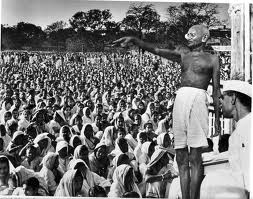
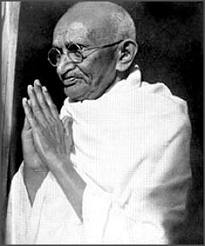
             Mahatma Gandhi has been dead for more than 63 years, and yet his relevance to the politics of our time has never been greater. It is a tribute to the power of Gandhi’s inspirational ideas and life that his current influence is far greater than that of any other leader of the past century. We recall such names as Churchill, Franklin Roosevelt, Mao Tse-tung, Lenin, and Nehru as individuals who were great leaders in their time and remain historic personages of lasting importance, but they do not speak directly to the political circumstances of the 21st century. Those seeking to challenge what is exploitative, destructive, humiliating, corrupt, and oppressive in their surroundings are mostly indifferent to or even ignorant of these agents of past history. By contrast, Gandhi remains a towering figure that seems as fascinating as when he had become on that dismal day in 1948 when he died at the hands of a Hindu nationalist assassin.


            Beyond this legacy is the claim that we are actually living through ‘a Gandhian moment.’ Some have invoked such an image to identify any sustained political challenge directed at the established order that is self-consciouslessly premised upon principles of nonviolence. For instance, a distinguished Gandhi scholar, Ramin Jahanbegloo, entitles a short essay on Iran’s Green Revolution ‘The Gandhian Moment,’ and treats these courageous massive uprisings in Iran that followed upon the apparently stolen election of June 12, 2009 as an example of an historic event illustrative of Gandhi’s contemporary impact, so much so that he honors the events by affixing the label ‘a Gandhian moment.’ He also believes that a series of other national leaders espousing nonviolent politics have contributed their own variant of a Gandhian moment: Khan Abdul Ghaffar Khan, Martin Luther King, Jr., Nelson Mandela, Lech Walesa, Vaclav Havel, Benigno Aquino, Aung San Suu Kyi, and Ibrahim Rugova. These are all admirable individuals who bravely fought against an oppressive established order, yet I find it dilutes and somewhat misinterprets the Gandhian legacy to bestow upon their activities the Gandhian imprimatur. Or explaining my reaction differently, the espousal of nonviolent politics is a necessary but far from sufficient reason for christening a momentous political occasion as a Gandhian moment.


            Without taking issue with Jahanbegloo’s list, I would note that several of those included were practitioners of tactical nonviolence without ever articulating an unconditional commitment of the sort that Gandhi made the signature of his life and theory. As far as I know Mandela never recanted his support for armed resistance to the apartheid regime in South Africa on the part of the ANC. Aquino although a determined democrat, failed to build a popular movement around nonviolent politics, although his widow, Cory Aquino led the people power movement that overthrew the Marcos regime in 1986, but again without any indication of being guided by such an unconditional framework as Gandhi insisted upon. And Rogova, although supporting an imaginative nonviolent resistance to oppressive Serbian governance of Kosovo, nevertheless welcomed the NATO intervention of 1999, and even had an autographed picture of Madeline Albright on his office wall. In effect, Jahanbegloo’s list mixes different degrees of nonviolent commitment without clarifying the originality of Gandhi’s mandatory framing of nonviolence in absolutist terms. This framing led to some awkwardness of response on Gandhi’s part as when he counseled German Jews to stay put in the face of Nazi persecution or advised the liberal democracies to dissuade Hitler from aggression by unilaterally disarming or urged civilians to confront the pilot of the planes dropping atomic bombs on Japanese cities with a sacrificial resignation of peacefulness and non-hostility. I mention these examples not to criticize Gandhi, but to clarify the extremity of his views on nonviolence that allowed no room for exceptions, no matter how extenuating the circumstances. From this perspective I am not comfortable with calling the Green movement in Iran, which had rather modest reformist goals even at its height, ‘a Gandhian Moment.’


And yet, I would argue that we are living through a Gandhian Moment in two quite different respects that relates to my understanding of the originality of Gandhi’s ethics, politics, and underlying spirituality. I find the two most significant features of a distinctively Gandhian approach to be his linkage of nonviolence with living in truth (satyagraha) that imparts its unconditional character and his dedication to what I call ‘the politics of impossibility,’ that is, dedication to goals that are beyond the limits of the feasible as conventionally understood. This was the case for Gandhi when he challenged British imperial rule in India after World War I, and it was even more characteristic of his unfulfilled philosophical anarchist vision for India.  His proclaimed ideal India was a country of self-reliant villages with minimal state institutions and a turn away from the corrupting lures of modernity. Even many of Gandhi’s closest associates, including the great Jawaharlal Nehru, opted for a politics of possibility once Indian independence was achieved, seeking to make India a normal state. This normalcy culminated in the acquisition of nuclear weapons by India in 1998, a move that would have certainly horrified Gandhi.


Why, then, claim we are in the midst of a Gandhian moment? First of all, because the various movements and uprisings associated with and stimulated by the Arab Awakening were rooted in their spontaneous commitment to a politics of impossibility coupled with an explicit and courageous dedication to nonviolent confrontation. This was especially true in Tunisia and Egypt, where although the trajectory remains radically uncertain, what has been achieved already qualifies as the attainment of ‘the impossible.’ A few months ago in Cairo when talking to activists who had been in Tahrir Square I was struck by their uniform commentary of what an extraordinary experience it had been to participate in a process that had been unimaginable before Mubarak’s remarkable departure from power took place before their eyes.

If the #OccupyWallStreet protests, now a presence in 70 American cities, succeed in producing a transformative movement, it would reinforce this reality of a global Gandhian Moment even if the name Gandhi never appears in the manifestos issued by the convenors. I want to suggest that a Gandhian Moment occurs whenever the inner affinities with the essential Gandhian legacy seem pronounced, and not necessarily when the influence of the man and his achievements is overtly acknowledged.


There is a second reason why I think it useful to identify our time as a Gandhian Moment. It is our inability to address any of the most pressing global challenges effectively and humanely without a dual reliance on a politics of impossibility and an unconditional commitment to nonviolence.

Among these challenges, I would mention the following: global climate change; nuclear disarmament; a sustainable and just Palestine/Israeli peace; water scarcities; transition to a post-petroleum economy; an equitable and stable world economy; extreme poverty; and global democracy. Each of these challenges is overwhelming, and in their aggregate, presages a catastrophic future for the human species. Yet we cannot know the future, and need to keep our spirits high by embracing appropriate transnational, global, regional,  local, and even personal forms of an empowering politics of impossibility. Whether in such a setting a new Gandhi will emerge is almost irrelevant to the claim that to be alive now is to enjoy the potential of experiencing the vibrant rhythms of a Gandhian Moment! 


A Modest Proposal: Is It Time for the Community of Non-Nuclear States to Revolt?

7 Oct


             There are 189 countries that are parties to the Nuclear Nonproliferation Treaty (NPT) that entered into force in 1970. Only India, Pakistan, Israel, and North Korea have remained outside the treaty regime so as to be free to acquire the weapons. The nuclear weapons states have done an incredibly successful job, especially the United States, in getting a free ride, continuously modernizing their arsenals while keeping the weapons out of most unwanted hands.


            But the NPT was negotiated as a world order bargain. The non-nuclear countries would forego their weapons option in exchange for receiving the full benefits of nuclear energy and a pledge by the nuclear weapons states to seek nuclear disarmament in good faith. After 40 years it seems time to question both the benefits of nuclear energy (especially so after Fukushima) and even more the good faith of the members of the nuclear weapons club. Back in 1996 the World Court unanimously concluded that the nuclear weapons states needed to fulfill their treaty obligation to seek nuclear disarmament as a matter of urgency, and yet nothing resembling disarmament negotiations has taken place. It seems time to declare that the good faith obligation of Article VI of the treaty has been violated, and that this is a material breach that allows all states to disavow any obligation.


            Two mind games have kept the non-nuclear majority of states in line so far: first, convincing the public that the greatest danger to the world comes from the countries that do not have the weapons rather than from those that do; secondly, confusing the public into believing that arms control measures are steps toward nuclear disarmament rather than being managerial steps periodically taken by the nuclear weapons states to cut the costs and risks associated with their weapons arsenals and programs and to fool the world into thinking they are living up to their obligation to phase out these infernal weapons of mass destruction.


            There are other problems too. Israel has been allowed to acquire nuclear weapons by stealth without suffering any adverse consequences, while Iraq was invaded and occupied supposedly to dismantle their nuclear weapons program that turned out to be non-existent and Iran is under threat of military attack because its nuclear energy program has a built in weapons potential. Such double standards and geopolitical discrimination severely erode the legitimacy of the NPT approach.


            Barack Obama earned much favorable publicity, and probably was given the Nobel Peace Prize, because in 2009 he made an inspirational speech in Prague announcing his commitment to a world without nuclear weapons. Although the speech was hedged with qualifications, including the mind-numbing reassurance to nuclearists not to worry, nothing would happen in Obama’s lifetime, it still gave rise to hopes that finally there would be a genuine attempt to rid the world of this nuclear curse. But it was not to be.

As with so many issues during the Obama presidency, the early gestures of promise were quietly abandoned in arenas of performance.


            Has not the time come for the too patient 184+ non-nuclear weapons states to stand together with the peoples of the world to challenge the world nuclear weapons oligopoly? One way would be to declare the treaty null and void due to non-compliance by the nuclear weapons states. Such a move would be fully in accord with international treaty law.


            Another way, perhaps more brash, but also maybe more likely to have a political impact, would be for as many non-nuclear states as possible to take a collective stand by way of an ultamatum: if the nuclear weapons states do not engage in credible nuclear disarmament negotiations designed to eliminate the weapons within two years, the treaty will be denounced.  


Rethinking Afghanistan After a Decade

19 Sep

This post is a short essay responding to a question about my dramatic change of position on the Afghanistan War with regard to its initial justification and flawed execution. It is both a reconsideration of errors of judgment and reflections on how the world has changed in the course of this decade, focusing on the inability of the United States to grasp either its own decline or the related decline in the historical agency of hard power approaches to security.

**********


Reading what I wrote about Afghanistan a decade ago reminded me of how much my understanding of the role of war and hard power in upholding security for the nation and the world has changed. Actually, it seems clear to me that my views on Afghanistan back in 2001 were an exception to my general skepticism about Western interventions in the non-Western world, a view formed during ten years of opposition to the American role in the Vietnam War. At the time, with the Al Qaeda attacks so recently seared into my political consciousness, and some anxiety that more attacks of a similar kind were likely to follow, it seemed logical and helpful to adopt a war strategy as part of an overall effort to disrupt the mega-terrorist capabilities to inflict further harm either in this country or somewhere else on the planet. Although I realized that the international law argument for attacking Afghanistan, with the clear objective of regime change, was weak absent the exhaustion of diplomatic remedies, but such considerations were overcome in my mind by the political argument for doing immediately whatever was necessary to uphold security in this country and generally, and the moral argument that any successor government to what was being imposed on the Afghan people by the Taliban would almost inevitably be a step in the right direction. At first, these early assessments of mine seemed vindicated, but now with the benefit of ten further years of military engagement and retrospective insight, a reappraisal is long overdue.


There were some reasons for skepticism and worry from the outset of the approach to Afghanistan. The manner by which the air war was conducted, and its failure to adopt tactics designed to have a maximum impact on Al Qaeda capabilities were disturbing to me from the beginning of the military operations. The American military undertaking seemed poorly conceived and implemented, naively relying on untrustworthy coordination with Afghan ground forces that had their own distinct agendas often at odds with U.S. counter-terrorist priorities. This unreliability should have been known on the basis of intelligence and prior counterinsurgency experience. The United States Government, and especially the Rumsfeld Pentagon, were ideologically committed to fighting the war with minimum American ground involvement, thereby avoiding heavy American casualties, and yet achieve the goals of the intervention. This was proclaimed at the time to represent a test case for a ‘revolutionary’ transformation of warfare in which technology displaced troops on the ground. We learned very soon that virtually the entire Al Qaeda leadership had managed to escape across the border to Pakistan along with its main cadre of militant trained fighters.


Beyond this central mission failure, the promised regime change in Afghanistan quickly became a costly and obvious fool’s errand. The authority of the new political leadership in Kabul, handpicked by Washington, could hardly extend its writ beyond the capital city despite its dependence on the delegitimizing presence of foreign occupying forces. This led over time to the resurgence and regrouping of a variety of forces of national resistance to foreign occupation, as well as the unexpected revival of the Taliban as both a fighting force and a serious political challenger for control of the country.


Faulty perceptions in this post-9/11 period, including my own, ignored the lessons of Vietnam. It was one thing to mount a counter-terrorist operation against the Al Qaida presence in Afghanistan, which was itself an alien intrusion on national political space, but another for the leading country in the West to seek to override the workings of self-determination within Afghanistan so as to impose a governing structure and political culture more to its liking. This renwed reliance on counterinsurgency thinking, of which General David Petraeus, was the most influential voice within the military, sought to overcome memories of defeat in Vietnam by adopting an approach more friendly to and respectful of the indigenous culture and the human rights of the people supposedly being protected. But it is one thing to be abstractly sensitive in these ways, but it is another to remain a benevolent presence while killing the inhabitants of the country, especially its women and children, while simultaneously doing everything possible to minimize risks of injury and death to one’s own troops. In the circumstances that exist in Afghanistan these two sincerely held objectives are often in tension with notable incidents leading to anger either at the scene in Afghanistan or at home in the United States. It is ironic that Petraeus, despite his historical knowledge, political acumen, and his own prior efforts to right the mistakes of the past, relied on drone strikes at a rate of ten times that of his predecessor, resulting in a predictable rise in civilian casualties and popular alienation. The use of sophisticated unmanned aircraft firing missiles at human targets carries to new heights the technological one-sidedness of such counterinsurgency warfare where as much of the risk as possible is shifted to the territorial society and those who pick targets in safety have neither accountability for deliberate or accidental wrongs nor possess any leverage over the political dynamics within the country. It is this disabling irony that has yet to have its proper impact on American policymaking. Our political leaders seem unwilling to learn that military dominance rarely translates into favorable political outcomes at acceptable costs in the early 21st century.


Despite the evidence supporting such an interpretation of recent historical trends the mistakes of the past are stubbornly repeated, and such a pattern calls for an explanation. It is necessary to consider the impact of factors that overcome the expected rationality of government decision-making and problem solving. Perhaps, the most important of these is the emergence of what Mark Selden calls ‘the permanent warfare state’ in the United States. The country has for decades made a disproportionate investment in achieving military dominance on a global scale. The existence of such expensive capabilities generate strong bureaucratic and ideological pressures to rely on military approaches to ensure a favorable outcome of international conflicts. After all at present, if the United States spends more than the next ten countries in the world combined, there must be a commensurate political payoff, or else it is extremely discrediting with respect to the use of taxpayer revenues in a setting of intense fiscal concern about government spending..


It is this hard power dogmatism that has led the United States, along with its Western junior partners, to engage in a nation-building war in Afghanistan that seems destined for defeat and humiliation. As the Afghan saying goes: “You got the watches, we got the time.” Because the benefits to the United States of persisting in Afghanistan despite the costs seem so uncertain as compared to the clear goals of the opposition to rid the country of foreign occupiers, it seems likely that the longer-term and deeper commitments of the Afghan national resistance will reap eventually the rewards of its persistence. Of course, this prediction is reinforced by the low quality of the Karzai government that undermined its democratizing claim by stealing the most recent faux elections and through its corrupting links to the drug trade and warlords. In the twenty-first century those who cooperate with foreign invaders and occupiers rarely are able to claim ‘mission accomplished’ with any credibility at the end of the day. It is important also to realize that this was not true in the colonial era during which the superior military technology of the colonialists generally prevailed without large losses or major expenditures. Prior to World War II, there was insufficient confidence in the capacity of most non-Western societies to mount an effective national resistance to a determined military intervention, although even here Afghanistan stood out as the one country in Asia that colonial powers found impossible to pacify in a manner that served their interests, with both Britain and Russia failing in their attempts to do so. It is difficult for Americans to appreciate that foreign occupation poses such a stiff challenge to self-determination as to be very rarely viewed as liberating or legitimate by the civilian majority in a country subject to military intervention.


Such generalizations need to be distinguished from the sorts of interventions that seem to have been effective in Kosovo in 1999, and maybe again this year in Libya.  In Kosovo, the foreign intervention was a rescue operation in support of a domestic struggle of the Albanian overwhelming majority against what was perceived to be Serbian alien rule sustained by atrocities against Kosovars and posing an imminent threat of violent ethnic cleansing. It was, to the extent that the people of Kosovo enjoyed the status of being ‘a people’ in international law, possible to consider the NATO intervention as being in furtherance of self-determination rather than as an attempt to impose a Western oriented outcome. True, the clarity of such an endorsement of the Kosovo War is qualified by the absence of any UN Security Council authorization for the use of force and by NATO’s controversial reliance on high altitude bombing that killed an estimated 500 civilians on the ground. The post-conflict establishment of Camp Bonsteel, a huge NATO military base also raises questions about the purity of the alleged protective intentions.


In the case of Libya, although the NATO operations ignored the limits of the UN Security Council authorization, the military action reinforced a struggle already underway in the country, and backed by a majority of the population, against a hated dictator that was engaging in indiscriminate violence against his own people, and threatening to do worse. It remains to be seen whether the victors in Libya can bring constitutional democracy and an equitable economy to the country, but at least the intervention is highly unlikely to engender national resistance as there is no foreign occupation contemplated. There are already concerns about the prospect of manipulation behind the scenes by the intervening parties to bring big profits to NATO oil companies and construction firms. If these concerns materialize it could be quite discrediting to the nationalist claims of the new Transnational National Council leadership. Nevertheless, as of now, the main point stands: with UN backing, without any intention of foreign occupation and military bases, against an existing cruel, exploitative, and oppressive rule, and in support of an existing oppositional movement, a Western military intervention can achieve its initial goals, but even then not without evoking considerable controversy and raising suspicions about ulterior motives. Phase one is regime change as has taken place with the defeat of the Qaddafi regime, phase two is constitutional state building and equitable and sustainable development that remains to be achieved, and depends on national will and capabilities.


There was another major dimension of the Afghanistan War as it appeared in 2001 as compared to the way it seems in 2011. What I failed to appreciate then, and has still not been properly registered in mainstream foreign policy thinking, is that during the presidency of George W. Bush, the grand strategic emphasis was placed on control of the Middle East. This objective of grand strategy took precedence over the successful prosecution of the post-9/11 struggle against terrorism.  The two different undertakings were misleadingly merged in public consciousness by relying on the unifying, yet diversionary label of ‘global war on terror,’ but in fact while Afghanistan was directly linked to the 9/11 attacks the government of Saddam Hussein in Iraq was only indirectly, if at all, linked. The Iraq War launched in 2003 increased anti-American resentment throughout the Islamic world, and was at odds with an all out struggle against Al Qaeda, which would have given continuing priority to consolidating the early gains in Afghanistan and neighboring Pakistan. Instead, after the military attacks on Afghanistan produced the collapse of Taliban rule, the American emphasis immediately shifted dramatically to the Iraq War, and Afghanistan became a forgotten sideshow, which encouraged the steady deterioration of political order in the country, making a mockery of early claims of achieving a liberating political change welcomed by the population. Obama tried to overcome this unfortunate legacy of neo-conservative foreign policy by both promising to end the Iraq War, a commitment that remains problematic and unfulfilled, and a commitment to view the Afghanistan War as requiring renewed attention due to its relevance to the challenge of terrorism.


Finally, ten years after 9/11 the road not taken of law enforcement, intelligence collaboration, occasional special forces covert undertakings in foreign countries seems attractive on a number of grounds, and the defense of human rights at home and abroad. It would have avoided the costly, mostly failed efforts in Iraq and Afghanistan. It would have avoided national humiliation associated with the panicky recourse to torture that led to the globally discrediting disclosures of  systematic abuse of detainees at Guantanamo and Abu Ghraib, and a homeland security apparatus containing many features of authoritarian governance. It would have strengthened claims by the United States to provide benevolent world order leadership based on minimizing the role of war and military solutions, while maximizing the role of law, international police cooperation, and diplomacy, including efforts to take steps to acknowledge and overcome the legitimate grievances of the Arab World, especially the American failure to push for a fair and balanced solution to the Palestine/Israel conflict. This approach would have also allowed a greater concentration of the political imagination and the resources of the country on meeting domestic infrastructure problems and addressing such rising global challenges as climate change and persistent extreme poverty. Furthermore, such non-war path in response to the 9/11 attacks could have demonstrated a realization of the limits of hard power approaches to the solution of conflict and security problems in the early 21st century, and avoided falling again into the traps unwittingly set for the country by pro-interventionists and counterinsurgency advocates. Of course, a counter-factual portrayal of the decade is by definition unaware of the bumps in the road that would undoubtedly have been encountered, especially if further attacks had been successfully launched on high value targets within the United States.  Even conceding this unknowability, this alternative path would have been in closer accord with out ‘better angels,’ and corresponded with American continuing claims on the global stage to be the home of moral exceptionalism. If it failed once having been tried, the grounds for a more muscular approach would have been responsibly laid.


These retrospective comments are meant to be non-partisan as far as internal American politics are concerned. The Bush approach after 9/11 enjoyed  overwhelming support among the citizenry and in Congress. There were no influential dissenting voices. The mobilization of national unity on the basis of fear and anger, and reinforced by patriotic pride, was intense, effective, and unconditional. My regrets about the policies pursued are mainly preoccupied with the deficiencies of American political culture given the realities and challenges of our world. Unless the political mind of the country becomes quickly disenchanted with military approaches to conflict resolution there is every likelihood of repeating the mistakes of the past decade that will increase dangerous storm clouds that already cast dark shadows menacing the future wellbeing of the country and world.

The American and Global Experience of 9/10, 9/11, 9/12 +10:

15 Sep


            There is unacknowledged freedom associated with any event inscribed in our individual and collective experience of profoundly disabling and disturbing public occurrences. For most older Americans what is most vividly remembered among such occurrences is likely to have been Pearl Harbor, the assassination of JFK, and the 9/11 attacks, each coming as a shock to a shared societal sense of exceeding the limits of what could be expected to happen.  I doubt that other societies would have a comparable hierarchy of recollections about these three rupture of expectations that have proved so significant for an understanding of American political identity over the course of the last fifty years. To make my point clearer, most Japanese would almost certainly single out Hiroshima, and possibly the more recent disaster that followed the 3/11/11 earthquake and tsunami that led to the Fukushima meltdown, and are likely to ignore the events that Americans have found so transformative. Germans, and many Europeans, are likely to be inclined to remember the fall of the Berlin Wall, and possibly the exposure of the Holocaust, while most citizens of former colonies are undoubtedly most moved by the day on which their national independence was finally achieved.


         Because American responses to such transformative events are likely to be global in their effect, there is a greater tendency to acknowledge some American preoccupations but not their interpretation. This diversity amid universality is probably truer for 9/11 than any other recent transformative event, not only because of the drama of the attacks and global visualization in real time, but as a result of the violence unleashed in response, what I identify here as the perspective of 9/12. Shifting ever so slightly the angle of perception greatly alters our sense of the significance of the event. Just as 9/12 places emphasis on the American response, the launching of ‘the global war on terror,’ the day before, 9/10 calls our attention to the mood of imperial complacency and global vulnerability to American power that preceded the attacks. This mood was completely oblivious to the legitimate grievances that pervaded the Arab populace associated with the appropriation of the region’s resources, the American support lent to cruel and oppressive tyrants, the lethal sanctions imposed on the people of Iraq for a decade, the deployment of massive numbers of American troops near to Muslim sacred sites, and the enabling over the course of many years of Israel’s oppressive dispossession and occupation of Palestinian lands. From this perspective, the crimes of 9/11 were widely understood as an outgrowth of the wrongs of 9/10 and led unreflectively to the crimes and strategic mistakes of 9/12.  Such a critical understanding does not diminish the criminality of attacks directed at civilians, a strategic pushback that violates the most fundamental constraints of law and morality.


           It is probably misleading to think of 9/11 as primarily a global historical event. Undoubtedly its interpretation is mainly a national experience more affected by 9/10 and 9/12 than by the attacks themselves. Such an observation reminds us that despite the hype about globalization that was so prominent during the dawn of the Information Age in the 1990s, it is our shared lives within a particular sovereign state that continues to dominate our political consciousness. Surely most Palestinians see 9/11 through an optic reflecting their ordeal as understood on 9/10, while most Israelis likely saw 9/11 as a long overdue enabling of the 9/12 response that led Americans to share Israel’s preexisting national preoccupation with terrorism.  A deeper encounter with 9/11 ten years later allows us to sense more clearly that most of us are still living in a world of sovereign states despite the borderless wonders of social networking and other globalizing phenomena of this historical period. Even Europe that seemed to go further toward establishing a state-transcending civilizational identity required only the stress of an economic recession to bring back its strong conviction that what mattered most was not being a European but rather being Italian, Spanish, Greek, or French.


            Of course, for Americans this is not so obvious. The United States is truly a global state, perhaps the first in history, with the capabilities and commitment to act anywhere on the planet if its vital interests are at stake. From this perspective, 9/11 was experienced by many Americans as a challenge that could be neither addressed territorially nor by retaliatory attacks on the enemy state that inflicted the harm.  The leaders at the time, but with wide national backing, insisted that future security meant limiting freedom at home while waging war abroad. It was this global projection of this American security response that made it natural for 9/12 to be the day that most stays in the mind of foreigners, perhaps not literally, but through their feelings of victimization that resulted from the American respnse by way of war rather than through reliance on the enforcement of law against those who commit crimes against humanity. This latter road not taken, and not even seriously considered, might have been the most radical peacemaking experiment in all of modern history. It was far too radical for either the leadership or the citizenry of not only America, but the constituted politics of all states.


            With this outlook of American geopolitical exceptionalism, globalization seems real. When Barrack Obama was elected the American president in November 2008, it was a global event, with people the world over often believing that his election was more important for their future than the outcome of their own national elections. When Lula went to a meeting in Europe of the G-20 while he was still President of Brazil he said that he prayed for Obama more than for himself. The American role in the world economy and security system is truly global, but does that mean that 9/11 was interpreted as a blow struck against the whole world as George W. Bush insisted at the time? Hardly. For parts of the world it meant new and increased violence in their homeland, drones attacking targets selected in the U.S., special forces and an array of mercenaries roaming covertly in search of terrorist suspects, and new wars.


           We are, of course, free to remember certain things and to forget others. This is normally not done consciously, but it will explain the incredible diversity of how 9/11 was observed on its tenth anniversary, itself a milestone that causes especially Americans to pause and reflect. For most Americans, this became an occasion for a renewal of remorse, lament, resolve, and anger, if not rage.


            The most innocent memories of 9/11 are those of loss, a recollectionthat is both personal and collective, associated with any human tragedy caused deliberately that has a negative impact on innocent civilian lives. Less innocent, and more relevant ten years later, is the complexity surrounding the response that is prompted by fear, revenge, counter-crusading passions, and geopolitical ambition. In these respects, 9/11 is both text and pretext, and gave way to the 9/12 furies that unleashed a global war on terror that has caused widespread destruction, questionable improvements in security, and a general weakening of the American claim to exercise global leadership.