Archive | International & Global Law RSS feed for this section

Misreading the Snowden Affair

11 Jul

This post is a revised and modified version of an essay published as an Op/Ed two days ago by Al Jazeera English; it attempt to reflect on the significance of the Snowden disclosures, and why governments did not rebuff the American efforts to take Snowden into custody as an accused criminal by the simple assertion that ‘political crimes‘ should never be the subject of cooperative inter-governmental efforts to achieve the enforcement of criminal law in a foreign country. The world benefits from the safety valve of such sanctuary, as does the country that is seeking to arrest and punish the whistleblower even if most of its leaders and opinion makers do not realize this. So far even the U.S. Government has not insisted that Snowden’s crime is somehow not to be considered ‘a political crime,’ nor could it plausibly make such an argument. For this reason to capture Snowden the United States has relied on its diplomatic clout and geopolitical capacity to impose costs on those who do not comply with its wishes. So far in the Snowden Affair it is small Latin American countries, including Bolivia, Ecuador, and Venezuela, that have risked the ire of the United States by pursuing independent policies with respect to Snowden, and acting correctly from the perspective of law and morality.


*******************************************************************************************************************


            I had thought that there was a clear set of principles that make the frantic American diplomatic pursuit of Edward Snowden as a fugitive from justice a rather empty and futile gesture. As far as I can tell, there is not even a need for asylum, which is normally reserved for someone with reasonable fears that persecution will occur is forced to return to his country of nationality. Every foreign governments should have been prepared to grant Snowden residence status because his alleged criminal acts in the United States were without doubt political crimes.


            I had thought it was as straightforward as law can be that any person who has committed a political crime should be exempted from mandatory extradition even if a treaty existed imposed a duty on its parties to hand over individuals accused of serious criminal activity. To be sure, from the perspective of the United States Government, Snowden’s exposure of the PRISM surveillance program was a flagrant violation of the Espionage Act and breach of classification constraints was unlawful. But it was also as self-evidently a political crime as almost any undertaking can be. There was no violence involved or threatened, and no person is harmed by the disclosures.

Quite the contrary, information in the public interest, related to the defense of individual liberties and national sovereign rights was made available, enhancing the prospects for protecting democracy against its many enemies.


            What puzzles me is why the refusal to hand Snowden over by expelling him to the United States, which is what Washington has asked Russia to do, raises any kind of serious question beyond wondering how and why the U.S. government officials posed such a request almost in the form of a demand in the first place. The U.S. Government approached Moscow as if they were harboring a common criminal: “We expect the Russian Government to look at all options available to expel Mr. Snowden to the United States to face justice for the crimes with which he is charged.” Putin spurned the request, but he might have made his correct stand stronger either by indicating that Snowden was welcome to remain in Russia or by rebuffing such a strongly worded request as inappropriate.


            It is also puzzling why governments in Europe did not politely respond to Washington by simply saying that it has long been their firm policy and consistent practice not to collaborate with foreign governments in the pursuit of individuals accused of committing nonviolent political crimes. There are excellent public policy and humanitarian reasons why such ‘criminals’ should not be treated internationally as fugitives from justice. Whistleblowing serves the overall public interest relating to maintain a balance of state and society in democratic polities, and providing sanctuary for those who commit political crimes benefits the public good of a state-centric world order.  


            It seems clearly within the domain of reason to believe that the extent of secret surveillance, both conducted by the United States within its own borders and globally, is posing a dangerous threat to the future of democracy, to the freedom, privacy, and the security of individuals, and to the national sovereignty of all states. In these respects, Snowden’s crimes are from a global perspective not crimes at all, but should be viewed as timely and brave contributions to human security.


            His disclosures can also be interpreted from within the United States as acts of civil disobedience, that is, deliberate violations of law to call attention to greater wrongs.   It was Snowden’s conscience as a citizen that appears to have led him to act against his normal interests, giving up a successful career and high income as a skilled government contract employee working in the private sector and accepting the pressures and insults that he must have anticipated would follow upon such a frontal challenge to counter-terrorist security policies relied upon by the most powerful country in the world. There is every indication that Snowden knew exactly what he was doing, and why. He deliberately violated the applicable criminal law of the United States in a sensitive area of national security, and not surprisingly has been labeled ‘a traitor’ by politicians and some media opinion writers, and some zealots have even accused him of ‘treason.’ Beyond this, more moderate critics have insisted that unlike Daniel Ellsberg who remained in the country after he released the Pentagon Papers, Snowden does not deserve to be respected as a whistleblower because he did not stay around to face the legal music, subservience to the criminal law system being regarded as the essential expression of good faith by those who claim to be acting for the public good when they defy the law for a supposedly higher good. It should be appreciated that in the post-9/11 world, especially within the United States, there is an almost unlimited willingness of American courts to treat government procedures of surveillance and policies of confidentiality as ‘reasonable’ provided only that a justification is made that such measures are needed to keep American safe and prevent future terrorist incidents. It is true that Snowden is insisting that his balancing of security and freedom is to be preferred over that of the government, including its elected representatives and leaders.


            The U.S. Government international pursuit of Snowden seems to  contradict its own long standing practice of refusing to give up to foreign governments those wanted for political crimes, including in some instances even shielding persons charged with terrorist activity if the target country is viewed as an enemy state. The most notorious example of such a pattern involves Luis Posada Carrilles, an exile from Cuba with a long record of involvement in anti-Castro terrorist activity and state terrorism. Carrilles, among other violent acts, is alleged to have been centrally involved with a plot to blow up a Cuban passenger plane in 1976 that killed all 73 persons on board. He has been living for decades without legal difficulties in Florida. This is not meant to show the extremes to which the political crimes doctrine is carried. Rather it illustrates carrying this exemption from criminal accountability much too far, and raises the opposite problem from that associated with the affair of Snowden.


            The shameful behavior of several European governments, succumbing to American pressure, cannot be overlooked, and suggests the extent to which law and morality can be bent by the exertion of geopolitical leverage. It is notable that such well established governments of France, Portugal, Spain, and Italy caved in, denying overflight rights to the plane carrying Evo Morales, President of Bolivia, apparently hoping to persuade a friendly government to seize Snowden wherever the plane eventually landed, and then turn him over to American authorities if he were on board who would have him transported back to the United States to face charges. It should hardly be surprising that such diplomatic hard ball at Bolivia’s expense angered several Latin American countries, justifiably sensitive to such a display of U.S. willingness to throw its weight around in a manner humiliating to a head of state in a Latin American country. It is unimaginable that the United States would tolerate such behavior if its president were to be denied normal overflight rights because there was believed to be on board an Iranian who had just revealed some state secrets about Iran’s nuclear program because he was fearful that the development of nuclear weapons by Iran would lead to war. Undoubtedly this effort to divert the Bolivian presidential plane was an anguishing reminder to Latin America that the imperial mentality responsible for the Monroe Doctrine and ‘gunboat diplomacy’ in the Western Hemisphere was not entirely a thing of the past.


            It is not known why Snowden himself shifted the context from the exemption of political crimes to a request for asylum, which presupposes a justifiable fear of persecution of returned to the country of nationality. It may be that he was not advised about the availability of political crimes exception to extradition or that he was informed by Russia and other governments that he would not welcome to remain in their country, perhaps because of seeking to avoid diplomatic difficulties with the United States. As it was, the U.S. officials and influential media commentators treated the refusal of Russia, China, and Hong Kong to hand Snowden over as an unfriendly, if not hostile, act. Secretary of State Kerry somewhat bizarrely reminded Russia of their recent cooperation in relation to the Boston Marathon terrorist case, as if this somehow created an obligation on Russia’s part to behave in a similar way with respect to Snowden. What make this bizarre is the seeming equivalence struck between the Boston murderers and Snowden.


            It is against such a background that Nicolás Maduro, President of Venezuela, offered Snowden asylum on July 5th, the national holiday celebrating independence in his country. The offer of asylum to Snowden on such an occasion was resonant with symbolism relating to a reminder to Washington that time have indeed changed, and even small Latin American countries will define their own national interests and shape public policy on the basis of Venezuelan values. Snowden has reportedly accepted the offer, but there is no indication how he will make sure that his trip from Shermetyevo International Airport in Moscow to Caracas is not interrupted on route in a way that allows the United States to take him into custody.


            There is another question lurking in the background. Will Venezuela be now made to pay for doing the right thing? And what of Bolivia, Nicaragua, Ecuador that each indicated sympathy with Snowden’s request for asylum? There has been speculation that in the post-Chavez era Maduro has been seeking to normalize relations with the United States, and that this goal might now be put on indefinite hold. And what about Hong Kong, China, and Russia that spurned American efforts to have Snowden expelled to the United States after his passport was cancelled? How far will the U.S. Government push this anti-leak diplomacy?


            I suppose that this attack of ‘surveillance panic’ is a symptom of the larger importance being attached by Washington to cyber security, and worries about disabling attacks directed at information networks by way of hacking and debilitating viruses. Even granting this, to go after Snowden in this way is more than panic, it suggests one more example of American exceptionalism that causes anger and resentment throughout the world—in effect, the United States is insisting that we expect from others far more than we are prepared to give. It is especially striking that among Snowden’s disclosures are confirmations of the earlier rumors that the United States and Israel had collaborate to develop the computer worm or virus, Stuxnet, that had been used in 2010 to disrupt operations in Iran’s nuclear facilities. As with the use of drones around the world, the blowback risks seem once more ignored as America flexes its geopolitical muscles without regard for the constraints of international law, the logic of reciprocity, and the values of a free society.


            Reciprocity is the indispensable foundation of effective international law, and it is here that the Snowden Affair seems particularly disturbing. If a Chinese Snowden was to make comparable revelations that violated Chinese criminal law there would not be a chance in a million that the United States would return such an individual to China, and wouldn’t Washington be outraged if China used its leverage to persuade governments to divert a plane suspected of carrying the person they were seeking to prosecute, especially if it were a plane known to be carrying the president of a sovereign state?


            Why should it be deemed ‘unfriendly’ to offer sanctuary to Snowden as European countries, and even China and Russia, seemed to believe? Why were even the Latin American countries seemingly only led to act when the Bolivian president was denied normal international comity in international airspace as head of a sovereign state, and this seemed like an affront that called for a response? Giving sanctuary to political crimes helps makes the world safe for political dissent and pluralism, and offers a shield against the autocratic security state. It should be expected as a dimension of a commitment to human rights and democracy. It is admirable that Venezuela, whatever its reasons, stepped forward to offer Snowden asylum, which was certainly deserved from the perspective of refugee law, considering the vindictive and punitive approach taken toward such other recent ‘leakers’ as Bradley Manning and Julian Assange.


            What may be most regrettable in this yet unfinished drama is the American refusal to engage in self-scrutiny, to wonder whether surveillance and secrecy are not being abused, a gross over-reaction to 9/11 and extremist threats, that alters the balance between state and society in an anti-democratic manner, as well as treats the entire world as if falls within the ‘territorial’ domain of U.S. national security. Such a worldview is decidedly imperial as it has no intention of honoring reciprocal claims made by others, and implicitly places the United States above the law by allowing it to seize such a fugitive from justice wherever in the world he might be found, thereby manipulating cooperative international criminal law enforcement to suit its own particular priorities.


            Instead of seeking to prosecute and punish Snowden, the healthy national response would be to consider placing stronger limits on governmental surveillance and extraterritorial security claims, and certainly to open such a debate. It is crucial that American citizens not be fooled by the politics of deflection by which the government and a pliant media avoid the message of disclosure and obsess about the messenger who discloses. It has never been more important for Americans and others to discuss the substantive concerns that prompted Snowden to take such a hazardous course. And yet the energy of the country has been almost exclusively devoted up to now to the purported need to punish this individual of conscience who chose courageously to endure the predictable fury of a state when some of its most unseemly secrets were shared with the public. Snowden gave us as planetary citizens this incredible opportunity and responsibility to evaluate the acceptability of these state secrets, which if not taken, might fasten forever the tentacles of the security state upon an increasingly nominal and pliant body politic. 

##

Protecting Snowden

4 Jul

Such self-designated ‘wise men’ of our time as David Brooks and Tom Friedman, highly influential opinion and opinionated writers of the NY Times, have been telling their readers that Edward Snowden was decent and intelligent, but overstepped the law by arrogating to himself the disclosure of the ‘total data’ surveillance programs of the National Security Agency of the U.S. Government. By deliberately releasing abundant evidence of the astonishing breadth and depth of surveillance, Snowden was clearly motivated by the concern that rights of privacy, the quality of democratic life, and respect for the sovereignty of foreign countries and the confidentiality of diplomatic events were being placed in jeopardy. For some, this bold decision to expose American intelligence gathering made Snowden a villain, called ‘a traitor’ by a variety of public officials including John Kerry, the Secretary of State. There is no doubt that Snowden is guilty of violating espionage laws, which automatically almost constitutes treason for those who possess an ultra-nationalist mentality. Those who think this way believe Snowden deserves to be punished to the limits of the law, and that foreign governments friendly to this country should accede to Washington’s request for his detention and expulsion to the United States to face charges.

Of course for many others Snowden is a hero for our times, actions that should be honored by a Nobel Prize. Snowden put democratic accountability ahead of his own career and security, knowingly placing himself at great risk by daring to challenge the security policies of the government of his own mighty country for the sake of avoiding a gathering Orwellian political storm. What President Obama speaking after the Snowden leaks described in Germany somewhat disingenuously as “a circumscribed, narrow system directed at us being able to protect our own people.” What protection of the American people have to do with listening in on the diplomatic communications of European Union members seems more than far fetched!

There are many sober voices declaring themselves worried about the dangerous implications of such a massive breach of national security, especially following the major discrediting disclosures of those recent master whistle blowers—Bradley Manning and Julian Assange. In effect, given the kind of security threats that exist in the post-9/11 world the public must trust the government to strike the right balance between protecting the country against threats to national security and upholding the liberty of its citizens and respecting the sovereignty of other countries. As Michael Hayden, former director of the CIA and later the NSA, put it after these events: “We are now going to target the U.S. as if it were a foreign country.” Should Snowden’s violation of his oath and of espionage laws be welcomed as ‘a safety valve,’ a check upon abusive government, or as a gaping hole in governmental operations that needs to be closed as tightly as possible? The Belt Way insiders’ argument is that unless this latter approach is taken governmental policymaking will suffer because the needed institutional confidence that secrets are kept will be lost.

I find the Big Brother fears more credible than these anxieties about leaks in the secrecy enclosures relied upon by supposedly constitutional governments in defiance of the democratic ethos of accountability, transparency, and participation. What one finds consistently in government practice is an excess of secrecy via promiscuous classification tendencies that seem frequently used often to avoid embarrassing politicians from exposing dubious behavior or protecting bureaucrats from second-guessing and hostile commentary by journalists and the public. What is evident is that the government, even in a country that prides itself on freedom and privacy, tends to view information gathering in a spirit similar to weaponry—do whatever the technology allows so long as the costs are reasonable and the risks can be contained at moderate levels. And with the advent of digitized information technology, the sky is the limit: the PRISM program that was what Snowden was working on in his role as private contractor in the employ of the consulting firm of Booz, Allen, and Hamilton, and —-, was an indiscriminate data collection process that didn’t confine its intrusions to those for whom there existed grounds of suspicion. Indeed, every person everywhere was now living under a cloud of suspicion, there were no roster of ‘usual suspects’ to be rounded up in the aftermath of serious criminal incidents. The distinction crucial for the political wellbeing of people living in a liberal society between suspect and citizen now seems superseded and irrelevant, and this is an ominous development that should be challenged.

Two major developments brought this unsavory reality into being, and given ‘libertarian politics’ a new credibility. First, the most feared existential security threat became associated with potential political extremists who could be anywhere, within or beyond national borders, with or without affiliations to a political network. Consider such instances as the Norwegian Islamophobic right wing sociopath, Anders Breivik, guilty of a massacre on July 22, 2011 or the Tsarnaev brothers who carried out the Boston Marathon bombers on April 15, 2013. It is truly the case that the presence of isolated individuals, as well as transnational terrorist networks, pose severe threats to the viability of constitutional democracies. Many have voiced fears that a repetition of 9/11 in the United States would produce a slide into a kind of reactive fascism, and thus some sacrificing of freedoms, placing our trust in elected leaders and representative institutions, and hoping for the best is a kind of situational necessity. Politicians contend that such information trolling in the private domains of peoples’ lives has already contributed to the avoidance of terrorist attacks and horrifying incidents in as many as 90% of the cases of successful prevention. That is, the kind of threat that dominates our current fears can only be addressed in a responsible manner by giving up any expectations of autonomous citizenship or the promises of accountable government. Such a democratic slippage may simply have become a fact of 21st century life about which most of society has accepted, even if with scant awareness of what is happening.

The second important factor is the ‘can do’ quality of digital technology as applied to the temptations of mass surveillance whether for purposes of governmental control or private profit. Information can be gathered, enlisting the social networking infrastructures of modern society, stored, analyzed, coded, and made available for a wide range of licit and illicit uses. There is a sinister continuity between the technological capabilities of the massive data collection program of the NSA known as PRISM and the lethal drone missions controlled by civilian operators acting far from any combat zone, carrying out battle plans based on the selection of targets from a kill list presented daily to the president, and approving in secret the execution of American citizens and those living in foreign countries who owe no allegiance to American laws. Such is the nature of the ‘global war’ unleashed by George W. Bush after 9/11 and continued by Barack Obama. There are reassurances that care is taken, efforts are made to minimize mistakes, and only the most imminent of threats are targets. The objective assessment of the killing fields tell a different story—of innocent persons killed, of ‘signature’ strikes targeting for death those against whom there is only vague circumstantial evidence, of a reign of terror in areas where suspects are supposed to be based.

In actuality, what Snowden did was surprisingly responsive to national security concerns, including the protection of secrecy surrounding controversial overseas undertakings. Snowden has indicated that he never had an intention to release any documents that implicate particular agents engaged in covert operations or that reveal the location of CIA bases in foreign countries. In effect, Snowden was acknowledging that the government has ‘secrets’ that deserve keeping, and that he was distinguishing these from the those that were not justified by security considerations and posed a severe threat to the future quality of constitutional democracy. It is undoubtedly the case, as Snowden has hinted, that he had good reason to believe without such an unauthorized disclosure, the public would have no way of finding out what was going on and no say in shaping the privacy/security balance, and the government would undoubtedly continue to rely on excessive claims of secrecy to insulate itself from procedures of accountability, including the rather unconvincing forms of oversight that are entrusted with avoiding wrongdoing in its surveillance gulag. I think there is good reason to conclude that it is only the obtrusiveness of whistleblowers that produces these occasional glimmers of sunlight that illumine to some degree the dark corridors of governmental power.

The three major whistleblowing incidents of the last half century bearing on national security, (Ellsberg (Pentagon Papers), Bradley Manning (Iraq and Afghanistan document trove), and Snowden (the NSA Prism Program of Surveillance) had one thing in come, disclosures of state crimes that had been long covered up, and were integral to structures of impunity that seem vital to the performance of the dirty work of empire. Daniel Ellsberg in a Salon interview with Brad Friedman on June 14, 2013 [Salon.com] insisted that a more permissive political atmosphere existed in 1972 when he released the Pentagon Papers. There was then at least the possibility of getting the story out without being thrown into prison under conditions of solitary confinement (Manning) or hounded as if a common criminal (Assange, and now Snowden). Under current conditions it seems as if the only way for Snowden to have some opportunity to give his reasons for doing what he did was to go abroad, and then seek asylum.

What seems most dismaying about the Snowden affair is the prosecutorial zeal of the Obama presidency, supposedly liberal in its outlook on matters of personal freedom and the values of constitutional government. What Snowden has done is so clearly ‘a political crime,’ if it is a crime at all, and in recognition of this there has existed since the French Revolution been seen as inconsistent with the generally desirable policy of inter-governmental cooperation in the apprehension of suspected criminals. In such circumstances it is unseemly to instruct the Vice President to call around the world exerting leverage to discourage grants of asylum or sanctuary to Snowden, or worse yet, to use American influence to interfere with international flights thought to be associated with Snowden’s attempt to seek asylum, itself a right conferred in Article 14(1) of the Universal Declaration of Human Rights. Maybe it is a legal stretch to insist on Snowden’s right of asylum considering that the ‘persecution’ he might face if returned to the United States would be nothing more (or less) than prosecution under applicable American criminal law, which presumably would be carried out in a judicially supervised manner as constitutionally prescribed by due process standards. But given the vindictive response to the Manning release of a cache of documents to WikiLeaks, and the refusal of the government to acknowledge the implications of policies that are criminal in nature, asylum should be granted to Snowden, and the failure to do so exhibits two features of present world order: American exceptionalism (would the US Government really turn over to China or Cuba a person who had risked everything to disclose state secrets to the world? The following statutory language is certainly suggestive of an answer: “No return or surrender shall be made of any person charged with the commission of any offense of a political nature.”); and the logic of major states that share an interest in collaborating with each other so as to keep the lid of secrecy covering their most nefarious practices.

##
Gaza: 7th Year of Unlawful Blockade (UN HRC SR Press Release)

15 Jun

Gaza Blockade

Prefatory Note: I am posting a press release of yesterday, 14 June 2013, to take note of the start of the seventh year of the Israeli blockade. After the Mavi Marmara incident, 31 May 2010 and the more recent November ceasefire agreement between Israel and the Gaza government there was an undertaking to ease the blockade with respect to the flow back and forth of people and goods, but the situation remains desperate for the civilian population of Gaza that remains essentially locked into the Gaza Strip where economic destitution has reached epidemic extremes and where the water is mostly unfit for human consumption. The international community, and its main leaders, have commented adversely on the blockade, but nothing happens! It is this sense of powerlessness that is undermining the legitimacy and relevance of the United Nations to the suffering of the Palestinian people, and with particular relevance to the extreme ordeal of the civilian population of Gaza.

**********************************************************

Freedom Flotilla 


UN Human Rights Office of the High Commissioner

Press Release on start of 7th year of Gaza Blockade

Collective punishment in Gaza must end: Israel’s blockade enters its 7th year – UN Special Rapporteur        

GENEVA, 14 June 2013 – The United Nations Special Rapporteur on the situation of human rights in the Palestinian territories occupied by Israel since 1967, Richard Falk, called today on Israel to end its blockade over the Gaza Strip, six years after it was tightened following the Hamas takeover in June 2007. The human suffering of the land, sea and air blockade imposed on the 1.75 million Palestinians living in one of the most densely populated and impoverished areas of the world has been devastating.

“Six years of Israel’s calculated strangulation of the Gaza Strip has stunted the economy and has kept most Gazans in a state of perpetual poverty and aid dependency,” said the UN expert. “Whether it is fishermen unable to go beyond six nautical miles from the shore, farmers unable to access their land near the Israeli fence, businessmen suffering from severe restrictions on the export of goods, students denied access to education in the West Bank, or patients in need of urgent medical attention refused access to Palestinian hospitals in the West Bank, the destructive designs of blockade have been felt by every single household in Gaza. It is especially felt by Palestinian families separated by the blockade,” he added.

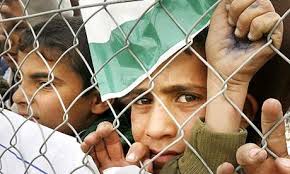
Gaza children at fence

“The people of Gaza have endured the unendurable and suffered what is insufferable for six years. Israel’s collective punishment of the civilian population in Gaza must end today,” said the Special Rapporteur.

“Israel has the responsibility as the Occupying Power to protect the civilian population. But instead of allowing a healthy people and economy to flourish, Israeli authorities have sealed off the Gaza Strip. According to statistics released by the Israeli Ministry of Defense, last month’s exports out of Gaza consisted of 49 truckloads of empty boxes, three truckloads of spices, one truckload of cut flowers, and one truckload of furniture,” he said. In 2012, the total number of truckloads of exports leaving Gaza was 254, compared to 9,787 in 2005 before the tightening of the blockade.

“It does not take an economist to figure out that such a trickle of goods out of Gaza is not the basis of a viable economy,” noted the UN expert. “The easing of the blockade announced by Israel in June 2010 after its deadly assault on the flotilla of ships carrying aid to the besieged population resulted only in an increase in consumer goods entering Gaza, and has not improved living conditions for most Gazans.  Since 2007, the productive capacity of Gaza has dwindled with 80 percent of factories in Gaza now closed or operating at half capacity or less due to the loss of export markets and prohibitively high operating costs as a result of the blockade. 34 percent of Gaza’s workforce is unemployed including up to half the youth population, 44 percent of Gazans are food insecure, 80 percent of Gazans are aid recipients,” he said.

“To make matters worse, 90 percent of the water from the Gaza aquifer is unsafe for human consumption without treatment, and severe fuel and electricity shortage results in outages of up to 12 hours a day. Only a small proportion of Gazans who can afford to obtain supplies through the tunnel economy are buffered from the full blow of the blockade, but tunnels alone cannot meet the daily needs of the population in Gaza.”

“Last year, the United Nations forecast that under existing conditions, Gaza would be uninhabitable by 2020. Less optimistic forecasts presented to me were that the Gaza Strip may no longer be viable only three years from now,” said the Special Rapporteur. “It’s clear that the Israeli authorities set out six years ago to devitalize  the Gazan population and economy,” he said, referring to a study undertaken by the Israeli Ministry of Defense in early 2008 detailing the minimum number of calories Palestinians in Gaza need to consume on a daily basis to avoid malnutrition.  The myriad of restrictions imposed by Israel do not permit civilians in Gaza to develop to their full potential, and enjoy and exercise fully their human rights.

ENDS

In 2008, the UN Human Rights Council designated Richard Falk (United States of America) as the fifth Special Rapporteur on the situation of human rights on Palestinian territories occupied since 1967. The mandate was originally established in 1993 by the UN Commission on Human Rights.

Learn more, log on to: http://www2.ohchr.org/english/countries/ps/mandate/index.htm

UN Human Rights – Occupied Palestinian Territories: http://www.ohchr.org/EN/countries/MENARegion/Pages/PSIndex.aspx

UN Human Rights – Israel: http://www.ohchr.org/EN/Countries/MENARegion/Pages/ILIndex.aspx

For more information and media requests, please contact Kevin Turner (kturner@ohchr.org) or Kiyohiko Hasegawa khasegawa@ohchr.org) or write to sropt@ohchr.org

For media inquiries related to other UN independent experts:

Cécile Pouilly, UN Human Rights – Media Unit (+ 41 22 917 9310 / cpouilly@ohchr.org)

UN Human Rights, follow us on social media:

Facebook: https://www.facebook.com/unitednationshumanrights

Twitter: http://twitter.com/UNrightswire

Google+ gplus.to/unitednationshumanrights    

YouTube: http://www.youtube.com/UNOHCHR

Storify:        http://storify.com/UNrightswire

Rethinking ‘Red Lines’

11 May

The Wrong ‘Red Line’ (expanded and revised Al-Jazeera opinion piece)


            There are widespread reports circulating in the media that President Obama had not fully appreciated the political consequences of responding to a question at an August press conference that asked about the consequences of a possible future use of chemical weapons by the Assad regime. Obama replied that such a use, should it occur, would be to cross ‘a red line.’ Such an assertion was widely understood to be a threat by Obama either to launch air strikes or to provide rebel forces with major direct military assistance, including weaponry. There have been sketchy reports that Syria did make some use chemical weapons, as well as allegations that the reported use was ‘a false flag’ operation, designed to call Obama’s bluff. As the New York Times notes in a frontpage story on May 7th, Obama “finds himself in a geopolitical box, his credibility at stake with frustratingly few good options.” Such a policy dilemma raised tactical issues for the U.S. Government about how to intervene in the Syrian civil war without risking a costly and uncertain involvement in yet another Middle Eastern war. Not responding also raises delicate questions of presidential leadership in a highly polarized domestic political atmosphere, already shamelessly exploited by belligerent Republican lawmakers backed by a feverish media that always seem to be pushing Obama to pursue a more muscular foreign policy in support of alleged America’s global interests, as if hard power geopolitics still is the key to global security.


            What is missing from the debate on Syria, and generally from the challenge to American foreign policy, is a more fundamental red line that the United States at another time and place took the lead in formulating—namely, the unconditional prohibition of the use of international force by states other than in cases of self-defense against a prior armed attack. This prohibition was the core idea embodied in the United Nations Charter, embedded in contemporary international law, and it was also a natural sequel to the prosecution and punishment of surviving German and Japanese leaders after World War II for their commission of Crimes against Peace, which was the international crime associated with engaging in aggressive warfare.  The only lawful exception to this prohibition was a use of force consistent with the terms of a prior authorization given by the UN Security Council. The key hope for world peace was this consensus among the winners in World War II that in the future aggressive war and any acquisition of territory by force, even acquired in the exercise of self-defense, must be outlawed without exceptions. Such authorizations by the Security Council were obtained by the West in the Gulf War of 1991 and again in the NATO Libya War of 2011, but in each instance the actual undertaking became controversial as a result of the scope and intensity of the military operations far exceeding the UN mandate. As a consequence, there was a loss of trust on the part of China and Russia in endorsing limited uses of force under UN auspices, which became evident in the course of the gridlocked debate about what to do in response to the regionally dangerous violence in Syria that combined internal strife with external proxy involvements threatening the expansion of the war zone in a variety of menacing ways.


            Actually the Charter red line has been surprisingly well respected over the period since 1945, at least in clear instances of border-crossing sustained violence. The UN authorized the defense of South Korea in response to an armed attack by North Korea in 1950. The UN, with surprising U.S. support, even exerted effective pressure in 1956 on the United Kingdom, France, and Israel to withdraw from territory seized after their attack on Egypt, which was the sole prominent example of law prevailing over geopolitics. In 1991 the UN successfully authorized force that followed sanctions, and succeeded in restoring the sovereignty of Kuwait after Iraq’s aggressive occupation and annexation of the country in the previous year. The UN red line held up reasonably well until the end of the last century, although all along its interpretation was subject to geopolitical manipulations by reference to a variety of loopholes and evasions associated with claims of humanitarian intervention, as well as a variety of strategically motivated covert interventions (e.g. Iran 1953, Guatemala 1954). This pattern of evasion was a prominent feature of the Cold War as both sides intervened in foreign states or in their respective spheres of influence (e.g. South Vietnam, Eastern Europe, Afghanistan) to uphold by force of arms an ideological alignment with one or the other superpower. Such uses of international force by rival superpowers without engaging the UN framework definitely eroded the authority of the anti-aggression red line and its stature in international law, but it did not lead political actors to call for its abandonment in view of the behavior of leading states. It is true that some anti-legalist international law specialists who subscribed to a realist worldview felt that patterns of state practice overrode the claims of international law and the UN Charter, and that, in effect, the red line had been erased, at least for the top tier of sovereign states. Although not made explicit, the American position was increasingly exhibiting the psychological characteristics of geopolitical bipolarity: no red line for American foreign policy, while maintaining a bright red line for others, especially for adversary states.


            What weakened this red line even more decisively was undoubtedly the American led ‘coalition of the willing’ attack on Iraq in 2003 after an American plea for UN permission to use force had been rebuffed by the Security Council despite a concerted effort to convince its members that Iraq’s supposed possession of weapons of mass destruction was such a great menace to world peace as to justify what amounted to a ‘preventive war’. This undisguised defiance of this most fundamental red line of international law by the United States also defied world public opinion that had expressed itself in the most massive anti-war demonstrations in all of history held in some 80 countries on February 15, 2003, a little more than a month before the ‘shock and awe’ start of the Iraq War.  Richard Perle, often touted as the most astute of the neocon intellectuals who fashioned American strategic policy during the Bush years, was exultant about this seemingly definitive breach of the red line, celebrating American aggression against Iraq in a Guardian article aptly headlined, “Thank God for the Death of the UN.” [March 20, 2003] Although the authority of the UN was definitely flouted by the invasion and occupation of Iraq, the UN is far from dead as an Organization in its manifold efforts to address the concerns of the world, and even its red line, although covered with dust, has not yet been erased. Maybe we should really thank God that the collective global consciousness is so forgetful!


            What is baffling about the Obama approach is that it purports to be very mindful of the importance of exhibiting respect for international law. Just last September in a speech to the General Assembly Obama said, “We know from painful experience that the path to security prosperity does not lie outside the boundaries of international law..” In his Second Inaugural Obama repeated the sentiment: “We will defend our people and uphold values through strength of arms and rule of law.” And in arguing on behalf of taking collective action against states that violate international law told the Nobel Peace Prize audience in Stockholm, “[t]hose that claim respect for international law cannot avert their eyes when those laws are flouted.”


            And yet, when reflecting on intervening in Syria or resort to a military option in relation to Iran’s nuclear program, Obama is silent about the relevance of international law, although neither instance of contemplated uses of force can be remotely claimed to be justified as either individual or collective self-defense. And for obvious reasons, there is also no mention of circumventing the red line by failing to seek authorization for a contemplated used of force from the Security Council. Presumably since approval would not be forthcoming due to the anticipated opposition of Russia and China it was not even worth considering as a public tactic. It is true that the Clinton presidency in participating via NATO in the Kosovo War proceeded also to embark on a non-defensive war without seeking prior authorization for somewhat similar reasons as any resolution on Kosovo proposing use of force was sure to be vetoed by Russia and China. The Kosovo precedent generated worries about non-defensive military undertakings lacking a legal foundation. These were offset in the belief that a humanitarian catastrophe had been averted. The Kosovo undertaking was convincingly justified at the time on credible moral grounds of imminent genocide, on political grounds as enjoying support from almost all of Kosovo’s European neighbors, and on practical grounds as a military intervention that was feasible. In effect, the legitimacy of the intervention was allowed to offset its illegality. As it turned out the military undertaking and political follow up was more difficult than anticipated, but still achieved at a reasonable cost, within a relatively short period, and productive of zero casualties among the intervening forces.

            The question raised is whether from an overall perspective, the red line of international law at stake in Syria is more like Iraq or Kosovo/Libya. It is unlike Iraq in the sense that there is an ongoing unresolved civil war in Syria that is actively destabilizing the region and already spilling over national borders to cause unrest in neighboring countries.  Syria is also the scene of severe Crimes Against Humanity that are being mainly committed by the regime. Finally, at present, there is no end of the violence is in sight give the relative strength of the two sides. It is, however, unlike Kosovo/Libya as there are proxy states acting as participants on both sides, the Damascus regime despite its behavior maintains considerable internal support while the opposition is widely viewed with deep suspicion and fear as to its democratic credentials, its lack of inclusiveness, and its uncertain respect for non-Sunni minorities. In a sense it is essential that each conflict be assessed within its own distinctive context, which should raise for discussion whether the red lines of international law and UN authority should be crossed in this instance on behalf of the blue lines of legitimacy (saving a vulnerable people from a humanitarian catastrophe) and white lines of feasibility (likelihood of success with minimum loss of life and high probability of positive net effects).


            Finally, it has been argued that the changing nature of conflict has made the red line embedded in the UN Charter obsolete or at least in need of a drastically modified interpretation.  The rationale for rethinking the Charter approach to the use of force is associated with the global security situation that has resulted from terrorist attacks since 9/11 leading to the global war on terror being waged on a battlefield without national limits and increasingly doing the killing via reliance on robotic warfare on the one side and very primitive forms of disruptive violence by political extremists on the other side. Traditional ideas of deterrence, containment, and territorial defense seem almost irrelevant in relation to global security regimes when the perceived assailants are individuals who cannot be deterred, and are operating in non-territorial networks and exhibiting a readiness to die to complete their mission. As matters are proceeding the policy about force is being formulated without bothering with the red lines of international law and the UN, regressively producing once again a world of unregulated sovereign states and extremist non-states essentially deciding on their own when war is permissible. The recent Israeli air strikes on Syrian targets is illustrative: unprovoked and non-defensive, yet eliciting scant criticism in the media or even commentary about the dangers of unilateralism with respect to uses of international force. Such normative chaos in a world where already nine countries possess nuclear weapons seems like a prescription for eventual species suicide, an impression reinforced by the failure to take precautionary steps with respect to the menace of global warming. Never has the world more needed red lines that are drawn by major states, and upheld by them out of the realization that the national interest has also merged with the global interest. Arguably the red lines of the Charter need to be modified in light of the rise of non-state actors and the advent of non-territorial warfare, but such an undertaking is no where on the agenda of major states, and so the world drifts back to the pre-World War I era of unrestricted warfare, at least on the level of geopolitics.


            What is strange in all this is that Obama talks the talk, but seems unwilling to walk the walk. Such a disjunction invites cynicism about law and morality, and induces despair on the part of those of us who believe the world we inhabit badly needs red lines, but the right red lines. Redrawing the red lines that fit the realities of our world and keep alive hopes for peace and justice, should be the great diplomatic challenge of our time, the visionary projects of leading diplomats whose imaginative gaze extends beyond addressing immediate threats. The old red lines have been put aside in contemplating what to do in relation to Syria, but without trying to establish new red lines that can serve humanity well in what has been so far a  disorienting journey in the 21st century.

The Iraq War: 10 Years Later

17 Mar


            After a decade of combat, casualties, massive displacement, persisting violence, enhanced sectarian tension and violence between Shi’ias and Sunnis, periodic suicide bombings, and autocratic governance, a negative assessment of the Iraq War as a strategic move by the United States, United Kingdom, and a few of their secondary allies, including Japan, seems near universal. Not only the regionally destabilizing outcome, including the blowback effect of perversely adding weight to Iran’s overall diplomatic influence, but the reputational costs in the Middle East associated with an imprudent, destructive, and failed military intervention make the Iraq War the worst American foreign policy disaster since its defeat in Vietnam in the 1970s, and undertaken with an even less persuasive legal, moral, and political rationale. The ongoing blowback from the ‘shock and awe’ launch scenario represents a huge, and hopefully irreversible, setback for the American global domination project in the era of hypertechno geopolitics.


            Most geopolitical accounting assessments do not bother to consider the damage to the United Nations and international law arising from an aggressive use of force in flagrant violation of the UN Charter, embarked upon in the face of a refusal by the Security Council to provide a legitimating authorization for the use of force despite great pressure mounted by the United States. The UN further harmed its own image when it failed to reinforce its refusal to grant authorization to the United States and its coalition, by offering some kind of support to Iraq as the target of this contemplated aggression. This failure was compounded by the post-attack role played by the UN in lending full support to the unlawful American-led occupation, including its state-building mission. In other words, not only was the Iraq War a disaster from the perspective of American and British foreign policy and the peace and stability of the Middle East region, but it was also a severe setback for the authority of international law, the independence of the UN, and the quality of world order.


            In the aftermath of the Vietnam War, the United States was supposedly burdened by what policymakers derisively called ‘the Vietnam Syndrome.’ This was a Washington shorthand for the psychological inhibitions to engage in military interventions in the non-Western world due to the negative attitudes towards such imperial undertakings that were supposed to exist among the American public and in the government, especially among the military who were widely blamed for the Vietnam disaster. Many American militarists at the time complained that the Vietnam Syndrome was a combined result of an anti-war plot engineered by the liberal media and a response to an unpopular conscription or ‘draft’ that required many middle class Americans to fight in a distant war that lacked both popular support, a convincing strategic or legal rationale, and seemed to be on the wrong side of history, which as the French found out in their own Indochina War favored anti-colonial wars of liberation. The flag-draped coffins of dead young Americans were shown on TV, leading defense hawks to contend somewhat ridiculously that ‘the war was lost in American living rooms.’ The government made adjustments that took these rationalizations serious: the draft was abolished, and reliance  henceforth was placed on an all-volunteer professional military complemented by large-scale private security firms; also, intensified efforts were made to assure media support for subsequent military operations by ‘embedding’ journalists in combat units and more carefully monitoring news reporting.


            President, George H.W. Bush told the world in 1991 immediately after the Gulf War that had been successfully undertaken to reverse the Iraqi annexation of Kuwait that “we have finally kicked the Vietnam Syndrome.” In effect, the senior President Bush was saying to the grand strategists in the White House and Pentagon that the role of American military power was again available for use to do the work of empire around the world. What the Gulf War showed was that on a conventional battlefield, in this setting of a desert war, American military superiority would be decisive, could produce a quick victory with minimal costs in American lives, and bring about a surge of political popularity at home. This new militarist enthusiasm created the political base for recourse to the NATO War in 1999 to wrest Kosovo from Serb control. To ensure the avoidance of casualties, reliance was placed on air attacks conducted from high altitudes. The war took more time than expected, but was interpreted as validating the claim of war planners that the United States could now fight and win ‘zero casualty wars.’ There were no NATO combat deaths in the Kosovo War, and the war produced a ‘victory’ by ending Serbian control over Kosovo as well as demonstrating that NATO could still be used and useful even after the Cold War and the disappearance of the Soviet threat that had explained the formation of the alliance in the first place.


            More sophisticated American war planners understood that not all challenges to United States interests around the world could be met with air power in the absence of ground combat. Increasingly, political violence involving geopolitical priorities took the form of transnational violence (as in the 9/11 attacks) or was situated within the boundaries of territorial states, and involved Western military intervention designed to crush societal forces of national resistance. The Bush presidency badly confused its new self-assurance about the conduct of battlefield international warfare where military superiority dictates the political outcome and its old nemesis from Vietnam War days of counter-insurgency warfare, also known as low-intensity or asymmetric warfare, where military superiority controls the battlefield but not the endgame of conflict which depends on winning the allegiance of the territorial population.


            David Petraeus rose through the ranks of the American military by repackaging counterinsurgency warfare in a post-Vietnam format relying upon an approach developed by noted guerrilla war expert David Galula, who contended that in the Vietnam War the fatal mistake was made of supposing that such a war would be determined 80% by combat battles in the jungles and paddy fields with the remaining 20% devoted to the capture of the ‘hearts and minds’ of the indigenous population. Galula argued that counterinsurgency wars could only be won if this formula was inverted.  This meant that 80% of future U.S. military interventions should be devoted to non-military aspects of societal wellbeing: restoring electricity, providing police protection for normal activity, building and staffing schools, improving sanitation and garbage removal, and providing health car and jobs.


            Afghanistan, and then Iraq, became the testing grounds for applying these nation-building lessons of Vietnam, only to reveal in the course of their lengthy, destructive and expensive failures that the wrong lessons had been learned by the militarists and their civilian counterparts. These conflicts were wars of national resistance, a continuation of the anti-colonial struggles against West-centric  domination, and regardless of whether the killing was complemented by sophisticated social and economic programs, it still involved a pronounced and deadly challenge by foreign interests to the national independence and rights of self-determination that entailed killing Iraqi women and children, and violating their most basic rights through the unavoidably harsh mechanics of foreign occupation. It also proved impossible to disentangle the planned 80% from the 20% as the hostility of the Iraqi people to their supposed American liberators demonstrated over and over again, especially as many Iraqis on the side of the occupiers proved to be corrupt and brutal, sparking popular suspicion and intensifying internal polarization. The truly ‘fatal mistake’ made by Petraeus, Galula, and all the counterinsurgency advocates that have followed this path, is the failure to recognize that when the American military and its allies attack and occupy a non-Western country, especially in the Islamic world, when they start dividing, killing and policing its inhabitants, popular resistance will be mobilized and hatred toward the foreign ‘liberators’ will spread. This is precisely what happened in Iraq, and the suicide bombings to this day suggest that the ugly patterns of violence have not stopped even with the ending of America’s direct combat role.


            The United States was guilty of a fundamental misunderstanding of the Iraq War displayed to the world when George W. Bush theatrically declared on May 1, 2003 a wildly premature victory from the deck of an American aircraft carrier USS Abraham Lincoln, with the notorious banner proclaiming ‘mission accomplished’ plainly visible behind the podium as the sun sank over the Pacific Ocean. Bush reveled in this misunderstanding by assuming that the attack phase of the war was the whole war, forgetting about the more difficult and protracted occupation phase. The real Iraq War, rather than ending, was about to begin, that is, the violent internal struggle for the political future of the country, one made more difficult and protracted by the military presence of the US and its allies. This counterinsurgency sequel to occupation would not be decided on the kind of battlefield where arrayed military capabilities confront one another, but rather through a war of attrition waged by hit and run domestic Iraqi forces, abetted by foreign volunteers, opposed to the tactics of Washington and to the overall aura of illegitimacy attached to American military operations in a Third World setting. Such a war has a shadowy beginning and a still uncertain ending, and is often, as in Iraq, as it proved to be earlier in Vietnam and Afghanistan, a quagmire for intervening powers. There are increasing reasons to believe that the current Iraqi leader, Nouri al-Maliki, resembles the authoritarian style of Saddam Hussein more than the supposed constitutional liberal regime that the United States pretends to leave behind, and that the country is headed for continuing struggle, possibly even a disastrous civil war fought along sectarian line. In many respects, including the deepening of the Sunni/Shi’a divide the country and its people are worse off that before the Iraq War without in any way questioning allegations about the cruelty and criminality of the regime headed by Saddam Hussein.


            The Iraq War was a war of aggression from its inception, being an unprovoked use of armed force against a sovereign state in a situation other than self-defense. The Nuremberg and Tokyo War Crimes Tribunals convened after World War II had declared such aggressive warfare to be a ‘crime against peace’ and prosecuted and punished surviving political and military leaders of Germany and Japan as war criminals. We can ask why have George W. Bush and Tony Blair not been investigated, indicted, and prosecuted for their roles in planning and prosecuting the Iraq War. As folk singer Bob Dylan instructed us long ago, the answer is ‘blowin’ in the wind,’ or in more straightforward language, the reasons for such impunity conferred upon the American and British leaders is one more crude display of geopolitics—their countries were not defeated and occupied, their governments never surrendered and discredited, and such strategic failures (or successes) are exempted from legal scrutiny. These are the double standards that make international criminal justice a reflection of power politics more than of evenhanded global justice.

Global civil society with its own limited resources had challenged both the onset of the Iraq War, and later its actual unfolding. On and around February 15, 2003, what the Guinness Book of Records called “the largest anti-war rally in history” took the form of about 3,000 demonstrations in 800 cities located in more than 60 countries and according to the BBC involved an estimated 6-10 million persons. Although such a global show of opposition to recourse to war was unprecedented, it failed to halt the war. It did, however, have the lasting effect of undermining the American claims of justification for the attack and occupation of Iraq. It also led to an unprecedented effort by groups around the world to pass judgment on the war by holding sessions in which peace activists and international law experts alleged the criminality of the Iraq War, and called for war crimes prosecutions of Bush and Blair. As many as twenty such events were held in various parts of the world, with a culminating Iraq War Tribunal convened in June of 2005, which included testimony from more than 50 experts, including several from Iraq and a jury of conscience headed by Arundhati Roy.


            There is also the question of complicity of countries that supported the war with troop deployments, such as Japan, which dispatched 1000 members of its self-defense units to Iraq in July 2003 to help with non-combat dimensions of the occupation. Such a role is a clear breach of international law and morality. It is also inconsistent with Article 9 of the Japanese Constitution. It was coupled with Tokyo’s diplomatic support for the U.S./UK-led Iraq War from start to finish. Should such a record of involvement have any adverse consequences? It would seem that Japan might at least review the appropriateness of its complicit participation in a war of aggression, and how that diminishes the credibility of any Japanese claim to uphold the responsibilities of membership in the United Nations. At least, it provides the people of Japan with a moment for national soul-searching to think about what kind of world order will in the future best achieve peace, stability, and human dignity.


            Are there lessons to be drawn from the Iraq War? I believe there are. The overwhelming lesson is that in this historical period interventions by the West in the non-West, especially when not authorized by the UN Security Council, can rarely succeed in attaining their stated goals. More broadly, counterinsurgency warfare involving a core encounter between Western invading and occupying forces and a national resistance movement will not be decided on the basis of hard power military superiority, but rather by the dynamics of self-determination associated with the party that has the more credible nationalist credentials, which include the will to persist in the struggle for as long as it takes, and the capacity to capture the high moral ground in the ongoing legitimacy struggle for domestic and international public support. It is only when we witness the dismantling of many of America’s 700+ acknowledged foreign military bases spread around the world, and see the end of repeated US military intervention globally, that we can have some hope that the correct lessons of the Iraq War are finally being learned. Until then there will be further attempts by the U.S. Government to correct the tactical mistakes that it claims caused past failures in Iraq (and Afghanistan), and new interventions will undoubtedly be proposed in coming years, most probably leading to costly new failures, and further controversies as to ‘why?’ we fought and why we lost. American leaders will remain unlikely to acknowledge that the most basic mistake is itself militarism and the accompanying arrogance of occupation, at least until this establishment consensus is challenged by a robust anti-militarist grassroots political movement not currently visible.      

Investigate the Death of Arafat Jaradat

1 Mar

What follows is a news report prompted by my press release on the shocking treatment of Arafat Jaradat who died while being held in an Israel prison.

27 February 2013 – A United Nations human rights expert today called for an international investigation into the death of Palestinian prisoner Arafat Jaradat, who died in Israeli custody just a few days after his arrest.

“The death of a prisoner during interrogation is always a cause for concern, but in this case, when Israel has shown a pattern and practice of prisoner abuse, the need for outside, credible investigation is more urgent than ever,” stressed the UN Special Rapporteur for human rights in the occupied Palestinian territories, Richard Falk.

“The best approach might be the creation of an international forensic team under the auspices of the UN Human Rights Council,” he added in a news release.

Both the UN Special Coordinator for the Middle East Peace Process, Robert Serry, and the Under-Secretary-General for Political Affairs, Jeffrey Feltman, have also called for an independent investigation into Mr. Jaradat’s death, which occurred on Saturday.

Mr. Falk pointed to the assessment made by the Palestinian Authority’s chief pathologist, Dr. Saber Aloul, who observed the autopsy carried out inside Israel, and found there were clear signs of torture on the body of the previously healthy, 30-year-old detainee.

Israeli officials initially claimed Mr. Jaradat died of a heart attack, but the preliminary autopsy findings did not include a cause of death, noted the news release.

“In light of Dr. Aloul’s findings that there was no evidence of heart disease or damage, and that there were signs of torture on Jaradat’s body, an independent international investigation should be launched,” stated Mr. Falk.

According to the Israeli human rights organization B’tselem, more than 700 Palestinian detainees have filed complaints against agents of the Israeli security agency Shin Bet for mistreatment during interrogation throughout the last decade. However, noted the news release, not one has led to a criminal investigation.

Mr. Jaradat hailed from the small village of Sa’ir near Hebron and was a gas station attendant. He leaves behind a four-year-old daughter and two-year-old son; his wife Dalal is pregnant with their third child.

“As an occupying power, Israel has special responsibilities under international humanitarian law to deal humanely with Palestinians held in detention, and the international community has similar responsibilities to ensure that these are carried out,” Mr. Falk underscored.

Independent experts, or special rapporteurs, are appointed by the Human Rights Council to examine and report back on a country situation or a specific human rights theme. The positions are honorary and the experts are not UN staff, nor are they paid for their work.

Urgent UN Press Statement: Release Palestinian Hunger Strikers Now

13 Feb

The following press statement was issued 13 February 2013 under the auspices of the UN Human Rights

Council in my capacity as Special Rapporteur for Palestinian Territories Occupied since 1967. This nonviolent

resistance to unlawful and abusive detention practices by Israel is a human rights outrage that should be the

occasion of media attention and a worldwide outcry. I encourage all who can to exert pressure on Israel before

these individuals die in captivity. They are currently reported to be in grave condition. Please use all

social networking tools to alert contacts.


**********************************


Press Statement – UN expert calls for the immediate

release of three Palestinian detainees on hunger strike held by Israel without

charges


GENEVA (13 February 2013) – United Nations Special Rapporteur Richard Falk

today called for the immediate release of three Palestinian detainees held

without charges by Israel. Mr. Falk expressed deep concern for the fate of

Tarek Qa’adan and Jafar Azzidine, who are on their 78th day of hunger

strike, and Samer Al-Issawi, who has been on partial hunger strike for

over 200 days.


“Continuing to hold Mr. Qa’adan, Mr Azzidine and Mr. Al-Issawi under these

conditions is inhumane. Israel is responsible for any permanent harm,”

warned the independent expert designated by the Human Rights Council to

monitor and report on Israeli rights violations in Palestine. “If Israeli

officials cannot present evidence to support charges against these men,

then they must be released immediately.”


“Mr. Qa’adan and Mr. Azzidine are reportedly on the verge of death, with

the threat of a fatal heart attack looming,” the expert noted, recalling

that both men were arrested on 22 November 2012 and began their hunger

strikes on 28 November, after being sentenced to administrative detention

for a period of three months. They were transferred to Assaf Harofi

Hospital near Tel Aviv on 24 January 2013 after their conditions

deteriorated sharply.


This is the second time that Mr. Azzidine and Mr. Qa’adan have undertaken

hunger strikes against administrative detention, since they took part in

the mass hunger strike of Palestinians from 17 April to 14 May 2012. Mr.

Qa’adan had been released after 15 months of detention on 8 July 2012 and

Mr. Azzidine had been released on 19 June 2012 after three months of

detention, before being re-arrested.


“Israel must end the appalling and unlawful treatment of Palestinian

detainees. The international community must react with a sense of urgency

and use whatever leverage it possesses to end Israel’s abusive reliance on

administrative detention,” urged the Special Rapporteur.


Mr. Falk noted that Israel currently holds at least 178 Palestinians in

administrative detention.

**********


Hamas, Khaled Mashaal and Prospects for a Sustainable Israel/Palestine Peace

12 Dec


            In the aftermath of Khaled Mashaal’s emotional visit to Gaza in celebration of Hamas’ 25th anniversary, commentary in Israel and the West has focused on his remarks at a rally as ‘defiant’ and disclosing ‘the true face’ of Hamas. Emphasis was particularly placed on his dramatic pledge to recover the whole of historic Palestine, from the Mediterranean to Jordan, “inch by inch,” no matter how long such a process might take. Mashaal also challenged the legitimacy of the Zionist project, and justified Palestinian resistance in whatever form it might assume, although disavowing the intention to attack civilians as such, and denying any complicity by Hamas in the November 21, 2012 incident in Israel when a bomb exploded in a Jerusalem bus.


            These remarks certainly raise concerns for moderate Israelis who continue to advocate a two-state solution in accordance with UN Security Council Resolution 242, but at the same time, it is important to listen to Hamas fully before reaching any firm conclusions. What Mashaal said in Gaza was at a rally dedicated to reaffirming its fundamental struggle in the immediate aftermath of the recent 8 day Israeli attack (code-named Pillar of Defense), and by a leader who for the first time in 45 years had openly dared to set foot in his occupied and oppressed homeland. Mashaal is a leader who has lived in exile in several countries of the region since he was 11 years old, having been born in the Selwad neighborhood of Ramallah, then under Jordanian control. He is someone who in 1997 Israel had tried to murder in a notorious incident in Jordan in which only the capture of the Mossad perpetrators induced Israel to supply a life-saving antidote for the poison that had been sprayed into Mashaal’s ear in exchange for their release from Jordanian captivity. In Mashaal’s imagery, this return to Gaza was his ‘third birth,’ the first being in 1956 when he was born, the second when he survived the Israeli assassination attempt, and the third when he was able to kiss the ground upon entering Gaza. These biographical details seem relevant for an assessment of his public remarks.


            The context was also given a heightened reality by the Hamas/Gaza success in enduring the latest Israeli military onslaught that produced a ceasefire that contained some conditions favoring Gaza, including an Israeli commitment to refrain from targeted assassinations in the future. It also was a context shaped by recent and more distant painful memories that was the main trigger of the upsurge of violence, especially the assassination of the Hamas military leader and diplomat, Ahmed al-Jabari, and the May 22, 2003 killing of the disabled spiritual founder of Hamas, Sheikh Ahmed Yassin. It was after Sheikh Yassin’s death that Mashaal was declared ‘world leader’ of Hamas.


            The most important element of context that needs to be taken into account is the seeming inconsistency between the fiery language used by Mashaal in Gaza and his far more moderate tone in the course of several interviews with Western journalists in recent weeks. In those interviews Mashaal had clearly indicated a readiness for a long-term hudna or truce, provided that Israel ended its occupation of the West Bank, East Jerusalem, and Gaza, and agreed to uphold Palestinian rights under international law. He made clear that these rights included the right of return belonging to the 4-5 million Palestinians living in refugee camps or exile, and contended that such a right was more deserving of recognition than is the Israeli grant of such a right of return to every Jew even to those completely without a prior connection to historic Palestine. Of course, this claimed right is in its potentiality a threatening claim to Israel, and to Zionism, as it could, at least in theory, threaten the Jewish majority presence in Israel. Whether many Palestinians if given the choice would return to live in Israel so as to reinhabit their ancestral homes seems highly questionable, but the right to do so  unquestionably belongs to Palestinians, at least to those who had previously resided in present Israel.


            In these interviews, Mashaal was consistent about the readiness of Hamas to pursue these national goals nonviolently, without “weapons and blood” if Israel were to accept such a framework for peace. His words to CNN in a November 22nd interview are notable in this respect: “We are ready to resort to a peaceful way, purely peaceful way without blood and weapons, as long as we obtain our Palestinian demands.” The extent of “Palestinian  demands” was left unspecified, which does create an ambiguity as to whether this meant accommodation or some kind of rearticulation of a unified Palestinian entity. Also unclear as to whether the peaceful path could precede the end of occupation, or must be a sequel to the existence of a state. In the other direction, Mashaal indicated that once Palestinian statehood was fully realized, then the issue of the acceptance of Israeli legitimacy could be placed on the political agenda. His deputy, Mousa Abu Marzook, in a conversation in Cairo told me in a similar vein that the Hamas Charter pledge to destroy the Zionist state had become “a false issue.” This PhD from Louisiana Tech, an intelligent exponent of Hamas thinking, echoed Mashaal’s moderate approach, and indicated that as with the U.S. Constitution’s treatment of slavery, the Hamas Charter has evolved with changing circumstance, and its clauses subject to modification by interpretation.   


            Along similar lines, Mashaal has spoken about Hamas as ‘realistic’ with respect to an appreciation of the balance of forces relative to the conflict, and referred to Arafat’s response to those who insisted that Israel would be at mortal risk if a Palestinian state were to be established on the West Bank. The former PLO leader had pointed out that any Palestinian move to threaten Israel militarily in such circumstances was unthinkable. It would be sure to produce a devastating attack that would crush Palestinian hopes forever.


            There is posed a fundamental question: what is the true voice of Hamas? There seems to be a sharp contrast between the fiery language of Mashaal’s words spoken at the anniversary demonstration in Gaza and his far calmer and accommodating tone in interviews and other statements in recent years.  The more hopeful understanding would suggest a gap between the emotional occasion of the speech and the more rational views consistently expressed elsewhere. Such an explanation is the opposite of the Western insistence that only the rally speech gave expression to the authentic outlook of Hama. In contrast, I would accord greater weight given to the moderate formulations, at least for exploratory purposes. Put differently, in Gaza Mashaal was likely expressing a maximalist version of the Palestinian narrative relating to its sense of legitimacy while in more reflective arenas, ever since the entry of Hamas into electoral politics back in 2006, its dominant emphasis has been on pursuing a political track that envisioned long-term peaceful co-existence with Israel, a sidestepping of the legitimacy issues, at least once the occupation was definitively ended and the rights of Palestinian refugees was recognized in accordance with international law.


            It can be asked, ‘How can Hamas dare to put forward such a claim in view of the steady rain of rockets that has made life treacherous and miserable for the more than a million Israelis living in the southern part of Israel ever since Israel ‘disengaged’ in 2005?’ Such a rhetorical question repeated over and over again without reference to the siege or Israeli violence has distorted the Western image of the interaction, suggesting that when Israel massively attacks helpless Gaza it is only exercising its defensive rights, which is the most fundamental entitlement of every sovereign state. Again the more accurate interpretation depends on a fuller appreciation of the wider context, which would include the American plot to reverse the outcome of the 2006 electoral victory of Hamas by arming Fatah with heavy weapons, the Israeli punitive blockade since mid-2007, [Vanity Fair, 2008] and many instances of provocative Israeli violence, including a steady stream of targeted assassinations and lethal over-reactions at the Gaza border. Although not the whole story, the one-sided ratio of deaths as between Israel and Palestine is a good first approximation of comparative responsibility over the period of Hamas ascendancy in Gaza, and it is striking. For instance, between the ceasefire in 2009 and the Israeli attack in November 2012, 271 Palestinians were killed and not a single Israeli. [B’Teselm report] The respected Haaretz columnist, Gideon Levy, has pointed out that since the first rockets were launched against Israeli in 2001 59 Israeli have died as compared to 4,717 Palestinians.


            The Western media is stunningly oblivious to these complications of perception, almost never disclosing Israeli provocations in reporting on the timelines of the violence of the parties, and fails to acknowledge that it has been the Israelis, not the Palestinians, that have been mostly responsible for ending periods of prolonged truce. There are further confusing elements in the picture, including the presence of some extremist Palestinian militias that launch rockets in defiance of Hamas policy, which in recent years generally limits rockets to retaliatory roles. Among the ironies of the al-Jabari assassination was that it was evidently his role to restrain these militias on  behalf of Hamas, including disciplining those extremists who refused to abide by policies of restricting rocket attacks to retaliatory situations.


            There is no doubt that Hamas’ reliance on rockets fired in the direction of Israeli civilian population centers are violations of international humanitarian law, and should be condemned as such, but even this condemnation is not without its problematic aspects. The Goldstone Report did condemn the reliance of these rockets in a typically decontextualized manner, that is, without reference to the unlawfulness of the occupation, including its pronounced reliance on collective punishment in the form of the blockade as well as arbitrary violent incursions, frequent military overflights, and a terrifying regime of subjugation that imparts on Palestinians a sense of total vulnerability and helplessness. The Goldstone Report also was silent as to the nature and extent of a Palestinian right of resistance. Such unconditional condemnations of Hamas as ‘a terrorist organization’ are unreasonably one-sided to the extent that Palestinian moral, political, and legal rights of resistance are ignored and Israel’s unlawful policies are not considered. This issue also reveals a serious deficiency in international humanitarian law, especially, as here, in the context of a prolonged occupation that includes many violations of the most fundamental and inalienable rights of an occupied people. The prerogatives of states are upheld, while those of peoples are overlooked or treated as non-existent.


            It is also relevant to take note of the absence of alternative means available to the Palestinians to uphold their rights under international law and to challenge the abuses embedded in Israeli occupation policies. Israel with its drones, Apache helicopters, F-16 fighter aircraft, Iron Dome, and so forth enjoys the luxury of choosing its targets at will, but Palestinians have no such option. For them it is either using the primitive and indiscriminate weaponry at their disposal or essentially giving in to an intolerable status quo. To repeat, this does not make Hamas rockets lawful, but does it make such reliance wrong, given the overall context of violence that includes absolute impunity for Israeli violations of international criminal law? What are we to do with international law when it is invoked only to control the behavior of the weaker party?


            It gives perspective to imagine the situation being reversed as it was during the Nazi occupation of France or the Netherlands during World War II. Resistance fighters were uniformly perceived in the liberal West as unconditional heroes, and no critical attention was given as to whether the tactics used unduly imperiled innocent civilian lives. Those who lost their lives in such a resistance were honored as martyrs. Mashaal and other Hamas leaders have made similar arguments on several occasions, in effect asking what are Palestinians supposed to do in the exercise of resistance given their circumstances, which have persisted for so long, given the failures of traditional diplomacy and the UN to secure their rights under international law.


            In effect, a sensitive appreciation of context is crucial for a proper understanding, which makes self-satisfied condemnations of the views and tactics of Hamas and Khaled Mashaal misleading and, if heeded, condemns the parties to a destiny of perpetual conflict. The Western mainstream media doesn’t help by presenting the rocket attacks as if taking place in a vacuum, and without relevant Israeli provocations. Of course, Israeli supporters will retort that it is easy to make such assessments from a safe distance, but what is a safe distance? “The risks are ours alone,” they will say with a somewhat understandable hostility. But what about the horrible Palestinian circumstances, are they not also entitled to redress?


            Is there a way out of such tragic dilemmas? In my view, only when the stronger side militarily treats ‘the other’ as having grievances and rights, and recognizes that the security of ‘the self’ must be based on mutuality, will sustainable peace have a chance. In this conflict, the Israelis missed a huge opportunity to move in this direction when the weaker Palestinian side made a historic concession by limiting its political ambition to Occupied Palestine (22% of historic Palestine, less than half of what the UN partition plan proposed in 1947) in accord with the consensus image of a solution embodied in Security Council Resolution 242. Instead Israel has sought to encroach further and further on that Palestinian remnant by way of its settlements, separation wall, apartheid roads, and annexationist moves, offering the Palestinians no alternative to oppression than resistance.  It is no wonder that even the accommodationist Palestinian Authority supported the recent Hamas anniversary celebrations, and joined in proclaiming an intention to reconcile, reuniting Hamas and Fatah under the umbrella of the Palestine Liberation Organization.


            It is possible to react to the Gaza speech of Khaled Mashaal as the definitive expression of the Hamas creed, but it seems premature and unwise to do so. Instead, it is time to give a balanced diplomacy a chance if indeed there is any political space left for the implementation of the two-state consensus, and if there isn’t, then it is time to explore alternatives, including a return to a unified Palestine that is governed in accordance with human rights standards and international law. If this diplomatic dead end is the stark reality as of 2012, then it must be concluded that the overreaching by the Zionist leadership in Israel, especially its insistence on viewing the West Bank and East Jerusalem as integral to biblical Israel, referencing the former as ‘Judea and Samaria’ and the latter as the eternal Jewish capital, has itself undermined the political, moral, and legal viability of the Zionist Project. These alternative options should long ago have been clarified, and now, by taking to heart ‘the peaceful alternative’ depicted by Mashaal, especially in the aftermath of the General Assembly endorsement of Palestinian statehood and signs of an incipient Palestinian unity, there is one last opportunity to do so, should peace-oriented perspectives on the conflict be given a chance, however remote, to guide our thinking, feelings, and actions. 

The Latest Gaza Catastrophe: Will They Ever Learn?

18 Nov


            [This post is an updated version of an article published in the online English edition of Al Jazeera, 17 Nov 2012, taking account of some further developments in the new horrifying unfolding of violence in Gaza.


            President Obama, upon his arrival today in Bangkok at the start of a state visit to several Asian countries, reminded the world of just how unconditional U.S. support for Israel remains. Obama was quoted as saying, “There is no country on earth that would tolerate missiles raining down on its citizens from outside of its borders. We are fully supportive of Israel’s right to defend itself.” Much is missing from such a sentiment, most glaringly, the absence of any balancing statement along the following line: “and no country would tolerate the periodic assassination of its leaders by missiles fired by a neighboring country, especially during a lull achieved by a mutually agreed truce. It is time for both sides to end the violence, and establish an immediate ceasefire.”


            But instead of such statesmanship from this newly elected leader what we hear from Ben Rhodes, his Deputy National Security Advisor, who is traveling with the president in Asia is the following: that the rockets from Gaza are “the precipitating factor for the conflict. We believe Israel has a right to defend itself, and they’ll make their own decisions about the tactics they use in that regard.” Of course, these tactics up to this point have involved attacking a densely urbanized population with advanced weaponry from air and sea, targeting media outlets, striking residential structures, and killing and wounding many civilians, including numerous children. Since when does ‘the right to defend oneself’ amount to a license to kill and wound without limit, without some clear demonstration that the means of violence are connected with the goals being sought, without a requirement that force be exclusively directed against military targets, without at least an expression of concern about the proportionality of the military response? To overlooks such caveats in the present context in which Gaza has no means whatsoever defend itself indicates just how unconditional is the moral/legal blindfold that impairs the political wisdom and the elemental human empathy of the American political establishment.


            The statement by Rhodes signals a bright green light to the Netanyahu government to do whatever it wishes as far as Washington is concerned, and omits even a perfunctory mention of the relevance of international law. It presumes American exceptionalism, now generously shared with Israel, that doesn’t even have to bother justifying its behavior, conveying to the world an imperial directive that what would be treated as unspeakable crimes if committed by others are matters of discretion for the United States and its closest governmental associates.


            And what Netanyahu proposes is as chilling as it is criminal: to “significantly expand” what he calls Israel’s “Gaza operation” and what I call “the killing fields of Gaza.” This idea that a state defends itself by such an all out attack on an undefended society is humanly unacceptable, as well as being a mandate for future retaliation and festering hatred. Operation Cast Lead was launched in December 2008 to contribute to Israeli security, but instead led Hamas to acquire the kind of longer range rockets that are now posing genuine threats to Israel’s major cities. The unfolding logic of the conflict is that in a few years, Israel will be confronted by more sophisticated rockets capable of eluding the Iron Dome and accurately pinpointing their intended targets. This deadly logic of the war system continues to guide strategists and military planners in Washington and Tel Aviv, and ignores the string of political failures that marks recent American history from Vietnam to Afghanistan. The world has changed since the good old colonial days of gunboat diplomacy, and the history-making reality of military superiority. Will they ever learn?


            What should have been clear long ago is that Israeli security is not achieved by guns and missiles, nor incidentally are Hamas’ goals reached by rockets. The only clear path to security is to follow a ceasefire with some mutual assurances of nonviolent coexistence, a lifting of the blockade of Gaza, an acceptance by Israel (and the United States) of both Hamas and the Palestinian Authority as political actors, freezing all settlement construction, and a revival of negotiations on the basis of a commitment to produce a sustainable and just peace in accordance with Palestinian and Israeli rights under international law, above all the Palestinian right of self-determination. Depicting such a moderate approach to security for these two peoples highlights just how pathological present patterns of ‘acceptable’ behavior have become.


            Israel’s policies seemed almost calculated to increase future ‘insecurity’ for its people and the region. There is a slow ongoing mobilization of the region in support of Palestinian claims well expressed by the diplomatic re-positioning of Egypt and Turkey.  It will be become much more difficult for the United States to insulate Israel from the consequences of its future aggressions against the Palestinians. This is partly because it is likely that the next time, militants hostile to Israel will be better armed, as was true for Hezbollah after the 2006 Lebanon War and for Hamas since the 2008-09 Gaza attacks, and partly because the balance of regional forces is tilting quickly against Israel.


            These speculations make such obvious points that most Israeli strategists must be assumed to have appreciated them. It makes one wonder whether it is wrong to think of this latest surge of Israeli violence as primarily motivated by security considerations. Perhaps other motivations have greater weight: diverting attention from annexationist moves in the West Bank; reinforcing the Netanyahu claims to be the gallant protector of the nation; removing any pressure on Israel to uphold Palestinian rights; reminding Iran yet again of the militarized fury of an antagonized Israel assured of U.S. support.]


**************the text of the AJ article is reproduced below—————————


            The media double standards in the West on the new and tragic Israeli escalation of violence directed at Gaza were epitomized by an absurdly partisan New York Times front page headline: “Rockets Target Jerusalem; Israel girds for Gaza Invasion.” (NYT,  16 Nov 2012) Decoded somewhat, the message is this: Hamas is the aggressor, and Israel when and if it launches a ground attack on Gaza must expect itself to be further attacked by rockets. This is a stunningly Orwellian re-phrasing of reality. The true situation is, of course, quite the opposite: namely, that the defenseless population of Gaza can be assumed now to be acutely fearful of an all out imminent Israeli assault, while it is also true, without minimizing the reality of a threat, that some rockets fired from Gaza fell harmlessly (although with admittedly menacing implications) on the outskirts of Jerusalem and Tel Aviv. There is such a gross disproportion in the capacity of the two sides to inflict damage and suffering due to Israeli total military dominance as to make perverse this reversal of  concerns to what might befall Israeli society if the attack on Gaza further intensifies.


            The reliance by Hamas and the various Gaza militias on indiscriminate, even if wildly inaccurate and generally harmless, rockets is a criminal violation of international humanitarian law, but the low number of casualties caused and the minor damage caused, needs to be assessed in the overall context of massive violence inflicted on the Palestinians. The widespread non-Western perception of the new cycle of violence involving Gaza is that it looks like a repetition of Israeli aggression against Gaza in late 2008, early 2009, that similarly fell between the end of American presidential elections and scheduled Israeli parliamentary elections.


            There is the usual discussion over where to locate responsibility for the initial act in this renewed upsurge violence. Is it some shots fired from Gaza across the border and aimed at an armored Israeli jeep or was it the targeted killing by an Israeli missile of Ahmed al-Jabani, leader of the military wing of Hamas, a few days later? Or some other act by one side or the other? Or is it the continuous violence against the people of Gaza arising from the blockade that has been imposed since mid-2007? The assassination of al-Jabani came a few days after an informal truce that had been negotiated through the good offices of Egypt, and quite ironically agreed to by none other than al-Jabani acting on behalf of Hamas. Killing him was clearly intended as a major provocation, disrupting a carefully negotiated effort to avoid another tit-for-tat sequence of violence of the sort that has periodically taken place during the last several years. An assassination of such a high profile Palestinian political figure as al-Jahani is not a spontaneous act. It is based on elaborate surveillance over a long period, and is obviously planned well in advance partly with the hope of avoiding collateral damage, and thus limiting unfavorable publicity. Such an extra-judicial killing, although also part and parcel of the new American ethos of drone warfare, remains an unlawful tactic of conflict, denying adversary political leaders separated from combat any opportunity to defend themselves against accusations, and implies a rejection of any disposition to seek a peaceful resolution of a political conflict. It amounts to the imposition of capital punishment without due process, a denial of elementary rights to confront an accuser.


            Putting aside the niceties of law, the Israeli leadership knew exactly what it was doing when it broke the truce and assassinated such a prominent Hamas leader, someone generally thought to be second only to the Gaza prime minister, Ismail Haniya. There have been rumors, and veiled threats, for months that the Netanyahu government plans a major assault of Gaza, and the timing of the ongoing attacks seems to coincide with the dynamics of Israeli internal politics, especially the traditional Israeli practice of shoring up the image of toughness of the existing leadership in Tel Aviv as a way of inducing Israeli citizens to feel fearful, yet protected, before casting their ballots.


            Beneath the horrific violence, which exposes the utter vulnerability, of all those living as captives in Gaza, which is one of the most crowded and impoverished communities on the planet, is a frightful structure of human abuse that the international community continues to turn its back upon, while preaching elsewhere adherence to the norm of ‘responsibility to protect’ whenever it suits NATO. More than half of the 1.6 million Gazans are refugees living in a total area of just over twice the size of the city of Washington, D.C.. The population has endured a punitive blockade since mid-2007 that makes daily life intolerable, and Gaza has been harshly occupied ever since 1967.


            Israel has tried to fool the world by setting forth its narrative of a good faith withdrawal from Gaza in 2005, which was exploited by Palestinian militants as the time as an opportunity to launch deadly rocket attacks. The counter-narrative, accepted by most independent observers, is that the Israeli removal of troops and settlements was little more than a mere redeployment to the borders of Gaza, with absolute control over what goes in and what leaves, maintaining an open season of a license to kill at will, with no accountability and no adverse consequences, backed without question by the U.S. Government. From an international law point of view, Israel’s purported ‘disengagement’ from Gaza didn’t end its responsibility as an Occupying Power under the Geneva Conventions, and thus its master plan of subjecting the entire population of Gaza to severe forms of collective punishment amounts to a continuing crime against humanity, as well as a flagrant violation of Article 33 of Geneva IV. It is not surprising that so many who have observed the plight of Gaza at close range have described it as ‘the largest open air prison in the world.’


            The Netanyahu government pursues a policy that is best understood from the perspective of settler colonialism. What distinguishes settler colonialism from other forms of colonialism is the resolve of the colonialists not only to exploit and dominate, but to make the land their own and superimpose their own culture on that of indigenous population. In this respect, Israel is well served by the Hamas/Fatah split, and seeks to induce the oppressed Palestinian to give up their identity along with their resistance struggle even to the extent of asking Palestinians in Israel to take an oath of loyalty to Israel as ‘a Jewish state.’ Actually, unlike the West Bank and East Jerusalem, Israel has no long-term territorial ambitions in Gaza. Israel’s short-term solution to its so-called ‘demographic problem’ (that is, worries about the increase in the population of Palestinians relative to Jews) could be greatly eased if Egypt would absorb Gaza, or if Gaza would become a permanently separate entity, provided it could be reliably demilitarized. What makes Gaza presently useful to the Israelis is their capacity to manage the level of violence, both as a distraction from other concerns (e.g. backing down in relation to Iran; accelerated expansion of the settlements) and as a way of convincing their own people that dangerous enemies remain and must be dealt with by the iron fist of Israeli militarism.


            In the background, but not very far removed from the understanding of observers, are two closely related developments. The first is the degree to which the continuing expansion of Israeli settlements has made it unrealistic to suppose that a viable Palestinian state will ever emerge from direct negotiations. The second, underscored by the recent merger of Netanyahu and Lieberman forces, is the extent to which the Israeli governing process has indirectly itself irreversibly embraced the vision of Greater Israel encompassing all of Jerusalem and most of the West Bank. The fact that world leaders in the West keep repeating the mantra of peace through direct negotiations is either an expression of the grossest incompetence or totally bad faith. At minimum, Washington and the others calling for the resumption of direct negotiations owe it to all of us to explain how it will be possible to establish a Palestinian state within 1967 borders when it means the displacement of most of the 600,000 armed settlers now defended by the Israeli Defense Forces, and spread throughout occupied Palestine. Such an explanation would also have to show why Israel is being allowed to quietly legalize the 100 or so ‘outposts,’ settlements spread around the West Bank that had been previously unlawful even under Israeli law. Such moves toward legalization deserve the urgent attention of all those who continue to proclaim their faith in a two-state solution, but instead are ignored.


            This brings us back to Gaza and Hamas. The top Hamas leaders have made it abundantly clear over and over again that they are open to permanent peace with Israel if there is a total withdrawal to the 1967 borders (22% of historic Palestine) and the arrangement is supported by a referendum of all Palestinians living under occupation. Israel, with the backing of Washington, takes the position that Hamas as ‘a terrorist organization’ that must be permanently excluded from the procedures of diplomacy, except of course when it is serves Israel’s purposes to negotiate with Hamas. It did this in 2011 when it negotiated the prisoner exchange in which several hundred Palestinians were released from Israeli prisons in exchange for the release of the Israel soldier captive, Gilad Shalit, or when it seems convenient to take advantage of Egyptian mediation to establish temporary ceasefires. As the celebrated Israeli peace activist and former Knesset member, Uri Avnery, reminds us a cease-fire in Arab culture, hudna in Arabic, is considered to be sanctified by Allah, has tended to be in use and faithfully observed ever since the time of the Crusades. Avnery also reports that up to the time be was assassinated al-Jabari was in contact with Gershon Baskin of Israel, seeking to explore prospects for a long-term ceasefire that was reported to Israeli leaders, who unsurprisingly showed no interest.


            There is a further feature of this renewal of conflict involving attacks on Gaza. Israel sometimes insists that since it is no longer, according to its claims, an occupying power, it is in a state of war with a Hamas governed Gaza. But if this were to be taken as the proper legal description of the relationship between the two sides, then Gaza would have the rights of a combatant, including the option to use proportionate force against Israeli military targets. As earlier argued, such a legal description of the relationship between Israel and Gaza is unacceptable. Gaza remains occupied and essentially helpless, and Israel as occupier has no legal or ethical right to engage in war against the people and government of Gaza, which incidentally was elected in internationally monitored free elections in early 2006. On the contrary, its overriding obligation as Occupier is to protect the civilian population of Gaza. Even if casualty figures in the present violence are so far low as compared with Operation Cast Lead, the intensity of air and sea strikes against the helpless people of Gaza strikes terror in the hearts and minds of every person living in the strip, a form of indiscriminate violence against the spirit and mental health of an entire people that cannot be measured in blood and flesh, but by reference to the traumatizing fear that has been generated.


            We hear many claims in the West as to a supposed decline in international warfare since the collapse of the Soviet Union 20 years ago. Such claims are This is to some extent a welcome development, but the people of the Middle East have yet to benefit from this trend, least of all the people of Occupied Palestine, and of these, the people of Gaza are suffering the most acutely. This spectacle of one-sided war in which Israel decides how much violence to unleash, and Gaza waits to be struck, firing off militarily meaningless salvos of rockets as a gesture of resistance, represents a shameful breakdown of civilization values. These rockets do spread fear and cause trauma among Israeli civilians even when no targets are struck, and represent an unacceptable tactic. Yet such unacceptability must be weighed against the unacceptable tactics of Israel that holds all the cards in the conflict. It is truly alarming that now even the holiest of cities, Jerusalem, is threatened with attacks, but the continuation of oppressive conditions for the people of Gaza, inevitably leads to increasing levels of frustration, in effect, cries of help that world has ignored at its peril for decades. These are survival screams! To realize this is not to exaggerate! To gain perspective, it is only necessary to read a recent UN Report that concludes that the deterioration of services and conditions will make Gaza uninhabitable by 2020. 


           That is, completely aside from the merits of the grievances on the two sides, for one side to be militarily omnipotent and the other side to be crouching helplessly in fear. Such a grotesque reality passes under the radar screens of world conscience because of the geopolitical shield behind which Israel is given a free pass to do whatever it wishes. Such a circumstance is morally unendurable, and should be politically unacceptable. It needs to be actively opposed globally by every person, government, and institution of good will.     


Hope, Wisdom, Law, Ethics, and Spirituality in relation to Killing and Dying: Persisting Syrian Dilemmas

12 Oct


            In appraising political developments most of us rely on trusted sources, our overall political orientation, what we have learned from past experience, and our personal hierarchy of hopes and fears. No matter how careful, and judicious, we are still reaching conclusions in settings of radical uncertainty, which incline our judgments to reflect a priori and interpretative biases. As militarists tends to favor reliance on force to resolve disputes among and within sovereign states, so war weary and pacifist citizens will seek to resolve even the most extreme dire conflict situations by insisting on the potentialities of non-violent diplomacy.


In the end, even in liberal democracies most of us are far too dependent on rather untrustworthy and manipulated media assessments to form our judgments about unfolding world events. How then should we understand the terrible ongoing ordeal of violence in Syria? The mainly polarized perceptions of the conflict are almost certain to convey one-sided false impressions that either the atrocities and violence are the work of a bloody regime that has a history of brutal oppression or that this hapless country has become the scene of a proxy war between irresponsible outsiders, with strong religious sectarian overtones of the Sunni/Shi’ia regional divide, and further complicated by various geopolitical alignments and the undisclosed ambitions of the United States, Russia, Israel, Iran, Saudi Arabia, and others. Undoubtedly, the truth lies at some point between the two poles, with many ambiguities, undisclosed interferences, and assorted unknowns undermining our capacity to reach any ‘objective’ understanding, and leading many to discount the extremely dirty hands of all the major participants, seen and unseen, so as to permit a clear partisan position of being for or against.


The difficulties are even greater. If, in contrast, we seek to interpret the conflict from all angles with as much detachment as possible, the result is likely to be paralyzing so far as action is concerned. There is too much uncertainty, secrecy, and complexity to give rise to the clarity needed to shape policy with any confidence, and without confidence killing or allowing the killing to continue, no responsible conclusion can be reached. In effect, only over-simplification, that is, polarized interpretations, are capable of overcoming passivity, but at a high cost. Arguably, in relation to the Syrian maelstrom, passivity functions as a political virtue, or put differently, as the lesser of evils.  


In such a situation, assuming we repudiate proxy and geopolitical agendas as the desired bases for determining the future for Syria, what should we hope for? A rapid end of the violence, some sort of now unimaginable accommodation between the two (or many) sides in the struggle, a recognition by the various ‘interested’ third parties that their goals cannot be attained at acceptable costs, an abdication by Bashar al-Assad, an arms embargo uniformly enforced, the completely implausible emergence of constitutional democracy, including respect for minority rights. Merely composing such a wish list underscores the seeming hopelessness of resolving the situation in as acceptable manner, and yet we know that it will somehow be eventually resolved.


From the perspective of the Syrian factions and participants, so much of their own blood has been spilled, that it probably seems unacceptable and unreliable to be receptive at this point to any offer of reconciliation, and when the only hope is for either an unconditional victory for the self or the extermination of the other. And with such extremist attitudes, it is not surprising that the bodies keep piling up! What are we to do when every realistic trajectory adds to an outcome that is already tragic?


My approach in these situations of internal conflict has been to oppose and distrust the humanitarian and democratizing pretensions of those who counsel intervention under the alluring banner of ‘the responsibility to protect.’ (R2P) and other liberal rationales supportive of military intervention, what Noam Chomsky tellingly calls ‘military humanism.’ Yet in concrete situations such as existed in Kosovo in 1999, Libya in 2011, and Syria today, to counsel a passive international response to the most severe crimes against humanity and genocidal atrocities would seems to deny the most elemental ethical bonds of human solidarity in a networked, globalized world, bonds that may turn out in the near future to be indispensable if we are to achieve environmental sustainability before the planet burns us to a crisp.


            There are structural issues arising from the statist character of world order in the post-colonial era that make political choices in such situations of bitter internal conflict a tragic predicament. On the one side, is the statist logic that endows territorial governments with unconditional authority to sustain their unity in the face of insurgent challenges, a political principle given constitutional backing in Article 2(7) of the UN Charter, prohibiting UN intervention in internal conflicts. This statist logic is deeply confused and contradicted by legitimizing the inalienable and emancipatory right of self-determination conferred on every ‘people,’ and not on governments. In the background, as well, are the various non-Western collective memories, uniformly bad, of colonial rule, and wellfounded contemporary suspicions that humanitarian interventions, however described and unwittingly, represent attempted colonialist revivals, both ideologically and behaviorally.  


On the other side of the policy fence, there is an odd coalition of liberal internationalists who sincerely regard intervention as an essential tool for the promotion of a more humane world along with more cynical geopolitical strategists who regard conflict zones, especially where large oil reserves exist, as targets of opportunity for extending Western interests. Further, normative confusion arises from the drift of practice on the part of the UN that has been understood to vest in the Security Council unlimited competence to interpret the Charter as it wishes. (See World Court decision in the Lockerbie case, which coincidentally involved Libya) In this regard, the rhetoric of human rights has been used to circumvent the Charter limits restricting UN competence to address conflicts internal to states: for instance, the Security Council in 2011 authorized a ‘No Fly Zone’ for Libya that was immediately converted by the NATO intervenors into a de facto mandate for ‘regime change’; the whole undertaking was validated for most advocates of the broadened undertaking because it freed Libya from a murderous dictatorship; others approved, believing that the operation involved a proper invocation of the R2P norm, and still others endorsed the intervention on the basis of its supposed post-conflict state-building successes, avoiding chaos, and especially the rather impressive efforts to base the governance of Libya on democratic procedures. As the situation continues to evolve, there exists controversy as to how to assess the positive and negative aspects of post-Qaddafi Libya.


In evaluating our positions for or against a given intervention, should our sense of strategic motivations matter? For instance, the Kosovo intervention was at least partially motivated by the desire in Washington and among many European elites to show that NATO was still useful despite the end of the Cold War and the disappearance of the Soviet threat that generated the alliance in the first place. Do such strategic considerations matter if indeed the people of Kosovo were spared the kind of ethnic cleansing endured not long before by the people of Bosnia, culminating in the genocide at Srebrenica in 1995? Might it not be claimed that only when strategic incentives exist, will an intervention be of sufficient magnitude to be effective? In effect, altruism alone will not produce effective forms of humanitarian intervention. Does the existence of double standards matter? Certain crimes against humanity generate an interventionary response while others are overlooked, for instance, the persisting collective punishment of the people of Gaza. Should we drink from a glass that is only half full? The same question applies to the recent surge of criminal prosecutions under the authority of the International Criminal Court.


There are other ways of evaluating what has taken place. For example, should the consequences of intervention or non-intervention color our assessments of the policy choice? Let’s say that Kosovo evolves in a constructive direction of respect for human rights, including those of the Serbian minority, or in contrast, becomes repressive towards of its minority population. Do we, should we, retrospectively reexamine our earlier view on what it was preferable to do back in 1999? And finally, should we give priority to the postulates of human solidarity, what might be called ‘moral globalization,’ or to the primacy of self-determination as the best hope that peoples of the world have of achieving emancipatory goals, recognizing that the grand strategies of the geopolitical actors are indifferent, at best, and often hostile to such claims?


My argument reduces to this: in such a global setting we cannot avoid making disastrous mistakes, but to renounce the effort to find the preferred course of action, we should not withdraw from politics and throw up our hands in frustration. We can expose false claims, contradictions, double standards, and we can side with those who act on behalf of emancipatory goals, while not being insensitive to the complexity, and even contradictions, of ‘emancipation’ in many political settings. There are often ‘right’ and ‘wrong’ sides from the perspective of international morality, international law, and global justice, but not always. When all sides seem deeply ‘wrong’ as in Syria, the dilemmas for the engaged global citizen is heightened to the point where the only responsible posture may be one of humility and an acknowledgement of radical uncertainty. In such circumstances, the most salient moral imperative is to refrain from acts that are likely to intensify the violence, intensify suffering, and increase dying and klling. This may not be a heroic political posture, but it may offer the most constructive response to a particular mix of circumstances, minimizing prospects of further escalation.


            Finally, it is not very helpful to observe, ‘time will tell whether this was the best response.’ Perhaps, we can learn for the future about factors overlooked that might have altered our assessment, but our past decision was based on what we knew and perceived at that time, and should not be revised by taking account of subsequent developments. In some situations, such as the many struggles of oppressed and occupied peoples, it seems desirable to be hopeful even in the face of the realization that the eventual outcome could bring deep disappointment. We should, I feel, as often as possible be guided by our hopes and beliefs even when, as nearly always, we are confronted by the dilemmas of radical uncertainty. We should also do our best not to be manipulated by those media savvy ‘realists’ who stress fears, claim a convergence of benevolence and interests, exaggerate the benefits of military superiority, and especially in America serve as the self-appointed chief designers of exploitative patterns of geopolitically shaped security.


            With hope we can often overcome uncertainty with desire, and engage in struggles for a just and sustainable future that celebrates human potential for moral growth, political enhancement, and spiritual wisdom.

            Without hope we fall victim to despair and will be carried along with the historical current that is leading nation, society, civilization, species, and world toward catastrophe.

 We live in what can be described both as the Information Age and cope daily with information overload. We are supposed to shape policy on the basis of knowledge, yet when it comes to crucial issues such war/peace or climate change, we act and advocate without sufficient knowledge, or even ignore an informed consensus, and what is worse, we put aside law, ethics, and our spiritual sensitivities.

Finally, to think, act, and feel as a citizen pilgrim provides the necessary foundation for hope, and its two sisters, wisdom and spirituality.