Archive | Uncategorized RSS feed for this section

The Ukraine War: A Geopolitical Perspective

12 Mar

[Prefatory Note: This post is a somewhat modified version of a talk on March 9th, 2022 at a session of the Global Studies Colloquium, UCSB, convened by Professor Jan Nederveen Pieterse. I regret not having a transcript as a series of challenging questions followed my remarks, including several participants in Europe. COVID has made transnational dialogue much more of a common and enriching feature of intellectual activity on university campuses.]

The Ukraine War: A Geopolitical Perspective

When we agreed on a theme for my presentation, we were in a pre-Ukraine world. In the interim developments in Ukraine, including the imprudent US-led provocations, Russian aggression against a sovereign state producing a severe humanitarian crisis in a country of over 44 million people, the confrontational Western response by way of sanctions and a surging Russophobia, producing a win/lose calculus rather than striving for partial win/win political outcomes, which I would identify as restoring respect for Ukrainian sovereign rights (ceasefire, Russian orderly w/drawal; reconstruction assistance; emergency humanitarian aid) coupled with a commitment by Ukraine to never join NATO or allow Western troops or weaponry to be deployed on its soil, as well as a commitment to allow self-government in Eastern Ukraine and the protection of human rights in Donbas region in accord with the reinvigoration of the Minsk Agreements of 2014-15. The West’s refusal to practice win/win diplomacy is suggestive of an absence of political and moral imagination at a time in world history when the resources and energies of the world need to be dedicated to global problem-solving as never before, and not be diverted by geopolitical dramas of the kind that has been tragically unfolding in Ukraine since February 24th.

Geopolitics is often invoked vaguely and abstractly, frequently given diverse meaning, and thus needs to be explained. Geopolitics is most usefully understood as referencing the behavior of dominant states, what used to be called Great Powers. There is a confusion embedded in IR, which generally refers to a state-centric world order based on juridical equality as exemplified by international law, and has been recently mystified in the political discourse of the U.S. Secretary of State, Antony Blinken. This high official insists that U.S. foreign policy adheres to the restraints of a rule-governed international order, while that of its rivals, China and Russia, does not, and that for him makes all the difference. In actuality, the reality of geopolitics is most manifest in war/peace or international security contexts where all Great Powers throughout the world history of several centuries privilege their strategic priorities over adherence to rules or norms of general application.

At the end of World War II there were basically two geopolitical actors—US & USSR. Additionally, through the strength of Winston Churchill’s personality and the vitality of the trans-Atlantic alliance, UK was treated as a third geopolitical actor. France was later added as a courtesy urged by Churchill to avoid Britain enduring the loneliness of being the predominant colonial power. China as the most populous country and the sole representative of the Global South was the final state admitted to this exclusive club of geopolitical actors, who not only became the five permanent members of the UN Security Council, but were also the first five countries to develop and possess nuclear weapons.

Franklin Roosevelt exerted American influence, backed by Stalin, to ensure that the United Nations would be established in a manner that took account of the institutional failures of the League of Nations that had been brought into existence after World War I to keep the peace. FDR attributed the failure of the League as arising from its Westphalian state-centric framing of authority. Instead of juridical equality as the dominant organizing principle, Roosevelt favored the establishment of a hybrid institution: geopolitical primacy for the Security Council endowed with sole authority to reach and implement, if necessary by force, binding decisions; Westphalian statism was relied upon to legitimate claims of authority in the GA and rest of UN System, yet limited in its efforts to influence behavior to advisory and recommendatory authority that has turned out have had inconsequential impacts in relation to the most pressing items on the global policy agenda.

Additional support for hybridity came from the Soviet Union that sought not only Permanent Membership in the SC but structural assurances that it would not be victimized by a tyranny of the majority composed of anti-Communist Western-leaning countries. Soviet concerns were set forth as part of the justification for granting a right of veto to the permanent five. The central idea was to frame the peace and security priorities of the new UN in a manner that clearer ample space political space for the practice of geopolitics within the four walls of the Organization. It is not surprising that this accommodation of geopolitics produced an impasse at the UN, approaching political paralysis during the Cold War. It also perversely meant that the P-5 were constitutionally empowered to opt out of compliance with international law whenever their strategic interests so decreed by simply casting a veto blocking a SC decision.

It should be noted that a quite differerent approach was taken in the economic sphere of the Bretton Woods institutions of the World Bank and IMF where Western primacy for market economies was achieved by weighted voting and leadership traditions proportionally based on capital contributions. Such a capitalist consensus did indeed lead to a rule-based international liberal order, which contrasted with the contested ideological combat zone of post-1945 geopolitics. [Ikenberry; WTO added later]

Roosevelt’s vision of the UN was vindicated to some extent by achieving and maintaining universality of membership throughout the entirety of the Cold War. Providing a comfort zone for geopolitics did overcome one of the principal procedural weaknesses of the state-centric League. The League suffered from non-participation (US), withdrawal (USSR), and expulsion (Germany), arguably the most important international actors between the two world wars.

The most hopeful part of FDR’s hopes to the UN proved irrelevant and naïve. Roosevelt was hopeful that the of countries with diverse ideologies that had cooperated so effectively in responding to the fascist challenge in the war would extend their alliance to peacetime. He believed, or maybe just hoped, that the victors in World War II would take on the less onerous challenges of peacetime. In retrospect, it seems clear that those who led the peace diplomacy after World War II underestimated the intensity of antagonistic geopolitical ambitions that had been temporarily subdued to address the common threat posed by fascism, and that the removal of that threat made possible the resumption of fierce geopolitical rivalry between the two military superpowers.

The Cold War, despite its periodic crises, proxy wars, and arms races managed to avoid a third world war by producing a relatively stable geopolitical balance of power based on two  principal elements: deterrence (mutual assured destruction) and respect for each other’s spheres of influence. The risks of war during this period arose over different perceptions of respective degrees of control over spheres of influence as in the Cuban Missile Crisis of 1962 and the interplay of nationalisms and ideological affinities in the three divided countries of Korea and Vietnam that led to horribly destructive proxy wars and Germany that produced recurrent crises that endangered peace in scary ways. War prevention was more successful in Europe where respective spheres of influence accepted hostile interventions by the Soviet Union in Eastern Europe and more subtly by the U.S. in Western Europe

What might be called ‘the geopolitics of peace’ during the Cold War reflected patterns of assertion and restraint that reflected the prevailing geopolitical structure: the presence of nuclear weapons, and the collapse of European colonialism. The structural reality of the Cold War period was captured by a militarist understanding of geopolitics in the nuclear age, and by the imaginary of ‘bipolarity.’ Such abstractions unless elaborated obscures the role of geopolitical leadership, internal cohesion and governance, and perceptions of the adversary. Yet ‘bipolarity’ gives a more instructive view of geopolitics than does an emphasis on the P-5 in the UN setting, and has prevailed in the academic IR literature.

The collapse of the Soviet Union led what the right-wing neoconservatives in the U.S. heralded as the onset of ‘a unipolar moment,’ which meant that the logic of balance and deterrence no longer applied, especially in conflicts within the spheres of influence bordering on China and Russia. Balance was replaced by the logic of dominance and asymmetry. A triumphalist atmosphere emerged in the US during the 1990s conveyed by such phrases as ‘the end of history,’ ‘the second American century,’ ‘the doctrine of enlargement,’ and ‘democracy promotion.’ No longer was geopolitics conceived largely in regional terms, but rather as a global undertaking of a single political actor, the United States, the first truly ‘global state’ whose security zone encompassed the planet.

But there were problems with operationalizing a Monroe Doctrine for the world: the potency of nationalist resistance neutralizing over time the impact of military superiority enjoyed by the intervening geopolitical actor, a revision of the balance of forces as between intervenors and national sites of struggle recently evident in Iraq and Afghanistan; the fact that China’s challenge was not primarily military, and thus could not be ‘deterred’ by force alone; the growing Russian resentment at being hemmed in and threatened by the geopolitical acrobatics of unipolarity.

One further observation of a conceptual nature: world order is constituted by two normative logics: a geopolitical logic based on inequality of states and a juridical logic based on their equality. For relations based on equality, international law provides a framework; for those based on inequality, strategic priorities including war avoidance underpin action. Bipolarity proved to be relatively resilient, unipolarity turned out to be dysfunctional, producing massive human suffering, widespread devastation and human displacement while frustrating the pursuit and attainment of geopolitical goals.

Before the Ukraine crisis, there seemed to be forming a new geopolitical configuration based on somewhat different patterns of alignment: ‘containment’ was being resurrected in relation to China and focusing on the defense of South Asia, including the islands, with a less Euro-centric alliance on both sides. Instead of NATO v Warsaw Pact there is the relations of US, India, UK, and Australia. Russia seemed to be replacing East Europe as the principal ally or partner of China suggesting a new phase of bipolarity and the onset of a second cold war.

Putin’s attack on Ukraine drastically challenged that playbill, or so it now seems. He had previously pledged ‘the end of the unipolar world,’ and seemed to mean this primarily in relation to the Russian sphere of influence along its Western borders, starting with Ukraine. Such a geopolitical approach is running into some comparable obstacles to those encountered by the US with respect to unipolarity. China is placed in an awkward position of conflicting priorities, balancing U.S. encroachments and hegemonic geopolitics, yet uphold the sanctity of territorial sovereignty, the major premise of Westphalian world order.

One can conjecture that if a diplomatic solution is soon found for Ukraine, the Sino-Russian defensive geopolitics will revive. The Trump factor cannot be discounted in the near future, and with it a return to a geopolitical realignment scheme that was friendlier to Russia and more economistic in character, viewing China as the more troublesome rival of the U.S. from the perspective of trade, investment, and technological innovation.

What seems clear is that the 30-year aftermath of the Cold War is ending amid the ruins and humanitarian crisis unfolding in Ukraine. What comes next depends on many factors, including the impingement of unmet global challenges not previously prominent on geopolitical agendas, yet posing dire threats to the future stability of planetary political, economic, and ecological arrangements if not treated as matters of urgency.

Toward a Second Arab Spring

4 Mar

[Prefatory Note: this opinion piece was previously published in the online weekly, Transcend Media Service in modified form on March 1, 2022; a much longer will be published under TRT auspices on a book dealing with the Arab World Ten Years After the Arab Spring, edited by Senar Akturk.]

Ten Years After the Arab Spring: Is It Time ‘to fail better’

Points of Departure

Looking back ten years on the apparent failure of the First Arab Spring, the situation of Arab societies in 2021 has dramatically regressed in at least two respects as compared to the conditions that prompted the unexpected uprisings a decade ago. First, the realities of poverty, gross inequality, corruption, and autocracy that motivated the populist movements have worsened in a variety of disturbing respects across the entire region, although to varying extents from country to country.

This assessment does not even take account of the violence and suffering flowing from negative side effects of counterrevolutionary actions devoted to restoring the prior order and punishing the insurrectionary opposition. Additionally political turbulence in several countries in the aftermath of the uprisings produced massive internal and international displacement of peoples that often resulted in a second experience of misery for those fleeing combat zones beset by civil strife and foreign intervention. The Arab Spring despite its initial inspirational display of unarmed protesters demanding freedom, human rights, and accountable democracy soon thereafter became the proximate cause of this tragic sequel in several countries. Ten years later there is very little of a positive character that remains of what seemed for a brief interlude to be a liberating moment for a series of societies enduring dysfunctional and repressive governance.

Secondly, although not the fault of the disappointing sequel to the Arab Spring, current regional and global conditions have given rise to a different apolitical set of challenges in the Middle East that make the earlier political quests for more humane and equitable state/society relations seem less capable of reigniting the spirit of 2011 in the near future. These new conditions include a growing awareness that the MENA region is particularly vulnerable to the adverse effects of climate change. It has been further stressed in recent years by the effects on oil and gas pricing due to global undertakings to lessen dependence on fossil fuels as rapidly as possible by hastening societal shifts to renewable sources of energy. The urgent priority of lessening the adverse consequences of global warming is likely to become even more preoccupying for societies struggling to manage ecological agendas, while while diverting attention from the revolutionary agendas that animated the Arab Spring.

As well, nothing has been done in the Middle East or by geopolitical actors to reduce the dangers of war and instability associated with confronting Iran by recourse to coercive diplomacy, including threats, assassinations, and harsh sanctions. In fact, the Palestinian people have been thrown to the wolves while Israel is given the economic and political benefits of normalization with Arab governments without any fulfilling the international consensus of achieving a prior negotiated peace with the Palestinians.  

Accentuating these concerns are serious prospects of destabilizing shifts in regional and global alignments that may give rise to making the Middle East once again, as during the Cold War, a site of struggle between global rivals, in this instance the U.S. versus China and Russia. The diminishing role of the United States in the region coupled with the increasing relevance of China and Russia as well as the wider potential implications of Israel’s increasingly normalized  relations with Arab countries, which has included making Israel an acknowledged partner in Saudi-led anti-Iranian and anti-Turkish coalitions. Such collaboration with Israel without achieving a genuine peace agreement with the legitimate representatives of the Palestinian people, including those in foreign refugee camps or involuntary exile, was unthinkable a decade ago. The ‘normalization accords’ initiated in 2020 at the end of Trump presidency have also had the effect of widening the gaps between the pro-Palestinian views of Arab peoples and the elites that govern in the Middle East. Such shifts tend to validate the views of those in opposition that the political leadership of many Arab countries is illegitimate as well as incompetent, corrupt, and repressive. In effect, a legitimacy hangs over those governments that have tacitly or avowedly abandoned the Palestinian struggle for the sake of making common cause with the Israelis against Iran, as well as to benefit from trade, investment, and access to arms markets.

Despite these developments, If we look forward in time, there seems present a set of conditions that will in due course give rise to a revival of activist displays of radical political discontent in several Arab countries. Recent political challenges to the status quo mounted in Algeria, Sudan, Lebanon, Iraq, and occupied Palestine have already foreshadowed such a future. Although the outcome of these challenges has been confused and unresolved, and far less dramatic than the Arab Spring, their occurrence reveals vitality in civil society as well as fissures at national sub-national levels of governance that amount to an early warning system of political volatility throughout the region.

There are also a variety of indications that the failures of the First Arab Spring have prompted adjustments in the outlook of democratizing activist thought and practice. It may also be relevant that the U.S. appears, at least temporarily, to have wearied of its engagement in regime-changing ‘democracy-promoting’ interventions in the Middle East being inhibited, at least temporarily, by its notable failures in Iraq, and more recently in Afghanistan.[i] Such wariness of military engagement on the part of the U.S. within the region takes some account of the fact that the most elaborate U.S./NATO attempts to alter the orientation and leadership in countries such as Iraq and Libya were costly and failed to produce the political results that were invoked to justify the interventions in the first place.[ii]

A major reaction to the removal of despotic leadership in several countries produced a collapse of national governmental capabilities to sustain order, producing a dispersal of power within the borders of states, notably Syria, Yemen, Libya, and Iraq. The weakening of governing capacity of the state bureaucracies led to persisting violent strife and chaos as well as death and devastation, and massive internal and cross-border displacement of populations. These chaotic circumstances on the ground have contributed to the acute economic and political misery of Arab populations, prompting rising opposition that is leading governments in the region to rely on ever more oppressive measures of political control that seem to be generating large-scale resentment and alienation throughout the MENA region, contributing to chronic chaos in several states.

The picture that emerges from looking back ten years combined with an attempt to sketch the present and near future of Arab political development is a bewilderingly contradictory configuration of great complexity, diversity of national circumstances, and radical uncertainty, especially pertaining to geopolitical intrusions in MENA. Going forward, the absence of any positive model in the region upon which to construct a visionary future seems to make unlikely large-scale recourse to oppositional action. 

The search goes on to develop a politics of action that combines fairness in the economic sphere with dignity and participation in the political sphere. This is likely to remain a haunting challenge for those social forces committed to drastic change. The experience of the Arab Spring suggests that even a popular movement strong and determined enough to remove long entrenched political leaders from the pinnacles of state power for alleged abuses of power, incompetence, and corruption may not have the knowhow, capabilities, and sustainable support to create a stable aftermath to the seizure of state power consistent with its revolutionary goals and expectations. More concretely, it has become questionable whether a freely elected national government can give rise to a resilient enough constitutional democracy to be hospitable to various forms of political, ethnic, and geographic pluralism that are characteristic features of many MENA states. 

Such a generalization applies whether emergent post-uprising leadership is of a secular or more Islamist variant. The dilemma of the aftermath becomes so daunting, and perhaps paralyzing, when it is realized that all of the available governance options in the Middle East have so far led to disappointing experiences if evaluated from the perspective of order (stability, national unity, territorial reach) and  justice (equitable representation, rule of law, human rights, social protection, ethical norms, public approval by free elections).


.

.

Private Prescriptions for a Better Life in 2022

1 Jan

[Prefatory Note: a thoughtful Indian friend in Paris sent this listas her prescription for a better life in 2022. I adopted her list and added to it. I invite readers of this blog to propose their own additions and subtractions.]

2022

More sleep

More music

More tea

More books

More creating

More long walks

More Laughter

More Dreaming

More Love                  

RAF Additions

+more peace

+more justice

+ more tennis

+more poems

+more chess

Covering Up Failure: Ignoring the Record of Regime-Changing Interventions

6 Dec

[Prefatory Note: the post below is the modified text of a keynote presentation at Fifth International Conference in Public Administration, Sofia University, Kliment Ohridski, “Public Governance after 2020: What we Know When we Know Nothing?” the title of my remarks was “The Record of American Military Intervention Since Vietnam: Why Knowledge Rarely Matters.” My central claim was that the militarized U.S. political class rejects the record of failure with respect to regime-changing interventions since suffering defeat in the Vietnam War, which ended in 1975.]

“Covering up Failure: Ignoring the Record of Regime-Changing Interventions”

My remarks may seem somewhat almost irrelevant to the conference theme of “public governance.” In actuality, I think this inquiry is uncomfortably on point, provided we treat law, morality, knowledge as vital components of public governance. The central question being asked is ‘why American foreign policy persists in carrying out regime-changing interventions in countries of the Global South when the performative record has been so consistently dismal since 1975. These interventions have proved to be costly failures ever since Vietnam, and include Iraq and indirectly Libya, and most recently Afghanistan. With such a record surely the members of the U.S. political class, generally intelligent and well-educated, can be assumed to have become aware that under 21st century conditions such political/military undertakings do not work. This was not a welcome message in Washington, and was not allowed to influence American foreign policy, excepts in marginal respects.

It would seem that knowledge of failure doesn’t fundamentally reshape policy when strong bureaucratic and private special interests oppose a major substantive adjustment that challenges entrenched power. The negative assessment by the public of the lost war was dubbed in establishment circles as the ‘the Vietnam syndrome,’ suggesting a medical disorder in the body politic that was having the effect of irrationally constraining U.S. threats and uses of military force in light of the Vietnam experience. At first, some tactical adjustments were made by strategic planners in Washington that were hoped to serve as a cure for what had gone wrong in Vietnam without rejecting the viability of military intervention if future geopolitical challenges arise. These adjustments included professionalizing the U.S. armed forces (and eliminating the draft of ordinary citizens that sparked the anti-war movement as casualties accumulated), embedding media representative with combat units as well as not showing on TV returning servicemen and women in coffins, and refashioning counterinsurgency doctrine to stress bonding with the national population. Such changes helped restore the viability of regime-change, quickly restoring credibility of such undertakings in elite circles. These adjustments while well received in government circles, but were not sufficient to convince the American public that it was

desirable for the country to get back in the intervention business. It took the First Gulf War of 1991 to achieve this result, a quick battlefield victory in a war with widespread regional and international support, which showed to advantage American superior weaponry and had the added of largely being financed by allies of the US. It was left to President George H.W. Bush to run the victory lap: “By God, we’ve kicked the Vietnam Syndrome once and for all.” Sadly, Bush’s comment was vindicated by revived U.S. militarism and foreign intervention, especially in the Middle East.

The victory achieved against Iraq’s inferior military forces was projected as an impressive instance of the decisive relevance of military superiority, but its relevance to the Vietnam-type experience was misinterpreted, possibly deliberately. The First Gulf War in 1991 was essentially a conventional war, a typical undertaking of collective self-defense resolved by encounters between opposed military force, and having the single goal of reversing Iraq’s prior conquest, occupation, and annexation of Kuwait. The war against Saddam Hussein’s Iraq did not involve intervention for regime-change or interference with the post-war political orientation of Kuwait. In fact, regime change in Baghdad was explicitly rejected as a goal by the American president. On the contrary, Kuwait’s sovereignty and independence was restored, while Iraq’s sovereignty and independence was respected, although the Iraqi people were seriously victimized by the imposition of post-war sanctions.

Despite the character of the First Gulf War, it proved possible to sell the victory to the American people as providing renewed confidence in U.S. capabilities to wage again cost effective warfare, especially on missions calling for regime change and occupation. In effect, the bad memories of Vietnam were erased prematurely. This shift in strategic outlook and the public mood paved the way to the notable  failures of subsequent years in Iraq, Libya, and Afghanistan. True these failures were politically mild as compared to Vietnam largely by the political effect of shifting battlefield tactics away from land warfare, by relying on weapons and tactical innovations that produced many fewer American casualties and what deaths did occur were those of professional soldiers that assumed such risk by their own volition, and by privatizing war-making through contract arrangements with new commercial undertakings of a mercenary nature. These features of subsequent interventions in the Global South had the net effect of weakening anti-war activism in the United States despite the fact that the Iraq War of 2003 replicated the experience of the Vietnam, completely failing in its political objectives, including securing a friendly reception from the targeted society.

The larger dynamic involves the public management of unwelcome knowledge. An awkward challenge faced the foreign policy elite in the U.S.–What should we do when we know something we would rather not know? A condition of radical uncertainty pertains to the future of international relations. Governments are confronting increasingly problematic relations of knowledge, policy, and behavior with respect to public governance. I believe this reflects the pressures exerted by an unprecedented bio-ethical-political-ecological crisis for which there is no diagnosis—as in the Asian acknowledgement of helplessness: ‘disease unknown, cure unknown.’ The knowledge foundations of modernity resting on science, rationality, empirical observation, open debate has been subverted. ‘Why do nothing when we know something’ (versus What We Know When We Know Nothing) With a mobilized political will governments have the tools, knowhow,

and capability to address climate change even if unable to reach consensus as to the underlying malaise

Why intervention has not been a successful policy option for militarily strong states seeking to retain entrenched colonial possessions or pursue hegemonic/geopolitical ambitions in the world since the end of WW II? During the Cold War this observation applied to both the Soviet Union and the U.S.? The Soviet experience in Eastern Europe and later in Afghanistan strengthened impression of widespread illegitimacy and impotence of these forms of militarist geopolitics, inducing persevering forms of national resistance and leading to an eventual successful assertion of national self-determination that produced political failure for the intervening side of the struggle.

The U.S. experience was somewhat more ambiguous but also bloodier than that of its closest allies, the main European colonial powers were encountering historical forces that were part of a worldwide decolonizing momentum. Israel was the most important exception to such a transformative global trend. For distinctive reasons the Zionist movement managed to establish a settler colonial state in Palestine at a time when the historical flow was strongly favorable to anti-colonial aspirations due to the weakening of Europe by the two world wars, rising nationalism elsewhere, a favorable normative climate for European decolonization associated with Soviet opposition to colonialism and US ambivalence.

The American War in Vietnam was a sequel to the lost French colonial war in Indochina. It was a war fought at the interface between the colonial era and the Cold War epoch. signaling the hazards of large-scale external military intervention seeking to control the political future of a formerly colonized country in the Global South. The outcome exhibited the failure of intervention despite being backed by overwhelming military superiority. This bewildering reality was confirmed over and over again in subsequent years. It should have demonstrated to the political class in the Global North that enjoying an edge on the battlefield was no match for determined resistance especially if bolstered by external assistance, skilled tactics of resistance, and sustained by the deep roots of nationalism.

We are left with some questions. Why has this repeated experience of defeat insufficiently convincing to discourage intervention? How was China able to learn to satisfy its geopolitical ambitions outside its immediate region and border areas by non-military means? Is this learning disparity the key factor that explains U.S. decline and China’s rise? Or is it more a matter of state-guided capitalism being superior to market-driven capitalism, at least against the background of Asian political culture? Or are the economistic benefits of authoritarian order, including the distribution of material benefits, a large part of the story of the rise and fall of great powers under contemporary conditions?

What we should know by now is that imperial reliance by the Global North on hard power to control societies in the Global South is a costly, prolonged undertaking, prone to failure and is a major reason for the power shifts from West to East during the last half century. Whether the West, led by the U.S. will continue to rely on militarist geopolitics to confront the challenge of China, and the East, still remains an open question. As does the complementary question as to how China and others will respond, whether by geopolitical realignment or by a reflexive geopolitics that confronts Western militarization with its own versions of militarized postures in foreign policy and at home. Not far in the background are the ecological challenges associated with climate change that may make traditional geopolitics, including the diversion of energies and resources associated with arms races and war, a fatal indulgence for the human species.

A Haiku for a friend who asked if I still write poetry

5 Aug

I promise sonnets
When mood and moon align
And you marry sunlight

Links for Signatures for Apartheid Declaration & Petition

9 Jul

Scholars and artists can continue to sign using this form

https://docs.google.com/forms/d/e/1FAIpQLSdkGoZ25r-Yj8Ur4jCHOcLrw4YvdbrD5URS5-J1emQuPbq1dg/viewform

Activists can endorse by signing this petition

https://www.wesign.it/en/droitshumains/we-call-for-the-dismantling-of-the-apartheid-regime-in-historic-palestine

The Declaration is available here

https://www.aurdip.org/declaration-on-the-suppression-and.html

Citizen Pilgrim: To Be or Not to Be

13 May

Public Intellectual: The Life of a Citizen Pilgrim – A Conversation with Richard Falk, Noura Erakat, Victoria Brittain and Jeremy Corbyn

When: Monday, May 17, 2021, 5:30 PM – 7:00 PM
Where: Online,

Book now

The International State Crime Initiative is delighted to host a conversation with Professor Richard Falk—preeminent international legal scholar, activist, and thinker on peace and justice—on his recently released memoir Public Intellectual: The Life of a Citizen Pilgrim. Professor Falk will be joined by Professor Noura Erakat, British journalist and author Victoria Brittain, and British MP and Former Leader of the Labour Party Jeremy Corbyn, who will reflect upon Falk’s life as a leading international and political figure.

This event, chaired by Professor Penny Green (Queen Mary), will take place on Monday 17 May at 5:30 pm (BST).

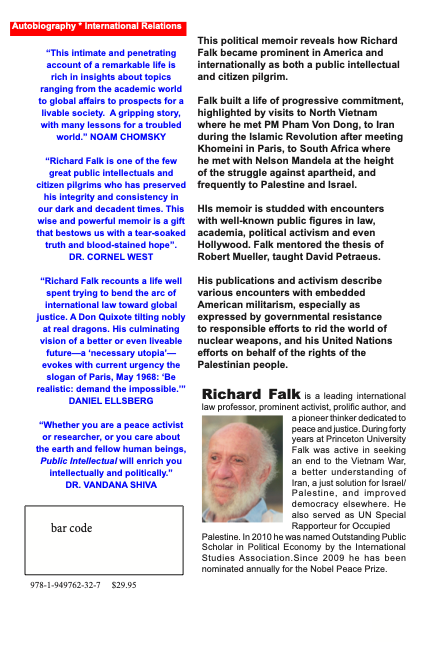
Professor Falk’s political memoir, Public Intellectual: The Life of a Citizen Pilgrim, chronicles Falk’s life of progressive commitment, highlighted by his visits to North Vietnam during the Vietnam War; to Iran during the Islamic Revolution; to South Africa at the height of the struggle against apartheid; and frequently to Palestine and Israel in his capacity as the UN Special Rapporteur for Occupied Palestine. Falk’s memoir also discusses the enduring defamatory attacks he faced in reaction to his stances for justice and his expressions of solidarity with the Palestinian struggle. As a Professor of International Law at Princeton University, Professor Falk would draw on these experiences to publish more than fifty books on topics of significant scholarly relevance, including studies of the profound dangers now facing humanity, the relevance of international law and the UN, and prospects for transforming world order in the direction of peace, justice, and ecological viability. His memoir excavates two key themes that have dominated his public roles: engaging with the controversies of the present and envisioning a future of world order that is humane and sensitive to ecological limits.

Speakers

Profile image for Richard Falk in black and whiteProfessor Richard Falk is a leading international law professor, prominent activist, and prolific author and scholar. During forty years at Princeton University Falk was active in seeking an end to the Vietnam War, a better understanding of Iran, a just solution for Israel/Palestine, and improved democracy elsewhere. He also served as UN Special Rapporteur for Occupied Palestine. His books include This Endangered Planet, A Study of Future Worlds; Power Shift, Revisiting the Vietnam War, Palestine Horizon, and On Nuclearism. He now holds a Chair in Global Law at Queen Mary University of London.
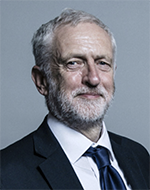
Rt Hon Jeremy Corbyn MPRt Hon Jeremy Corbyn MP is British MP for Islington North and Former Leader of the British Labour Party and Leader of the Opposition (2015-2020). Corbyn was first elected to Parliament in 1983. His professional and personal journey has led him to spend significant time and energy on issues of anti-racism, anti-imperialism, LGBT+ rights, transport, the environment, opposition to nuclear weapons and military intervention, Trade Union policies, Miscarriages of Justice and more. Through his roles and activism he has travelled widely and continues to support communities affected by unresolved conflict, including the Western Sahara, Chagos Islands, the Middle East, Africa, Latin America, Ireland, West Papua, the Dalit community, and the Rohingya. Corbyn was awarded the Sean McBride Peace Prize in 2017, and before that the Gandhi International Peace Award in 2013. He is currently a member of the Parliamentary Assembly for the Council of Europe, the UK Socialist Campaign Group, and a regular participant at the United Nations Human Rights Council (Geneva), Campaign for Nuclear Disarmament (Vice President), and Chagos Islands All Party Parliamentary Group (Honorary President), and a Vice president of the British Group Inter-Parliamentary Union (IPU).
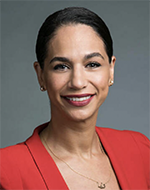
Professor Noura ErakatProfessor Noura Erakat is a human rights attorney, Associate Professor of Africana Studies at Rutgers University, and non-resident fellow of the Religious Literacy Project at Harvard Divinity School. Noura is the author of Justice for Some: Law and the Question of Palestine (Stanford University Press, 2019), which received the Palestine Book Award and the Bronze Medal for the Independent Publishers Book Award in Current Events/Foreign Affairs. She is co-founding editor of Jadaliyya and editorial board member of the Journal of Palestine Studies. She has served as Legal Counsel for a Congressional Subcommittee in the US House of Representatives, as Legal Advocate for the Badil Resource Center for Palestinian Refugee and Residency Rights, and as national organizer of the US Campaign to End the Israeli Occupation. Noura has also produced video documentaries, including “Gaza In Context” and “Black Palestinian Solidarity.” She has appeared on CBS News, CNN, Fox News, and NPR, among others.

Victoria BrittainVictoria Brittain worked at the Guardian for more than 20 years as a foreign correspondent and then Associate Foreign Editor. She has lived and worked in Saigon, Algiers, Nairobi and reported from many countries in Africa and the Middle East for numerous media outlets in the anglophone and francophone worlds. She is the author, co-author or editor of 10 books and plays including Love and Resistance in the Films of Mai Masri (Palgrave Macmillan, 2020).

Chair

Penny Green, Head of the Department of LawProfessor Penny Green is Head of the Law Department at Queen Mary University and Professor Law and Globalisation. Professor Green has published extensively on state crime theory (including her monographs with Tony Ward, State Crime: Governments, Violence and Corruption; and State Crime and Civil Activism: on the dialectics of repression and resistance), state violence, Turkish criminal justice and politics, ‘natural’ disasters, the Rohingya genocide, mass forced evictions in Israel/Palestine, and civil society resistance to state violence. Professor Green is Co-editor in Chief of the State Crime Journal and Founder and Director of the award-winning International State Crime Initiative.
**Please note this is an online event and that all registrants will be sent joining details on the day of the event.

Contact the university

Queen Mary University of London
Mile End Road
London E1 4NS
+44 (0) 20 7882 5555

Follow us:

18 Feb

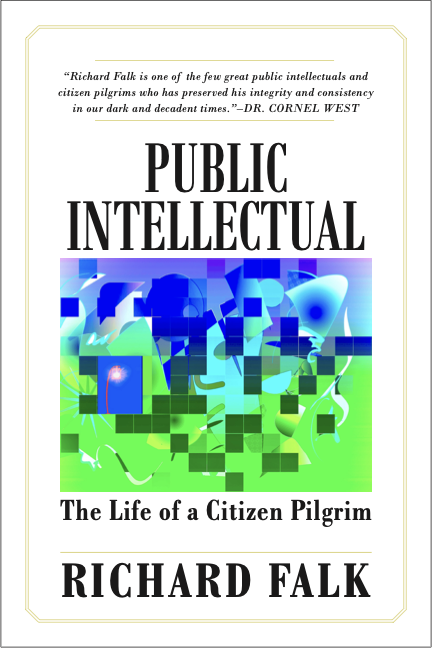
I post below images of the covers of my political memoir that was published this week, and is available from online booksellers in Kindle and paperback formats. I discovered that the interface between the person and the political can be as treacherous as visiting a combat zone, I welcome reactions and dialogue.

Nuclear Violence is Why We Are Living in the Anthropocene Age

15 Feb

[Prefatory Note: The short essay below is my contribution to the latest thematic Forum of the Great Transition Initiative. It responds to a beautifully crafted paper by the Founder of GTI under the auspices of the Tellus Institute, Paul Raskin. Paul’s initial paper and a series of fascinating responses can be found at  https://greattransition.org/gti-forum/interrogating-the-anthropocene. GTI has developed a powerful and sophisticated global network for dialogue about achieving a visionary future despite the dark clouds that now fill the sky.]

GTI FORUM 
Violence: Another Existential Crisis 

Contribution to GTI Forum Interrogating the Anthropocene: Truth and Fallacy

Richard Falk February 2021 

As I grasp the essence of the consensus emerging from this discussion of Paul Raskin’s eloquent essay, it is an acceptance of the Anthropocene as a dire warning that the human species is headed for disaster, if not extinction, if its ecological footprint is not greatly reduced in the relatively near future. The GTI perspective adds the indispensable insight that social evolution has many pathways to the future that can be instructively framed as a dramatic narrative enacted as a struggle between forces sustaining the destructive perishing patterns of the currently dominant modernist variants of civilization and those intent on achieving a variety of alternative civilizational constellations that incorporate what Paul calls for at the end of his conjectures: “expanded identity, solidarity, and citizenship.” It is fair to assume that these enlargements move civilizational vectors toward greater appreciations of species destiny along with possibilities of nurturing satisfaction with the experience of human community on a global scale. Such futures imply living with a new contentment based on underlying commonalities while at the same time valuing gender, societal, ethnic, and generational differences and overcoming past abuses.

I regard the GTI community as an ideational vanguard that is carrying forward the work of restorative vision with respect to the organically connected ecological and societal challenges. The hopeful ontological premise is the existence of reservoirs of species potential to turn the negative impacts of human geological agency, which mostly explains the designation of our time as the Anthropocene, into positive forms of social behavior that incorporate ecological and humanistic ethics in ways capable of actualizing variants of the GTI project.

There is also the baffling question of transcendence, which opens the portals of freedom and discovery by uniquely privileging and burdening the human species with freedom, and hence with responsibility to do the right thing. Individually and collectively, we can learn to see properly, and when we do, we have the freedom and responsibility to struggle for a better, and perhaps radically different, future. In this spirit, should the primary endeavor be to redesign capitalist dynamics to avoid destructive ecological effects and mitigate alienating and exploitative impacts on social relations, or should our ways of producing, consuming, and living be reframed to conform more closely to imaginaries of human flourishing? Due to the limited time to avoid irreversible or catastrophic damage, should GTI efforts prioritize “buying time” by settling for modest adjustments, assuming more fundamental change can emerge over longer periods? There exists a “Hegelian Trap” whereby an envisaged future gets confused with an attainable future. The teaching of the Anthropocene is that major ecological adjustments must be made soon—with the crucial sociological feedback being that the looming tragedy is not attributable to the human condition, but rather reflects a civilizational turn, sometimes associated with the turn from hunter-gathering civilizational ascendancy to agriculture and specialization, and reaching its climax by way of “modernity” as emanating from the Industrial Revolution.

Against this background, I find it useful to highlight the role of war, violence, and identity as carried to clarifying extremes by the United States. The US is the world’s leading source of arms sales, maintains black sites in foreign countries used to torture terrorist suspects, manages one of the largest per capita prison populations in the world, possesses the world’s only constitutionally grounded gun culture, and yet is less secure than ever before in its history. And to underscore this disturbing pattern, the most revered advocate of nonviolent struggle in the United States, Martin Luther King, Jr., was assassinated in 1968.

My sense of the socioeconomic side of predatory capitalism and ecological denialism is this pervasive delusion that weaponry and violence bring “security” to individuals, neighbors, and countries. Even the alarm bells set off by the use of atomic bombs in 1945 did not overcome the deeply entrenched roots of militarism at all levels of social interaction from gun culture to nuclear arsenals. With the passage of time, the possession of nuclear weapons was normalized for the states that prevailed in World War II, and global policy focused on keeping the weaponry away from other states by establishing an anti-proliferation regime, a system of nuclear apartheid that reflects the latest phase of geopolitical primacy as the fallacious basis of stability in world affairs. There are two points interwoven here: the pervasiveness of violence in human experience and the degree to which a nuclear war could parallel eco-catastrophe, threatening the Gaia Equilibrium that led stratigraphers to pronounce our geological age as the Anthropocene.

When we consider the sorts of human futures that would transcend the maladies of the present historical circumstances, we cannot get very far without a radical turn against individual and collective forms of violence and warfare. It is relevant to take note of the degree to which violence in every shape and form infuses even entertainment in many civilizational spaces, including even most indigenous communities. China is far from nonviolent, yet its remarkable surge, overcoming the extreme poverty of at least 300,000,000 million Chinese, as well as its expansionist vision of the vast Belt and Road Initiative seems a better platform from which to hope for benign civilizational transcendence.

As earlier observed, there are also obstacles associated with the civilizational modalities that presently control the basic categories of time and space. There is a mismatch between the time horizons of ecological, economic, and security challenges and electoral cycles of accountability. Political, corporate, and financial leaders are viewed by their short-term performance records, and thus tend to under-react to medium- and longer-term threats. In relation to space, the vast differences in wealth and capabilities among states and regions produces inequalities perceived as unjust, and need to be defended and justified by ideologies that fragment of human identity and community. In terms of world order, the whole is less than the sum of its parts, and until that ratio can be inverted, Paul Raskin’s imperative of expanded identity, solidarity, and citizenship will fall mostly on deaf ears. We live in a world in which the part is valued more than the whole, and such a political order might have persisted in a pre-Anthropocene worldview, but is now in deep jeopardy.

GTI FORUM 
Violence: Another Existential Crisis 

Contribution to GTI Forum Interrogating the Anthropocene: Truth and Fallacy


As I grasp the essence of the consensus emerging from this discussion of Paul Raskin’s eloquent essay, it is an acceptance of the Anthropocene as a dire warning that the human species is headed for disaster, if not extinction, if its ecological footprint is not greatly reduced in the relatively near future. The GTI perspective adds the indispensable insight that social evolution has many pathways to the future that can be instructively framed as a dramatic narrative enacted as a struggle between forces sustaining the destructive perishing patterns of the currently dominant modernist variants of civilization and those intent on achieving a variety of alternative civilizational constellations that incorporate what Paul calls for at the end of his conjectures: “expanded identity, solidarity, and citizenship.” It is fair to assume that these enlargements move civilizational vectors toward greater appreciations of species destiny along with possibilities of nurturing satisfaction with the experience of human community on a global scale. Such futures imply living with a new contentment based on underlying commonalities while at the same time valuing gender, societal, ethnic, and generational differences and overcoming past abuses.

I regard the GTI community as an ideational vanguard that is carrying forward the work of restorative vision with respect to the organically connected ecological and societal challenges. The hopeful ontological premise is the existence of reservoirs of species potential to turn the negative impacts of human geological agency, which mostly explains the designation of our time as the Anthropocene, into positive forms of social behavior that incorporate ecological and humanistic ethics in ways capable of actualizing variants of the GTI project.

There is also the baffling question of transcendence, which opens the portals of freedom and discovery by uniquely privileging and burdening the human species with freedom, and hence with responsibility to do the right thing. Individually and collectively, we can learn to see properly, and when we do, we have the freedom and responsibility to struggle for a better, and perhaps radically different, future. In this spirit, should the primary endeavor be to redesign capitalist dynamics to avoid destructive ecological effects and mitigate alienating and exploitative impacts on social relations, or should our ways of producing, consuming, and living be reframed to conform more closely to imaginaries of human flourishing? Due to the limited time to avoid irreversible or catastrophic damage, should GTI efforts prioritize “buying time” by settling for modest adjustments, assuming more fundamental change can emerge over longer periods? There exists a “Hegelian Trap” whereby an envisaged future gets confused with an attainable future. The teaching of the Anthropocene is that major ecological adjustments must be made soon—with the crucial sociological feedback being that the looming tragedy is not attributable to the human condition, but rather reflects a civilizational turn, sometimes associated with the turn from hunter-gathering civilizational ascendancy to agriculture and specialization, and reaching its climax by way of “modernity” as emanating from the Industrial Revolution.

Against this background, I find it useful to highlight the role of war, violence, and identity as carried to clarifying extremes by the United States. The US is the world’s leading source of arms sales, maintains black sites in foreign countries used to torture terrorist suspects, manages one of the largest per capita prison populations in the world, possesses the world’s only constitutionally grounded gun culture, and yet is less secure than ever before in its history. And to underscore this disturbing pattern, the most revered advocate of nonviolent struggle in the United States, Martin Luther King, Jr., was assassinated in 1968.

My sense of the socioeconomic side of predatory capitalism and ecological denialism is this pervasive delusion that weaponry and violence bring “security” to individuals, neighbors, and countries. Even the alarm bells set off by the use of atomic bombs in 1945 did not overcome the deeply entrenched roots of militarism at all levels of social interaction from gun culture to nuclear arsenals. With the passage of time, the possession of nuclear weapons was normalized for the states that prevailed in World War II, and global policy focused on keeping the weaponry away from other states by establishing an anti-proliferation regime, a system of nuclear apartheid that reflects the latest phase of geopolitical primacy as the fallacious basis of stability in world affairs. There are two points interwoven here: the pervasiveness of violence in human experience and the degree to which a nuclear war could parallel eco-catastrophe, threatening the Gaia Equilibrium that led stratigraphers to pronounce our geological age as the Anthropocene.

When we consider the sorts of human futures that would transcend the maladies of the present historical circumstances, we cannot get very far without a radical turn against individual and collective forms of violence and warfare. It is relevant to take note of the degree to which violence in every shape and form infuses even entertainment in many civilizational spaces, including even most indigenous communities. China is far from nonviolent, yet its remarkable surge, overcoming the extreme poverty of at least 300,000,000 million Chinese, as well as its expansionist vision of the vast Belt and Road Initiative seems a better platform from which to hope for benign civilizational transcendence.

As earlier observed, there are also obstacles associated with the civilizational modalities that presently control the basic categories of time and space. There is a mismatch between the time horizons of ecological, economic, and security challenges and electoral cycles of accountability. Political, corporate, and financial leaders are viewed by their short-term performance records, and thus tend to under-react to medium- and longer-term threats. In relation to space, the vast differences in wealth and capabilities among states and regions produces inequalities perceived as unjust, and need to be defended and justified by ideologies that fragment of human identity and community. In terms of world order, the whole is less than the sum of its parts, and until that ratio can be inverted, Paul Raskin’s imperative of expanded identity, solidarity, and citizenship will fall mostly on deaf ears. We live in a world in which the part is valued more than the whole, and such a political order might have persisted in a pre-Anthropocene worldview, but is now in deep jeopardy.

Blocking Twitter & Twitter Blocking Trump: Why We Should Worry

13 Jan

Blocking Twitter & Twitter Blocking Trump: Why We Should Worry

Living these past months in Turkey, I became quite conscious of President Recep Tayyip Erdoğan’s efforts to shut down Twitter and other Internet platforms, as well as block access to Wikipedia. This censorship was taken in reaction to insulting and critical material about the Turkish leader and his family. Turkey also has long blocked all erotic sites that are accessible in most democratic countries, subject only to extremely lax self-censorship by platforms protecting against such sex crimes as child pornography and sex trafficking. In the liberal West there was a surge of self-righteous indignation after Erdoğan’s clampdown. Most of the complaints directed against Turkey involved allegations of encroachments on rights of free expression and accusations of unwarranted censorship by the state against critics and dissenters. 

More objectively considered a serious question is raised: should a government have the authority to limit the dissemination by social media of material derogatory to or defamatory of the elected leadership of the country, as well as have a mandate to impose limits on access to sexually explicit material in deference to public morals? Of course, the question is somewhat complicated by the ease by which such blockages can be and are widely circumvented by VPN software here in Turkey or states, such as China, which regulate platforms to prevent criticism and dissent. In this respect there is a new kind of cyber tug of war between control from the governmental center and libertarian elements in the citizenry. How this multi-dimensional struggle involving technology as well as politics unfolds is among the haunting uncertainties of the Digital Age. 

The United States now faces a variant of the same basic concern after Trump’s incitement of his followers on January 6, 2021 to launch a militant and violent demonstration at the U.S. Capitol that has shaken the foundation of American constitutionalism, symbolically and substantively. Lurid pictures of Capitol security personnel herding frightened and endangered elected high officials to safe shelter confirm, not only for Americans, but for the world this drama of right-wing sedition that certainly had the makings of a coup with various indications of support from elements in the police, military, and governmental bureaucracy. Because of Trump’s extensive use of and reliance on a private Twitter account to vent his rage, and more instrumentally, to mobilize his base, it was natural to believe that this behavior menaced the republic, and must be stopped. Since incitement to violence by Trump was being enabled by the Internet, and specifically by Twitter, its decision to suspend permanently his account was widely accepted as reasonable and desirable, and if anything long overdue. Facebook, YouTube, and Instagram followed the Twitter lead, including cancelling Trump’s  megaphone’ that facilitated reaching his millions of followers. 

Trump’s account had 88 million followers, many of whom apparently believed, and acted upon, his lies and did his bidding. There is little doubt that Twitter and other social media platforms had been long used by Trump to undermine faith in and loyalty toward constitutionalism in the United States. Such a subversive dynamic escalated after Trump’s electoral defeat on November 4th, reaching a climax with the seditious moves against the Capitol on January 6th. Only then did the tech giants take action concerted against Trump. The niche right-wing platform, Parler, lost its business support, and Apple and Google stopped selling the app, and Amazon ended its hosting service, and the impact seems to have been to put the platform at the brink of bankruptcy, and likely soon out of business. These efforts also led to more concerted Internet suppression of Nazi groups, white supremacists, and fake accounts.

In the Turkish experience the state, as personified by its leader, takes the initiative to establish filters through which only news acceptable to the state can reach the public, consolidating its authority with respect to permissible knowledge as well as regulating what can be publicly disseminated by Internet platforms. This kind of authoritarian approach is complemented by various actions taken by the government, directly and indirectly, to control the flow of information, including intimidation and punitive moves against more traditional TV and print journalists, which can involve loss of jobs and even imprisonment for those targeted. Should such control over social media, and indeed all public communication, be subject to regulation by an overly sensitive governmental leadership? Or is it preferable to let the winds of freedom blow without minimal authorized self-interested interference by the state?

The current U.S. situation exhibits an opposite set of issues, entrusting private sector digital giants to become self-anointed monitors of political propriety of an autocratic leader on the Internet. From one perspective, such monitoring reflects a benevolent bias toward decentralization of authority by allowing companies, rather than the state, to draw the disciplinary lines of political and moral propriety in public discourse, which if crossed, will serve as tripwire to censorship or even as here, a targeted denial of access and use rights to individuals, including the elected leader currently serving out the remainder of his time in office. From another perspective, an acceptance of such patterns of control empowers corporate and financial elites to serve as guardians of civic virtue despite their wealth and use of money that is partly responsible for the weakening of the fabric of democracy, so long  conceived as governance by ‘we, the people.’ 

In many respects these tech giants undermine and distort the interaction of diverse points of view. A truly free society depends on avoiding unhealthy concentrations of power in private sector entities that possess quasi-monopolistic influence. [For confirmation see Glenn Greenwald, “How Silicon Valley, in a Show of Monopolistic Force, Destroyed Parler,’ Information Clearing House, Jan. 13, 2021] With respect to social media, it is not only a concern about predatory economic practices, but about manipulations of the mind, and shaping the rules governing the political play of forces. Of course, incitements to domestic insurrection should not be considered ‘free expression,’ being more akin to shouting ‘fire!’ in a crowded theater, and should be seen as exceptions to a broad tolerance of the use of social media to further disparate worldviews.

There is another issue that has been totally overlooked in the post-Capitol discussions. We need international rules and a comprehensive regime to govern transnational communications, including by social media, in the Digital Age. Incitement by words and deeds against foreign governments should be as taboo as is such behavior against our own. At present, with mainstream media complicity, the U.S. Government and the public overall feels abused by Russian hacking of government files, while engaged in a variety of such activities throughout the world ourselves. The U.S., in particular, has for many years suffered from an acute form of ‘geopolitical bipolarity’ without even noticing the cognitive dissonance of vigorously carrying out a variety of lethal schemes to destabilize foreign governments that our deep state and governing political class dislikes while denouncing as foul play even feeble attempts by foreign governments to retaliate in kind. Until we as a country adhere to policies and practices based on international law as reinforced by reciprocity, meaning desisting from behavior against others that we deplore when it threatens ourselves. Such a course of action would be a major departure from still prevailing ideas of hierarchy, American exceptionalism, and impunity that have guided U.S. grand strategy ever since the end of World War II. Our most thoughtful ideologues may praise the virtues of a rule-based liberal international order, but our geopolitical behavior sends a different message to the world.

Concretely expressed, when we allow presidential boasts about international crimes to be freely transmitted on social media headquartered in the U.S. without blinking while moving vigorously to protect the social and political order at home from those who would destroy it from within and without, a defective America-first ethic is being unwittingly endorsed. It is time to revive the prime ethical imperative: ‘do unto others as you would have them do to you,’ or more pointedly, ‘do not do to others what you would not have them do unto you.’ Otherwise the hypocrisy of domestic thought control in defense of democratic constitutionalism feeds continuing self-delusions about American innocence abroad.

As a poignant example, I think of President Trump’s inflammatory and false

boast on January 3, 2020 justifying the unlawful targeted killing a year ago by attack drone of General Qassim Soleimani of Iran while this important leader of a state was on a diplomatic mission in Iraq at the invitation of the Iraqi Prime Minister, Adil Abdul Mahdi. [For critique of such a political assassination see UN Special Rapporteur Report , A/HRC/44/38 (August 2020; see also my blog, .] To allow such an international crime to be obscured by state propaganda is illustrative of a broader pattern of self-deception at home and anti-American hostility abroad. For instance, in the aftermath of this assassination, the leadership of Iraq asked that the U.S. Government remove its armed forces from the country. The fact that this has not yet happened is more a reflection of complex regional geopolitics than it is an expression of an Iraqi change of heart.

I have personally experienced abuses of such regulatory authority, informally and formally, as a response to my words and actions in solidarity with the Palestinian people in their long struggle for basic rights. The adoption of the IHRA (International Holocaust Remembrance Alliance) definition of anti-Semitism is broad enough to encompass nonviolent peaceful campaigns such as BDS or public advocacy viewed as anti-Zionist or harshly critical of Israel. My Facebook postings and lectures have been occasionally blocked and cancelled as a result of such anti-democratic and misleading Internet posting purporting to guard against my ‘anti-Semitic’ views. The effect has been defamatory damage to my overall reputation, but it is of trivial consequence compared to the life-changing harm done to such important scholars (e.g. Norman Finkelstein, Steven Salaita) who lost jobs and to journalists and experts whose professional standing was seriously tarnished. Where political passions are strong and leverage is not balanced by countervailing pressures, social media platforms and mainstream media impose controls that tend to maintain one-sided and hegemonic presentations of events that should be receive balanced treatment. Not only is society deprived of debates on controversial issues needed if democracy vital, but an inhibiting message is sent out that discourages citizens from challenging the distortions of self-censorship. We grow numb, hardly noticing that ideologues such as Alan Dershowitz have their opinion pieces published and is invited as a guest expert while Noam Chomsky’s far greater forthrightness and intellectual eminence is rendered invisible because of his political views. And as it happens Chomsky, when it comes to Israel/Palestine offers a critical voice on the side of justice, while Dershowitz mindlessly sides with the oppressors. Such asymmetry is illustrative of the bitter fruit of private sector controls, abetted by some interaction with governments, over the flows of information and opinion in public space.  

For these reasons it seems a dangerous mistake to address these issues of principle under the stress of extreme conditions generated by Trump in the aftermath of the lost November elections, culminating in the January 6th assault on the U.S. Capitol. Given the genuine national emergency resulting from an abusive president, the ad hoc responses of social media were benevolent in this instance, despite setting off alarms about entrusting the guardianship of democracy in the Digital Age to for profit private sector actors, especially given the concentration of market control, the wealth, and the record of regressive one-sidedness not only of social media, but of more traditional print and TV outlets. [See Michelle Goldberg, “The Scary Power of the Companies That Finally Shut Trump Up,” N Y Times, Jan. 11,2021; and more pointedly, Fraser Meyers, “Like him or not, the censorship of Donald Trump has set a terrifying precedent.” Information Clearing House, Jan. 12, 2021.] 

The pre-digital political life of the United States was already severely tilted to the right as a result of allowing money to pour toxic substances on the electoral process by which public officials at all levels of society are selected, as well as to fashion media empires around quasi-fascist worldviews. There is also a dumning down effect as the opposition, especially if not aligned with Wall Street or Silicon Valley, must itself beg for money rather than focus on issues, programs, and socio-economic justice. The result is the commodification of political life where beliefs and values are monetized.

Behind the tumult is the Trump electoral defeat in 2020, which Trump falsely attributed to reality-defying fraud, a macabre fairy tale that was accepted by an astonishing 70% of those who had voted for him and even a significant number of lawmakers who probably knew better, but thought their political careers would suffer more from breaking with Trump than sticking with him. But, perhaps, more astonishing is the nature of Biden’s victory. It was a clear political victory, 306-232 in electoral college votes, and a margin just over seven million in the popular vote. Yet, in one sense it was revealingly close, and actually registered a Republican victory in the state-level elections across America. If California and New York are removed from the Biden column, Trump wins in the electoral college and, narrowly, even the popular vote. By federalist logic, a large majority of the states making up the union, endorsed the Trump presidency even in the face of his malignancy as a leader, exhibited most devastatingly his COVID denialism that cost many lives and much misery, and brought the economy tumbling down. What should we as a country learn from this movement built by such a sinister demagogic pied piper?

From another angle, if COVID had not occurred, the economy would have remained strong, unemployment low, and no health crisis present to spoil his record of ‘achievements.’ In such an atmosphere, there seems little doubt that Trump would have rather easily prevailed by a margin no smaller than his surprise victory in 2016. What do these looks beneath the surface tell us, not only about the election, but about the public and governmental acceptance of four years of governance that deepened class, ethnic, and gender differences, that hurt badly the U.S. world reputation, that adopted a catastrophic denialist stand toward climate change, that championed alternative realities and proudly proclaimed post-truth guidelines, while ignoring urgent socio-economic disparities and infrastructure.

This Trump experience requires more than censorship, whether by the state or private sector. Above all, it calls for renewed attention to the deficiencies of citizen education. We have post-modern technology in a society that still cleaves to the worst forms of superstitious pre-modern worldviews. It is time for another ‘war,’ this time a ‘war on ‘ignorance’.’ After Trump the country needs a Second Enlightenment more even than the rectification of such evils as systemic racism,  ecological disregard, and commodified democracy.