Palestine Horizons: Winning the Long Game

21 Mar

Palestinian Balance Sheet: Normative Victories, Geopolitical Disappointments

Winning the Long Game

In recent weeks the Palestinian people have scored major victories that would havedire consequences for Israel if law and morality governed political destiny. Instead, these successes are offset by adverse geopolitical developments as a result of the Biden presidency embracing some of the worst features of Trump’s hyper-partisanship with respect to Israel/Palestine. Law and morality alter reputations, bear on the legitimacy of contested policies, while geopolitics bear more directly on behavior, the difference is best understood as separating symbolic and substantive politics.

Yet, legitimacy gains should not be dismissed just because nothing that matters on the ground seems to change, and sometimes vindictively changes for the worse. In the long game of social and political change, especially in the course of the last 75 years, the winner of the Legitimacy War waged for the high legal moral ground and competition for intensity of political commitment has much more often than not eventually controlled the outcome of a struggle for national self-determination and sovereign independence, overcoming geopolitical obstructions and military superiority along the way. The anti-colonial wars, it should not be forgotten, were won by the weaker side militarily, although quite often enduring an ordeal of desecration along the way. So far, Israeli leadership, although worried by its setbacks on the battlefields of the Legitimacy War have not departed from the American game plan of devising security through a combination of military capabilities and regional activity, allying against Iran, while subverting the unity and stability of potential hostile neighboring States. 

Relevant is the great unlearnable lesson of the last century that the U.S. dominated the military dimensions of the Vietnam War and yet managed to lose the war. Why unlearnable? Because if learned, the case for a permanent wartime military budget would disappear, and the stubborn mythic belief that ‘our military keeps us safe’ would lose much of its credibility.

With Biden as president, reviving alliance-based confrontational geopolitics, the prospect is for a dangerous and costly worsening of relations among major centers of global wealth and military power, avoiding the kind of reallocation of resources urgently requires to meet the challenges of the Anthropocene. We can bemoan the dysfunctionality of global militarism, but how can we gain the political traction to challenge it? This is the question we should be asking of our politicians without distracting them from addressing the urgencies of the domestic agenda bearing on health, economic recovery, and assaults upon voting rights. 

The Palestinian struggle continues, and offers the template of a colonial war carried on in a post-colonial era, in which a huge national oppressive regime backed by geopolitical support is required to enable Israel to swim against the strong liberation tides of history. Israel has proved to be a resourceful settler colonial state that has carried to completion the Zionist Project by stages, and with the vital help of geopolitical muscle, and has only recently begun to lose control of the normative discourse that earlier had been controlled by dramatizing the saga of persecuted Jews in Europe who deserved sanctuary accompanied by the denialist dismissal of Palestinian national claims to be secure in their own homeland. The Palestinians, having no significant relationship to the history of antisemitism were made to pay some of the humanitarian costs inflicted on Jews by the Holocaust while the liberal West looked on in stony silence. This one-sided discourse was reinforced by claiming the benefits of modernity, an insistence that the replacement of dirty backward Arab stagnancy in Palestine by a dynamic modern and flourishing Jewish hegemony, which later was also valued as a Western foothold in a region coveted for its energy reserves and more recently feared because of its anti-Western extremism and Islamic resurgence. The conflict over the land and the ideological identity of the emergent state, unfolding over a century, has had many phases, and has been affected, almost always adversely, by developments within the region and by geopolitical intervention from outside.

As with other anti-colonial struggles, the fate of the Palestinians will eventually turn on whether the struggles of the victimized people can outlast the combined power of the repressive state when, as here, it is linked to the regional and global strategic interests of geopolitical actors. Can the Palestinian people secure their basic rights through their own struggles wages against a combination of internal/external forces, relying on Palestinian resistance from within, global solidarity campaigns from without? This is the nature of the Palestinian Long Game, and at present its trajectory is hidden among the mystifications and contradictions of unfolding national, regional, and global history.

Palestinian Normative Victories

Five years ago no sensible person would have anticipated that Israel’s most respected human rights NGO, B’tselem, would issues a report declaring that Israel had established a unified apartheid state that governed from the Jordan River to the Mediterranean Sea, that is, encompassing not only Occupied Palestine but Israel itself. [This is Apartheid: A regime of Jewish Supremacy from the Jordan River to the Mediterranean Sea, B’Tselem: The Israeli Information Center for Human Rights in Occupied Territory, 12 Jan 2021] With careful analysis the report showed that Israeli policies and practices with respect to immigration, land rights, residency, and mobility were administered in accordance within an overriding framework of Jewish supremacy, and by this logic, Palestinian (more accurately non-Jewish, including Druze and non-Arabic Christians) subjugation. Such a discriminatory and exploitative political arrangement is descriptive of apartheid, as initially established in South Africa and then generalized as an international crime in the 1973 International Convention on the Suppression and Punishment of the Crime of Apartheid. This idea of apartheid criminality was carried forward in the Rome Statute that provides the framework within which the International Criminal Court (ICC) in The Hague carries on its activities. Article 7 of the Rome Statute, a treaty of the parties, governing the ICC enumerates the various Crimes Against Humanity over which the ICC asserts its jurisdictional authority. Apartheid is classified as such a crime in Article 7(j), although without any accompanying definition, and no investigation by the ICC of apartheid allegations involving Israeli perpetrators has ever occurred. It is notable that regarding ‘apartheid’ as a crime against humanity would reduce the burden of proof as compared to allegations of ‘genocide.’

Only weeks after the B’Tselem Report came the much anticipated decision of the Pre-Trial Chamber of the ICC on February 6, 2021. By a 2-1 vote the Chamber’s decision affirmed the authority of Fatou Bensouda, the ICC Prosecutor, to proceed with an investigation of war crimes committed in the Occupied Palestinian territories since 2014, as geographically defined by its provisional 1967 borders. To reach this outcome the decision had to make two important pronouncements: first, that Palestine, although lacking many of the attributes of statehood as define by international law, did qualify as a State for purposes of this ICC proceeding, having been accepted as a Party to the Rome Statute in 2014 after being recognized by the General Assembly on November 29, 2012 as a ‘non-member Observer State.’; and secondly, that the jurisdiction of ICC to investigate crimes committed on the territory of Palestine was authoritatively identified as the West Bank, East Jerusalem, and Gaza, that is, the territories occupied by Israel during the 1967 War. In a decision that sought to convey impressions of judicial self-restraint it was pointed out that these legal positions were limited to the facts and claims under consideration, and did not purport to prejudge the statehood or territorial claims of either Israel or Palestine in other contexts. The lengthy dissent rejected this reasoning, relying heavily on the continuing relevance of the agreements concluded in accord with Oslo diplomacy that allegedly altered the status of the occupation, and took precedence, concluding that the Prosecutor lacked the legal competence to proceed with the investigation. [As the present Prosecutor’s term expires in June 2021, and a new Prosecutor takes over, Karim Khan, the future of these legal proceeding is uncertain.] 

It should be observed that this Pre-Trial proceeding had attracted unusually widespread interest in the world both because of the identity of the parties and the intriguing character of the issues. Jurists have long been intrigued by defining statehood in relation to different legal settings and by settling jurisdictional disputes addressing issues arising in territories that lack permanently established international borders and clear lines of sovereign authority. An unprecedented number of amicus curiae briefs were submitted to the ICC, including by prominent figures on both sides of the controversy. [I submitted an amicus brief with the collaborative help of the Al Haq researcher, Pearce Clancy. ‘The Situation in Palestine,’ amicus curiae Submissions Pursuant to Rule 103, ICC-01/18, 16 March 2020] Israel was not a Party to the Rome Statute, and declined to participate in the proceedings directly, but its views were well articulated by several of the amicus briefs. [e.g. by Dennis Ross who led the Clinton Era peace negotiations between Israel and Palestine. ‘Observations on Issues Raised by Prosecution for a ruling on the Court’s territorial jurisdiction in Palestine,’ ICC-01/18, 16 March 2020].

This decision was promising from a Palestinian point of view as an exhaustive Preliminary Investigation conducted by the Prosecutor over the prior six years had already concluded that there was ample reason to believe that crimes had been committed by Israel and by Hamas in Palestine, specifically referencing three settings: (1) the massive IDF military operation of 2014 in Gaza, known as Protective Edge; (2) the disproportionate uses of force by the IDF in responding to the Right of Return protests during 2018; (3) settlement activity in the West Bank and East Jerusalem.

The Prosecutor can now go forward has been legally established, including with the identification of individual perpetrators who could be charged and held accountable.

Whether this will happen now depends on the approach adopted by Mr. Khan when heassumes the role of Prosecutor in June, which remains a mystery despite speculation.

A further Palestinian victory is the defection of highly respected and well known liberal Zionists who have, so to speak, not seen the light, but speak openly about it, and command access to mainstream media. Peter Beinert is the most relevant example in an American context, but his announced disbelief in Israeli willingness to reach accommodation with the Palestinians on any reasonable basis is one more victory in the domain of symbolic politics. 

Geopolitical Disappointments

It was reasonable for Palestine and Palestinians to hope that a more moderate Biden presidency would reverse the most damaging moves taken by Trump that seemed to undermine still further Palestinian bargaining power as well as significantly encroached on Palestinian basic rights, and did so in a manner that rejected both the authority of the UN and international law. The Biden Secretary of State, Antony Blinken, sent signals on the most significant issues that seemed to affirm and ratify rather than reverse or modify the Trump diplomacy. Blinken affirmed, what Biden had implied, with respect to shifting the U.S. Embassy from Tel Aviv to Jerusalem, and thus joining Trump in defying a UNGA Resolution in 2017 that declared such a move as ‘void’ and without legal effect. Blinken has also indicated support for Israel’s territorial incorporation of the Golan Heights, which again defied international law and the UN, which had stood by a firm principle, earlier endorsed with respect to Israel’s occupation of Palestinian territories after the 1967 War in iconic Security Resolution 242. This text confirmed that foreign territory could not be

acquired by force, and anticipated Israeli withdrawal to 1967 borders (as modified by negotiations about minor border adjustments agreed to between the parties).

And above all, Blinken endorsed the normalization agreements between Israel and four Islamic States (U.A.E., Bahrain, Sudan, Morocco) achieved by bullying tactics of Trump

and the pursuit of self-interest. These were mainly symbolic victories for Israel having to do with regional acceptance and legitimacy credentials as well as regional containment and pushback alignment contra Iran. In many respects they extend prior de facto developments with a minimal impact of Israeli/Palestine dynamics.

Assessing Gains and Losses

So far Israeli fury directed at the ICC outweighs Palestinian geopolitical disappointments, the latter being likely tempered by apparent lingering hopes for a marginally improved relationship between the PA the U.S. and EU countries. And there have been some proper adjustments, including the announced willingness to reopen of PLO information centers in the U.S. and resumed diplomatic contact by Washington with the Palestinian Authority, and some language suggesting a return to diplomacy between in contrast with the Trump effort to dictate the terms of an Israeli victory put forth as ‘the deal of the century.’ Yet Biden’s early efforts in less controversial policy spheres to undo as much of Trump international mischief as possible, from rejoining Paris Climate Change Agreement, the WHO and UN Human Rights Council to expressing the intention to stress global cooperation and a revived internationalism, contrast with leaving as is the worst elements of the Trumpist effort to shatter Palestinian hopes. Whether this can be explained by the strength of bipartisan U.S. support of the Israeli unconditional relationship or by regional strategic factors is a matter of conjecture. Perhaps, the most plausible explanation is Biden’s own pro-Israeli past combined with his proclaimed commitment to unify America, working with Republicans to the extent possible. His totemic slogan seems to be ‘together we can do anything,’ which so far has not

had much encouragement from the other side of the aisle.

What might make the Palestinians somewhat more hopeful is the degree to which these two developments were battleground sites for those defending Israel by all means possible. Even Jimmy Carter was demeaned as an ‘anti-Semite’ because his 2007 book merely suggested in its title that Israel needed to make peace with the Palestinians or risk becoming an apartheid state. Recall that John Kerry’s rather mundane observation that Israel had two years left within the Oslo framework to make peace with Israel to avoid an apartheid future for itself encountered such a hostile reaction that he was led to apologize for the remarks, more or less repudiating what seemed so plausible when articulated.

As recently as 2017 an academic study sponsored by the UN, which I wrote together with Virginia Tilley, confirming apartheid allegations was denounced in the Security Council as a defamatory text unfit to be associated with the UN. The critical statements were accompanied by veiled American threats to withhold funds from the UN unless our report was repudiated, and it was dutifully removed from the UN website by order of the Secretary General. Even most Zionist militants at this point prefer silence in global settings rather than mounting attacks on B’Tselem once most beloved by liberal Zionists as tangible proof that Israel was ‘the only democracy in the Middle East.’

The reaction by Israel to the ICC decision rises to apoplectic levels of intensity. The fuming response of Netanyahu was echoed across the whole spectrum of Israeli politicians. In Netanyahu’s outrageous calumny against the ICC: “When the ICC investigates Israel for fake war crimes, this is pure anti-Semitism.” He added, “We will fight this perversion of justice with all our might.” Intemperate as are these remarks, they do show that Israel cares deeply about legitimacy issues, and rightly so. International law and morality can be defied as Israel has done repeatedly over the years but it is deeply mistaken to suppose that the Israeli leadership does not care. It seems to me that Israeli leaders understand that South African racism collapsed largely because it lost the Legitimacy War. Maybe some Israeli leaders are beginning to grasp the writing on the wall. The ICC decision may turn out to be a turning point not unlike the Sharpeville Massacre of 1965. This may be so even, as is likely, not a single Israeli is ever brought to justice before the ICC.  

The Geopolitics of the Normalization Agreements

10 Mar

Listen Closely to the Israeli Discourse in an American Liberal Idiom: Geopolitical Dreams, Ethical Nightmares


Thomas Friedman is both an echo of the liberal establishment and a media force to be reckoned with when it comes to post-cold war, post-Trump America. Known for championing the excesses of modernity by conceiving of technology, markets, capital flows, permissive social norms, and science-based truth and rationality as alone capable of offering promises of a good life for everyone. Friedman’s tone has always been arrogant and condescending. He is never shy about offering the rich and powerful the benefit of his technocratic wisdom. When it comes to foreign policy especially in the Middle East, and most particularly where Israel is involved, Friedman seeks to mount a guru’s pedestal so as to position himself above the fray, yet he never departs from the party line that unconditionally affirms Israel while being blind to Palestinian grievances and hostile to Palestinian resistance and global solidarity initiatives. In other words, Friedman is to liberal Zionism, what Sheldon Adelson was to militant Zionism as epitomized by the Netanyahu leadership, but whose stance is endorsed by the spectrum of right-wing political parties in Israel that dominate the scene when it comes to victimizing the Palestinian people. 

Yet even judging by the low standards that Friedman has set for himself over the years, his most recent NY Times opinion piece was as grotesque as informed commentary on the Middle East can become, especially if read carefully, and with a critical eye. Published as an opinion piece on March 2nd with a title that is as foolishly flippant as the text that follows is pernicious: “Jumping Jehoshaphat: Have You Seen How Many Israelis Just Visited the U.A.E.” As if Israeli shopping trips to Dubai or Abu Dubai are political signposts indicating that the region has started to overlook the Palestinian struggle for basic rights, and get on with the more important work of servicing consumers and tourists. If a spike in U.A.E. shopping is one sign, the ICC decision of February 5th to proceed further with investigate well-evidenced allegations of Israeli criminality in Occupied Palestine points in quite a different direction. It seems revealing that this latter development does not warrant even a nod of recognition in Friedman’s warped imagination that heeds market signals far more than international law grievances, especially if put forth by adversaries of the U.S. or Israel.

It is tempting to deal comprehensively with the several perversions of policy encountered in the course of a journalistic piece of less than 1,000 words, but I will mention only those that seem most outrageous from the perspective of law, morality, and transparency. The piece can be read as above all a promotional boost for the normalization agreements reached in the last weeks of the Trump presidency, a triumph of Washington bullying governments. It not only gave Israel a big political victory but helped show the folks back home that Trump’s style of diplomacy succeeded where his more highminded predecessors had failed. Despite being a strident critic of Trump in conformity with his liberal persona, Friedman has this to say about the normalization agreements, which he further blesses by adopting the self-glorifying name of the Abraham Accords bestowed by supporters: “I believed from the start that the opening between Israel, Bahrain, Morocco and Sudan—forged by Jared Kushner and Donald Trump could be game-changing.” Not a word about the arms deals and diplomatic payoffs made to twist the arms of the Arab governments, and not even a notation that this normalization ploy was the Trumpist culmination of carrying pro-Israeli partisanship to its extremes, which meant proceeding as if the Palestinians are to be seen nor heard as little as possible, and certainly never acknowledged.

Friedman goes on to say that it is too soon to know whether this good news will go further, recalling his disappointment that the once seemingly hopeful bonding of Israel with Lebanese Christians in the early 1980s turned out to be a ‘shotgun wedding and divorce.’ This meant that this promise an Arab-Israeli rapprochement was nothing more than a disillusioning house of cards that failed to produce lasting results of achieving peaceful relations with Arab countries without the inconvenience of doing something for the Palestinians. Again, it is the silences that are the most revealing aspect of Friedman’s lament. There is not a word in the column that the peak moment of bonding between Israelis and Lebanese Christians came during the Lebanon War of 1982, reaching its dramatic climax when Israel’s IDF collaborated with the Maronite militias in overseeing the civilian massacres in the Palestinian refugee camps of Sabra and Shatila. To lament the breakdown of this ill-fated marriage of convenience, without noting one of the starkest mass atrocities of the past half century in the region, is a typical embodiment of Friedman’s hypocritical morality and opportunistic geopolitics. Friedman does not stop there. He adds a gratuitous insult directed at Hezbollah coupled with a passing slur directed at Iran because it supports Hezbollah, and thus has the temerity to challenge Israeli/Saudi/U.S. phantasies.

Bad as is this foray into the tragic realities of Lebanese politics, worse is to come. Friedman regards the real payoff of the Trump normalization process is situated in the future. He conjectures that a parallel agreement with Saudi Arabia would be the crown jewel of the process, opining that such “..normalization would be huge for both Israel-Arab and Jewish-Muslim relations.” At the same time, Friedman reluctantly recognizes that the murder of Kamal Khashoggi is seen by some as an awkward impediment to reach this proclaimed goal. Here is how Friedman frames the grisly event: “The CIA-reported decision to have Saudi democracy advocate Jamal Khashoggi, who a long-time U.S. resident, killed and dismembered was utterly demented—an incomprehensible response to a peaceful critic who no threat to the kingdom.”

The language, as always with Friedman is revealing in ways that should make this journalist of post-colonial imperialism squirm. Why the word ‘demented,’ meaning bizarre action without rational justification, when the act in question was a wonton criminal abuse of power, accentuated by the misuse of diplomatic facilities to carry out an act of aggravated state terror—the Saudi Consulate in Istanbul. Further that the killing Khashoggi was ‘incomprehensible’ because it served no state purpose since there was ‘no threat to the kingdom.’ Cynical and hypocritical to the core: Hezbollah is demeaned for no reason, while a much deserved condemnation of MBS is sidestepped by Friedman’s rather implausible claim of being mystified by what he portrays as the senseless murder of Khashoggi a harmless critic of Mohamed bin Salmon’s Saudi imperium. Having taken note of the bloody deed, Friedman makes his priorities unmistakable by giving a green light to the nefarious business of geopolitics. Friedman always ready to provide unsolicited advice, without pausing for a breath of fresh air, observe that while “[t]he Biden team is still sorting out how it will relate to MBS” it remains right “to insist that that America will continue to deal with Saudi Arabia in general as an ally.”

Without the slightest show of moral inhibition, Friedman cuts to the chase, affirming the triangular relations between Saudi Arabia, Israel, and the United States as a constructive partnership in the region. He celebratory mood is expressed as follows: “If the Abraham Accords do thrive and broaden to include normalization between Israeli and Saudi Arabia, we are talking about one on the most significant realignments in modern Middle Eastern history, which for many decades was largely shaped by Great Power interventions and Arab-Israeli dynamics. Not anymore.” Again, this realignment is presupposed to be a constructive development without any indications of qualifications either by reference to the dangers of inclining the region even more toward a military confrontation with Iran or by acting as if the daily Palestinian ordeal was not worth addressing in the course of assessing such a diplomatic misadventure.

Friedman does go on to contend implausibly that in such an altered diplomatic environment, Israel might become more amenable to a two-state solution without even pausing to point out that even under pressure, Israel never wanted to co-exist with a viable Palestinian state, and now with the rightward drift of its internal politics and its guaranty of continued unconditional support in Washington, it no longer needs to pretend. The accelerating growth of Israeli settlements in defiance of the UN, the deferred pledges of substantial annexation of the West Bank, and the evident resolve by Israel to uphold its claim to govern Jerusalem as a unified whole, capital for Israel alone, makes any resurrection of two-state diplomacy an even crueler bad joke than Oslo told to the world while Palestinian aspirations are drenched in blood and the Palestinian people faced with an indefinite prospect of suffering under an apartheid Israeli regime.

The fact that the Biden presidency wasted no time resurrecting the two-state corpse is the clearest possible demonstration of the moral and political bankruptcy of U.S. policy with respect to the Palestinian struggle to achieve basic rights after many decades of denial. Unlike the Trump years, Friedman can exult in the reality that he is no longer out of step with those who preside over policymaking in the White House when it comes to the Middle East. And now post-Trump I am quite sure Friedman would not urge the Biden/Blinken to take back any of the unlawful gifts bestowed on Israel during the four Trump/Kushner years, including the Syrian Golan Height, the UN-defying move of the American Embassy to Jerusalem, the ‘legalization’ of the settlements along with de facto annexation of significant territory in occupied Palestine.   

Corrupting Democracy One Dollar at a Time

7 Mar

Commodifying Democracy is a Costly Failure in America

Everyday I receive ten to twenty times more appeals for money to support this or that political campaign than I receive any kind of serious substantive statement of explanation or concern. And because this storm has become so deadening, the language of most appeals is nearly always hysterical, wildly exaggerating good or bad marginal developments designed to create a sense of urgency on the part of recipients. Not only can I not afford to respond to so many appeals, each insisting that the future of the republic is at stake, but the numbing effect is perhaps most disturbing, a kind of Gresham’s Law effect: bad ‘politics’ is driving out ‘good.’

Of course, these is an understandable issue at stake. The proto-fascist Republican, Trumpist side benefits from wealthy transactional donors who give vast sums with expectations of even vaster material gains, poses a challenge. This is not meant to deny that mainstream Democrats have their own cohort of special interest donors who are not shy about sharing their wish list, but somehow, the funding of Democratic agenda and its progressive candidates seems much more dependent on idealistic contributions from middle class citizens who want nothing other than more humane, competent, and equitable government.

In the background of this central message that ‘politics is money,’ which seems to overwhelm a more progressive views of citizenship as ‘politics is ideas,’ ‘citizenship is participation,’ ‘progressive goals dependent on movements from below.’ Of course, the media platforms are partly responsible as it has become so easy to solicit contributions from vast mailing lists, and it seems that to capture attention given the hordes of solicitors it seems a general belief that to be heard at all in such an atmosphere, it is necessary to shout alarmist slogans rather than to reason carefully or inform helpfully. There are many commonalities of approach in this barrage of appeals that account for a loss of credibility of the democratic process. Among the most annoying practices is the scripting of political formulae by coupling a few words of urgency with promises that whatever you donate will be matched by 300%, 400%, or even more. Also irritating is to receive several solicitations each day asking for money to support campaigns not only nationally and in my home state, but in distant states with candidates I know nothing about or in support of this or that law. True, there are rare occasions when such appeals make good political sense as was the case for the recent Senate races in Georgia, because without Democratic control of the Senate, Biden’s presidency would have been ruined on day one. But should I be expected to be intimately interested, much less monetarily involved in Congressional races in New Mexico or North Dakota between candidates I had never heard of before?

My point is that this kind of messaging is having a deadly, demobilizing effect on conventional politics. A fundamental impression is conveyed that the candidate who collects the most money will prevail, and that the substantive issues are nothing much more than partisan expressions of class interests. Maybe the two-party system is certainly to blame for the qualitative debasement of democracy, which across a broad spectrum of crucial concerns functions as if in its essence it is a one-party system. This seems most evident when it comes to approving the military budget, regulating Wall Street, supporting Israel, and more recently, exhibiting hostility toward China. Thus, policy convergence and competing for donations have become the stuff of democratic political life in 2021 for most of us, with much trumpeted(!) leadership faceoffs reduced to personality or popularity contests, while all this time proto-fascism wraps its tentacles ever tighter around the body politic.

Is there a solution? Perhaps, yet not without struggle. Many entrenched interests would have to be dislodged from their comfort zones. A beginning could be made by way of the federal financing of election campaigns along with imposing strict time limits on Internet appeals for funding candidates and promoting legislative reforms. In the present atmosphere there seems to be absent the kind of political will that would treat tweaking as breakthroughs. I believe if this pattern persists, it will produce the further commodification of democratic life and empty citizenship and civic responsibility of most of the meaning it clings to during the stresses exacted by the COVID challenges that had been superimposed on the demagogic presidency of Donald Trump during 2017-2021.

Can more robust democratic forms of political participation be imagined and established other than by way of donating money and often voting for ‘one-party’ candidates with two names? This atmosphere of monetary determinism is responsible for the macro-corruption of the citizenry, which in the end is even more deeply disabling than the numerous forms of micro-corruption associated with the (mis)shaping of policy by rewarding special interests who paid for ‘friendly’ treatment.  From one angle, I realize that I criticizing what persons genuinely dedicated to enhancing democracy believe is the best they can do, given the current climate of submission to the ethos of the Internet. Worst of all, they may be right! 

A German Court Punishes An International Crime Committed in Syria

26 Feb

[Prefatory Note: The post below is a much modified text of my responses to questions given to a Turkish journalist, Murat Sofuoglu, associated with TRT. The questions related to a German court decision that held a Syrian intelligence official guilty of aiding and abetting a crime against humanity. The case is significant because it asserts the legal authority of a national court to impose accountability when the territorial sovereign is itself the culprit and international tribunals lack the means to pursue those most responsible for the commission of the most serious international crimes. In this instance, Russia and China vetoed an attempt in the UN Security Council to authorize allegations against Syria.]

A German Court Punishes An International Crime Committed in Syria

  1. What is your legal assessment of the case against the Syrian intelligence member in Germany?

This is a notable case because it invokes international criminal law to punish a Syrian accused of aiding and abetting crimes against humanity in Syria while working as an intelligence officer for the Damascus government. The German court in the city of Koblenz found Eyad al-Ghraib guilty as charged, imposing a prison sentence of 4.5 years. His alleged crime was to continue detaining opponents of the Damascus government in 2011 after he had knowledge that once delivered them to the al-Khatib Prison (also known as Branch 201) they would face torture. The exercise of such legal authority by a national court in Germany, punishing a Syrian acting in Syria under governmental authority has been hailed a landmark decision in the struggle to extend accountability for international crimes beyond what can be done by way of international tribunals such as the International Criminal Court in The Hague. Such a decision is particularly welcomed in the Syrian context where there have long been extensive proof of widespread torture and other abusive behavior, millions of Syrians had fled abroad after being victimized, and international judicial redress was unavailable. For many human rights activists the German decision came as a kind of deliverance from a long dark night, and the use of Universal Jurisdiction was applauded as filling, at least symbolically, the accountability gap.

Less noticed so far, however, was a certain moral complexity in the case. The accused individual did not contest the use of torture in the prison or deny his knowledge of what was occurring, but claimed that he was acting on orders from his superior in the Syrian intelligence service and was threatened with death to himself and his family if he refused to deliver 30 detainees to the prison. Beyond this al-Ghraib failed to carry out order to shoot the demonstrators, and later defected, becoming himself so endangered in Syria that he became a refugee. Aside from the testimony of Syrian refugees, the most persuasive evidence against al-Ghraib apparently came from information he gave German immigration authorities at the time he applied for asylum in Germany. Did not the court act over-zealously under these circumstances? The lawyer for the defense has indicated an appeal, but apparently not to the verdict, but to the harshness of the sentence. The judge, Anna Kerber, was reported to have condemned the specific acts associated with the prosecution with a broader reliance on torture as itself part of ‘a system of torture. This sense of the wider and deeper setting of al-Ghraib’s actions led human rights experts and the Syrian refugee community to welcome the decision, but insist that the punishment was too lenient. There are difficult moral judgments to be made. This defendant was faced with a tragic dilemma, and he was a person who was not a policymaker but a cog in the wheel. When those that put these policies into operation are beyond reach does it make sense to punish those near the bottom of the bureaucratic hierarchy?’

There is a parallel case in the same court against another more senior Syrian intelligence official, Anwar Raslan, who is accused of committing a Crime Against Humanity consisting of supervising the torture of 4,000 Syrian detainees, leading to the death of 58 persons. The case is more serious and complex, and no decision is expected until October. Raslan more than al-Ghraib was in a responsible position carrying out official policies, and seeming less deserving of a certain degree of empathy. It is not known why Raslan left Syria or arranged entry to Germany.    

This far reaching legal authority, known as Universal Jurisdiction, means that anyone who enters a foreign country could be accused of committing an international crime in another country, provided sufficient evidence was presented to justify prosecution and conviction. It was also necessary to be able to bring the accused perpetrator physically before the court , requiring that he was either present in the prosecuting country or could be extradited from a third country. Al Ghraib defected from Syria in 2012. He initially entered Turkey and then Greece as a refugee, eventually entering Germany in 2018 as an asylum seeker. A year later he was recognized by other Syrian refugees who were victims of the 2011 torture experience in the Damascus prison, and the prosecution was launched.

Such an assertion of legal authority generally presupposes that a country’s legislation criminalizes certain specified forms of behavior such as genocide, war crimes and crimes against humanity. The judicial exercise of Universal Jurisdiction rests on the international behavior being prosecuted having been incorporated as a crime in the national legal system of the country. This German decision deserves our attention because it is the first time that such a claim has been internationally prosecuted in relation to the widespread pattern of criminality attributed to the Syrian Government in responding to the popular uprising that began in 2011 in the context of the Arab Spring. Some 30 years earlier Spanish courts claimed a limited authority to prosecute individuals accuses of international crimes committed in Chile.

There was a prominent American case, Filitaria v. Pena-Irala, in 1980 which awarded large damages for acts of torture carried out in Chile against a non-American victim. Unlike this Al Gharib case, Filitaria, was a tort claim, not a criminal prosecution, but it posited the same kind of extra-territorial claim of authority to apply the law of one country to wrongful acts performed in a foreign country so as to uphold a grievance of the harmed individual even if a non-national. 

  • How could the case affect other potential prosecutions across the world against Syrian government officials?

The decision of this German court provides a legal precedent for similar prosecutions, provided evidence is available, the defendant can be brought before the court, and the nation legal system endorses the practice of Universal Jurisdiction. Democratic countries generally vest such legal authority in their national courts. It is easy to understand that the widespread application of such claims resting on Universal Jurisdiction, while a victory for criminal accountability, could seriously hamper travel, tourism, commercial relations, and even diplomatic relations, and hence is both controversial and subject to abuse. It was reported at various times that such public figures as Henry Kissinger and the former Israeli Foreign Minister, Tzipi Livni, were warned by their governments or lawyers not to travel to certain West European countries because they might be subject to arrest on the basis of accusations of war crimes, and subject to detention or extradition. A much publicized case in 1998-99 involved a Spanish request of extradition of the former Chilean dictator, Augusto Pinochet, present in the UK for medical treatment. If extradited, Pinochet faced charged in Spain for his role in presiding over the torture of numerous political prisoners in Chile during his time as president of the country.

It is possible that in light of this German precedent that future legal arguments will be made that Universal Jurisdiction is globally applicable even without criminalization by law at the national level. If this happens, more cases could be launched as there exist many grievances against international crimes throughout the world. Of course, more is needed than an allegation. There must be a legally valid way of bringing the accused individual before the national court, and the prosecuting entity must possess sufficient evidence to produce a guilty verdict. Such legal events would give rise to frictions in the diplomatic relations between states, and could intensify tensions and conflict, but they also hold out hope that new limits on territorial impunity could be achieved, accountability for international crimes extended, and to some extent recourse to criminal forms of governance could be to some extent deterred.

  • Do you find the verdict as a historic decision in a legal sense?

The decision does provide a potential path to greater accountability for international criminal activity in situations where the government of the country where the actions took place is unwilling or unable to prosecute and no international tribunal or punitive remedy is available. It remains to be seen whether the follow up to the German decision creates a trend or is but an

Isolated instance. The lawyer of the loser in the Ghraib case has indicated that the decision will be appealed. Should the decision be reversed the outcome will be quickly forgotten. If not, then a lot depends on whether other law suits of a similar kind go forward, and are successful.

There is a second case being litigated in German courts, but apparently several months from reaching the decision stage. It involves allegations against Anwar Raslan, a more senior prison official in Syria, who is charged with Crimes Against Humanity, which included involvement in the murder of 58 prisoners and the torture of another 4,000. If the Raslan case reaches a similar conclusion to the Ghraib case it will definitely create an international stir, but it could be a backlash involving the repudiation of Universal Jurisdiction. It could with the help of extradition greatly strengthen procedures of accountability in relation to serious international crimes.

It should be remembered that it is somewhat unusual for the perpetrator, as was the story with Ghraib and Aslan, to have sought asylum in a country whose government had opposed the Syrian response to the post-2011 challenge to its leadership of the country. With more than four million Syrian refugees in Turkey it seems likely that if UJ is available cases would be forthcoming.

18 Feb

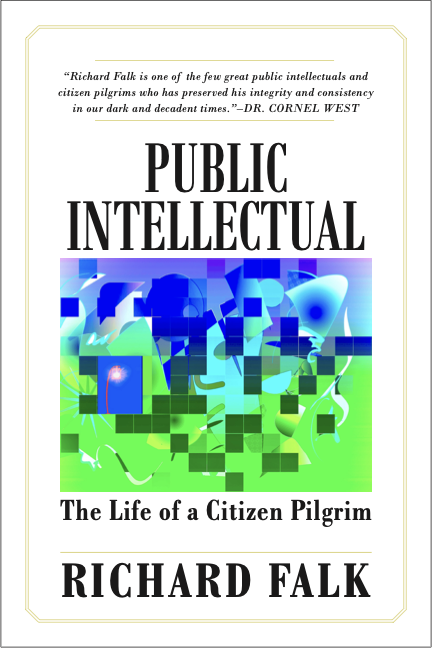
I post below images of the covers of my political memoir that was published this week, and is available from online booksellers in Kindle and paperback formats. I discovered that the interface between the person and the political can be as treacherous as visiting a combat zone, I welcome reactions and dialogue.

Nuclear Violence is Why We Are Living in the Anthropocene Age

15 Feb

[Prefatory Note: The short essay below is my contribution to the latest thematic Forum of the Great Transition Initiative. It responds to a beautifully crafted paper by the Founder of GTI under the auspices of the Tellus Institute, Paul Raskin. Paul’s initial paper and a series of fascinating responses can be found at  https://greattransition.org/gti-forum/interrogating-the-anthropocene. GTI has developed a powerful and sophisticated global network for dialogue about achieving a visionary future despite the dark clouds that now fill the sky.]

GTI FORUM 
Violence: Another Existential Crisis 

Contribution to GTI Forum Interrogating the Anthropocene: Truth and Fallacy

Richard Falk February 2021 

As I grasp the essence of the consensus emerging from this discussion of Paul Raskin’s eloquent essay, it is an acceptance of the Anthropocene as a dire warning that the human species is headed for disaster, if not extinction, if its ecological footprint is not greatly reduced in the relatively near future. The GTI perspective adds the indispensable insight that social evolution has many pathways to the future that can be instructively framed as a dramatic narrative enacted as a struggle between forces sustaining the destructive perishing patterns of the currently dominant modernist variants of civilization and those intent on achieving a variety of alternative civilizational constellations that incorporate what Paul calls for at the end of his conjectures: “expanded identity, solidarity, and citizenship.” It is fair to assume that these enlargements move civilizational vectors toward greater appreciations of species destiny along with possibilities of nurturing satisfaction with the experience of human community on a global scale. Such futures imply living with a new contentment based on underlying commonalities while at the same time valuing gender, societal, ethnic, and generational differences and overcoming past abuses.

I regard the GTI community as an ideational vanguard that is carrying forward the work of restorative vision with respect to the organically connected ecological and societal challenges. The hopeful ontological premise is the existence of reservoirs of species potential to turn the negative impacts of human geological agency, which mostly explains the designation of our time as the Anthropocene, into positive forms of social behavior that incorporate ecological and humanistic ethics in ways capable of actualizing variants of the GTI project.

There is also the baffling question of transcendence, which opens the portals of freedom and discovery by uniquely privileging and burdening the human species with freedom, and hence with responsibility to do the right thing. Individually and collectively, we can learn to see properly, and when we do, we have the freedom and responsibility to struggle for a better, and perhaps radically different, future. In this spirit, should the primary endeavor be to redesign capitalist dynamics to avoid destructive ecological effects and mitigate alienating and exploitative impacts on social relations, or should our ways of producing, consuming, and living be reframed to conform more closely to imaginaries of human flourishing? Due to the limited time to avoid irreversible or catastrophic damage, should GTI efforts prioritize “buying time” by settling for modest adjustments, assuming more fundamental change can emerge over longer periods? There exists a “Hegelian Trap” whereby an envisaged future gets confused with an attainable future. The teaching of the Anthropocene is that major ecological adjustments must be made soon—with the crucial sociological feedback being that the looming tragedy is not attributable to the human condition, but rather reflects a civilizational turn, sometimes associated with the turn from hunter-gathering civilizational ascendancy to agriculture and specialization, and reaching its climax by way of “modernity” as emanating from the Industrial Revolution.

Against this background, I find it useful to highlight the role of war, violence, and identity as carried to clarifying extremes by the United States. The US is the world’s leading source of arms sales, maintains black sites in foreign countries used to torture terrorist suspects, manages one of the largest per capita prison populations in the world, possesses the world’s only constitutionally grounded gun culture, and yet is less secure than ever before in its history. And to underscore this disturbing pattern, the most revered advocate of nonviolent struggle in the United States, Martin Luther King, Jr., was assassinated in 1968.

My sense of the socioeconomic side of predatory capitalism and ecological denialism is this pervasive delusion that weaponry and violence bring “security” to individuals, neighbors, and countries. Even the alarm bells set off by the use of atomic bombs in 1945 did not overcome the deeply entrenched roots of militarism at all levels of social interaction from gun culture to nuclear arsenals. With the passage of time, the possession of nuclear weapons was normalized for the states that prevailed in World War II, and global policy focused on keeping the weaponry away from other states by establishing an anti-proliferation regime, a system of nuclear apartheid that reflects the latest phase of geopolitical primacy as the fallacious basis of stability in world affairs. There are two points interwoven here: the pervasiveness of violence in human experience and the degree to which a nuclear war could parallel eco-catastrophe, threatening the Gaia Equilibrium that led stratigraphers to pronounce our geological age as the Anthropocene.

When we consider the sorts of human futures that would transcend the maladies of the present historical circumstances, we cannot get very far without a radical turn against individual and collective forms of violence and warfare. It is relevant to take note of the degree to which violence in every shape and form infuses even entertainment in many civilizational spaces, including even most indigenous communities. China is far from nonviolent, yet its remarkable surge, overcoming the extreme poverty of at least 300,000,000 million Chinese, as well as its expansionist vision of the vast Belt and Road Initiative seems a better platform from which to hope for benign civilizational transcendence.

As earlier observed, there are also obstacles associated with the civilizational modalities that presently control the basic categories of time and space. There is a mismatch between the time horizons of ecological, economic, and security challenges and electoral cycles of accountability. Political, corporate, and financial leaders are viewed by their short-term performance records, and thus tend to under-react to medium- and longer-term threats. In relation to space, the vast differences in wealth and capabilities among states and regions produces inequalities perceived as unjust, and need to be defended and justified by ideologies that fragment of human identity and community. In terms of world order, the whole is less than the sum of its parts, and until that ratio can be inverted, Paul Raskin’s imperative of expanded identity, solidarity, and citizenship will fall mostly on deaf ears. We live in a world in which the part is valued more than the whole, and such a political order might have persisted in a pre-Anthropocene worldview, but is now in deep jeopardy.

GTI FORUM 
Violence: Another Existential Crisis 

Contribution to GTI Forum Interrogating the Anthropocene: Truth and Fallacy


As I grasp the essence of the consensus emerging from this discussion of Paul Raskin’s eloquent essay, it is an acceptance of the Anthropocene as a dire warning that the human species is headed for disaster, if not extinction, if its ecological footprint is not greatly reduced in the relatively near future. The GTI perspective adds the indispensable insight that social evolution has many pathways to the future that can be instructively framed as a dramatic narrative enacted as a struggle between forces sustaining the destructive perishing patterns of the currently dominant modernist variants of civilization and those intent on achieving a variety of alternative civilizational constellations that incorporate what Paul calls for at the end of his conjectures: “expanded identity, solidarity, and citizenship.” It is fair to assume that these enlargements move civilizational vectors toward greater appreciations of species destiny along with possibilities of nurturing satisfaction with the experience of human community on a global scale. Such futures imply living with a new contentment based on underlying commonalities while at the same time valuing gender, societal, ethnic, and generational differences and overcoming past abuses.

I regard the GTI community as an ideational vanguard that is carrying forward the work of restorative vision with respect to the organically connected ecological and societal challenges. The hopeful ontological premise is the existence of reservoirs of species potential to turn the negative impacts of human geological agency, which mostly explains the designation of our time as the Anthropocene, into positive forms of social behavior that incorporate ecological and humanistic ethics in ways capable of actualizing variants of the GTI project.

There is also the baffling question of transcendence, which opens the portals of freedom and discovery by uniquely privileging and burdening the human species with freedom, and hence with responsibility to do the right thing. Individually and collectively, we can learn to see properly, and when we do, we have the freedom and responsibility to struggle for a better, and perhaps radically different, future. In this spirit, should the primary endeavor be to redesign capitalist dynamics to avoid destructive ecological effects and mitigate alienating and exploitative impacts on social relations, or should our ways of producing, consuming, and living be reframed to conform more closely to imaginaries of human flourishing? Due to the limited time to avoid irreversible or catastrophic damage, should GTI efforts prioritize “buying time” by settling for modest adjustments, assuming more fundamental change can emerge over longer periods? There exists a “Hegelian Trap” whereby an envisaged future gets confused with an attainable future. The teaching of the Anthropocene is that major ecological adjustments must be made soon—with the crucial sociological feedback being that the looming tragedy is not attributable to the human condition, but rather reflects a civilizational turn, sometimes associated with the turn from hunter-gathering civilizational ascendancy to agriculture and specialization, and reaching its climax by way of “modernity” as emanating from the Industrial Revolution.

Against this background, I find it useful to highlight the role of war, violence, and identity as carried to clarifying extremes by the United States. The US is the world’s leading source of arms sales, maintains black sites in foreign countries used to torture terrorist suspects, manages one of the largest per capita prison populations in the world, possesses the world’s only constitutionally grounded gun culture, and yet is less secure than ever before in its history. And to underscore this disturbing pattern, the most revered advocate of nonviolent struggle in the United States, Martin Luther King, Jr., was assassinated in 1968.

My sense of the socioeconomic side of predatory capitalism and ecological denialism is this pervasive delusion that weaponry and violence bring “security” to individuals, neighbors, and countries. Even the alarm bells set off by the use of atomic bombs in 1945 did not overcome the deeply entrenched roots of militarism at all levels of social interaction from gun culture to nuclear arsenals. With the passage of time, the possession of nuclear weapons was normalized for the states that prevailed in World War II, and global policy focused on keeping the weaponry away from other states by establishing an anti-proliferation regime, a system of nuclear apartheid that reflects the latest phase of geopolitical primacy as the fallacious basis of stability in world affairs. There are two points interwoven here: the pervasiveness of violence in human experience and the degree to which a nuclear war could parallel eco-catastrophe, threatening the Gaia Equilibrium that led stratigraphers to pronounce our geological age as the Anthropocene.

When we consider the sorts of human futures that would transcend the maladies of the present historical circumstances, we cannot get very far without a radical turn against individual and collective forms of violence and warfare. It is relevant to take note of the degree to which violence in every shape and form infuses even entertainment in many civilizational spaces, including even most indigenous communities. China is far from nonviolent, yet its remarkable surge, overcoming the extreme poverty of at least 300,000,000 million Chinese, as well as its expansionist vision of the vast Belt and Road Initiative seems a better platform from which to hope for benign civilizational transcendence.

As earlier observed, there are also obstacles associated with the civilizational modalities that presently control the basic categories of time and space. There is a mismatch between the time horizons of ecological, economic, and security challenges and electoral cycles of accountability. Political, corporate, and financial leaders are viewed by their short-term performance records, and thus tend to under-react to medium- and longer-term threats. In relation to space, the vast differences in wealth and capabilities among states and regions produces inequalities perceived as unjust, and need to be defended and justified by ideologies that fragment of human identity and community. In terms of world order, the whole is less than the sum of its parts, and until that ratio can be inverted, Paul Raskin’s imperative of expanded identity, solidarity, and citizenship will fall mostly on deaf ears. We live in a world in which the part is valued more than the whole, and such a political order might have persisted in a pre-Anthropocene worldview, but is now in deep jeopardy.

Remembering George Shultz

10 Feb

Remembering George Shultz After 53 Years

The academic year of 1968-69 was a consequential year for me. I had visited North Vietnam a few months earlier, coming away with a deeply altered view of that pivotal conflict that put a roadblock in the path of United States global ascendancy that has yet to be removed. This roadblock will not be taken away so easily, and certainly not by the timidity of the recent welcome leadership changes in the White House. As long as the U.S. throws its geopolitical weight around in conflicts distant from its homeland, its declining reputation will reach new depths. A beginning of restorative diplomacy for the country would be to stop overinvesting in global militarism and cease lecturing, and worse, sanctioning foreign governments on their departures from democratic practices or their failures to uphold human rights. I mention this only to underscore the disastrous consequences of failing to learn the lessons of defeat in the Vietnam War, and hence to reenacting this most dismal experience in other foreign settings.

The academic year I spent at Stanford started in September of 1968, and was memorable for three separate reasons. I spent an intellectually stimulating year at the Standard Center for Advanced Study in the Behavioral Sciences as a Visiting Fellow during which I discovered the relevance of ecology and eventually wrote This Endangered Planet: Prospects and Proposals for Human Survival (Random House, 1972); I was allowed to witness the breathtaking birth of my wonderful son Dimitri who arrived on the planet after a long and difficult delivery process; and I became a temporary friend of George Shultz who was the only other devoted tennis player among the 50 fellows at the Center that year, several of whom became more durable friends.

George never seemed entirely comfortable with the cloistered, scholarly atmosphere at the Center, and as the months passed, it seemed more as though he was waiting for his call to serve in the Nixon Cabinet than working on some publishable manuscript. Indeed, the call to Washington came in the Spring of 1969, and George, a labor economist, was appointed to become the new Secretary of Labor. I had bonded briefly and temporarily with George partly due to this shared love for tennis, and perhaps more so because I was on faculty leave from Princeton for the year, which was his beloved alma mater where he had been a standout football player, a nostalgic start of his amazing career as academician, high government appointee, business leader, and at the end of his life, a public source of wonkish wisdom on a range of issues, including the advocacy of denuclearization in collaborative efforts with colleagues at the Hoover Institution, which became notorious in the 1980s as the home of the Reagan brain trust, and later sanctuary for former government stalwarts, a kind of West Coast Brookings Institution, which featured good weather and right-wing politics.

George came across to me as a principled conservative, currently an endangered species, who was decidedly mainstream in his Cold War thinking, comfortable interacting with a wide range of persons, never dogmatic, more gifted at listening than talking, and a person who believed above all in the pragmatics of trust and trustworthiness in his relationship, including with those who were on the other side of the aisle. During the Cold War, he was adept at making positive relationships with prominent Soviet leaders, putting aside own conventional anti-Communist worldview. If George had a distinctive approach it was to balance his ‘free world’ orthodoxy with an abiding commitment to work toward a more peaceful world without ruffling establishment feathers. From my perspective, ‘a mission impossible.’ 

After our tennis matches, we often had rambling conversations about current events always accompanied by a soothing gin and tonic. What I remember best, even now with an affectionate smile is that George would ask me more than once to explain my opposition to the Vietnam War, the intensity of which he found surprising. He confessed that part of his curiosity about my views was selfish–possibly helping him understand better why his children had become so anti-war. I explained that visiting North Vietnam helped me see the war from the perspective of the totally vulnerable Vietnamese people. I had the impression back then that my views neither angered, moved, nor convinced him. Perhaps, this quality of serenity was the secret of George’s extraordinary success in the disparate university, government, and corporate worlds. Or maybe they are not as disparate as I would like to believe!  Anyhow, to live productively until the age of 100 among clashing views and egos that inhabit the pinnacles of these domains of power, wealth, and influence undoubtedly called upon George’s uncommon qualities of composure amid stress.

After enduring the Trump style of malicious bombast, I recall nostalgically, George’s civility, which according to reports, nevertheless required backbone, resisting the Nixon’s tactics that prefigured Trump’s antic presidency. George impressively stood his ground firmly whenever political leaders asked him to cross his red lines of law and morality, so unlike the Republicans who inhabit Congress, and toe the Trump line no matter what. Perhaps, the most relevant compliment I can pay this man who lived such a fulfilled, successful, and long life is that he would have likely been appalled by Trump’s sense of ‘America’ long before the outrages of January 6th awakened some long slumbering Trumpists. My biggest reservation about George is an assumption that he would have found the ultra-conservative community of the Hoover Institution more to his liking that the adventure in ideas encountered in the generally liberally inclined Stanford Center where we met.   

Iran’s Islamic Republic Celebrates its 42nd Anniversary

9 Feb

[Prefatory Note: Iran is in the process of celebrating the 42nd Anniversary of the Islamic Revolution that led to the downfall of the Shah of Iran’s dynastic rule and its replacement by the Islamic Republic of Iran, which has defied the odds by resisting successfully a variety of attempts to restore the old established order either by an Iraqi encouraged war in the 1980s, destabilization efforts all along pushed by the U.S. and Israel, and an undisguised goal of regime change. It should also be remembered that the U.S. helped restore the Shah to his imperial  crown in 1953 by helping to engineer a coup against the democratically elected Mohamad Mosaddeq. Months after the Shah abdicated and revolutionary supporters took over the Iranian government, Iranian students seized control of the American Embassy in Tehran and held the staff, including diplomats, hostage for more than a year. Such an event escalated the confrontation between Iran and the United States, which has risen to war-threatening heights at times, and veered toward normalization at other times. With a new American president in the White House who seems eager to promote a more moderate atmosphere in the Middle East there were widespread hopes for accommodation, but so far there are as many signs of continuity with the Trump years as indications of seeking accommodation based on equality and respect. 

I am aware that it is ‘politically correct’ in the West to comment favorably on this anniversary occasion, but I continue to view Iran as practicing the politics of post-colonial self-determination that has made it a target for hostile forces in the Middle East and elsewhere, and that hopes for a peaceful regional future rest on the further dewesternization of liberal secular criteria of governmental and behavioral legitimacy. I would not minimize Iran’s bad record when it comes to human rights, but its emphasis in the Western media is more a matter of geopolitics than empathy for victims, especially if compared with the silence about much worse infractions by regional allies of the Wesst, and taking account of the tendencies of even the purist of democracies to become paranoid and repressive when threatened by intervention and a counterrevolutionary crusade. Surely, maintaining comprehensive sanctions on Iran by the United States despite humanitarian appeals for their suspension during the COVID pandemic because of the massive harm done to the Iranian people should also be taken into account.]   

Q. 1: The anniversary of the victory of the Islamic Revolution in Iran is coming up. Many argue that the Iranian revolution, besides having internal effects, has affected the region and the international community. If you are positive with this viewpoint, what are its major international effects?

It is difficult to draw firm conclusions about cause and effect in international relations as there are many factors interacting at that same time. It seemed clear that the Islamic Revolution posed a challenge to Western vital strategic and economic interests that were tied closely to the Shah’s regime. It should be remembered that Henry Kissinger reminded the world that the Shah was “that rarest of things, an unconditional ally.” More broadly, the Islamic Revolution created the perception that the U.S. had a new adversary in the Middle East additional to, and perhaps more threatening, than the Soviet Union and the ideology of Marxism/Leninism. Its regional policies had previously emphasized, other than the containment of Soviet influence, access to oil at affordable prices and the security of Israel. This belief in Iran as a strategic threat was interpreted in the West as an ideological threat, as well, giving rise to Islamophobia that reached its peak in the United States after the 9/11 attacks in 2001 on the World Trade Center and Pentagon, primary symbols of American economic and military power. 

Imam Khomeini reinforced Western and regional anxieties by his insistence that the transformation of Iran was an ‘Islamic Revolution,’ nor a ‘Iranian Revolution’ or a ‘Sunni Revolution,’ implying strong concerns beyond the borders of Iran. Such a sentiment had an electrifying and mobilizing effect on Islamic thought and action throughout the Arab world, and recreated the idea that territorial states within enclosed borders were a European conception of community imposed on the Middle East after World War I, and the collapse of the Ottoman Empire. Nationalist thinking and organization inauthentically displaced the primary existential community of shared adherence to Islamic beliefs, the umma. Such an interpretation of community undermined the legitimacy of many governments in the Arab/Islamic context that relied on nationalist and secular sources of legitimacy while actually serving the interests of the West. 

The Western views of the Khomeini impact were highlighted by such phrases as regarding Islamic countries as the new ‘arc of crisis,’ or more memorably as ‘the clash of civilizations,’ the sequel to the Cold War, and the basis for a new phase of ideological and geopolitical confrontation. 

The Israeli dimension of the effects of the Islamic Revolution in Iran should not be overlooked. Israel was regarded as an alien force in the region, anti-Islamic, secular, and a lingering remnant of the colonial era. For the West it was an outpost of enlightenment, modernity, and shared goals, and after the fall of the Shah the became the leading strategic ally of the United States, a relationship that continues to haunt the region with intervention and political violence, as well as the denial of basic rights to the Palestinian people in their own homeland.

 Q. 2: Imam Khomeini, as the founder of the Islamic Revolution, unified the Muslim community towards certain causes, while before the Iranian revolution, there was not a dynamic wave of the Muslim community. What reasons caused that situation before the revolution?

Before the Iranian developments in 1978-79, the Middle East in particular was governed by authoritarian regimes that were on one side or the other of the Cold War rivalry between the U.S. and the Soviet Union. Many regional leaders in the Islamic world were fearful of the Islamic orientation of their own people, portraying Islam as anti-modern and an enemy of progress, and potentially threatening to the economic elites bonded with international capitalism. The Shah’s Iran typified this orientation and exhibited an acute form of civilizational alienation.

Imam Khomeini arrived on the political scene with a different vision of a political community animated by the resurgence of Islam as tradition and the foundation of ethically grounded governance. Because Iran faced counterrevolutionary threats from within and without, the governing challenges in Iran gave priority to protecting the revolution from its enemies, with a harshness often relied upon by the West to contend that the Islamic Revolution was a regressive development, a view encouraged by many of the Iranians who fled the country for various reasons. It is notable that these harsh tactics allowed the Islamic Revolution to survive and evolve, and contrasts with the experience of other efforts to achieve transformation, even reform, in Islamic countries, for instance, Egypt. The achievement of the Islamic Revolution is to persist in such a hostile environment suggests the skills of its leaders and the support of the great majority of its people.  

Q. 3: Experts on the Palestinian issue argue that the Islamic Revolution changed the direction of fights against Israel. What is your opinion about this matter?

In a few words, whereas before the Islamic Revolution support for the Palestinian struggle was pragmatic and opportunistic, while afterwards identification with Palestine became a matter of fundamental principle and a source of authentic identity. The Islamic Republic of Iran, no matter what pressures it was subjected to during the last four decades, has never wavered in support for the rights of the Palestinian people. 

Such speculation is difficult to be sure about as many forces were at work, but certainly the Islamic Revolution was one factor that altered the character of the struggle over the future of Palestine. From an Israeli perspective, Iran posed an increasing threat not only to its internal security and nationalist claims of legitimacy, but also to its regional and expansionist ambitions. At the same time, Iranian hostility to Israel reinforced Western hostility to the Islamic Republic. It also had the effect of leading the Gulf countries, with the exception of Qatar, to believe that their own legitimacy and stability was more threatened by the Islamic Republic than by Israel. These regimes, led by Saudi Arabia, also emphasized sectarian identities, insisting that only Sunni Islam was the true faith and that Shi’ia Islam was a deviation. At the same time, these Arab elites became persuaded that their rivalry throughout the Middle East with Iran was their primary concern, shared with Israel (and the United States), and that tensions and opposition to Israel no longer served governmental interests despite the persisting identification of their citizens with the Palestinian struggle. The climax of this revision of priorities became evident when the anti-Iran diplomacy was recently signaled to the world by the normalization agreements reached with several Arab countries, encouraged by others, and celebrated as a triumph of Trump’s pro-Israel foreign policy.

The Palestinian movement for self-determination was always viewed as problematic, and potentially dangerous, by the top-down governing processes in Iran and throughout the Arab world. Any bottom-up popular democratizing movement, epitomized by the Islamic Revolution in Iran and later by the rise to power of the Muslim Brotherhood in Egypt, was opposed by these repressive government scared of their own people. The Palestinian movement was deemed threatening in two of its dimensions—as putting forth political demands from below (a polar opposite from dynastic claims to rule from above, and so condition the role of Islam) and as challenging the links to the West to sustain internal security through weaponry and counterinsurgent tactics.

 Q. 4: Was Imam Khomeini, as a spiritual leader, effective in changing the status of the Palestinian issue?

I think Imam Khomeini did give the Palestinian struggle a higher status than it had earlier possessed, particularly within the region, it became a matter of ethics, not just politics. His emphasis on Palestinian self-determination, the illegitimacy of the Zionist Project, was treated as a fundamental commitment of the Islamic Republic from its inception, and Israel was viewed as a distinctly Western challenge to the prevalence of his sense of the Islamic community of peoples. In the course of my meeting with Imam Khomeini he made very clear that in his view of the illegitimacy of a Jewish state based on claims of ethnic superiority coincided with his great respect for Judaism as an authentic religion. He expressed his hope at that time in 1979, that the Jewish minority in Iran would disentangle itself from identification with and support for Israel and the Zionist Project, and if this happened, he declared his view that it would be a tragedy for Iran if Jews did not remain in the country after the revolution. 

This distinction between Israel and Judaism is crucial, and is the opposite of what the Israeli leadership and its more militant followers want the world to believe, which is that Israel, Jewishness, and Zionism are one, and that any criticism of Israel necessarily exhibits a form of anti-Semitism. Recently, the world respected Israeli human rights NGO issued a report that confirmed the view that Israel was an apartheid stated, premised on the efforts to make Israel ‘a Jewish supremacy state.’ As apartheid in any form is an international crime, listed as a Crime Against Humanity, in Article 7(j) of the Rome Statute governing the framework of the International Criminal Court in The Hague, the views of Imam Khomeini accord with basic principles of law and justice on this crucial matter of distinguishing between the State of Israel and the Jewish people.  

Q. 5: It is widely believed that Iran’s resistance against international pressures has shifted the international order and has created a new resistance force against world powers. Can we connect this process to the current undermined position of the United States?

I believe it is correct that the failure of the United States to overcome Iranian resistance to its destabilization and counterrevolutionary efforts is viewed as one dimension of American imperial decline. Military intervention and even coercive diplomacy by way of sanctions and threats is far less effective than in the colonial era, and is unable to control the political outcomes of many internal struggles for the control of States. It has contributed to what is generally viewed as a much more multipolar world. New patterns of alignment are emerging globally and regionally. The Biden presidency will try to restore the Cold War Euro-centric pattern of alliances, with China as the new principal rival, with Russia also on the outside looking in. There are many uncertainties in all domains of international life that will reshape world order in coming years. Of especial importance will be the management of climate change, health hazards, and global economic policy. There are several lines of uncertainty, including whether a new form of ideological tension arises and inhibits global cooperative problem-solving. There is a need for stronger institutional mechanisms at all levels of political interaction to safeguard and promote the global public good. The United Nations could be reformed to play a more central role in moderating diversities of interests and values, while protecting the sovereign rights of States and extending a greater effort to impose UN Charter Principles on the five Permanent Members of the Security Council. The UN would benefit for greater funding independence and less tolerance for geopolitical impunity.  

THE B’TSELEM REPORT ON ISRAELI APARTHEID

3 Feb

[Prefatory NoteThe post below consists of my responses to questions posed by Merve Ayadogan of the Anadolu Agency in Turkey, focused on the significance of the B’Tselem Report that recently concluded that Israel imposes an apartheid regime to sustain Jewish supremacy on both Israel itself and the all of Occupied Palestine. The Published version on Februrary 3, 2021 was crafted for the readers of the news agency.]

            THE B’TSELEM REPORT ON ISRAELI APARTHEID

Q 1: An Israeli human rights group, B’Tselem has labelled Israel as an “apartheid state” over its policy of favoring Jews over the Palestinians earlier this month. How would you comment on this declaration? Could it ease the Israeli aggression on Palestinians?

It is definitely an important development when Israel’s most respected human rights organization issues a report that confirms earlier UN reports and allegations that the Palestinians are victimized by an apartheid regime that seeks to impose policies and practices that ensure the supremacy of Jews by victimizing the Palestinian people throughout the whole of historic Palestine. Such a de facto one-state reality of unified Israeli control suggests that the internationally endorsed goal of a negotiated two-state solution has been superseded by Israeli ambitions to complete the Zionist project of establishing a Jewish exclusivist state on the entire  ‘promised land’ of ‘biblical Israel.’ These ambitions were implicitly acknowledged by Israel in 2018 when it enacted a Basic Law that asserted that only the Jewish people had a right to self-determination within the state of Israel, that the internationally unlawful settlement enterprise deserved national support, and that Hebrew was the only official language. Not only were Palestinians being subordinated despite being citizens, but so were Druze and Christian minorities.

It should be appreciated that ‘apartheid’ is listed as a Crime Against Humanity in Article 7(j) of the Rome Statute governing the activities of the International Criminal Court in The Hague. Although the crime of apartheid is derived from the South African racist regime that proudly declared itself to be a governance structure based on apartheid ideas of separate and unequal development, it has become a generic crime given an authoritative definition in the 1976 International Convention on the Suppression and Punishment of the Crime of Apartheid. The Government of Israel, especially in international settings such as the UN, is outraged by allegations of apartheid that it repudiates as nothing other than a vicious form of anti-Semitism. The internationally acclaimed Israeli journalist, Gideon Levy, writing in Haaretz, goes beyond the B’Tselem Report in his insistence that Israel plus the territory it occupies is an apartheid regime: “The reality of apartheid and Jewish supremacy from the Jordan River to the sea is hidden only from the blind, the ignorant, the propagandists and the liars.”

One of the contributions of the Report is to identify the elements of Israeli apartheid by reference to specific policies and practices that are relied upon to maintain Jewish supremacy over non-Jews within its sovereign territory. Among these are discriminatory standards applicable to immigration, giving Jews worldwide an unrestricted ‘right of return’ while denying Palestinian any immigrations rights even if parents or grandparents were born within its territory. Other important instances of discrimination based on ethnicity concern land tenure, citizenship and nationality rights, freedom of mobility, security of residence, administration of law, and issuance of building permits. It is clear that these apartheid features vary from domain to domain, from Israel proper to East Jerusalem, West Bank, and Gaza, but the core undertaking is stable: exploitative domination by Jews over non-Jews, especially Palestinians.

There is one mysterious weakness in my reading of the B’Tselem Report: the erasure of seven million or so Palestinian refugees and involuntary exiles. The Report deals with apartheid. only in the context of the control of territory rather than its deliberate and intended design of exerting control of people, and yet from 1948 to the present, Palestinians have suffered as a people, whether subject to Israeli territorial control or not, with hundreds of thousand  being displaced and dispossessed from 1948 onwards as integral to the 

Israeli overall plan to be a Jewish majority state that could lay a legitimating claim to being a democracy. In effect, ‘ethnic cleansing’ was a necessity, given Israel claims to legitimacy as a democracy. Palestinian forced to abandon their homeland by becoming refugees or exiles are at least as much a victim of apartheid as are Palestinians living under Israeli territorial control.

I have no reason to believe that Israel will act more humanely toward Palestinians as a result of the B’Tselem Report, but will condemn the report, as has already happened, as an instance of ‘Jewish anti-Semitism.’ As with BDS, Israeli first defenders will deliberately confuse criticism of criminally unlawful governing policies in Israel with hatred of Jews. A peaceful and secure future for both peoples will not arise until Israel dismantles apartheid and agrees to treat Palestinians in accordance with human rights standards, including respect for the Palestinian right of self-determination, as well as a genuine endorsement of racial equality.

  • Q 2: Despite pledging a new beginning in the Middle East, during Obama-era we saw a rise in conflicts and emerge of Daesh terror. Then came the Trump administration and we saw an atrophy in US-Palestine relations due to former president’s controversial decisions in favor of Israel. Now the newly-elected US President Joe Biden has directed his administration an immediate renewal of relations with Palestine and its people, what do you think of Biden administration’s policy regarding Palestine, the Middle East and wider region? Could we expect an “unseen” US policy for the region?

It is basically too early to tell whether the Biden presidency will do more than roll back some of Trump’s extremist moves. My best guess would be continuity with the approach to Israel/Palestine taken during the Obama period, with the special relationship fully reaffirmed, and Israel protected against censure and nonviolent pressures of the sort associated with the BDS Campaign or at the UN. Much will be revealed by how the Biden administration approaches Iran, particularly whether it attaches new conditions to the revival of Nuclear Program Agreement (JCPOA) of 2015 from which Trump withdrew. The suspensions of arms deals with Saudi Arabia and the UAE are welcome signs that Biden’s foreign policy might be directed at achieving some demilitarization of the Middle East with special emphasis placed on ending chaos and strife in Yemen, Syria, and Libya, as well as promoting stability in Iraq and Lebanon. It seems likely that Israel will continue to exert a strong influence on U.S. policy toward the region, and the Biden leadership has promised to consult with Israel before making any new policy moves in the region. At the same time, it is my impression is that Biden’s priorities will be overwhelmingly domestic (COVID, economic recovery), and that he will try hard to avoid the distractions of adopting controversial foreign policy positions. Even more troublesome than the Middle East, is an escalation of tensions with China and Russia, which definitely seems to be on the radar screen of Antony Blinkon and other top foreign policy advisors.

Q 3: Former US President Trump announced a “peace plan” which is widely known as “the deal of the century.” Do you think it was a realistic initiative?

The Trump plan was essentially a demand that Palestinians agree to political surrender with respect to their struggle for basis rights in exchange for economic assistance in improving the quality of their daily lives. In the post-colonial age of robust nationalism to expect a people to accept subordination in their own homeland and 

The renunciation of their inalienable right of self-determination is unrealistic, besides being contrary to the spirit of the post-colonial ethos. Such a one-sided proposal as put forward by the Trump presidency was nothing other than a tactic of geopolitical bullying, and should not be confused with genuine peacemaking. 

Q 4: How would you comment on the position of international community regarding Palestine conflict?

The international community seems stuck in a time warp by its continued adherence to the totally discredited Oslo diplomacy, which was premised on a two-state solution. As B’Tselem Report clearly demonstrates, the one-

state reality has become the only foundation of any future meaningful peace process, posing a challenge of how to arrange for future governance on a basis of true ethnic equality. Until this happens, UN and internationalist initiatives will be irrelevant. It is my belief that what hope exists for a just solution will arise from Palestinian resistance and global solidarity initiatives exerting sufficient pressure on the Israeli leadership so as to cause a recalculation of national interests. It is useful to remember that it was this combination of developments that explains the abrupt and unexpected collapse of the South African apartheid regime.

Q 5: Though UN has commented on the illegality of the settlements that Israel continues to develop on the occupied Palestinian territories, the organization still falls short in bringing about a peaceful solution. What should the UN do to ensure security, accountability, human rights and dignity for the Palestinian people?

The UN did pass a strong anti-settlements resolution at the end of 2016 by a 14-0 vote in the Security Council, with the U.S. abstaining, during the last days of the Obama presidency. [SC RES 2334, 23 Dec 2016] It was the strongest reassertion of UN authority in recent years, yet it led nowhere when it came to implementation. As Israel has repeatedly demonstrated over the course of its history, it will not be swayed by international law or UN directives, and will experience no adverse consequences for such defiance. It has now provocatively challenged the Biden presidency by approving 3,000 new permits for unlawful settlement construction, many of the approved new structures are situated deep in the West Bank, signaling Israel’s continuing establishment of unlawful facts on the ground to reinforce its refusal even to consider the negotiated emergence of a viable Palestinian state. It is important that the UN agenda continue to document Israeli wrongdoing as this will encourage and legitimize civil society activism. It is only Palestinian resistance from within and global solidarity from without that can have any prospect of achieving Palestinian rights and a peaceful future for both peoples. 

Is There An American ‘Deep State’?

23 Jan

Is There An American ‘Deep State’?

When a society is deeply troubled, and governed in ways that seem under the influenceof dark forces and disinformation becomes part of everyday life, it seems natural that all sorts of explanations will flourish. Few of us can handle uncertainty, and so many affirm falsehoods for thesake of achieving a specious clarity about the unknowable, or at least convert uncertainty into congenial forms of certainty, a dynamic that explains the rise of cultic thinking in our time and the spread of extremist versions of religious teachings. One variant of this phenomenon that has gained salience during the Trump presidency was supposedly pernicious role of the American ‘deep state.’ Trumpists complaining that unelected bureaucrats were subverting the great leader’s agenda while anti-Trumpists were disappointed that this source of influence didn’t find ways to remove such a political imposter given the damage he was doing national self-confidence and to the international rendering of the previously high end American brand. Some asked in exasperated tones ‘why is the deep state asleep?’  

The sharp divisions of race, class, and ethnicity in American society explain much of the confusion surrounding this dangerously imprecise terminology of ‘deep state.’ It is crudely used by polarized adversaries to identify hidden forces that are regarded as the marionettes manipulating the puppets, we the people. And these marionettes in their turn, when they don’t like what they hear from deep staters, insult their accusers by dismissing their allegations as the work of ‘conspiracy theorists,’ which is a way of discrediting explanations they do not like, and in the process dispensing with any need for a well-reasoned and serious response. Those who challenged the official version of the 9/11 attacks were quick to be defamed by the mainstream media, derided as ‘truthers,’ without even a glance at the evidence that led many responsible political observers to harbor many suspicions from day one.

More sophisticated academic commentators on U.S. foreign policy, especially progressive critics on the left, have recourse to a deep state hypothesis to account for the absence of significant debate on core national and global security issues throughout the more than four decades of Cold War. A typical definition of the deep state—‘a hidden government within the legitimate government’—creates a convenient shorthand, but seems too concrete to capture the reality. The word ‘government,’ an abstraction never easy to tie down with specific attributes, and unlike the open state is amorphous without even buildings, documents, briefings, and visible leaders. The terminology seems derived from some special features of the Turkish experience during the 1990s. The Turkish deep state refers to undisclosed anonymous high-level permanent bureaucrats in the intelligence and military sectors of government who act in concert to uphold their views of legitimate government, and step in when red lines are crossed. Such a process made no attempt vaguer to portray itself as ‘a hidden government.’ I believe the spread of the deep state rhetoric can be explained as an instructive way to take note of elites acting together in private to achieve informal agreements on crucial aspects of national security policy. The consensus reached is then loosely formulated to exert influence on the elected government to keep policies and practices within its boundaries. This dynamic gives rise to a certain atmosphere of ‘group think’ that discourages policy divergencies and proceeds without much relationship to partisan and overt party differences. [See Irving L. Janis, Groupthink: Psychological Studies of Policy Decisions and Fiascos, Boston, Wadsworth Learning, 1982]

The more emotive political uses of ‘deep state’ are associated with conspiratorial beliefs of individuals or groups in society that attribute official behavior to the sinister power and influences, attributions with little or no credibleevidence, e.g.QAnon! Such deep states are usually connected by sensation-seeking or culturally paranoid observers. Often such explanations of public behavior is blamed on the opinions of entrenched elite that are vehicles for a range of dark forces, including CIA, Council on Foreign Relations, the Rockefeller family, Goldman Sachs, Silicon Valley, Jeff Bezos or Elon Musk, or even such secretive foreign entities as Mossad, the Bilderberg Group, World Economic Forum working either independently or collaboratively. The basic idea behind such assertions is that the will of the people or citizenry is being secretly and effectively perverted and exploited by anti-democratic elements that do not operate openly.  

Conjectures about the deep state have been more responsibly used to explain the behavior of many governments around the world, including Turkey, Colombia, Italy, Egypt, and others, and in each national situation particular characteristics of the phenomenon have been stressed. In recent times, a left version of such an outlook were given prominence in the U.S. by the constant drumbeat of Bernie Sanders’ denunciations of the tyranny of the 1%. The main reference here is a Wall Street financial and corporate elite that has manipulated the U.S. government into becoming a vehicle for perpetuating and extending the grossest forms of wealth inequality. It also propagates a public policy biased toward the rich, swayed by money in disregard of the collective will or overall wellbeing of the citizenry, and makes a shambles of Main Street.

A second left variant, which assumed prominence during the Cold War, blames the national security state for working behind the scenes to keep American global militarism and worldwide alliance networks as the apolitical centerpiece of U.S. foreign policy no matter what the real security needs of the nation or the case for allocating more resources to social protection goals. This kind of deep state elite seems guilty of grossly exaggerating and militaryzing international security threats to the U.S. homeland and global economic and diplomatic interests. The underlying materialist motivations for a critique of such policies is the allegation that these bureaucratic operatives are dedicated to maintaining support for a very high peacetime military budget and a robust private sector flourishing arms industry that captures resources from other uses and securitizes the federal bureaucracy. [For effective documentation and analysis see Christian Sorensen, Understanding the Arms Industry (Clarity Press, 2020)]

During the Cold War there emerged agreement among the leadership of both political parties that the Soviet Union was a dangerous ideological and geopolitical rival that threatened American global leadership, its economic and diplomatic interests around the world, as well as its ideological leadership. Such an agreement within the country became widely known as a ‘bipartisan consensus,’ which mysteriously survived even the end of the Cold War and the collapse of the Soviet Union, which had been its animating rationale in the late 1940s. There was an immediate search for new enemies that posed threats, allowing new prospects of warfare to emerge that reflected clashes of interests, ideas, and values. After the Cold War, Japan was posited as outperforming the U.S. economically in ways that supposedly threatened its primacy in the Pacific. Then the Iranian Revolution turned attention to Islam notoriously depicted by Samuel Huntington as generating a formidable challenge as ‘the clash of civilizations,’ given its time in the sun after the 9/11 attacks, the provocation that launched the notorious worldwide ‘war on terror’ that also posed unprecedented threats to homeland security. Now there is reemerging hostility toward Russia based on its reabsorbing of the Crimea and interference in the Ukraine, and it is being superseded by magnifying a series of grievances involving China. The purveyors of such militarized views of security are coming to the rescue of would be warriors occupying the many Washington office buildings and Beltway think tanks where its mostly anonymous occupants spend their working days validating the need to maintain American military dominance in all regions of the world or otherwise Americans will have to learn to live with the misfortunes of systemic decline. Leading academic experts on foreign policy and world politics, to varying degrees, endorse this continuing bipartisanship as the only game worth playing in international arenas, thereby situating views favoring a peacetime budget and domestic priorities as falling outside the boundaries of responsible debate in mainstream venues. When you find conservative and liberal voices raised on behalf of the plight of the Uighors, while being silent about the Palestinians it should be obvious that something is fishy. 

Among the most intelligent non-governmental participants in these circles of geopolitical consensus formation, Stephen Walt denies the fact that such bipartisanship is the work of a ‘secret conspiracy.’ In Walt’s words, “..to the extent that there is a bipartisan foreign policy elite, it is hiding in plain sight.” In other words, the bipartisan consensus, endorsed by both Democrats and Republicans, does not reflect the nefarious priorities of the deep state, but is the considered judgment of objective specialists, politicians, media, and the most informed and influential segments of the citizenry in and out of government. Such a view does not dispose of the deep state role in shaping and sustaining the bipartisan consensus for several reasons that can be summarized. The absence of a downward shift in military expenditures after the Cold War; the continued refusal to learn lessons of military frustration in Vietnam, Afghanistan, Iraq, and Libya; the exaggeration of international terrorist threats as acts of war; and the refusal of mainstream media venues to include anti-militarist commentary that suggest alternatives to or weaknesses of the bipartisan consensus. Incidentally, if some peace minded Democratic Party candidate were to emerge who advocated deep cuts in the military budget, geopolitical reconciliation with Russia and China, nuclear disarmament, and the closing of foreign military bases, there is little doubt in my mind that an equivalent group of former national security officials who had been lifelong Democrats would quickly form to explain in a public forum why they could never vote for such a candidate. It is this likely symmetry of outlook, reinforced by mainstream media, that makes the bipartisan consensus more than the figment of a disenchanted imagination, but what Noam Chomsky christened long ago as ‘indoctrination in a liberal society.’

And then came Trump. During the 2016 presidential campaign, he was initially perceived as an opportunistic and comedic business billionaire and TV reality show personality (‘The Apprentice”), but as he began putting himself forward as an outsider with the intention and talent to become a populist leader. When Trump began pledging his raucous rallies that he would ‘to drain the swamp,’ he began to be seen as what he was, a potent ideological threat to the bipartisan consensus. Such a perception led many visible members of the national security component of the Republican elite to break ranks during the 2016 campaign to publicize their worries about Trump and explain to the citizenry their decision not to vote for Trump although it meant breaking ranks with their lifelong Republican allegiance. They did the unthinkable, indirectly throwing support to that nemesis of most Republicans, Hillary Clinton. This unusual rejection of the Republican candidate from within was given great attention by the mainstream media when expressed through the release of an Open Letter to the American People in 2016. Trump’s strategic consultants were seen as dangerous adversaries of the deep state of unelected bureaucrats who had held government positions that exerted influence in government and had enjoyed widespread outside support from mainstream media, Washington think tanks, and the academic establishment. What worried these Republican former bureaucrats who made a point of highlighting their past consistent support of Republican candidates were the hints that Trump would seek some sort of geopolitical realignment bypassing the Atlanticist alliance that had been the centerpiece of American foreign policy ever since the end of World War II. Trump was also critical of regime-changing interventions of the sort that led to ‘forever wars’ with no discernable benefit to U.S. interests, but helpful in inflating military expenditures. Trump was also unfavorably seen by this group as an opponent of global cooperation and neoliberal globalization, which they regarded as a key element in America’s worldwide success after 1945. Trump’s formula for making America great again involved a transactional and ultra-nationalist approach to trade, investment, and immigration, with a decidedly pointed withdrawal from foreign entanglements, cooperative frameworks, and global leadership. Although it was this challenge to the Cold War enactment of global militarism and alliance diplomacy, the Open Letter rested its disapproval mainly on Trump’s lack of experience and impulsive temperament than on the more arcane issues of global policy. As his years in the White House have demonstrated, these fears of former Republican officials were not misplaced. If anything, Trump’s repudiation of guidance from the intelligence services and controversial connections with Putin’s Russia went beyond these 2016 fears, and led to a second Open Letter by discontented former Republican national security officials during the 2020 campaign, including cabinet level figures such as Colin Powell and former directors of the CIA and FBI. [For texts see [“Open Letter to Donald Trump from GOP National Security Leaders,” Texas National Security Review, March 2, 2016; “More than 70 former GOP National Security Officials wrote an Open Letter backing Biden, calling Trump corrupt and unfit to lead,” Business Insider, August 21, 2020.]  

Despite these concerns about Trump wandering off the reservation, many deep state priorities were actually upheld: the military budget was sustained, geopolitical confrontation with China was endorsed, special relationships with Israel and Saudi Arabia were pushed further than ever, relations with Iran were stressed in ways that reverted to the pre-Obama Bush years of hostility and sanctions. Even U.S. military disengagements from overseas arenas such as Iraq and Afghanistan were slowed, and Trump momentarily pleased the old consensus when he retaliated with a military strike against the Syrian government after what appears to be a fabricated claim that Damascus was responsible for a chemical weapons attack on Douma in April 2018. Yet his Lone Ranger style of diplomacy continued to worry the overseers of a governing process that became deeply troubled by Trump’s highly erratic one man’s show, which did collateral damage by depriving the ‘permanent government’ of its policy roles. In addition to these matters of style and procedure, the Open Letter signatories were opposed to the implications of downgrading NATO, Atlanticism, and Europe generally, especially the seeming soft, even deferential, approach taken toward Putin’s Russia, and the unseemly withdrawal by such breakthrough global agreements in 2015 as the Paris Climate Change Agreement and the Joint Comprehensive Plan of Action that addressed the Iranian nuclear programs, enjoying the blessings of all five permanent members of the Security Council plus Germany. 

Trump was unintimidated, mounting a populist pushback against these deep state outbursts. The Trump worldview was initially most coherently articulated by Steve Bannon, and transmitted to the grassroots by Trump’s rally rants and nighttime tweets. The pro-Trump counterattack alleged that within the government itself are a Euro-centric gang of unelected bureaucratic operatives that had been calling the shots, especially on foreign policy, ever since 1945. This cabal was also held responsible by Trumpists for embracing ‘forever wars,’ not charging allies for military protection in the form of military bases, deployed troops and weapons, and a total securitization of foreign policy, subverting the true interests of the American people, and abetted by the Wall Street crowd that sent millions of manufacturing jobs abroad and in the process alienating much of the American working class. This rightest version of populism subscribes to the litany of anti-liberal scapegoats ranging from alarmist environmentalist to asylum seekers from South of the border, a variety of hidden forces within the government that are conspiring with the cancel culture to destroy the once virtuous white America.

As suggested at the outset allegations of a deep state can serve contradictory ideological perspectives. Some versions are highly speculative, even paranoid, others seem grounded in reality and substantiated by convincing evidence, backed up by open avowal and careful analysis. The core idea of the deep state as a hidden government is far too concrete in its imagery. I prefer to think of a preferred delineation of the deep state in America as a metaphor that encompasses both the internal agreements prevailing among career and appointed national security officials who exert great influence with public opinion due to their media credibility. This type of deep state is a confluence of influential persons who owe allegiance to shared ideas about the role of military and diplomatic capabilities that emerged out of World War II, persisted throughout the Cold War, and managed to dominate the formation of foreign policy despite repeated performance failures that badly tarnished the U.S. reputation and imposed heavy costs without achieving any of its proclaimed goals. In effect, Trump’s foreign policy was indeed disastrous, but it did somewhat illuminate the anachronistic character of the zombie like ‘bipartisan consensus’ that yet be revived in the course of reaffirming the old Cold War/neoliberal globalization orthodoxy of pre-Trump America.