[Prefatory Note: This opinion piece was published in Middle East Eye on May 18,2021, and republished in Il Manifesto and The Wire under different titles. It attempts to contextualize the current violence directed against Gaza in earlier Israeli provocations. It also takes note of Israel’s reliance on excessive force in its attack upon an essentially helpless Gazan civilian population of over two million people trapped inside a crowded and unlawfully blockaded enclave. The communal violence between Arabs and Jews in Israeli towns and villages, the unity displayed by Palestinians inside and outside the occupied territories, the protests at the borders of Jordan and Lebanon, the Jewish dissent from Israeli criminal assault on Gaza, and the greater receptivity of the Western media and even the US Congress to Palestinian grievances different than past interludes of severe violence. The future will tell us whether finally an inflection point in the Palestinian struggle has been reached in which the path to peace is cleared by the fusion of resistance from within and solidarity from without.]
The Last Stand of Settler Colonialism: Apartheid Israel
The current crisis of Palestine/Israel deepens and widens as casualties mount, smoke from destroyed buildings blacken the sky over Gaza, rioting on the streets of many Israeli and West Bank towns, Israeli police disrupting worshippers in the Al-Aqsa mosque compound and protecting extremist Jewish settlers shouting genocidal slogans ‘death to the Arabs’ in their inflammatory marches through Palestinian neighborhoods. Underlying this entire eruption of tensions between oppressor and oppressed were the flimsy legalized evictions of six Palestinian families long resident in the Sheikh Jarrah. These evictions epitomized the long Palestinian ordeal of persecution and banishment in what psychologically remains their homeland. While this mayhem continues the lights have remained scandalously dim at the UN. Western leaders pathetically call for calm on both as if both sides shared equal blame, while perversely affirming the one-sidedness of ‘Israel’s right to defend itself,’ which supposes that Israel had been attacked out of the blue.
Is this but one more cycle of violence exhibiting the unresolvable clash between a native people overwhelmed by a colonial intruder emboldened by a unique religiously grounded settler sense of entitlement? Or are we witnessing the beginning of the end of the century long struggle by the Palestinian people to defend their homeland against the unfolding Zionist Project that stole their land, trampled on their dignity, and made Palestinians victimized strangers in what had been their national home for centuries? Only the future can fully unravel this haunting uncertainty. In the meantime, we can expect more bloodshed, death, outrage, grief, injustice, and continuing geopolitical interference. What these events have made clear is that the Palestinians are withstanding prolonged oppression with their spirit of resistance intact, and refuse to. be pacified regardless of the severity of the imposed hardships. We also are made to appreciate that the Israeli leadership and most of its public is no longer in the mood even to pretend receptivity to a peaceful alternative to the completion of their settler colonial undertaking despite its dependence on a weaponized version of apartheid governance.
THE HASBARA NARRATIVE
For Israelis and much of the West the core narrative continues to be the violence of a terrorist organization, Hamas, challenging the peaceful state of Israel with destructive intent, making the Israeli response seem reasonable as both a discouragement of the rockets but also as a harsh punitive lesson for the people of Gaza designed to deter future terrorist attacks. The Israeli missiles and drones are deemed ‘defensive’ while the rockets are acts of ‘terrorism’ even though Israeli human targets are seldom hit, and despite the fact that it is Israeli weaponry that causes 95% of the widespread death and destruction among the over two million civilians Gazans who have been victims of an unlawful and crippling blockade that since 2007 has brought severe suffering to the impoverished, crowded, traumatized Palestinian enclave long enduring unemployment levels above 50%.
In the current confrontation Israel’s control of the international discourse has succeeded in de-contextualizing the timeline of violence, having the effect of leading those with little knowledge of what induced the flurry of Hamas rockets to believe falsely that the destruction in Gaza was a retaliatory Israeli reaction to hundreds of rockets launched by Hamas and Gaza militia groups. With abuses of language that might even surprise Orwell, Israel’s state terrorism is airbrushed by the world along with the rebuff of Hamas’ peace diplomacy over the past 15 years that has repeatedly sought a permanent ceasefire and peaceful coexistence.
For Palestinians, and those in solidarity with their struggle, Israel knowingly allowed the subjugated population of East Jerusalem to experience a series of anguishing humiliations to occur during the holy period of Muslim religious observances in Ramadan rubbing salt in the a wounds recently opened by the Sheikh Jarrar evictions, which had the inevitable effect of refreshing Palestinian memories of their defining experiences of ethnic cleansing days before the annual May 15th observance of the Nakba. This amounted to a metaphoric reenactment of that massive crime of expulsion accompanying the birth of Israel in 1948, culminating in the bulldozing of several hundred Palestinian villages signaling a firm Israeli intention to make the banishment permanent.
SOUTH AFRICAN APARTHEID
Unlike South Africa, which made never claimed to be a democracy, Israel legitimated itself by presenting itself as a constitutional democracy. This resolve to be a democracy came with a high price tag of deception and self-deception, necessitating to this day a continuing struggle to make apartheid work to secure Jewish supremacy while hiding Palestinian subjugation. For decades Israel was successful in hiding these apartheid features from the world because the legacy of the Holocaust lent uncritical credence to the Zionist narrative of providing sanctuary for the survivors of the worst genocide known to humanity. Additionally, the Jewish presence was making the desert bloom, while at the same time virtually erasing Palestine grievances, further discounted by hasbara visions of Palestinian backwardness as contrasting with Israeli modernizing prowess, and later on by juxtaposing a political caricature of the two peoples portraying Jewish adherence to Western values as opposed to Palestinian embrace of terrorism.
WINNING THE LEGITIMACY WAR
Recent developments in the symbolic domains of politics that control the outcome of Legitimacy Wars have scored several victories for the Palestinian struggle. The International Criminal Court has authorized the investigation of Israeli criminality in Occupied Palestine since 2015 despite vigorous opposition from the leadership of the Israeli government, fully supported by the United States. The investigation in The Hague, although proceeding with diligent respect for the legalities involved, was not openly engaged by Israel, but rather was immediately denounced by Netanyahu as ‘pure antisemitism.’
Beyond this, the contentions of Israeli apartheid, which only a few years ago was similarly denounced when an academic report commissioned by the UN concluded that the allegation of apartheid was unequivocally confirmed by Israeli policies and practices of an inhuman character designed to ensure Palestinian victimization and Jewish domination. In the past few months both B’Tselem, Israel’s leading human rights NGO, and Human Rights Watch, have issued carefully documented studies that reach the same startling conclusion that the Israel indeed administers an apartheid regime within the whole of historic Palestine, that is, the Occupied Palestinian Territories plus Israel itself. While these two developments do not alleviate Palestinian suffering or the behavioral effects of enduring denial of basic rights, they are significant symbolic victories that stiffen the morale of Palestinian resistance and strengthen the bonds of global solidarity. The record of struggles against colonialism since 1945 support reaching the conclusion that the side that wins a Legitimacy War will eventually control the political outcome, despite being weaker militarily and diplomatically.
The endgame of South African apartheid reinforces this reassessment of the changing balance of forces in the Palestinian struggle. Despite having what appeared to be effective and stable control of the African majority population through the implementation of brutal apartheid structures, the racist regime collapsed from within under the combined weight of internal resistance and international solidarity. Outside pressures included a widely endorsed BDS campaign enjoying UN backing. Israel is not South Africa in a number of key aspects, but the combination of resistance and solidarity was dramatically ramped upwards in the past week. Israel has already long lost the main legal and moral arguments, almost acknowledging this interpretation by their defiant way of changing the subject with reckless accusations of antisemitism, and is in the process of losing the political argument.
Israel’s own sense of vulnerability to a South African scenario has been exposed by this growing tendency to brand supporters of BDS and harsh critics as ‘antisemites,’ which seems in the context of present development best described as ‘a geopolitical panic attack.’ I find it appropriate to recall Gandhi’s famous observation along these lines: “first, they ignore you, then they insult you, then they fight you, then you win.”
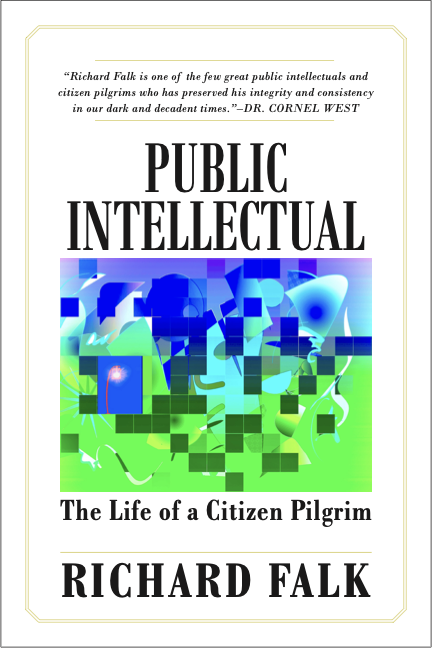
The International State Crime Initiative is delighted to host a conversation with Professor Richard Falk—preeminent international legal scholar, activist, and thinker on peace and justice—on his recently released memoir Public Intellectual: The Life of a Citizen Pilgrim. Professor Falk will be joined by Professor Noura Erakat, British journalist and author Victoria Brittain, and British MP and Former Leader of the Labour Party Jeremy Corbyn, who will reflect upon Falk’s life as a leading international and political figure.
This event, chaired by Professor Penny Green (Queen Mary), will take place on Monday 17 May at 5:30 pm (BST).
Professor Falk’s political memoir, Public Intellectual: The Life of a Citizen Pilgrim, chronicles Falk’s life of progressive commitment, highlighted by his visits to North Vietnam during the Vietnam War; to Iran during the Islamic Revolution; to South Africa at the height of the struggle against apartheid; and frequently to Palestine and Israel in his capacity as the UN Special Rapporteur for Occupied Palestine. Falk’s memoir also discusses the enduring defamatory attacks he faced in reaction to his stances for justice and his expressions of solidarity with the Palestinian struggle. As a Professor of International Law at Princeton University, Professor Falk would draw on these experiences to publish more than fifty books on topics of significant scholarly relevance, including studies of the profound dangers now facing humanity, the relevance of international law and the UN, and prospects for transforming world order in the direction of peace, justice, and ecological viability. His memoir excavates two key themes that have dominated his public roles: engaging with the controversies of the present and envisioning a future of world order that is humane and sensitive to ecological limits.
Speakers
Professor Richard Falk is a leading international law professor, prominent activist, and prolific author and scholar. During forty years at Princeton University Falk was active in seeking an end to the Vietnam War, a better understanding of Iran, a just solution for Israel/Palestine, and improved democracy elsewhere. He also served as UN Special Rapporteur for Occupied Palestine. His books include This Endangered Planet, A Study of Future Worlds; Power Shift, Revisiting the Vietnam War, Palestine Horizon, and On Nuclearism. He now holds a Chair in Global Law at Queen Mary University of London.
Rt Hon Jeremy Corbyn MP is British MP for Islington North and Former Leader of the British Labour Party and Leader of the Opposition (2015-2020). Corbyn was first elected to Parliament in 1983. His professional and personal journey has led him to spend significant time and energy on issues of anti-racism, anti-imperialism, LGBT+ rights, transport, the environment, opposition to nuclear weapons and military intervention, Trade Union policies, Miscarriages of Justice and more. Through his roles and activism he has travelled widely and continues to support communities affected by unresolved conflict, including the Western Sahara, Chagos Islands, the Middle East, Africa, Latin America, Ireland, West Papua, the Dalit community, and the Rohingya. Corbyn was awarded the Sean McBride Peace Prize in 2017, and before that the Gandhi International Peace Award in 2013. He is currently a member of the Parliamentary Assembly for the Council of Europe, the UK Socialist Campaign Group, and a regular participant at the United Nations Human Rights Council (Geneva), Campaign for Nuclear Disarmament (Vice President), and Chagos Islands All Party Parliamentary Group (Honorary President), and a Vice president of the British Group Inter-Parliamentary Union (IPU).
Professor Noura Erakat is a human rights attorney, Associate Professor of Africana Studies at Rutgers University, and non-resident fellow of the Religious Literacy Project at Harvard Divinity School. Noura is the author of Justice for Some: Law and the Question of Palestine (Stanford University Press, 2019), which received the Palestine Book Award and the Bronze Medal for the Independent Publishers Book Award in Current Events/Foreign Affairs. She is co-founding editor of Jadaliyya and editorial board member of the Journal of Palestine Studies. She has served as Legal Counsel for a Congressional Subcommittee in the US House of Representatives, as Legal Advocate for the Badil Resource Center for Palestinian Refugee and Residency Rights, and as national organizer of the US Campaign to End the Israeli Occupation. Noura has also produced video documentaries, including “Gaza In Context” and “Black Palestinian Solidarity.” She has appeared on CBS News, CNN, Fox News, and NPR, among others.
Victoria Brittain worked at the Guardian for more than 20 years as a foreign correspondent and then Associate Foreign Editor. She has lived and worked in Saigon, Algiers, Nairobi and reported from many countries in Africa and the Middle East for numerous media outlets in the anglophone and francophone worlds. She is the author, co-author or editor of 10 books and plays including Love and Resistance in the Films of Mai Masri (Palgrave Macmillan, 2020).
Chair
Professor Penny Green is Head of the Law Department at Queen Mary University and Professor Law and Globalisation. Professor Green has published extensively on state crime theory (including her monographs with Tony Ward, State Crime: Governments, Violence and Corruption; and State Crime and Civil Activism: on the dialectics of repression and resistance), state violence, Turkish criminal justice and politics, ‘natural’ disasters, the Rohingya genocide, mass forced evictions in Israel/Palestine, and civil society resistance to state violence. Professor Green is Co-editor in Chief of the State Crime Journal and Founder and Director of the award-winning International State Crime Initiative.
**Please note this is an online event and that all registrants will be sent joining details on the day of the event.
Footer navigation
Contact the university
Queen Mary University of London Mile End Road London E1 4NS +44 (0) 20 7882 5555
Daniel Falcone:Public Intellectual: The Life of a Citizen Pilgrimis considered both an autobiography and a book about international relations. I like how you provide the reader, with a narrative-analysis. In other words, it seems that you are interested in explaining a great deal of your (and others) analytical frameworks by unpacking your own life in the pursuits of these intellectual developments. Can you comment on this?
Richard Falk: From the beginning I was seeking to understand the interfaces connecting the personal, professional, and political that seemed to have dominated the adult portions of my life journey. In doing this, I realized that it was an exercise in self-scrutiny that is comparable with self-administered post-Freudian therapy. I was, in part, motivated by the goal of understanding why I had chosen several less traveled paths in shaping life experience, as well as narrating my journey guided in its last stages by a progressive imaginary. I decided, also, to risk recalling my past totally on the basis of memory, without recourse to such materials as journals and books in my possession. Of course, this was hazardous at any age, but particularly on a project that did not get fully underway until my late 80s. I doubt that it would have been more selective in distorting ways than if I had checked my recollections against the records I kept over the years.
I also had a strong sense that my problematic childhood and adolescence was relevant to what came later. I am quite sure that my interpretative gaze would have been quite different if I had started this project five or ten years earlier, which suggests that there is a degree of contingency embedded in attempting a memoir. The personal and historical context would have been different, and hence the lens by which I reconstructed my life. I felt strongly that I should be as honest as possible, while taking on responsibilities of not without being hurtful to persons who were alive and with whom I had once been intimate. I found it difficult to decide whether explaining why a romantic relationship did not endure was worse than overlooking the relationship altogether, which was the course chosen in several instances.
Early on as I reflected upon my childhood, why it was so humdrum, exhibiting little by way of achievement or even sense of direction. Aside from my own failings, I attribute the snail pace of my development, perhaps overly, to the impact of my divorced parents, my mother detached and uncaring, my father too protective and deeply disappointed by the downward trajectory of his own life. In some ways, I think my insecurity of those years helped me avoid the worst sorts of failures. In a real sense, I lacked the courage to fail altogether, hanging on to the edge of the cliff with my fingernails because of my fear of falling. I began to gain a certain composure, probably nothing more than a fragile veneer of self-confidence as a college undergraduate, then a law school student, and later as a young faculty member at a large mid-western university. Each of these experiences in an academic institution by stages helped me find a political identity of my own. I had long lounged under the umbrella of my father’s ultra-conservative stance, which was both anti-New Deal and unconditionally anti-Communist. I was not at ease with such a political outlook, but I lacked an alternative.
The publisher of my memoir, supportive and empathetic from start to finish, rightly instructed me cut 100,000 words that I had struggled to find during the ordeal of composition. As it said, sometimes the best of a film is left on the floor of the cutting room, I am not sure whether my editorial surgery was properly selective in its arbitrary decisions about what could go and what should stay. In retrospect, the subjectivity of constructing one’s own life by staring for several years at oneself in a rear view mirror made me aware that there is a much finer line separating fiction from non-fiction than I had assumed for the prior 90 years.
Maybe a better book, certainly a different one, would have emerged if I had allowed myself the freedom to embellish my life rather than to try to render it. Is it important, in other words, to keep the faith? Or would most readers prefer to wander with me down phantasy lane? Is there really such a thing as a ‘fake life’ any more than there is a ‘true life.’ Of course, appalled by Trump’s dodges of truth and truthfulness, I felt it a political obligation to be as truthful as possible. And maybe this worked to skew the narrative toward an unimaginative literalness, and is the sort of historical contextual circumstance that tilts the tone and substance in a different way than I had embarked the memoir writing experience during the Obama presidency.
Daniel Falcone: I particularly enjoyed reading about the impacts that students from Puerto Rico had on your educational leadership, your politics in general, and how they helped you gain an appreciation for the politics of the islandspecifically. Can you inform readers of this experience and what these mentorships and friendships cultivated and produced?
Richard Falk: You pose an interesting series of questions about friendship with a particular stress on friendship with students. It may be had I responded to these questions prior to writing this memoir I would have approached these issues in more perceptive ways. Pondering now why friendship has always loomed large in my enjoyment of life at every stage, I would have to acknowledge that it probably reflects the shortcomings of the family dimensions of my life, leading me to search elsewhere for meaning and affection. As well, the absence of the kind of community affiliations that bestows a sense of both identity and belonging that most frequently arise from religious practices and cultural traditions was entirely absent, leading to feelings of envy for apparent ‘normalcy’ of my school classmates who almost all seemed more attached to their families and ethnic backgrounds than I.
As so much of my early pleasure and later of wellbeing involved competitive sports. I found many early friends on these playing fields, and this kind of satisfying bonding continued to be a sustaining feature of my social life throughout my life. Especially at Princeton where so many students were talented and ambitious, I found many young persons who interested me, especially among those who came from less privileged backgrounds at graduate levels. At the same time, because my research interests and political activities situated me at the professional margins, I found students by and large less judgmental than my faculty colleagues and often more congenial and interesting. It embarrasses me, yet only slightly, that after 40 years at Princeton, with a few notable exceptions, my only close faculty friends on campus, with a few exceptions, were those with whom I played tennis and squash with on a weekly basis over many years. Others with strong shared interests and views were not to be found on campus, but were either former students or those with whom I bonded through shared political commitments or other forms of sympathetic intimacy.
What I discovered early on in my faculty experience was that teaching provided a great arena for learning provided I had the self-confidence to listen carefully even to objections and also to approach my lectures without excessive preparation, which I realize may sound strange. This latter characteristic might seem odd, and it can be taken too far, or prove disastrous if not familiar with the overall subject-matter, particularly its framework. The advantage of being creatively underprepared is that it leaves space for spontaneous free associations and opens more space for dialogue with students. If relying on old notes or even transcripts of old lectures there is a fixation on text, a corresponding reluctance to explore uncharted territory, and at atmosphere not receptive to dialogue.
In my memoir I describe lingering impressions of students who made a career with a public resonance, often having the opportunity to relate to them in small-class atmospheres or as thesis advisees. Among the most notable were Robert Muller, David Petraeus, Richard Perle, Saud Faisal, Moulay Hicham Abdullah, and Anne-Marie Slaughter. They were a diverse group, which sometimes anticipated what they became later on in ‘the real world’ and other times surprised me. Except for Moulay Hicham these celebrity students never became friends, and we lost contact after they left Princeton, but they left imprint with their strong personalities. I take note of the fact, with regret, that were male with a single exception.
I think your question is primarily concerned with the interplay between the pedagogy of university education and arenas of political activism. By pointing to the exertion of influence by a Puerto Rican student, you hit upon a good example, although it relates more to my being influenced by students than befriending them. In this particular instance, a graduate student in history at Princeton who came from a political independentista background educated me about the tawdry nature of what I came to regard as the ‘internal colonialism’ in his homeland within my homeland.
Through this student I came into contact with several leading Puerto Rican political figures and intellectuals, and visited the country, not in the normal tourist modalities but to understand more experientially the detrimental impacts associated with making PR serve U.S. military priorities, and caught between the emotions of nationalism and the practical advantages of tax advantages that derived from their intermediate status as a commonwealth within the frame of U.S, sovereignty. This squeezed identity is expressed by singing songs of liberations in barrooms and voting to remain tied to the commonwealth reality.
I was especially struck by visiting the small island of Vieques (part of the PR island group), two-thirds of which was appropriated as a naval artillery range for U.S. warships greatly harming the traditional island’s economy and traditional way of life based on small-scale fishing and farming. Above all, I learned a valuable lesson from this involvement. It taught me that supplementing academic learning with the experience of being there in some caring (not for a research project) capacity contributed a dimension to understanding that could not be derived from tourism or even prolonged academic field trips. As it happened, I soon became preoccupied with the Vietnam War, and lost contact with my Puerto Rican student mentor, but the effects of his pedagogy lingered.
More associated with the interplay between classroom and being there was my contact with the somewhat analogous role played by the United States in the Philippines. The Marcos dictatorship was providing hospitality for large U.S. military bases that compromised political independence and provided a cover for elite corruption that kept the country poor, and its citizenry repressed and antagonized. In this instance, two Filipino students with deep and abiding ties to the national struggle for human rights, democracy, and true political independence, kindled my interest and arranged for me to make several trips to the country, either related to the nationalist movement of opposition to the bases that included several politicians who were leading members of the Senate, and who also became my friends in the course of these visits.
The students back in Princeton, Walden Bello and Lester Ruiz, went on to have important careers of their own, and they remain among my cherished friends to this day. Walden became a leading anti-imperial voice through his books and activism, while Lester became a colleague in my more future-oriented work in the World Order Models Project that devoted itself to envisaging a humane world order, its structure and how to bring into being. What I want to stress is that the original interaction in the classroom led to a learning experience in a distant country, which deepened my understanding and motivation when I returned to the classroom.
It was not just a matter of being there, but being engaged while in the Philippines, leaving a lasting imprint, and making me, I believe, a more effective lecturer. The experiential factor was thus not observational in the spirit of anthropology but enlivened by active solidarity with ongoing struggles for justice that provided insight into a range of analogous issues in an array of countries throughout the global south. The friendship dimension was integral to the existential context, enabling me to be received in communities of solidarity in an atmosphere of trust, friendship, and disclosure.
Daniel Falcone: Although you are a widely read international relations scholar, with experience in research schools and global institutions, I learned in the book that you often navigated a common humbling experience of everyday life within the humanities and education. Your teaching at Ohio State and Princeton at times brought you into contact with people interested in athletics and activities that were prioritized over your subject matter. Can you talk about this more, as I think teachers and professors would find your insights helpful.
Richard Falk: Over the years in academic life, I came under various sorts of pressure, which were more-subtle during my time at Princeton than during the five years spent at Ohio State University at the end of the 1950s. OSU was a nationally ranked team in the two major college sports of football and basketball, and it was the source of institutional pride for its alumni and administrators. I was approached on one occasion by an adjunct member of the faculty who made his name and his fortune as a lawyer in private practice in Columbus with an angry request that I change the grade of a student in my first year class in criminal law because, and solely because he was the son of a prominent figure in Ohio state politics. This lawyer, used to getting his way confronted me as a young untenured member of the law faculty with what amounted to a diktat, and when I declined, he stormed out of my office never to speak to me again. After the incident I was rather sure he would approach the dean of our faculty who was known to have ambitions to become president of OSU, and I feared that this would be my last year at the university. Actually, nothing came of my refusal to adjust this student’s grade, perhaps because it was such a crass attempt to encroach upon faculty grading autonomy. He could have at least pleaded the case for a grade change by some sort of story that the boy was under unusual pressure because his parents were going through an ugly divorce, and a low grade would have devastated him further.
At Princeton, pressures from the alumni were frequent and more sophisticated. For one thing, the Princeton alums felt as an entitlement to interfere as many were major annual donors, accounting for the wealth of the university, and university administrators wanted them to feel a stake in the institution. Some conservative alumni were upset with my political activism, and visibility in the national public sphere. I was told by a sympathetic administrator in the aftermath of the Vietnam War that it was estimated that my anti-war stands cost Princeton $1,000,000 per year as a result of donors flexing their philanthropic muscles.
After my visit in 1979 to Iran to view the unfolding of the Iranian Revolution, which was widely reported including a NY Times opinion piece that I had been solicited to write, members of the Board of Trustees in conjunction with enraged members of the alumni informally established a ‘Committee to Investigate Richard Falk.’ I am not sure whether this committee ever did any investigating, but the pushback against my activism came to nothing.
Another time, I was asked by NBC to comment on the appointment of Henry Kissinger as Secretary of State, and they listed my Princeton title under my name on the TV screen—‘Albert G. Milbank Professor of International Law and Practice, Princeton University.’ I received a message from the Princeton President reporting that the Milbank family requested that I not be identified in public by reference to the Chair that they had endowed. I responded that I was not even aware that my title had been shown, and that I never mention it in media appearances. Again, nothing came of it, beyond giving me a reputation as ‘controversial,’ which had the undisclosed blessing of keeping me from being appointed to university-wide committees that would call attention to my presence in the campus community.
For some years in the 1970s and early 1980s, the Princeton Alumni Weekly (PAW), a glossy magazine designed to keep the alumni connected with the university after graduation, and hopefully financially supportive, I was for years a habitual target of disgruntled alums who blamed me (falsely) for broader changes at Princeton that they believed tarnished their fondest memories of the place. I was blamed for the admission of women as students, political activism on campus, and disappointment that their children developed with what the U.S. was doing in the world. Week after week these hostile letters appeared in the PAW blaming me for a range of developments that they disapproved, many of which I had no connection. If the truth was told in those activist years on the campus between the mid-1960s and mid-1970s I was much more influenced by the students than the other way around.
I think over time has led me to become what I would call ‘a patriot of humanity,’ a term more expressive of this ethos of solidarity for me than proclaiming myself ‘a world citizen,’ which lacks real substance given the non-existence of a ‘world community.’ Citizenship is only meaningful to the extent that allows participation in what can be legitimately called a community that coheres because of shared perceptions of security, justice, identity bound together by effective procedures of governance, respect for diversity of belief and practice reflected in some form of effective legal order. These elements of political community are lacking at the global level although the UN and some elements of international law express aspirations and strivings for such a world community, yet it remains largely unrealized.
In retrospect, I believe that if my overall profile as someone who advocated controversial positions through journalism, media appearances, publicized visits to countries at odds with the U.S. had been clearer during my years at OSU, the Princeton gatekeepers would have barred my entry. However, once through the gates, academic criteria sufficiently prevailed with respect to career assessments, and I published enough scholarly work and enjoyed a decent reputation among colleagues in my field. I felt no pushback in terms of salary and leaves of absence, and was glad about my status as someone who was never invited to speak at alumni events when Princetonians returned to the campus for a weekend of drinking and exposure to faculty talks on current events and research at frontiers of specialized knowledge in the natural and social sciences.
Only once when I was invited to accompany a Princeton alumni cruise in Asia as a faculty lecturer, which was an expensive, secure, and luxurious way to visit foreign countries, a public relations service of the university presumably reinforcing alumni loyalty. I enjoyed the experience of lecturing to these conservatives as we traveling the Mekong River visiting Vietnam and Cambodia. I was amused when one of passengers told me that several of those who had signed up for the cruise were on the verge of canceling because I was one of the two lecturers. In his words, “we thought you had horns, but happily our experience was good.” I found this reaction amusing and instructive because I developed friendly and appreciative relations with these Princeton ultra-privileged alums, another instance of how experiencing the other can be enlightening, avoiding stereotyping dismissals of those with whom we have both real and imagined disagreements.
Busra Cicek: I admired your personal, academic, and activist story while discussing encounters with authoritarian regimes re: Philippines and South Korea, apartheid South Africa, wartime Vietnam, revolutionary Iran, repressed Palestine, polarized Turkey, and the United States. In your work, you stated your awareness of your “Ivy-league educated, white, and American, privileged way of living that was free from oppression or acute pressures of deprivation.” Could you talk about how you managed to intellectually escape the United States’ political imagination?
Richard Falk: I have wondered about this myself. Part of the explanation is that I did not find my father’s strong anti-Communist ideology combined with enthusiasm for the armed forces congenial. It took me a long time to work out my own way of engaging politically with the world. All along I was helped by encounters with progressive friends. My educational experience, particularly at Yale Law School, I came under the influence of several gifted lecturers who endorsed the prevailing Cold War worldview, and rather than persuading me, stimulated strong contrarian tendencies, which by then I was capable confident enough to rely upon as providing independent rationalizations of my alternative worldview. I felt as though I was finally walking on my own path. As described in an earlier response, at every stage there were people, often students, who encouraged me to take an interest in particular problems involving injustices of a systemic nature. Additionally, later on my public visibility as an anti-war critic of the Vietnam War opened other my eyes to many other ongoing struggles of resistance against U.S. intervention and to human rights abuses in distant countries, as well as here at home.
I did not altogether escape from the influence of U.S. dominant forms as I inhabited, although more and more of a dissenter from within than participant, including such influential platforms as Princeton, the Council of Foreign Relations, and the American Society of International Law. This gave me an insider/outsider identity that was rather unusual and came about as a result of unplanned circumstances, resulting from a combination of good credentials, late political maturity, and a curiosity as to what elites were really thinking. I was more a witness than a participant. I learned to stand my ground when important issues of principle came to the surface. It was not always easy. There were costs as I never belonged anywhere, producing a degree of loneliness.
I think that the decisive influences came from experience and likeminded friends, not ideology, and moral intuition. I was influenced both by experience taking the form of direct contact with the realities of injustice, or through artistic renderings that combined screams of rage and plaintive calls for help. I felt that I began to understand the structures of racism upon reading James Baldwin, Fire Next Time and Toni Morrison, Beloved and listening to Martin Luther King, Jr. and Cornel West speak. I was not clear about Vietnam and South African racism until I visited Hanoi in 1968 during the war, and in the same year, Pretoria and Johannesburg during the height of the apartheid regime. I was influenced forever by what I saw and heard, and the feelings of empathy for those who suffered and admiration for those who resisted.
The same pattern holds true with respect to the Palestinian struggle. Friendship with Edward Said and Raji Sourani, followed by visits to Israel and Occupied Palestine shifted my perspective from an opinionated observer to a dedicated advocate of Palestinian basic rights. I began telling my students that knowledge without experience tends to be barren, and there is only so much you can learn from reading and lectures. I guess I am expressing a truism: that emotional underpinnings are integral to political engagement. This helps explain why feelings/values arise from experience and background, and it also accounts for why novels and poems often proved to be my favorite teachers when it came to understanding how the world works.
Most of my faculty colleagues seemed more comfortable being compliant ‘children of the enlightenment,’ trusting in the sufficiency of the rational mind, scientific method, and the implicit biases of middle class social positioning, liberal in disposition, risk averse. Inevitably, I still partake of this mentality, more than I realized until Donald Trump came on the scene with his post-truth politics. It allowed me to rediscover the virtues of the Enlightenment at least as a shield against bigotry and lies and made me think that I had blamed the failures of modernity too much on its reliance upon instrumental rationality. I still think the marginalization of conscience is the curse haunting modernity, accounting for its insensitive exploitation of nature and imperial forms of domination over variously victimized peoples.
There are a few exceptional events that can be understood sufficiently without direct experience or artistic renderings—images of Nazi death camps and the atomic bombings of Japanese cities need no commentary to be felt. When visiting Hiroshima thirty years after the fact, it struck me that the city of Hiroshima was the one place where the memory of that horrendous event was erased or minimized because the residents did not want to go through life with their identities tied to that horrifying and traumatizing past. The past was not altogether ignored in Hiroshima. There was a peace museum in Hiroshimadevoted to the radioactive birth of the nuclear age, but it was visited when I was there mainly by foreigners. And annual anniversaries of remembrance, acknowledging and bemoaning the tragedy. The images of ‘the mushroom cloud’ and the burning victims or the Nazi death camps and the starving and pathetic victims are so vivid as to provoke our silent screams.
Busra Cicek: In your work, you shared your academic and diplomatic experiences as “a critic of Israel and Zionism in the context of the Palestinian struggle for basic rights and an activist to opposing the Vietnam War from the perspective of international law” that situated you on “the far left,” meanwhile you positioned yourself as a “visionary humanist.” Could you please talk about what this position means in the context of the American political spectrum? What does it tell us about current American academics and students engaged in critical scholarship? How can your notions of “humane realism,” “progressive internationalism,” and “visionary humanism” shape progressive academia?
Richard Falk: To some extent, my prior response addresses this question. I guess for liberals and right-wing people I am perceived as being on the left, but among those dogmatically or organizationally on the left I am not one of them. I do not explain myself or my politics by reference to any variant of Marxist thought or even the leftism of Antonio Gramsci, and besides my receptivity to religion and spirituality is not rooted in an institutionalized canon of thought as was the case with ‘liberation theology.’ I find kinship with those traditions of systematic thought but I tend to learn on the job. Your question makes me realize that I have never been recruited by formalized leftist such as political parties or NGOs.
I suppose I felt closer to the progressive variants of existentialist thinking that prevailed after World War II as it stripped away the metaphysics of fixed belief and seemed to align with those that were struggling for emancipation in one form or another without demonstrating ‘scientifically’ that it was materially conditioned or preordained by the contradictions of class conflict. Existentialism took its shape in reflections on and resistance to the Nazi experience.
I suppose that my language of ‘visionary humanism’ makes clear that I don’t belong to any of the familiar political categories. My anti-militarist, anti-interventionist, anti-business and socialist approaches to health, education, and welfare to alienate and antagonize the right. Liberals, or so-called independents, favor making incremental changes that are ‘realistic’ and tend to avoid what they deem as extremes on either side of the political spectrum, generally refraining from dwelling on divisive structural explanations of social policy that focus on predatory capitalism, systematic racism, and entrenched militarism. The liberal/independent orientation aims to improve the quality of democracy one step at a time, doing what is feasible in the political domain, while I advocate what I believe to be necessary and desirable even though not feasible from the perspective of politics as the art of the possible.
This has pushed me in the direction of what is deemed by the mainstream as ‘utopia,’ which I call a ‘necessary utopia’ or ‘a politics of impossibility.’ On some immediate agenda issues such as restoring the nuclear agreement with Iran or avoiding a cold war with China I feel almost comfortable making common cause with liberals/independents. On other issues I gladly take a left position such as support for self-determination in Venezuela and Palestine, demilitarization, and opposition to imposing sanctions on adversaries of the United States that makes those who are centrists, drawing support from ‘both sides of aisle’ uncomfortable. Their politics of feasibility is based on what for me is delusional, that the only way to get things done in America is by building a broad coalition that stretches beyond independents to incorporate moderate Republicans, pointing to issues such as immigration, tax reform, climate change, and minimum wage to prove their point. This may be a description of the workings of top down American politics in the last half century, but it does not meaningfully respond to the crucial challenges that require transformative initiatives based on pressures from the street.
My efforts over the years have been divided between resistance to existing policies by solidarity with ongoing struggles or structural longer term critiques of global governance that aim at sustainability, justice, and nonviolence, hoping for the emergence of ‘patriots of humanity’ and ‘guardians of nature’ who seek equitable management of the planetary agenda and minimum governmentality in societal arrangements.
Richard Falk: On the level of critique, the grossest ethical deficiencies of the current form of global governance is expressed by reliance on ‘ethically unacceptable’ practices and policies including systemic denials of fundamental human rights, dependence on warfare and coercive diplomacy for the resolution on conflict, multiple forms of inequality, and imposition of destructive forms of dominion over nature. There are failures of ‘political legitimacy’ associated above all with the inability to address adequately challenges of global scope including nuclear weaponry, climate change, hunger and malnutrition, migration and asylum, and the extension of legal accountability to geopolitical actors. Finally, there are disastrous shortcomings when it comes to ‘ecological sustainability’ the most prominent of which are insufficient regulation of greenhouse gas emissions, loss of biodiversity, failures to protect the viability of the global commons, especially air, soil, water (rivers, oceans), and jeopardizing the quality of life of future generations. These conditions affect even the most privileged elites whose imaginary increasingly veers toward escapist scenarios that borrow from science fiction. At their extreme are plans for migrating to the moon, building underground habitable structures in New Zealand, or being content with denialism. In these circumstances, the poor and disadvantaged feel the heaviest blows from a world order system that endangers humanity as a whole. This pattern of vulnerability has been evident in various studies of infection and death rates resulting from the COVID-19 pandemic, which is a template for illustrating the inequitable distribution of benefits and burdens embedded in current arrangement of global governance.
A more emancipatory perspective presupposes thinking beyond the horizons of what seems politically feasible given global constraints, and imagining what is necessary if we are to overcome the dire deficiencies of existing world order. Essentially, this means a transformative shift in energies from the priorities of modernity—basically, national interests as measured by the efficiency and profitability of capital and the security, autonomy, and status of the territorial sovereign state. To close the gap between the feasible and the necessary depends upon enough people becoming guardians of nature and patriots of humanity rather than patriots of the state and promoters of corporate capitalism. More concretely this means creating mechanism that recognize that the whole is greater than the parts in the reorganization of life on the planet, establishing effective mechanisms for realizing global and human interests, respecting the carrying capacity of the earth. Admittedly such a vision of the future has a utopian quality, what I have earlier called to ‘a necessary utopia’ that can be attained by ‘a politics of impossibility.’ For this to happens, requires a massive movement from below, possibly nurtured by elite defectors, that appears to come from nowhere, a carrier of an ecological ethos of renouncing harmful and reckless policies and practices.
Will this happen? We should know from experience that the future unfolds in unpredictable ways. There are hints that there are active cultural tremors seeking transition to an ecologically oriented civilization. There are also contradictory signs that the human species has no collective will to survive beyond its own mortality. My response is that since the future is unknowable and has given rise throughout history to major unpredicted changes for better and worse, we have no excuse but to struggle as best we can for the future we prefer. We are living in an unprecedented time in human history signaled by geologists and others identifying this epoch as the Anthropocene in recognition of the fact that human activity has the capability to impact on the basic ecological balances of the earth. In this sense, the necessary utopia as seen from the perspective of the dysfunctional present is nothing other than ‘responsible anthropocentrism,’ entailing renegotiating our relations with nature, the future, and learning to live together on the planet in a spirit of coexistence and dialogue.
Daniel Falcone is a writer, activist, and teacher in New York City and studies in the PhD program in World History at St. John’s University in Queens, New York.Busra Cicek is a Doctoral Fellow in the World History Department at St. John’s University in Queens, New York and researches the development of nationalist discourses and its relationship with statecraft in Turkey.
☰[PREFATORY NOTE: Previously published online in Counterpunch, May 4, 2021. Biden’s international bipartisan approach risks a renewed arms race in a political and economic atmosphere that makes it unaffordable as well as acutely dangerous. My conversation with David Krieger explores some of the ramifications.]
Ricard Falk: The humane and competently handled responses that the Biden presidency has pursued with respect to the COVID challenge, mitigating economic burdens on the poor, empathy for abuses of persons of color, and moves toward proposing a massive infrastructure program are uplifting changes in policy and leadership of the country, especially welcomed after enduring Trump for four years. Even the handling of the seasonal surge of asylum aspirants at the Mexican border, although disturbing, exhibits a presidential approach seeking to find ways to reconcile ethics with practicalities of governance. Yet if we turn from these impressive beginnings at home to the early indications of Biden’s foreign policy the picture seems bleaker, and this includes our primary focus on nuclear weaponry.
Of course, it makes perfect political sense for Biden to tackle these domestic challenges first, and avoid distractions that would arise if the government were to pursue international policies that agitated pro-military Republicans and even so-called moderate Democrats. To get his emergency programs past legislative obstacles in a robust form required mustering as much unity across the political spectrum as possible, yet even with this acknowledgement I feel uncomfortable about what Biden has so far done with respect to foreign policy. I am worried by the Biden stress on restoring the alliance/deterrence approach to global security as if the Cold War never ended. In slightly veiled language that conveys a militarist spirit Biden expresses these sentiments in a cover letter to his March 2021 Interim National Security Strategy Guidance official document, advancing as “..a core strategic proposition: the United States must renew its enduring advantages so that we can meet today’s challenges from a position of strength.”
Apparently without forethought Biden called Russia’s leader, Vladimir Putin, ‘a killer,’ and lacking ‘a soul,’ then followed up by rejecting Moscow’s temperate call for a diplomatic meeting between the leaders to address disagreements between the two countries. Biden’s Secretary of State, Antony Blinken and his National Security Advisor Jake Sullivan have followed suit with interactions in their Alaska meetings with Russian counterparts that were calculated to raise tensions. Such postures are all about projecting American strength and conveying to others a dangerous geopolitical disposition that refuses to back down in crisis situations that are certain to arise, and for these important public figures, it means encounters with China and Russia.
When it comes to the nuclear agenda, despite agreeing to renew the START Treaty for another five years, preliminary glimpses of Biden’s general outlook seem driven by viewing America’s global experience as one of confronting, deterring, and overcoming. More concretely, it seems to involve reconstructing the Cold War atmosphere of friends and enemies, which is accompanied by national self-love, American exceptionalism, and a strong tendency to blame others for whatever goes wrong in the world. We lecture others, while bitterly resent being criticized, especially along similar lines.
It is not that the shortcomings of Russia and China are unworthy of concern, but not less so than systematic racism, gun violence, and persisting poverty in the United States, national deficiencies that are well within our capabilities to correct. Foreign policy aims are cynically disclosed by whether human rights violations are obscured as with Saudi Arabia and India or stridently asserted as with Russia and China.
In such an atmosphere to have the head of the U.S. Strategic Command, Admiral Charles Richard proclaim that relations with these two adversaries of the U.S. is likely to produce a regional crisis in the months ahead is a signal that should not be ignored. Worse, Richard adds that given the stakes and force postures in the South China Seas, such a faceoff could quickly escalate to the point of provoking a nuclear war. The admiral is not inclined to suggest ways to reduce such risks of confrontation. Instead, he issues a solemn assertion that it is imperative for the U.S. to shift the focus of its security planning from the supposedly prevailing idea that the use of nuclear weapons is not possible to the view that such use “is a very real possibility.” [See Richard, “Forging 21st Century Strategic Deterrence,” Proceedings of United States Naval Institute, Feb. 2021.] The failure to repudiate or to tone down such a public statement might well be causing panic among strategic planners in Beijing and Moscow.
It seems Inexcusable to let matters move so quickly in such menacing and unacceptable directions. Not only is Admiral Richard’s language chilling, but it is being used to plead for increased spending devoted to the modernization of the U.S. already outsized nuclear arsenal. I think we at the Nuclear Age Peace Foundation should be depicting an alternative denuclearizing future with all the energy and resources at our disposal. As serious as are the domestic challenges we must remain vigilant, doing our best to avoid the scenarios that Admiral Richard projects as probable, and even more so, the way he envisions nuclearizing responses to such geopolitical challenges should they arise. Such conjectures are made more menacing if account is taken of recent Pentagon simulations that suggest that China’s regional naval prowess is such that if war making erupts China is likely to prevail if the confrontation is confined to conventional weaponry.
Is it already too late to awaken Biden and his entourage to this heightened nuclear risk? Let’s hope we never find out? To be clear, I would argue that this overarching issue commands our immediate attention, but there are other pressing concerns and opportunities for those of us devoted to achieving a world without nuclear weapons as a necessary and attainable goal.
David Krieger: Biden embarked on the presidency with a full and pressing domestic agenda, starting with bringing the Covid-19 pandemic under control in the U.S., and dealing with an economy in serious trouble as a consequence of the pandemic. In addition, Biden has pushed forward legislation on rebuilding infrastructure in the country and in support of voting rights for all Americans. He has been ambitious and determined in pursuing his domestic agenda, but has so far paid little attention to foreign policy.
Biden’s choices for Secretary of State and National Security Advisor have been from the foreign policy establishment, individuals who support, as does Biden, a strong U.S. nuclear posture based in Cold War thinking. You raise some worrisome examples of expressions of nuclear arrogance toward Russia and China, which demonstrate more of a taunting attitude than the compassion and empathy that Biden has expressed toward victims of Covid, mass shootings, and poverty.
Biden should be commended for acting quickly upon assuming the presidency to extend the New START treaty with Moscow. He has not, however, brought the U.S. back into the Joint Comprehensive Plan of Action (JCPOA), which was designed to prevent Iran from developing nuclear weapons and from which Trump unilaterally withdrew in 2018. Nor has he pursued relations with North Korea concerning their nuclear weapons program. On balance, it appears that Biden has not given much attention to foreign policy matters and that his default position is a Cold War stance based upon nuclear deterrence, and a world divided into alliance partners (friends) and adversaries (enemies). This is a dangerous posture because nuclear deterrence is not guaranteed to work and, in fact, cannot be proven to work because it is not possible to prove a negative (something does not happen because something happens). Nuclear deterrence is based on threats of nuclear use, which could encourage one side to act first in launching nuclear weapons at an adversary before the adversary launches first.
I doubt that Biden or those around him have seriously considered the critique of nuclear deterrence and simply accept it at face value. Presidents Reagan and Gorbachev concluded that “a nuclear war cannot be won and must never be fought.” Biden seems comfortable basing U.S. security on a policy of nuclear strength. But strength in the form of nuclear deterrence is extremely dangerous. A nuclear war could begin by malice, mistake, miscalculation, or madness. Of these, only malice is even possibly subject to nuclear deterrence. Mistake, miscalculation and madness are not influenced by nuclear deterrence posture (threat of nuclear retaliation).
I believe that Biden is a good and decent man who is guided in his life and leadership by compassion and empathy. Nonetheless, he has not shown up to now that he brings those traits to bear on U.S. nuclear policy. He must be pressed to understand the global dangers of policy based upon U.S. nuclear dominance. Such a policy, although it has been U.S. policy since the end of World War II, could fail catastrophically, were nuclear deterrence to fail. It is as if we were playing a game of nuclear roulette with the gun pointed at the heart of humanity. This is the message that the Nuclear Age Peace Foundation and other like-minded groups must convey to Biden. If we are to reduce the dangers of standing at the nuclear precipice, he must bring as much compassion and leadership to U.S. nuclear policy as he has shown he is capable of bringing to U.S. domestic policy.
What do you see as the specific policy initiatives that we should press for in the area of foreign and nuclear policy?
Falk: I don’t want to come across as someone who has only one arrow in his quiver, but I believe the danger of a confrontation with China in the South China Seas poses the highest risk of nuclear warfare since the 1962 Cuban Missile Crisis. I recall no prior occasion where top military officials were arguing in public that a regional confrontation with China was not only probable, but that the U.S. naval capabilities would not be able to avoid defeat in such combat if conducted with conventional weaponry. Since an American defeat at the hands of China would be an unacceptable option, preparation for the use of nuclear weaponry should be seen by American strategists as probable, imperative, and strategically necessary. All indications are that China regards this region off its coast as properly within its sphere of influence, and would be unlikely to back off if confronted either mistakenly or deliberately. We know further that both sides have engaged in provocative activity in the region to convey their commitment to defend strategic interests, which could easily have produced a military encounter due to bluff or miscalculation, if not by deliberate intention.
What is disturbing is Biden and Blinken’s failure, given these risks, to seek a de-escalation of tensions, but have acted in directly the opposite manner. I don’t share your sense that the Biden presidency has not accorded a significant amount of attention to foreign policy. Throughout his campaign and in comments since in the White House three connected ideas have been stressed: (1) making a great effort to restore a bipartisan consensus in foreign policy with a revived emphasis on alliance diplomacy of the sort that flourished during the Cold War; (2) treating China as a prime adversary because it challenges U.S. economic and technological primacy in the world, and adheres to an alien ideology that includes the oppression of the Uyghur minority; when U.S. foreign policy stresses human rights is wants to inflame tensions, when it wants to nurture allies it shuts up—for example, silence about the Modi discriminatory moves against Muslims in India or Sisi’s persecution of the Muslim Brotherhood in Egypt; (3) the combination of (1) + (2), points to rising geopolitical tensions and an alarming dependence on nuclear weapons to ensure a favorable balance; this is enough for me to reach the conclusion that a pre-crisis atmosphere exists between these two globally dominant states that must be exposed, and bold steps taken with no time to waste, seeking peaceful coexistence with China (and Russia) coupled with a tangible readiness to cooperate on meeting the challenges of climate change.
I do not want to evade your invitation with regard to specific steps that would have denuclearizing effects. I have long been supportive of seeking to engage nuclear weapons states in a joint pledge of No First Use, and if that were not forthcoming, then a bilateral pledge along such lines by the United States and Russia, the two countries with 90% of the nuclear warheads in existence. Such a step, accompanied by adjustments in doctrine, deployments, and strategic planning would considerably reduce the risks of stumbling into a nuclear war and would go part way to repudiate the unconscionable development of first use weaponry and missions, as well as the failure to take the immediate step of confining deterrence to a situation of ultimate self-defense, thereby partially conforming to the views of the International Court of Justice as expressed by the majority in the rendering of 1996 Advisory Opinion.
A second specific step would be to restore the JCPOA Nuclear Agreement with Iran as you suggest. Again, I think that rather than explain the failure of Biden to move constructively to undo the damage done by Trump’s withdrawal by inattentiveness, the hard bargaining stance taken by the U.S. is an attempt to be responsive to Israeli and Saudi pressures, as well as to avoid giving rise to distracting controversies at home.
Let me conclude by feeling less positive about Biden’s political profile. I do, like you, as I earlier indicated, commend his sensitive and energetic responses to the pandemic, the need for equity in government efforts to hasten an economic recovery, and thinking big on infrastructure. And yet I don’t see evidence in his past for an optimistic rendering of either his policies or character. He is the political variant of ‘a company man’ as near I can tell. Recall Kamala Harris’ acerbic takedown of Biden during an early campaign debate. He not only supported the Iraq War in 2003, he championed the public and Congressional mobilization for it as chair of the relevant Senate Committee; he was always a reliable proponent of large peacetime military budgets, a Cold Warrior in all respects, who was also compliant with Wall Street’s agenda, and certainly did not do himself proud during the Clarence Thomas hearings while presiding over the pillorying of Anita Hill. Let’s hope this past is not a prelude to his foreign policy future. Yet we should refrain from canceling his complicities in some of America’s worst past political moments. We can forgive, but we are foolhardy if we forget.
Krieger: I share your concern that a confrontation between China and the U.S. could escalate into a nuclear war, but the same holds true of a confrontation between India and Pakistan over Kashmir or a confrontation between the U.S. and Russia over Ukraine. There are any number of ways in which a nuclear war could be initiated and, so long as nuclear arsenals exist, escalation of a conflict to nuclear war is always a possibility. De-escalation of tensions in a nuclear-armed world is always called for, but even more important is recognizing the chronic danger of nuclear weapons in the world and taking actions to move away from the precipice of nuclear catastrophe by committing to and developing a plan for moving to nuclear zero. I am most interested in what actions need to be taken now to achieve the goal of nuclear zero. In other words, what actions must be taken to assure that the world is on the way to a place where fear of nuclear war is matched by steps leading to total nuclear disarmament. Thus far, Biden has shown no inclination to move in this direction. He has not opposed such steps, but neither has he proposed them, For the most part he has been silent on issues related to nuclear policy and his silence has been worrisome.
You mention that one step toward nuclear sanity would be a pledge of No First Use of nuclear weapons. This is a controversial step in that it seems to give some legitimacy to second use (retaliatory use) of nuclear weapons. Still, though, it is the case that if no country used nuclear weapons first, there would be no use at all, except for the possibility of mistake or accident, which would remain a serious problem. A further critique of No First Use is its reliance on a pledge, which could be broken. The best way to deal with the danger of breaking the pledge would be to accompany the pledge with deployment strategies that make first use far more difficult, such as separating warheads from delivery vehicles, as I believe is still done by China. Further, in the case of the U.S., it would be appropriate to dismantle and destroy all land-based nuclear-armed missiles, since, as fixed targets, they are “use them or lose them” weapons.
It was reported that Barack Obama wanted to make a pledge of No First Use near the end of his presidency, but this idea received considerable push-back from his national security team. It would be interesting to know what position Biden took on the possibility of a U.S. No First Use pledge. Regardless, though, of where Biden stood on this issue then, it should be pressed on him now or, even better, he should be pressed to make a pledge of No Use of nuclear weapons. This would be an even larger step toward nuclear abolition, demonstrating that the U.S. had no plans to use these omnicidal weapons and, in that way, demonstrating serious leadership toward the goal of nuclear zero. The push-back for this step would be that it would likely cause the states under the U.S. nuclear umbrella to develop their own nuclear arsenals.
In addition to restoring the Iran Nuclear Deal (JCPOA), there is much more restoring of agreements that should be done. Trump pulled the U.S. out the Intermediate-range Nuclear Forces (INF) treaty with Russia, which eliminated a whole class of missiles. Trump also pulled the U.S. out of the Open Skies Agreement, a confidence building agreement between the U.S., many European countries, and Russia, which allows for overflights of each other’s territories. Additionally, George W. Bush pulled the U.S. out of the Anti-Ballistic Missile (ABM) Treaty with Russia. These treaties were important means of restraint of nuclear arms races. They should be restored and expanded.
There is much more that Biden could do if he had the inclination to protect U.S. security by moving toward eliminating the nuclear threat to the U.S. and the world. He could, for example, make a pledge of No Launch on Warning, in order to protect against launching to a false warning. He could change U.S. policy so that the president no longer has the sole authority to launch nuclear weapons. He could stop plans to modernize the U.S. nuclear arsenal, and use the one trillion dollars saved to support his plans for replacing infrastructure and supporting social welfare programs.
Biden has given little indication as of now that the issues of nuclear catastrophe and nuclear policy are on his mind. But, as I said previously, he has been focusing on eradicating the Covid pandemic and on his domestic agenda. You are right to say that we should not forget that Biden has made some unfortunate decisions, such as supporting the initiation of the Iraq War, during his long political career. Regardless, he is who we have as president, and he is certainly far more thoughtful and rational than his predecessor. He may not be ideal, but we have no choice but to try to influence his nuclear policies in the direction of nuclear sanity. I think the most important thing that we could do is to challenge the efficacy of nuclear deterrence. If we can successfully do this, it opens the door to moving the U.S. to play a leadership role in seeking the abolition of all nuclear weapons, as it is required to do under the terms of the nuclear Non-Proliferation Treaty.
Falk: I agree with all that you propose in your last response, and agree that those who favor denuclearization and the abolition of nuclear weaponry should suspend final judgment on whether Biden, once that the domestic challenges have been addressed, would seem responsive to some of the points of emphasis that you encourage. My supposition is that he is so much a product of the Cold War mentality that he will not be willing to question the continuing reliance on a deterrence role for nuclear weapons beyond adapting its delimitation to the present realities of political rivalry. His imaginary featuring an American-led global alliance of democratic states also presupposes deterrence to reassure allies such as Japan, South Korea, and others that the U.S. security umbrella remains trustworthy enough so that other governments will not feel a need for obtaining their own national nuclear option. In other words, deterrence and non-proliferation are tied together in what could be described as ‘a suicidal knot.’
I would add two issues to those you have proposed. First of all, I think it would be opportune to argue for either the good faith implementation of the NPT as interpreted by the ICJ Advisory Opinion in 1996 at least at the level of the majority decision, which called unanimously for adherence to Article VI of the treaty. This would have the advantage of putting not only the question of nuclear disarmament diplomacy at the top of the political agenda, but would also look toward a more general international obligation to seek the demilitarization of International relations more generally. It often forgotten that Article VI mandates ‘general and complete disarmament’ as well as ‘nuclear disarmament.’
If Biden refuses such a course of action, then it would be appropriate for non-nuclear states to threaten to withdraw from the NPT if compliance with Article VI is not forthcoming within two years. The movement for nuclear zero should make clear that the record of the nuclear weapons states has been to treat these Article VI requirements as ‘useful fictions’ rather than as an integral element in the treaty bargain between the nuclear weapons states and non-nuclear states. It would also be analytically helpful to make clear that NPT has been supplemented by an American-led geopolitical regime of ‘enforcement’ that denies certain states their Article X right of withdrawal, and as applied is relied upon to justify sanctions against North Korea and Iran, which constitute unlawful threats and uses force in circumstances other than self-defense, violating the core prohibition of the UN Charter set forth in Article 2(4).
In other words, the NPT was drafted to reflect an acceptance of a denuclearization agenda, but it has been geopolitically interpreted over its more than half century of existence from an arms control perspective that seeks to lower some costs and risks of nuclearism but implicitly rejects the treaty premise of denuclearization. We at the NAPF can contribute to vital public education by making this understanding clear, and demystifying the behavior of nuclear weapons states that rhetorically affirm denuclearization while operationally pursuing security in a manner consistent with the logic of nuclearism, including the retention of deterrence as an indispensable element. At the very least, the next NPT review conference tentatively rescheduled for August 2021 should examine adherence to Article VI in a systematic and high-profile manner, and perhaps the diplomatic practice surrounding Article X as well.
Closely related, is the status of the Treaty for the Prohibition of Nuclear Weapons (TPNW), with 86 signatories, which entered into force earlier in 2021 after the receipt by the UN of the 50thratification. The five permanent members of the Security Council have removed any doubt about their posture toward nuclear weaponry by issuing a joint statement opposing the philosophy underlying TPNW, and essentially opting for the benefits of deterrence, which would be lost if the comprehensive prohibition of all aspects of nuclearism were to be implemented. The anti-nuclear movement throughout the world, despite its many differences, should seek unity through supporting ratification by all sovereign states of TPNW, and most of all the nuclear weapons states. I would hope that an argument to the effect could be made, possibly by a widely circulated statement endorsed by a range of moral authority figures, from William Perry and Jerry Brown to Dan Ellsberg and David Krieger. It would lead, I believe, to a necessary national debate that would alert the public to the dangers of the present structure of nuclearism and point to the existence of a preferred alternative peaceful path to enhanced global security at reduced cost.
My final point is to suggest that we are now at the early stages of a major geopolitical reconfiguration of global relations. It seems likely that the near future will bring either a new form of bipolarity pitting the West against China, and possibly Russia, or an acceptance of coexistence among major states as the basis for multilateral problem-solving with respect to such global challenges as climate change, biodiversity, industrial agriculture and fishing, worldwide migration, and transnational crime. This kind of global cooperative order will not materialize if a regional confrontation in the South China Seas occurs between the U.S. and China, and especially not if nuclear weapons are threatened or used to avoid a U.S. defeat. Such a scenario, even if its occurrence is conjectural, is an added reason to deescalate frictions with China as a foreign policy priority. Martin Sherwin in his fine book, Gambling with Armageddon: Nuclear Roulette from Hiroshima to the Cuban Missile Crisis (2021) convincingly documents his central finding that it was dumb luck that saved the world from a nuclear war occurring in the course of the Cuban Missile Crisis. Let’s at least learn to be prudent before our luck as a nation and species runs out.
Krieger: You add two treaties, one relatively old and one relatively new, to the set of options available to Biden that could lead to progress on nuclear abolition. The older of the two treaties is the Non-Proliferation Treaty (NPT), with its Article VI obligations of good faith negotiations to end the nuclear arms race at an early date, for nuclear disarmament, and for general and complete disarmament. Article VI was the quid pro quo for on the part of the nuclear weapons states for nonproliferation on the part of the non-nuclear weapon states. It was never intended, at least by the non-nuclear weapon states, for the NPT to be the justification for setting up a permanent structure of nuclear “haves” and “have-nots,” and Article VI was the means by which the playing field would be leveled in achieving a world free of nuclear weapons. The problem with Article VI is that it has never been pursued in any serious or sustained fashion by the nuclear weapons states.
When the parties to the NPT met in 1995 for a review and extension conference, 25 years after the treaty entered into force, it was already clear that the nuclear weapons states, and their allies under their nuclear umbrella, were not acting in good faith on Article VI. Nonetheless, the nuclear weapons states and their allies argued for and achieved an indefinite extension of the treaty rather than a series of shorter extensions contingent upon progress on the Article VI obligation of good faith negotiations for nuclear disarmament. I strongly agree with you that the public needs to be educated on the actual bargain of the NPT, and the behavior of the nuclear weapons states toward their end of the bargain needs to be demystified and exposed to public scrutiny. It may be that Biden is too much of a cold warrior to play a leadership role on this, but we need to try to influence both him and the public under any circumstances. The longer the Article VI obligations remain unfulfilled, the more likely it becomes that a bad nuclear outcome will ensue, by accident or design. As I have said before, the nuclear status quo is akin to playing nuclear roulette with the gun pointed at the heart of humanity.
The second treaty you refer to, the Treaty on the Prohibition on Nuclear Weapons (TPNW), is a relatively new treaty. It is a comprehensive ban on nuclear weapons, and was achieved as a result of a civil society campaign led by the International Campaign to Abolish Nuclear Weapons (ICAN), which lobbied and worked with non-nuclear weapon states to create and support the treaty. The treaty was adopted by the United Nations in 2017, and entered into force on January 22, 2021. The Nuclear Age Peace Foundation was one of some 500 member organizations in ICAN, and shared along with the other member organizations the 2017 Nobel Peace Prize.
You are certainly right that the nuclear weapons states have put on a full-court press to oppose this nuclear ban treaty, and therefore we must do all we can to educate the public on the existence and importance of the treaty. If we could spark a national debate on the treaty, it could take us a long way toward changing attitudes about nuclear weapons and the need to abolish them before they abolish us.
Upon considerable reflection, it still remains hard to understand why weapons that could destroy civilization and possibly the human species have been so small a part of our national discussion, and the leadership of the country seems so reliant upon this weaponry. Nuclear deterrence is not a shield; nor is it a reasonable justification for threatening or committing mass murder. It is a strategy that puts a target on every man, woman and child in the nuclear weapons states, with ripple effects endangering all of humanity. Until these weapons are abolished we are all at risk of nuclear annihilation. The leaders of the nuclear weapons states seem to have learned very little about nuclear dangers or risks over the decades since they were first used at Hiroshima and Nagasaki. Our luck has held since then, but such luck is not guaranteed to continue. There have been many close calls, many near nuclear disasters.
Biden may be, as you say, most comfortable as a cold warrior, but his compassion could move him to explore alternatives to nuclear deterrence, which could result in new hope to end the scourge that nuclear weapons pose to humanity and other forms of life. There is still time to bring about change, moving us back from the precipice of annihilation, and this must serve as a source of hope. Biden could take the all-important step of convening the leaders of the nuclear weapons states in a nuclear abolition summit to chart a path to move from the Nuclear Age to nuclear zero, to change the course of our nuclear future. This would be a valuable step in fulfilling the obligations of Article VI of the NPT and could open the door to the nuclear weapons states and their allies joining the rest of the world in becoming parties to the Treaty on the Prohibition of Nuclear Weapons. While this may seem like an improbable step at this time, stranger things have happened and it does have the potential of combining hope with logic and vision.
. David Krieger is President Emeritus of the Nuclear Age Peace Foundation.
[Prefatory Note: Correio Braziliense Interview Questions from Rodrigo Craveiro (IV/27/2021) in response to Report of Human Rights Watch on Israeli Apartheid; it is followed by myresponses to questions of Zahra Mirzafarjouyan on behalf of Mehr News Agency in Tehran, addressing some of the underlying causes of Palestinian grievances.]
1- In the 213-page report, HRW accuses the Israeli authorities of crimes against humanity of apartheid and of persecuting the Palestinians. What do you have to say about it?
For a mainstream and highly respected NGO such HRW to make such accusations, backed by extensive documentation, is a major development, almost unthinkable a few years ago. There will certainly be hostile reactions from Israeli sources and governments supporting in Israel but many consequences will follow adverse to Israel. It is notable that this HRW Report came just months after the principal Israeli human rights NGO B’Tselem issued a similar bombshell report that also concluded that Israel was guilty of the crime of apartheid.
Although apartheid originated with the racist regime in South Africa the international crime of apartheid need not resemble those structures of white supremacy. It stands on its own.
It is also highly significant that the finding of apartheid pertains not just to occupied Palestine, but to Israel itself, or to the entirety of Palestine as it existed under the British mandate, that is, from the Jordan River to the Mediterranean Sea. This extended scope of criminality is explained not only by references to the similarity of discriminatory practices, but also by Israel annexationist moves against Jerusalem and the West Bank.
2- How do you see the use of the term “apartheid” for the situation in the Palestinian territories?
It is has been increasingly recognized by independent expert observers that the interplay of the Israeli state and the Palestinian people satisfies the core features of the crime of apartheid. The Israel Basic Law of 2018 made explicit the claim of Jewish supremacy by vesting the right of self-determination exclusively in the Jewish people.
It should be understood that the allegation of apartheid is based on the core feature of the crime, which is domination, systemic discrimination, and victimization so as to sustain Jewish supremacy over the Palestinians under their control. Apartheid is defined in the HRW Report by reference to comprehensive racial domination of Jews over Palestinians and in Article 7(j) of Rome Statute governing the International Criminal Court as one type of Crime Against Humanity. The most authoritative definition of apartheid from the perspective of international law is to be found in Article II of the 1973 International Convention on the Suppression of the Crime of Apartheid, which is reprinted in full because of its importance:
Article II
For the purpose of the present Convention, the term “the crime of apartheid”, which shall include similar policies and practices of racial segregation and discrimination as practised in southern Africa, shall apply to the following inhuman acts committed for the purpose of establishing and maintaining domination by one racial group of persons over any other racial group of persons and systematically oppressing them:
(a) Denial to a member or members of a racial group or groups of the right to life and liberty of person:
(i) By murder of members of a racial group or groups;
(ii) By the infliction upon the members of a racial group or groups of serious bodily or mental harm, by the infringement of their freedom or dignity, or by subjecting them to torture or to cruel, inhuman or degrading treatment or punishment;
(iii) By arbitrary arrest and illegal imprisonment of the members of a racial group or groups;
(b) Deliberate imposition on a racial group or groups of living conditions calculated to cause its or their physical destruction in whole or in part;
(c) Any legislative measures and other measures calculated to prevent a racial group or groups from participation in the political, social, economic and cultural life of the country and the deliberate creation of conditions preventing the full development of such a group or groups, in particular by denying to members of a racial group or groups basic human rights and freedoms, including the right to work, the right to form recognized trade unions, the right to education, the right to leave and to return to their country, the right to a nationality, the right to freedom of movement and residence, the right to freedom of opinion and expression, and the right to freedom of peaceful assembly and association;
d) Any measures including legislative measures, designed to divide the population along racial lines by the creation of separate reserves and ghettos for the members of a racial group or groups, the prohibition of mixed marriages among members of various racial groups, the expropriation of landed property belonging to a racial group or groups or to members thereof;
(e) Exploitation of the labour of the members of a racial group or groups, in particular by submitting them to forced labour;
(f) Persecution of organizations and persons, by depriving them of fundamental rights and freedoms, because they oppose apartheid.
**************
It is clear that there is no legal requirement that Israeli apartheid resemble South African apartheid. The policies and practices may vary with national conditions, but it makes no difference so long as the core reliance on discriminatory practices to maintain racial or ethnic supremacy is present.
The HRW Report specifies the kinds of systemic discrimination that has been undertaken by Israeli apartheid to maintain Jewish domination and to secure Palestinian subordination. Among the principal policies and practices constituting Israeli apartheid are as follows: confiscation of Palestinian land; discriminatory issuance of building permits; restrictions on movement; manipulation of residency rights; discriminatory budgeting of public services; closure of Gaza; 99.7% conviction rate in Israeli military courts prosecuting Palestinians living under occupation.
3- The report recommends the prosecution of the International Criminal Court to open an investigation against the State of Israel for crimes against humanity and apartheid. How do you analyze this?
It is a simple matter. The HRW Report found overwhelming evidence of discriminatory practices based on the dual identities of Jew and Palestinian that seemed to establish a strong case for alleging apartheid as a Crime against Humanity under the Rome Statute. Israel is not a Party of the Rome Statute, and hence crimes on its territory are not within the jurisdictional reach of the ICC. However, Palestine is a Party, and as a result the ICC has legal authority to inquiry into alleged crimes committed on occupied Palestinian territories since Palestine became a Party,, which covers the West Bank, East Jerusalem, and Gaza. As it happens, the ICC decided earlier in 2021 that it possesses this authority to conduct criminal investigations of occupied Palestine with respect to Israeli crimes in violation of the law of war arising out of its military operations in Gaza back in 2014, its uses of excessive force in responding to Great March of Return in 2018, and its unlawful settlement activity in the West Bank and East Jerusalem.
Whether this will actually happen is problematic. The United States not only backs Israel in the contention that the ICC lacks authority to proceed against non-Parties, but has its own complaint arising from an investigation of its crimes in Afghanistan and some secret black sites in Europe where torture is alleged to have occurred of Afghan detainees. The ICC is a fragile international institutional with severe funding challenges that partly reflect the geopolitical
pressure it has come under in recent years since it began challenging the impunity of Western states. Whether the UN follows the recommendation of HRW to set up a commission of inquiry is more uncertain. It could happen despite furious opposition by Israel and its supporters, but if as is likely the findings and recommendations were similar to those of the HRW, it seems almost certain that their implementation will be effectively blocked, This has been the fate of the several UN formal inquiries into Israeli wrongdoing, most prominently the Goldstone Commission investigating the violations of the law of war during the Israeli attack on Gaza in 2008-2009. All these reports confirmed Israeli wrongdoing, yet all were blocked when it came to carrying out the policy recommendations.
And yet this report, and the trend to acknowledge credibly on the basis of evidence and legal analysis that Israel is an apartheid state is of lasting importance. It will spread and intensify the solidarity efforts of pro-Palestinian groups throughout the world. It will make it hard to smear such efforts as anti-Semitism. It will strengthen the resolve of Palestinian resistance. In years to come we may look back on this day when HRW issued its report as the turning point in the struggle. It is time to declare Palestine as the victor in the Legitimacy War for the control of the legal and moral discourse, the symbolic battlefield where many of the prolonged struggles of the last 75 years have been won and lost.
************************
Questions of Zahra Mirzafarjouyan, International Department, Mehr News Agency (May 1, 2021) on failures of to protect the basic rights of the Palestinian people.]
Have international organizations been successful in addressing the human rights situation in Palestine? If so, why are Israel’s human rights abuses still continuing?
International organizations, particularly the United Nations, has a mixed record when it comes to dealing with human rights violations in Palestine. The UN, especially the Human Rights Council, has a generally good record in identifying violations and recommending remedies. Such delimitations of Israeli behavior are important in validating Palestinian grievances and justifying international solidarity efforts. Unfortunately, this symbolic verification of wrongdoing with respect to human rights is not substantively implemented. All efforts to enforce human rights are
blocked by geopolitics, and particularly the United States. This interference takes various forms, including shielding Israel from accountability by the use of the veto power entrusted to the five Permanent Members of the Security Council.
In addition, Israel has defied the findings and recommendations of international organizations that have found it responsible for serious violations of international human rights standards and the norms of international humanitarian law without suffering from adverse consequences. Israel defends itself not by substantive claims that it has been falsely accused, but by contending falsely that its critics are guilty of antisemitism.
2. Why are most UN Security Council resolutions against the Israeli regime vetoed by the United States?
The United States has interpreted its ‘special relationship’ as obliging it to shield Israel from criticism at the UN and to block the implementation of any moves to hold Israel accountable. Partly the US Government takes such a position because of its strategic interests in the region and partly as a reflection of well-organized pro-Israeli lobbying,
which has been very effective with the US Congress. The UK and France, and the EU generally, have also supported Israel at the international level, although not as strongly as the US.
3. Which governments do you think play the biggest role in violating Palestinian rights?
It seems obvious that the US and the EU countries are most responsible. This reflects in part the broader conflict patterns in the Middle East, which focus on Iran. It is generally believed in the West that Iran seeks the destruction of the Jewish state, and this partly accounts for the strong backing of Israel as the last European colonial venture. It is my understanding that Iran opposes the Zionist Project so far as it seeks to extend Jewish supremacy over the non-Jewish residents of Israel and the Occupied Palestinian Territories. This supremacy has been recently determined to be an instance of the international crime of apartheid by the influential and politically independent human rights organization, Human Rights Watch, as well as by the leading human rights NGO in Israel, B’Tselem.
4. What is the mission of world public opinion, especially Europe and the United States, in dealing with such inhuman behavior?
There is an encouraging increase is solidarity support in Europe and the US for the Palestinian struggle to achieve basic rights. The BDS campaign is exerting pressure from without and below upon Israel in a manner similar to anti-apartheid campaign waged successfully against South Africa more than 25 years ago. Israel is losing the Legitimacy War to the Palestinian movement, and the history of anti-colonial movements has demonstrated that what happens with respect to the control of the legitimacy discourse is generally more important over time than what happens on the battlefield in terms of the ultimate political outcome of political struggles in the period since World War II.
5. How do you assess the internal situation in Israel, given the growing economic pressures and identity challenges in this society?
I think the electoral impasse in Israel is a clear indication that all is not well. Israel has drifted politically steadily to the right as to the pursuit of a diplomatic solution of the conflict with Palestine, and feels no current security pressure to scale back the ambitions of the Zionist movement. At the same time there are internal identity challenges evident in the tensions between the secular character of the Israeli state and the increasing leverage of extreme Orthodox Judaism. Whether the economic effects of the boycott and divestment efforts supporting Palestinian goals is being offset by the normalization agreements concluded with Arab governments at the end of 2020 remains to be seen.
6. Why have peace projects in the region, which are more in the interests of Israel, failed to move forward?
Israel relies on alleged security threats from Iran to keep its citizens mobilized and unified around this central challenge, although it is Israel that commits aggression against Iran and tries its best to prevent the revitalization of the JCPOA Nuclear Agreement, which will have the effect of eliminating US sanctions on Iran. There has been a shift in Israeli foreign policy priorities from the Palestinian/Arab threat, which has been neutralized at present, to the primacy of the Iranian threat. Iran is seen as threatening Israel’s nuclear weapons regional monopoly and as supporting groups throughout the region that are perceived as hostile to Israel’s interests, including Hamas, Hezbollah, and the Houthis. Israel is aware that the regional balance could shift quickly against it by future political developments, as well as by the deployment and development of weaponry that could challenge its security at home and throughout the region. So long as the Islamic Republic Tehran exists, Israel will base its foreign policy on aggressive military actions toward Iran. Israel has always felt that its regional security depends on opposing the consolidation of any strong regional actor that is sympathetic with the Palestinian struggle, such as Iran, Turkey, and Syria.
[Prefatory Note: Subsequent to our article addressing alleged genocide by China against the Uyghur people, President Joe Biden declared the Armenian massacres of 1915 to be an instance of ‘genocide.’ The following paragraph addresses this issue in summary form:
“Biden has added another dimension to the misuse of ‘genocide,’ making another indirect controversial intrusion on past memories and present realities by fulfilling on behalf of the United States Government his campaign pledge to declare what befell the Armenian community in 1915 as ‘genocide’ on April 24, 2021 without bothering to clarify whether this was a legal, political, or moral assessment of events that occurred in the midst of World War I. The Nuremberg Judgment was very clear that for action to legally qualify as an international crime it must have been preceded by the enactment of the relevant legal norm. Otherwise, it is an instance of retroactive criminalization, and cannot validly be prosecuted, however abhorrent. As we know the word ‘genocide’ was a linguistic innovation of the 1940s, and it only became criminalized by the adoption of the Genocide Convention in 1948. For Biden to come along in 2021 and pronounce these events as genocide is again to trivialize this ultimate crime for the sake of domestic political gain and as a way of demeaning Turkey because of some foreign policy differences. If genuinely motivated for historical redress, a responsible approach might have been to call for an independent international inquiry to interpret the events, giving Turkey, as well as representatives of the Armenian community, an opportunity to present its narrative which is more an explanation than a justification.”]
This photograph depicts the Armenian leader Papasyan seeing what’s left after the horrendous murders near Deir-ez-Zor in 1915-1916. Photograph Source: Bodil Katharine Biørn – National Archives of Norway – Public Domain
The misuse of the word genocide is disdainful toward relatives of the victims of the Armenian massacres, the Holocaust, the Rwandan genocide – and as well a disservice to both history, law, and the prudent conduct of international relations. We already knew that we were adrift in an ocean of fake news. It is far more dangerous to discover that we are also at risk of being immersed in the turbulent waters of “fake law”. We must push back with a sense of urgency. Such a development is not tolerable.
We thought that Biden’s election would spare us from menacing corruptions of language of the sort disseminated by Donald Trump, John Bolton and Mike Pompeo. We thought that we would no longer be subjected to evidence-free allegations, post-truth and cynical concoctions of fact. It now seems we were wrong.
We recall Pompeo’s bragging about the usefulness of lying, we listened to his incendiary allegations against Cuba, Nicaragua, his outlandish claims that Hezbollah was in Venezuela, his antics on behalf of Trump — all in the name of MAGA.
Donald Trump and Mike Pompeo did not succeed in making America great again. They did succeed in lowering the already low opinion that the world had of America as a country that played by the rules set forth in international. A decisive development in this downward spiral was George W. Bush’s megacrime — the unprovoked invasion and devastation of Iraq, which UN Secretary-General Kofi Annan called an “illegal war” on more than one occasion. We observed Barak Obama’s involvement in the destruction of Libya, given a bitter resonance by Hillary Clinton’s unspeakable words on Qaddafi’s demise uttered with imperial glee: “We came, we saw, he died”. We cannot forget Trump’s criminal economic sanctions and financial blockades punishing whole societies in the midst of a crippling pandemic. These were crimes against humanity committed in our name. Such sanctions reminded us of merciless medieval sieges of towns, aimed at starving whole populations into submission. We think back to the one million civilian deaths resulting from Germany blockading Leningrad 1941-44.
No, to make America great again, it seems perverse to suppose that this can come about by continuing to behave as an international bully, threatening and beating up on entire peoples. No, in order to make America respected and admired in the world we can and should start by reviving the legacy of Eleanor Roosevelt, by rediscovering the spirit and spirituality of the Universal Declaration of Human Rights, and more broadly reenacting the peace-oriented humanism of John F. Kennedy.
We can and should be demanding more from Joe Biden and Antony Blinken. Evidence-free allegations of “genocide” in Xinjiang, China, are unworthy of any country, and most of all, of the country that wants to act as the prime international champion of human rights. Raphael Lemkin would turn in his grave if he learned that the crime of “genocide” has been so crassly instrumentalized to beat the drums of Sinophobia. The sudden flurry of United States interest in the fate of the Uyghur people seems less motivated by compassion or the protection of human rights than lifted from the most cynical pages of the Machiavellian playbook of geopolitics.
Genocide is a well-defined term in international law – in the 1948 Genocide Convention and Article 6 of the Rome Statute.The most respected international tribunals have separately agreed that proof of the crime of genocide depends on an extremely convincing presentation of factual evidence, including documentation of an intent to destroy in whole or in part national, ethnic, racial or religious group. The International Criminal Tribunal for the former Yugoslavia, the International Criminal Tribunal for Rwanda, the International Court of Justice – all have endeavoured to provide authoritative tests of “intent,” treating intent as the essential element in the crime of genocide. This jurisprudence is what should be guiding our politicians in reaching prudent conclusions as to whether there exist credible grounds to put forward accusations of genocide, given its inflammatory effects. We should be asking whether the factual situation is clouded, calling for an independent international investigation followed by further action if deemed appropriate, and in nuclear-armed world, we should be extremely careful before making such an accusation.
Mike Pompeo’s allegation that China was committing genocide in Xinjiang was unsupported by even a hint of evidence. It was a particularly irresponsible example of ideological posturing at its worst, and besides, an embrace of reckless geopolitics. That is why it is so shocking to us that the 2021 US State Department Human Rights Report repeats the “genocide” charge in its Executive Summary, yet doesn’t even bother to mention such a provocative charge in the body of the report. This is an irresponsible, unreasonable, unprofessional, counter-productive, and above all, dangerously incendiary allegation, which could easily spiral out of control if China should choose to respond in kind. China would be on firmer ground than Pompeo or the State Department if it were to accuse the United States of “continuing genocide” against the First Nations of the Americas, Cherokees, Sioux, Navajo, and many other tribal nations. We can only imagine the angry backlash if it hadbeen China that had been the first to put forward loose talk about genocide.
By making non-substantiated claims the U.S. Government is seriously undermining its own authority and credibility to revive its role as global leader. To play this constructive international role is not on display by “weaponizing” human rights against China – or Russia. Instead, a foreign policy dedicated to the genuine promotion of human rights would call for international cooperation in conducting reliable investigations of gross violations of human rights and international crimes, wherever they occur – whether it be in India, Egypt, China, Russia, Turkey, Saudi Arabia, Myanmar, Yemen, Brazil, Colombia. We would hope that Biden’s Washington is confident enough to be even receptive to investigations undertaken in response to allegations of violations against the United States of America and its closest allies in Europe and elsewhere.
The Orwellian corruption of language by U.S. Government officials, the double-standards, the dissemination of fake news by the mainstream media, including the “quality press” and CNN, self-anointed as “the most trusted name in news” are eroding our self-respect. Indeed, the manipulation of public opinion undermining our democracy as we succumb
to the exaggerations of the wrongs of others that give an added bite to hostile propaganda, and are leading the world to the very edge of a forbidding geopolitical precipice, and in the process, heightening the prospects of a new cold war – or worse.
The Biden Administration at the very least should show respect for the American people and for international law by stop cheapening the meaning of the word “genocide” and cease treating human rights as geopolitical tools of conflict. Such irresponsible behavior may soothe the nerves of Trumpists, and fashion a façade of unity based on portraying China as the new ‘evil empire,’ but it’s a foreign policy ploy that should be rejected as it seems a recipe for global disaster.
Alfred de Zayas is a lawyer, writer, historian, expert in the field of human rights and international law and retired high-ranking United Nations official.
[Prefatory Note: The following text is based on a series of questions posed on the basis of my memoir by the Egyptian journalist, Bassem Aly, to be published in Al-Ahram Weekly and Ahram Online on 20 April 2021. The interview covers several distinct issues that involve interpretations of major foreign policy concerns in the Middle East.]
Your memoir, Public Intellectual thoroughly explains your experience in Vietnam. In your view, did costly interventions as those of Vietnam, and others in Iraq and Afghanistan, limit the US appetite for repeating them during the past decade?
Unfortunately, the real lessons of involving Iran are interwoven with the Vietnam War and both remain unlearned. The fundamental failures were repeated as your question suggests later in Iraq and Afghanistan. I would add Libya, and less directly, Yemen and Syria.
The U.S. Government did attempt to make some adjustments: in reaction to defeat in Vietnam. It ended reliance upon conscripted armed forces obligating the general citizenry to do military service. Instead, it established entirely professionalized armed forces who were recruited on the basis of career opportunities within the military sphere of the public sector. This adjustment was based on the partially misleading assumption was the Vietnam War was lost, not in Vietnam, but in American living rooms where families watched on nightly TV coffins carrying dead young American men home from a distant war that seemed remote from national security. With further support from a middle class anti-war movement, the public withdrew political support, and this influenced most political leaders to defer to public opinion. In American society a long war cannot continue without the support of the public support, which will not be patient if middle class children are being forced to participate. With Afghanistan, a war lasting at least 20 years, those in open combat enduring casualties were either hardened professionals or persons of color with little voice in American politics.
A second type of adjustment was to replace traditional combat troops and ground warfare with high technology interventions that could be carried out largely from the air, relying on more and more sophisticated weaponry, exemplified by the increasing reliance on attack drones equipped with missiles directed from remote locations often thousands of miles away from the combat zones. Some attempt was also made to neutralize criticism in the media by ‘embedding’ journalists with combat forces, hoping that their outlook would be more sympathetic to the military mission underway if they could be made to feel part of it. In effect, the post-Vietnam approach was to rely on innovative technology that reduces dependence on soldiers fighting on the ground and neutralizing critical media accounts of how the war was going from the perspective of American intervenors.
There has been some reaction against these costly inconclusive interventions, even aside from concern over casualties and the effectiveness of military approaches to conflict resolution. As Vietnam showed, and these other interventions reinforced, it is almost impossible for external actors to prevail in internal struggles for power by relying on their military superiority. This explains why these struggles are increasingly called into questions as ‘forever wars’ that do not serve the national interests of the United States or the West generally, and such major commitments as Vietnam, Afghanistan, and Iraq are being gradually terminated.
At the same time, domestic forces in or connected with the United States government bureaucracy and the private sector continue to encourage the belief that military engagements seeking to control the outcome of foreign internal struggles are essential to uphold the global security system that the U.S. and NATO have established and sustained since after World War II. The ongoing quest of strategic planners in the U.S. is find ways to inject military power from sea, air, cyber sources that are becoming the features of postmodern forms of warfare. These operations are reinforced through modalities of covert operations conducted by ‘special forces’ that carry on their destabilizing activities as secretly as possible and by drone warfare, sanctions, threats, and economic coercion. Part of this continuing militarization of foreign policy has to do with maintaining the public acceptance of the idea that American security, economic interests, and standard of living are under threat from multiple actors around the world, and only a wartime military budget will enable the government to protect the prosperity and security of the American people, and that of close allies.
2. You argued that the “dynamics of self-determination” should serve as the basis of the US-Iranian ties. But Joe Biden’s administration refuses to re-join the nuclear agreeement that Donald Trump withdrew from, for the former wants to include Iran’s Middle East strategy in the deal. Do both Republicans and Democrats now see this Obama-sponsored agreement as a mistake?
The issues involving Iran are interwoven with the special relationship that the U.S. has with Israel and Saudi Arabia, and the degree to which the pro-Israeli lobby in America wields disproportionate influence in Congress, and within Biden leadership circles. Restoring the JCPOA with Iran serves the real interests of Iran and the U.S., but since it antagonizes Israel and Saudi Arabia, it has become a treacherous rite of passage for the Biden presidency. Biden above all quite reasonably does not want to risk weakening public support for domestic priorities associated with overcoming the COVID challenge, restoring the American economic, and reforming immigration policy. In this sense, the nuclear agreement is not evaluated on its own but in the context of these regional relationships, which are obsessive in their intent to confront Iran. Israel and Saudi Arabia seek to discourage U.S. renewed participation in the nuclear agreement, but insist that if the US again participates in JCPOA it should demand that Iran imposes limits on its missile capabilities, especially with respect to range, numbers, and precision. They also are exerting pressure on Washington to curtail political alignments between Iran and such non-state regional political forces as Hamas, Hezbollah, and Houthis as the political price of ending U.S. sanctions, which are blamed for disrupting the regional status quo.
U.S. policies have long been distorted, and regional stability has collapsed as a result. From the perspective of the Middle East, the most sensible development would be to push for denuclearizing arrangements and mutual non-aggression pledges. A dramatic sensible stabilizing step would be to establish a Middle East Nuclear Free Zone, but this would require Israel to eliminate its nuclear weapons stockpile and limit the enrichment capabilities of its centrifuges. It is notable that every important countries in the region including Iran has favored such a development, with the notable exception of Israel.
Because of this exception, the U.S. will not even consider such steps despite their immediate major proliferation and stability benefits, as well as for once demonstrate that American leadership is committed to conflict reduction in the diplomatic sphere, and is not any longer relying on the flexing of its geopolitical muscle.
3. Turkey has recently clashed with the West on many levels, including its purchase of Russian missile system, attacking a French navy vessel in the Mediterranean, threatening the EU to send migrants or militarily intervening in the conflicts of Libya, Syria and Nagorno-Karabakh. How would this impact the future relations between Turkey and the West?
These conflictual issues are real, but are all on a secondary level as compared to the shared interests in re-centering American global policy on a reenergized NATO and an approach that associates the primary security challenge to the West as emanating from China, and secondarily from Russia. In this sense, despite the tensions with Europe and the U.S., Turkey remains an important player in the Biden scheme of things, which highlights on intensifying geopolitical rivalries and reviving Western alliance diplomacy in conjunction with its traditional European allies. Turkey also plays a key role in mitigating the flow of refugees and migrants from the Middle East, especially Syria, which in turn is viewed as essential if Western European countries are to remain politically moderate enough to retain membership in the liberal democratic camp.
It should be remembered, as well, that since the failed Turkish coup of 2016 seeking the overthrow of the Erdogan government, there has been a concerted anti-Turkish international campaign that has linked Kemalist, Fetullah Gülen, Kurdish, and Armenian, which has been strongly encouraged behind the scenes by Israel and Saudi Arabia. In effect, there are contradictory relations between Turkey and the West—both an anti-regime coalition seeking to exert pressure on the Erdogan leadership of Turkey and a traditional NATO worldview that relies on Turkey as an alliance partner.
4. Concerning the seven-decade, Palestinian-Israeli conflict, in your view, which factors have prevented a comprehensive settlement to it?
Most of the explanation for the persistence of the struggle relates to Israel, and its enactment step by step of the maximalist Zionist program, which makes it increasingly clear that there is no willingness to reach the sort of negotiated agreement based on a political compromise that would lay the foundations for a sustainable peace. The Palestinians have long made it very clear, including representations by Hamas, that they would accept an interim peace arrangement of indefinite duration if Israel would withdraw to 1967 borders. The Arab Peace Initiative of 2002, and even the earlier 1988 expression of willingness by the PLO to normalize relations with Israel if such a withdrawal were to be coupled with an acceptance of Palestinian statehood, the basis of the two-state diplomacy that underpinned the Oslo Framework since 1993, having been implicit in international thinking ever since the UN General Assembly Partition Resolution 181 in 1947. Such an approach also underlay the unanimous UN Security Resolution 242 adopted after 1967.
It is also important to acknowledge that the Palestinians have not acted effectively in promoting their struggle for basic rights in several important respects. Above all, in all these years, there has never been a clearly articulated Palestinian authoritative peace proposal put forward. Palestinian peace diplomacy has been reactive and seemingly passive. It seems that Palestine has never achieved sufficient political unity to put forth a position that represents the Palestinian people as a whole, exhibiting splits in its political factions between secular and religious elements and between Palestinians living under occupation and confined to refugee camps in neighboring countries. This failure of the Palestinian movement to put all differences aside until achieving political independence in a viable form has disclosed a crucial weakness of their diplomacy. It has allowed Israel to move toward achieving their goals by implementing a politics of fragmentation with to the Palestinian people combined with their own relentless push toward territorial expansion and the legitimation of Israel as an ethnocracy, openly avowed, after decades of denial, in its Basic Law of 2018.
From the perspective of the present, the Palestinian struggle for basic rights and self-determination seems to be blocked. Neither the UN nor traditional international diplomacy, led by the U.S., has been able to fashion a solution, and perhaps never strongly motivated to do so. Continuing lip service to the two-state approach is almost an admission of U.S. failure given Israel’s unmistakable opposition, taking into account its own territorial ambitions, and its largely irreversible encroachments on occupied Palestine, substantively highlighted by the scale and dispersion of its unlawful settlements in the West Bank and East Jerusalem. With these considerations in mind, the future for the whole of Palestine (that is, from the Jordan River to the Mediterranean Sea) is almost certain to be governance as a single state, which is presently the de facto reality. In practical terms, this means either a continuation of a single apartheid Israel one-state outcome or a secular democratic singly state based on ethnic equality and the diligent observance of human rights, which in effect rolls back Zionist ambitions from a Jewish state to the original pledge of a Jewish homeland.
Given the failure of the UN and inter-governmental diplomacy after decades of futile maneuvering, prospects for peace rest almost entirely on Palestinian resistance and global solidarity initiatives of civil society, giving Israel the choice between pariah status and peaceful coeexistence based on human rights for all. The combination of forces that led to the collapse of South African apartheid could lead to a similar outcome for Israel/Palestine. It is this earlier experience of overcoming a long period of oppressive governance that should inspire hope among Palestinians and their supporters and haunt the sleep of Israel’s leaders and its Zionist supporters within the country and around the world.
5. The Palestinians will vote for a new parliament and president in May and July respectively. To what extent would the polls contribute to the finalization of the intra-Palestinian, reconciliation process?
At this time, there is little reason to be hopeful that these three scheduled elections will produce either reconciliation among Palestinians or the kind of dynamic leadership that could create Palestinian unity and robust international support for Palestine’s struggle to achieve self-determination on the basis of arrangements that produced a negotiated peace arrangement that was widely accepted as fair and reasonable for both people given the surrounding circumstances. The most likely outcome of the election if held at all is to reinforce current divisions, including a renewal of the electoral mandate of existing leaders and the protection of the entrenched interests of Palestinian elites. In fairness, the elections are being conducted under conditions of apartheid governance with undisguised Israeli interferences designed to prevent results that would strengthen the quality of Palestinian leadership and governance potential. So far, Israel seems unwilling to allow the Palestinian residents of East Jerusalem to vote because Israel claims territorial sovereignty over the whole of Jerusalem as a result of formal annexation in 1967.
If serious peace prospects are to emerge in coming years, it will result from Palestinian resistance, augmented by a growing international solidarity movement rooted in civil society activism and likely featuring the BDS Campfaign. Such pressures from within and without might over time induce the Israeli leadership to recalculate their own interests in such a way as to replace the Zionist conception of Israeli statehood based on Jewish supremacy by a scaled back willingness to settle for a Jewish homeland as constitutionally implememted in a democratic secular state based on an ethos of collective and individual equality. Although such a solution to the Palestinian struggle and appropriate political arrangements between Jews and Palestinians based on ethnic equality seems ‘impossible’ from the standpoint of the present, it seems the only alternative to ongoing resistance combined with oppressive rigors of apartheid governance.
Ramsey Clark was a great man, and it was my privilege to work with him closely on several occasions. His death is a time to mourn, but it is also a time to remember who he was and why his life mattered in profound ways to so many people.
I first met Ramsey under somewhat unusual circumstances. It was not long after the ending of the infamous Chicago 8 trial of 1969 that prompted Ramsey’s withdrawal from government, and it was just prior to the Harrisburg Kissinger Kidnapping Trial of Philip Berrigan, Elizabeth McAlister, Eqbal Ahmed, and several other for a fanciful alleged plot to kidnap Henry Kissinger while he was Secretary of State, at attractive phantasy but never planned beyond the musings of anti-war imaginaries. There were concerns about the future wellbeing of these idealistic defendants. because Harrisburg was deemed a conservative site for such a trial and that attempted kidnapping might produce lengthy prison sentences. With these considerations in mind, these defendants believed that it would be inflammatory to have the defense team led by a theatrical celebrity lawyer like William Kunstler who was seen as likely taunting and probably antagonizing judge, jury, and community. It was feared by friends of the defendants that such tensions could lead to a harsher sentence, however outlandish the charges.
The three best known defendants were my close friends, and I was asked to go meet Ramsey in Washington and see if he might be willing to represent the Berrigan/McAlister defense, which was delicate, as Bill Kunstler was their longtime devoted lawyer, friend, and devoted comrade. Ramsey was still in his Washington office shortly after leaving the government as its Attorney General, accompanied by gossip that LBJ hoped that Ramsey would become the next Texan to become a U.S. President. I was somewhat nervous about such a mission and intimidated by the prospect of meeting on my own about an ultra-sensitive issue with this high profile former government official who had this recent change of heart with respect to the Vietnam War.
My anxieties were misplaced. I arrived on time, and was immediately ushered into Ramsey’s office, directed to a comfortable seat while he finished a phone call. As soon as I sat down, Ramsey tossed me a box of triscuits that had been on his desk, and fortunately I caught it or else legal history might have turned out differently. But what was disclosed by this trope was Ramsey’s unpretentious, casual, folksy, humble, and unassuming manner, which was a bit disconcerting as it was combined with a laser sharp mind and a character that could stand his ground as firmly as the most prized Texas Longhorn steer. When Ramsey’s phone call ended we talked without formality, as if friendly cousins who had much in common and had not seen each other recently. Our conversation ended with Ramsey agreeing to visit Philip Berrigan in a Danbury, Connecticut jail where he was serving time for prior acts of civil disobedience. Ramsey went on to represent and befriend the famed Berrigan brothers, at first only Philip at Harrisburg, bonded with them and the others on the legal team, and staked his claim, never to be relinquished, as America’s once mainstream nationally prominent civil servant, who became in the years after his heralded departure from government a renegade to those who identified with the establishment and a legendary hero to those of us who thirsted for progressive change.
For me Ramsey was a great man because of two extraordinary qualities:
–he never allowed his formidable ambition and public reputation stand in the way of principled action,resigning with cause from the highest echelons of government, burning his bridges of return by identifying openly with the radical wing of the anti-Vietnam War Movement. It has long surprised me how rare such displays of conscience are in American public lifeI could think of only Daniel Ellsberg who came close, who although acting from a lower level of prominence, made his notorious break with the government by way of high drama featuring the release of a large dossier of classified official documents relating to Vietnam policy, known to us as the Pentagon Papers that he expected to land him in prison for a lengthy sentence. Ramsey never wavered, and as far as I can tell, never regretted this momentous change from looking down from the pinnacles of public authority to looking up from the trenches of struggle on behalf of thoae marginalized and vulnerable at home and abroad. Ramsey, in common again with Dan, never lost his faith that the American way, politically and constitutionally, was the best path for governance, but if and only if it lived up to the Jeffersonian vision of political democracy so early encapsulated in the Declaration of Independence, which critics insist was already relegated to museum viewings by the more property-minded conservative U.S. Constitution.
–Ramsey second quality that so impressed me was his fearlessness in the face of danger. We went together with Philip Luce to Iran at the climax of the revolution in early 1979, and had some harrowing experiences that shook my composure while leaving him unphased. I recall with especial vividness, as if yesterday, being together for lunch in the Iranian religious city of Qom after having just had an intellectually stimulating meeting with a leading Islamic figure, Ayatollah Shariat Maderi, who we were told was the best theological mind in Iran. After enjoying a simple Persian lunch on the central square, we ventured outside for a walk, soon to be confronted by young Iranians of high school age who identified us as Americans. They shouted in English chilling slogans: “Death to the Shah, Death to Americans.” Before we realized what was happening, hundreds more were attracted by the spectacle, some carrying posters with the picture of Ayatollah Khomeini. Two youthful ardent mullahs took over the spontaneous gathering, leading the chanting that raised the mob temperature to a fever pitch, which I interpreted as the prelude to a lynching. Ramsey standing tall amid the bloodthirsty crowd was as calm as if cutting a birthday cake.
As might be obvious as I survived to recall the incident, our guides from Tehran finally managed to convince the mullahs that we were not CIA operatives or off-duty American soldiers, but had come to Iran at this time at the personal invitation of Mehdi Bazargan so as to understand that a popular revolution was underway, which was revolutionary determined to transform the country but hoped it could avoid a feared U.S. intervention of the kind that had displaced the democratically elected Mohamed Mossadeq in 1953. With the switch in crowd mood from hostile to hospitable, Ramsey was fully at ease, while it took me time to quell my anxieties of a few minutes earlier when I was sure that I was on the verge of experiencing a bloody ending of my life. As it happened, we had meetings back in Tehran, declining offers of dinner by our former tormentors, and left in peace with the blessings of those whose chants had called for our death a short while ago.
–Ramsey had a third quality, which for most of us would have been sufficient to make most of us feel fulfilled in life, but for him merely added luster to those virtuous qualities that I believe he would have most wanted to be remembered for—principle above all else and fearlessness. As I was earning bread and board as a salaried intellectual, Ramsey’s third special quality aalone aroused my envy, knowing that the first two were beyond my reach. Ramsey possessed a prodigious storehouse of quotations from Rousseau, Jefferson, Locke, Oliver Wendell Holmes, FDR, JFK, Churchill, Martin Luther King, Jr., and many others that he inserted effortlessly into his many extemporaneous talks during our times together, conveying the impression that he had internalized the wisdom of the ages. In addition, he was able to recall and distinguish what we were told by the numerous political and religious figures whom we had met day after day, reciting sentences verbatim, without ever taking a single note. I felt my mental inferiority, struggling to take down as much as I could from this fascinating array of individuals who met with us during those ten historic days in Iran during which the Shah left his throne forever, allowing the revolutionary movement to celebrate its extraordinary victory. All the while our modest mission dealt with a daunting schedule from dawn until the moon was high in the sky, and Ramsey gladly missed sleep rather than cancel even one of our scheduled meetings.
During this exhausting trip, climaxing with a long meeting with Ayatollah Khomeini in Paris, just prior to his return to Iran after 17 years spent in exile, we all learned a great deal, grateful for this exposure to the live tissue of revolution. I am tempted to set down as part of this concluding conversation with this future leader of Iran in the form of recalling this mysterious personage who was to dominate the political stage in his country for the rest of his life, but I will refrain. I did try to recall and appraise in my political memoir, Public Intellectual: The Life of a Citizen Pilgrim that published weeks ago, which devotes a long chapter to this Iranian visit, with Ramsey figuring larger than life in many of its aspects.
Having praised Ramsey, I want to acknowledge some minor reservations that caused some friction during this Iran experience, and an earlier one in the less fraught, yet still tense, circumstances of the Tunisian struggle for democracy in the face of dictatorial rule. We had been invited to the country to speak at a human rights conference in the capital city of Tunis, convened by the leading opposition figures. The public event was cancelled by government edict, and we tried our best to perform in private venues according to the wishes of our brave, unintimidated hosts. Ramsey was as in Iran a tower of strength, an eloquent voice for freedom, democracy, decency who avowed his solidarity with those in opposition who, unlike the revolutionaries in Iran, resembled American liberals, invoking John F. Kennedy as their model of governance.
My reservations may be linked in various ways to Ramsey’s virtues. I was at times embarrassed by his ‘lectures’ to eminent Iranian religious and political leaders in which he basically urged them to follow the path of American constitutionalism. Although he was all for their revolutionary struggle, he felt its outcome could be best realized by following the American lead. Our hosts were invariably polite, partly sensing the importance of winning the valuable support of such a high profile visitor who opposed in Iran what Washington was hoping for, but I also noticed that they were bored and despite their best efforts, inattentive, staring out the window, playing with a pen or pencil but refraining from taking notes. I believed then and still do, that these Iranians didn’t appreciate being instructed even by Ramsey about what was best for the future of their country, a place with a long history and deep distinctive cultural characteristics. In my view, even Ramsey didn’t understand that we lacked credibility to Instruct Iranians about how to construct their post-Shah future.
I was also bothered by Ramsey’s tendency to dominate these meetings, and our contacts with the media. I felt that I had some things worth saying as did our third companion, Phil Luce, a notable anti-war activist with a religious vocation, combining social shyness with political brashness. We both felt somewhat frustrated by this unintentional marginalization. I overcame my own deference to Ramsey to raise our concern somewhat timidly. He responded that he understood, but claimed that he was helpless, that the persons we encountered and the media were primarily interested in him because of his background. This was a large part of the story, but not the whole of it. Ramsey could have made space for us, but the more I observed him, the more I realized that he flourished in the limelight, and sought it. Putting all this in perspective, on reflection it is more impressive that someone so ambitious in a context that was within his comfort zone, could toss ambition aside when it encroached upon his principles of justice and truth. I learned so much more from Ramsey about being-in-the-world that perhaps I should have suppressed these petty reservations. These criticisms are do not dilute my admiration for the man and his life, although maybe these qualities might have limited the depth of our friendship to some degree.
One final thought. When I first knew Ramsey he was a different person in the presence of Georgia, his life partner, who brought him joy and loving companionship, as well as lightened his manner. Without Georgia, Ramsey was a different person, austere and totally serious even when off camera. I never had the feeling that Ramsey on his own was capable of self-indulgence—reading trashy novels or watching entertaining movies, following sports, playing games, and being silly. Maybe he exposed his less puritanical sides to others who were more intimate. The bottom line is that Ramsey Clark, in my book, was an American hero who coveted virtue more than power or profits, and more than most lived his truths to the fullest.
[Prefatory Note: the post below consists of my responses to questions posed by the Iranian journalist Javad Heiran-Nia Questions on the China/Iran Agreement (4 April 2021). The agreement, officially known as Comprehensive Strategic Partnership was signed formally just a few weeks before it was announced that so-called ‘indirect talks’ between Iran and the U.S. were taking place in Vienna dealing with conditions relevant to the U.S. willingness to rejoin the JCPOA (Joint Comprehensive Plan of Action, the international agreement on Iran’s nuclear program, that had been negotiated in 2015 to address proliferation concerns of the UN P-5 + Germany and the sanctions concerns of Iran. The U.S. withdrew from the agreement in 2018 in fulfillment of Donald Trump’s 2016 campaign pledge to do so because it was derided as a bad deal for the West. What accounts for such talks being ‘indirect’ is not covered in the interview, and seems like a hedge against directly failing to find enough common ground to commence overdue ‘direct’ talks.]
25-year cooperation document between Iran and China was signed. What is the significance of this document for the two countries?
The agreement configured to be worth at least $400 billion, carefully negotiated, and significantly named Comprehensive Strategic Partnership, promises significant mutual benefit to both countries. For China it offers both a major extension of its Belt and Road Initiative, involving huge infrastructure and investment features, especially Chinese investment in Iranian energy infrastructure and an Iranian commitment to supply China with crude oil. It also extends China’s diplomatic presence to and economic engagement with an important country in the Middle East at an opportune time given the present global setting. The fact that the agreement covers a period of 25 years suggests that it represents long-term commitment by China to Iran and Iran to China, presupposing continuity of governing structures in both countries.
For Iran, it signals the United States that Beijing is not isolated, and possess policy alternatives that can encroach upon American strategic interests. It also sends the message that China will not submit to U.S. pressures with respect either to the restoration of JCPOA or curtail its regional diplomacy that runs counter to the positions of Israel, Saudi Arabia, and the U.S.. The economic dimensions relating to infrastructure investment and trade also promise relief from the burdens imposed on Iran and its people by U.S. sanctions and threat diplomacy over a period of almost 40 years. The long duration projected for the arrangements also gives Iranian governing arrangements a vote of confidence as to stability and legitimacy.
2. In terms of timing, what messages does the signing of this document have for the United States?
The timing seems important. Coming at the outset of the Biden presidency it sends a dual message: China is prepared to lend its support to countries that are placed under intense pressure by the United States and that China’s international policies will not be changed by the sort of bullying tactics that were exhibited by the American Secretary of State, Antony Blinken, at the recent bilateral meetings in Alaska. It also is an illustration of the difference between the U.S. emphasis on militarism by way of coercive diplomacy, arms sales, and overseas bases, and the very different Chinese stress on fashioning win/win economic relationships that result in mutual benefits without entailing intervention in internal affairs or abridgement of sovereign rights, although in this agreement it contains a provision on security cooperation including sharing intelligence and joint training exercises. At times, Chinese diplomacy may weaken national self-reliance and autonomous development of its partners, but its diplomacy seems to rest consistently on peaceful means and mutual benefits.
3. The United States has expressed concern about the signing of this cooperation document. What worries America?
It seems inevitable considering the scale, scope, duration, timing, and even the name of the Iran-China agreement would cause concern in Washington.
The United States has two principal concerns: a weakening of its diplomatic leverage with Iran and a further display of Chinese competitive skills that expose the weakness of current U.S. hegemonic approaches to world order, and specifically in the Middle East. The fact that this cooperative mega-agreement is situated in the Middle East threatens to diminish U.S. regional influence in a crucial strategic setting where it has been unopposed since the end of the Cold War in the early 1990s. This observation is given added plausibility by the recent efforts of several important countries in the Middle East, including even Israel and Saudi Arabia, to enter into significant economic relationships with China. The recent good will visit of the Chinese Foreign Minister, Wang Yi, to the region also reinforced the impression of increasing China’s interests and activities in the region, which can only make Washington nervous about being displaced, or at least challenged. Mr. Wang set forth five principles delimiting satisfactory inter-governmental conduct, which he indicated that if accepted by the governments of the region, would encourage China to play a supportive role. These five principles, somewhat resembling the principles of peaceful coexistence drafted and endorsed by the UN General Assembly are rather benign, but convey aspirations for cooperative relations among states rather than conflictual or hegemonic international relations. [See Declaration of Principles of International Law Concerning Friendly Relations and Co-operation Among States in Accordance with the Charter of the United Nations, GA Res 2625 (XXV), 24 Oct 1970] The five points set forth are mutual respect, upholding equity and justice, achieving non-proliferation, collective security, and accelerated development assistance. Only ‘achieving non-proliferation’ seems a bit peculiar considering that Israel already possesses nuclear weaponry [for elaboration see “Wang Yi Proposes a Five-point Initiative on Achieving Security and Stability in the Middle East,” PR China, March 26, 2021] In this spirit the Foreign Minister ventured to suggest China’s willingness to host a conference dealing with the security of sea lanes and oil facilities in the Middle East.
4- During Iran foreign minister Zarif’s visit to China, the Chinese Foreign Minister somehow tied the signing of this agreement to the settlement of Iran’s disputes with the countries of the region. But he has now traveled to Iran to sign the agreement. Has there been a change in China’s view since Biden came to power in the United States? In other words, has China been waiting for the policy of the new US administration?
That earlier Chinese reluctance to sign the agreement has not been mentioned very often in the Western assessment of the event, which had been tied to Iran’s successful overcoming of difficulties with Arab countries in the region. This somewhat unusual demand, and now the change of position on China’s part lends weight to the circumstantial evidence that formalizing the agreement at this time reflects a reaction to the wider political context. It particularly suggests that China is prepared to demonstrate its firmness and independence in relation to the United States. It is a warning to the Biden presidency that if the U.S. forcibly challenges China’s regional sphere of influence in the South China Seas, China has ways to retaliate. China may still be hoping for a de-escalation of tensions when the negative effects of starting a new cold war become better appreciated by the Biden leadership. This is speculative on my part as nothing formally articulated suggests that such a reconsideration is underway in Washington. The irresponsible allegations of ‘genocide’ allegedly being perpetrated by the Chinese government against the Uyghur minority in the Xinjiang area suggest a further worsening of relations, allegations certain to further inflame relations between these two major countries.
Nevertheless, Washington’s cautious signs of willingness to move toward the resumption of negotiations with regard to JCPOA may also be indicative of a new American interest in neutralizing China’s leverage and influence in Tehran. And beyond this, to keep open the possibility of limiting confrontations to peaceful forms of competition, regionally and globally.
The underlying agreement, officially known as Comprehensive Strategic Partnership was signed formally just a few weeks before it was announced that so-called ‘indirect talks’ between Iran and the U.S. were starting in Vienna dealing with U.S. conditions and demands relevant to its willingness to rejoin the JCPOA (Joint Comprehensive Plan of Action, the international agreement on Iran’s nuclear program, that had been negotiated in 2015 to address proliferation concerns of the UN P-5 + Germany and the sanctions concerns of Iran. The U.S. withdrew from the agreement in 2018 in fulfillment of Donald Trump’s 2016 campaign pledge to do so because it was derided as a bad deal for the West. What accounts for such talks being ‘indirect’ is not covered in the interview, and seems like a hedge against directly failing to find enough common ground to commence overdue ‘direct’ talks
5-One of the important issues raised for this cooperation document is Iran’s land connection to Iraq and Syria. In this way, China can connect to the Mediterranean Sea through Iran, Iraq and Syria. Iran has a strong presence in the Syrian port of Tartus, and pro-Iranian forces also control the Bokmal border crossing in Syria’s Deir ez-Zor province and the al-Qaim crossing in Iraq’s Anbar province. How feasible do you think this path is?
I am not in a good position to make any informed judgment beyond expressing the view that this kind of projection is consistent with other arrangements concluded within the framework of the Belt and Road Initiative, which has taken advantage of Chinese capital and skilled labor for similar development projects in Asia and Africa. All of these countries benefit when such plans go forward, and it would strengthen the temptation to preserve political independence in Iraq and Syria to encourage such arrangements, which could be part of a broader strategy of protecting national security of vulnerable countries by practicing equi-distance diplomacy, that is, maintaining workable relations with both the U.S. and China without alignment with either one, and thereby retaining freedom of maneuver.
The Chinese agreement with Iran, officially known as Comprehensive Strategic Partnership was signed formally just a few weeks before it was announced that so-called ‘indirect talks’ between Iran and the U.S. were taking place in Vienna dealing with conditions relevant to the U.S. willingness to rejoin the JCPOA (Joint Comprehensive Plan of Action, the international agreement on Iran’s nuclear program, that had been negotiated in 2015 to address proliferation concerns of the UN P-5 + Germany and the sanctions concerns of Iran. The U.S. withdrew from the agreement in 2018 in fulfillment of Donald Trump’s 2016 campaign pledge to withdraw because the agreement was derided as a bad deal for the West. What accounts for such talks being ‘indirect’ is not covered in the interview, and seems like a hedge against failing to find enough common ground if the parties were to commence overdue ‘direct’ talks without adequate preparation. It is likely that these indirect talks are really to intend to explore whether negotiations had a reasonable prospect of success.
[Prefatory Note: The post below is a slightly modified version ofPolicy Paper #4 RESPONDING TO CHINESE VIOLATIONS OF HUMAN RIGHTS, published previously on the website of the Committee for a Sane China Policy. It reflects my view that the protection of human rights is being geopolitically manipulate to mobilize public support for an anti-Chinese foreign policy in the West that risks generating a dangerous geopolitical confrontation. Such a confrontation is costly, amounts to war-mongering, and diverts U.S. attention from self-scrutiny and global peacebuilding. Whether a second cold war is already underway is a matter of interpretation, but even those reluctant to reach such a depressing assessment would have to acknowledge that unless there are strong efforts made to support what I would call ‘inclusive global multipolarity,’ the drift toward such a dismal near-term future will become inevitable. The need to sound the alarm has reached a level of urgency.]
Introduction:
There is no doubt that Chinese governmentencroachments on the fundamental human rights of its population have become more pervasive and serious in several respects during the leadership of President Xi Jinping. This unfortunate development has been increasingly highlighted, often with inflammatory intent, by Westernleaders and media outlets – apattern that is contributing to increasing tensions between China and the West, especially the United States. This emphasis on Chinese violations of human rights is reinforced by complaints that China acted irresponsibly and oppressively in its early responses to the COVID-19 challenge, is defying international law in the South China Sea, and has not participated in the world economy in a fair and proper manner, hence justifying suchAmerican responses asblocking exports of high-technology items to China, persuading European governments to avoid tying their internet network to Chinese 5G technology, placing burdens on Chinese investment in the United States, and above all in mounting a global propaganda offensive against China.
President Biden in his speech to the Munich Security Conference on February 19, 2021 highlighted what he called ‘competition’ with China as well as with Russia, blaming each for bad behavior, while saying that the U.S. seeks to avoid a new cold war and looks forward to cooperation with China in areas of shared concern, most notably in relation to health and climate change.[1] At the same time the, central thesis of the Munich speech was disturbing, a confusing call for solidarity among democratic countries, highlighting NATO’s mission in ‘prevailing’ over the challenges mounted by the rise of autocratic nationalism all over the world. For those able to recall the bellicose rhetoric of prior decades, this call is highlyresonant with Cold War slogans about the ‘free world’ resistingthe totalitarian Soviet bloc. It was also confusing by combining alliance solidarity with Biden’s call for the formation of a united front of democratic states, forgetting that many U.S. allies are far from achieving democratic credentials – consider the Philippines, India, Brazil, Hungary, and Saudi Arabia.
There are also unacknowledged worries in the West about competitiveness arising not from Chinese improper behavior towards its own people, but from its growing technological creativity and regional military muscle. The so-called ‘Thucydides Trap’ has historically prompted nervous dominant states seek to turn back a challenge to their preeminence by initiating a war while still enjoying military superiority, which is feared will soon be overtaken.[2] The dangers of confrontation with China are especially great given the flashpoints in the South and East China Seas, and especially in relation to Taiwan. China seems intent on establishing its regional supremacy while the United States seeks to reassert its long-dominant regional role by displaying its formidable naval presence as a sign of readiness to meet political threats with shows of force, a recipe for dangerous forms of unintended escalation. There are additional concerns arising from the anticipated further military buildup in the Indo-Pacific regions, based on $27 billion additional budget requests over the next five years. In the background of intensifying militarization is the related public expression by high-ranking Pentagon officials that in view of China’s regional buildup of forces, the U.S. would be under great pressure to use nuclear weapons. A top admiral urged strategic planners to grasp this reality by understanding that the use of nuclear weapons in a forthcoming crisis would not be possible but probable, and should be prepared. Such a conclusion was reinforced by recent war game simulations showing that China would prevail at conventional levels of interaction. Not since the Cuban Missile Crisis has there been a situation in which ‘rational’ security analysts acknowledged a dependence on nuclear weapons to meet strategic goals, and not just as serving in a deterrent role.
It is against this background of mixed messages that U.S. policy toward human rights in China should be shaped, especially if the goal is to avoid war and establish an overall atmosphere that encourages cooperative engagements. This critical goal would bestbe served by reducing tensions that could give rise to hazardous and hostile confrontations, and even outright conflict. This paper seeks to thread the needle so as to separate genuine concerns about human rights from the overriding priority of not stumbling into a cold war – let alone a hot war – with China. In that spirit it sets forth a profile of China’s human rights record, including taking account of its considerable positive sides, and expresses a skeptical view as to whether overt hostile criticisms, policies, or actions are justified or effective, adopting the view that such a pushback is certain to be resented by Chinese leaders and dismissed as hostile propaganda. It is certain to be ineffective in changing China’s controversial domestic policies.
Declaring this, however, does not dispose of the problem. As with the Cold War and regime-changing interventions, the denunciation of human rights violations by an adversary of the United States, usually in exaggerated form, has proven extremely usefulin mobilizing Congressional, media, and citizen support for coercive diplomacy, taking a variety of forms, including military buildups, sanctions, interventions, threats, and covert destabilizing operations. When John Bolton, a relentlessright-wing geopolitical hawk when it comes to opposing Muslim political aspirations in the Middle East and elsewhere, expressed fury over Donald Trump’s unwillingness to do anything substantial about the plight of the approximately 12 million Turkic speaking Muslim Uyghurs and Kazakhs living in the Xinjiang Autonomous Region of China, we should realize that his concern is not about human rights or the plight of the Uyghurs, but is about seizing the opportunity to use human rights concerns to bludgeon the Chinese and arouse anti-Chinese sentiments in the United States already inflamed by Trump’s frequent allusions to the ‘Wuhan virus’ or ‘China virus.’.
Some Perspective on China’s Human Rights Record
It is difficult to disentangle Western anti-Chinese propaganda from an objective appraisal of China’s record on human rights. This difficulty is compounded by certain Asian values and traditions that help explain government behavior, which when given a special Chinese twist, diverge in approach from Western liberal approaches that give priority to individual freedoms.
There is no doubt that China’s policy toward Tibetan, Eastern Mongolian, and Uyghur minorities raise serious human rights issues that have been reliably reported by respected human rights organizations. The allegations include involuntary detention and abusive treatment in so-called ‘reeducation camps,’ forced sterilization, denials of freedoms of expression, religion, and cultural identity, family separation, and discrimination in paid work.[3]
Yet the underlying issues are complex, and can be interpreted from contradictory perspectives. Concerns about human rights, especially when associated with discontented ethnic and religious minorities, are inevitably interrelated with questions about the interplay of territorial sovereignty and specifying the acceptable nature of national identity. This includes grappling with the indistinct relationship between duties to uphold the internationally protected human rights of minorities and responses to social movements based onclaimsof autonomy and separation. In such cases, human rights issues need to be balanced against measures undertaken to maintain the unity of the state. There are legal ambiguities and factual complexities about who has the authority to strike a balance between collective human rights and governmental responsibility to uphold the unity of the state. What constitutes a reasonable balance? Who decides? There are no firm answers.
International law has long wrestled with this complexity. On the one side exists a strong affirmation of the right of self-determination that inheres in every ‘people’ and it set forth in Article 1 of both the International Covenant on Civil and Political Rights and the International Covenant on Economic, Social, and Cultural Rights. On the other side is the common understanding in international law, as confirmed by an influential 1970 UN resolution, as prohibiting claims of self-determination that seek to fragment or threaten the unity of existing sovereign states. The language of the preamble to the UN resolution is clear and uncontested: “…any attempt aimed at the partial or total disruption of the national unity and territorial integrity of a State or country or at its political independence is incompatible with the purposes and principles of the [UN] Charter.[4] This conceptual confusion is accentuated to the extent that international law confers the right of self-determination on a ‘people’ while endowing ‘states’ with ‘sovereignty,’ which often encompasses more than one people. Governments are legally empowered to exercise virtually unrestricted authority within recognized territorial boundaries to curb movements that exhibit separatist tendencies.
Yet when national policy is being challenged by ethno-political movements seeking greater degrees of cultural and political autonomy, including language rights and questions bearing on the freedom of religion, issues of human rights and sovereign authority are inevitably intertwined. In these contexts, independence demands, nationalist claims, and secessionism tendencies are often disguised beneath assertions of human rights grievances, partly to arouse a sympathetic international response. Not only is a careful balancing of facts, law, and rights called for, but account must be taken of how and why some human claims are ignored while others are strongly confirmed. International alignments often explain these glaring differences of response. The human rights wrongdoing of geopolitical adversaries is exaggerated, while comparable wrongs of friends are overlooked or handled discreetly. Perhaps, this unequal response is to some extent understandable given the way the world is politically organized, but when, as here, there is present a dangerous tendency to use human rights issues to stoke the fires of geopolitical contestation,caution and prudence are called for. We observe a toxic correlation of recommended toughness in relating to China in the context of trade and the South China Sea disputeswith inflammatory complaints about Chinese violations of human rights. Such behavior threatens confrontation, serious crises, even war, and so has verydifferent implications than justifiable efforts to counteract abusive exercises of state power by the recent military takeover of the government in Myanmar.
Some of China’s policies toward the Uyghurs seem to be clearly in violation of international human rights standards. Such behavior is unacceptable, but even here the facts are not as clear in its character as China’s most fervent critics contend. China has long adopted controversial measures to curb population growth and was widely criticized for its one-family policies, but also widely praised for avoiding demographic pressures that might have intensifies expansionist policies, causing conflict.
There is doubt that China also exhibits intolerance toward political dissent and opposition politics that would be viewed in many national settings as violating civil and political rights. More than elsewhere, China has established intrusive surveillance mechanisms to monitor the behavior of its citizenry that encroach upon the privacy of its citizens. But China is hardly the only country in the world where this is occurring. In general, the drift throughout the world is toward authoritarianism with respect to state/society relations, and however regrettable, this trend often discloses the political will of the nation as expressed through periodic elections, and although noted with concern by Washington, is not allowed to influence U.S.foreign policy, especially if authoritarianism prevails in an ally or friendly country. As a result, this focus on China’s authoritarian policies and practices seems less concerned with the rights of the Chinese people and better understood as a means of ramping up geopolitical pressures.
Again, police brutality in response to public demonstrations in Hong Kong seem unacceptable from the perspective of a truly free society; note, however, thatthe Chinese government response is far less harsh than the far bloodier Egyptian response to peaceful demonstrations in recent years, and yet no media or State Department scrutiny has been forthcoming in that case. In contrast, the Hong Kong confrontational demonstrations are given intensive, one-sided, and totally sympathetic media coverage.
Fairly considered, the human rights picture in China looks quite different if economic and social rights are taken into account. China, perhaps more rapidly and impressively than any country throughout all of history, has overcome the extreme poverty of as many as 300 million of its citizens, providing for health, education, housing, food security, and infrastructure development in ways that many affluent countries of the West fail to do, despite centuries of effort. China’s ‘Belt and Road Initiative,’ the largest public works project ever undertaken – while controversial in some respects – has produced many beneficial outcomes in Asia and Africa that have enabled developing countries to better meet the needs of their peoples, and indirectly contribute to the realization of economic and social rights.
China’s Human Rights Record and U.S. Foreign Policy
When attempting to devise an appropriate U.S. foreign policy response to China’s human rights record, there are several issues that need to be distinguished:
· What is the overall Chinese record on human rights if fairly appraised, given some uncertainties as to evidence and behavior reflective of cultural divergencies?
· Should U.S. foreign policy highlight Chinese violations of human rights?
· Would highlighting be effective in improving the protection of human rights in China?
· Would such highlighting increase the likelihood of heightened geopolitical tensions, reduced global cooperation, and greater conflict in the South China Seas?
Assessing the Record
China’s record on human rights is definitely mixed. If judged by Western liberal standards it can be faulted for serious violations of the International Covenant on Civil and Political Rights. If appraised by non-Western and Global South standards, its achievements with respect to economic and social rights stand out, and compares favorably with many Western countries. The Universal Declaration of Human Rights contains many provisions confirming economic and social rights, and is considered expressive of customary international law, despite being originally set forth as ‘declaratory’ and ‘non-binding.’ In the public discourse about China, even the most respected Western human rights NGOsaccord China zerocredit for this amazing record of poverty alleviation, and thus its overall reputation is denied a proper appraisal.
The most serious internationally actionable allegations with respect to China involve the treatment of the Uyghur minority. As mentioned earlier, there is no doubt that allegations involving serious human rights violations by China in Xinjiang involving the Uyghurs seem based on extensive evidence. In the words of the Human Rights Watch World Report for 2020, China’s “‘Strike Hard Campaign Against Violent Extremism’ has entailed mass arbitrary detention, surveillance, indoctrination, and destruction of the region’s cultural and religious heritage.”[5] But whether pressure from outside China will help or hurt the Uyghurs is problematic. It should be kept in mind that many some of these charges against China are difficult to evaluate, and rest on rationalizations relied on by many governments under the heading of anti-separatism and counter-terrorism. As such, they are subject to controversy and much of the evidence relied upon is clouded by partisan political interpretations relating to legally ambiguous issues such as the discretion of the territorial sovereign with respect to the treatment of minority nationalities that exhibit violent separatist tendencies.[6]
The most serious charges of ‘genocide’ seem certainly exaggerated and unfounded by reference to international standards, which impose exacting standard of intentionality.[7] In this instance, to allege genocide, as Secretary of State Mike Pompeo did on the basis of discredited assessments by Andrew Zenz, seems outrageous considering verified population increases among Uyghurs in recent years.[8] Such extreme charges are politically motivated, highly provocative, legally unsupportable, and hence, diplomatically irresponsible.
Would Highlighting be Effective in Improving China’s Human Rights Record?
Overall, when dealing with major countries, including the United States, improving compliance with human rights comes about as a result of developments from within territorial borders. Criticism from outside, even from the UN or other international institutions, tends to be ignored or discounted as hostile propaganda. Such a pattern not only reflects the statist nature of world order, but is also a reaction to the cynical use of human rights discourse to justify hostile attitudes toward foreign adversaries or geopolitical rivals. Such patterns of behavior were very characteristic of the selective emphasis on human rights throughout the Cold War: a country with a left or Marxist outlook was condemned for human rights violations while countries that were aligned with the West were not criticized, much less sanctioned, no matter how serious their violations of fundamental human rights.
Against this background it would be a mistake for the U.S. Government to emphasize allegations of Chinese human rights violations when seeking to work out relations with China that accord with the national, regional, and global priorities that should serve as the foundation of American foreign policy, including cooperation on climate change and monetary stabilization. It would seem that mainstream human rights NGOs in the West should be sensitive to similar cross-cutting considerations bearing on current policy priorities in international relations, although to a lesser extent than the U.S. government, as their undertaking is to report on human rights as objectively, reliably, and persuasively as possible. At the same time, civil society actors should be cautious about accepting insufficiently evidenced allegations of human rights violations that seem to intrude upon China’s territorial sovereignty, especially given the inflammatory character of the present diplomatic setting in which those advocating an aggressive approach toward China seek to play the human rights card.
The most effective way to engage China on human rights would be to rely on discreet methods of communication through private and peace-oriented channels that do not seek to exert public pressures and are diplomatically linked to an underlying commitment to encourage global cooperation with respect to shared issues such as climate change and conflict resolution. A genuine concern with human rights in China must acknowledge that any improvement in the situationdepends on internal Chinese developments that cannot beexploited to generate hostile propaganda and are not funded or encouraged by covert destabilizing operations.
Foreign Policy Imperatives in the Present Era
Unlike the Cold War in which the focus was placed on the containment of Soviet military expansion, especially in Europe, and on contestingthe ideological embrace of Marxist ideas of political economy within the Global South, the challenges posed by the rise of China are entirely different, and call for different types of response. For one thing, China poses no threat to core U.S. security interests, especially in this post-Trump period when the United States seeks to revive a Eurocentric alliance in the course of reviving its global leadership role. Unlike the Soviet Union, China has largely pursued itsgeopolitical ambitions by non-military, economicmeans, except in maritime areasclose to its shores and in border disputes with neighboring countries. This difference ingeopolitical profile strengthens the incentives to avoid tensions that could lead to risky militaryconfrontations in the South and East China Seas; from this perspective, avoiding excessivecriticism of China’s violations of human rights would seem helpful from a war prevention perspective. There is no reason to laud China’s domestic political environment, but high-profile complaints about Xinjiang and Hong Kong will be met with counter-allegations about American shortcomings with respect to human rights and would likely intensify the confrontational atmosphere.
Also different is the nature of the global agenda. Although it would have been a welcome contribution to world peace if the United States and the Soviet Union had more vigorously cooperated to produce a monitored and comprehensivenuclear disarmament treaty, the need for cooperation in responding to climate change is unprecedented. If the dangers posed by global warming are not addressed cooperatively it will produce a worldwide disaster, and China – as the leading source of greenhouse gas emissions – is an indispensable partner in managing a positive response.
It is worth remembering that if overcoming the threats posed by Hitler’s Germany had not involved cooperation with the ideologically alien Soviet Union during World War II, which included suspension of most Western criticisms of the excesses of Stalinism, the outcome of war might not have resulted in victory for the Western democracies. The Soviet Union posed no economic threat to American global economic primacy. China does pose such a threat, and so could lead the United States to make irrational responses that would weaken the global role of the dollar as reserve currency and produce a downward spiral of trade and investment that would hurt all countries, andquite possibly inducing a new world depression of even greater gravity than the Great Depression of the 1930s. Here, as with climate change, the interests of the West favor a geopolitics of accommodation, compromise, and asearch for win/win outcomes. In this regard, accentuating the human rights failures of China is imprudent, ineffective, and dangerous under present conditions.
4. Declaration of Principles concerning Friendly Relations and Cooperation Among States, Commentary on Principle (e), UN General Assembly Res. 2625, Oct. 24, 1970, https://www.un.org/rule of law/files/3dda1f104.pdf.
5. Human Rights Watch (HRW), Human Rights Watch World Report, 2020 (HRW, 2020), p. 1.
6.. See, for example, James Millward, Violent Separatism in Xinjiang: A Critical Assessment (Washington, D.C.: East-West Center, 2014).
7. On the high legal bar with respect to genocide, see: Judgment, Application of the Convention on the Prevention and Punishment of the Crime of Genocide (Bosnia and Herzegovina v. Serbia and Montenegro, ICJ Reports, 1996).
Richard Falk is an international law and international relations scholar who taught at Princeton University for forty years. Since 2002 he has lived in Santa Barbara, California, and taught at the local campus of the University of California in Global and International Studies and since 2005 chaired the Board of the Nuclear Age Peace Foundation. He initiated this blog partly in celebration of his 80th birthday.