The Great March of Return: The Gaza Sniper Massacre
“No country would act with greater restraint than Israel.”
NIKKI HALEY, U.S. Ambassador to the UN
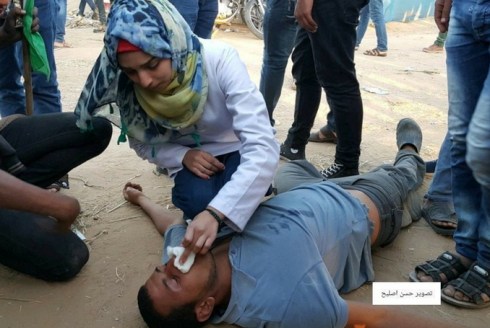
[Prefatory Note: The Gaza Sniper Massacre in response to the Great Return March is one more milestone in Palestinian resistance and yet another frightening episode in the Israeli apartheid narrative of cruel and excessive violence, a shameful sequel of crimes for which there exists no adjudicative tribunal available to the victimized party to pursue justice. The post that follows consists of juxtaposing news items, a searing opinion piece by the courageously uncompromising Israeli journalist Gideon Levy and a wide-ranging brilliant commentary by my friend, Jim Kavanaugh. The post and is dedicated to the memory of Razan al-Najjar, the brave 21year old paramedic mortally shot while tending Palestinian demonstrators wounded at or near the Gaza fence. This young woman epitomized the purity of nonviolent yet heroic resistance, an identity given historical depth by her joy for life and her supreme sacrifice imposed by sniper brutality.
The Israeli political leadership and military commanders must be presumed to have chosen such a display of excessive and vindictive violence for a clear political objective, which will remain undisclosed. It would seem to be taking advantage of having unlimited support from the Trump presidency and the most favorable regional political situation of their history, but we may still ask ‘to what end?’ My best guess is that the effort was designed to convince the people of Gaza, more than Hamas, that resistance, and especially unarmed resistance was futile. Without a diplomatic path and with the annexationist path wide open, Israel would benefit from a Palestinian acknowledgement that the struggle is over, and they have lost. The Great March of Return was a defiant refusal to concede defeat, no doubt angering Israel, and inflicting a major defeat in the other war—the Legitimacy War being fought for hearts and minds on the basis of seizing the high moral and political ground.
Finally, we need to understand that the problem of winning the Legitimacy War is mostly a struggle to have the truth heard, to have it understood on all the major issues in dispute, law and morality are aligned with the Palestinian demands, but this has so far proved politically irrelevant as geopolitics and military capabilities strongly lean in an Israeli direction. Can Palestinian resistance as reinforced by a growing global solidarity movement overcome these Israeli
advantages? Time will tell. So far the corporatized media has sided with Israel, which is a battlefield in the Legitimacy War where the Palestinians have mainly fared badly.]
(1) The Free Gaza Movement
Please share this news with everyone you can think of. The only way we have a hope that these brave sailors will be safe is if the news gets out. There has been very little coverage so far. This is what we have found in the past day.
Quds News Network·
For the first time, #Gaza will attempt to break the 12-year-long siege by sea
On Tuesday morning, ships will set sail with a number of injured Gazans and patients abroad, carrying the hopes and dreams of the Palestinian people for freedom.
Tuesday’s Gaza flotilla will coincide with the 8th anniversary of an Israeli attack on the Turkish “Mavi Marmara” flotilla, in which nine Turkish activists were killed when the Israeli navy attacked the vessel in international waters. A tenth activist died nearly four years later, succumbing to injuries sustained during the raid.
https://www.middleeastmonitor.com/20180527-gaza-boats-will-attempt-to-break-israel-navy-siege-on-tuesday/
https://www.reuters.com/article/us-israel-palestinians-violence/israeli-air-strikes-target-boat-moored-in-gaza-residents-idUSKCN1IO06T
https://www.aljazeera.com/news/2018/05/boats-carrying-gaza-patients-set-bid-break-israel-blockade-180527150238689.html
Greta Berlin, Co-Founder, the Free Gaza movement
**************************************************************************************************************************
(2) Jonathan COOK ‘LETTER FROM NAZARETH”
The flames that killed Fathi Harb should make us all burn with guilt and shame
27 May 2018
The National – 27 May 2018
Fathi Harb should have had something to live for, not least the imminent arrival of a new baby. But last week the 21-year-old extinguished his life in an inferno of flames in central Gaza.
It is believed to be the first example of a public act of self-immolation in the enclave. Harb doused himself in petrol and set himself alight on a street in Gaza City shortly before dawn prayers during the holy month of Ramadan.
In part, Harb was driven to this terrible act of self-destruction out of despair.
After a savage, decade-long Israeli blockade by land, sea and air, Gaza is like a car running on fumes. The United Nations has repeatedly warned that the enclave will be uninhabitable within a few years.
Over that same decade, Israel has intermittently pounded Gaza into ruins, in line with the Israeli army’s Dahiya doctrine. The goal is to decimate the targeted area, turning life back to the Stone Age so that the population is too preoccupied with making ends meet to care about the struggle for freedom.
Both of these kinds of assault have had a devastating impact on inhabitants’ psychological health.
Harb would have barely remembered a time before Gaza was an open-air prison and one where a 1,000kg Israeli bomb might land near his home.
In an enclave where two-thirds of young men are unemployed, he had no hope of finding work. He could not afford a home for his young family and he was about to have another mouth to feed.
Doubtless, all of this contributed to his decision to burn himself to death.
But self-immolation is more than suicide. That can be done quietly, out of sight, less gruesomely. In fact, figures suggest that suicide rates in Gaza have rocketed in recent years.
But public self-immolation is associated with protest.
A Buddhist monk famously turned himself into a human fireball in Vietnam in 1963 in protest at the persecution of his co-religionists. Tibetans have used self-immolation to highlight Chinese oppression, Indians to decry the caste system, and Poles, Ukrainians and Czechs once used it to protest Soviet rule.
But more likely for Harb, the model was Mohamed Bouazizi, the Tunisian street vendor who set himself on fire in late 2010 after officials humiliated him once too often. His public death triggered a wave of protests across the Middle East that became the Arab Spring.
Bouazizi’s self-immolation suggests its power to set our consciences on fire. It is the ultimate act of individual self-sacrifice, one that is entirely non-violent except to the victim himself, performed altruistically in a greater, collective cause.
Who did Harb hope to speak to with his shocking act?
In part, according to his family, he was angry with the Palestinian leadership. His family was trapped in the unresolved feud between Gaza’s rulers, Hamas, and the Palestinian Authority (PA) in the West Bank. That dispute has led the PA to cut the salaries of its workers in Gaza, including Harb’s father.
But Harb undoubtedly had a larger audience in mind too.
Until a few years ago, Hamas regularly fired rockets out of the enclave in a struggle both to end Israel’s continuing colonisation of Palestinian land and to liberate the people of Gaza from their Israeli-made prison.
But the world rejected the Palestinians’ right to resist violently and condemned Hamas as “terrorists”. Israel’s series of military rampages in Gaza to silence Hamas were meekly criticised in the West as “disproportionate”.
The Palestinians of the West Bank and East Jerusalem, where there is still direct contact with Israeli Jews, usually as settlers or soldiers, watched as Gaza’s armed resistance failed to prick the world’s conscience.
So some took up the struggle as individuals, targeting Israelis or soldiers at checkpoints. They grabbed a kitchen knife to attack Israelis or soldiers at checkpoints, or rammed them with a car, bus or bulldozer.
Again, the world sided with Israel. Resistance was not only futile, it was denounced as illegitimate.
Since late March, the struggle for liberation has shifted back to Gaza. Tens of thousands of unarmed Palestinians have massed weekly close to Israel’s fence encaging them.
The protests are intended as confrontational civil disobedience, a cry to the world for help and a reminder that Palestinians are being slowly choked to death.
Israel has responded repeatedly by spraying the demonstrators with live ammunition, seriously wounding many thousands and killing more than 100. Yet again, the world has remained largely impassive.
In fact, worse still, the demonstrators have been cast as Hamas stooges. The United States ambassador to the UN, Nikki Haley, blamed the victims under occupation, saying Israel had a right to “defend its border”, while the British government claimed the protests were “hijacked by terrorists”.
None of this can have passed Harb by.
When Palestinians are told they can “protest peacefully”, western governments mean quietly, in ways that Israel can ignore, in ways that will not trouble consciences or require any action.
In Gaza, the Israeli army is renewing the Dahiya doctrine, this time by shattering thousands of Palestinian bodies rather than infrastructure.
Harb understood only too well the West’s hypocrisy in denying Palestinians any right to meaningfully resist Israel’s campaign of destruction.
The flames that engulfed him were intended also to consume us with guilt and shame. And doubtless more in Gaza will follow his example.
Will Harb be proved right? Can the West be shamed into action?
Or will we continue blaming the victims to excuse our complicity in seven decades of outrages committed against the Palestinian people?
(3) The Israel Massacre Forces
The shooting on the Gaza border shows once again that the killing of Palestinians is accepted in Israel more lightly than the killing of mosquitoes
Gideon Levy
https://www.haaretz.com/opinion/.premium-the-israel-massacre-forces-1.5962852
The death counter ticked away wildly. One death every 30 minutes. Again. Another one. One more. Israel was busy preparing for the seder night. TV stations continued broadcasting their nonsense.
It’s not hard to imagine what would have happened if a settler had been stabbed – on-site broadcasts, throw open the studios. But in Gaza the Israel Defense Forces continued to massacre mercilessly, with a horrific rhythm, as Israel celebrated Passover.
If there was any concern, it was because soldiers couldn’t celebrate the seder. By nightfallthe body count had reached at least 15, all of them by live fire, with more than 750 wounded. Tanks and sharpshooters against unarmed civilians. That’s called a massacre. There’s no other word for it.
Comic relief was provided by the army spokesman, who announced in the evening: “A shooting attack was foiled. Two terrorists approached the fence and fired at our soldiers.” This came after the 12th Palestinian fatality and who knows how many wounded.
Sharpshooters fired at hundreds of civilians but two Palestinians who dared return fire at the soldiers who were massacring them are “terrorists,” their actions labeled “terror attacks” and their sentence – death. The lack of self-awareness has never sunk to such depths in the IDF.
As usual, the media lent its appalling support. After 15 deaths Or Heller on Channel 10 News declared that the most serious incident of the day had been the firing by the two Palestinians. Dan Margalit “saluted” the army. Israel was brainwashed again and sat down to a festive meal in a spirit of self-satisfaction. And then people recited “Pour out Thy wrath upon the nations that know Thee not,” impressed by the spread of plagues and enthusing at the mass murder of babies (the killing of the first-born Egyptians, the 10th plague).
Christian Good Friday and the Jewish seder night became a day of blood for the Palestinians in Gaza. You can’t even call it a war crime because there was no war there.
The test by which the IDF and the pathological indifference of public opinion should be judged is the following: What would happen if Jewish Israeli demonstrators, ultra-Orthodox or others, threatened to invade the Knesset? Would such insane live fire by tanks or sharpshooters be understood by the public? Would the murder of 15 Jewish demonstrators pass with silence? And if several dozen Palestinians managed to enter Israel, would that justify a massacre? The killing of Palestinians is accepted in Israel more lightly than the killing ofmosquitoes. There’s nothing cheaper in Israel than Palestinian blood.If there were a hundred or even a thousand deaths Israel would still “salute” the IDF. This is the army whose commander, the good and moderate Gadi Eisenkot, is received with such pride by Israelis. Of course, in the holiday media interviews, no one asked him about the anticipated massacre and no one will ask him now either.
But an army that prides itself on shooting a farmer on his land, showing the video on its website in order to intimidate Gazans; an army that pits tanks against civilians and boasts of one hundred snipers waiting for the demonstrators is an army that has lost all restraint. As if there weren’t other measures. As if the IDF had the authority or right to prevent demonstrations in Gaza, threatening bus drivers not to transport protesters in territory where the occupation has long ended, as everyone knows.
Despairing young men sneak in from Gaza, armed with ridiculous weapons, marching dozens of kilometers without hurting anyone, only waiting to be caught so as to escape Gaza’s poverty in an Israeli jail. This doesn’t touch anyone’s conscience either. The main thing is that the IDF proudly presents its catch. Palestinian President Mahmous Abbasis responsible for the situation in Gaza. And Hamas, of course. And Egypt. And the Arab world and the whole world. Just not Israel. It left Gaza and Israeli soldiers never commit massacres. The names were published in the evening. One man was rising from his prayers, another was shot while fleeing. The names won’t move anyone. Mohammed al-Najar, Omar Abu Samur, Ahmed Odeh, Sari Odeh, Bader al-Sabag. This space is too small, to our horror, to list all their names.
(4)Sacrificing Gaza: The Great March of Zionist Hypocrisy
By Jim KavanaghOn June 4, 2018
Photo by Jordi Bernabeu Farrús | CC BY 2.0
The Great March of Return is a startling, powerful expression of Palestinian identity and resistance. Thousands of Palestinians have come out, bravely and unapologetically, to say: “We refuse to remain invisible. We reject any attempt to assign us to the discard pile of history. We will exercise our fundamental right to go home.” They have done this unarmed, in the face of Israel’s use of deadly armed force against targets (children, press, medics) deliberately chosen to demonstrate the Jewish state’s unapologetic determination to force them back into submissive exile by any means necessary. By doing this repeatedly over the last few weeks, these incredibly brave men, women, and children have done more than decades of essays and books to strip the aura of virtue from Zionism that’s befogged Western liberals’ eyes for 70 years.
What the Israelis have done over the past few weeks—killingat least 112and wounding over 13,000people (332 with life-threatening injuries and 27 requiring amputation)—is a historical crime that stands alongside the Sharpeville Massacre(69 killed), Bloody Sunday(14 killed), and the Birmingham Fire Hoses and Police Dog Repressionas a defining moment in an ongoing struggle for justice and freedom. Like those events, this month’s slaughter may become a turning point for what John Pilger correctly calls“the longest occupation and resistance in modern times”—the continuing, unfinished subjugation of the Palestinian people, which, like apartheid and Jim Crow, requires constant armed repression and at least occasional episodes of extermination.
The American government, political parties, and media, which support and make possible this crime are disgraceful, criminal accomplices. American politicians, media, and people, who feel all aglow about professing their back-in-the-day support (actual, for some; retrospectively-imagined, for most) of the Civil-Rights movement in the American South and the anti-apartheid struggle in South Africa but continue to ignore the Palestinian struggle for justice against Zionism, because saying peep one about it might cost them some discomfort, are disgraceful, cowardly hypocrites.
You know, the millions of ant-racist #Resistors who are waiting for a quorum of Natalie Portmans and cool elite, preferably Jewish, personalities to make criticism of Israel acceptable before finding the courage to express the solidarity with the Palestinian people they’ve always had in their hearts. Back in the day, they’d be waiting for Elvis to denounce Jim Crow before deciding that it’s the right time to side with MLK, Malcolm, and Fred Hampton against Bull Connor, George Wallace, and William F. Buckley.
Dis/Ingenuity
The bankruptcy of purportedly anti-racist and humanitarian liberal-Zionist ideology and ideological institutions reached an apogee with the eruption of various apologia for Israel in the wake of this crime, not-so-subtly embedded in mealy-mouthed “regret the tragic loss of life” bleats across the mediascape. All the usual rhetorical subjects were rounded up and thrown into ideological battle: “Israel has every right to defend its borders” (NYT Editorial Board); the “misogynists and homophobes of Hamas” orchestrated the whole thing (Bret Stephens); the protestors are either Hamas “terrorists” or Hamas-manipulated robots, to be considered “nominal civilians” (WaPo). And, of course, the recurring pièce de résistance: Human Shields!
Somewhere in his or her discourse, virtually every American pundit is dutifully echoing the Israeli talking pointlaid down by Benjamin Netanyahu during the Israeli attack on Gaza in 2014: that Hamas uses the “telegenically dead” to further “their cause.” The whole March of Return action is “reckless endangerment, bottomlessly cynical” (Stephens). Women and children were “dispatched” to “lead the charges” although they had been “amply forewarned…of the mortal risk.” It’s a “politics of human sacrifice” (Jonathan S. Tobinand Tom Friedman), staged by Hamas, “the terrorist group that controls [Gazans’] lives,” to “get people killed on camera.” (Matt Friedman, NYT Op-Ed). The White House, via spokesman, Raj Shah, adopts this line as its official response“The responsibility for these tragic deaths rests squarely with Hamas,” which “intentionally and cynically provoke[ed] this response” in “a gruesome… propaganda attempt.”
Shmuel Rosner takes this “human shields” trope to its ultimate “no apologies” conclusion in his notorious op-edin the NYT, “Israel Needs to Protect Its Borders. By Whatever Means Necessary.” Feeling “no need to engage in ingénue mourning,” Rosner forthrightly asserts that “Guarding the border [or whatever it is] was more important than avoiding killing.” They want human sacrifice, we’ll give ‘em human sacrifice!
He acknowledges that Gazans “marched because they are desperate and frustrated. Because living in Gaza is not much better than living in hell,” and that “the people of Gaza … deserve sympathy and pity.” But the Palestinians were seeking“to violate [Israel’s] territorial integrity,”so “Israel had no choice” but to “draw a line that cannot be crossed,” and kill people trying to leave that hell. It was “the only way to ultimately persuade the Palestinians to abandon the futile battle for things they cannot get (“return,” control of Jerusalem, the elimination of Israel).”The alternative is“more demonstrations — and therefore more bloodshed, mostly Palestinian.”
Though he acknowledges that “the interests of Palestinians are [not] at the top of the list of my priorities,” Shmuel nonetheless feels comfortable speaking on their behalf. He sincerely “believe[s] Israel’s current policy toward Gaza ultimately benefits not only Israel but also the Palestinians.”Following the wisdom of “the Jewish sages” (featuring Nick Lowe?) he opines: “Those who are kind to the cruel end up being cruel to the kind.”
Fear not, Shmuel, for the pitiable people of Gaza: Knesset member Avi Dichter reassuresus that the Israeli army “has enough bullets for everyone. If every man, woman and child in Gaza gathers at the gate, in other words, there is a bullet for every one of them. They can all be killed, no problem.”For their ultimate benefit. Zionist tough love.
There is nothing new here. Israel has always understood the ghetto it created in Gaza. In 2004, Arnon Soffer, a Haifa University demographer and advisor to Ariel Sharon, said: “when 2.5 million people live in a closed-off Gaza, it’s going to be a human catastrophe. … The pressure at the border will be awful. … So, if we want to remain alive, we will have to kill and kill and kill. All day, every day….If we don’t kill, we will cease to exist.” And when challenged again in 2007about “Israel’s willingness to do what he prescribes… – i.e., put a bullet in the head of anyone who tries to climb over the security fence,” Soffer replied with a shrug:. “If we don’t, we’ll cease to exist.”
Soffer’s only plaint: “The only thing that concerns me is how to ensure that the boys and men who are going to have to do the killing will be able to return home to their families and be normal human beings.” A reprise of Golda Meir’s “shooting and crying” lament; “We can never forgive [the Arabs] for forcing us to kill their children.” Ingénue mourning, anyone?
We can point out the factual errors and concrete cruelties that all these apologias rely on.
We can point out that Hamas did not “orchestrate” these demonstrations, and that the thousands of Gazans who are risking their lives are not instruments. “You people always looked down at us,” one Gazan toldAmira Hass, “so it’s hard for you to understand that no one demonstrates in anyone else’s name.”
We can point out that the fence the Israelis are defending is not a “border” (What country are the Gazans in?), but the boundary of a ghetto, what Conservative British PM David Cameron calleda giant “prison camp” and Israeli scholar Baruch Kimmerling called“the largest concentration camp ever to exist.” It’s a camp that tens of thousands of Palestinians were forced into by the Zionist army. The right of those families (80% of Gaza’s population) to leave that confinement and go home is a basic human right and black-letter international law.
We can point out that Gazans aren’t just trying to cross a line in the sand, they are trying to break a siege,and that: “The blockade is by definition an act of war, imposed and enforced through armed violence. Never in history have blockade and peace existed side by side. …There is no difference in civil law between murdering a man by slow strangulation or killing him by a shot in the head.” Those were, after all, thewords ofIsraeli Foreign Minister Abba Eban, when he was justifying Israel’s attack on Egypt in 1967. And they are confirmed today by New York judge Mary McGowan Davis, who says: “The blockade of Gaza has to be lifted immediately and unconditionally.”
We can point out that there can be no excuse in terms of modern international law or human rights principles for Israel’s weeks-long “calculated, unlawful” (HRW) mass killing and crippling or unarmed protestors who were standing quietly, kneeling and praying, walking away, and tending to the wounded hundreds of meters from any “fence”—shootings carried out not in any “fog of war” confusion, but with precise, targeted sniper fire (which, per standard military practice, would be from two-manteams).
As the IDF bragged, in a quickly deleted tweet: “Nothing was carried out uncontrolled; everything was accurate and measured, and we know where every bullet landed.” Indeed, as Human Rights Watch reports, senior Israeli officialsorderedsnipers to shoot demonstrators who posed no imminent threat to life, and many demonstrators were shot hundreds of meters, and walking away, from the fence.
We can point out that the IDF’s quick deletion of that tweet indicates its consciousness of guilt awareness, in the face of proliferating images of gruesome, unsupportable casualties, of how bad a Rosner-like “no apology, no regrets” discourse sounds. After all, it’s hard, since they “know where every bullet landed,” not to conclude the Israelis deliberately targeted journalists and medical personnel, who were never threatening to “violate [Israel’s] territorial integrity.” There have been at least 66 journalists wounded and 2 killedwearing clearly marked blue “PRESS” flak jackets. And everyone should see the powerful interviewwith Canadian doctor, Tarek Loubani, who was shot in the leg, describing how, after six weeks with no paramedic casualties, suddenly:
“in one day, 19 paramedics—18 wounded plus one killed—and myself were all injured, so—or were all shot with live ammunition. We were all… away during a lull, without smoke, without any chaos at all, and we were targeted…So, it’s very, very hard to believe that the Israelis who shot me and the Israelis who shot my other colleagues… It’s very hard to believe that they didn’t know who we were, they didn’t know what we were doing, and that they were aiming at anything else.”
It was on another day that this 21-year-old “nominal civilian” nurse, Razan al-Najjar, was killedby an Israeli sniper while tending to the wounded.
Of course, pointing all this out won’t mean anything to these apologists or to those who give them a platform. Everybody knows the ethico-political double standard at work here. No other country in the world would get away with such blatant crimes against humanity without suffering a torrent of criticism from Western politicians and media pundits, including every liberal and conservative Zionist apologist cited above. Razan’s face would be shining from every page and screen of every Western media outlet, day after day, for weeks. Even an “allied” nation would get at least a public statement or diplomatic protest; any disfavored countries would face calls for punishment ranging from economic sanctions to “humanitarian intervention.” Israel gets unconditional praisefrom America’s UN Ambassador.
Indeed, if the American government “defended” its own actual international border in this way, liberal Zionists would be on the highest of moral saddles excoriating the Trump administration for its crime against humanity. And—forgetting, as is obligatory, the thousands of heavily-armed Jewish Zionists who regularly force their way across actual international borders with impunity—if some Arab country’s snipers killed hundreds and wounded tens of thousands of similarly unarmed Jewish Zionist men, women, children, and paraplegics who were demonstrating at an actual international border for the right to return to their biblical homeland, we all know the howling and gnashing of morally outraged teeth that would ensue from every corner of the Western political and media universe. No “Guarding the border was more important than avoiding killing” would be published in the NYT,or tolerated in polite company, for that scenario.
Nathan J. Robinson got to the bottom line in his wonderful shreddingof Rosner’s argument, it comes down to: “Any amount of Palestinian death, however large, was justified to prevent any amount of risk to Israelis, however small.” Western governments and media have fashioned, and are doing their utmost to sustain, an ethico-political universe where Israel can“lay siege to a million people, ‘bomb them occasionally,’ and then kill them when they show up at the wall to throw rocks.”
Is there a way anymore of not seeing the racism of Zionism? Can we just say, once and for all, that the interests of Palestinians—not as pitiable creatures but as active, fully, enfranchised human beings—are not anywhere on the list of Soffer’s or Dichter’s or Rosner’s (or the Western media’s or governments’) priorities, and refuse any of their pitifully disingenuous expressions of concern for the Palestinians’ benefit? Nobody gets to put “For your own benefit,” in front of “Surrender or I’ll put a bullet in your head.” The onlyconcern any of these commentators have for the people of Gaza is that they submissively accept their forced displacement and imprisonment in “the largest concentration camp ever to exist.”
Does the vulgarity of it shock you?
The “human shields, human sacrifice” trope, which all these apologias hang on, is particularly mendacious and hypocritical as used by Zionists. It’s also a classic example of projection.
This is a “human shield”:
It is Israel which has repeatedly used the specific, prohibitedtactic of using children as “human shields” to protect its military forces. According tothe U.N. Committee on the Rights of the Child, Israel is guilty of the “continuous use of Palestinian children as human shields and informants.” Besides this namby-pamby UN Committee that no red-blooded American/Zionist would pay any attention to, the High Court of Justice in Israel identified and denounced the “human shield” procedures the IDF acknowledged and defended using 1,200 times. These include “the ‘neighbor procedure,’ whereby neighbors of wanted Palestinians are forced to go into the wanted man’s house ahead of troops, in case it is booby-trapped,” andIsraeli “soldiers forcibly position[ing] members of [a] family, including the children, at the windows of [a] home and proceed[ing] to fire from behind them.”
So, when Zionists use a “human shields” argument as a moral cudgel against unarmed civilian protestors, and a moral justification for a powerful army, which brazenly uses children to shield its own soldiers, killing scores of those protestors by the day—well, it’s not a stretch to see this charge is a projection of Zionists’ own pattern of thought and behavior.
Besides being an ongoing tactic of today’s Israeli army, “human shields” and the “human sacrifice” they imply were an integral element of the Zionist narrative—expressly articulated and embraced, with no apology, as a necessity for the establishment of a Jewish State.
Take a look at what Edward Said in 2001 called: “the main narrative model that [still] dominates American thinking” about Israel, and David Ben-Gurion called“as a piece of propaganda, the best thing ever written about Israel.” It’s the “’Zionist epic’…identified by many commentators as having been enormously influential in stimulating Zionismand support for Israelin the United States.” In this piece of iconic American culture, an American cultural icon—more sympathetically liberal than whom there is not—explains why he, as a Zionist, is not bluffing in his threat to blow up his ship and its 600 Jewish refugees if they are not allowed to enter the territory they want:
–You mean you’d still set it [200 lbs. of dynamite] off, knowing you’ve lost?…Without any regard for the lives you’d be destroying?…
Every person on this ship is a soldier. The only weapon we have to fight with is our willingness to die.
–But for what purpose?”
Call it publicity.
—Publicity?
Yes, publicity. A stunt to attract attention….Does the vulgarity of it shock you?
More Zionist tough love.
In the face of the scurrilous “human shield” accusation against Palestinians now being used to denigrate the killed, maimed, and still-fighting protestors in Gaza, we would do well to recall Paul Newman’s Zionist-warrior, “no apology,” argument for 600 telegenically deadJewish men, women, and children as a publicity stunt to gain the sympathy of the world.
Lest we dismiss this as a fiction, remember that Paul Newman’s fictional boat, Exodus, is based on a real ship, the SS Patria. In 1940, the Patriawas carrying 1800 Jewish refugees from Nazi-occupied Europe whom the British authorities refused entry into Palestine. While the Patria was in the port of Haifa, it was blown up and sunk by Munya Mardoron the orders of the Haganah, which did not want Jewish refugees going anywhere but Palestine. At least 267 people were killed. The Haganah put out the story that the passengers had blown up the ship themselves – a story that lasted 17 years, nourishing the imagination of Leon Uris, author of the Exodus fiction. This wasn’t a commander or leading organization urging people to knowingly take a deadly risk in confronting a powerful enemy; it was “their” self-proclaimed army blowing its people up with no warning—and then falsely claiming they did it to themselves! Nobody who wouldn’t use “bottomlessly cynical” to denigrate the Haganah should be using it to denigrate Gazans.
At a crucial moment in history, it was Zionists who practiced a foundational “human shield” strategy, holding the victims of Nazism “hostage” to the Zionist “statehood” project – as none other than the publisher of the New York Times, Arthur Hays Sulzberger, recognized and criticized:
I cannot rid myself of the feeling that the unfortunate Jews of Europe’s D. P. [Displaced Persons] camps are helpless hostages for whom statehood has been made the only ransom. …[W]hy in God’s name should the fate of all these unhappy people be subordinated to the single cry of Statehood?
The Exodus/Patria/Paul Newman/Haganah willingness to blow up hundreds of Jewish refugees in order to force their way into a desired territory was an attitude endemic to the Zionist movement, and enunciated quite clearly by its leader, David Ben-Gurion, as early as 1938: “If I knew it was possible to save all [Jewish] children of Germany by their transfer to England and only half of them by transferring them to Eretz-Yisrael, I would choose the latter.” You want human sacrifice?…
(Sulzberger, by the way, “opposed political Zionism not solely because of the fate of Jewish refugees because he disliked the ‘coercive methods’ of Zionists in this country who use economic means to silence those with differing views.” Yes, the NYT! So change is possible.)
What’s Right Is Wrong
And here’s the thing: You want to call what the Gazans did—coming out unarmed by the thousands, knowing many of them would be killed by a heavily-armed adversary determined to put them down by whatever means necessary—a “politics of human sacrifice”? You are right.
Just as you’d be right to say that of the Zionist movement, when it was weak and faced with much stronger adversaries. And just as you’d be right to say it of the unarmed, non-violent Civil Rights Movement, when it faced the rageful determination of the immensely more powerful American South, to preserve the century-old Jim Crow apartheid that wasits identity, by whatever means necessary.
Princeon Professor Eddie Glaude, Jr. nailed it when, to the visible discomfort of his MSNBC co-panelists, he respondedto the invocation of the White House line that it’s “all Hamas’ fault and that they’re using them as tools for propaganda,” with: “That’s like saying to the children in the Children’s March of Birmingham it was their fault that Bull Connor attacked them.”
Civil-rights activists did put children on the front lines, and put their own and those children’s lives in danger to fight and defeat Jim Crow. They knew there were a lot of people armed and willing to kill them. And children, as well as activists, were killed. And those actions weresupported (but by no means “orchestrated”) by “extremist” organizations—i.e., the Communist Party. At the time, conservatives attacked Freedom Riders with the same arguments that Zionists are now using to attack Gaza Return Marchers.
All unarmed, non-violent but disruptive, Gandhian strategies to eliminate entrenched systems of colonial-apartheid rule will knowingly sacrifice many lives to attain their victory. Call it a politics of human sacrifice if you want. I won’t make any ingénue objections. But it’s not a sign of the subjugated people’s cynicism; it’s a result of their predicament.
“Human sacrifice” defines the kind of choices a desperate and subjugated people are forced to make in the face of armed power they cannot yet overcome. A militarily-weak insurgent/liberation movement must use an effectively self-sacrificing strategy of moral suasion. That is now a standard and powerful weapon in political struggle. (Though moral suasion alone will not win their rights. Never has. Never will.)
For Gazans, it’s the choice between living in a hell of frustration, misery, insult, confinement, and slow death, or resisting and taking the high risk of instant death. It’s the choice faced by people whose “dreams are killed” by Israel’s siege and forced expulsion, and who are willing to risk their lives “for the world’s attention.” Young men like Saber al-Gerim, for whom, “It doesn’t matter to me if they shoot me or not. Death or life — it’s the same thing.” Or the one who told Amira Hass: “We die anyway, so let it be in front of the cameras.” Or 21-year-old Fathi Harb, who burned himself to death last Sunday. Or Jihadi al-Najjar, who had to make the choice between continuing to care for his blind father (“He was my sight. He helped me in everything, from going to the bathroom to taking a shower to providing for me…I saw life through Jihadi’s eyes.”) or being killed by an Israeli sniper while, as his mother Tahani says “defending the rights of his family and his people.”
Tough choices, to get the world’s attention. This is the kind of choice imposed on the untermenschen of colonial-apartheid regimes. The only weapon they have is their willingness to die. But Gazans won’t get the sympathetically-anguished Paul Newman treatment. Just “bottomlessly cynical.”
Paul’s choice, Sophie’s choice, is now Saber’s and Jihad’s and Fathi’s, and it’s all bad. Maybe some people—comrades and allies in their struggle—have a right to say something about how to deal with that choice. But the one who doesn’t, the one who has no place to say or judge anything about that choice, is the one who is forcing it. Those who are trying to fight their way out of a living hell are not to be lectured to by the devil and his minions.
So, yes, in a very real sense, for the Palestinians, it is a politics of human sacrifice—to American liberals, the gods who control their fate.
By choosing unarmed, death-defying resistance, Palestinians are sacrificing their lives to assuage the faux-pacifist conscience of Americans and Europeans (particularly, I think, liberals), who have decreed from their Olympian moral heights that any other kind of resistance by these people will be struck down with devastating lightning and thunder.
Funny, that these are the same gods the Zionists appealed to to seize their desired homeland, and the same gods the civil-rights activists appealed to to wrest their freedom from local demons of lesser strength. Because, in their need to feel “sympathy and pity,” the sacrifice of human lives seems the only offering to which these gods might respond.
The Nakba Is Now
The Israelis and their defenders are right about something else: They cannot allow a single Gazan to cross the boundary. They know it would be a fatal blow to their colonial-supremacist hubris, and the beginning of the end of Zionism—just as Southern segregationists knew that allowing a single black child into the school was going to be the beginning of the end of Jim Crow. Palestinians gaining their basic human rights means Israeli Jews losing their special colonial privileges.
As Ali Abunimah points out, Arnon Soffer was right, when he said: “If we don’t kill, we will cease to exist,” and Rosner, when he said the Gazans threatened the “elimination of Israel.” To continue to exist as the colonial-apartheid polity it is, Israel must maintain strict exclusionist, “noright of return,” policies. Per Abunimah: “the price of a ‘Jewish state’ is the permanent and irrevocable violation of Palestinians’ rights…If you support Israel’s “right to exist as a Jewish state” in a country whose indigenous Palestinian people today form half the population, then you… must come to terms with the inevitability of massacres.”
What’s happening in Gaza is not only, as Abunimahsays, a “reminder… of the original sin of the ethnic cleansing of Palestine and the creation of a so-called Jewish state,” it is a continuation of that unfinished work of the devil. The Nakba is now.
I’m all for everybody on both sides of the issue to be aware of the stakes and risks in this struggle, without any disingenuous denials.
Whether you sympathize with, or denigrate, the choices of people who put their own, their comrades’, and even their children’s, lives at risk is not determined by whether some tactical choices can be characterized as “human shields, human sacrifice”; it’s determined by what they’re fighting for, and what and whom they are fighting against, anwhere your solidarity lies.
Stage Left
Here’s the core of the disagreement about Gaza (and Palestine in general): There are those—they call themselves Zionists—who think the Palestinians deserve to have been put in that concentration camp, and who stand in solidarity with the soldiers who, by whatever means necessary, are forcing them to stay there. And there are those—the growing numbers who reject Zionism—who stand in solidarity with every human being trying to get out of that camp by whatever means necessary.
There’s a fight—between those breaking out of the prison and those keeping them in; between those seeking equality and those enforcing ethno-religious supremacism; between the colonized and the colonizer. Pick a side. Bret Stephens, Shmuel Rosner, and Tom Friedman have. The New York Times, The Washington Post, and Breitbart have. ABC, CBS, (MS)NBC, and Fox have. The Democrats and Republicans and the Congress and the White House have. And they are not shy about it.
It’s past time for American progressives to clearly and unequivocally decide and declare which side they are on. It’s time for professedly humanitarian, egalitarian, pro-human rights, anti-racist, and free-speech progressives to express their support of the Palestinian struggle—on social media, in real-life conversation, and on the street.
It’s time to firmly reject the hypocritical discourse of those who would have been belittling any expression ofsorrow and outrage over Emmet Till, Chaney, Schwerner and Goodman, and the four black schoolgirls killed in Birmingham, while “ingénue mourning” the terrible moral quandary in which those disrupters had put Bull Connor’s boys. Don’t shrink from it, talk back to it—every time.Make them ashamed to be defending colonialism and apartheid with such patently phony arguments.
Politically? At a minimum, demand of any politician who seeks your vote: End the blockade of Gaza, immediately and unconditionally. Support BDS. Refuse any attempt to criminalize BDS and anti-Zionism. Stop blocking UN and ICC actions against Israeli crimes. Restrict arms sales to Israel. Reject the hypocritical Zionist apologetics. Refuse any attempt to censor or restrict the internet. (This last is very important. Nothing has threatened Zionist impunity more than the information available on the internet, and nothing is driving the demand to censor the internet more than the Zionists’ need to shut that off.)
This is a real, concrete, important resistance. What’ll it cost? Some social discomfort? It’s not sniper fire. Not human sacrifice. Not Saber’s choice.
Are we at a turning point? Some people think this year’s massacre in Gaza will finally attract a sympathetic gaze from the gods and goddesses of the Imperial City. Deliberately and methodically killing, maiming, and wounding thousands of unarmed people over weeks—well, the cruelty, the injustice, the colonialism is just too obvious to ignore any longer. And I hope that turns out to be so. And I know, Natalie Portman and Roger Waters and Shakira, and—the most serious and hopeful—the young American Jews in groups like Students for Justice in Palestine and IfNotNow. There are harbingers of change, and we must try.
I also know there is nothing new here. Thirty years ago, a doctor in Gaza said: “We will sacrifice one or two kids to the struggle — every family. What can we do? This is a generation of struggle.” It was obvious thirty years ago, and forty years before that. TheNakbawas then. The Nakbais now. Was it ever not too obvious to ignore?
My mother was an actress on Broadway, who once came to Princeton University to share the stage, and her professional skills, with Jimmy Stewart and other amateur thespians. She played the ingénue. Me, I’m not so good at that.
By all means, regarding Palestine-Israel and the sacrifices and solidarity demanded: No more ingénue politics.
Article printed from http://www.counterpunch.org: https://www.counterpunch.org
URL to article: https://www.counterpunch.org/2018/06/04/sacrificing-gaza-the-great-march-of-zionist-hypocrisy/
************************************************************************************
(5) Israeli army frames slain medic Razan al-Najjar as ‘Hamas human shield’

Mondoweiss7 June 2018 by Jonathan Ofir –
Just when you thought Israel couldn’t get any lower… The Israeli army has just released an incitement video, titled “Hamas’ use of human shields must stop”, in which it frames the slain medic Razan al-Najjar as a “Hamas human shield”– a day after it claimed she was killed by accident. This is more than adding insult to injury. This is adding malice to crime. The propaganda effort is based on twisting al-Najjar’s own words. I have consulted with three Arabic experts, who have looked at the original Arabic interview from which the IDF took the “human shield” text, and it is clear to them beyond a doubt that the IDF was knowingly and cynically manipulating Razan’s words to mean something other than what she said. Bear with me, this requires close analysis: First the video features Razan throwing away a gas grenade in the field. Obviously, this is one of the tear gas grenades fired by the Israeli army, which she is taking up and throwing to a safe distance. By this visual, the IDF is trying to create the impression that Razan is a kind of ‘combatant’. Then comes the short clip from an interview. The original interview has been found to be from Al Mayadeen News, a channel based in Beirut. The IDF video runs subtitles, saying: “I am Razan al-Najjar, I am here on the frontlines and I act as a human shield…” That’s all the IDF needs. Now, with the ominous music in the background, the IDF text states: “Hamas uses paramedics as human shields”. But the IDF cut out a very significant part of the sentence. Razan actually says: “I the Paramedic Razan al-Najjar, I am here on the Front Line acting as a human shield of safety to protect the injured at the Front Line. No one encouraged me on being a Paramedic, I encouraged myself. I wanted to take chances and help people…” (my emphasis)….
http://mondoweiss.net/2018/06/israeli-frames-najjar/
########
__._,_.___
Tags: Crimes Against Humaniotyu, Gaza Fence, Israel Violence, Legitimacy War, March of Return, Razan al-Najjar


 Global Justice in the 21st Century
The U.S. Withdrawal from the UN Human Rights Council
Explicitly focusing on alleged anti-Israel bias the U.S. withdrew from further participation in the UN Human Rights Council. The only internationally credible basis for criticizing the HRC is its regrettable tendency to put some countries with the worst human rights records in leading roles, creating genuine issues of credibility and hypocrisy. Of course, such a criticism would never be made by the U.S. as it could only embarrass Washington to admit that many of its closest allies in the Middle East, and elsewhere have lamentable human rights records, and, if fairly judged, the U.S. has itself reversed roles since the year 2000, itself slipping into the category of the most serious human rights offenders. In this regard, its ‘withdrawal’ can be viewed as a self-imposed ‘suspension’ for falling short when it comes to the promotion and protection of human rights.
Undoubtedly, the U.S. was frustrated by its efforts to ‘reform’ the HRC according to its views of the UN agency should function, and blamed its traditional adversaries, Russia, China, Venezuela, Cuba, along with Egypt, with blocking its initiative. It also must not have welcome the HRC High Commissioner, Zeid Ra’ad al-Hussein, for describing the separation of children from their immigrant parents at the Mexican border as an ‘unconsciounable’ policy.
In evaluating this latest sign of American retreat from its prior role as global leader, there are several considerations that help us understand such a move that situates the United States in the same strange rejectionist corner it now shares with North Korea and Eritrea:
–the fact that the U.S. withdrawal from the HRC occurred immediately after the Israeli border massacre, insulated from Security Council censure and investigation by a U.S. veto, is certainly part of political foreground. This consideration was undoubtedly reinforced by the HRC approval of a fact-finding investigation of Israel’s behavior over prior weeks in responding to the Great Return March border demonstrations met with widespread lethal sniper violence;
–in evaluating the UN connection to Palestine it needs to be recalled that the organized international community has a distinctive responsibility for Palestine that can be traced all the way back to the peace diplomacy after World War I when Britain was given the role of Mandatory, which according to the League of Nations Covenant should be carried out as a ‘sacred trust of civilization.’ This special relationship was extended and deepened when Britain gave up this role after World War II, transferring responsibility for the future of Palestine to the UN. This newly established world organization was given the task of finding a sustainable solution in the face of sharply contested claims between the majority Palestinian population and the Jewish, mainly settler population.
This UN role was started beneath and deeply influenced by the long shadow of grief and guilt cast by the Holocaust. The UN, borrowing from the British colonial playbook, proposed a division of Palestine between Jewish and Palestinian political communities, which eventuated in the UN partition plan contained in General Assembly Resolution 181. This plan was developed and adopted without the participation of the majority resident population, 70% non-Jewish at the time, and was opposed by the independent countries in the Arab world. Such a plan seemed oblivious to the evolving anti-colonial mood of the time, failing to take any account of the guiding normative principle of self-determination. The Partition War that followed in 1947 did produce a de factor partition of Palestine more favorable to the Zionist Project than what was proposed, and rejected, in 181. One feature of the original plan was to internationalize the governance of the city of Jerusalem with both peoples given an equal status.
This proposed treatment of Jerusalem was never endorsed by Israel, and was formally, if indirectly, repudiated after the 1967 War when Israel declared (in violation of international law) that Jerusalem was the eternal capital of the Jewish people never to be divided or internationalized, and Israel has so administered Jerusalem with this intent operationalized in defiance of the UN. What this sketch of the UN connection with Palestine clearly shows is that from the very beginning of Israeli state-building, the role of the international community was direct and the discharge of its responsibilities was not satisfactory in that it proved incapable of protecting Palestinian moral, legal, and political rights. As a result, the majority of Palestinian people have been effectively excluded from their own country and as a people exist in a fragmented ethnic reality. This series of events constitutes one of the worst geopolitical crimes of the past century. Rather than do too much by way of criticizing the behavior of Israel, the UN has done far too little, not because of a failure of will, but as an expression of the behavioral primacy of geopolitics and naked militarism;
–the revealing stress of Ambassador Haley’s explanation of the U.S. withdrawal from the HRC gives almost total attention to quantitative factors such as the ‘disproportionate’ number of resolutions compared with those given to other human rights offenders, making no attempt whatsoever to refute the substantiveallegations of Israeli wrongdoing. This is not surprising as any attempt to justify Israeli policies and practices toward the Palestinian people would only expose the severity of Israel’s criminality and the acuteness of Palestinian victimization. The U.S. has also long struggled to be rid of so-called Item 7 of the Human Rights Council devoted to human rights violations of Israel associated with the occupation of Palestinian territories, which overlooks the prior main point that the UN is derelict in its failure to produce a just peace for the peoples inhabiting Mandate Palestine.
–withdrawing from international institutional arrangements, especially those positively associated with peace, human rights, and environmental protection has become the hallmark of what be identified as the negative internationalismof the Trump presidency. The most egregious instances, prior to this move with regard to the HRC, involved the repudiation of the Nuclear Program Agreement with Iran (also known as the JCPOA or P5 +1 Agreement) and the Paris Climate Change Agreement. Unlike these other instances of negative internationalism this departure from the HRC is likely to hurt the U.S. more than the HRC, reinforcing its myopic willingness to do whatever it takes to please Netanyahu and the lead American Zionist donor to the Trump campaign, Sheldon Adelson. Only the provocative announcement of the planned unilateral move of the American Embassy to Jerusalem last December was as explicitly responsive to Israel’s policy agenda as is this rejection of the HRC, both initiatives stand out as being contrary to a fair rendering of American national interests, and hence a show of deference to Israel’s preferences. Despite this unabashed one-sidedness the Trump presidency still puts itself forward as a peacemaker, and promised to produce ‘the deal of the century’ at the proper moment, even enjoying the backing of Saudi Arabia, which seems to be telling the Palestinians to take what is offered or shut up forever. Knowing the weakness and shallow ambitions of the Palestinian Authority, there is no telling what further catastrophe, this one of a diplomatic character, may further darken the Palestinian future. A diplomatic nakbamight be the worst disaster of all for the Palestinian people and their century-long struggle for elemental rights.
It should also be observed that the U.S. human rights record has been in steady decline, whether the focus is placed on the morally catastrophic present policies of separating families at the Mexican border or on the failure to achieve acceptable progress at home in the area of economic and social rights despite American affluence (as documented in the recent report of Philip Alston, UNHRC Special Rapporteur on Extreme Poverty) or in the various violations of human rights committed in the course of the War on Terror, including operation of black sites in foreign countries to carry on torture of terror suspects, or denials of the tenets of international humanitarian law (Geneva Conventions) in the administration of Guantanamo and other prison facilities;
–it is also worth noting that Israel’s defiance of internatonal law and international institutions is pervasive, flagrant, and directly related to maintaining an oppressive regime of occupation that is complemented by apartheid structures victimizing Palestinian refugees, residents of Jerusalem, the Palestinian minority in Israel, and imprisoned population of Gaza. Israel refused the authority of the International Court of Justice with respect to the ‘separation wall’ that back in 2004 declared by a near unanimous vote of 14-1 (U.S. as the lone dissent) that building the wall on occupied Palestinian territory was unlawful, that the wall should be dismantled, and Palestinians compensated for harm endured. There are many other instances concerning such issues as settlements, collective punishment, excessive force, prison conditions, and a variety of abuse of children.
In conclusion, by purporting to punish the Human Rights Council, the Trump presidency, representing the U.S. Government, is much more punishing itself, as well as the peoples of the world. We all benefit from a robust and legitimated institutional framework for the promotion and protection of vital human rights. The claim of an anti-Israeli bias in the HRC, or UN, is bogus, the daily violation of the most basis rights of the Palestinian people is a tragic reality. This is all we need to know.
Tags: bogus anti-Israei bias, Human Rights Council, Israel-Palestine, Palestinian Rights, U.S. global leadership, UN, withdrawal