Tag Archives: Israel

The Massive Palestinian Hunger Strike: Traveling below the Western Radar

2 May


            Can anyone doubt that if there were more than 1300 hunger strikers in any country in the world other than Palestine, the media in the West would be obsessed with the story?  It would be featured day after day, and reported on from all angles, including the severe medical risks associated with such a lengthy refusal to take food. At this time two Palestinians who were the first to start this current wave of resistance, Thaer Halaheh and Bilal Diab, entering their 64th day without food, are reported by the prisoner protection association, Addameer, and the NGO, Physician for Human Rights-Israel, to be in critical condition with their lives hanging in the balance.  Despite this dramatic state of affairs there is scant attention in Europe, and literally none in North America. It is the case that prison protests, even large-scale ones such as occurred in California a year ago often attract little national and international notice unless deaths occur, as happened in the famous Maze Prison IRA hunger strikes back in 1981, but to ignore this expression of Palestinian resistance in the overall context of the conflict with Israel is lamentable. After all, as an occupying power of Palestinian territories Israel has a particular responsibility to the international community.


            In contrast, consider the attention that the Western media has devoted to a lone blind Chinese human rights lawyer, Chen Guangcheng, who managed to escape from house arrest in Beijing a few days ago and find a safe haven at the U.S. Embassy. This is an important international incident, to be sure, but is it truly so much more significant than the Palestinian story as to explain the total neglect of the extraordinary exploits of these thousands of Palestinians who are sacrificing their bodies, quite possibly their lives, to nonviolently protest severe mistreatment in the Israeli prison system.? Except among their countrymen, and to some extent the region, these many thousand Palestinian prisoners have been languishing within an opaque black box ever ever since 1967, are denied protection, exist without rights, and cope as best they can without even the acknowledgement of their plight.


            There is another comparison to be made. Recall the outpouring of concern and sympathy throughout the West for Gilad Shalit, the Israeli soldier who was captured on the Gaza border and held captive by Palestinians for five years. A powerful global campaign for his release on humanitarian ground was organized, and received constant reinforcement in the media. World leaders pleaded for his release, and Israeli commanding officers even told IDF fighting forces during the massive attacks on Gaza at the end of 2008 that killed more than 1450 Palestinians that their real mission was to free Shalit or at least hold accountable the entire civilian population of Gaza. When Shalit finally released in a prisoner exchange a few months ago there was a brief celebration that abruptly ended when, much to the disappointment of the Israeli establishment, Shalit reported good treatment during captivity. Shalit’s father went further, saying if he was a Palestinian he would have tried to capture Israeli soldiers. Not surprisingly, Shalit, instead of being revered as an Israeli hero, has quietly disappeared from public view.           


            This current wave of hunger strikes started on April 17th, Palestinian Prisoners’ Day, and was directly inspired by the recently completed long and heroic hunger strikes of Khader Adnan (66 days) and Hana Shalabi (43 days) both of whom protested against the combination of administrative detention and abusive arrest and interrogation procedures. It should be understood that administrative detention is validated by secret evidence and allows Israel to imprison Palestinians for six months at a time without bringing any criminal charges, with terms renewable as they expire. Hana Shalabi was among those released in the prisoner exchange, but then barely recovering from her prior detention period, was rearrested in a night arrest raid, and sentenced once again to a term of confinement for four months. Or consider the experience of Thaer Halahla, eight times subject to administrative detention for a total of six and a half years.  


Both Mr. Adnan and Ms. Shalabi were released by deals negotiated at a time when their physical survival seemed in doubt, making death seem imminent. Israel apparently did not want to risk a third intifada resulting as a reaction to such martyrdom. At the same time Israel, as usual, did not want to seem to be retreating, or draw into question its reliance on administrative detention and imprisonment. Israel has refused, until the present, to examine the grievances that gave rise to these hunger strikes. In Hana Shalabi’s case her release was coupled with a punitive deportation order, which cruelly confines her to Gaza for the next three years, away from her family and the familiar surroundings of her home village of Burqin near Jenin in the West Bank. There are some indications that Ms. Shalabi was not fully informed about the deportation feature of her release, and was manipulated by prison authorities and the lawyer representing her interests. The current hunger strikers have been offered similar conditional releases, but have so far steadfastly refused to resume eating if it led to deportation or exile. At this time it is unclear how Israel will respond. There is a fierce struggle of wills between the strikers and the prison authorities, between those with hard power of domination and those with the soft power of moral and spiritual courage. The torment of these striking prisoners is not only a consequence of their refusal to accept food until certain conditions are met. Israeli prison guards and authorities are intensifying the torments of hunger. There are numerous reports that the strikers are being subjected to belittling harassment and a variety of punishments, including solitary confinement, confiscation of personal belongings, denial of family visits, denial of examination by humanitarian NGOs, and a hardhearted refusals to transfer to medically threatened strikers to civilian hospitals where they could receive the kinds of medical treatment their critical conditions require.


The Israeli response to the hunger strikes is shocking, but hardly surprising, within the wider setting of the occupation. Instead of heeding the moral appeal implicit in such extreme forms of resistance, there are widespread reliable reports of punitive responses by Israeli prison authorities. Hunger strikers have been placed in solitary confinement, held in shackles despite their weakened conditions, denied family visits, had personal belongings confiscated, were subjected to harassing comments by guards intended to demoralize. Israeli media has generally taken a cynical attitude toward the strikes, suggesting that these hunger strikers are publicity seeking, aiming to receive ‘a get out of jail free’ card, and deserve no empathy even if their life is in jeopardy because they voluntarily gave up food by their own free will, and hence Israeli prison authorities have no responsibility for their fate. Some news reports in Israel have speculated about whether if one or more hunger strikers dies in prison it will spark an uprising among the Palestinians, but this is less an expression of concern or a willingness to look at the substantive issues than it is a source of worry about future stability.


            Broader issues are also at stake. When in the past Palestinians resorted to violent forms of resistance they were branded by the West as terrorists, their deeds were covered to bring out sensationalist aspects, but when Palestinians resort to nonviolent forms of resistance, whether hunger strikes or BDS or an intifada, their actions fall mainly on deaf ears and blind eyes, or worse, there is a concerted propaganda spin to depict the particular tactic of nonviolent resistance as somehow illegitimate, either as a cheap trick to gain sympathy or as a dirty trick to destroy the state of Israel. All the while, Israel’s annexationist plans move ahead, with settlements expanding, and now recently, with settler outposts, formerly illegal even under Israeli law, in the process of being retroactively legalized. Such moves signal once and for all that the Netanyahu leadership exhibits not an iota of good faith when it continues to telling the world that it is dedicated to negotiating a peace treaty with the Palestinians. It is a pity that the Palestinian Authority has not yet had the diplomatic composure to call it quits when it comes to heeding diversionary calls from the Quartet for a resumption of yet another round of meaningless direct talks. It is long past time to crumble bridge to nowhere.


            That rock star of liberal pontificators, Thomas Friedman, has for years been preaching nonviolence to the Palestinians, implying that Israel as a democratic country with a strong moral sensitivity that would yield in the face of such a principled challenge. Yet when something as remarkable as this massive expression of a Palestinian commitment to nonviolent resistance in the form of this open-ended hunger strike, dubbed ‘the war of empty stomachs’, takes place, Friedman along with his liberal brothers is stony silent, and the news sections of the newspaper of the New York Times are unable to find even an inch of space to report on these dramatic protests against Israel’s use of administrative detention and abusive treatment during arrest, interrogation, and imprisonment. Shame on you, Mr. Friedman! 

(At last, the NY Times on May 3, 2012 reports on the hunger strikers in a front page story, perhaps yielding to the growing shame of its silence up to now!)


            Robert Malley, another influential liberal voice who had been a Middle East advisor to Bill Clinton when he was president, while more constrained than Friedman, suggests that any sustained display of Palestinian nonviolence if met with Israeli violence would be an embarrassment for Washington. Malley insists that if the Palestinians were to take to the streets in the spirit of Tahrir Square, and Israelis responded violently, as the Netanyahu government certainly, it “would put the United States in an ..acute dilemma about how to react to Israel’s reaction.” The dilemma depicted by Malley derives from Obama constant encouragement of the democratic aspirations of a people who he has repeatedly said deserve their own state on the one side and the unconditional alignment with Israel on the other. Only a confirmed liberal would call this a genuine dilemma, as any informed and objective observer would know, that the U.S. Government would readily accept, as it has repeatedly done in the past, an Israeli claim that force was needed to maintain public order. In this manner, Palestinian nonviolence would be disregarded, and the super-alliance of these two partners in crime once more reaffirmed.


            Let there be no mistake about the moral and spiritual background of the challenge being mounted by these Palestinians. Undertaking an open ended hunger strike is an inherently brave act that is fraught with risks and uncertainties, and is only undertaken as an expression of extreme frustration or acute deprivation. It is not an act undertaken lightly or as a stunt. For anyone who has attempted to express protest in this manner, and I have for short periods during my decade of opposition to the Vietnam War, it is both scary and physically taxing even for a day or so, but to maintain the discipline and strength of will to sustain such a strike for weeks at a time requires a rare combination of courage and resolve. Only specially dedicated individuals adopt and maintain such a tactic. For a hunger strike to be done on such a scale of collective action underscores the horrible ordeal of the Palestinians that has been all but erased from the political consciousness of the West in the hot aftermath of the Arab Spring, and may also point to a wider willingness of Palestinians to mount their own version of Tahrir Square.


            [

            The world has long refused to take notice of Palestinian one-sided efforts over the years to reach a peaceful outcome of their conflict with Israel. It is helpful to recall that in 1988 the PLO officially accepted Israel within its 1967 borders, a huge territorial concession, leaving the Palestinians with only 22% of historical Palestine on which to establish an independent and sovereign state. In recent years, the main tactics of Palestinian opposition to the occupation, including on the part of Hamas, has been largely to turn away from violence, adhering to a diplomacy and practice that looked toward long-term peaceful coexistence between two peoples. Israel has not taken note of either development, and has instead continuous thrown sand in Palestinian eyes. The official Israeli response to Palestinian moves toward political restraint and away from violence have been to embark upon a program of feverish  settlement expansion, extensive targeted killing, reliance on excessive retaliatory violence, as well as an intensifying oppressiveness that gave rise to these hunger strikes. One expression of this oppressiveness is the 50% increase in the number of Palestinians held under administrative detention during the last year, along with an officially mandated worsening of conditions throughout its prison system.


UN rights expert raises alarm over Palestinian prisoners on hunger strike in Israeli Prisons

1 May

UN Press Release—HUMAN RIGHT COUNCIL–2 May 2012

UN rights expert raises alarm over Palestinian prisoners on hunger strike in Israeli Prisons

GENEVA (30 April 2012) – UN Special Rapporteur on the situation of human rights in the Palestinian territories occupied since 1967, Richard Falk on Monday said he was appalled by the “continuing human rights violations in Israeli prisons,” amid a massive wave of hunger strikes by Palestinian prisoners.

In extraordinary acts of collective nonviolent resistance to abusive conditions connected to Israel’s prolonged occupation of Palestinian territory, more than 1,000 Palestinian prisoners began an open-ended hunger strike on 17 April 2012, Palestinian Prisoners Day. This hunger strike is a protest against unjust arrest procedures, arbitrary detention and bad prison conditions. Prison authorities have reportedly taken punitive measures against those on hunger strike, including by denying them family and lawyer visits, confiscating their personal belongings and placing them in solitary confinement.

“I am appalled by the continuing human rights violations in Israeli prisons and I urge the Government of Israel to respect its international human rights obligations towards all Palestinian prisoners,” Falk said. “Israel must treat those prisoners on hunger strike in accordance with international standards, including by allowing the detainees visits from their family members.”

Falk noted that since the 1967 war, estimated 750,000 Palestinians including 23,000 women and 25,000 children have gone through detention in Israeli jails. This constitutes approximately 20 percent of the total Palestinian population in the occupied Palestinian territory or 40 percent of the total male Palestinian population in the occupied Palestinian territory.

“Israel’s wide use of administrative detention flies in the face of international fair trial standards,” Falk said. “Detainees must be able to effectively challenge administrative detention orders, including by ensuring that lawyers have full access to the evidence on which the order was issued.” The Special Rapporteur noted that Israel currently holds around 300 Palestinians in administrative detention.

Falk called on the international community to ensure that Israel complies with international human rights laws and norms in its treatment of Palestinian prisoners.

ENDS

In 2008, the UN Human Rights Council designated Richard Falk (United States of America) as the fifth Special Rapporteur on the situation of human rights on Palestinian territories occupied since 1967. The mandate was originally established in 1993 by the UN Commission on Human Rights. Learn more, log on to: http://www2.ohchr.org/english/countries/ps/mandate/index.htm


OHCHR Country Page – Occupied Palestinian Territories: http://www.ohchr.org/EN/countries/MENARegion/Pages/PSIndex.aspx


Why Europe is not yet ‘A Culture of Peace’

5 Apr


             It is undoubtedly true that the greatest unacknowledged achievement of the European Union (EU) is to establish ‘a culture of peace’ within its regional enclosure for the 68 years since 1944. This has meant not only the absence of war in Europe, but also the absence of ‘war talk,’ threats, crises, and sanctions, with the single important exception of the NATO War of 1999 that was part of the fallout from the breakup of former Yugoslavia. This was undertaken by the American-led alliance both to accomplish the de facto independence of Kosovo from Serbian rule, to ensure the post-Cold War viability of NATO, to reinforce the lesson of the Gulf War (1991) that the West could win wars at low costs due to their military superiority, and to rescue Albanian Kosovars from a possible humanitarian catastrophe at the hands of their Serb oppressors.  The contrast with the first half of the 20th century is stark when Europe seemed definitely the global cockpit of the war system in the East-West struggle for global supremacy.  Millions of soldiers and civilian died in response to the two German attempts by force of arms to gain a bigger role within this European core of West-centric geopolitics. Germany challenged the established order not only by recourse to massive aggressive wars in the form of World War I and II, but also by establishing a diabolical political infrastructure that gave rise in the 1930s to the violently genocidal ideologies of Nazism and fascism.


Even during the Cold War decades, Europe was not really at peace, but always at the edge of yet another devastating. For the four decades of the Cold War there existed a constant threat of a war fought with nuclear weapons, a conflict that could have produced totally devastating warfare at any point resulting from provocative American-led deployments of nuclear weapons or inflammatory Soviet interventions in Eastern Europe, or from the periodically tense relations in the divided city of Berlin. Also, to some extent the Soviet Union, with its totalitarian variant of state socialism, was as much European as it was Asian, and thus to a degree the Cold War was being fought within Europe, although its violent dimensions were prudently limited to the global periphery. Despite the current plans to surround Russia with defensive missile systems, supposedly to construct a shield to stop Iranian missiles, there seems little threat of any war being fought within European space, and even a diplomatic confrontation seems improbable at this point. In many respects, the EU culture of peace, although partial and precarious, has been transformative for Europeans even if this most daring post-Westphalia experiment in regional integration and sovereignty has been wrongly assessed almost exclusively from an economistic perspective as measured by trade and investment statistics, and the strength of the Euro and the rate of economic growth. The deep financial crises afflicting its Mediterranean members captures the public imagination without any appreciation of this European contribution to peaceful regional governance.


Many foreign policy experts are tend to discount this claim of an internally peaceful Europe. First because it had the benefit of an external Soviet adversary that made a political consensus among European elites appear to be a condition of physical and ideological survival. Secondly, because it could count on the American military presence, hegemonically instrumentalized via NATO, to protect Europe and to soften the edges of any intra-European disagreements. This latter role helps us understand the deployment in Europe of American forces so long after the fighting stopped, even if gradually reduced from troop levels of over 300,000 to the present 50,000. Even this smaller military presence is maintained at high cost to the United States, but it is widely seen in Washington as both a guarantor of peace in Europe and as an expression of America’s global engagement and permanent repudiation of its earlier geopolitical stance toward Europe of what was called ‘isolationism.’ Such a stance was never truly descriptive of American foreign policy, which was almost from its time of independence was expansionist and disposed toward intervention in hemispheric affairs.


            While I would with some qualifications affirm the European experience with regionalism as a step forward from the perspective of global governance, there are some darker features of European behavior that need to be taken into account. The colonial powers did not give up their empires without a fight. While the EU was emerging from the wreckage of World War II, European powers fought some dirty wars in futile efforts to hold onto their overseas empires in such countries as Malaya, Indonesia, Indochina, and Algeria. In a sense, the European culture of violence toward non-Europeans was taken over by the United States in its almost continuous engagement in counterinsurgency warfare against the peoples and nations of the South, a mode of one-sided warfare that reached its climate during the Cold War in Vietnam and has risen to alarming levels of destructiveness in Afghanistan and Iraq.


            There are also some broader matters of global policy involved.  After the end of the Cold War, the Western security priorities shifted from the defense of Europe against a Soviet threat to an ongoing campaign led by the United States to control the geopolitics of energy. This refocusing shifted the fulcrum of world conflict from Europe to the Middle East, a process strongly reinforced by Washington’s willingness to follow Israel’s lead on most matter of regional security. In such settings external to the territorial domain of the EU, the approach adopted under American leadership has been premised on discretionary recourse to violence under NATO banners, as in Afghanistan and Libya, especially following the American resecuritization of world politics along liberal internationalist lines since the NATO War in Kosovo, and even more so after the 9/11 attacks. The recent buildup toward war against Iran, allegedly because it is on the verge of acquiring nuclear weapons, is a further demonstration of the contrast between the EU as a European regional arrangement based on the rejection of war as a foreign policy option and NATO as a Western hierarchal alliance that performs as a discretionary mechanism of military intervention in the non-Western world, especially in the energy-rich countries of the Muslim Middle East.


Iran is the poster child of such separation of Europe as a zone of peace and the Islamic world as a zone of war. It is notable that the threats to attack Iran in the coming months and the imposition of four stages of crippling sanctions are premised on the unacceptability of Iran’s nuclear program, which is allegedly moving close to the threshold of nuclear weaponry. It could certainly be doubted whether if Iran was intent on acquiring nuclear weapons, and thereby violating its pledge under the Nuclear Nonproliferation Treaty, it would be grounds for recourse to force.  If the issue were to be more reasonably contextualized it would make us more aware of the relevance of Israel’s stealth acquisition and development of nuclear weapons, accumulating an arsenal estimated to exceed 300 warheads. The exclusions of geopolitical discourse, facilitated by a compliant media, allow Israel to lead the charge against Iran’s supposed quest for nuclear weapons without even an acknowledgement that in light of the overall realities the most prudent and equitable approach would be for all states in the region to unconditionally renounce their intention to acquire or possess this infernal weaponry of mass destruction.


But the situation is even more distressing than this shocking embrace of double standards. The available evidence makes it doubtful that Iran is even trying to become a nuclear weapons state. This conclusion is supported by an apparent agreement of all 16 American intelligence agencies that share the view that a high probability exists that Iran abandoned its nuclear weapons program in 2003, and has not resumed it. This intelligence consensus corresponds with the Iranian contention that it is not seeking to acquire nuclear weapons. The moves toward war against Iran have been amplified by repeated threats of attack in violation of Article 2(4) of the UN Charter, as well as by deliberately imposing punitive sanctions of intensifying severity and by engaging in provocative destabilizing intrusions on Iranian sovereignty taking the form of targeted killings of nuclear scientists and the encouragement of anti-regime violence. Europe is a willing junior partner of the United States in this post-colonial reassertion of Western interests in the oil-rich Middle East, and thus complements its imperfect regional culture of peace with a dangerous global culture of war and hegemony.


            As might be expected, this kind of European role external to Europe has sparked a variety of anti-European acts of violent opposition. In turn, Europe has turned in an Islamophobic direction, giving rise to anti-immigrant reactionary politics that are mainly directed against Islamic minorities living within its midst, to a reluctance to move down the road leading to Turkish accession to EU membership, and to various restrictions of religious freedom associated with the practice of religious Islamic women such as wearing a headscarf or burka.


            What is striking here is the dedication by the West to sustain by relying on its military superiority the colonial hierarchy of North/South relations in the post-colonial world order. The state system has been universalized since 1945, but the countries of the North, under American leadership, have continuously intervened to promote Western interests at the cost of millions of lives, first as an aspect of worldwide anti-Soviet and anti-Chinese geopolitics, and more recently, to secure oil reserves and to counter Islamic political moves to control national governance structures, as in Afghanistan. The West no longer seeks to fly its flag over the governmental buildings of non-Western countries, but it as hungry as ever for their resources, as well as to ensure receptivity to Western foreign investment and trade interests. Whether to slay the dragons of Communism or Islam, or to satisfy the bloodthirsty appetites of liberal internationalists that champion ‘humanitarian interventions,’ the dogs of war are still howling in the West. The doctrinal masks of law and a UN mandate obscure the realities of aggressive war making, but should not be allowed to deceive those genuinely dedicated to a peaceful and just world.  For one thing, we should not be fooled by belligerent governments relying on legitimizing imprimatur of the Responsibility to Protect—R2P—norm, as in Libya or Syria, to mount their military operations, while at the same time adhering to a non-interventionary ethos when it comes to Gaza, Kashmir, Chechnya, Kurdistan, Tibet). Of course, consistency is not the whole story, but it does penetrate the thick haze of geopolitical hypocrisy. More basic is the renunciation of violent geopolitics and reliance for social and political change on the dynamics of self-determination. Let us appreciate the biggest successes in the Arab Spring took place where the uprising were essentially non-violent and there was minimal external interference, and the most dubious outcomes have occurred where the anti-regime movement was violent and received decisive military assistance from without.


            Unfortunately, despite the complexities involved we cannot count on the United Nations partly because the veto creates a possibility to preclude appropriate responses (as in relation to Israeli abuses of Palestinians) or its failure to be used due to geopolitical pressures authorizes essentially unlawful warfare (as in relation to the Libyan intervention where opponents abstained rather than block military action). True, the UN can sometimes withhold its certification for aggression, as it did in 2003 when it rejected the American appeal for a mandate to invade and occupy Iraq, but even then it stood aside when the aggression took place, and even entered Iraq to take part in consolidating the outcome of the unlawful attacks. The UN can be useful in certain peacemaking and peacekeeping settings, but when it comes to war prevention it has lost credibility because tied too closely to the lingering dominance of Western geopolitics.

            These critical assessments highlight the need of persons seeking peace and justice to work within and beyond the established channels of institutional governance. And more specifically, to take note of what Europe has achieved, and might yet achieve, without overlooking past and present colonial and colonialist wrongdoing. In this respect, we need both a UN that becomes as detached as possible from its geopolitical minders and a robust global Occupy Movement that works to provide the peoples of the world with a democratic public order that protects our lives and is respectful of nature’s limits.  

Why not get the Law and Politics Right in Iran?

23 Mar


In his important article in the New York Times, March 17, 2012, James Risen summarized the consensus of the intelligence community as concluding that Iran abandoned its program to develop nuclear weapons in 2003, and that no persuasive evidence exists that it has departed from this decision. It might have been expected that such news based on the best evidence that billions spent to get the most reliable possible assessments of such sensitive security issues would produce a huge sigh of relief in Washington, but on the contrary it has been totally ignored, including by the highest officers in the government. The president has not even bothered to acknowledge this electrifying conclusion that should have put the brakes on what appears to be a slide toward a disastrous regional war. We must ask ‘why’ such a prudent and positive course of action has not been adopted, or at least explored,


Given that the American debate proceeds on the basis of the exact opposite assumption– as if Iran’s quest for nuclear weapons is a virtual certainty.  This contrary finding that it is a high probability that iran gave up its quest of nuclear weapons almost a decade ago is quite startling. Listening to the Republican presidential candidates or even to President Obama makes it still seem as if Iran is without doubt hell bent on having nuclear weapons at the earliest possible time. With such a misleading approach the only question that seems worth asking is whether to rely on diplomacy backed by harsh sanctions to achieve the desired goal or that only an early attack to stop Iran from crossing the nuclear threshold.


It seems perverse that this public debate on policy toward Iran should be framed in such a belligerent and seemingly wrongheaded manner. After all the United States was stampeded into a disastrous war against Iraq nine years ago on the basis of deceptive reports about its supposed stockpile of weapons of mass destruction, trumped up exile allegations, and media hype. I would have assumed that these bad memories would make Washington very cautious about drifting toward war with Iran, a far more dangerous enemy than Saddam Hussein’s Iraq. It would seem that at present the politicians are distrustful of reassuring intelligence reports and completely willing to go along with the intelligence community when it counsels war as ‘a slam dunk.’


Reinforcing this skepticism about Iran’s nuclear intentions is a realistic assessment of the risk posed in the unlikely event that the intelligence community’s consensus is wrong, and Iran after all succeeds in acquiring nuclear weapons. As former heads of Mossad and others have pointed out the existential threat to Israel even then would still be extremely low. It would be obvious that Iran’s few bombs could never be used against Israel or elsewhere without producing an annihilating response. There is no evidence that Iran has any disposition to commit national suicide.


There is a further troubling aspect of how this issue is being addressed. Even in the Risen article it is presumed that if the evidence existed that Iran possesses a nuclear weapons program, a military attack would be a permissible option. Such a presumption is based on the irrelevance of international law to a national decision to attack a sovereign state, and a silent endorsement of ‘aggressive war’ that had been criminalized back in 1945 as the principal conclusion of the Nuremberg Judgment.


This dubious thinking has gone unchallenged in the media, in government pronouncements, and even in diplomatic posturing. We need to recall that at the end of World War II when the UN was established states agreed in the UN Charter to give up their military option except in clear instances of self-defense. To some extent over the years this prohibition has been eroded, but in the setting of Iran policy it has been all but abandoned without even the pressure of extenuating circumstances.


Of course, it would be unfortunate if Iran acquires nuclear weapons given the instability of the region, and the general dangers associated with their spread. But no international law argument or precedent is available to justify attacking a sovereign state because it goes nuclear. After all, Israel became a stealth nuclear weapons state decades ago without a whimper of opposition from the West, and the same goes for India, Pakistan, and even North Korea’s acquisition of weapons produced only a

muted response that soon dropped from sight.


There are better policy options that are worth exploring, which uphold international law and have a good chance of leading to regional stability. The most obvious option is containment that worked for decades against an expansionist Soviet Union with a gigantic arsenal of nuclear weapons. A second option would be to establish a nuclear weapons free zone for the Middle East, an idea that has been around for years, and enjoys the endorsement of most governments in the region, including Iran. Israel might seem to have the most to lose by a nuclear free zone in the Middle East because it alone currently possesses nuclear weapons, but Israel would benefit immensely by the reduction in regional tensions and probable economic and diplomatic side benefits, particularly if accompanied by a more constructive approach to resolving the conflict with the Palestinian people. The most ambitious option, given political credibility by President Obama in his Prague speech of 2009 expressing a commitment to a world without nuclear weapons, would be to table a proposal for complete nuclear disarmament on a step-by-step basis. Each of these approaches seem far preferable to what is now planned, are prudent, accord with common sense, show respect for international law, a passion for the peaceful resolution of conflict, and at minimum deserve to be widely discussed and appraised.


As it is there is no legal foundation in the Nonproliferation Treaty or elsewhere for the present reliance on threat diplomacy in dealing with Iran. These threats violate Article 2(4) of the UN Charter that wisely prohibits not only uses of force but also threats to use force. Iran diplomacy presents an odd case, as political real politik and international law clearly point away from the military option, and yet the winds of war are blowing ever harder. Perhaps even at this eleventh hour our political leaders can awake to realize anew that respect for international law provides the only practical foundation for a rational and sustainable foreign policy in the 21st century.

THE ORDEAL OF HANA SHALABI: Medical Urgency and Spiritual Defiance

22 Mar


            The respected human rights NGOs, Addameer-Palestine and Physicians for Human Rights-Israel, have expressed their deep concern for the mortal danger facing Hana Shalabi who continues her historic hunger strike to protest abuse that she experienced and her objections to the Israeli practice of prolonged detention without charges, without trial. There are reported to be currently as many as 24 other Palestinians in administrative detention that have declared their own hunger strike in solidarity with Hana Shalabi’s protest.


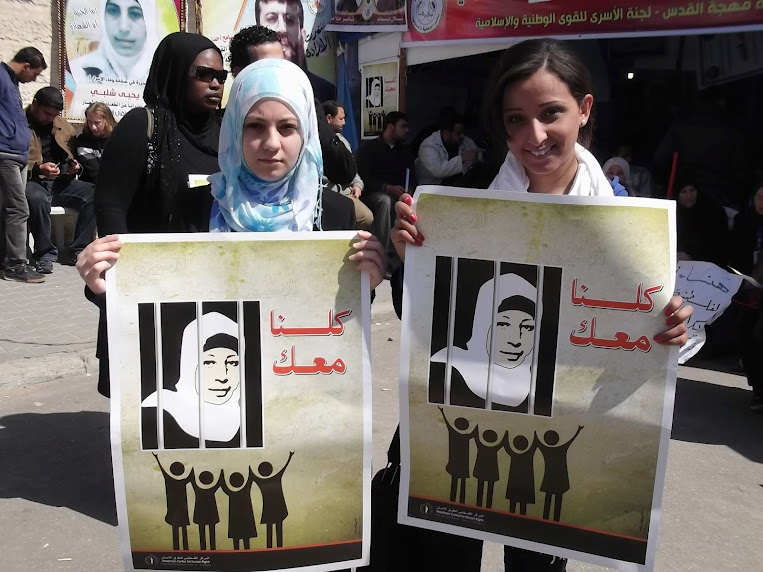
            There are signs of growing expressions of global awareness and solidarity, including a vigil in Trafalgar Square on 23 March at 6:30 pm and Day of Action in Glascow, Scotland on the following day. There are new allegations that even in her present circumstances of clinging to life, she has been abused by prison authorities, and her family has been denied visitation rights.  Her father, Yahya Shalabi, is quoted as saying, “My daughter sticks to her words and promises. She has committed to do this for herself and Palestine.” And Hana Shalabi has herself said of this sacrificial commitment, “[i]t is true that our lives are very precious, but our freedom is even more precious and more powerful than their cells.” Although Israeli newspapers refer to Hana Shalabi in the dehumanizing rhetoric of  ‘a terrorist suspect’ without even acknowledging that a hunger strike is the absolute opposite of terrorism: it turns violence against the innocent self so as to illuminate the wrongs of the guilty other who is rendered exempted from physical harm, and to the extent that others are targets at all, it is in the form of extraordinary appeals to their consciousness and conscience. We all must not allow these acts of spiritual defiance be in vain. I am posting below the statement released by PHR-I two days ago and a revised version of an earlier post of mine that was published a few  days earlier by Al Jazeera.


***************


Full text of Physicians for Human Rights – Israel statement

On the 33rd day of her hunger strike, administrative detainee Hana Shalabi is in danger of imminent death

On the 33rd day of her hunger strike, administrative detainee Hana Shalabi is in danger of imminent death. An independent physician from Physicians for Human Rights – Israel (PHR-Israel) examined her today and determined that she must be hospitalized immediately

Physicians for Human Rights: the Prison Service treatment of Shalabi violates medical ethics

Hana Shalabi, an administrative detainee held at the Sharon Prison, has been on hunger strike for more than a month, in protest of her violent detention, the humiliating and hurtful search that was conducted on her upon her detention, and also in protest of being held in administrative detention. A hearing on her case is expected to be held at the military court.

This morning (March 19th) an independent physician visited Hana Shalabi on behalf of PHR-Israel, and she states that there has been a significant deterioration in her condition, and that she risks death. The deterioration is expressed in a process of muscle breakdown, with a weight loss of 14 kg (31 lb.) since the onset of the hunger strike, a very slow pulse, and a drop in blood sodium levels. These symptoms could indicate grave damage to the heart and the beginning of the breakdown of the heart muscle, which could lead to heart failure at any moment.

Additionally, her body temperature is low (hypothermia), recorded at 35.05C (95.09F), with Shalabi reporting that she feels cold. This finding indicates that the energy production in her body is mostly directed at the essential organs, which also indicates possible damage to the heart, which could be expressed in arrhythmia, systemic deterioration, or sudden death. The attending physician adds that Shalabi is not taking medications, has gone from ambulatory independence to being dependent on others for locomotion, and suffers from significant weakness, low blood pressure, serious pain throughout her body, significant sensitivity in her upper abdominal region, and serious dizziness.

The results of the blood test taken on March 14th indicate a drop in the levels of blood glucose and sodium, and damage to the thyroid functions. The thyroid plays a critical role in maintaining body temperature, as well as heart, liver, and brain function. Significant damage to the thyroid gland could lead to a coma, and this possibility is clearly present with regard to Shalabi. Additionally, blood work done today indicates disruption of the clotting functionality, and a significant lack of iron and vitamins.

Following her examination, the physician has determined that Shalabi is in immediate danger to her life, and recommended that she be transported to a hospital with no delay, for close supervision and follow-up. The Prison Service has announced that it has transported Shalabi to the Meir Hospital in Kfar Saba pursuant to the recommendation of the physician.

Physicians For Human Rights Israel today calls out the problematic conduct by the Israeli Prison Service in its treatment of Hana Shalabi:

  • Great pressure is being exerted on Shalabi to stop the hunger strike, both by the Prison Service Ethics Committee and the Muslim cleric who is a member of that committee.
  • The Chief Medical Officer for the Prison Service communicated with the PHR-I physician, asking that she persuade Shalabi to stop her strike. This clearly violates the principles of medical ethics.
  • Hana’s communication with the PHR-I physician who is supposed to follow up closely on her health – is very limited. For example, when Shalabi asked to see the PHR-I physician last week, the Prison Service did not inform the physician of this request.
  • The results of Shalabi’s blood tests, as communicated to the PHR-I physician last week, over a phone call with the Chief Medical Officer for the Prison Service, were found to be different from the printed results, which were sent from the lab and given to the PHR physician to review physically today. The results conveyed presented a different medical picture than that which actually existed in reality.
  • It seems that the question of force-feeding has not been ruled out, and that the discussion of this matter continues in the Prison Service Ethics Committee.
  • It appears that an attempt is being made to undermine Shalabi’s faith in the independent physician by presenting her with incorrect information. In the course of the physician’s examination today, Shalabi indicated that she had been told by the Prison Service representatives that the PHR independent physician had given the blood tests to the Prison Service, and that she did not wish to take them herself.

Physicians For Human Rights again expresses extreme concern for Hana Shalabi’s life. The organization expresses its dismay at the fact that medical teams are still considering the possibility of force-feeding her, despite the fact that international treaties prohibit this.

The organization calls upon the local and the international community to act immediately and intervene for the release of Shalabi, and to act to end Israel’s use of administrative detention.

For reports of prior examinations by the PHR physician see: March 13th.

Background:

On 23 February 2012 an administrative detention order for six months was issued for Ms. Hana Shalabi. On 29 February there was a hearing regarding her detention in Ofer military court. On 4 March the military court decided to reduce the detention period from six to four months, but without promising to extend or renew it. As a result, Ms. Hana Shalabi announced she would continue to hunger strike until her release. On 7 March, an appeal hearing regarding the court’s decision was held at Ofer, and the military judge ordered the parties to try and reach a compromise by Sunday 11 March, but no agreement has yet been reached.

Administrative detainees’ protests are growing. Two additional administrative detainees, Bilal Diab and Thair Halahleh declared hunger strikes on 1 March, which they claim will continue until their release from administrative detention. On 3 March, two other administrative detainees declared hunger strikes until their release. Since the beginning of March, a number of administrative detainees have refused to acknowledge the military court and refused to participate in legal hearings of their cases. Due to Israel’s use of administrative detention, and the unwillingness of the military court to interfere in this practice, a hunger strike serves as a non-violent and the sole tool available to administrative detainees to protest and fight for their basic human rights.

Approximately 309 Palestinians are currently held in administrative detention in Israeli prisons. Administrative detention allows Israel to hold detainees for indefinitely renewable six-month periods. The arrest is granted on the basis of “secret information” and without a public indictment. Therefore, administrative detainees and their lawyers cannot defend against these allegations in court.

********************


Hana Shalabi: The Challenge of Palestinian Nonviolence


            No sooner had Khader Adnan ended his 66-day, life threatening hunger strike than new urgent concerns are being voiced for Hana Shalabi, another West Bank hunger striker now without food for more than 34 days.  With a grim irony there is continuity between these acts of spiritual defiance as both Khader Adnan and Hana Shalabi have been held in the same room at the Ramleh Prison Hospital.


            Both strikes are directed against the abusive use of administrative detention by Israeli West Bank occupying military forces, protesting both the colonial practice of internment without charges or trial and the degrading and physically harsh treatment administered during the arrest, interrogation, and detention process.


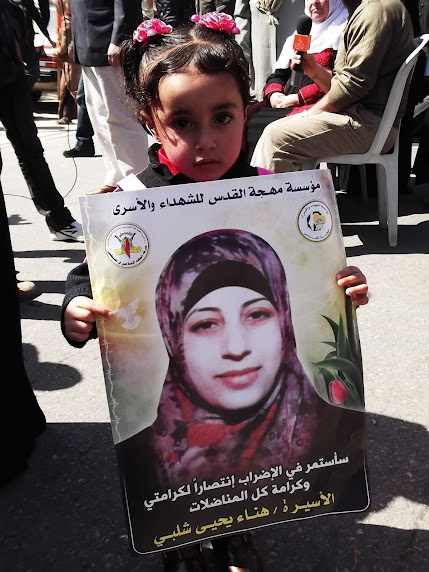
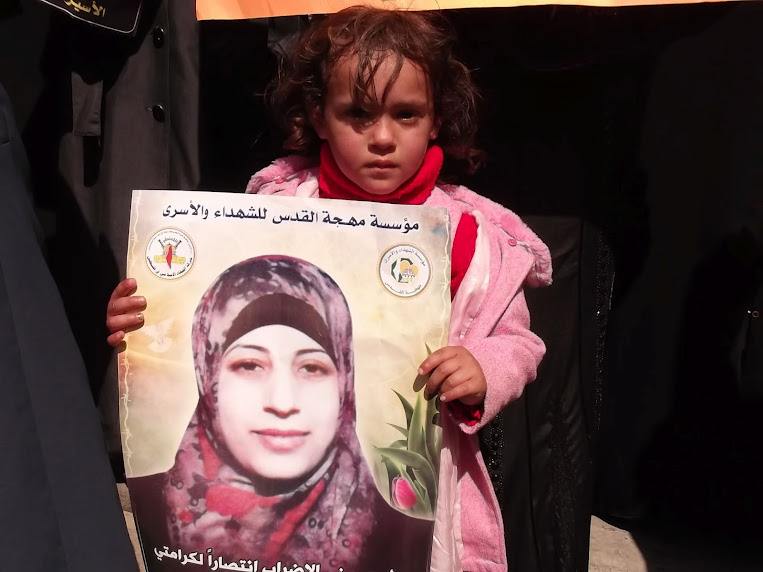
            The case of Hana Shalabi should move even the hardhearted. She seems a sensitive and caring young woman of 29 who is a member of Islamic Jihad, and appears dedicated to her family, hopes for marriage, and such simple pleasures as shopping for clothes and home furnishings. She had previously been held in administrative detention at the HaSharon prison in Israel for a 30 month period between 2009 and 2011, being released in the prisoner exchange of four months ago that freed 1027 Palestinians and the lone Israeli soldier captive, Gilad Shalit. After her release, according to her mother, she spent weeks recovering from the deep sense of estrangement she experienced in prison, and rarely left her home or the company of her family. As she was returning to normalcy she was re-arrested in a highly abusive manner, which allegedly included a strip-search by a male soldier at the interrogation center and other behavior intended to humiliate and intimidate.


            On February 16, 2012, the day of this renewal of her administrative detention, Hana Shalabi announced her resolve to start a hunger strike to protest her own treatment and to demand an end of administrative detention now relied upon by Israel to hold at least 309 Palestinian in prison. Her family has been denied visitation rights even in her present critical condition, Hana Shalabi was placed in solitary confinement at the outset of her detention, and her health has deteriorated to the point of severe concern for her health, even her life. According to her lawyer, Raed Mahameed, Hana Shalabi was examined by a doctor from Physicians for Human Rights and the doctor said that “she suffers from low heart beat rate, low blood sugar, loss of weight, weakness in muscles, yellowing of the eyes and high levels of salt in the blood which affected her kidneys causing her pain in her sides specially the left side as well as pain in chest bones. Physicians for Human Rights said that Shalabi cannot sleep because of pain, she also suffers dizziness and blurred and occasional loss of vision. Ms. Shalabi told Mahameed that she took salt last week but refused to take any salt since then and is living on two litres of water a day.”

            Impressively, her parents have committed themselves to a sympathy hunger strike for as long as their daughter remains under administrative detention. Her mother, Badia Shalabi, has made a video in which she says that even to see food makes her cry considering the suffering of her daughter. Her father has likewise made a global appeal to save the life of his child.


            Despite frequent mentoring to Palestinians from liberals in the West to rely on nonviolent tactics of resistance, these extraordinary hunger strikes have met with silence or indifference in both Israel and the West. Israeli authorities cynically declare that undertaking a hunger strike is a voluntary action and a publicity stunt for which they take no responsibility and that the striker is alone responsible if any harm results. There is also not a hint that Palestinian grievances about administrative detention are well founded and will even be considered much less acted upon. Such hardheartedness in the face of such sacrificial bravery is a sure sign that Israel is not ready for a sustainable and just peace with Palestine.


            The UN also disappoints those who believe in its ideals. It has not raised its voice even to take notice of Hana Shalabi’s plight or Israeli accountability. I share the view of Khitam Saafin, Chairwoman of The Union of Palestinian Women’s Committees: “The UN must be responsible for the whole violation that are going on against our people. These prisoners are war prisoners, not security prisoners, not criminals. They are freedom fighters for their rights.” The sad yet inspiring spiritual defiance of Hana Shalabi is also well expressed by Yael Maron, a spokesperson for the NGO, Physicians for Human Rights- Israel: “The story of Hana Shalabi, like that of Khader Adnan before, is in my opinion a remarkable example of a struggle that’s completely nonviolent towards one’s surroundings..It is the last protest a prisoner can make, and I find it brave and inspiring.”


            To engage in an open ended hunger strike, especially for a person who is not in a leadership role, requires a deep and abiding dedication to right a perceived wrong of the greatest gravity. It is physically exceedingly painful and dangerous to bodily health, as well as being psychologically demanding in the extreme. It presupposes the strongest of wills, and usually arises, as in these instances, from a sense that any lesser form of resistance has proved futile, exhibiting a long record of failure. In the end, this unconditional hunger strike is an appeal to the conscience and humanity of the other, and a desperate call to all of us, to understand better the cartography of abuse that abusive imprisonment and occupation entails, which can only be pervasively humiliating for a religiously oriented young Islamic woman. To risk life and health in this way without harming or even threatening the oppressor is to turn terrorism against the innocent on its head. It is potentially to sacrifice one’s life to make an appeal of last resort, an appeal that transcends normal law and politics, and demands our response.


            We can only fervently hope and pray that Hana Shalabi’s heroic path of resistance will end with her release and the complete restoration of her health. For Israel’s own moral wellbeing it is time, really long past time, to renounce reliance on administrative detention and to do more than this, to end forthwith its varied crimes of occupation. At this point the only possible way to do this is to withdraw unconditionally behind the 1967 borders, and to start peace negotiations from such an altered position of acknowledged wrongdoing without asking or expecting any reciprocal gesture from the Palestinian side. In the present atmosphere, it is politically unimaginable that Israeli leaders will heed such a call, but it is morally unimaginable that Israel will survive an impending spiritual collapse if it does not quickly learn to do so.


            In the meantime, we who are beyond these zones of occupation, abuse, and imprisonment, must do more than stand and watch as this tragic drama plays itself out.  We need to do all we can to strengthen the demands of Khader Adnan, Hana Shalabi, and all are refusing food in solidarity for the immediate release of all Palestinians currently held in administrative detention, for an end to detention without charges, to abusive arrests in the middle of the night, and beyond this, and to an end to an occupation that has lasted for 45 years with no end in sight.

Hana Shalabi: A Brave Act of Palestinian Nonviolence

10 Mar

                                                                (photo by Joe Catron)

            No sooner had Khader Adnan ended his 66 day life threatening hunger strike than new urgent concerns are being voiced for Hana Shalabi, another West Bank hunger striker now without food for more than 24 days. Both strikes were directed by Palestinian activists against the abusive use of administrative detention by Israeli West Bank occupying military forces, protesting both the practice of internment without charges or trial and the degrading and physically harsh treatment administered during the arrest, interrogation, and detention process.


            The case of Hana Shalabi should move even the most hardhearted. She seems a young tender and normal woman who is a member of Islamic Jihad, and is dedicated to her family, hopes for marriage, and simple pleasures of shopping.

She had previously been held in administrative detention at the HaSharon prison in Israel for a 30 month period between 2009 and 2011, being released in the prisoner exchange of four months ago that freed 1027 Palestinians and the lone Israeli soldier captive, Gilad Shalit. Since her release she has been trying to recover from the deep sense of estrangement she experienced in prison, and rarely left her home or the company of her family. As she was returning to normalcy she was re-arrested in an abusive manner, which allegedly included a strip-search by a male soldier. On February 16, 2012, the day of this renewal of her administrative detention, Hana Shalabi indicated her resolve to start a hunger strike to protest her own treatment and to demand an end of administrative detention now relied upon by Israel to hold at least 309 Palestinian in prison. Her parents have been denied visitation rights, Hana Shalabi has been placed in solitary confinement, and her health has deteriorated to the point of concern for her life. Impressively, her parents have committed themselves to a hunger strike for as long as their daughter remains under administrative detention. Her mother, Badia Shalabi, has made a video in which she says that even to see food makes her cry considering the suffering of her daughter.


            Despite the calls to Palestinian from liberals in the West these extraordinary hunger strikes have met with silence or indifference in both Israel and the West. Israeli authorities declare that such a posture is a voluntary action for which they have no responsibility. The UN has not raised its voice, as well. I share the view of Khitam Saafin, Chairwoman of Union of Palestinian Woman’s Committee: “The UN must be responsible for the whole violation that are going on against our people. These prisoners are war prisoners, not security prisoners, not criminals. They are freedom fighters for their rights.” The plight of Hana Shalabi is also well expressed by Yael Maron, a spokesperson for the Israeli NGO, Physicians for Human Rights- Israel: “The story of Hana Shalabi, like that of Khader Adnan, before is in my opinion a remarkable example of a struggle that’s completely nonviolent towards one’s surroundings..It is the last protest a prisoner can make, and I find it brave and inspiring.”


            To engage in an open ended hunger strike, especially for a person who is not in a leadership role, requires a deep and abiding dedication to right a perceived wrong of the greatest gravity. It is physically painful and dangerous to bodily health, as well as being psychologically demanding in the extreme. It presupposes the strongest of wills, and usually arises, as in these instances, from a sense that any lesser form of resistance is futile, and has a long record of failure. In the end, it is an appeal to the conscience and humanity of the other, and a desperate call to all of us, to understand better the cartography of abuse that abusive imprisonment entails, which I would imagine is pervasively humiliating for a religiously oriented young Islamic woman. To risk life this way without harming or even threatening the oppressor is to turn terrorism against the innocent on its head. It is potentially to sacrifice one’s life to make an appeal of last resort, an appeal that transcends normal law and politics.


            We can only fervently hope and pray that Hana Shalabi’s heroic path of resistance will end with her release and the restoration of her health. For Israel’s own moral wellbeing it is time, really long past time, to renounce reliance on administrative detention and to do more than this, to end forthwith its varied crimes of occupation. At this point the only possible way to do this is to withdraw unconditionally behind the 1967 borders, and to start peace negotiations from that altered position. It is politically unimaginable that Israeli leaders will heed such a call, but it is morally unimaginable that Israel will survive its impending spiritual collapse if it does not do so.


(photo by Joe Catron)

            In the meantime, we who are beyond these zones of occupation, abuse, and imprisonment must not only stand and watch as this tragic drama plays itself out. Wherever we are, whatever we can do, we need to act, to appeal, to shout, and to denounce the inhumanity of allowing such cruelty to be enacted before our watching eyes. 

Saving Khader Adnan’s Life and Legacy

21 Feb


            It is a great relief to those millions around the world who were moved to prayer and action by Khader Adnan’s extraordinary hunger strike of 66 days that has ended due to Israel’s agreement to release him on April 17. We who were inspired by such a heroic refusal to accept humiliation and arbitrary arrest can only hope that for the sake of his family, for the cause of Palestinian resistance, and for the struggle to achieve a just peace that Mr. Adnan will fully recover to resume his personal and political life. We can not take for granted that there will be a full recovery given Mr. Adnan’s critical condition confirmed by examining doctors, just prior to his decision on February 21 to resume eating in a normal manner.


            While it is appropriate to celebrate this ending of the strike as ‘a victory’ there are several disturbing features that deserve comment. To call an arrangement that saved someone’s life a ‘deal,’ as the media consistently put it, is itself demeaning, and reveals at the very least a failure to appreciate the gravity and deep dedication of purpose that is bound up with such a nonviolent form of resistance. Similarly, the carelessness of the initial reactions was notable, often referring to Mr. Adnan’s ‘release’ when in fact he will be still held in administrate detention for several more weeks, and could conceivably be confined much longer, should Israeli military authorities unilaterally decide that ‘substantial evidence’ against him emerges in this period immediately ahead.


            It should also be noted that on matters of policy and principle Israel did not retreat even an inch: in relation to Mr. Adnan, he will be remain in captivity and will be subject to the ‘legal’ possibility that his period of imprisonment could still be extended indefinitely; beyond this, Israeli authorities express no willingness whatsoever to review the cases of the 309 other Palestinians who are presently being held under the administrative detention procedure.


            These Palestinians being held include one prisoner detained for more than 5 years, and 17 others for periods of 2-4 years. Israel did not even agree to a review of their misapplications of this administrative procedure within their own frameworks of claims about addressing imminent security threats. The general justification of administrative procedures by governments that rely upon it is to insist that its use is reserved for true and credible emergency situations. But as Mustafa Barghouti points out in the New York Times (February 22, 2012) such a claim strains credulity past the breaking point in the Israeli case. Barghouti writes tellingly that it is worth observing “that among..[those] Palestinians now held in ‘administrative detention’ are 21 of the 120 elected members of the Palestinian Legislative Council, most of whom have  been held for years for no apparent crime other than being democratically elected in 2006, in an election universally regarded as free and fair, as candidates of the party which won a clear majority of seats but which Israel does not like.” In other words, the Israeli claims of exceptional circumstances taking precedence over due process protections do not exist in many of the evident political uses of administrative detention as a means of weakening all forms of Palestinian resistance, including nonviolent opposition politics.


            It should also be noted that Israeli commentary treated the arrangement ending the standoff produced by the hunger strike with measured cynicism if not disdain. Even those Israeli who supported the agreement justified it as a practical way of avoiding trouble down the road should Khader Adnan have died while held by Israelis, given the breadth and depth of support his extended hunger strike was receiving among Palestinians and sympathizers from around the world. Keeping Mr. Adnan alive was also seen by Israelis as a means to avoid a wider scrutiny of the institution and practice of administrative detention as it has been used by the Israeli military ‘justice’ system.


            Also the timing of the announcement of the arrangement is significant. It was made an hour before an emergency session of the Israeli Supreme Court that was scheduled to hear Mr. Adnan’s petition for release, and there is speculation that although this highest judicial body in Israel has in the past consistently supported the military position in such instances, the situation was so extreme that it might prove embarrassing for Israeli military authorities. There were even some worries on the Israeli side that the extremities of this case could produce an adverse result and even a repudiation of the manner in which Israeli authorities used administrative detention as a procedure allegedly for security, but seemingly for the harassment and intimidation of militant opponents of an oppressive occupation that has continued for 45 years and is aggravated by continuously appropriating Palestinian land and water for the benefit of settlement expansion while disrupting and cleansing long-term Palestinian residency.


            What was entirely absent from the Israeli public discourse was some expression of compassion, even if only for the family of Mr. Adnan, which consists of two daughters of four years or less and his articulate pregnant wife, Randa. There was not even the slightest show of respect for the dignity of Mr. Adnan’s long hunger strike or sympathy for the acute suffering that accompanies such a determined foregoing of food and speech for an extended period. Instead, the Israeli commentary that was supportive of the arrangement stressed only pragmatic considerations from the perspective of Israel’s interests. It was one more lost opportunity for Israelis of all shades of opinion to reach across the abyss of political conflict to affirm a common humanity.


            But in a contrary spirit, the spokesperson for the Netanyahu government, Mark Regev, seemed only interested in deflecting criticism directed at Israel. He parried criticism by cynically observing that other governments rely on administrative dentention in the name of security, including the United States, so why shouldn’t Israel. He also added that the legality of Israel’s use of administrative detention should not be questioned since it depended not on an Israeli law, but on a 1946 law enacted when Britain was controlling Palestine, unintentionally conceding that Israel was the ‘colonial’ successor to the British! If the legal veil is lifted from administrative detention its character is one of ‘internment,’ a standard practice of colonial powers in dealing with unruly natives.


            Of course, Israeli ultra hardliners went further in this direction, referring to Mr. Adnan as ‘a terrorist’ despite the vagueness of official allegations that didn’t ever make such a claim, but only mysteriously contended that he constituted what an official in Tel Aviv described as ‘a threat to regional security,’ whatever that might mean. As might be expected, the notorious Israeli Foreign Minister, Avigdor Lieberman, was characteristically forthright, calling his ‘release’ ‘a wrong decision’ yet accepting the outcome because it is ‘our duty to honor and respect every Supreme Court decision even when we don’t agree with it.” As we know, Mr. Adnan was not released nor did the Israeli Supreme Court make a decision.  This comedy of errors by a leading government official should raise questions about Lieberman’s competence, not to mention his questionable political judgment as to policy. Lieberman’s mean spiritedness extended to attacks on Arab members of the Knesset who visited Mr. Adnan as somehow an indication that  by so doing they were ‘representing terrorists.’ Similarly, MK Danny Danon ignored the context and scorned the agreement ending the hunger strike by calling it reprehensible, an instance of a ‘[capitulation] to terrorism.’


            The issues directly raised by this hunger strike are ones of human rights and humane treatment, as well as reliance on administrative detention, and are quite independent of whether or not we endorse Mr. Adnan’s past and present tactics of resistance, which are not at all clear. Some apologists for Israel have tried to deflect these ethical and legal concerns by emphasizing Mr. Adnan’s association with Islamic Jihad and its record of violent attacks and extremist politics. Israelis casually refer to Mr. Adnan as a ‘terrorist’ without charges or proof. He has, in fact, been most often described in recent years more neutrally by those knowledgeable about his role and activities as a spokesperson for Islamic Jihad, but not engaged beyond this. There is no indication in his past or present that he was directly involved in violence, although an undated and unverified YouTube video has surfaced somewhat suspiciously in which Mr. Adnan is depicted as advocating violent resistance and an active recruiter of suicide bombers. Although Islamic Jihad has been responsible in the past for suicide bombings it has seemingly abandoned the practice, which is in line with the repudiation of such forms of violent resistance by Hamas more than ten years ago. Mr. Adnan’s prior arrests  stemmed from militant peaceful demonstrations that landed him in Israeli jails seven times, a Palestinian Authority prison once, and induced him to undertake shorter hunger strikes on three previous occasions, one as recently as 2010.  From what is known, Mr. Adnan is definitely a committed activist who has associated himself with Islamic Jihad, but works on a daily basis as a village baker and maintains a strong family role and popular community presence in his small West Bank town of Arraba.


            It is important to pause long enough to take account of Khader Adnan’s achievement, symbolically, substantively, and with respect to future possibilities. We should note that Mr. Adnan’s hunger strike of 66 days is the exact length of Bobby Sands’ hunger strike in 1981 strengthening the bond between the two men, a bond that has been movingly confirmed by a number of Irish family members of their strikers. What is more, the date of Bobby Sands’ death, May 5, 1981, is generally viewed as the turning point in the Irish struggle, the time when the British Government finally started treating the IRA as a political actor with genuine grievances rather than as a terrorist organization that must be run into the ground and exterminated. We can only hope that Febuary 21, 2012 will live in history as a turning point in the Palestinian struggle. Only the future will reveal whether this is a pious wish on my part or becomes over time a historical reality.


            Substantively, it is crucial to support a campaign to free the other several hundred Palestinians currently being held in administrative detention and to exert enough pressure to end reliance on the practice altogether. Mr. Adnan’s brave stand will have been mostly without effect if his compelling exposure of the cruelty and arbitrariness of Israeli reliance on administrative detention is allowed to slip from view now that his strike is over. Instead, knowing what we have come to know, it is the responsibility of all of us to do all we can to discredit and force the abandonment of administrative detention by Israel, and as well, challenge its role in the United States and elsewhere. A fitting tribute to Mr. Adnan’s hunger strike would be to put opposition to administrative detention on the top of the human rights agenda throughout the world. We should begin by refusing to use the phrase ‘administrative detention,’ rechristening it as ‘administrative torture’ or ‘lawless captivity,’ and associate with past colonial and present authoritarian tendencies of ‘democratic’ governments.


            And finally, we will know the enduring significance of Mr. Adnan’s self-sacrifice by what takes place in the future. Will this event, possibly along with other influences, inspire a greater commitment to the Palestinian struggle for peace, justice, and liberation in occupied Palestine and throughout the world? Maybe ‘the regional threat’ that was being referred to by the Israeli official justifying Mr. Adnan’s detention was an indirect, and hopefully accurate reference to the growing impact of the positive sides of the Arab Spring, that is, as an occasion prompting a further awakening of self-empowerment among Palestinians both in relation to their struggle and in their renewed quest for unity among themselves. In effect, let us hope that Khader Adnan’s bravery becomes contagious and will be remembered as a charismatic event in the long narrative of the Palestinian struggle for self-determination.


Saving Khader Adnan’s Life Saves Our Own Soul

18 Feb


             The world watches as tragedy unfolds beneath its gaze as Khader Asnan enters his 63rd day as a hunger striker in an Israeli prison being held under an administrative detention order without trial, without charges, and without any indication of the evidence against him. From the outset of his brutal arrest by scores of soldiers, featuring blindfolding, cuffing, and physical roughness in the middle of the night, a gratuitous ritual enacted the presence of his wife and young daughters Khader Adnan has been subject to the sort of inhumane and degrading treatment that is totally unlawful and inexcusable, and an assault on our moral justification. At present, approximately 300 other Palestinians are being held in administrative detention, and Mr. Adnan has indicated that his protest is also on their behalf, and indeed against the practice of administrative detention itself.


            The only plausible explanation of such Israeli behavior is to intimidate by terrifying all Palestinians who have lived for almost 45 years under the yoke of an oppressive occupation that continuously whittles away at Palestinian rights under international humanitarian law, especially their right to self-determination, which is encroached upon every time a new housing unit is added to the colonizing settlements that dot the hilltops surrounding Jerusalem and throughout the West Bank. While Palestinian prospects of a viable political future are continuously diminished by Israeli expansionism the world politely watches in stunned silence. Only resistance from within and solidarity worldwide can provide the Palestinians with hope about their future. They have been failed over and over again by the UN, by the EU, by their Arab neighbors, and above all by that global leader beholden to Israel whose capital is in Washinton, D.C.! It is only against this broader background that the importance of Khader Adnan’s resistance to the continuing struggle of Palestinians everywhere can begin to be appreciated as a political act as well as an insistence on the sacred dignity of the human person.


            The case of Khader Adnan is a revealing microcosm of the unbearable cruelty of prolonged occupation, and the contrast that is drawn in the West between the dignity of a single Israeli prisoner held in captivity and the steadfast refusal to be attentive to the abuse of thousands of Palestinians languishing in Israeli jails through court sentence or administrative order.  Mr. Adnan’s father poignantly highlighted this contrast a few days ago by reference to Gilad Shalit, the Israeli soldier held by Hamas in captivity for several years and recently released in good health: “Where are the mother and father of Gilad Shalit? Do they not feel for me in this humanitarian case? Where are they?” The comparison pointedly suggests that it is Mr. Adnan who is the more deserving of such a global outpouring of concern: “My son was arrested from his house, from among his wife and children, was taken prisoner. He was not carrying any weapon. Whereas Shalit was fighting against the people of Gaza, and destroying their homes, and firing upon, and Shalit was released.” In fact, Shalit has not been personally associated with violence against the Palestinians and their property, but he was operating as a member of the IDF that has been consistently engaged in such activity, frequently in stark violation of international humanitarian law. While Shalit was being held foreign authority figures, from the UN Secretary General on down, displayed their empathy not only for Shalit but for the intense anxiety experienced by Israelis concerned for the wellbeing of Shalit, but these same personalities are notably silent in the much more compelling ordeal taking place before our eyes in the form of Mr. Adnan’s captivity seemingly unto death. It should not be surprising that surviving family members of IRA hunger strikers should step forward to express solidarity with Mr. Adnan and the compare the Irish transforming acts of resistance in 1981 (ten hunger strikers died, and Britain shifted from counterterrorism to a politics of reconciliation) to that of the Palesinians, increasingly referring to Khader Adnan as the West Bank Bobby Sands.


            And who is Khader Adnan? We do not know very much about him except that he is a member of the Islamic Jihad Party, a 33-year old father of two young daughters, a baker by profession, and viewed with respect and affection by his neighbors. There are no accusations against him that implicate him in violence against civilians, although he has a history of imprisonment associated with his past activism. A fellow prisoner from an earlier period of confinement in Ashkelon Prison, Abu Maria, recalls Mr. Adnan’s normalcy, humanity, and academic demeanor while sharing a cell, emphasizing his passionate dedication to informing other imprisoned Palestinians about the history and nature of the conflict: “Prison was like a university in those times and he was one of the professors.” Commenting on his hunger strike that has brought him extreme pain, Abu Maria says he is convinced that Khader Asnan wants to live, but will not at the price of enduring humiliation for himself and others held in administrative detention: “He is showing his commitment and resistance in the only way he can right now, with his body.”


            Addameer, the respected Palestinian NGO concerned with prisoner issues, “holds Israel accountable for the life of Khader Adnan, whose health has entered an alarmingly critical stage that will now have irreversible consequences and could lead to his fatal collapse at any moment.” Physicians who have observed his current condition conclude that, at most, Mr. Adnan could live a few more days, saying that such a hunger strike cannot be sustained beyond 70 days in any event. Any attempt at this stage to keep Mr. Adnan alive by forced feeding would be widely viewed as a violation of his right to life and is generally regarded as a type of torture.


            Finally, the reliance by Israel on administrative detention in cases of this sort is totally unacceptable from the perspective of international law, including the Geneva Conventions, especially so with no disclosure of the exceptional circumstances or evidence that might warrant for reasons of imminent security the use of such an extra-legal form of imprisonment for a few days. Given the number of Palestinians being held in a manner similar to that of Mr. Adnan, it is no wonder that sympathy hunger strikes among many Palestinians in and out of Israeli jails are underway as expressions of solidarity. Have we not reached a stage in our appreciation of human rights that we should outlaw such barbarism by state authorities, which is cunningly shielded from critical scrutiny by the anonymity and bureaucratic neutrality of the term ‘administrative detention’? Let us hope and make sure that the awful experience of Khader Adnan does not end with his death, and let us hope and do everything in our power to encourage a worldwide protest against both administrative detention and prisoner abuse and by the government of Israel, and in due course elsewhere. The Palestinian people have suffered more than enough already, and passivity in the face of such state crimes is an appalling form of complicity. We should expect more from our governments, the UN, human rights NGOs, and ourselves!


Help End the Hunger Strike of Khader Adnan

15 Feb

I am publishing here my press release of today expressing urgent concern about the fate of Khader Adnan, a Palestinian activist, who is near death resulting from his continuing hunger strike that expresses his refusal to accept the humiliating conditions of imprisonment without charges and accompanied by an Israeli court approved denial of visitation rights to his wife. Please do whatever you can to exert pressure to obtain the immediate release of Mr. Adnan, and to make the world aware that Israel is responsible for respecting his rights and protecting his wellbeing.  The text below is released under the auspices of the UN Office of the High Commissioner of Human Rights, and prepared in my role as Special Rapporteur for Occcupied Palestine of the Human Rights Council.

*****

> Israel: UN rights expert appeals for international help for a Palestinian
> prisoner on hunger strike
>
> CAIRO / GENEVA (15 February 2012) – The United Nations Special Rapporteur
> on the situation of human rights in the Palestinian territories occupied
> since 1967, Richard Falk, expressed his urgent and extreme concern
> regarding the situation of Palestinian prisoner Khader Adnan, and urged
> the international community to intervene on his behalf.
>
> “I call on the international community, especially States with close
> relations with Israel, to urge the Israeli Government to fulfill its
> responsibilities under international law, most urgently with regard to Mr.
> Adnan,” the human rights expert said. Mr. Adnan, whose life is reportedly
> in jeopardy, has maintained a hunger strike for 60 days in response to the
> humiliating circumstances of his imprisonment without charges by the
> Government of Israel.
>
> “In view of the emergency of his situation, the Government of Israel must
> take immediate and effective action to safeguard Mr. Adnan’s life, while
> upholding his rights,” stressed the Special Rapporteur, who is currently
> undertaking a fact-finding mission to the region.
>
> Mr. Falk also called on the Government of Israel to respect its legal
> obligations pertaining to the several thousand Palestinians it has
> imprisoned. “The improper treatment of thousands of Palestinian prisoners
> by the Government of Israel should be of great concern to the
> international community, and it is a problem that I am paying close
> attention to in the context of my ongoing visit to the region.”
>
> The Special Rapporteur will convene a press conference at the end of his
> regional visit, on 20 February in Amman, and will submit a full report on
> his mission to the Human Rights Council in June 2012.
>
> ENDS
>
> In 2008, the UN Human Rights Council designated Richard Falk (United
> States of America) as the fifth Special Rapporteur on the situation of
> human rights on Palestinian territories occupied since 1967. The mandate
> was originally established in 1993 by the UN Commission on Human Rights.
>
> Learn more about the mandate and work of the Special Rapporteur:
> http://www2.ohchr.org/english/countries/ps/mandate/index.htm
>
> OHCHR Country Page – Occupied Palestinian Territories:
> http://www.ohchr.org/EN/countries/MENARegion/Pages/PSIndex.aspx
>
> OHCHR Country Page – Israel:
> http://www.ohchr.org/EN/Countries/MENARegion/Pages/ILIndex.aspx
>
> For more information and media requests, please contact Kevin Turner (+41
> (0)79 509 0557 / kturner@ohchr.org) or write to sropt@ohchr.org.
>
> For media inquiries related to other UN independent experts:
> Xabier Celaya, OHCHR Media Unit (+ 41 22 917 9383 / xcelaya@ohchr.org)
>
> UN Human Rights, follow us on social media:
> Facebook: https://www.facebook.com/unitednationshumanrights
> Twitter: http://twitter.com/UNrightswire
> YouTube: http://www.youtube.com/UNOHCHR
>
> Check the Universal Human Rights Index: http://uhri.ohchr.org/en
>

Turkey’s Foreign Policy: Zero Problems with Neighbors Revisited

8 Feb


            Pundits in Europe and North America in recent months have delighted in citing with a literary smirk ‘zero problems with neighbors,’ which has been the centerpiece of Ahmet Davutoglu’s foreign policy agenda since he became Foreign Minister on May 1, 2009. Mr. Davutoglu had previously served as Chief Advisor to both the Prime Minister and Foreign Minister ever since the AKP came to power in 2002, and was known in those years as the ‘architect’ behind the scenes. Critics of the zero problems approach point to the heightened Turkish tensions with Syria and Iraq, the persisting inability of Ankara to overcome the hostile fallout from Mavi Marmara incident with Israel, and even the revived salience of the long unresolved dispute with the Armenian diaspora sparked by a new French law that makes the denial of genocide associated with the 1915 massacres a crime and has led to a dramatic worsening of Turkish-French relations.


            Troubles to be sure, but should these be interpreted as ‘failures,’ and more precisely as ‘Turkish failures’? Perhaps, Davutoglu was insufficiently cautious, or alternatively too optimistic, when he articulated the zero problems diplomacy, but was it not at the time an accurate way of signaling a new dawn for Turkey’s approach to neighbors, especially its Arab neighbors, and actually, to the world as a whole. And Davutoglu implemented his lofty vision with a dizzying series of initiatives that opened long locked doors. He also made it clear that the neighborhood was not to be understood in a narrow geographical sense, but rather in as broad a sense as disclosed by cultural and historical affinities and mutual strategic interests. Davutoglu was eager not only to banish lingering bad memories associated with centuries of Ottoman rule over much of the Arab world, as well as to renew connections with countries that shared Turkic and Muslim identities.


            It should be recalled that Turkish foreign policy began charting this new course years before Davutoglu became Foreign Minister, and thus was a shift in worldview that was shared with Recip Tayyip Erdogan and Abudllah Gul, the two dominant political leaders during the past decade.  Indeed, both men deserve some of the credit, and a share of the responsibility, for steering the Turkish ship of state into such mainly uncharted waters of diplomatic initiative.


            In an important sense, the turning point came in 2003 when the Turkish government, after sending some mixed signals to Washington, finally refused to allow the United States to use its territory to stage an invasion of Iraq. At the time the anti-AKP domestic opposition challenged this unprecedented act of geopolitical insubordination by Ankara as the biggest mistake in the whole of Turkish republican history. In retrospect, this opting out of the invasion of Iraq constituted a transformational moment for Turkey that demonstrated to its neighbors and the world, and even to itself, that Turkey could and would think and act for itself when it comes to foreign policy, that the hierarchical alliances of the Cold War period were over, and that Washington should no longer take Ankara’s collaboration for granted. And yet this move did not mean, as some critics in both Turkey and the United States wrongly claimed, a turn toward Islam and away from the West or its continuing involvement in Western security arrangements. Even during the Iraq War Turkey allowed the Incirlik Air Base to be used by American combat aircraft, including for bombing missions. As recently shown, Turkey still values its NATO ties even to the extent of allowing radar stations to be deployed on its territory that is linked to a missile defense system that seems mainly intended to protect Europe, Israel, and the Gulf from Iran in the immediate future and possibly Russia in the long-term.


            By now it is almost forgotten that it was Turkey that encouraged peace talks between Syria and Israel to resolve their conflict that seemed to be headed for success until their abrupt breakdown, a development attributed at the time to the Israeli attacks on Gaza at the end of 2008, but in retrospect better understood as the unwillingness of Israel to give up its 1967 conquest and subsequent occupation of the Golan Heights. Turkey also sought to be a peacemaker further afield in the Balkans and Caucasus, doing the seemingly impossible, bringing Bosnia and Serbia together in a manner that moved these two antagonistic governments on a path leading to normalization and at least a cold peace. Even more ambitiously, in collaboration with Brazil, Turkey used its new stature as an independent regional player in May 2010 to persuade Tehran to accept an arrangement for the storage of a large portion of Iran’s enriched uranium in Turkey, thereby demonstrating the plausibility of a peaceful alternative to the United States/Israel posture of sanctions and warmongering.


            To be sure, the earlier sensible effort to have friendly relations with Syria has now badly backfired, but not until the regime in Damascus started the massive shooting of its citizens and refused to meet the demands of its people for far reaching reforms.  Arguably, the same reversal of outlook in Ankara occurred in relation to Libya after Qaddafi threatened to massacre his opposition, leading eventually to extending some Turkish humanitarian support for the UN-backed NATO intervention in Libya in 2011 that shaped the outcome of an ongoing internal struggle for control of the Libyan political future. Also, there is no doubt that the refusal of the European Union to shift its one-sided stance on Cyprus that is punitive toward Turkey has had some serious consequences. It has soured relations with Greece, producing a temporary deterioration that has taken place despite the Turkish show of reasonableness and exhibiting a spirit of compromise in relation to Cyprus. And, together with the recent Islamophobic surge in Europe, this perceived unfairness to Turkey with respect to Cyprus has reinforced the weakening of an earlier Turkish commitment to qualify for membership in the EU. 


            Even with Israel, despite the strong sympathies of the Turkish public with the struggle of the Palestinians, the AKP leadership has done its best to restore normalcy to the relationship between the two countries. After all, the May 31, 2010 attack by Israel’s navy in international waters on the Mavi Marmara carrying humanitarian activists and assistance to Gaza and challenging the Israeli blockade was not only a flagrant breach of international law but resulted in the death of nine Turkish passengers. Turkey has demanded an official apology and compensation for the families of the victims, a reasonable set of expectations that was apparently on the verge of acceptance by Tel Aviv, but collapsed at the last hour when challenged by the internal political opposition to Netanyahu led by the super-hawk foreign minister, Avigdor Liebermann, now under government investigation for fraud.


            What this brief overview argues is that Turkey has consistently tried to avert recourse to intervention and war in the Middle East and to promote diplomatic approaches that rely to the extent possible on soft power. It has, to be sure, experienced several geopolitical rebuffs, as in relation to its efforts to end the confrontation with Iran, impressively refusing to stay in line behind the bellicose leadership of the United States and Israel. Davutoglu has correctly affirmed Turkey’s resolve to act on the principled basis of its values and convictions, as well as strategic calculations of its interests, in the post-Cold War politics of the region, and not blindly follow directives from Washington. Iran is a striking case where the Turkish approach, although seemingly incapable of stemming the drift toward war being mounted by the West, is both wiser and more likely to achieve the goal of reassuring the world that Tehran means what it says when it insists that it does not intend to acquire nuclear weapons. As in every other foreign policy setting, Davutoglu is exhibiting his belief that in the 21st century persuasion works better than coercion when it comes to achieving political goals without even considering the costs of death, devastation, and displacement.


            In sum, the zero problems with neighbors as a touchstone to Turkish foreign policy in the Middle East and the world needs to be understood as an aspiration and strong preference rather than as an invariable and inflexible guide to practice. There are too many contradictions embedded in the political realities of the contemporary world to be slavishly tied to a rigid foreign policy doctrine that is incapable of taking account of context and shifting perceptions and interests. For instance, in Syria and Libya the Turkish government was forced to choose between siding with a regime slaughtering its own people and backing a disorganized opposition in its heroic if clouded efforts to democratize and humanize the governing process.  Of course, there are suspicions that Turkey’s support for the anti-Assad insurgency also reflects a disguised preference for a Sunni opposition that is anchored, if at all, in the Muslim Brotherhood as compared to the secular authoritianism of the Damascus regime. As well, there are speculations that in the ongoing regional struggle for ascendancy Turkey would rather in the end side with Saudi Arabia and Egypt, reinforced by the United States, than Iran and a newly engaged Russia.


Zero problems needs to be understood as a preferred framework for addressing the relations between countries, not just governments, and in situations of strife choices must be made. Arguably Turkey went too far when it backed NATO in Libya and the UN Security Council with respect to Syria or not far enough when it failed to show support for the Green Revolution in Iran after the stolen elections of June 2009. These are difficult interpretative choices upon which reasonable persons of good faith can disagree. Whatever the policies pursued in specific situations,  they do not necessarily invalidate the principled positions articulated by Davutoglu since he became Foreign Minister. Davutoglu has repeatedly affirmed these principles as being as important for him as are realist calculations in shaping foreign policy in complex situations. Possibly, if the Green Revolution had shown more persistence and promise or the Iranian regime had engaged in more widespread killing of its people Turkey would have made a ‘Syrian choice.’


            Davutoglu on more than one occasion has expressed enthusiastic support for the upheavals grouped together under the banner of ‘the Arab Spring.’ He calls these upheavals great historical transformations that are irreversible, and expressions of a thirst by young people in their respective countries for lives of dignity and democratic freedoms. There is nothing that Turkey has done to thwart these high ideals.


            In this respect, I think it is possible to reach an assessment of Turkish foreign policy as of early 2012. It has charted a course of action based to the extent feasible on soft power diplomacy, taking numerous initiatives to resolve its conflicts with neighbors but also to offer its good offices to mediate and unfreeze conflicts between states to which it is not a party. Its credibility has become so great that Istanbul has replaced European capitals as the preferred venue for conflict resolution whether in relation to Afghanistan or even Iran, and despite its much publicized diplomatic differences with Washington. It is notable that despite Western annoyance with Ankara regarding Iran or resulting from the simmering dispute with Israel, the U.S. Government seems to favor Istanbul as the most propitious site for any prospective negotiations with Iran concerning its nuclear program.


            At the same time, as the policy reversals with respect to Syria and Libya illustrate, it is not always possible to avoid taking sides in response to internal struggles, although Turkey has delayed doing so to give governments in power the opportunity to establish internal peace. In a globalizing world boundaries are not absolute, and sovereignty must give way if severe violations of human rights are being committed by the regime. Even in such extreme circumstances armed intervention should always be a last resort, and one only undertaken in extreme instances on behalf of known opposition forces and in a manner that has a reasonable prospect of cumulative benefits at acceptable costs for the targeted society. Such conditions almost never exist, and so intervention under present world conditions is rarely if ever, in my judgment, justified, although bloodshed, oppression, and crimes against humanity may generate strong public and governmental support for interventionary diplomacy.


            We can only hope that Turkey stays the Dautoglu course, pursuing every opening that enables positive mutual relations among countries and using its diplomatic stature to encourage peaceful conflict resolution wherever possible. Rather than viewing ‘zero problems’ as a failure, it should be a time to reaffirm the creativity of Turkish foreign policy in the course of the last decade that has shown the world the benefits of soft power diplomacy, and a pattern that other governments might learn from while adapting to their own realities. This diplomacy, as supplemented by Turkey’s economic success and political stability, helps us appreciate the deserved popularity of and respect for the Turkish Prime Minister, Recep Tayyip Erdogan, throughout the region and the world.