I am posting the edited and slightly modified transcript of a talk given on the evening of June 8, 2012 at the University Temple Methodist Church in Seattle. The actual talk is available via YouTube. It is published here in response to several requests. Comments of course welcome.
*************************************
Thank you so much. It’s intimidating for me to be in this sacred space to begin with, but I think I’ve never had the experience of three introductions. I’m not sure I can live up to one, but three is quite overwhelming. I also want to thank Rev. Lang for allowing us to meet here in this very imposing atmosphere. And let me express gratitude to all of these groups that joined together to sponsor this event. They deserve our deep appreciation, because no issue confronting American society more needs the kind of open discussion that I hope we will have this evening than the realities of the Israel-Palestine conflict and how it is distorting the American role in the Middle East.
There is an important price that is more than the monetary price tag. There is a moral and a political price tag that has been associated with allowing such an oppressive structure as Israel maintains in relation to the Palestinian people to be subsidized and for the United States to be complicit through such a long period of time in the subjugation of a people deprived of its land and deprived of its rights.
I wanted to say at the outset that my approach to the Israel Palestine conflict does not proceed very much from my religious identity as a Jew or on the basis of my national identity as an American, but it is mostly an expression of my human identity. And I think if we want to live on this planet successfully we have to more and more think as humans not as Americans, not as Jews or Christians or Muslims. We have to retain the pride of those identities, but they have to be part of a human experience, and the more that we allow ourselves to be human, the more likely we are to take suffering seriously. And when we take suffering seriously, we become inevitably committed to the struggle for justice.
And I really think that’s what this whole set of issues, in the end, is about. Rev. Lang referred to the importance of courage and compassion, and I think that also is an essential part of what is involved here. I would say less courage, although the hostility to truth-seeking in this area sometimes requires at least stubbornness, if not courage, but what I really think it demands of all of us is responsibility, taking seriously our sense of freedom and opportunity as citizens to engage as much as we can in trying to solve a situation that has been so productive of violence and suffering and injustice.
I would contend that it is responsibility and compassion are what guides my understanding of these issues, and that compassion is something very fundamental in our historical space, I believe. Because living in a more and more crowded planet that is fragile and exquisitely complex, we need increasingly to be able to think, feel, and act as if the other is not an object but a subject. We have to find ways to have sympathy with the circumstances of the other, and if we allow ourselves to do that, the suffering of others does become intolerable. In a way I think what seeking the truth leads us to do is to bring us into contact, if we allow ourselves, with such suffering and therefore to recognize that it is intolerable to live passively in its presence.
We meet tonight June 8th on the 45th anniversary of the Israeli attack on the American espionage vessel the USS Liberty. In that attack 34 American naval personnel were killed and 170 wounded This incident happened a long time ago, but it illustrates for me the fundamental distortion of our sense of reality that has been fostered by a very disturbing relationship between our government and the government of Israel. Evidence has long confirmed that this attack on the USS Liberty was a deliberate attack by the Israeli government. This is well documented, including by a former CIA operative, Stephen Green among others. The reason for the Israeli attack was that this ship was listening to message traffic between Tel Aviv and the Israeli forces on the Egyptian border during the Six Day War. The Israeli leadership, particularly the military commander Moshe Dayan, at the time didn’t want the US to hear about Israeli plans to shift its forces so as to mount an attack on Syria and occupy the Golan Heights. The U.S. Government at that time opposed such an attack. It was very nervous about doing anything provocative in Syria, which was allied with Moscow, and could easily draw the Soviet Union into an open conflict with the West, and this was quite likely to escalate the situation in ways that were potentially extremely dangerous. So there was a clear Israeli strategic motive for attacking the U.S.S. Liberty.
I think it is really extraordinary that Israel, America’s supposed close ally, would actually carry out such an attack. The Liberty was well marked and in international waters, but what is more, I think, and more revealing and most disturbing is that the American government would suppress the reality of what happened and engage in a cover up all these years, a dynamic of misinformation originally insisted upon by Lyndon Johnson, the president at the time.
Even then, 45 years ago, the U.S. government was more prepared to allow this criminal sacrifice of its own people without a whimper of protest than to tell the American people the truth about what happened and why. It seems that even in 1967 Johnson was worried about a domestic Jewish backlash that would hurt his political standing if Israel were to be blamed for the attack.
What I really think is most important about this sorry story is the degree to which we need, as citizens and as human beings, to pursue the truth on our own. We cannot rely on our government, which is most unfortunate, to transmit the truth, even in such a situation where Americans serving as naval officers and seamen were the deliberate objects of lethal attack by the government of a foreign country. I think we should all think about what the saga of the Liberty tells us about our government, as well as about this unhealthy relationship with Israel.
The other anniversary that overlaps with what happened to the Liberty was the Six-Day War, the June war in 1967, which again was presented to all of us, including myself I must admit, as a war in which Israel had no choice but to defend itself against the prospect of imminent Arab aggression. It’s only now that we in the public are beginning to get a more accurate sense of the reality. There was an important article by Miko Peled the son of one of the leading Israeli generals at the time, who wrote, and somewhat surprisingly his piece was published in the Los Angeles Times, and many of you may have seen the article, in which he recounts on the basis of very reliable documentation that Israel did not perceive a threat in 1967 and that they understood that there was no danger at all that its Arab neighbors could attack them with any harmful effects on Israeli security. But what the Israeli leadership at the time did see was an attractive opportunity for expanded their territorial domain, and as well, they saw an excellent opportunity to destroy the military capabilities of their Arab neighbors. And so what was presented, again with the active complicity of our government, whose intelligence operative knew better, was a complete false conception. Put simply, a war of aggression was portrayed as a war of necessary self-defense, the overall claim being that Israel’s survival was at stake unless it struck first. To indulge such a fiction was to cast aside the most fundamental inhibition embedded in the UN Charter, namely, the absolute prohibition on a war of aggression, what the Nuremberg Judgment treated as Crimes Against the Peace.
This is very disturbing on a number of levels. To begin with, at the most fundamental level, it illustrates that even in relation to these most vital issues of war and peace, one cannot trust our own popularly elected government to tell its own citizens the truth. In situations where people are dying and being killed, one would have hoped that this kind of cover-up and dishonesty would be a form of treason that is regarded as a severe national crime against the people. But we tolerate, almost we legitimize, lying by the state for whatever strategic or domestic priorities it may have at a particular time. This experience also informs us that we have to depend on our own capacities to find the truth and pursue the truth without accepting public manipulations of a sensitive and controversial political reality.
In light of these preliminary remarks, I would now like to call our attention to three areas of falsehood or myth that explain in part the rationale for this unhealthy tight bonding between the United State Government and Israel. It seems almost unique in the history of international relations, particularly the degree to which the much smaller and weaker partner country is able to manipulate the superpower in such a manner as to distort its own interests and subvert its professed values. In this extreme situation, the superpower has actually relinquished its own capability to offer criticism or expose the truth, however justified such clarifications may be from the point of view of American national interests.
Can you appreciate how radical and unusual is such a posture of deference? That this government – no matter which party is in power – is intimidated or inhibited from expressing its own understanding of its own national interests because it doesn’t want to offend pro-Israeli media and domestic Jewish constituencies, agitate Congress, and antagonize certain sectors of public opinion. And nothing illustrates this intimidation more vividly, I think, than the way in which the Iran war is being promoted on the basis of contrived fears and implanted expectations. There has for several months been an insidious build-up toward a confrontation with Iran, threats that have been posed by Israel continuously and by the United States less vigorously have proceeded despite the widespread understanding that to carry out these threats would be disastrous – economically, politically in the region, and would likely have very adverse military repercussions.
And my point is not to make that substantive argument so much as to say our elected leaders are unwilling even to put the policy issue before the people as an issue for debate. In fact, as some of you who follow this question may have learned, all 16 American intelligence agencies are agreed that the overwhelming evidence points to Iran’s abandonment of a program to acquire nuclear weapons back in 2003. If you listen to our leaders or follow the media, you would never even know about this essential dimension of the situation, which should be itself shocking. You would never know that there was any ambiguity about what Iran is doing, which is what these various intelligence capabilities that we pay billions of dollars to possess are telling us about, and yet we refuse to listen or heed their assessment despite the reassurance that would undercut this dangerous drift toward a disastrous war.
I would have expected that at least President Obama would mention when talking about these issues that there substantial doubts exist was currently seeking to acquire nuclear weapons. Instead, the U.S. Governemt has joined with Israel in threatening Iran continuously, while imposing ever harsher sanctions, and we have taken such coercive measures without even daring to refer to the relevance of Israel’s nuclear weapons arsenal. Now why is this seeming oversight serious? It’s serious because it indirectly supports what I would call Israel’s incredible geopolitical hypocrisy, and makes clear that for Washington there is one set of rules for our friends and another for our adversaries. Such double entry bookkeeping deeply compromises the rule of law, because you can’t expect a system of law in which equals are treated so unequally to engender respect. Such a regime is not law at all, but power, a form of hard power, because it deals with an essential security issue.
What is I regard as deeply troubling beyond what I’ve already said is that there exists a perfectly attractive alternative to this kind of war diplomacy, and that is to establish a nuclear-free zone in the Middle East that would include Israel. Nothing could be better actually for the genuine longer term security of Israel, among other things, than to get rid of these weapons and their threat. All of the governments in the region would be welcome such an initiative that would denuclearize the region and avoid what almost any objective observer would view as a disastrous encounter, that is already generating acute tensions in the region and further destabilizing a situation that is already highly unstable.
But my main point here, which is part of my wider effort to convey an understanding of the Israel-Palestine conflict, is that because Israel is intent on this threat diplomacy directed at Iran, the U.S. leadership cannot even mention the fact that there exists an alternative to this military approach. Even a coercive sanctions approach is basically trying to impose a solution by force, where there is present a much more constructive way to proceed that is well known and quite obvious.
So there are two problems here that are both in my view fundamental. One problem is the inability or, let me express this more forthrightly, the political unwillingness of our elected leadership to criticize Israeli approaches to problems even when we know they are wrong. And you should be aware of what an extreme claim is being made: I’m saying that even when we know that Israel is taking a wrong course, we can’t propose an alternative, at least not in public, and our leaders are utterly unwilling to offer criticism of even the most ill-advised Israeli behavior.
The other point that I think is equally serious is that Israel and the United States, more than any other important governments in the world, have confined their understanding of security to a matter of choosing among military options. They see security through an outmoded optic that biases policy toward military approaches that have been proven to be, among other things, unsuccessful over and over again in recent decades.
One of the most important unlearned lessons of the post -colonial world is that the stronger military side usually over time loses a conflict. That was the main lesson of the Vietnam war, or should have been. The U.S. had complete military superiority- in the air, on sea, on land. Lyndon Johnson derisively referred to Vietnam as “a tenth-rate Asian power” that couldn’t hope to stand up to the might of the United States– and yet as we all know they eventually won the war. The Pentagon has stubbornly refused to learn this lesson, and so we keep reinventing technology and doctrines to say “Next time we can win.” And the most recent next times have been Iraq and Afghanistan, which only the most befuddled or corrupted observer would call victories.
In other words, our leadership and our media have great difficulty thinking outside the military box, and therefore they tend to ignore peaceful alternatives in conflict situations. Their political imagination is blinkered, in such a way as to incline the response to situations of conflict to select military instruments no matter how dysfunctional these may. This is a most disturbing situation if it is a generally accurate commentary on how our leadership approaches these issues of international peace and security.
Let me now consider directly some of the ideological infrastructure of this unconditionally pro-Israeli approach that has been adopted by our government. I think there are three main ‘myths’ that have been widely disseminated so as to constitute conventional wisdom, yet are essentially misleading. The first is that the Jewish people, having endured the Holocaust, have long been persecuted and that only when Jews act from strength can the Jewish people find security in a world that remains essentially anti-semitic. And besides that, in addition to that sense of permanent victimization, is the coupled belief that the only political language that the Arab world understands is the language of force. So it is this complementary set of ideas that shapes this first myth: when Jews are weak and passive, they have been mercilessly persecuted; but when they are strong and use their power aggressively, they are respected and their existed is treated as a valuable asset for others.
I think that such an outlook, admittedly in a somewhat exaggerated form, is being expressed by Israel’s current leadership, particularly by Netanyahu and Lieberman. In a recent essay in the New York Review of Books, David Shulman, who is a widely known and admired Israeli peace activist, conveyed a similar understanding: “Like many Israelis, he (Netanyahu) inhabits a world where evil forces are just about to annihilate the Jews, who must strike back in daring and heroic ways to snatch their life from the jaws of death. I think that like many other Israelis, he is in love with such a world and would reinvent it even if there was no serious threat from outside.”
I believe that this sense of political paranoia, coupled with a stereotyping of the Arab adversary as disposed toward violence unless faced with greater violence, explains a lot about the mentality that has emerged in Israel. Almost everything is wrong with such a stance, including that it greatly undervalues the relevance of peaceful diplomacy, the sort of diplomacy that I just discussed with reference to Iran. Those who subscribe to this first myth become unduly distrustful of genuine efforts to achieve peace by compromise and normalization, and thinking that does move in a political zone that is not dominated by militarist analysis and understanding is discredited. So I think there are many things wrong with such an approach, and its prevalence helps explain this willingness by the United States over the years to subsidize such a world view that is excessively militarist and has made the relationship with Israel unnecessarily costly in a number of different ways.
Peter Beinart challenges this myth in his important recent book The Crisis of Zionism. Beinart is himself an ardent Zionist, but what he persuasively argues is we need a new American Jewish narrative, built around this basic truth: Jews are not history’s permanent victims. To perpetuate this identity as victim is a choice partly being made by the victim and does not fit the world situation that now confronts Israel. Jewish victimization not in any sense a matter of destiny or necessity, and to rely on such an identity in order to justify the victimization of the Palestinians is neither morally acceptable nor politically viable.
A second widely endorsed explanation of this special American relationship is that Israel is the only democracy in the region, which is what you hear sanctimoniously declaimed so often in the halls of Congress – [laughter from the audience] – although you don’t often hear this asserted greeted with such welcome laughter. There are several things wrong with such a generalization. At least since the Arab Spring of 2011, it’s no longer accurate to not recognize that Tunisia and possibly Egypt as at least have become fledgling democracies that are operating within a framework of respect for law and fundamental human rights. These countries have seriously problems, but they are definitely moving toward establishing democracies after engaging in largely peaceful revolutionary movements. Even before the Arab Spring Turkey had established a successful democratic governing system that was also economically extremely robust and pursuing a foreign policy that has resulted in the Turkish leader becoming by far the most respected political leader in the Middle East, and has led Turkey to be the most admired country outside of the Western world. It certainly no longer fits the reality, that Israel is the only democratic country in the region, even if one does not cast doubt upon Israel’s claim to be ‘democratic.’
And if you are more in touch with the circumstances of Israel, you would realize that Israel in many respects doesn’t deserve to be called a democratic county. Not only is it not the only democracy– it may be a democracy at all. There exist at least 26 separate laws in Israel that discriminate against the Palestinian minority living there, which is 1.5 million people or 20 percent of the total population. So it’s a very serious thing to claim, to paper over the reality of this discriminatory structure that has been present in Israel since its inception. The Palestinian minority in Israel are at best second-class citizens and in many ways are living with increasing vulnerability and in an atmosphere where they’re not wanted, in a state that is proclaiming itself as dedicated to the purification, to the ethnic purification of the population, with the goal of making Israel as Jewish as possible in all its dimensions.
In addition to this pattern of discrimination, Israel’s democratic credentials are tarnished by its the consistent defiance of international law. It is one of the characteristics of a democratic society in the 21st century that it shows respect for international law and international institutions. Israel rejected without bothering to give its own version of the legal issues a nearly unanimous of the International Court of Justice in 2004 declaring that the separation wall built on Palestinian occupied territory was unlawful, should be dismantled, and Palestinians compensated. It’s very rare to have a 14-1 decision rendered by the International Court of Justice. The judges come from all over the world. This was a clear case when it comes to deciding the legal issues present, there was not room for responsible legal dissent. I am sure that you can guess which country the one dissenting judge came from, and of course, you would be right.
But what should have been embarrassing, again from the picture of this Israeli bias that has crept into all corners of our public life, is that the U.S. Government rejected the International Court of Justice’s opinion even before Israel did, seemingly eager to demonstrate that it was more pro-Israeli than Israel itself. And Washington did the same thing after the release of the Goldstone Report on the Gaza war of 2008-2009. Contrary to Israeli this was a very balanced report that identified with clarity those battlefield practices Israel relied upon that were inconsistent with international law. From my perspective the report was actually quite pro-Israeli. It overlooked some very important Palestinian issues, such as the fact that the civilian population of Gaza was locked into the combat zone during the war. This is very unusual. It meant that Palestinians were not permitted to become refugees, they were not allowed to leave the combat zone, which both cruel and harmful to the civilian population, as well as violative of Israel’s obligation to the people of Gaza in its continuing role as the occupying power.
Another example of the Israel disregard of international law involved the Turkish ship, Mavi Marmara, in May of 2010. At that time Israeli naval commandos attacked a humanitarian ship that was trying to bring medical supplies to Gaza that were very much needed and was trying to challenge a blockade that was a form of collective punishment that is itself a war crime prohibited by Article 33 of the Fourth Geneva Convention. And so in a way this defiance of international law and the support that the U.S. has consistently given to such defiance is one further expression of the degree to which American foreign policy cannot fulfill its national ideals because of this readiness to exempt Israel from criticism, despite the fact that we have provided Israel with so much military and economic assistance, and should at least be able to voice our opinions to uphold national interests and core values.
The third of these myths that I wanted to bring to our attention is a kind of hard-power myth, that Israel is the most reliable and important strategic ally possessed by the United States in the Middle East, which is crucial because the region contains such a large percentage of the world’s proven energy reserves. In my view this is a complete misunderstanding of the best means to ensure positive relations with the oil-producing countries in the region. Such a goal could be far better realized if the U.S. were to pursue a balanced approach to the conflict and exerted pressure on Israel to solve the conflict in conformity with respect for the rights of the Palestinians under international law, and thereby help establish conditions needed for a sustainable peace.
In other words, this idea that Israel is so important as a strategic ally is another misinterpretation, it seems to me, of security in the 21st century, because it identifies conflates security with military superiority. There is no question that Israel is the strongest military power in the region, and that its power can be thought of as an addition to American military power. The misunderstanding arises from the belief that security can be achieved by reliance on military superiority. Such a belief was more or less true in the nineteenth century, and it was generally accurate before the anti-colonial movement succeeded, but it isn’t true in the world as it’s constituted today. This change helps us understand why military superiority has generally not produced favorable political outcomes in the major conflicts of the last 75 years. More than ever military capabilities can destroy unlimited amounts of physical structures and kill people, but it can rarely control the political outcome of long and deep conflicts. Military agency is not how history is moving in the 21st century, and as long as we try to ignore the populist movement of history by continuing to believe in the military foundations of security, we will find ourselves more and more mystified by political frustrations in actual conflict situations.
The United States has never been militarily stronger in its history relative to the rest of the world, from a military perspective, yet at the same time never more insecure. It’s this disjunction that our leaders and citizens have yet to comprehend, and therefore our country has been unable to act globally in a rational fashion, unable to uphold its own security. I would revert to the approach being taken to Iran’s supposed program to acquire nuclear weapons as emblematic of this utter failure to understand both the limits of military superiority and the nonviolent alternatives to it that are most often more effective. Both sides of this 21st century reality are important in my view, and neither is being acted upon in an appropriate manner in American foreign policy, and the consequences are most unfortunate.
Beyond these features of the global setting, the absurdly one-sided relationship with Israel has damaged greatly U.S. credibility as a trusted global leader. It has reinforced an image of this country as hypocritical, exploitative, overbearing, and a purveyor of double standards. Activists who were participating in the Arab Spring movements made clear their insistence on gaining distance from the United States. One of the few shared element across was that the Arab publics were not only were eager to get rid of their domestic tyrants, but they also were intent in not having any successor political arrangement restore American influence in their governing process. So the American regional global role was seen in a largely negative way. This was due in large part to the American complicity in the denial to the Palestinian of their fundamental rights.
So what I’m trying above all to express is that the relationship to Israel has reinforced an independent militarist turn in this country that derives from the existence of a permanent war economy that came into being during World War II and persisted during the long Cold War. This wartime atmosphere produced a militarist bureaucracy, what Eisenhower 50 years ago tried to warn the American people about, what he called the military-industrial complex. A government that has become bureaucratized in a way that is biased toward adopting military approaches to problem-solving cannot be reconciled over time with maintaining the inner spirit of democratic government. The militarist turn creates a constant emphasis on security threats and generates fear of and hatred toward enemies, real and imagined. This leads to perceived justifications for many encroachments upon freedoms at home. The post 9-11 period has been dramatically illustrative of the unfortunate domestic consequences of militarizing security.
What I’m trying to convey is that a dominant mentality has emerged out of this long process of militarization that is crippling the national political and moral imaginations. It disables the country from pursuing a rational and moral course that is compatible with the particular challenges of our new century. The relationship with Israel is an extreme version, as well as being a microcosm of a much broader problem that makes it so difficult for the country at this stage to find workable and humane solutions for problems at home and abroad.
I want to say, before bringing these remarks to an end, that there are several important developments in relation to the Palestinian conflict that should be noticed by people such as yourselves who care about these issues, but also to remind us that our understanding of this conflict is filtered through an extremely biased media and an extremely one-sided government set of responses. These atmospheric factors deprive us of the opportunity to think for ourselves about what’s happening in this conflict.
The developments that I wanted to mention briefly are illustrative of this. The first of these is the almost total disillusionment with international negotiations between Israel and the Palestinian Authority as at all relevant to a just resolution of the conflict. This mood of disillusionment is widespread, and for different reasons, is on both sides of the fence, Israel and Palestine. I want to point out is that time is not neutral as between the parties. The Israelis have used the failed negotiations ever since 1993, when the so-called Oslo framework was accepted, to gradually annex significant portions of the West Bank and to change the demographic character of West Jerusalem.
In other words, the Palestinians have lost and the Israelis have gained by the absence of progress during several decades of negotiations. Therefore, it has come to seem like a fool’s errand to continue to participate in such a game, at least from the Palestinian side. The most widely respected political leader, Marwan Barghouti, recently made a call from his prison cell to, what saying to his people, “give up the farce of the peace process” and negotiations and have recourse to massive nonviolent resistance. I find this sensible advice.
The second development that both follows from and was really anticipated prior to what Barghouti had to say, is to take proper note of the dramatic turn on the part of Palestinian activists, including its more radical elements, such as Hamas and Islamic Jihad, toward nonviolence. What I would emphasize consistent with my theme is that you would have to be a reader of online, marginal publication to have any awareness of this trend. The media blackout should be shocking in view of the earlier discrediting of Palestinian resistance precisely because it was violent and had targeted those who were innocent.
It’s not only that for several years the Palestinians have essentially given up armed resistance, although not totally or with a principled rationale. Palestinian militia groups in Gaza have retaliated periodically when Israel has attacked or assassinated their leaders. These responses have been largely symbolic as the rockets and mortars used have been too inaccurate to cause much harm, although they do generate fear in the Israeli communities within range, and represent unacceptable tactics. The basic Palestinian political strategy is evidenced by how they have resisted for some years the construction of this unlawful separation wall. It has been exclusively by reliance on peaceful demonstrations that have been carried on courageously every week for seven years and have remained nonviolent despite enduring considerable Israeli violence that has produced death and injury. Palestinians and international solidarity groups, including some from Israel, have tried to break the blockade of Gaza by way of the Free Gaza Movement that is essentially a civil society initiative that seeks peacefully to challenge an unlawful regime of blockade that governments and the UN have not been able to do anything about except denounce. And Palestinian NGOs have initiated the global boycott, divestment, and sanctions campaign, which is growing in strength and geographic reach and has had an increasing tangible effect on Israeli trade and investment.
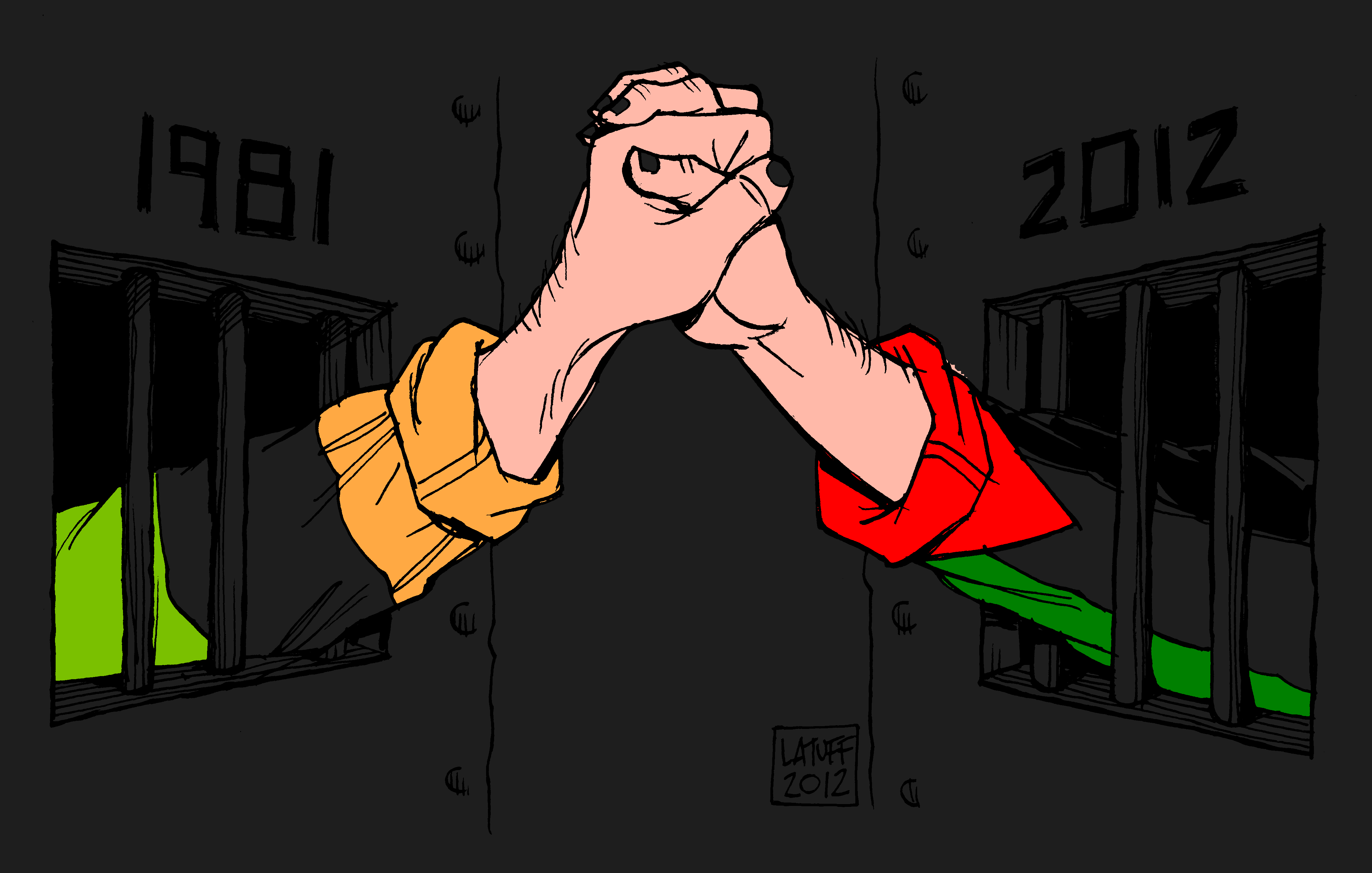
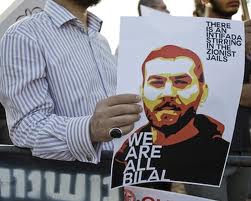
And most, perhaps, impressive of all, Palestinians have recently challenged the use of imprisonment and administrative detention through a series of remarkable hunger strikes, which have gone almost completely unreported by the American media. We hear endlessly about Chinese human rights activists or about those that challenge the situation in Tibet, and we should hear about them—I am not suggesting that we shouldn’t – but these hunger strikes, currently there’s one Palestinian who’s a soccer star that’s been on a hunger strike for over 82 days, which is 16 days longer than Bobby Sands’ famous IRA hunger strike unto death back in 1981, and yet there is a complete blackout in the media
In stark contrast, the IRA hunger strike was covered on a daily basis. This anti-Palestinian media bias involves a double movement that has had a distorting effect on American public opinion: a politics of invisibility so far as Palestinian initiatives are concerned and Palestinian grievances are concerned, and there’s a politics of magnification as soon as the Palestinians engage in anything wrong. This style of reportage creates an unreal appreciation of what the circumstances, the existing circumstances are. And this damage is, I think, magnified further by the internal drift of Israeli politics, which has gone further and further in the direction of an expansionist, non-interest in a compromise, no feeling of pressure that there is any need to compromise with the Palestinians so as to reach an agreed solution. David Shulman, in this same essay that I quoted from before, said that what has happened in Israel is a take-over by the settler mini-state of the central institutions of the Israeli state system as a whole.
And this development should be regarded as quite alarming, because the whole settler movement has been premised from its outset on a flagrant violation of international humanitarian law. Article 49, Paragraph 6 of the Fourth Geneva Convention prohibits transfer of population from an occupying country to the occupied country, an interpretation that is shared by virtually every government in the world.
So the whole settlement phenomenon is an affront to international law, and the fact that the Palestinian Authority has to be apologetic when they ask for a suspension or freeze of the settlement activity during direct negotiations suggests how distorted our expectations have become as to what is reasonable to expect. And for Netanyahu to be praised when a partial freeze was agreed to for a few months in the West Bank, which wasn’t observed in practice anyway, reinforces this sense that the United States Government is incapable of objective analysis and thought when it comes to addressing the conflict.
There is a further development that I think is important to realize and again has not received much commentary, and that is: American society, much more so than five years ago, I think would be ready to accept a balanced approach to the conflict. It’s the Beltway, that is official Washington, that is completely organized by AIPAC and by the right-wing evangelical movements, in such a way as to not only prevent a balanced approach, but to discourage a serious debate as to what might work equitably and effectively. It’s an extreme distortion that was I think dramatized for anyone who observed the wildly enthusiastic reception that Netanyahu received in the U.S. Congress a few months ago, a reception more favorable than would be accorded any leader of any other country in the world.
So what I’m really saying is that American society cannot find ways at the present time to translate its changed sentiments about the conflict, more desire for a more balanced approach, can’t translate this willingness into policy. There is this growing gap between what the government is doing and what the society would accept. And that is a challenge to all of us, I think, to exert pressure to close this gap.
Let me end with a couple of quotes and a reference to the challenge that we face in light of these circumstances. A famous, or celebrated, Jewish thinker and rabbi, Abraham Heschel, said “Few are guilty, but all are responsible.” And I think we as Americans have a particular responsibility. Our funds, taxpayer funds, are used to subsidize this unlawful and cruel occupation, this drift toward promiscuous Israeli and American militarism that is endangering the stability of the region. And there are opportunities to do things. We can certainly be more active in informing our representatives that the American people want a more balanced and truthful policy. We can do things to support the BDS movements in our communities, and I know there have been some initiatives here in Washington. We can certainly object to the sale of products that were made in the settlements and to corporations that profit from their dealings with occupied Palestine. We can also do our best to influence the media presentation of this conflict and oppose military assistance to Israel.
Israel has become a prosperous country with a high standard of living that should be taken into account in shaping U.S. policy. The continuation of lavish economic assistance despite the fiscal troubles here makes no sense, and considering that such funds are subsidizing Israeli militarism makes these contributions a real scandal, or should a policy that deserves to be treated as a real scandal.
Albert Einstein made many illuminating remarks on the human condition, and one of them fits with the tenor of my concluding sentiments: “Unthinking respect for authority is the greatest enemy of truth.” I think that we need to do our best to avoid such deference to authority to overcome the weight of conventional thinking on these issues, to get around the distortions of government policy, and to do something to correct for the biased media filter that gives us such a selective presentation of the facts as the conflict unfolds. And if you ask what is truth is this situation, I think it is getting to understand the experience and the facts as accurately as possible with as little interference from biased sources as can be achieved.
I think we are all challenged to do our part. I feel that the Palestinian people have displayed great courage and steadfastness, and they do need courage, and have expressed that courage in a variety of ways, that I find inspirational. We who are on the outside do not need courage but we do need commitment, thereby to strengthen a compassionate attachment to their struggle, the only path to a just peace for both peoples. Thank you very much.
Tags: Golan Heights, Israel, Liberty, Six-Day War, United States, US government, USS Liberty, YouTube


![[Palestinians hold photographs of their relatives jailed in Israel during a support rally for Palestinian prisoners on hunger strike, in the West Bank city of Ramallah, May 5, 2012. Image by Majdi Mohammed/AP Photo.]](https://i0.wp.com/www.jadaliyya.com/content_images/3/LadiesStriking.jpg "[Palestinians hold photographs of their relatives jailed in Israel during a support rally for Palestinian prisoners on hunger strike, in the West Bank city of Ramallah, May 5, 2012. Image by Majdi Mohammed/AP Photo.]") [
[ My U. S. government, in this situation, is misguided and wrong wrong wrong….






Akram Rikhawi and the Saga of Palestinian Hunger Strikes
9 JulThe persistence of Palestinian hunger strikes shocks me for two reasons: that these extreme expressions of moral freedom alert all who choose to expose their consciousness to such realities of the severely abusive arrest, detention, and interrogation procedures that many Palestinians living under Israeli occupation must endure; that the world’s media, foreign governments, the UN, the Arab League barely acknowledge such events, which if they occurred in other countries would generate outpourings of outrage and sympathy, and depending on the geopolitical calculus, hypocritical calls for the application of the ‘responsibility to protect’ norm.
I post below a joint press release by respected NGOs of Palestine and Israel that summarize the desperate medical condition of Akram Rikhawi, who has continued his hunger strike for more than 85 days, an extraordinary display of discipline and resolve, the exemplary Palestinian virtue of samud (steadfastness). Mr. Rikhawi, whose home is in Gaza, has been held in prison since 2004 after being convicted to a nine-year term by an Israeli military court. He has been denied mercy by the Israeli authorities despite a present political atmosphere in which the Palestinian resistance has not been posing violent challenges to Israeli security behind the green line, and his condition would in any event make political activism an impossibility.
As a result of the ‘Shalit Law,’ a vindictive violation of international humanitarian law that retaliates against Palestinian prisoners because of the capture of Gilad Shalit an Israeli soldier who was released a year ago, Rikhawi has been denied family visits since 2006 despite being the father of eight children plus the five young children of his recently deceased brother. Yasmine, daughter of his brother, summed up Akram Rikhawi’s tragic situation: “My uncle made a decision and we support him because we live life once; we either live it with dignity or we die fighting for it.” No human being should be forced to face such a dilemma, and those that do deserve our compassion and support. Jasmine describes Akram Rikhawi as the main source of financial and emotional support of the entire family, which was the center of his life. She describes him as an avid reader who was constantly challenging the family to engage in serious discussions, including issues arising from his intense opposition to the occupation.
He suffers from multiple life-threatening ailments, including serious asthma and diabetes, and has been targeted for abuse since initiating this hunger strike as the following report makes clear.
Putting all the pieces together, including the realization that many hunger strikes have been in process since Khader Adnan had recourse to a hunger strike on December 17, 2010 in protest against his arrest and confinement as a result of an administrative detention decree, we can reach some tentative conclusions:
–these brave acts of nonviolence have inspired Palestinians and some others, sustaining their dignity under the most difficult and inhumane of circumstances;
–Western countries and Western NGOs, claiming to be champions of humanitarian diplomacy, have spurned the moral and political challenges posed by these hunger strikes;
–despite such malign neglect, the hunger strikes have shined a bright light on the unlawfulness and cruelty of Israeli arrest and interrogation procedures and prison conditions that has increased awareness of this dimension of prolonged Israeli occupation of Palestine;
–with such an awareness comes responsibility, including acting on the request of Addammeer and Phsicians for Human Rights-Israel that letters demanding Akram Rikhawi’s release be sent to listed Israeli officials.
*****************************************************************
Concern mounts for the life of Akram Rikhawi on his 85th day of hunger strike
An independent doctor from PHR-IL visited Akram Rikhawi yesterday and an Addameer lawyer visited him today, along with Samer Al-Barq and Hassan Safadi. Samer and Hassan are still denied access to independent doctors.
Joint Press Release, Addameer Prisoner Support and Human Rights Association and Physicians for Human Rights-Israel
Ramallah-Jaffa, 5 July 2012—Physicians for Human Rights-Israel (PHR-IL) and Addameer Prisoner Support and Human Rights Association are gravely concerned for the life of Akram Rikhawi, who is now on his 85th day of hunger strike. An independent doctor from PHR-IL visited Akram in Ramleh prison medical center yesterday, 4 July, which was made possible only after an appeal to the Israeli District Court, where the judge eventually ordered the Israeli Prison Service (IPS) to allow the entry of the independent doctor no later than 3 July.
Following the visit to Akram, the PHR-IL doctor reported the alarming deterioration of Akram’s asthma, which continues to be unstable. The doctor believes Akram has been given very high doses of steroids as treatment, which can cause severe long-term and irreversible damage. The doctor reiterated recommendation for immediate examination by a lung specialist, which was not performed as recommended after the last visit by an independent doctor on 6 June.
Akram also reported that he is experiencing severe dizziness, can no longer walk and is having difficulty standing. Even more troubling, Akram has not been given any assistance in these matters, leaving him vulnerable to the danger of falling, which could result in fatal injury due to his osteoperosis. The doctor further noted that Akram is experiencing tingling and numbness in his left thigh, which could indicate peripheral nerve damage, and recommended immediate examination in a public hospital, for fear of permanent neurological damage.
The IPS has continued to punish Akram for his hunger strike by confiscating his books and reading materials, isolating him from other prisoners and cancelling his daily break. He is also being held in a cell with no fan or air conditioning, despite the high humidity and how badly it affects his asthma.
Akram pointed out to the independent doctor and to Addameer lawyer Mona Neddaf in her visit today that he was recently hospitalized at Assaf Harofeh Hospital, but was shackled at all times to the hospital bed and felt his needs were mostly ignored by the medical staff. He emphasized to Ms. Neddaf his desire to have unrestricted access to the independent doctors from PHR-IL.
Ms. Neddaf also visited Samer Al-Barq, who is on his 45th day of renewed hunger strike in protest against the extension of his administrative detention. Ms. Neddaf noted that he seems significantly weaker than during her last visit on 25 June. He is consuming only water with glucose.
Samer’s family has reported that he suffers from kidney problems and high blood pressure and has lost more than 25% of his original weight. On 21 June, PHR-IL submitted a request to allow access for independent physicians. On 25 June the IPS denied this request without providing any reasons.
Hassan Safadi is on his 15th day of renewed hunger strike, after previously spending 71 days on prolonged hunger strike. His last administrative detention order was due to expire on 29 June and, according to the agreement ending Palestinian prisoners’ mass hunger strike, he was supposed to be released on that date. However, his lawyer was informed on 21 June of the renewal of his administrative detention order for a further six months, in violation of the agreement.
According to Ms. Neddaf after her visit with him today, Hassan’s lawyer submitted a request to the military judge that he review the agreement and consider his immediate release. The judge responded that he would give a decision on this matter in two weeks. Hassan stressed that he will not break his hunger strike until he is released to his home in Nablus.
Hassan was transferred to Ramleh prison medical center last week and is currently being held in an isolated cell. He is drinking water with salt and taking vitamins due to a low potassium level in his blood. He has lost approximately 8 kilos in weight since the beginning of his renewed strike. PHR-IL submitted a request to allow access for an independent doctor on 26 June and have not yet received a response from the IPS.
In light of the deterioration of the conditions of the remaining Palestinian prisoners on hunger strike, PHR-IL and Addameer urge the international community to immediately intervene on their behalf and demand:
*Write to the Israeli government, military and legal authorities and demand that Akram Rikhawi be released immediately and receive adequate medical care.
*Write to your own elected representatives urging them to pressure Israel to release Akram Rikhawi.
Tags: Akram, Akram Rikhawi, Human rights, Hunger strike, Israel, Israel Prison Service, Palestinian people, Physicians for Human Rights-Israel