Tag Archives: West Bank

Beyond the Politics of Invisibility: Remembering Not to Forget Palestinian Hunger Strikers

28 May


            With a certain amount of fanfare in Israel and Palestine, although still severely underreported by the world media and relatively ignored by the leading watchdog human rights NGOs, it was observed with contradictory spins that the Palestinian hunger strikes had been brought to an end by agreement between the strikers and Israel. At least, that is what most of us believed who were following this narrative from outside the region, but like so much else in the region our understanding was a half-truth, if that. Whether Israel abides by its assurances remains to be seen, and although these strikes were courageous acts of nonviolent resistance it is not clear at this point whether they will have any longer term effects on the Israel’s occupation, arrest, and prison policy, or on the wider Palestinian struggle.


            Two things are certain, however. First, a much wider awareness that Israel’s reliance on administrative detention, its abusive arrest procedures, and its prison system deserves wider scrutiny than in the past, and that this dimension of the prolonged occupation of Palestine has been responsible for inflicting great suffering on many Palestinians and their families ever since 1967. Whether such a structure of imprisonment of an occupied people should be viewed as a hitherto neglected dimension of state terrorism is an open question that should be further investigated. Secondly, that the hunger strike as a mode of resistance is now part of the Palestinian culture of resistance, and an option that engages Palestinian political consciousness in manner that did not exist prior to Khader Adnan’s 66 day hunger strike initiated on December 17, 2011.


            There were parallel and overlapping strikes: A sequence of long-term strikes, first, Adnan, followed by Hana Shalabi, then Thaer Halahleh and Bilal Diab, and maybe others, focusing on humiliating and abusive arrest procedures, as well as administration detention as a practice; and then a second wave of strikes, commencing on April 17, 2012, Palestine Prisoners Day and ending 30 days later on the eve of the 2012 Nakba observance. This latter protest involved more than 1600 Palestinian prisoners, who were initially inspired by the Adnan and Shalabi strikes, and focused their challenge on deplorable prison conditions.  


            Supposedly Israeli prison authorities agreed under the pressure of these latter strikes to reduce reliance on solitary confinement in its prisons and to allow more family visits, especially from Gaza. Gaza prisoners had been denied such visits for years as an unlawful reprisal mandated by the Knesset in angry reaction to the capture of the Israeli soldier, Gilad Shalit. What was this pressure? It was not moral suasion. It seemed to be a calculated decision by Israeli prison authorities that it would be better to make small concessions than risk angry reactions to the death of any hunger strikers. The debate in the Israeli press was entirely pragmatic: whether it was worse to have bad publicity or to show weakness by giving in. Israel only seemed to give in. It needs to be understood that Israel retains all the prerogatives to rely on administrative detention in the future and continuing to have unmonitored exclusive control over prison life.


            In the background it should be appreciated that the whole structure of this Israeli prison system violates the Fourth Geneva Convention that explicitly forbids the transfer of prisoners from an occupied territory to the territory of the occupier.


            These uncertainties about the results of these past strikes should certainly be kept in mind. What is presently of more urgent concern is the failure even to realize that long-term hunger strikes were never ended by at least two prisoners, Mahmoud Sarsak, without food for 70 days, and Akram Rikhawi on strike for 40 days. Both are, as could hardly be otherwise, are currently in danger of dying, and yet hardly anybody seems to know. Sarsak who is 25 years of age and a resident of the Rafah Refugee Camp in Gaza is hardly a nobody. When arrested in July 2009 he was a member of the Palestine National Football Team on his way to a match in the West Bank. He was arrested under the ‘Unlawful Combatants Law,’ which offers a person detained even less protection than is provided by ‘administrative detention.’ It is aimed at Palestinians living in Gaza, a part of Palestine that is treated by Israel (but not the international community) as no longer occupied since Sharon’s ‘disengagement plan’ was implemented in 2005. Iman Sarsak has bemoaned his brother’s fate, “My family never would have imagined that Mahmoud would have been imprisoned by Israel. Why, really why?”


            There is reason to believe that rather than some conjured up security concern, Sarsak was arrested as part of a broader effort to demoralize the Palestinians, especially those long entrapped in Gaza. During the savage attacks on Gaza at the end of 2008 (‘Operation Cast Lead’) the national stadium used for football and the offices of the Palestine Football Association were targeted and destroyed, and three members of the Palestine team killed. All along, the team has been handicapped by curfews, checkpoints, and harassments, as well as the blockade of Gaza, that has forced the team to forfeit many games. The goalkeeper, Omar Abu Rwayyes has said, “if you degrade the national team you degrade the idea that there could ever be a nation.” Football, what we Americans call soccer, plays a vital symbolic role in the self-esteem and national consciousness of peoples throughout the Arab world, and elsewhere in the South, to a degree unimaginable for even a sports crazy country like the United States.


            There has been some slight notice taken of the plight of the Palestinian team in the football world. A few years ago Michel Piatini, President of FIFA, warned Israel that it was risking its own membership in the world association if it continued to interfere with the Palestinian efforts to field the best possible team for international competition. But as with many international gestures of protest against Israel, there was no follow through, nullifying the original impulse. In fact, a disturbing reversal of approach took place. Not long afterwards, Piatini actually presided over a process that awarded Israel the honor of hosting the 2013 Under-21 European Championships. A British NGO, ‘Soccer Without Borders’ was not so easily seduced, issuing a declaration urging a boycott of the event in Israel, declaring that its organization “stands in solidarity with Mahmoud Sarsak and all Palestinian political prisoners.”


            As is usually the case, the Israeli response in self-justifying and cynical. A shin bet official insisted that Israel “can’t play by the rules of bridge if everyone else is playing rugby.” This kind of assertion papers over the degree to which Israeli society in recent years has enjoyed peace, prosperity, and security while Palestinians have been enduring the rigors of a cruel occupation and the severe vulnerabilities of a rightless existence. Palestinians have also been experiencing the split reality of observing a set of protective laws applied Israeli settlers (all of whom are part of an unlawful enterprise) and an unregulated military structure applied arbitrarily to the indigenous residents of the West Bank, East Jerusalem, and Gaza.


            With national athletes being such objects of interest it shows how effective is this ‘politics of invisibility’ that keeps the world from knowing the harm being done to the Palestinian people and how they are resisting, often at great risk and self-sacrifice, as epitomized by these long hunger strikes. One can be certain that if such repressive measures were taken by China or Myanmar there would be a mighty cascade of interest, coupled with high minded denunciations from the global bully pulpits of political leaders and an array of moral authority figures. But when the Palestinians experience abuse or resist by reliance on brave forms of nonviolence there is a posture of almost total disregard, and if a few voices are raised, such as that of Archbishop Tutu it is either ignored because his witness is treated as partisan or according to Israel’s more zealous defenders, he is discredited by being alleged to be ‘anti-semite,’ a denunciation whose meaning has been conflated so as to apply to any critic of Israel. Even such a globally respected figure as Jimmy Carter could not escape the wrath of Israeli loyalists merely because the word ‘apartheid’ in the title of a book urging a just peace between the two peoples.


            The politics of invisibility is cruel and harmful. It is cruel because it does not acknowledge a pattern of injustice because the victims have been effectively stigmatized. It is harmful because it sends a strong signal that victimization will only be given some sort of visibility if it shocks the conscience by its violence against those who seem innocent. Such visibility has a largely negative and stereotyping impact, allowing the oppressor to escalate state violence without risking any kind of backlash or even notice, and validating the perception of the victim population as undeserving, and even as evil endorsers of an ethos of terrorism. Israeli hasbara has worked hard over many years to stereotype the Palestinians as ‘terrorists,’ and by doing so to withdraw any sympathy from their victimization, which is portrayed as somehow deserved. These hunger strikers, despite all indications to the contrary, are so described, attributing their supposed association with Islamic Jihad as synonymous with an embrace of terrorism.  A more objective look at the evidence suggests that Islamic Jihad has itself for several years abandoned tactics of violence against civilian targets, and is part of a broader shift in Palestinian tactics of resistance in the direction of nonviolence. Such shifts are either totally ignored by the politics of invisibility or there is a refusal to acknowledge the shift so as to keep the negative stereotype before the public. 


            It is one more challenge to global civil society to do what international law is currently incapable of doing: treat equals equally. If the world media renders visible the plight of Chinese human rights activists who are abused by the state, might not at least human rights NGOs note this emergency plight of Palestinian hunger strikers on the edge of death?  And if these NGOs are afraid to do so, should not those with eyes able to see such torment, start screaming at the top of our lungs?

What is New in the Israel/Palestine Conflict

25 May


           Undoubtedly transfixed by the extraordinary developments throughout the Arab world since Mohamed Boazizi’s self-immolation on December 17, 2010: from Tahrir Square to the NATO intervention in Libya to bloody confrontations in Syria, Yemen, Bahrain to the eerie quiet in Algeria to the relative and temporary calm in Morocco, there has been a widespread few have noticed that the Israeli/Palestine conflict has changed its character in fundamental respects during the last couple of years.


            For some the first of these transformative developments may have been realized for somewhat longer, but now almost everybody knows, except for those in high places, especially in Washington and Tel Aviv who seem to have a political need not to know. The stark fact is that both Israel and Palestine have no hope that international negotiations between governmental representatives of the two sides has any chance of reaching an agreement that will end the conflict. Israelis, especially those backing the Netanyahu government never desired or believed in the possibility of a diplomatic solution. The ‘peace process’ that started in Oslo back in 1993 has steadily deteriorated the Palestinian prospects while enhancing those of Israel; it has been worse than gridlock for the Palestinians and a smokescreen for Israelis to carry out their expansionist plans while pretending to be pursuing a political compromise based on withdrawing from land occupied in 1967. The sequel to Oslo has been a pathetic enterprise, taking the form of ‘the quartet’ (U.S., European Union, Russia, and the UN) setting forth a roadmap that was supposed to lead the Palestinians to a state of their own drawn along the borders of the green line, but in practice has been a charade that Israel has scoffed at while representatives of the Palestinian Authority seemed to believe that it was worth playing along, although working within the confines of the occupation to establish governmental institutions that could claim statehood by unilateral self-assertion. The PA did seize this option last September when President Mahmoud Abbas made his historic plea to the UN General Assembly, but was stymied by exertion of U.S. geopolitical muscle

 on Israel’s behalf. At this point even the PA seems to have abandoned its effort to challenge a supposed status quo that is more realistically comprehended as a toxic mixture of annexation and apartheid should no longer be called ‘occupation.’


            Apparently to please Washington, and to a lesser extent the EU, neither Tel Aviv nor the Palestinian Authority in Ramallah have openly repudiated diplomacy, and continue to give lip service to a readiness to talk yet again, although the PA has at least the dignity to insist that no further negotiations can occur until Israel agrees to halt settlement expansion in the West Bank. To demand that Israel discontinue unlawful activities that impact upon what is being discussed should be regarded as a no brainer, but it is treated by the world media as though the Palestinians were seeking a huge concession from the Israelis, and in a way it is, if we acknowledge that the Netanyahu government is essentially a regime under the control of the settlers.


            The second of these under observed developments in the conflict is a definite shift toward nonviolence by the Palestinians. In different sites of struggle the Palestinians have confirmed the declarations of their leaders that resistance no longer primarily refers to armed struggle and suicide bombings, but is based on a range of nonviolent undertakings that challenge the legitimacy of Israeli policies, above all its oppressive policies and structures of abuse and exploitation in the West Bank, East Jerusalem, and Gaza.


            There are several different manifestations of this turn to nonviolence and a global solidarity movement. The following instance are illustrative, and should have been treated as major news, but because Israel refuses to be challenged, even nonviolently, the world media have been silent, and offered very little overall analysis. Among the forms of nonviolent opposition are the following: repeated village demonstrations in the West Bank against the continued building of the separation wall located on occupied Palestinian territory and held to be unlawful in 2004 by a near unanimous International Court of Justice; strong support and some impressive results for a growing worldwide Boycott, Divestment, and Sanctions initiative modeled on the Anti-Apartheid global campaign that was so effective in inducing the collapse of the racist regime in South Africa; and the Freedom Flotillas in which humanitarian activists from many countries challenged the Israeli blockade of Gaza that has persisted for five years and led to the ugly confrontation in May 2010 when the Turkish ship Mavi Marmara was assaulted in international waters by Israeli naval commandos, killing 8 Turks and one Turkish-American.


            Most impressive of these nonviolent challenges by Palestinians civil society has been a dramatic series of hunger strikes in Israeli jails that has reignited the Palestinian moral and political imagination. These strikes were initiated in December 2011 by the bravery of a single individual, Khader Adnan, who was harshly arrested in his home in the middle of the night and placed in ‘administrative detention’ a procedure used to hold suspects without charges, evidence, and trial. Adnan defiantly continued his strike for 66 days, was on the verge of death, and only agreed to resume eating when Israel somewhat relented.


            These hunger strikes mobilized widespread support among Palestinians, and an enthusiasm that contrasts with the bitter disillusionment directed at the failed peace talks. The strikes against administrative detention stimulated a related mass hunger strike of more than 1600 prisoners in Israeli prisons protesting conditions of their confinement. This parallel undertaking began on Palestinian Prisoners Day, April 17, and lasted for a full month until settled when Israel agreed to meet several of the demands put forward by the strikers.


            Hunger strikes are not grasped by the Western mind in their full significance. Such voluntary actions are an extreme form of nonviolence. The striker sacrificially foregoes violence against the other, seeking to awaken the conscience of those accused, bearing witness to abusive behavior, and appealing for solidarity from the wider affected community. Such extended hunger strikes send a moral message to both the oppressed and the oppressor, although the latter is likely to turn away in cynical disregard as has been the case with respect to the Israeli response.


            It should still be shocking, despite not being entirely surprising that the Western media has taken almost no notice of these remarkable hunger strikes and how they illustrate this new face of Palestinian resistance. We have only to take note of the ceaseless coverage given to Chen Guangcheng, the blind Chinese activist now enjoying sanctuary in the United States. Must we believe that Palestinian behavior is only of interest to Western media when it can be presented as fanatical and takes the form of violence against civilians? Of course this Chinese dissident deserves our sympathy, but should his story be so captivating as to completely eclipse the more extreme challenges posed by Palestinian hunger strikers that seem ready to make the supreme sacrifice of their own life? Recalling that the death in 1981 of Bobby Sands, the IRA hunger striker, helped open a door that led to a kind of peace in Northern Ireland and that Mohamed Boazizi’s death sparked revolution in Tunisia, only time will tell whether these Palestinian hunger strikes, unquestionably heroic, will lead the Palestinian people closer to realizing their right of self-determination and the finality of a just peace.            


            The third major development is the shift in the regional balance in favor of the Palestinians. The public opinion among the Arab people is strongly supportive of the Palestinian struggle and deeply alienated by the kind of Egyptian collaboration with Israel typified by the Mubarak regime. Turkey, once a strategic ally of Israel, is now an antagonist, as well as being an avowed backer of Palestinian claims. In light of these changes, I would have supposed that Israeli realists would be devoting their utmost energies to finding ways to reach a sustainable peace agreement that is sensitive to Palestinians rights under international law. Israeli realists may have sought refuge underground to avoid humiliation or worse in an Israel so firmly under the thumb of Netanyahu extremists who refuse to read this ominous writing on the regional wall, a refusal applauded by a U.S. Congress that is ready to jeopardize American security at the alter of Israeli militarism. Such an unnatural geopolitical relationship is currently unchallengeable in the United States, which is itself sad and dangerous.


            My claim is that these three sets of development should lead us to reimagine the Israel/Palestine struggle, and to channel our hopes and resources accordingly. The Israeli government and its strategic think tanks are clear that they are more threatened by this turn town militant nonviolence than by armed resistance. Israel has the weaponry and the skill on the battlefield, but fortunately their formidable propaganda machine has been unable to stem the rising tide of public opinion hostile to Israel and supportive of the Palestinian struggle.  


The Nakba: 2012

17 May


            The recent parallel hunger strikes in Israeli prisons reignited the political imagination of Palestinians around the world, strengthening bonds of ‘solidarity’ and reinforcing the trend toward grassroots reliance on nonviolent resistance Israeli abuses.  The crisis produced by these strikes made this year’s observance of Nakba Day a moral imperative for all those concerned with attaining justice and peace for the long oppressed Palestinian people whether they be living under occupation or in exile. The Palestinian mood on this May 14th, inflamed by abuse and frustration, but also inspired by and justly proud of exemplary expressions of courage, discipline, and nonviolent resistance on the part of imprisoned Palestinians who are mounting the greatest challenge of organized resistance that Israel has faced since the Second Intifada.


            The agreements ending the strikes were reached as a result of Israeli concessions, pledges to reduce reliance on administrative detention, abandon solitary confinement, and allow family visits, including from Gaza. Whether these pledges will be honored remains to be seen. Past Israeli behavior whether with respect to Israeli settlement activity or with respect to softening the impact of the blockade on Gaza that has been maintained for five years suggest that only careful monitoring will determine whether Israel abides by its commitments. The experience of Hana Shalabi is not encouraging. In an agreement that ended her hunger strike after 43 days in exchange for her release from administrative detention, she was not allowed to return to her West Bank home but sent to Gaza and ordered to remain there for three years.

Whether she was told about this condition at the time of her release has not been satisfactorily clarified, but it does strongly suggest that it is important to

Remember that there are two devils: one hangs out in the details, the other in the degree to which behavior corresponds with the pledges.


            As of now, the outcome of these hunger strikes have been justly celebrated as a victory for Palestinian resistance, and a further demonstration that at this stage the political struggle against Israeli occupation depends on the will and creativity of the people, and not on the diplomatic skill of the leadership.  Inter-governmental diplomacy of the sort associated with ‘the Oslo peace process’ and ‘the Quartet’s road map’ have provided a smokescreen to divert attention from Israeli expansionist ambitions for the past twenty years without moving the two sides one inch closer to a sustainable and just peace.


            Perhaps, the other good news for the Palestinians is the further decline of Israel’s global reputation. According to a BBC poll only Iran and  Pakistan are viewed more unfavorably than Israel among the 22 countries ranked, suggesting the utter failure of the expensive Israeli propaganda campaign. Even if Europe the unfavorable ratings associated with Israel are strikingly high: 74% Spain, 65%, France, 69% Germany, 68% Britain. What calls for explanation is why these European governments and the European Union ignore such a mandate from their own citizens, and continue to pursue policies that are unconditionally pro-Israeli.


            There are other signals of a shift in the diplomatic balance of forces. According to another new poll 61% of Egyptians want to cancel the 1979 Treaty with Israel. This is reinforced by the resentment of Egyptians toward  the United States’ role in their country in the Middle East generally. 79% of the 1000 Egyptians interviewed expressed their unfavorable view of the United States.


            Where are the Israeli ‘realists’ hiding? Instead of loose talk about attacking Iran isn’t time to give weight to such recent developments? The writing is on the wall. Military superiority and political violence do not ensure security in the early 21st century. Legality and legitimacy matter more than ever. It is Turkey that exerts regional influence, not because it throws its weight around, but because it has, despite some serious flaws, pursued a path that has brought greater prosperity at home, acted independently and effectively in fashioning its foreign policy, and achieved a governing style reflective of its cultural identity. These achievements generate a Turkish Model that is attractive, overlooking unresolved acute problems with minorities and a clumsy kind of unwillingness to respect dissenting voices.     


            Reverting to the Palestinian epic hunger strikes that continue to deserve our attention and admiration. It all started when a lone prisoner, Khader Adnan initiated a hunger strike to protest his abusive arrest and administrative detention on December 17th, which happens to be the exact anniversary of the day that the Tunisian vendor, Mohammed Bouazizi, set himself on fire, his death leading directly to a wave of uprisings across the region that became known throughout the world as the Arab Spring. Adnan gave up his strike after 66 days when Israel relented somewhat on his terms of detention, and this was the same length of time that Bobby Sands maintained his hunger strike unto death so as to dramatize IRA prison grievances in North Ireland. It is not surprising that the survivors of the 1981 Irish protest should now be sending bonding messages of empathy and solidarity to their Palestinian brothers locked up in Israeli jails.


            What Adnan did prompted other Palestinians to take a similar stand. Hana Shalabi, like Adnan a few weeks later experienced a horrible arrest experience that included sexual harassment and was sent to prison without charges or trial four months after she had been ‘released’ in the Shalit prisoner exchange in October 2011. She too seemed ready to die rather than endure further humiliation, and was also eventually released, but punitively, being ‘deported’ to Gaza away from her West Bank village and family for a period of three years. Others hunger strikes followed, and now two types of hunger strike under way, each influenced by the other.


            The longer of the strike involves six protesting Palestinians who are in critical condition, with their lives at risk for at least the past week. Bilal Diab and Thaer Halahleh who have now refused food for an incredible 76 days, a sacrificial form of nonviolent resistance that can only be properly appreciated as a scream of anguish and despair on behalf of those who have been suffering so unjustly and mutely for far too long. It is a sign of Western indifference that even these screams seem to have fallen on deaf ears.


            The second closely related hunger strike that has lasted almost a month is an equally an extraordinary display of disciplined nonviolence, initiated on April 17th Palestinian Prisoners Day. By now there are reported to be as many as 2000 prisoners who are refusing all food until a set of grievances associated with deplorable prison conditions are satisfactorily. The two strikes are linked because the longer hunger strike inspired the mass strike, and the remaining several thousand non-striking Palestinian prisoners in Israel jails are already pledged to join the strike if there are any deaths among the strikers. This heightened prisoner consciousness has already been effective in mobilizing the wider community of Palestinians living under occupation, and beyond.


            This heroic activism gives an edge to the 2012 Nakba observance, and contrasts with the apparent futility of traditional diplomacy. The Quartet tasked with providing a roadmap to achieve a peaceful resolution of the Israel/Palestine conflict seems completely at a loss, and has long been irrelevant to the quest for a sustainable peace, let alone the realization of Palestinian rights. The much publicized efforts of a year ago to put forward a statehood bid at the United Nations seems stalled indefinitely due to the crafty backroom maneuvers of the United States. Even the widely supported and reasonable recommendations of the Goldstone Report to seek accountability for Israeli leaders who seemed guilty of war crimes associated with the three weeks of attacks on Gaza at the end of 2008 has been permanently consigned to limbo. And actually the situation is even worse for the Palestinians than this summary depiction suggest. While nothing happens on the diplomatic level other clocks are ticking at a fast pace.  Several developments adverse to Palestinian interests and aspirations are taking place at an accelerating pace: 40,000 additional settlers are living in the West Bank since the temporary freeze on settlement expansion ended in September 2010, bringing the overall West Bank settler population to about 365,000, and well over 500,000 if East Jerusalem settlers are added on.


            Is it any wonder then that Palestinians increasingly view the Nakba not as an event frozen in time back in 1947 when as many as 700,000 fled from their homeland, but as descriptive of an historical process that has been going on ever since Palestinians began being displaced by Israeli immigration and victimized by the ambitions and tactics of the Zionist Project? It is this understanding of the Nakba as a living reality with deep historical roots that gives the hunger strikes such value. Nothing may be happening when it comes to the peace process, but at least, with heightened irony, it is possible to say that a lot is happening in Israeli jails. And the resolve of these hunger strikers is so great as to convey to anyone that is attentive that the Palestinians will not be disappeared from history. And merely by saying this there is a renewed sense of engagement on the part of Palestinians the world over and of their growing number of friends and comrades, that this Palestinian courage and sacrifice and fearlessness will bring eventual success and, in contrast, it is the governmental search for deals and bargains built to reflect power relations not claims of rights that seems so irrelevant that its disappearance would hardly be noticed.


            By and large, the Western media, especially in the United States, has taken virtually no notice of these hunger strikes, as if there was no news angle until the possibility of martyrdom for the strikers began at last to stir fears in Israeli hearts and minds of a Palestinian backlash and a public relations setback on the international level. Then and only then has there been speculation that maybe Israel could and should make some concessions, promising to improve prison conditions and limit reliance on administrative detention to situations where a credible security threat existed. Beyond this frantic quest by Israel to find a last minute pragmatic escape from this volatile situation posed by both hunger strikers on the brink of death and a massive show of solidarity by the larger prison population, is this sense that the real message of the Nakba is to underscore the imperative of self-reliance and nonviolence and ongoing struggle. The Palestinian future will be shaped by the people of Palestine or nothing. And it is up to us in the world, whether Palestinian or not, to join in their struggle to achieve justice from below, sufficiently shaking the foundations of oppressive structures of occupation and the exclusions of exile to create tremors of doubt in the Israeli colonial mindset. And as doubts grow, new possibilities suddenly emerge.


            For this reason, the Nakba should become important for all persons of good will, whether Palestinian or not, whether in Israel or outside, as an occasion for displays of solidarity. This might mean a global sympathy hunger strike as is being urged for May 17th or an added commitment to the BDS Campaign (Boycott, Divestment, and Sanctions) or signing up to join the next voyage of the Freedom Flotilla. Certainly the Nakba is a time of remembrance for the historic tragedy of expulsion, but it is equally a time of reflection on what might be done to stop the bleeding and to acknowledge and celebrate those who are brave enough to say “this far, and no further.”   

Palestinian Hunger Strikers: Fighting Ingrained Duplicity

12 May

The article below was written jointly by Noura Erakat and myself, and was posted on the Jadaliyya website on May 11, 2012

[Palestinians hold photographs of their relatives jailed in Israel during a support rally for Palestinian prisoners on hunger strike, in the West Bank city of Ramallah, May 5, 2012. Image by Majdi Mohammed/AP Photo.][Palestinians hold photographs of their relatives jailed in Israel during a support rally for Palestinian prisoners on hunger strike, in the West Bank city of Ramallah, May 5, 2012. Image by Majdi Mohammed/AP Photo.]

On his seventy-third day of hunger strike, Thaer Halahleh was vomiting blood and bleeding from his lips and gums, while his body weighs in at 121 pounds—a fraction of its pre-hunger strike size. The thirty-three-year-old Palestinian follows the still-palpable footsteps of Adnan Khader and Hana Shalabi, whose hunger strikes resulted in release. He also stands alongside Bilal Diab, who is also entering his seventy-third day of visceral protest. Together, they inspired nearly 2,500 Palestinian political prisoners to go on hunger strike in protest of Israel’s policy of indefinite detention without charge or trial.

Administrative detention has constituted a core of Israel’s 1,500 occupation laws that apply to Palestinians only, and which are not subject to any type of civilian or public review. Derived from British Mandate laws, administrative detention permits Israeli Forces to arrest Palestinians for up to six months without charge or trial, and without any show of incriminating evidence. Such detention orders can be renewed indefinitely, each time for another six-month term.

Ayed Dudeen is one of the longest-serving administrative detainees in Israeli captivity. First arrested in October 2007, Israeli officials renewed his detention thirty times without charge or trial. After languishing in a prison cell for nearly four years without due process, prison authorities released him in August 2011, only to re-arrest him two weeks later. His wife Amal no longer tells their six children that their father is coming home, because, in her words, “I do not want to give them false hope anymore, I just hope that this nightmare will go away.”

Twenty percent of the Palestinian population of the Occupied Palestinian Territories have at one point been held under administrative detention by Israeli forces. Israel argues these policies are necessary to ensure the security of its Jewish citizens, including those unlawfully resident in settlements surrounding Jerusalem, Area C, and the Jordan Valley—in flagrant contravention of the Fourth Geneva Convention‘s Article 49(6), which explicitly prohibits the transfer of one’s civilian population to the territory it occupies.

The mass hunger strike threatens to demolish the formidable narratives of national security long propagated by Israeli authorities. In its most recent session, the United Nation’s Committee for the Elimination of Racial Discrimination concluded that Israel’s policy of administrative detention is not justifiable as a security imperative, but instead represents the existence of two laws for two peoples in a single land. The Committee went on to state that such policies amount to arbitrary detention and contravene Article 3 of the Convention on the Elimination of All Forms of Racial Discrimination, which prohibits “racial segregation and apartheid.” Nevertheless, this apartheid policy has so far escaped the global condemnation it deserves. In general, Palestinian grievances are consistently evaded with the help of media bias that accords faint coverage to signs of resistance, including even this extraordinary non-violent movement mounted by Palestinian victims of institutionalized state abuse.

Although there has not been a principled or total abandonment of armed struggle by Palestinians living under occupation, there has been a notable and dramatic shift in emphasis to the tactics of nonviolence. For yearsliberal commentators in the West have been urging the Palestinians to make such a shift, partly for pragmatic reasons. Even President Obama echoed this suggestion in his 2009 Cairo address when he said,

Palestinians must abandon violence….For centuries, black people in America suffered the lash of the whip as slaves and the humiliation of segregation. But it was not violence that won full and equal rights. It was a peaceful and determined insistence upon the ideals at the center of America’sfounding.

But when Palestinians act in this recommended manner, the West averts its gaze and Israel responds with cynical disregard, dismissing near-death Palestinian hunger strikers as publicity stunts or cheap tricks to free themselves from imprisonment. Today, Palestinians have epitomized the best of American values that reflect the global history of non-violent resistance, as they wage a mass hunger strike, engage in a global boycott, divestment, and sanctions (BDS) movement against Israeli Apartheid, and risk their bodies on a weekly basis in peaceful protests against the Annexation Wall. The latter continues to expand its devastating encroachment upon and around Palestinian lands in defiance of a near unanimous Advisory Opinion of the International Court of Justice as well as countless Security Council Resolutions.

Yet, this America chooses to label the hunger strikers’ prison guards, the architects of racist laws and policies, as well as the engineers of the Apartheid Wall, as the sole and exemplary democracy in the Middle East. Rather than condemn Israel’s colonial practices, which constitute the core of Arab grievances and explain the widespread resentment of the US role in the Middle East, a US Congressional House panel has just now approved nearly one billion US dollars in additional military assistance to augment Israel’s anti-missile defense program. If passed, Israel will receive a record amount of four billion dollars in military aid next year—more than any country in the world.

There is a stark contrast between the round-the-clock coverage given to Chen Guangchen, the blind Chinese human rights activist who escaped from house arrest to the safety of the US Embassy, and the scant notice given this unprecedented Palestinian challenge to the Israeli prison system that is subjecting the protesters to severe health risks, even death. What is more, such hunger strikes are part of a broader Palestinian reliance on a powerful symbolic appeal to the conscience of humanity in their quest for long-denied rights under international law. Said deprivations include a disavowal of a peace process that has gone nowhere for decades, while a pattern of settlement expansion has made any realization of the widely endorsed “two-state solution” increasingly implausible. The prolonged nature of the occupation also steadily transforms what was supposed to be a temporary occupation into a permanent arrangement best understood as a mixture of annexation and apartheid.

In the face of this opportunity to place pressure upon Israel to comply with international law and human rights norms, the international community of governments and inter-governmental institutions has been grotesquely silent as Palestinians place their very lives at sacrificial risk. For its part, the United Nations’ most senior officials said nothing until a group of forty young protesters blocked the entrance of UN offices in Ramallah on 8 May, demanding the issuance of a statement on behalf of the hunger striking prisoners. Together with the help of a global social media campaign to trend #UNclosed, UN Secretary-General Ban Ki-Moon and UNRWA’s director Filippo Grandi have finally issued statements expressing deep concern. Grandi has gone the farthest to urge that Israel either provide trials for the detainees or release them, though his statement has been conspicuously removed from the Agency’s website.

It is hard to deny the irony of tacit approval, at worst, or timid condemnation, at best, in the United Nations, the United States, or elsewhere. In its 2008 Boumedienne decision, the US Supreme Court declared that (arguably) the world’s most villainous and immoral persons are entitled to habeas corpus review in US courts in order to avoid the cruelty of indefinite detention. Yet, Israel’s policy of detaining indigenous Palestinians who inhabit the lands the State seeks to confiscate and settle for more than four decades has denied those Palestinians exactly such legal protection. What are Palestinians to do in the face of such frustrating circumstances? What message does the lack of international support for their strong displays of nonviolence, self-sacrifice, and personal bravery send to them and to their Arab and Muslim counterparts who are once more exposed to blatant US hypocrisy in the region?

Palestinian civil society is now mainly opting for explicit acts of collective nonviolent resistance to register their dissatisfactions with the failures of the United Nations—or inter-governmental diplomacy in general—to produce a sustainable peace that reflects Palestinian rights under international law. The main expression of this embrace of nonviolence is the adoption of tactics used so successfully by the anti-Apartheid campaign to change the political climate in racist South Africa, yielding a nonviolent path to multiracial constitutional democracy. At the present time the growing BDS movement is working to achieve similar results.

Let us recall that successful global nonviolent movements are not restricted to fasts and marches, but include the boycott, non-cooperation, and civil disobedience tactics deployed by Palestinians today. Though President Obama, encumbered as he may be by a domestic election cycle, may feel compelled to ignore Palestinian responses to his call, the rest of the world should not.  Certainly, US-based and global citizens should demand that the Western media begin to act responsibly when dealing with injustices inflicted on the Palestinian people, and not sheepishly report human rights abuses only when committed by the adversaries of their state. The media itself is a tactical target and a residual problem. In solidarity with the hunger strikers, civic allies should address the institutional edifice upholding administrative detention. It extends from a discriminatory core and therefore its requisite treatment includes ensuring the enjoyment of internationally guaranteed rights; rights enshrined by the BDS call to action and reified by the movement’s steady and deliberate progression.

GravatarMy U. S. government, in this situation, is misguided and wrong wrong wrong….

Gravatar

Historic Hunger Strikes: Lightning in the Skies of Palestine

8 May


There is ongoing militant expression of Palestinian resistance to the abuses of Israel’s 45 years of occupation and de facto annexation of the West Bank and East Jerusalem, and five year blockade of Gaza taking the form of a series of hunger strikes. Recourse to this desperate tactic of courageous self-sacrifice is an extreme form of nonviolence, and should whenever and wherever it occurs be given close attention. Palestinians have protested by hunger strikes in the past but failed to inspire the imagination of the wider Palestinian community or shake the confidence of Israeli officialdom. Despite the averted gaze of the West, especially here in North America, there are some signs that this time the hunger strikes have crossed a historic threshold of no return.


These strikes started by the individual exploit of a single person, Khader Adnan, at the end of 2011. Dragged from his home in the village of Arraba near Jenin by a night raid by dozens of Israeli soldiers, humiliated and roughed up in the presence of his two and four year old daughter, carried away shackled and blindfolded, roughly interrogated, and then made subject to an administrative decree for the eighth time in his young life, Adnan’s inner conscience must have screamed ‘Enough!’ and he embarked on an open-ended hunger strike. He continued it for 66 days, and agreed to take food again only after the Israeli authorities relented somewhat, including a pledge not to subject Adnan to a further period of administrative detention unless further incriminating evidence came to the surface. Upon release, Adnan to depersonalize his ordeal insisted on visiting the families of other Palestinians currently under administrative detention before returning to his own home.

He has spoken out with firm gentleness and invited persons of conscience everywhere to join in the struggle to induce Israel to abandon administrative detention, and the accompanying violations of Palestinian human rights. Khader Adnan’s open letter to the people of the world is reproduced below to convey the tone and substance of his struggle.


Following Adnan, and inspired by him, was Hana Shalabi, a young Palestinian woman subject to a similar abusive arrest, accompanied by humiliations associated with her dress and sexual identity. Shalabi was from the villange of Burqin also near Jenin, and had been released a few months earlier in October 2011 as part of the prisoner exchange that was negotiated to obtain the release of the sole Israeli captive, Gilad Shalit. She had seldom strayed from her family home prior to the re-arrest on February 16, 2012, and her life was described as follows by her devoted sister, Zahra: “The four months between October and February were trouble-free days, bursting with dreams and ambitions. Hana loved to socialize and meet with people. She was busy with getting her papers in order to register for university, with her eyes set on enrolling at the American University in Jenin. She wanted to get her driver’s license, and later buy a car. She went on a shopping spree, buying new carpets and curtains for her bedroom…and she dreamed of getting married and of finding the perfect man to spend the rest of her life with.” It is little wonder that when arrested in the middle of the night she reacted in the manner described by Zahra: “She was panicking, and kept repeating over and over again that she was not going with the soldiers because she didn’t do anything.”


As with Adnan, Shalabi was released after she was in critical condition, but in a vindictive manner, being sent to live in Gaza for three years, thereby separated from her family and village, which were her places of refuge, love, and nurturing. She also made it clear that her experience of resistance was not meant for herself alone, but was intended to contribute to the struggle against prison abuse and the practice e of administrative detention, but even more generally as engagement in the struggle for Palestinian rights, so long denied. The example set by Adnan and Shalabi inspired others subject to similar treatment at the hands of the Israelis arrest and prison service. Several Palestinians detained by administrative detention decrees commenced hunger strikes at the end of February, and as many as 1650 others, and possibly more,  initiated a massive hunger strike on Palestinian Prisoner’s Day, April 17th that is continuing, and has been named ‘the battle of empty stomachs.’ The main battlefield is the mind of the oppressor, whether to give in and seem weak or remain firm and invite escalating censure, as well as Palestinian militancy, should any of those now in grave condition die.     


The latest news suggests that Bilal Diab and Thaer Halahleh, continuing their hunger strike that started on February 28th of this year, are clinging to life by a thread. A few days ago they were both been finally transferred to civilian hospitals. Mr. Halahleh after the 70th day without food announced that he was  no longer willing even to drink any water or accept further medication.


As might be expected the voices of concern from the international community have been muted and belated. The International Committee of the Red Cross has finally expressed in public its concern for the lives of these strikers. The UN Envoy to the Middle East, Robert Serry, never someone outspoken, acknowledged a few days ago in a brief and perfunctory statement that he was ‘deeply troubled’ by the danger to these hunger strikers, as if such a sentiment was somehow sufficient to the outrages being inflicted.


More persuasively, several human rights NGOs, including Physicians for Human Rights–Israel have been reminding Israel of its obligation to allow family visits, which prison authorities have repeatedly denied, despite it being an accepted tenet of medical ethics that is affirmed in Israel’s Patient’s Rights Law.


On May 7, 2012 the Israel’s High Court of Justice denied urgent petitions for release from administrative detention filed on behalf of Mr. Diab and Mr. Halahleh. The Court in a classic example of the twisted way judges choose to serve the state rather than the cause of justice declared: “Hunger strikes cannot serve as an element in a decision on the very validity of administrative detention, since that would be confusing the issue.” Would it be so confusing to say that without some demonstration of evidence of criminality rejecting such a petition amounts to imposing a death sentence without even the pretensions of ‘a show trial’ that relies on coerced confessions? Israel’s highest judicial body leaves no doubt about their priorities by invoking anti-terrorism as a blanket justification, saying that Israel “should not have to apologize for securing its own safety.”


Other reports that the Israeli government has yet to feel pressure from European governments to act in a more humanitarian manner in response to these hunger strikes, but is worried that such pressure might come soon. After

remaining silent for a long time, Robert Serry, the UN Envoy to the Middle East, a few days ago timidly issued a public statement saying that he was ‘deeply troubled’ by the near death condition of the Mr. Diab and Mr. Halahleh.


On a wider canvas, the hunger strikes are clearly having some effect on Israeli prison policy, although it is not clearly discernible as yet. The Israeli Public Security Minister, Yitzhak Aharonovitch, convened a meeting in which he voiced the opinion that Israeli reliance on administrative detention was excessive, and should be reduced. There is also some discussion with officials of the Israeli Prison Service and a committee representing some of the April 17th prisoners on a series of demands relating to prison conditions.


The following demands have been articulated by the April 17th hunger strikers, under the banner of ‘The Prisoners Revolution’:


1. Ending the Israeli Administrative detention and solitary confinement, in which Palestinians were imprisoned for more than ten consecutive years, in solitary cells that lack basic human necessities of life.

2. Allowing family visits to those from the Gaza Strip due to political decisions and unjust laws, such as the so-called “law of Shalit.

3. Improving the livelihood of prisoners inside Israeli Jails and allowing basic needs such as a proper health treatment, education and TV channels and newspapers.

4. Putting an end to the humiliation policy carried by the Israeli Prison Service against Palestinian prisoners and their families, through humiliating naked inspection, group punishment, and night raids.   

 ***********


Khader Adnan’s Open Letter to the Free People of the World


In the name of Allah, Most Compassionate, Most Merciful,*


 * Praise be to Allah, and peace and blessings be upon the Messenger of

 Allah.*


 Dear free people of the world. Dear oppressed and disenfranchised around

 the globe. Dear friends of our people, who stood with me with a stern belief in     freedom and dignity for my people and our prisoners languishing

in the Occupation’s prisons.


 Dear free women and men, young and elderly, ordinary people as well as

 intellectual elites everywhere – I address you today with an outpouring of

 hope and pain for every Palestinian that suffers from the occupation of his

 land, for each of us that has been killed, wounded or imprisoned by the

 state of terror, that denies anything beautiful in our lives, even the

 smile of our children and families. I am addressing you in my first letter

 following my release – praying it will not be the last – after Allah

 granted me freedom, pride and dignity. I was an “administrative detainee”

 in the jail of occupation for four months, out of which I have spent 66

 days on hunger strike.


 I was driven to declare an open-ended hunger strike by the daily harassment

 and violation of my people’s rights by the Israeli Zionist occupation. The

 last straw for me were the ongoing arrests, the brutal nighttime raid on my

 house, my violent detention, during which I was taken to the “Mavo Dotan”

 settlement on our land occupied 1967, and the beatings and humiliation I

 was treated to during arrest interrogation. The way I was treated during

 the interrogation at the Jalameh detention center, using the worse and

 lowest verbal insults in the dictionary. After questioning, I was sentenced

 to imprisonment under administrative detention with no charges, which

 proves mine and others’ arrests serve only to maintain a quota of

 prisoners, to harass us, to restrict our freedom and to undermine our

 determination, pride and dignity.


 I write today to thank all those who stood tall in support of my people,

 with our prisoners, with Hana al-Shalabi and with myself. I call on you to

 stand for justice pride and dignity in the face of occupation. The assault

 on the freedom and dignity of the Palestinian people is an assault on free

 people of the world by a criminal occupation that threatens the security,

 freedom and dignity of all, no matter where.


 Please, continue in exposing this occupation, boycotting and isolating it

 internationally. Expose its true face, the one that was clearly exposed in

 the attack of an Israeli officer on our Danish cohort. Unlike that attack,

 the murder our people is a crime that goes by unspoken of and slips away

 from the lens of the camera. Our prisoners are dying in silence. Hundreds

 of defenders of freedom are on hunger strike inside the prisons, including

 the eight knights, Bilal Diab and Thaer Hlahalh, who are now on their 61st

 day of hunger strike, Hassan Safadi, Omar Abu Shalal, Mahmoud Sarsak,

 Mahmoud Sarsal, Mohammad Taj, Jaafar Azzedine (who was arrested solely           for standing in solidarity with myself) and Ahmad haj Ali. Their lives now are

 in great danger.


 We are all responsible and we will all lose if we anything happen to them.

 Let us take immediate action to pressure the Occupation into releasing them

 immediately, or their children could never forgive us.


 Let all those free and revolutionary join hands against the Occupation’s

 oppression, and take to the streets – in front of the Occupation’s prisons,

 in front of its embassies and all other institutions backing it around the

 world.


 With deep appreciation,


*Khader Adnan *


++++


Having followed these hunger strikes for several months, I am convinced that these individuals subject to administrative detention are ordinary persons living a normal life, although chafing under the daily rigors and indignities of prolonged occupation. Israeli commentary tends to divert humanitarian concerns by branding these individuals as ‘terrorists,’ taking note of their alleged affiliation with Islamic Jihad. Adnan who is obviously preoccupied with his loving family, a baker by profession, working in his village, does not seem a particularly political person beyond the unavoidable political response to a structure of domination that is violent, cruel, and abusive. The language of his Open Letter is one that exhibits moral intensity, and seeks support for the Palestinian struggle for a sustainable peace with justice. It has none of the violent imagery or murderous declarations found in Al Qaeda’s characteristic calls for holy warfare against the infidels.


I was impressed by Hana Shalabi’s sister’s response when asked about the alleged connection with Islamic Jihad. Zahra responded to the question with a smile saying, ‘She’s not really Islamic Jihad. She doesn’t belong to any faction. When Israel imprisons you, their security forces ask which political faction you belong to. Hana chose Islamic Jihad on a whim.’ Even if it was than a whim, for a religious person to identify with Islamic Jihad it does not at all imply a commitment to or support for terrorist tactics of resistance. Zahra asks rhetorically, ‘Does she have missiles or rockets? Where is the threat to Israel? ..Why can’t we visit her? She has done nothing.’ And finally, ‘I would never place my enemy in my sister’s position…I would not wish this on anyone.’


Israel has by vague allegations of links to terrorist activities tried its best to dehumanize these hunger strikers, or to dismiss such actions as the foolish or vain bravado of persons ready to renounce their lives by their own free will. But their acts and words if heeded with empathy, their show of spiritual stamina and sense of mission, convey an altogether different message, one that exhibits the finest qualities that human beings can ever hope to achieve. Those of us who watch such heroic dramas unfold should at least do our best to honor these hunger strikers, and not avert our eyes, and do our utmost to act in solidarity with their struggles in whatever way we can.


We cannot now know whether these hunger strikes will spark Palestinian resistance in new and creative ways. What we can already say with confidence is that these hunger strikers are writing a new chapter in the story line of resistance sumud, and their steadfastness is for me a Gandhian Moment in the Palestinian struggle.  

The Massive Palestinian Hunger Strike: Traveling below the Western Radar

2 May


            Can anyone doubt that if there were more than 1300 hunger strikers in any country in the world other than Palestine, the media in the West would be obsessed with the story?  It would be featured day after day, and reported on from all angles, including the severe medical risks associated with such a lengthy refusal to take food. At this time two Palestinians who were the first to start this current wave of resistance, Thaer Halaheh and Bilal Diab, entering their 64th day without food, are reported by the prisoner protection association, Addameer, and the NGO, Physician for Human Rights-Israel, to be in critical condition with their lives hanging in the balance.  Despite this dramatic state of affairs there is scant attention in Europe, and literally none in North America. It is the case that prison protests, even large-scale ones such as occurred in California a year ago often attract little national and international notice unless deaths occur, as happened in the famous Maze Prison IRA hunger strikes back in 1981, but to ignore this expression of Palestinian resistance in the overall context of the conflict with Israel is lamentable. After all, as an occupying power of Palestinian territories Israel has a particular responsibility to the international community.


            In contrast, consider the attention that the Western media has devoted to a lone blind Chinese human rights lawyer, Chen Guangcheng, who managed to escape from house arrest in Beijing a few days ago and find a safe haven at the U.S. Embassy. This is an important international incident, to be sure, but is it truly so much more significant than the Palestinian story as to explain the total neglect of the extraordinary exploits of these thousands of Palestinians who are sacrificing their bodies, quite possibly their lives, to nonviolently protest severe mistreatment in the Israeli prison system.? Except among their countrymen, and to some extent the region, these many thousand Palestinian prisoners have been languishing within an opaque black box ever ever since 1967, are denied protection, exist without rights, and cope as best they can without even the acknowledgement of their plight.


            There is another comparison to be made. Recall the outpouring of concern and sympathy throughout the West for Gilad Shalit, the Israeli soldier who was captured on the Gaza border and held captive by Palestinians for five years. A powerful global campaign for his release on humanitarian ground was organized, and received constant reinforcement in the media. World leaders pleaded for his release, and Israeli commanding officers even told IDF fighting forces during the massive attacks on Gaza at the end of 2008 that killed more than 1450 Palestinians that their real mission was to free Shalit or at least hold accountable the entire civilian population of Gaza. When Shalit finally released in a prisoner exchange a few months ago there was a brief celebration that abruptly ended when, much to the disappointment of the Israeli establishment, Shalit reported good treatment during captivity. Shalit’s father went further, saying if he was a Palestinian he would have tried to capture Israeli soldiers. Not surprisingly, Shalit, instead of being revered as an Israeli hero, has quietly disappeared from public view.           


            This current wave of hunger strikes started on April 17th, Palestinian Prisoners’ Day, and was directly inspired by the recently completed long and heroic hunger strikes of Khader Adnan (66 days) and Hana Shalabi (43 days) both of whom protested against the combination of administrative detention and abusive arrest and interrogation procedures. It should be understood that administrative detention is validated by secret evidence and allows Israel to imprison Palestinians for six months at a time without bringing any criminal charges, with terms renewable as they expire. Hana Shalabi was among those released in the prisoner exchange, but then barely recovering from her prior detention period, was rearrested in a night arrest raid, and sentenced once again to a term of confinement for four months. Or consider the experience of Thaer Halahla, eight times subject to administrative detention for a total of six and a half years.  


Both Mr. Adnan and Ms. Shalabi were released by deals negotiated at a time when their physical survival seemed in doubt, making death seem imminent. Israel apparently did not want to risk a third intifada resulting as a reaction to such martyrdom. At the same time Israel, as usual, did not want to seem to be retreating, or draw into question its reliance on administrative detention and imprisonment. Israel has refused, until the present, to examine the grievances that gave rise to these hunger strikes. In Hana Shalabi’s case her release was coupled with a punitive deportation order, which cruelly confines her to Gaza for the next three years, away from her family and the familiar surroundings of her home village of Burqin near Jenin in the West Bank. There are some indications that Ms. Shalabi was not fully informed about the deportation feature of her release, and was manipulated by prison authorities and the lawyer representing her interests. The current hunger strikers have been offered similar conditional releases, but have so far steadfastly refused to resume eating if it led to deportation or exile. At this time it is unclear how Israel will respond. There is a fierce struggle of wills between the strikers and the prison authorities, between those with hard power of domination and those with the soft power of moral and spiritual courage. The torment of these striking prisoners is not only a consequence of their refusal to accept food until certain conditions are met. Israeli prison guards and authorities are intensifying the torments of hunger. There are numerous reports that the strikers are being subjected to belittling harassment and a variety of punishments, including solitary confinement, confiscation of personal belongings, denial of family visits, denial of examination by humanitarian NGOs, and a hardhearted refusals to transfer to medically threatened strikers to civilian hospitals where they could receive the kinds of medical treatment their critical conditions require.


The Israeli response to the hunger strikes is shocking, but hardly surprising, within the wider setting of the occupation. Instead of heeding the moral appeal implicit in such extreme forms of resistance, there are widespread reliable reports of punitive responses by Israeli prison authorities. Hunger strikers have been placed in solitary confinement, held in shackles despite their weakened conditions, denied family visits, had personal belongings confiscated, were subjected to harassing comments by guards intended to demoralize. Israeli media has generally taken a cynical attitude toward the strikes, suggesting that these hunger strikers are publicity seeking, aiming to receive ‘a get out of jail free’ card, and deserve no empathy even if their life is in jeopardy because they voluntarily gave up food by their own free will, and hence Israeli prison authorities have no responsibility for their fate. Some news reports in Israel have speculated about whether if one or more hunger strikers dies in prison it will spark an uprising among the Palestinians, but this is less an expression of concern or a willingness to look at the substantive issues than it is a source of worry about future stability.


            Broader issues are also at stake. When in the past Palestinians resorted to violent forms of resistance they were branded by the West as terrorists, their deeds were covered to bring out sensationalist aspects, but when Palestinians resort to nonviolent forms of resistance, whether hunger strikes or BDS or an intifada, their actions fall mainly on deaf ears and blind eyes, or worse, there is a concerted propaganda spin to depict the particular tactic of nonviolent resistance as somehow illegitimate, either as a cheap trick to gain sympathy or as a dirty trick to destroy the state of Israel. All the while, Israel’s annexationist plans move ahead, with settlements expanding, and now recently, with settler outposts, formerly illegal even under Israeli law, in the process of being retroactively legalized. Such moves signal once and for all that the Netanyahu leadership exhibits not an iota of good faith when it continues to telling the world that it is dedicated to negotiating a peace treaty with the Palestinians. It is a pity that the Palestinian Authority has not yet had the diplomatic composure to call it quits when it comes to heeding diversionary calls from the Quartet for a resumption of yet another round of meaningless direct talks. It is long past time to crumble bridge to nowhere.


            That rock star of liberal pontificators, Thomas Friedman, has for years been preaching nonviolence to the Palestinians, implying that Israel as a democratic country with a strong moral sensitivity that would yield in the face of such a principled challenge. Yet when something as remarkable as this massive expression of a Palestinian commitment to nonviolent resistance in the form of this open-ended hunger strike, dubbed ‘the war of empty stomachs’, takes place, Friedman along with his liberal brothers is stony silent, and the news sections of the newspaper of the New York Times are unable to find even an inch of space to report on these dramatic protests against Israel’s use of administrative detention and abusive treatment during arrest, interrogation, and imprisonment. Shame on you, Mr. Friedman! 

(At last, the NY Times on May 3, 2012 reports on the hunger strikers in a front page story, perhaps yielding to the growing shame of its silence up to now!)


            Robert Malley, another influential liberal voice who had been a Middle East advisor to Bill Clinton when he was president, while more constrained than Friedman, suggests that any sustained display of Palestinian nonviolence if met with Israeli violence would be an embarrassment for Washington. Malley insists that if the Palestinians were to take to the streets in the spirit of Tahrir Square, and Israelis responded violently, as the Netanyahu government certainly, it “would put the United States in an ..acute dilemma about how to react to Israel’s reaction.” The dilemma depicted by Malley derives from Obama constant encouragement of the democratic aspirations of a people who he has repeatedly said deserve their own state on the one side and the unconditional alignment with Israel on the other. Only a confirmed liberal would call this a genuine dilemma, as any informed and objective observer would know, that the U.S. Government would readily accept, as it has repeatedly done in the past, an Israeli claim that force was needed to maintain public order. In this manner, Palestinian nonviolence would be disregarded, and the super-alliance of these two partners in crime once more reaffirmed.


            Let there be no mistake about the moral and spiritual background of the challenge being mounted by these Palestinians. Undertaking an open ended hunger strike is an inherently brave act that is fraught with risks and uncertainties, and is only undertaken as an expression of extreme frustration or acute deprivation. It is not an act undertaken lightly or as a stunt. For anyone who has attempted to express protest in this manner, and I have for short periods during my decade of opposition to the Vietnam War, it is both scary and physically taxing even for a day or so, but to maintain the discipline and strength of will to sustain such a strike for weeks at a time requires a rare combination of courage and resolve. Only specially dedicated individuals adopt and maintain such a tactic. For a hunger strike to be done on such a scale of collective action underscores the horrible ordeal of the Palestinians that has been all but erased from the political consciousness of the West in the hot aftermath of the Arab Spring, and may also point to a wider willingness of Palestinians to mount their own version of Tahrir Square.


            [

            The world has long refused to take notice of Palestinian one-sided efforts over the years to reach a peaceful outcome of their conflict with Israel. It is helpful to recall that in 1988 the PLO officially accepted Israel within its 1967 borders, a huge territorial concession, leaving the Palestinians with only 22% of historical Palestine on which to establish an independent and sovereign state. In recent years, the main tactics of Palestinian opposition to the occupation, including on the part of Hamas, has been largely to turn away from violence, adhering to a diplomacy and practice that looked toward long-term peaceful coexistence between two peoples. Israel has not taken note of either development, and has instead continuous thrown sand in Palestinian eyes. The official Israeli response to Palestinian moves toward political restraint and away from violence have been to embark upon a program of feverish  settlement expansion, extensive targeted killing, reliance on excessive retaliatory violence, as well as an intensifying oppressiveness that gave rise to these hunger strikes. One expression of this oppressiveness is the 50% increase in the number of Palestinians held under administrative detention during the last year, along with an officially mandated worsening of conditions throughout its prison system.

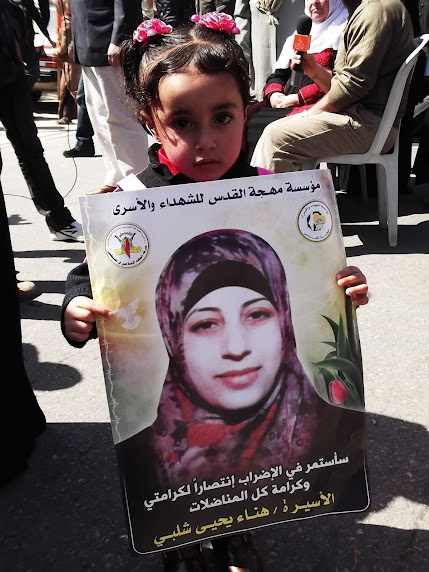
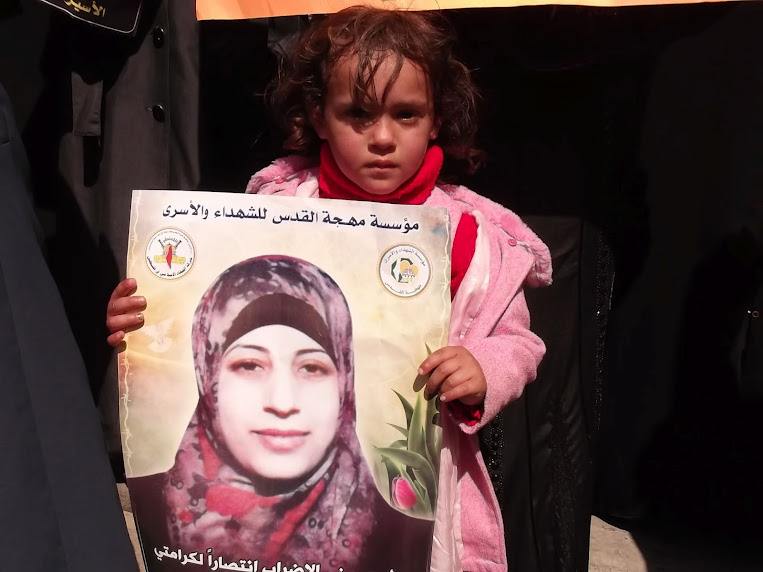
Hana Shalabi: A Brave Act of Palestinian Nonviolence

10 Mar

                                                                (photo by Joe Catron)

            No sooner had Khader Adnan ended his 66 day life threatening hunger strike than new urgent concerns are being voiced for Hana Shalabi, another West Bank hunger striker now without food for more than 24 days. Both strikes were directed by Palestinian activists against the abusive use of administrative detention by Israeli West Bank occupying military forces, protesting both the practice of internment without charges or trial and the degrading and physically harsh treatment administered during the arrest, interrogation, and detention process.


            The case of Hana Shalabi should move even the most hardhearted. She seems a young tender and normal woman who is a member of Islamic Jihad, and is dedicated to her family, hopes for marriage, and simple pleasures of shopping.

She had previously been held in administrative detention at the HaSharon prison in Israel for a 30 month period between 2009 and 2011, being released in the prisoner exchange of four months ago that freed 1027 Palestinians and the lone Israeli soldier captive, Gilad Shalit. Since her release she has been trying to recover from the deep sense of estrangement she experienced in prison, and rarely left her home or the company of her family. As she was returning to normalcy she was re-arrested in an abusive manner, which allegedly included a strip-search by a male soldier. On February 16, 2012, the day of this renewal of her administrative detention, Hana Shalabi indicated her resolve to start a hunger strike to protest her own treatment and to demand an end of administrative detention now relied upon by Israel to hold at least 309 Palestinian in prison. Her parents have been denied visitation rights, Hana Shalabi has been placed in solitary confinement, and her health has deteriorated to the point of concern for her life. Impressively, her parents have committed themselves to a hunger strike for as long as their daughter remains under administrative detention. Her mother, Badia Shalabi, has made a video in which she says that even to see food makes her cry considering the suffering of her daughter.


            Despite the calls to Palestinian from liberals in the West these extraordinary hunger strikes have met with silence or indifference in both Israel and the West. Israeli authorities declare that such a posture is a voluntary action for which they have no responsibility. The UN has not raised its voice, as well. I share the view of Khitam Saafin, Chairwoman of Union of Palestinian Woman’s Committee: “The UN must be responsible for the whole violation that are going on against our people. These prisoners are war prisoners, not security prisoners, not criminals. They are freedom fighters for their rights.” The plight of Hana Shalabi is also well expressed by Yael Maron, a spokesperson for the Israeli NGO, Physicians for Human Rights- Israel: “The story of Hana Shalabi, like that of Khader Adnan, before is in my opinion a remarkable example of a struggle that’s completely nonviolent towards one’s surroundings..It is the last protest a prisoner can make, and I find it brave and inspiring.”


            To engage in an open ended hunger strike, especially for a person who is not in a leadership role, requires a deep and abiding dedication to right a perceived wrong of the greatest gravity. It is physically painful and dangerous to bodily health, as well as being psychologically demanding in the extreme. It presupposes the strongest of wills, and usually arises, as in these instances, from a sense that any lesser form of resistance is futile, and has a long record of failure. In the end, it is an appeal to the conscience and humanity of the other, and a desperate call to all of us, to understand better the cartography of abuse that abusive imprisonment entails, which I would imagine is pervasively humiliating for a religiously oriented young Islamic woman. To risk life this way without harming or even threatening the oppressor is to turn terrorism against the innocent on its head. It is potentially to sacrifice one’s life to make an appeal of last resort, an appeal that transcends normal law and politics.


            We can only fervently hope and pray that Hana Shalabi’s heroic path of resistance will end with her release and the restoration of her health. For Israel’s own moral wellbeing it is time, really long past time, to renounce reliance on administrative detention and to do more than this, to end forthwith its varied crimes of occupation. At this point the only possible way to do this is to withdraw unconditionally behind the 1967 borders, and to start peace negotiations from that altered position. It is politically unimaginable that Israeli leaders will heed such a call, but it is morally unimaginable that Israel will survive its impending spiritual collapse if it does not do so.


(photo by Joe Catron)

            In the meantime, we who are beyond these zones of occupation, abuse, and imprisonment must not only stand and watch as this tragic drama plays itself out. Wherever we are, whatever we can do, we need to act, to appeal, to shout, and to denounce the inhumanity of allowing such cruelty to be enacted before our watching eyes. 

Saving Khader Adnan’s Life and Legacy

21 Feb


            It is a great relief to those millions around the world who were moved to prayer and action by Khader Adnan’s extraordinary hunger strike of 66 days that has ended due to Israel’s agreement to release him on April 17. We who were inspired by such a heroic refusal to accept humiliation and arbitrary arrest can only hope that for the sake of his family, for the cause of Palestinian resistance, and for the struggle to achieve a just peace that Mr. Adnan will fully recover to resume his personal and political life. We can not take for granted that there will be a full recovery given Mr. Adnan’s critical condition confirmed by examining doctors, just prior to his decision on February 21 to resume eating in a normal manner.


            While it is appropriate to celebrate this ending of the strike as ‘a victory’ there are several disturbing features that deserve comment. To call an arrangement that saved someone’s life a ‘deal,’ as the media consistently put it, is itself demeaning, and reveals at the very least a failure to appreciate the gravity and deep dedication of purpose that is bound up with such a nonviolent form of resistance. Similarly, the carelessness of the initial reactions was notable, often referring to Mr. Adnan’s ‘release’ when in fact he will be still held in administrate detention for several more weeks, and could conceivably be confined much longer, should Israeli military authorities unilaterally decide that ‘substantial evidence’ against him emerges in this period immediately ahead.


            It should also be noted that on matters of policy and principle Israel did not retreat even an inch: in relation to Mr. Adnan, he will be remain in captivity and will be subject to the ‘legal’ possibility that his period of imprisonment could still be extended indefinitely; beyond this, Israeli authorities express no willingness whatsoever to review the cases of the 309 other Palestinians who are presently being held under the administrative detention procedure.


            These Palestinians being held include one prisoner detained for more than 5 years, and 17 others for periods of 2-4 years. Israel did not even agree to a review of their misapplications of this administrative procedure within their own frameworks of claims about addressing imminent security threats. The general justification of administrative procedures by governments that rely upon it is to insist that its use is reserved for true and credible emergency situations. But as Mustafa Barghouti points out in the New York Times (February 22, 2012) such a claim strains credulity past the breaking point in the Israeli case. Barghouti writes tellingly that it is worth observing “that among..[those] Palestinians now held in ‘administrative detention’ are 21 of the 120 elected members of the Palestinian Legislative Council, most of whom have  been held for years for no apparent crime other than being democratically elected in 2006, in an election universally regarded as free and fair, as candidates of the party which won a clear majority of seats but which Israel does not like.” In other words, the Israeli claims of exceptional circumstances taking precedence over due process protections do not exist in many of the evident political uses of administrative detention as a means of weakening all forms of Palestinian resistance, including nonviolent opposition politics.


            It should also be noted that Israeli commentary treated the arrangement ending the standoff produced by the hunger strike with measured cynicism if not disdain. Even those Israeli who supported the agreement justified it as a practical way of avoiding trouble down the road should Khader Adnan have died while held by Israelis, given the breadth and depth of support his extended hunger strike was receiving among Palestinians and sympathizers from around the world. Keeping Mr. Adnan alive was also seen by Israelis as a means to avoid a wider scrutiny of the institution and practice of administrative detention as it has been used by the Israeli military ‘justice’ system.


            Also the timing of the announcement of the arrangement is significant. It was made an hour before an emergency session of the Israeli Supreme Court that was scheduled to hear Mr. Adnan’s petition for release, and there is speculation that although this highest judicial body in Israel has in the past consistently supported the military position in such instances, the situation was so extreme that it might prove embarrassing for Israeli military authorities. There were even some worries on the Israeli side that the extremities of this case could produce an adverse result and even a repudiation of the manner in which Israeli authorities used administrative detention as a procedure allegedly for security, but seemingly for the harassment and intimidation of militant opponents of an oppressive occupation that has continued for 45 years and is aggravated by continuously appropriating Palestinian land and water for the benefit of settlement expansion while disrupting and cleansing long-term Palestinian residency.


            What was entirely absent from the Israeli public discourse was some expression of compassion, even if only for the family of Mr. Adnan, which consists of two daughters of four years or less and his articulate pregnant wife, Randa. There was not even the slightest show of respect for the dignity of Mr. Adnan’s long hunger strike or sympathy for the acute suffering that accompanies such a determined foregoing of food and speech for an extended period. Instead, the Israeli commentary that was supportive of the arrangement stressed only pragmatic considerations from the perspective of Israel’s interests. It was one more lost opportunity for Israelis of all shades of opinion to reach across the abyss of political conflict to affirm a common humanity.


            But in a contrary spirit, the spokesperson for the Netanyahu government, Mark Regev, seemed only interested in deflecting criticism directed at Israel. He parried criticism by cynically observing that other governments rely on administrative dentention in the name of security, including the United States, so why shouldn’t Israel. He also added that the legality of Israel’s use of administrative detention should not be questioned since it depended not on an Israeli law, but on a 1946 law enacted when Britain was controlling Palestine, unintentionally conceding that Israel was the ‘colonial’ successor to the British! If the legal veil is lifted from administrative detention its character is one of ‘internment,’ a standard practice of colonial powers in dealing with unruly natives.


            Of course, Israeli ultra hardliners went further in this direction, referring to Mr. Adnan as ‘a terrorist’ despite the vagueness of official allegations that didn’t ever make such a claim, but only mysteriously contended that he constituted what an official in Tel Aviv described as ‘a threat to regional security,’ whatever that might mean. As might be expected, the notorious Israeli Foreign Minister, Avigdor Lieberman, was characteristically forthright, calling his ‘release’ ‘a wrong decision’ yet accepting the outcome because it is ‘our duty to honor and respect every Supreme Court decision even when we don’t agree with it.” As we know, Mr. Adnan was not released nor did the Israeli Supreme Court make a decision.  This comedy of errors by a leading government official should raise questions about Lieberman’s competence, not to mention his questionable political judgment as to policy. Lieberman’s mean spiritedness extended to attacks on Arab members of the Knesset who visited Mr. Adnan as somehow an indication that  by so doing they were ‘representing terrorists.’ Similarly, MK Danny Danon ignored the context and scorned the agreement ending the hunger strike by calling it reprehensible, an instance of a ‘[capitulation] to terrorism.’


            The issues directly raised by this hunger strike are ones of human rights and humane treatment, as well as reliance on administrative detention, and are quite independent of whether or not we endorse Mr. Adnan’s past and present tactics of resistance, which are not at all clear. Some apologists for Israel have tried to deflect these ethical and legal concerns by emphasizing Mr. Adnan’s association with Islamic Jihad and its record of violent attacks and extremist politics. Israelis casually refer to Mr. Adnan as a ‘terrorist’ without charges or proof. He has, in fact, been most often described in recent years more neutrally by those knowledgeable about his role and activities as a spokesperson for Islamic Jihad, but not engaged beyond this. There is no indication in his past or present that he was directly involved in violence, although an undated and unverified YouTube video has surfaced somewhat suspiciously in which Mr. Adnan is depicted as advocating violent resistance and an active recruiter of suicide bombers. Although Islamic Jihad has been responsible in the past for suicide bombings it has seemingly abandoned the practice, which is in line with the repudiation of such forms of violent resistance by Hamas more than ten years ago. Mr. Adnan’s prior arrests  stemmed from militant peaceful demonstrations that landed him in Israeli jails seven times, a Palestinian Authority prison once, and induced him to undertake shorter hunger strikes on three previous occasions, one as recently as 2010.  From what is known, Mr. Adnan is definitely a committed activist who has associated himself with Islamic Jihad, but works on a daily basis as a village baker and maintains a strong family role and popular community presence in his small West Bank town of Arraba.


            It is important to pause long enough to take account of Khader Adnan’s achievement, symbolically, substantively, and with respect to future possibilities. We should note that Mr. Adnan’s hunger strike of 66 days is the exact length of Bobby Sands’ hunger strike in 1981 strengthening the bond between the two men, a bond that has been movingly confirmed by a number of Irish family members of their strikers. What is more, the date of Bobby Sands’ death, May 5, 1981, is generally viewed as the turning point in the Irish struggle, the time when the British Government finally started treating the IRA as a political actor with genuine grievances rather than as a terrorist organization that must be run into the ground and exterminated. We can only hope that Febuary 21, 2012 will live in history as a turning point in the Palestinian struggle. Only the future will reveal whether this is a pious wish on my part or becomes over time a historical reality.


            Substantively, it is crucial to support a campaign to free the other several hundred Palestinians currently being held in administrative detention and to exert enough pressure to end reliance on the practice altogether. Mr. Adnan’s brave stand will have been mostly without effect if his compelling exposure of the cruelty and arbitrariness of Israeli reliance on administrative detention is allowed to slip from view now that his strike is over. Instead, knowing what we have come to know, it is the responsibility of all of us to do all we can to discredit and force the abandonment of administrative detention by Israel, and as well, challenge its role in the United States and elsewhere. A fitting tribute to Mr. Adnan’s hunger strike would be to put opposition to administrative detention on the top of the human rights agenda throughout the world. We should begin by refusing to use the phrase ‘administrative detention,’ rechristening it as ‘administrative torture’ or ‘lawless captivity,’ and associate with past colonial and present authoritarian tendencies of ‘democratic’ governments.


            And finally, we will know the enduring significance of Mr. Adnan’s self-sacrifice by what takes place in the future. Will this event, possibly along with other influences, inspire a greater commitment to the Palestinian struggle for peace, justice, and liberation in occupied Palestine and throughout the world? Maybe ‘the regional threat’ that was being referred to by the Israeli official justifying Mr. Adnan’s detention was an indirect, and hopefully accurate reference to the growing impact of the positive sides of the Arab Spring, that is, as an occasion prompting a further awakening of self-empowerment among Palestinians both in relation to their struggle and in their renewed quest for unity among themselves. In effect, let us hope that Khader Adnan’s bravery becomes contagious and will be remembered as a charismatic event in the long narrative of the Palestinian struggle for self-determination.


Saving Khader Adnan’s Life Saves Our Own Soul

18 Feb


             The world watches as tragedy unfolds beneath its gaze as Khader Asnan enters his 63rd day as a hunger striker in an Israeli prison being held under an administrative detention order without trial, without charges, and without any indication of the evidence against him. From the outset of his brutal arrest by scores of soldiers, featuring blindfolding, cuffing, and physical roughness in the middle of the night, a gratuitous ritual enacted the presence of his wife and young daughters Khader Adnan has been subject to the sort of inhumane and degrading treatment that is totally unlawful and inexcusable, and an assault on our moral justification. At present, approximately 300 other Palestinians are being held in administrative detention, and Mr. Adnan has indicated that his protest is also on their behalf, and indeed against the practice of administrative detention itself.


            The only plausible explanation of such Israeli behavior is to intimidate by terrifying all Palestinians who have lived for almost 45 years under the yoke of an oppressive occupation that continuously whittles away at Palestinian rights under international humanitarian law, especially their right to self-determination, which is encroached upon every time a new housing unit is added to the colonizing settlements that dot the hilltops surrounding Jerusalem and throughout the West Bank. While Palestinian prospects of a viable political future are continuously diminished by Israeli expansionism the world politely watches in stunned silence. Only resistance from within and solidarity worldwide can provide the Palestinians with hope about their future. They have been failed over and over again by the UN, by the EU, by their Arab neighbors, and above all by that global leader beholden to Israel whose capital is in Washinton, D.C.! It is only against this broader background that the importance of Khader Adnan’s resistance to the continuing struggle of Palestinians everywhere can begin to be appreciated as a political act as well as an insistence on the sacred dignity of the human person.


            The case of Khader Adnan is a revealing microcosm of the unbearable cruelty of prolonged occupation, and the contrast that is drawn in the West between the dignity of a single Israeli prisoner held in captivity and the steadfast refusal to be attentive to the abuse of thousands of Palestinians languishing in Israeli jails through court sentence or administrative order.  Mr. Adnan’s father poignantly highlighted this contrast a few days ago by reference to Gilad Shalit, the Israeli soldier held by Hamas in captivity for several years and recently released in good health: “Where are the mother and father of Gilad Shalit? Do they not feel for me in this humanitarian case? Where are they?” The comparison pointedly suggests that it is Mr. Adnan who is the more deserving of such a global outpouring of concern: “My son was arrested from his house, from among his wife and children, was taken prisoner. He was not carrying any weapon. Whereas Shalit was fighting against the people of Gaza, and destroying their homes, and firing upon, and Shalit was released.” In fact, Shalit has not been personally associated with violence against the Palestinians and their property, but he was operating as a member of the IDF that has been consistently engaged in such activity, frequently in stark violation of international humanitarian law. While Shalit was being held foreign authority figures, from the UN Secretary General on down, displayed their empathy not only for Shalit but for the intense anxiety experienced by Israelis concerned for the wellbeing of Shalit, but these same personalities are notably silent in the much more compelling ordeal taking place before our eyes in the form of Mr. Adnan’s captivity seemingly unto death. It should not be surprising that surviving family members of IRA hunger strikers should step forward to express solidarity with Mr. Adnan and the compare the Irish transforming acts of resistance in 1981 (ten hunger strikers died, and Britain shifted from counterterrorism to a politics of reconciliation) to that of the Palesinians, increasingly referring to Khader Adnan as the West Bank Bobby Sands.


            And who is Khader Adnan? We do not know very much about him except that he is a member of the Islamic Jihad Party, a 33-year old father of two young daughters, a baker by profession, and viewed with respect and affection by his neighbors. There are no accusations against him that implicate him in violence against civilians, although he has a history of imprisonment associated with his past activism. A fellow prisoner from an earlier period of confinement in Ashkelon Prison, Abu Maria, recalls Mr. Adnan’s normalcy, humanity, and academic demeanor while sharing a cell, emphasizing his passionate dedication to informing other imprisoned Palestinians about the history and nature of the conflict: “Prison was like a university in those times and he was one of the professors.” Commenting on his hunger strike that has brought him extreme pain, Abu Maria says he is convinced that Khader Asnan wants to live, but will not at the price of enduring humiliation for himself and others held in administrative detention: “He is showing his commitment and resistance in the only way he can right now, with his body.”


            Addameer, the respected Palestinian NGO concerned with prisoner issues, “holds Israel accountable for the life of Khader Adnan, whose health has entered an alarmingly critical stage that will now have irreversible consequences and could lead to his fatal collapse at any moment.” Physicians who have observed his current condition conclude that, at most, Mr. Adnan could live a few more days, saying that such a hunger strike cannot be sustained beyond 70 days in any event. Any attempt at this stage to keep Mr. Adnan alive by forced feeding would be widely viewed as a violation of his right to life and is generally regarded as a type of torture.


            Finally, the reliance by Israel on administrative detention in cases of this sort is totally unacceptable from the perspective of international law, including the Geneva Conventions, especially so with no disclosure of the exceptional circumstances or evidence that might warrant for reasons of imminent security the use of such an extra-legal form of imprisonment for a few days. Given the number of Palestinians being held in a manner similar to that of Mr. Adnan, it is no wonder that sympathy hunger strikes among many Palestinians in and out of Israeli jails are underway as expressions of solidarity. Have we not reached a stage in our appreciation of human rights that we should outlaw such barbarism by state authorities, which is cunningly shielded from critical scrutiny by the anonymity and bureaucratic neutrality of the term ‘administrative detention’? Let us hope and make sure that the awful experience of Khader Adnan does not end with his death, and let us hope and do everything in our power to encourage a worldwide protest against both administrative detention and prisoner abuse and by the government of Israel, and in due course elsewhere. The Palestinian people have suffered more than enough already, and passivity in the face of such state crimes is an appalling form of complicity. We should expect more from our governments, the UN, human rights NGOs, and ourselves!


On (Im)Balance and Credibility in America: Israel/Palestine

18 Nov


            I could not begin to count the number of times friends, and adversaries, have give me the following general line of advice: your views on Israel/Palestine would gain a much wider hearing if they showed more sympathy for Israel’s position and concerns, that is, if they were more ‘balanced.’ Especially on this set of issues, I have always found such advice wildly off the mark for two main reasons. 

            First, if the concern is balance, I am not the place to begin, but the absurd pro-Israeli balance that pervades the response to the conflict in Washington, in the Congress, at the White House and State Department, among Beltway think tanks, as well as in the mainstream media. There is a serious problem of balance, or I would say distortion, that undermines diplomatic credibility. Such a toxic imbalance here in the United States makes the American claim to mediate the conflict and provide neutral auspices futile, if not ridiculous, or at best a reliance on geopolitical ‘justice’ in place of legal justice (based on rights). When the Goldstone Report is rejected before it has been read or the World Court’s near unanimous Advisory Opinion (14-1) condemning as unlawful the separation wall constructed in occupied Palestinian territory is repudiated without offering a serious critical argument, it is clear that bias controls reason, making the resulting imbalance a willing partner in crime. 

            But what of the imbalance that sides with the evidence, with the law, with the ‘facts on the ground’ to arrive at its findings and conclusions? What of the continuous expansion of settlements in the West Bank and East Jerusalem, the denial of Palestinian refugee rights of return, of the apartheid legal structure of occupation, of discrimination against the Palestinian minority living as Israeli citizens, of the appropriation of scarce Palestinian water reserves, of the abuse of prisoners and children, of the long siege imposed on the people of Gaza as a sustained collective punishment? What of the continuous defiance of international law by Israeli reliance on excessive and disproportionate uses of force in the name of security? In light of this record, is not such imbalance, particularly in the inflamed American atmosphere, the only possible way for truth to speak to power?  Or stated more strongly, is not a circumstance of imbalance written into the fabric of the conflict, and exhibited in the daily suffering and thralldom of the Palestinian people whether living under occupation, in refugee camps in neighboring countries, in exile, and as a subjugated minority?


           Finally, the idea of balance and symmetry should also ‘see’ the structures of life that describe the contrasting conditions of the two peoples: Israelis living in conditions of near normalcy, Palestinians enduring for an incredible period that stretches over six decades a variety of daily hardships and abuses that is cumulatively experiences as acute human insecurity. To be structurally blindfolded and blind is to adopt a common, yet deforming, appearance of ‘balance’ that perpetuates an unjust ‘imbalance’ between oppressor and oppressed.

             In relation to self-determination for Palestinians and Israelis I favor a stance of ‘constructive imbalance,’ which I believe is the only truthful manner of depicting this reality. Truth and accuracy is my litmus test of objectivity, and as such, knowingly defies that sinister god who encourages the substitution of balance for truth!