Archive | Netanyahu RSS feed for this section

Interview on Israel, Palestine, and Peace

14 Sep

[Prefatory Note: The interview below, conducted by C.J. Polychroniou and Lily Sage (bios at the end of the interview) was published in TruthOut on Sept. 10, 2016. It is republished here with a few stylistic modifications, but substantively unchanged. It is relevant, I suppose,to report that subsequent to the interview the U.S. Government and Israel have signed a military assistance agreement promising Israel $38 billion over the next ten years, the largest such commitment ever made. Such an excessive underwriting of Israel’s policies and practices should be shocking to taxpaying Americans but it passes almost noticed below the radar. It is being explained as a step taken to ensure that Obama’s legacy is not diminished by claims that he acted detrimentally toward Israel, but it is, pathetically, one of the few instances of genuine bipartisanship in recent U.S. foreign policy. Again, we should grieve over the extent to which ‘reality’ and morality is sacrificed for the sake of the ‘special relationship’ while looking the other way whenever the Palestinian ordeal is mentioned.

The initial question pertaining to Turkey is explained by my presence in that turbulent country when the interview was conducted.]


“A Continuous War Mentality”: Richard Falk on Israel’s Human Rights Abuses

Polychroniou & Sage: Israel’s treatment of Palestinians mirrors the abominable system of apartheid in South Africa, but many members of the “international community” who fueled the gradual delegitimization and eventual collapse of South Africa’s apartheid regime are failing to apply similar pressure against Israel. In fact, many nations are even strengthening their ties with the Israeli government.


Even Greece has established close ties to Israel under the opportunistic Syriza government, while Sultan Erdogan in Turkey has also begun a process of kissing up to Israel after a few years of pursuing an “antagonistic” relation with the US’s closest ally under the pretext of expressing solidarity towards the Palestinian cause. Meanwhile, the increased militarization of Israeli society continues to intensify the oppression and subjugation of Palestinians.


The Israeli government has recently suggested that a “normalization” process is underway with the Palestinians, but in reality Israel’s construction of illegal settlements continues unabated, and the right-wing politicians inside Israel who portray Palestinians as an “inferior race” are gaining ground. This is exactly what “normalization” has always meant in Israeli political jargon: continuing to commit abominable human rights violations against Palestinians while the world looks away. Indeed, apartheid, annexation, mass displacement and collective punishment have become core policies of the state of Israel.


After years of intense antagonism, the Erdoğan regime has begun making overtures once again to Israel. Why now?

 The normalization agreement with Israel needs to be appreciated as part of a broader foreign policy reset that started well before the failed coup attempt of July 15th. The basic Turkish motivation appears to be an effort to ease bilateral tensions throughout the region, and as Turkish Prime Minister Binali Yildirim has expressed it, “make as many friends as possible, and as few enemies.” It is the second coming of what had earlier gained political traction for Turkey throughout the region in the first 10 years of AKP (Justice and Development Party) leadership with the slogan “zero problems with neighbors.”


The main reset by far is with Russia, which had become an adversary of Turkey in the context of the Syrian War, but Israel is a close second. [Israel’s relationship with Turkey] had been in freefall after Erdoğan harshly criticized Israel at the World Economic Forum in 2009, directly insulting the then-Israeli President Shimon Peres, who was present.


Then in 2010 came the Mavi Marmara incident, when Israeli commandos boarded a Turkish ship carrying humanitarian aid to Gaza, and directly challenging the Israeli blockade together with a group of smaller boats filled with peace activists in an initiative known as the Freedom Flotilla. The Israeli attack on the Mavi Marmara resulted in nine Turkish deaths among the peace activists on the ship and pushed the Israeli-Turkish relationship close to the brink of war. For the past year or so both sides have shown an interest in de-escalating tensions and restoring diplomatic normalcy. And Turkey, now more than ever, would like to avoid having adversary relations with Israel, which is being given precedence over Turkey’s support of the Palestinian national struggle.


Israeli Prime Minister [Benjamin] Netanyahu said recently that he cares more about the Palestinians than their own leaders. Do you wish to offer a comment on this statement?


Netanyahu has a gift for exaggerated, bombastic, and misleading, often outrageous political language. This is a clear instance. There are plenty of reasons to question the adequacy of the Palestinian Authority as the representative of the Palestinian people in advancing their national struggle. But to leap from such an unremarkable acknowledgement to the absurd claim that Netanyahu cares more about the Palestinian future than do Palestinians themselves represents a grotesque and arrogant leap into the political unknown. It is Netanyahu who led the country to launch massive attacks against Gaza first in 2012, and then again in 2014. It is Netanyahu who has pushed settler expansion and the Judaizing of East Jerusalem. For Netanyahu to speak in such a vein is to show his monumental insensitivity to the daily ordeal endured by every Palestinian and to the agonies associated with living for so long under occupation, in refugee camps, and in exile.


What do you make of the “anti-normalization” campaign initiated by some Palestinian factions and the Boycott, Divestment and Sanctions (BDS) movement?


I think the BDS campaign makes sense under present conditions. These conditions include the recognition that the Oslo “peace diplomacy” is a dead-end that for more than two decades gave Israel cover to expand settlements and the settler population. They also include the realization that geopolitical leverage of the United States at the UN blocks all efforts to exert meaningful political pressure on Israel to reach the sort of compromise on issues of land, refugees, borders, water, settlements and Jerusalem that is indispensable if sustainable peace arrangements are to be agreed upon by Israelis and Palestinians.


Against this background, it is important to recognize that civil society is presently “the only game in town,” and that BDS is the way this game is being played at present with the benefit of Palestinian civil society guidance and enthusiasm. Whether this campaign can exert enough pressure on Israel and the United States to change the political climate sufficiently to induce recalculations of national interest — only the future can tell. Until it happens, if it does, it will be deprecated by Israel and its Zionist supporters. While being dismissed as futile and destructive of genuine peace initiatives its participants will be attacked. A major effort is underway in the United States and Europe to discredit BDS, and adopt punitive measures to discourage participation.


Israel’s pushback by way of an insistence that BDS is seeking to destroy Israel and represents a new virulent form of anti-Semitism suggests that BDS now poses a greater threat to Israel’s concept of an established order than armed struggle or Palestinian resistance activities. Major Zionist efforts in the United States and elsewhere are branding BDS activists as anti-Semites.


It seems clear that nearly the entirety of the population of Israel and Palestine are in a constant trauma-reification cycle that began when Israel largely became inhabited by traumatized Jewish refugees, post-WWII. Do you think it is possible to overcome this, and would it be possible to find a peaceful resolution if this didn’t occur?


This is an insightful way of conceiving of the toxic interactions that have taken place over the years being harmful, in my view, to both people. However, unless the assertion is seriously qualified, it suffers from a tendency to create impressions of symmetry and balance, when the reality of relations from the outset, especially since the Nakba [the mass displacement of Palestinians from their homes and villages in 1948], has been one of oppressor and oppressed, invader and invaded, occupier and occupied. It is undoubtedly true that Israeli ideas about the use of force and security were reflections of their collective trauma and Holocaust memories, and Zionist ideology.


This Israeli narrative is further reinforced by biblical and ancient historical claims, but it is also the case that the Palestinians were invaded in their habitual place of residence, and then occupied, exploited, dispossessed and turned into refugees in their own country, while Israelis came to prosper, and to establish a regional military powerhouse that has enjoyed the geopolitical reinforcement of an unprecedented special relationship with United States. The early politics surrounding the establishment of Israel were also strongly influenced by the sense of guilt that existed in Western liberal democracies after World War II. Such guilt was epitomized by the shame associated with the refusal to use munitions to disrupt the Holocaust through air bombardment.


Under Netanyahu, Israel has moved dangerously closer to becoming a fundamentalist and neo-fascist state, although long-standing Israeli propaganda has it that “Israel is the only democracy in the Middle East.” In your view, what accounts for the transformation of Israel from a once-promising democracy to an apartheid-like state with no respect for international law and human rights?


I believe there always were major difficulties with Israel’s widely proclaimed and internationally endorsed early identity as a promising democracy guided by progressive ideals. This image overlooked the dispossession of several hundred thousand Palestinian residents, the destruction of hundreds of Palestinian villages, and the long-term discriminatory regime of military administration imposed on the remaining Palestinian minority that coincided with the establishment of the newly established Israeli state. What is important to appreciate is that this 20th-century process of state-creation took place in an era that was increasingly imbued with anticolonial activism that was at odds with the project to establish Israel from its international genesis and given a colonialist certificate of approval by way of the Balfour Declaration in 1917). Even taking into the Holocaust into account as the culminating historic tragedy of the Jewish people there is no way evading the conclusion that the establishment of Israel amounted to a European colonialist imposition on the Arab world and the latest instance of settler colonialism, although abetted by the Zionist mobilization of world Jewry on behalf of establishing a Jewish state in Palestine.


Against this background, Israel became embattled in various ways with internal Palestinian resistance and regional hostility that produced several wars. In that process, a series of developments moved Israel further and further toward the right. A continuous war mentality tends to erode democratic structures and values even under the best of circumstances. Military successes, especially after the 1967 War, created a triumphalist attitude that also solidified US geopolitical support and made it seem possible for Israel to achieve security while expanding its territorial reality (via settlements) at Palestinian expense. Israeli demographics over the years, involving large-scale immigration of Sephardic and Russian Jews and high fertility rates among Orthodox Jews, pushed the political compass ever further to the right. These key developments were reinforced by Israeli public opinion that came to believe that several proposals put forward by Israel to achieve a political compromise were irresponsibly rejected by the Palestinians. These negative outcomes were misleadingly interpreted as justifying the Israeli conclusion that they had no Palestinian partner for peace and that the Palestinians would settle for nothing less than the destruction of Israel as a state. These interpretations are gross misreadings of the Palestinian readiness to normalize relations with the Israel provided a sovereign Palestinian state were to be established within 1967 borders and some kind of arrangements were agreed upon for those displaced from their homes in 1948.


Additionally, the supposed need for Israel to remain aggressively vigilant after Gaza came under the control of Hamas in 2007 led Israelis to entrusting the government to rightest leadership and in the process, weakened the peace-oriented political constituencies remaining active in Israel. In part, here, memories of the Nazi experience were invoked to induce acute anxiety that Jews suffered such a horrible fate because they remained as a group too passive in face of mounting persecution, and failed to take Hitler at his word. Fear-mongering with respect to Iran accentuated Israeli security-consciousness, and undercut more moderate political approaches to the Palestinians.


Have you detected any changes in US foreign policy toward Israel under the Obama administration?


There has been no change of substance during the eight years of the Obama presidency. At the outset in 2009 it seemed that the US government under Obama’s leadership was ready to pursue a more balanced diplomacy toward Israel, at first insisting that Israel suspend settlement expansion to enable a restart of the Oslo peace process with a fresh cycle of negotiations. When Israel pushed back hard, abetted by the powerful Israeli lobby in the US, the Obama administration backed off, and never again, despite some diplomatic gestures, really challenged Israel, its policies and practices, and its overall unilateralism. It did call Israeli settlement moves “unhelpful” from time to time, but stopped objecting to such behavior as “unlawful.” Washington never seemed to question the relevance of a two-state solution, despite the realities of steady Israeli de facto annexation of prime land in the West Bank, making the prospect of a Palestinian state that was viable and truly sovereign less and less plausible. Although, for public relations credibility in the Middle East, the Obama presidency continued to claim it strongly backed “peace through negotiations,” it did nothing substantive to make Israel respect international law as applied to the occupation of Palestine, and consistently asserted that the Palestinians were as much to blame for the failure of past negotiations as were the Israelis, fostering a very distorted picture of the relative responsibility of the two sides, as well as who benefitted and who lost from the failure to resolve the conflict. Western media tended to accept this pro-Israeli picture, making it appear that both sides were equally unready to make the concessions necessary to achieve peace.


What could make Israel change course regarding its treatment toward Palestinians and the “Palestinian question?”


The easy answer to this question is a sea change in Israeli outlook as to its security, combined with an insistence by the US government that continued backing of Israel was contingent on its adherence to international law and its credible readiness to reach a fair political compromise, whether in the form of a two-state or one-state solution, but based on a recognition that sustainable peace depends on acknowledging Palestinian rights under international law and a concern for the equality of the two peoples when it comes to issues of security, resources, and sovereignty. Such a shift in Israeli elite opinion could conceivably come about through a reassessment of Israeli prospects in reaction to mounting international pressures and continued Palestinian resistance in various forms. This seems to have been what happened in South Africa, producing an abrupt and unexpected change of outlook by the governing white leadership in Pretoria that signaled a willingness to dismantle its apartheid regime and accept a constitutional order based on racial equality and procedural democracy. Such a development will be dismissed as irrelevant by Israeli leaders until it happens, if it ever does, so as to avoid encouraging those mounting the pressures.


You served for many years as special rapporteur on Palestinian human rights for the United Nations Human Rights Council. Did that experience teach you anything about the Israeli/Palestinian conflict that you were not aware of prior to this appointment?


In many ways, it was a fascinating experience, in almost equal measure dispiriting and inspiring. UN Watch, acting as an Israeli surrogate within the UN, repeatedly targeted me with vicious contentions that I was an anti-Semite and a proponent of a variety of extremist and irresponsible views that didn’t represent my actual views. UN Watch, along with other pro-Israeli NGOs, organized a variety of protests with the purpose of canceling my speaking invitations throughout the world, and threatening institutions with adverse funding implications if they went ahead with the events. Although no speaking invitation was withdrawn or event canceled, it shifted the conversation at the event and in the media — often from the substance of my presentation to whether or not the personal attacks were accurate. Also, I know of several invitations that were not issued because of these institutional concerns with controversy.


I also learned in ways that I only suspected prior to my six years as Special Rapporteur on Human Rights for Palestine, what a highly politicized atmosphere prevails at the UN, and how much leverage is exercised by the United States and Israel to impair UN effectiveness in relation to Israel/Palestine. At the same time, I realized that from the perspective of strengthening the legitimacy and awareness of Palestinian claims and grievances, the UN provided crucial venues that functioned as sites of struggle.


Are there Israeli organizations working on behalf of Palestinians and their ordeal, and, if so, what can we do from abroad to assist their efforts?


There are many Israeli and Palestinian NGOs within Israel and in Occupied Palestine that are working bravely to protect Palestinians from the worst abuses of the Israeli state, both in Occupied Palestine and in Israel (as defined by the 1949 “green line”). On the Israeli side, these initiatives, although having no present political relevance so far as elections and governing policy is concerned, are important ways of maintaining in Israel a certain kind of moral awareness.


If the political climate changes in Israel due to outside pressure and a general recognition that Israel needs to make peace to survive, then those that kept the flame of justice and peace flickering despite internal harassment will be regarded, if not revered, with long overdue appreciation as the custodians of Jewish collective dignity. In the meantime, it is a lonely battle, but one that we on the outside should strongly support.

It is also important to lend support to the various Palestinian efforts along the same lines and to the few initiatives that brings together Jews and Palestinians, such as the Israeli Committee Against House Demolitions, of which scholar-activist Jeff Halper was a cofounder and remains a leader. There are many Palestinian initiatives under the most difficult conditions, such as Human Rights Defenders working courageously in and around Hebron, and of course, in Gaza.


There is an unfortunate tendency by liberal Zionists to fill the moral space in the West by considering only the efforts of admirable Israeli organizations, such as B’Tselem or Peace Now, when presenting information on human rights resistance to Israeli oppressive policies and practices. This indirectly marginalizes the Palestinians as the subject of their own struggle and in my view unwittingly denigrates Palestinian national character.


What’s the best way to explain the conversion of an oppressed group of people into oppressors themselves, which is what today’s Israeli Jews have structurally become?


This role reversal is part of the tragedy that Zionist maximalism has produced for the Jewish people living in Israel, and to some extent, for Jews worldwide. It has made the Nakba into a continuing process rather than an historical event that could have been addressed in a humane manner from the perspective of restorative justice as depicted so vividly and insistently by Edward Said, including in his influential 1993 book Culture and Imperialism. What has ensued has been a geopolitically conditioned unbalanced diplomacy that has served as a shield behind which Israel has been creating conditions for an imposed, unilateralist solution.


Israeli leaders, especially those on the right, have used the memories of the Holocaust, not as an occasion for empathy toward the Palestinians, but as a reminder that the well-being of Jews is based on strength and control, that Hitler succeed because Jewry was weak and passive. Further, that even the liberal West refused to lift a finger to protect Jews when threatened with genocidal persecution, which underscores the central Zionist message of Jewish self-reliance as an ethical and political imperative.


Psychologically, this general way of thinking is further reinforced by supposing that only the Israeli Defense Forces keeps Israel from befalling the fate of deadly Palestinian maximalism, a political delusion reinforced by images of a second Holocaust initiated by Iran or generated by the terrorist tactics attributed to Hamas. In effect, Israeli oppressiveness is swept under the rug of security, while the settlements expand, Gaza is squeezed harder, and the regional developments give Israel the political space to attempt an Israeli one-state solution.


The Interviewers

LILY SAGE

Lily Sage is a Montessori pedagogue who is interested in questions of symbiosis, intersectional feminism and anti-racist/fascist praxis. She has studied in the fields of herbalism, visual/performance art, anthropology and political theory in Germany, Mongolia and the US.


C.J. POLYCHRONIOU

C.J. Polychroniou is a political economist/political scientist who has taught and worked in universities and research centers in Europe and the United States. His main research interests are in European economic integration, globalization, the political economy of the United States and the deconstruction of neoliberalism’s politico-economic project. He is a regular contributor to Truthout as well as a member of Truthout’s Public Intellectual Project. He has published several books and his articles have appeared in a variety of journals, magazines, newspapers and popular news websites. Many of his publications have been translated into several foreign languages, including Croatian, French, Greek, Italian, Portuguese, Spanish and Turkish.


General Golan’s Holocaust Remembrance Day Speech

15 May

The Holocaust Remembrance Day Speech of Major General Yair Golan


There are many reasons to lose sleep over the kind of leadership that has risen to the surface in almost every important sovereign state, and this dark generalization pertains as much to democracies as to authoritarian polities. As an American confronting the almost certain presidential choice in November between Clinton and Trump, the issue has assumed an immediacy that is not limited to what happens to the country after Americans voters choose between evils. This election affects the entire world. It should not be overlooked that the United States is the first global state in history. As such, it projects military, diplomatic, cultural, and political power globally, and yet the people impacted, sometimes protected but often victimized, have no vote. Those several billion foreign residents are disenfranchised from an election that may be as important as votes cast within their homeland, and thus if America goes badly wrong in coming years the price will be paid globally.


The problem posed extends beyond the morbidity of declining empire, and beyond the alarming prospects of further global warming and even the nuclear catastrophe that has waited decades to happen. This global embrace of disastrous governmental leadership exhibits the unleashing of self-destructive passions of peoples throughout the world in the form of wild-eyed support for demagogues and aspiring autocrats. We seem to be experiencing a global nihilistic mood that is engulfing politics in our time, causing widespread despair and alarm. This political trend is abetted by massive displacements brought about by masses of people fleeing from war torn and drought-stricken countries, especially in the Middle East and Africa. For this reason alone when voices shout bravely into the winds of disorder and depravity, we should listen intently, and respond with expressions of solidarity and gratitude.


The anti-democratic trends and leadership failures cannot be associated with the United States alone. Similar negative tendencies toward the militarism, corruption, and the autocratic consolidation of power are evident in Russia, China, Brazil, India, Japan, South Africa, Saudi Arabia, Turkey, and elsewhere. In effect, there is a looming crisis of legitimacy pertaining to governance throughout the entire world, as particularized by crises of legitimate political leadership and of democratic governance.


I write these words as background for an expression of appreciation for the Holocaust Remembrance Day Speech earlier this month of Major General Yair Golan, Deputy Chief of Staff of the Israel Defense Forces (IDF). Speaking at Tel Yitzak Kibbutz, where the Massuah Institute for Holocaust Studies is located, General Golan urged that this very special day of observance in Israel be treated as an occasion for soul-searching. He placed this call in an extraordinary context by suggesting that conditions in Israel were disturbing in ways relevant to the Holocaust, horror of horrors. In Golan’s words, “[i]t is scary to see horrifying developments that took place in Europe as a whole, and in Germany in particular, some 70, 80 and 90 years ago and finding evidence of those trends here among us, in 2016.” With obvious reference to the abuse of Palestinians the general observed: “It must bring us to some soul-searching as to responsibility of leadership and the quality of our society. It must lead us to fundamentally rethink how we, here and now, behave toward the other.” This barbed thought is reinforced with the observation, “[t]here is nothing easier than hating the stranger, nothing easier than to stir fears and intimidate.”


Golan concretized these abstractions calling for self-scrutiny through a reference to the recent incident in Hebron involving an IDF soldier, Elor Azarya, who shot in the head at point blank range a young Palestinian, Abd al-Fattah Yusri al-Sharif, who was lying helpless on the ground after having been already shot, allegedly in reaction to have attempted a stabbing. Even more disturbing than this extra-judicial execution itself, has been the upsurge of grassroots support for Azarya in Israel based on the claim that he did the right thing.


General Golan made clear in his speech that he was speaking as a loyal Israeli who was intent on reviving a sense of higher national purpose that he felt to be in jeapardy. As he put it, “[w]e believe in the justice of our cause but not everything we do is just.” And more grandiosely, “[m]ost of all, we should ask how is that we are to realize our purpose as a light unto the nations and a model for our own people.”


Despite these closing assertions General Golan was immediately slammed by prominent leaders and in the mainstream media, including by Netanyahu and Naftali Bennett, a rightest party leader and Minister of Education who was in the audience. Netanyahu called the remarks of General Yalon ‘outrageous’ with an effect that ‘cheapened’ the Holocaust. Miri Regev, Minister of Culture and Sport, insisted that Golan should resign his commission as it was unthinkable to have the “deputy chief of staff, a uniform-wearing officer, be a part of the delegitimation against Israel.”


It is important to acknowledge that up until now Israel remains enough of a democracy that a prominent military leader like Golan can raise serious concerns about deeply distressing national trends, specifically a failure to treat Palestinians with due regard for law and their dignity, and the uncomfortable reminder to the Jews of Israel that this was how the Nazis treated Jews in the period leading up to the Holocaust. Of course, such a comparison is obviously meant to be provocative, especially so I would suppose on the day of solemn remembrance set aside to recall Jewish suffering and victimization, as well as given the still raw memories of the grotesque behavior of Nazi Germany. General Golan’s basic ‘wrong’ was to invoke the wider resonance of such a past in the context of Israel’s own disregard of law and morality with respect to the Palestinian people, with particular emphasis on the victimization of those who have endured the draconian occupation for almost 50 years or have led wasted lives in refugee camps in neighboring countries.


It is encouraging to those of us that believe that the only tolerable future for both Israelis and Palestinians is a just peace that someone of General Golan’s profession and stature can engage so deeply in this treacherous work of self-scrutiny. The hostile reaction of Israeli leaders is to be expected given their extreme rightwing outlook. I found more disappointing and somewhat surprising the totally unconvincing statement of General Golan that his remarks never intended a comparison with Nazi Germany nor did he mean to criticize the current leadership of Israel. Considering the unmistakable meaning of his remarks, elaborated in ways that left no reasonable doubt in his audience as confirmed by the immediate high-level denunciations that his speech received. It is a great pity that pressures and critical reactions apparently led him to make this retreat. It is also surprising as the Haaretz columnist Chemi Shalev noted that General Golan would have spoken as he did without anticipating a hostile reaction. As Shalev put it, either Golan was “brave or stupid or possibly both.”


As often is the case, the original understanding and plain meaning of General Golan’s speech will generate debate and reflection, and his retraction will be properly discounted as backing down in the face of aggressive pushback by the powers that be In Israel. Those in Israel most angered by General Golan oppose the slightest undermining of the Israeli remembrance of the Holocaust as challenging the Zionist portrayal of the Jew as eternal victim. Any words of critical self-scrutiny are unacceptable, especially if made by the country’s second most important military officer.


The question presented is whether this kind of commentary on Israel should be viewed as some serious crack in the Israeli establishment, considering that

remarks of this nature have come from dissident Israeli intellectuals and journalists for some years, including those who have emigrated in despair such as Ilan Pappé and Daniel Levy. Other Israel military officers and retired intelligence chiefs have said harsh politically incorrect things in recent years.


And on the government side there have been many signs of rightest extremism Perhaps none is more relevant than the rise of the Ayelet Shaked to prominence by being named Minister of Justice in the Netanyahu cabinet. It was Shaked who endorsed, if not advocated, a genocidal approach to the Palesetinians in a long Facebook posting during the 2014 Israeli attack on Gaza, a notorious posture that received over a thousand ‘likes’ before being withdrawn. Shaked is also a staunch advocate of moving toward the formal designation of Israel as ‘a Jewish state,’ fostering ethnocracy at the expense of democracy through its disempowering of its 20% non-Jewish minorities.


What this pattern cumulatively expresses is the outcome of Israeli settler expansionism and prolonged occupation that has become calcified as an instance of apartheid, as well as severe and lengthy reliance on collective punishment in the aftermath of the 2005 disengagement from Gaza. The widely admitted collapse of Israeli-Palestine diplomacy, within the Oslo framework, is part of Israeli turn toward militarist unilateralism in addressing Palestinian claims. I would contextualize General Golan’s remarks as a desperate outburst of concern, perhaps not consciously intended, as to what has become of the Zionist project, and fright as to where Israel is heading given trends in the treatment of Palestinian and their rights. Regardless of intentions, this is a message worth heeding.


In contrast to General Golan’s call for self-scrutiny, was the display of the dominant Israeli mood conveyed by the remarks made by Netanyahu, also on Holocaust Remembrance Day at the Holocaust Museum, Yad Vashem. As is his usual point of departure, Netanyahu insisting on Israeli identity as eternal victim. He went on to consider the recent rise of anti-Semitism, particularly in Europe. With typical hyperbole, Netanyahu compares current European anti-Semites to “Nazis who slandered Jews before destroying them.” Not content with such a frightening arousal of fear among Jews, Netanyahu lays the blame for this development on radical Islam without even a reference to the Christian neo-fascist resurgence in Europe, mainly reflecting nativist, xenophobic, and Islamophobic sentiments. Instead, Netanyahu, without naming the offenders, blames “British parliamentarians, senior Swedish officials, and opinion-makers in France” for entering into “odd pairings” with “barbaric fundamentalists, the persecutors of gays, destroyers of cultural treasures.” This is truly inflammatory rhetoric that exhibits total refusal to recognize the degree to which anti-Semitism, to the extent that it is genuinely increasing in Europe, derives not from radical Islam but from the perceived abuse of the Palestinian people and a denial of their rights. At the core of Netanyahu’s diatribe is an effort, now common among Zionist militants around the world, to act as if any serious criticism of Israeli policies and practices should be automatically treated as an embrace of anti-Semitism. Such an outlook has practical goals, especially to demonize the BDS campaign, and even to criminalize BDS and enact punitive measures against those that take part in this nonviolent transnational movement seeking justice and sustainable peace. It is shocking that United States politicians at the state and federal level are playing Netanyahu’s game, and thereby using the muscle of state power to weaken, if not destroy, the moral impulses of people of good will and active conscience who are seeking to oppose injustice and the denial of human rights by recourse to nonviolent initiatives.


There are two intertwined domains of radical concern: (1) the worldwide trend toward autocratic government in various forms, coupled with antipathy toward strangers and ‘others’; (2) the particularization of this trend as it is unfolding in the United States and Israel. There are nationalist variations that will be considered in future commentaries, as well as systemic explanations for why at a time of unprecedented global challenges, creative and progressive political energies are mainly in retreat, and being marginalized. It would seem that the kind of political imagination that would generate hope for the future of humanity is currently on life-support.


An Open Letter to Ban Ki-moon

12 Feb

[Prefatory Note: The post that follows is a modified version of an opinion piece published by Middle East Eye on 6 February 2016. Its focus on the metaphor of ‘shooting the messenger’ has usually been reserved for critics of Israel, and it is only when high officials depart from their scripted roles as faithful servants of the established order that their behavior results in demeaning rebukes. Israel and its most ardent defenders have been repeatedly guilty of shooting the messenger, thereby diverting attention from the damaging message by defaming the agent who delivered the message. It is a tactic that works, partly because the media finds character assassination more marketable than substantive commentary of a controversial nature. In my case, being frequently a messenger due to my UN role for six years, the nastier side of the attack tactics was to describe me (and others) as ‘a self-hating Jew’ or ‘anti-Semite.’ I tried to stay on message, largely ignoring the attacks, especially within the UN itself, but media coverage was preoccupied with an assessment of the personal vendetta that was difficult to ignore altogether without seemingly to acquiesce in the allegations. I should add that my tormenters extended beyond Mr. Ban Ki-moon and included others on the UN Watch mailing list including Susan Rice, then U.S. Ambassador at the UN, and high officials from other white settler countries, including Canada and Australia. Even the supposedly liberal Samantha Power, although previously a friendly acquaintance, joined the party, calling me biased and ill-suited for the position in statements to the press. She based her attack on the harshness of my criticisms leveled at Israel in my reports that highlighted the mismatch between their policies and practices as the Occupying Power in Palestine with the standards, duties, and principles set forth in the Geneva Conventions.]


th-1

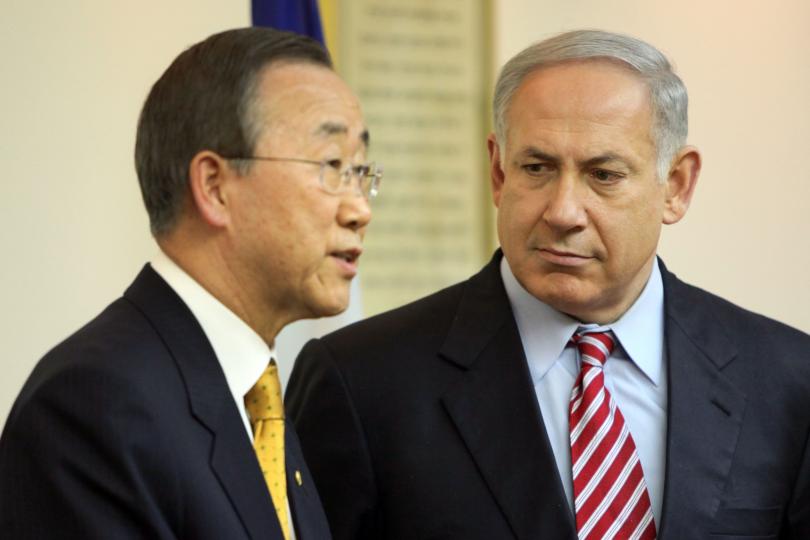
ban-ki-moon-benjamin-netanyahu 

Dear Mr. Ban Ki-moon, Secretary General of the United Nations:


Having read of the vicious attacks on you for venturing some moderate, incontestable criticisms of Israel’s behavior, I understand well the discomfort you clearly feel. Not since the Richard Goldstone chaired the group that released the report detailing apparent Israeli war crimes during its massive attack on Gaza at the end of 2008 have Israel’s big political guns responded with such unwarranted fury, magnified as usual by ultra-Zionist media commentary. Netanyahu has the audacity to claim that your acknowledgement that it is not unnatural for the Palestinians oppressed for half century to resist and resort to extremism is tantamount to the encouragement of terrorism, what he described as giving a “tailwind to terrorism.”


The fact your intention was quite the opposite hardly matters. Or your repeated denunciation of terrorism will be disregarded by these irresponsible critics whose sole objective is take attention away from the issues raised. Israel and its keenest supporters have found that there is no better way to do this than by defaming their critics, branding them as soft on terrorism or even as anti-Semites. And it makes no difference, whatsoever, that you have leaned over backwards during years as Secretary General, almost falling to the ground, to deflect even the most justifiable criticisms of Israel during your time as leader of the UN.


It is hardly surprising that you should respond to these attacks directed at you by way of a New York Times opinion piece that chides Israeli officials and Zionist zealots for ‘shooting the messenger’ and instead of heeding the message.[Ban Ki-moon, “Don’t Shoot the Messenger, Israel.” NY Times, Feb. 1, 2016] What both intrigues and appalls me is that while I was Special Rapporteur for Occupied Palestine during the period 2008-2014 you chose to attack me personally in public on several occasions, joining with U.S. and Israel diplomats calling for my dismissal and doing the utmost to undermine my credibility while I was working in this unpaid UN position under difficult conditions. At the time I was doing my best to bear witness to some of the same truths about Israel’s unlawful and immoral behavior that recently got you in similar hot water. My UN mandate was to report upon the reality of Israeli violations of international law while sustaining their apartheid regime of oppressive control over the Palestinian people. The Palestinians need and deserve such a voice as provided by the UN to make governments of the world more aware of their responsibility to take steps that will bring this unprecedented ordeal endured by the Palestinian people to an end. In carrying out these duties it is my hope that future UN Special Rapporteurs receive the support that they need from future Secretary Generals.

 th

In my case, hurt and offended by being so unfairly attacked by you, the highest UN official, I was encouraged by some highly placed officials in the UN Office of the High Commissioner in Geneva to seek some kind of explanation from you or your office, and hopefully even an apology. You never criticized my reports on Palestine or objected to my criticisms of Israel’s policies and practices, but rather focused your venomous remarks on some comments attributed to my views as expressed on my personal blog that were concerned with the 9/11 attacks and the Boston marathon bombings.


It was obvious to me from the content of your attack that you relied on a letter written by Hillel Neuer, Executive Director of UN Watch, Israel’s faithful watchdog NGO in Geneva, that gave my rather carefully qualified blog comments deliberately inflammatory twists, but like you seemed wary of engaging in any debate about the substance of my criticisms of Israel’s polices and practices in my reports. I called your office, and was referred to your affable aide de camp. He seemed immediately apologetic even before I was even able to register my complaint and explain to him my actual position on these controversial issues. After listening to what I had to say, he obliquely accepted my concerns by admitting that ‘we didn’t do due diligence,’ by which he evidently meant that the SG and his advisors relied on Neuer’s letter rather than reading what I actually wrote on the blog, which was nuanced and moderate in tone and content. This UN official volunteered a further explanation to the effect that “we were under great pressure at the time from the U.S. Congress, and this was an opportunity to show that we were not anti-Israeli.” He ended the conversation with a promise to talk with you, and get back to me. I am sad to say, this never happened.


This incident occurred while you were campaigning successfully for a second term as SG, and apparently wanted to reassure Washington that you would not rock the boat if reelected. I venture to say that if you had back then voiced such strong criticisms of Israel’s settlement policy or indicated a similar empathetic understanding of Palestinian resistance, you would never have received Washington’s blessings for a second term as Secretary General. I understand that your reticence back then was prudential, even a sensible, although dispiriting, concession to the realities of UN leadership. What I have trouble to this day understanding is your willingness, in old Soviet style, to defame by name a lowly UN holding a position as appointed volunteer, so as to beef up your credentials as a team player when it came to Israel. You even relied through a spokesperson at a news briefing on my status as someone outside the UN civil service to explain why you lacked the authority to dismiss me. Without contacting me in advance for an explanation or afterwards for an apology seems to me to exhibit an extreme version of bureaucratic immorality.


In light of this experience, I felt at the time that you were joining with others in shooting a messenger, and invoked the metaphor, who was seeking to convey some inconvenient truths about Israel’s behavior. These truths are rather similar to your own recent comments about the denial of Palestinian rights, especially with respect to the right of self-determination. The folk wisdom of ‘what goes around comes around’ seems to fit your plight. You who expediently took shots at the messenger are now taking umbrage when the tactic is directed at you. This response is reasonable in this instance but awkwardly inconsistent with your own past behavior. You say, “..when heartfelt concerns about shortsighted or morally damaging policies emanate from so many sources, including Israel’s closest friends, it cannot be sustainable to keep lashing out at every well-intentioned critic.” True, of course, but why only now? And only you?


Actually, although your critical stress on settlements and resistance is welcome and significant, your overall stance still falls far short of adopting a helpful way forward. You continue to insist misleadingly that compromises are called for by both sides in pursuing the goal of reaching a sustainable peace based on the establishment of Palestinian state. I find puzzling the assertion in your article that “..I am so concerned that we are reaching a point of no return for the two-state solution.” In your statement of 26 January to the Security Council you urge Palestinian unity as necessary so that the Palestinians “can instead focus their energies on establishing a stable state as part of a negotiated two-state solution.” Have you forgotten that every step taken by the Palestinian Authority and Hamas to establish unity has been opposed by anger, reinforced by punitive pushback on Israel’s part, a response endorsed by the United States? And wasn’t that ‘point of no return’ reached some time ago, and certainly after what the American Secretary of State, John Kerry, proclaimed as ‘the last chance’ negotiations broke down in the Spring of 2014 after a year of trading allegations and achieving not a single positive result? And how, Mr. Ban, is a two-state solution to be achieved over the opposition and resolve of more than 600,000 Israeli settlers, with more expansion underway and even more promised?


You acknowledge being “disturbed by statements from senior members of the Israeli’s government that the aim [of a Palestinian state] should be abandoned altogether.” What you fail to say is that these ‘senior members’ include Israel’s elected prime minister, its president, its current ambassador to the UN. In light of this unified opposition to a two-state approach by Israel’s highest governmental leaders, how can you encourage reliance on this discredited diplomatic path that has resulted in an ongoing process of severe territorial encroachment on occupied Palestine and subjection to a regime of intensified suffering for the Palestinian people? Clinging to the two-state mantra is not neutral. Delay benefits Israel, harms Palestine. There is every reason to believe that this pattern will continue as long as Israel is not seriously challenged diplomatically and by Palestinian resistance, as well as by the sorts of growing pressures mounted by the international solidarity movement and the BDS campaign.


More widely, and important to understand, shooting the messenger is part of a broader Israel strategy to minimize attention given to substantive criticisms of their behavior. You are merely the latest victim, and one of the most highly placed. The intensity of defamation seems to be roughly proportional to the perceived impact of your criticism. In this sense, Mr. Secretary General, you have scored highly, especially due to your reminder to the Security Council that the UN will “continue to uphold the right of Palestinians to self-determination.” This is not the language Israel’s leaders hoped to hear coming from your lips, and hardly consistent with earlier your record of steadfast support for Israel that included condemning even the Second Freedom Flotilla that sought to deliver humanitarian assistance to Gaza. To be meaningful beyond a ritual affirmation, self-determination must be understood, given present realities, as something more and other than another delusionary embrace of a diplomatically negotiated two-state solution. At the very least, you might have urged the Security Council to consider the applicability of the ‘responsibility to protect’ (R2P) norm to relieving the anguish of Gazan captivity, a timely move considering that Netanyahu has been warning of yet another massive attack, promising that it will be even more lethal than the earlier one-sided massacres.

th-2


You also tell the Security Council that “incitement has no place, and that questioning Israel’s right to exist cannot be tolerated.” Fair enough, but challenging Israel’s postures, policies, and practices should be placed high on the UN agenda of unfinished business if what you propose on behalf of the Palestinian people is ever to have the slightest chance of being achieved. We need all to realize what else should not be tolerated: while the Palestinian flag flies outside UN Headquarters, the Palestinian people have lived for almost 70 years under the daily brutalities of occupation, refugee camps, Gazan captivity, and involuntary exile. Can you bring yourself to call this ordeal ‘intolerable’? Then at least you could leave your UN post with a feeling that when your career was no longer in jeopardy you spoke truth to power.


Sincerely,


Richard Falk

UN Special Rapporteur of the Human Rights Council for Occupied Palestine (2008-2014)

Professor of International Law

Israel’s Likud Troika: Burying the Oslo ‘Peace Process’

12 Sep


[Prefatory Note: This is a slightly modified text of an article published in Middle East Eye on September 1, 2015, and republished on my blog with permission. http://www.middleeasteye.net/columns/israel-s-likud-troika-and-end-oslo-peace-process-1425103979]


Israel’s relentless accumulation of territorial facts on the ground some years ago doomed the peace process associated with the Oslo Framework of Principles adopted in 1993. It became increasingly difficult to envisage an Israeli willingness to dismantle settlements and road network or remove the separation barrier, and without such steps there could never be achieved an independent and viable Palestinian state. It should be kept in mind, without even raising the issue of the right of return of at least five million Palestinian refugees living outside of Palestine, that the whole premise of Palestinian statehood was based on the green line ceasefire borders that emerged from the 1967 borders. Even if Israel were persuaded to withdraw from the entirety of occupied Palestine, it would amount to only 22% of historic Palestine, less than half of what the UN recommended to a much smaller population by way of partition in 1947 (GA Res. 181). Yet even in those days of illusion when Israel was purporting to be receptive to the two-state approach it insisted on carving out a permanent security zone in the agriculturally rich Jordan Valley and maintaining a significant measure of border control.


For years Israel has played along with the diplomatic consensus constructed on basis of a two-state solution of the conflict as the only reasonable politically compromise. Israel had lots to gain from upholding this consensus, but quite a bit to lose by actually implementing it in a reasonable manner. Maintaining the diplomatic track satisfies its own citizenry and world public opinion that it is doing everything possible to reach a peaceful end of the conflict. In the course of such events, Israel gained the time it needed to expand the settlement phenomenon until it became so extensive as to negate any reasonable prospect for substantial reversal. And yet by relying on its sophisticated control of the media it could pin most of the blame on the Palestinian Authority for one round after another of failed bilateral negotiations. This in turn made it possible to mount propaganda campaigns around even the false claim that Israel lacked a Palestinian partner for peace negotiations.


While this diversionary process has continued for more than two decades, Israeli consolidated its influence in the U.S. Congress, which strengthened an already unprecedented ‘special relationship’ between the two countries. These dynamics made a mockery of Washington’s claim to be a neutral intermediary. And above all, the consensus pacified the international community, which repeatedly joining the public chorus calling for resumed negotiations. This became a cynical process with diplomats whispering in the corridors of UN buildings that the diplomatic effort to end the conflict was a sham while their governments kept restating their faith in the Oslo approach.


As argued here, the present futility of Oslo diplomacy has been indirectly acknowledged by Israel, and should be explicitly abandoned by the world community. Whether Israel’s was ever prepared to accept a Palestinian state remains in doubt. The fact that each prime minister since Oslo, and this includes Yitzhak Rabin, endorsed settlement expansion raises suspicions about Israel’s true intentions, but there were also indications that Tel Aviv earlier had looked with favor upon the diplomatic option provided that it could, with American backroom help, persuade the Palestinians to swallow a one-sided bargain that incorporated the settlement blocs and satisfied Israel’s security goals.


In the last couple of years the veil has been lifted, and it is overdue to declare Oslo diplomacy a failure that has been costly for the Palestinian people and their aspirations. We can reinforce this assessment by pointing to three connected developments at the pinnacle of Israeli state power, dominated in recent years by the right wing Likud Party. The first is the election by the Knesset in 2014 of Reuven Rivlin as the tenth Israeli president.

Rivlin is a complex political figure in Likud politics, a party rival of Netanyahu, a longtime advocate of a one-state solution that calls for the annexation of the West Bank, and an opponent of international diplomacy. The complexity arises because Rivlin’s vision is one of humane, democratic participation of the Palestinian population, conferring citizenship based on fully equality, and even envisioning an ethnic confederation of the two peoples to be achieved within Israel’s expanded sovereign borders.


The second development was the campaign promise made by Netanyahu on the eve of the March elections that a Palestinian state would never be established so long as he was prime minister. This startling break with the American posture was also a reversion to Netanyahu’s initial opposition to the Oslo Framework, and bitter denunciations of Rabin for embracing a process expected to result in Palestinian statehood. Netanyahu’s 2015 campaign pledge seemed closer to his true position all along if judged by his behavior although contradicting what his talk at Bar Ilan University back in 2009 when he declared support for Palestinian statehood as the only way for Israel to achieve peace with security. To slightly mend relations with Washington after his recent electoral victory, Netanyahu always crafty, again modified his position, by saying that in the heat of the elections he only meant that no Palestinian state could be established so long as jihadi turmoil in the region persisted. Given the extent of Israeli territorial encroachments on occupied Palestine I would trust Netanyahu’s electoral promise much more than his later clarification, a feeble attempt to restore confidence in the special relationship with the United States.


The third development, which should remove the last shred of ambiguity with respect to a diplomatic approach, is the designation of Danny Danon as Israel’s next ambassador at the UN. Danon is a notorious settlement hawk, long an outspoken advocate of West Bank annexation, arrogantly disdaining the arts of diplomacy needed to deflect the hostile UN atmosphere. If Israel felt that it had anything to gain by maintaining the Oslo illusion, then certainly Danon would not have been the UN pick. There are plenty of Israel diplomats skilled in massaging world public opinion that could have been sent to New York, but this was not the path chosen.


How shall we best understand this Israeli turn toward forthrightness? In the first instance, it reflects the primacy of domestic politics, and a corresponding attitude by Israel’s leaders that it has little need to appease world opinion or accommodate Washington’s insistence that diplomacy, while not now working, remains the only road leading to a peaceful solution.

Furthermore, the Likud troika seems to be converging on a unilateralist approach to the conflict with the Palestinians, while doing its best to distract the international attention by exaggerating the threat posed by Iran. This unilateralist approach can move in two directions: The Netanyahu direction, which is a shade more internationalist, and involves continuing the process of de facto annexation of occupied Palestine, reinforced by an apartheid structure of control over the Palestinian people; the Rivlin/Danon direction overtly incorporating the West Bank into Israel, and then either following the democratic and human rights path of treating the two peoples equally or hardening still further the oppressive regime of discriminatory control established during over 48 years of occupation.


While this Israeli scenario of conflict resolution unfolds most governments, not sensing an alternative, continue to proclaim their allegiance to a two-state solution despite its manifest disappointments and poor prospects. At present, there are a series of international gestures toward lifting the peace process from its deathbed. Sisi of Egypt hosts Mahmoud Abbas of the Palestinian Authority proclaiming a readiness to mediate bilateral negotiations, and even Netanyahu in the immediate aftermath of Israel’s inability to scuttle the Iran Nuclear Agreement has the temerity to indicate an interest in renewed peace talks. In effect, ‘Oslo is dead, long live Oslo.’ Put differently, the political death of Oslo is being disguised by a diplomatic afterlife. It will be shameful if the Ramallah leadership again enters this cynically set diplomatic trap. As the above analysis shows there is no evidence whatsoever that Israel is at all inclined to allow an independent sovereign Palestinian state to come into existence. Israel is even fought hard against allowing Palestine to fly national flag in front of the UN building. Of course, as in the past, Israel will for the sake of public relations, including rehabilitating its ‘special relationship’ with the United States, evidently again play this cruel game of charades. But why are the Palestinians willing to be partners to such a sham?


This see-no-evil posture of governments, and even the UN, ignores the emergence of two more promising alternatives: the gathering momentum of civil society activism exhibited via the BDS campaign and increasingly acknowledged by Israel as its most security threat, leading recently to the establishment of an official ‘Delegitimation Department’ assigned to do battle with the Palestinian solidarity movement.


And on a diplomatic level, pursued with some energy and imagination by the Palestinian Authority, is the use of international law and Palestinian statehood to engage the wider international community of states in support of its struggle. Several examples illustrate the approach: the 2012 General Assembly endorsement of Palestinian statehood; the adherence to prominent international law treaties and conventions; admission as member to UNESCO; adherence to the Rome Treaty framing the activities of the International Criminal Court; and just days ago, the GA approval of the wish of Palestine, although having the status of a non-member observer state, to fly its national flag alongside the flags of UN members at UN buildings. With the abandonment of armed struggle and the breakdown of bilateral diplomacy, Palestinian recourse to legitimacy tactics reinforces the civil society global solidarity network that has been exerting increasing pressure on Israel.


The Nuclear Challenge (4): 70 Years After Hiroshima and Nagasaki-The Iran Agreement in Perspective

24 Aug

The Nuclear Challenge (4): 70 Years After Hiroshima and Nagasaki-The Iran Agreement in Perspective


Without question the P5 +1 nuclear agreement with Iran is a vital move toward peace and stability in the Middle East, a step back from the maelstrom of conflict that is roiling much of the region, and leaving what stability there is among sovereign states under the control of various absolutisms that repress and exploit their own populations.


At the same time before congratulating the negotiators and building a strong rationale for yet another Nobel Peace Prize given to architects of Western diplomacy, we should pause and peer behind the curtain of hegemonic confusion embellishing a more dubious statecraft by an ever compliant mainstream media. If we pull back the curtain, what do we see?


First of all, we should immediately recognize that the most sensible agreement for the region and the world would have included Israel’s nuclear weapons arsenal in the negotiating mix, and yielded a unanimous call for responding to nuclear anxieties with a Middle East Nuclear Weapons Free Zone. As far I know, every government but Israel in the region, and this includes Iran and Saudi Arabia, favors regional nuclear disarmament, and is decidely uncomfortable with Israel as the sole nuclear weapons state in the region.


Many may feel that I am dreaming when I raise this point, but without the clarifying impact of dreams, political reality remains an opaque spin chamber. In a decent world order that was built on a foundation of law and equality among sovereign states with respect to the challenge of nuclear weapons there would be no double standards and no discriminatory policies. When reflecting on the current emphasis on reaching an agreement with Iran there is a political unwillingness to widen the optic for discussion, much less for implementation, of the most rational and ethically coherent approach to denuclearization of the Middle East.


If we are so obtuse or arrogant to ask ‘why?’ this is so there are several explanations. Undoubtedly, the most illuminating response is to point out that to include Israel’s nuclear weaponry in denuclearization diplomacy would violate ‘the special relationship’ binding the United State to Israel, although not vice versa as the Netanyahu/AIPAC outrageous campaign to undermine the P5 +1 initiative unmistakably demonstrates. Obama’s refusal to go along with Israel’s insistence on far tighter restraints on Iran as a precondition for its acceptance of an agreement is straining the special relationship and weakening the overwhelming support it had previously enjoyed among Jews in the United States. These tensions also reveal that even this most special of special arrangements has its outer limits! Yet it seems evident that these have yet to be discovered by the majority of the U.S. Congress.


Secondly, Iran is targeted by the agreement as a pariah state that is being subjected to a more stringent regime of inspection and restraint than has ever been imposed on any other non-nuclear state. Yet what has Iran done internationally to deserve such harsh treatment? In the period since the Islamic Republic took control of the country in 1979, Iran was aggressively attacked by Saddam Hussein’s Iraq in 1980 with the encouragement and blessings of the United States Government, resulting in approximately one million battlefield deaths in the eight-year war to both sides. In the last decade or so, Iran has been the acknowledged target of destabilizing covert violent acts by the United States and Israel, including targeted assassinations of nuclear scientists and cyber efforts to disrupt Iran’s nuclear program. Additionally, Israel has made a series of unlawful threats of military attack and the United States has exhibits Martian solidarity by uttering somewhat more veiled assertions of its residual reliance on a military option, recently rearticulated by Obama as ‘war’ being the only alternative to the agreement should it be rejected by the United States.


We should not forget that Iran that is surrounded by belligerent adversaries openly talking about the feasibility of military attacks upon their country under present world conditions. From a purely realist perspective it is Iran that has one of the most credible security claims ever made to acquire nuclear weapons as a deterrent weapon in response to Israeli aggressiveness reinforced by American backing. After all, it has been reliably disclosed and documented that Israel on more than one occasion was on the verge of attacking Iraq, backing off at the last minute due only to splits within the Israeli cabinet over issues of feasibility and fears of adverse consequences.


This whole discourse on Iran’s nuclear program is notable for presuming that policy options can be selected by its adversaries without any consideration of the relevance of international law. Even supposing that Iran was, in fact, overtly seeking a nuclear weapon, and approaching a threshold of acquisition, this set of conditions would not validate recourse to force. There is no foundation whatsoever in international law for launching an attack to preempt another country from acquiring nuclear weapons. The U.S. relied on such a pretext to justify its attack on Iraq in 2003, but such an argument was rejected by the UN Security Council, and the American led attack and occupation were widely viewed as contrary to international law and the UN Charter. To launch a non-defensive attack on Iran would be a flagrant violation of Article 2(4) of the UN Charter and of the norm prohibiting recourse to aggressive war used to convict German and Japanese surviving leaders after World War II of state crime. It is well to acknowledge that Iran succumbed to a kind of geopolitical blackmail by accepting this one-sided agreement. It is hardly surprising that the logic of geopolitics triumphed over respect for international law, and yet the fact that the liberal media and world public opinion smile so gratefully, apparently not realizing what an unhealthy an atmosphere exists, is discouraging, and not a good omen for the future.


Maybe there could be a case for bending, or even breaking international law, if Iran was genuinely posing a plausible threat that could not be met through diplomacy and defensive capabilities. But the realities are quite different. Iran has been the target of unlawful threats and various forms of covert intervention, and has responded with responsible caution, if at all. To reinforce this one-sided experience of insecurity with this kind of agreement sets the unfortunate perverse precedent of treating the victim of an unlawful intervention as the culprit justifying international sanctions, and possibly a future military onslaught. This represents a perversion of justice, as well as exhibiting a fundamental disregard of international law.


This reasoning is not meant to exonerate Iran from severe criticism for its internal failures to uphold the human rights of its citizens or for its continued punitive action against the leaders of the Green Revolution. It is important to realize that regulating recourse to international uses of force has been deliberately separated in the UN Charter from interfering in state/society relations absent the commission of severe crimes against humanity or genocide, and a green light is given by the UN Security Council for what amounts to ‘humanitarian intervention,’ recently justified by reference to the emergent international norm of a ‘right to protect’ or R2P. Such a R2P justification was put forward and controversially enacted in Libya in 2011.


True, during the Ahmedinejad years irresponsible fiery and provocative language was used by Tehran with reference to Israel, including repeated calls for the abolition of the Zionist project. The language used by Ahmedinejad was given its most inflammatory twist by Israeli translations of the Farsi original. Read more objectively, it was not Jews as such that were the subject of the invective, or even Israel, but Zionism and its belligerent behavior in the region, especially its refusal over the course of decades to achieve a sustainable peace with the Palestinian people, and on the contrary, its policy of continual land grabbing in Palestine to make peace between the two peoples an increasingly distant prospect of diminishing relevance in the domains of practical diplomacy.


The principal point of this analysis is to show that this agreement reflects the primacy of geopolitics, the neglect of international law, the impact of the US/Israel special relationship, and yet despite these drawbacks, it is still the best that supporters of peace and stability can hope for under present conditions of world order. Such a reality is occluded by the presentation of the debate in the United States as mainly the exaggerated mini-dramas associated with pressuring key members of Congress to vote for or against the agreement and engaging in sophisticated discussions as to whether the constraints imposed by the agreement on Iran’s nuclear program, although the strongest ever imposed, are still as strong as Obama claims or as some uncertain Congress people demand. As argued here, support for the agreement is overwhelmingly in the national, global, regional, and human interest, but this assessment does not mean we should view world order through the distorting lens of heavily rose-tinted glasses.


This nuclear agreement reflects where we are in dealing with global crises, not where we should be. It is this distinction that is suppressed by the liberal media and government spokespersons that tout the agreement as an extraordinary achievement of international diplomacy. If we value international law, global justice, and indeed the future of the human species, then the distinction between the realm of the ‘feasible’ and the realm of the ‘desirable’ deserves energetic critical exposure by all of us who fancy ourselves as citizen pilgrims, that is, devotees of human and natural survival, as well as of global justice and human rights.

Why Congress Must Support the Nuclear Agreement With Iran

22 Aug


[Prefatory Note: this post republishes an article appearing in the Huffinton Post on Aug. 21, 2015. It is jointly written with Akbar Ganji, an important human rights defender who spent several years for his efforts in an Iranian jail. Ganji is a leading commentator on Iranian affairs and world issues, and recipient of an International Press Association World Press Hero award. Our articles stresses the critical importance of obtaining American approval of the nuclear agreement.] 


Why Congress Must Support the Nuclear Agreement With Iran


Akbar Ganji & Richard Falk


What should have been an occasion of diplomatic rejoicing has turned into an ugly partisan struggle over whether or not the international agreement negotiated with Iran will or will not be approved by the United States Government. The extremely troublesome obstruction to the agreement is centered in the U.S. Congress where anti-Obama Republicans are teaming up with pro-Netanyahu Democrats to create uncertainty as to whether the arrangments negotiated with such persistence by the five permanent members of the UN Security Council together with Germany will be undermined by this unprecedented leverage being exerted by Israel on the internal governmental processes in America. It should be appreciated that the agreement has been unanimously endorsed by a positive vote of all 15 members of the Security Council, a rarity in UN politics for an issue of this geopolitical magnitude.


In the end this debate raises some fundamental questions about American domestic politics along with its leadership in the Middle East and indeed, the credibility of its global role. Here is an agreement, restricting Iran’s freedom of action with regard to its nuclear program beyond that imposed on any other country ever, clearly serving the national interest of the United States in Middle Eastern stability, an outcome of dedicated efforts by the President and Secretary of State to find a way to avoid both another war in the region and a dangerous nuclear arms race.


That such a diplomatic breakthrough is being so furiously opposed posts a warning that irrationality is mounting a serious challenge to common sense and self-interest. As Obama has noted on several occasions he knows of no other leader that interferes so directly in the national policy debates of a foreign country than deos Netanyahu( 1 and 2 ) . Britain’s Foreign Secretary Philip Hammond observed: “Israel wants a permanent state of stand-off and I don’t believe that’s in the interests of the region. I don’t believe it’s in our interest.”


Israel has used all the influence at its disposal to block approval, mobilizing rich ultra-Zionist donors in the U.S. to create a war chest of $20 milion and relying on AIPAC (American-Israel Public Affairs Committee) to twist enough legislative arms to override an expected Obama veto if the agreement is turned down by a majority in the two houses of Congress. This drive has been led by the ever belligerent Israeli Prime Minister, Benjamin Netanyahu, but it is disturbing to realize that all the leading political parties in Israel are united in their opposition to the agreement. This alone tells us the degree to which political attitudes in Israel are out of sinc with those prevailing in the rest of the Middle East, and indeed the world.


As such, there is a moment of truth for the relationship between the United States and Israel. A rejection of the agreement will raise serious questions about the capacity of this country to pursue a foreign policy that reflects its best interests and dominant values. It will also raise doubts about whether it is capable of constructive leadership in the Middle East and the world. If the agreement is approved, as we firmly believe it should be, it will not only confirm the autonomy of national institutions in the United States but show that the alliance relationship with Israel can withstand disagreement when vital issues are at stake.


The Iran Problem


The Islamic Republic of Iran is a religious dictatorship that systematically violates the rights of its citizens, and has demonstrated enmity toward the United States since the 1979 Revolution. Despite this, compared with other Islamic countries of the Middle East and North Africa, it is far better situated to realize democracy and respect human rights.


Iran is a stable nation that has not invaded another country for nearly 300 years. Its population has nearly more than doubled since the 1979 Revolution, but its number of university students has increased by a factor of 27, with more than 60 percent of them female. The most important international writings of Western liberal, feminist, and secular thinkers have been translated into Farsi, including the work of some of the most important Jewish thinkers. Iran has a large middle class, and is the only country in the region, aside from Turkey, that has the prerequisites for a transition to democracy despite problematic features of the relations between state and society.


For over 22 years Netanyahu has been “making” nuclear bombs for Iran, continuously claiming that Iran is only a short time away from having the bomb. The predictions have turned out to be false and inflammatory, but his desire and appetite for war with Iran seems only to have increased over time. The nuclear agreement with Iran, which has imposed severe restrictions on its peaceful nuclear program despite going well beyond what the 1968 Nonproliferation Treaty requires, has agitated Netanyahu and the political mainstream in Israel. There are several explanations of this irrational Israeli response to an agreement that help all in the region. Netanyahu has engaged in fear-mongering that has mobilized Israeli society. Beyond this, a focus on Iran’s nuclear program draws attention away from other difficult problems confronting Israel,, including the Palestinian problem and its own covertly acquired arsenal of nuclear weapons.


National interests of the United States or Netanyahu’s political interests?


As President Obama has repeatedly said, the only alternative to the nuclear agreement with Iran is war. But, this would be a war that Israel wants the United States to fight on its behalf. Military attacks on Iran will almost certainly produce an extremely strong reaction by Iran and other nations in that region, a process likely to set the entire Middle East on fire. Iran with its population of 78 million will likely degenerate into another Iraq and Syria, and extremists from throughout the world will stream across its borders to join the struggle. How can risking such an outcome possibly be in the interests of the United States?


Approving the nuclear agreement with Iran is by far the least costly solution to whatever problems can be associated with Iran’s nuclear program, and approval will also promote peace and stability in the Middle East. With this background in mind Congress should clearly approve the agreement, and it is also why the citizenry of the United States should welcome it. After approval,, the United States would find itself in an excellent position, perhaps in coopeation with other governments to help address other problems on the Middle East agenda by proposing an ambitious diplomatic package with the following essential elements:


Guaranteeing present national borders through resolutions backed by the United Nations Security Council


Elimination of all weapons of mass destruction from the region through the establishment of a nuclear free zone in the whole of the Middle East


Resolving the Palestinian problem encouraging two-state diplomacy premised on the right of the Palestinian people to form their own independent, viable and contiguous state on all territories occupied since 1967, and if diplomacy fails, then more coercive measures should be imposed by action of the United Nations


A collective security and mutual non-aggression treaty signed by all the Middle Eastern nations

Investment in the economic and political development of the region combined with the regulation of arms sales

Moving forward from the agreement it is important to appreciate that peace is a common value envisioned and shared by Jews, Muslims, and Christians:

“They will beat their swords into plowshares and their spears into pruning hooks. Nation will not take up sword against nation, nor will they train for war anymore” (Isaiah 2:4).

“Blessed are the peacemakers, for they will be called children of God”(Matthew 5:9).

“Making peace is the best” (an-Nissa 128) and “O, you who believe! Fulfill the promises and covenants made [by you]” (al-Maidah 1).


For too long these shared values, deeply embedded in the worldviews of these civilizational perspectives, have been ignored, even repudiated. The nuclear agreement with Iran creates the opportunity to move the flow of history in better directions. Such an opportunity must not be lost. If lost, the United States and Israel would be morally, politically, and legally responsible for whatever harm befalls the region and the world.

FIFA Scandals are Worse than Bribes

5 Jun


Lost in the heavy clouds cast by the spectacular FIFA corruption disclosures climaxing so far with the resignation of its compromised president, Sepp Blatter, is a worse scandal of racist discrimination that has so far been flying beneath the media radar. Blatter, with customary wheeling and dealing, did his best to protect Israel from long standing Palestinian grievances—physical harassment of Palestinian players and teams by long delays and arbitrary restrictions on movement, an indulgent attitude toward the hateful baiting by Beitar Jerusalem threateningly yelling ‘death to the Arabs’ as a warning to Palestinian players, and inclusion of teams from the unlawful settlements competing in Israel soccer leagues violating FIFA’s own rules. The Palestinian Soccer Association was persuaded by Blatter to drop its charges, with a renewal of previously empty pledges to ameliorate conditions confronting Palestinians coupled with a surely ironic plea to keep ‘politics’ from intruding on ‘the beautiful game.’ As if the humiliations and constraints imposed on the Palestinian teams were not political!


Without recounting the details, I would make reference to three assertions that are markers for the moral imagination in relation to this provocative interplay of sport and politics in situations of acute oppression and criminality. The first assertion is by the mild mannered president of the Palestinian Soccer Association, Jabril Rajoub: what Palestinians face is worse than what South African blacks faced in the apartheid era—“There they wanted them to be slaves. But here in Palestine, they don’t want us to be.” [quoted in Rudi Rodoven, “Palestinian Soccer Association Drops Effort to Suspend Israel from FIFA,” NY Times, May 29, 2015] Whether there is objective confirmation of such an attitude or not on the Israeli side, this Palestinian subjectivity is widely experienced, and is certainly confirmed

by the tactics and language of right-wing Israelis who increasingly control the political and moral space in the country. There is much public and legal attention right given to establishing genocidal intent, but rarely is there notice paid to the ways acute oppression and racism is experienced by the victimized community.


Mr. Rojoub’s cry of torment reminded me of Audre Lorde’s poem, ‘Litany for Survival’ that was frequently quoted a year ago in the days after the Ferguson killing of Michael Brown to express a similar subjectivity prominent among African-Americans. Counseling her people to speak their true feelings even if it produced angry pushback, the last lines of Lorde’s poem resonate with those anguished words of Jabril Rajoub quoted above:

and when we speak we are afraid our words will not be heard

nor welcomed
but when we are silent we are still afraid

So it is better to speak remembering
we were never meant to survive

It is a sad truth confirmed over and over again in tragedy after tragedy that those who are dispossessed, subjugated, and displaced are never meant to survive, and thereby finally erased altogether from the consciousness of those who do the dispossessing, subjugating, and displacing. It took a strong dose of revisionist history to challenge generations of delusion that allowed children in America to celebrate Columbus Day without pausing to wonder what tears flowed in native American communities that were never meant to survive.


From such a reflection, the mind moves without pause to the sentiments often captured in early self-serving Zionist musings about ‘a country without a people for a people without a country.’ Perhaps the most memorable formulation was that of Chaim Weizman in 1914 at the World Zionist Congress: “..there is a country which happens to be called Palestine, a country without a people, and on the other hand, there exist the Jewish people, and it has no land. What else is necessary than to fit the gem into the ring, to unite this people with this country?” Remember that such malicious falsehoods were uttered long before the name of Hitler was even known, much less Naziism or the Holocaust experienced. This assertion was made even a few years before the infamous Balfour Declaration alerted the world to British colonial support for the establishment of a Jewish national home in Palestine. It is worth noting that Palestine was inhabited at the time by well over a half million Palestinian Arabs, of whom less that 7% were Jews, and many of these were then opposed to the Zionist project as disruptive of their mostly calm co-existence with the Arab majority.


What do these three laconic reflections on the relations between perpetrators and victims tell us? As Rajoub implies, the presence of the slave, however much abused, is wanted, even deemed necessary, as the prevailing social and economic arrangements depend on such exploited labor. As the unfolding South Africa overcoming of apartheid disclosed, at some point, because there is a deformed kind of mutuality between master and slave, when the underlying balance shifts, a previously unimaginable accommodation abruptly becomes attainable.


But when the primary stake is land, not labor, then erasure is the goal of the perpetrator and the justifiable fear of the victim is extinction, or at least, exclusion. Fortunately, in our modern world these polarized subjectivities are not acted out to their full extreme except in the most monstrous of scenarios such as the fate that befell European Jewry in the period of Nazi hegemony. Yet even if not literalized there are objective consequences of the illusion that the other doesn’t exist or should be induced quietly to disappear. In the emergence of Israel, the Zionist momentum shifted the site of struggle from the imaginary of emptiness to the battlefields of dispossession inflicting the traumas of the nakba and naksa, and without an end in sight.


What has so far been distinctive, even inspirational, about Palestinian perseverance is their refusal to leave the historical stage despite enduring a long litany of unspeakable abuses that would have broken the will of many peoples. We cannot know the future by peering through such ‘a glass darkly,’ but more and more people throughout the world are becoming aware that solidarity with the ongoing Palestinian struggle for political oxygen is the most salient and compelling moral cause of our time.


In the aftermath of Netanyahu’s electoral victory in March David Shulman writes movingly and enigmatically of the unsustainability of the status quo: “Perhaps hope lies in a vision of all territory west of the Jordan River as somehow more than one state but less than two, under conditions of true equality… One thing is certain. The demand to fully enfranchise the Palestinians now suffering under Israeli rule will eventually prove irresistible. What happens after that, no one can say.” [Shulman, “Bibi: The Hidden Consequences of His Victory,” NY Review of Books, April 23, 2015] Even such a somewhat hopeful prospect is insufficient to render justice to the Palestinians as it leaves out of account the more than 7 million Palestinians living in refugee camps or exile; in many instances, their circumstances are as desperate, or even more so, than that of Palestinians living in utter vulnerability beneath the yoke of prolonged occupation.

Apartheid and the Palestinian National Struggle

28 Apr

Apartheid and the Palestinian National Struggle


Preliminary Observations


In this period when the centenary of the genocidal victimization of the Armenian people in 1915 is being so widely observed and discussed, it seems especially appropriate to call attention to the comparable victimization of the Palestinian people. This second story of prolonged collective victimization also received its jump start almost a century ago with the issuance by the British Foreign Office of the Balfour Declaration supporting the Zionist movement project of establishing a Jewish national home in historic Palestine. The most striking difference between these two experiences of severe historical wrongs is that the Armenian people are seeking acknowledgement and apology for what was done to their ancestors a century ago, and possibly seeking reparations, while the Palestinian people may sometime in the future have the opportunity to seek similar redress for the past but now their urgent focus is upon liberation from present daily structures of acute oppression. This Palestinian situation is tragic, in part, because there is no clear path to liberation, and the devastation of oppressive circumstances have gone on decade after decade with no end in view.


The political puzzle of the Israel/Palestine conflict continues to frustrate American policymakers despite their lengthy diplomatic engagement in the search for a peaceful future that satisfies both peoples. There are significant changes, of course, that have occurred as time unwinds. Perhaps, the most crucial change has involved the gradual extension of Israeli control over virtually the whole of historic Palestine with American acquiescence. This coincides with a growing and more vivid awareness around the world of how much suffering and humiliation the Palestinian people have endured over the course of the last century, and the degree to which this frozen situation can be blamed on the unlimited willingness of the United States to deploy its geopolitical muscle on Israel’s behalf.


My approach to the Palestinian struggle reflects four points of departure: first, regarding the long suffering of the Palestinian people as having become the primary international moral challenge of our time, which does not deny that there are other equally serious moral challenges, but none is so implicated in wider global patterns of past injustice or as salient in the political consciousness of the peoples of the world; secondly, believing that international law and morality should be allowed to provide essential guidance in determining the contours of a just and sustainable peace between these two long embattled peoples; thirdly, emphasizing the decisive liberating role of nonviolent civil society militancy in finding a solution for the conflict, achieving liberation from below by the mobilization of people, not the action governments as offering the most promising present scenario for ending the Palestinian ordeal; and fourthly, approaching the struggle for Palestine as matter of human wellbeing without privileging a particular ethnicity, nationality, and religion, that is, from a sense of shared humanity rather than from adversary perspectives of Jewish and Palestinian exclusivity.  


The Palestinian struggle is about far more than the ‘end to occupation,’ although the concreteness of the Israeli occupation of Palestine lends itself to visualization, as would Israeli withdrawal, and this partly explains why so many liberal activists equate peace with ending the occupation. Yet conceiving the conflict in this territorial manner is profoundly misleading. It ignores the depth and complexity of what is at stake for both Jews and Palestinians, but especially for Palestinians. I consider the Palestinian national struggle within its broader scope and less distinct parameters as a persisting struggle to achieve the right of self-determination. Self-determination is the solemn promise of common Article 1 in the two international human rights covenants made to all peoples in the world, in effect, a legal, moral, cultural, and frequently a political entitlement to determine collective destiny so long as the equal right of other peoples is not encroached upon. These 1966 covenants set forth the content of international human rights law in their most authoritative treaty form. The extended inability to realize this right is the core tragedy of the Palestinian people, informing the hardships and humiliations of daily life.


In some respects, even describing the Palestinian goal in the language of self-determination is too restrictive, and by itself, not very clarifying. Ultimately the preconditions and contours of a just and sustainable peace is what should concern us most. It is an outcome that controversially also addresses the overlapping and conflicting right of self-determination enjoyed by those of Jewish identity who are now long enough resident in Israel to possess their own legitimate basis for claiming self-determination. The key strategy of accommodation is to find the best formula for reconciling these basic competing claims of self-determination, and to reject as unacceptable contentions of their fundamental incompatibility or their resolution by force of arms. It is important at this stage to recognize that Israeli unilateralism and Zionist maximalism are making it increasingly difficult for the affected parties to find such a formula, much less give it life.


When considering the content of this underlying right of self-determination additional substantive concerns are disclosed, above all the fate of the several million Palestinian refugees many living for more than 50 years in miserable refugee camps in Jordan, Syria, and Lebanon. If Palestinian goals or the requirements of peace are confined to the territorial language of ending the occupation, the plight of Palestinian refugees tends to be left in limbo or at best consigned to the periphery of peacemaking that implicitly denies any right of repatriation and leaves the refugee communities without adequate representation.


There are other challenges facing peacemakers, as well. Edward Said, and other sensitive commentators on the interminable Palestinian ordeal have repeatedly observed that one catastrophic dispossession, that of the Palestinians in 1948, in no way justifies seeking a second dispossession, this time of Jews. In effect, the illegitimacies of the past that have victimized the Palestinians and produced the present intolerable state of affairs, must be put to one side in peacemaking contexts, and the future framed by reference to how Palestinians and Jews can best live together when account is taken of all the circumstances of past and present, including the allocation of rights by the application of international law. This injunction of mutuality should not be interpreted as a readiness to forget the past, or to minimize its relevance. Rather it is an insistence that replicating past wrongs by superimposing on all of historic Palestine a new power structure that excludes or subjugates Jews is not ethically acceptable or politically feasible as goals of conceiving Palestinian empowerment. Said did insist, however, that grave past injustices endured by the Palestinians, especially the massive dispossessions of 1948 and again in 1967, must be confronted and acknowledged by Israel before any sustainable progress toward peace and reconciliation is possible. Similarly, there is no way of reconciling the contending claims of self-determination if Zionism clings to its demand of ‘a Jewish state’ and an exclusive unlimited right of return for Jews only.


The contention that Israel has become an apartheid state is highly relevant to grasping the fate endured by the Palestinian people over the course of the last hundred years. Most poignantly, if the quest for Palestinian self-determination continues to fail, the outcome of the unresolved struggle will almost certainly result in the further entrenchment of existing systematic structures of ethnic discrimination. Such structures possess the key elements of the international crime of apartheid. If this is so, it means that the very arrangement relied upon to sustain public order in Palestine and Israel is itself an ongoing international crime of utmost gravity. Apartheid is designated as a crime against humanity in the Rome Statute of 2002, the treaty that regulates the operations of the International Criminal Court.


In other words, the present and the future of the Israel/Palestine relationship cannot be understood in neutral, symmetrical, and static terms of both sides more or less equally thwarting the path leading to conflict resolution and enduring the same consequences if that path remains blocked. Unfortunately, this has long been the official American rebuke to both parties. John Kerry, the American Secretary of State, and President Barack Obama, never tire of telling Israel and Palestine that each must make ‘painful concessions’ if the deadlock is to be broken and peace to be attained. Such language conveys a fundamentally distorted image of the present reality because it refuses to take account of the essential and vital difference between the situation of the oppressor and the oppressed, a difference that becomes unmistakable if you experience directly the many dimensions of everyday inequality between the two peoples. [this point is often made by Edward Said. See for instance his last interview: “My Right of Return,” (with Ari Shavit), in Gauri Viswanathan, ed., Power, Politics, and Culture: Interviews with Edward W. Said (Pantheon, 2001, 443-458, esp. 445-449.]


The imagery of deadlock and equal responsibility for the unsatisfactory present reality also falsely implies a static situation that would seem detrimental to both sides. This is a false image because with the passage of time Palestine loses, and Israel gains. This is so territorially, but also to live as the oppressor is consistent in most respects with living well, while living under conditions of oppression or as refugees in to varying degrees living badly. Of course, power shifts are common, and roles can be reversed, although this does not seem likely anytime soon.


The existing Israel and Palestine interplay is constantly evolving. This understanding leads me to have a quite different overview of the present situation that I will express in a deliberately provocative way–either the future will witness a further entrenching of the Israeli apartheid state or Israel will abandon and dismantle current apartheid structures and accept a Palestinian call for peace in accord with international human rights law, and more generally, agree on steps that need to be taken to realize the Palestinian right of self-determination. As previously stated such a Palestinian realization of self-determination must not be exercised at the expense of a complementary Jewish right of self-determination. This is not meant as an indirect endorsement of Zionist goals as articulated by currently dominant Israeli forces. It is obviously difficult to adjudicate between these overlapping claims of self-determination, and doing so most likely requires help from genuinely detached third parties. Putting this more concretely, a spiritual homeland for the Jewish people in ancient Palestine would could be maintained, but not the current Jewish state with its preferential ethnically framed nationality laws, making Israel what the Jewish leader Henry Siegman perceptively identifies as an ‘ethnocracy’ rather than a ‘democracy.’


Let me acknowledge, without delving into the matter, that the Palestinian Authority (PA) and the Palestinian Liberation Organization, the formal representatives of the Palestinian people in international venues, has been partly responsible for the confusion about these fundamental points by seeming to go along with both a territorial definition of the conflict and a solution based on the Oslo process despite it being tainted by the United States acting in the role of intermediary. The PA posits its primary goal to be the establishment of some kind of Palestinian state on the currently occupied territory of the West Bank, and indeed claims that such a state already exists, a position affirmed by the General Assembly in a resolution adopted on November 29, 2012. This also allows Israel and the United States to continue treating ‘the peace process’ as necessitating direct negotiations between the parties despite Israel’s multiple efforts to de facto annex portions of the West Bank at Palestine’s expense ever since the early 1990s. By now it should be evident that these direct negotiations have given the Palestinians zero benefits for the last 20+ years while bestowing on Israel a golden opportunity to pursue its expansionist agenda in violation of international law. The fact that Israel continues to lend rhetorical support to such a peace process sustains for many the illusion that its government favors a genuine effort to solve the conflict through diplomatic compromise. Washington does its part, going sheepishly along not only because it habitually defers to Israel, but because playing this particular diplomatic game enables the United States to continue portraying itself as patron of a process dedicated to producing peace.


Understanding Israel’s Recourse to Apartheid


At a conference at the National Press Club on April 10, 2015 in Washington devoted to assessing and depicting the Israel Lobby as it operates in the United States, the influential Haaretz columnist, Gideon Levy, painted a picture of the current Palestinian ordeal concisely with a few verbal brush strokes. He emphatically told the audience what every follower of this ‘peace process’ should have understood long ago: “The two state solution is dead!” What does that mean? According to Levy, neither Israeli motivation nor any practical possibility of moving toward Palestinian self-determination is present, even in that constricted and inadequate sense of territorial empowerment with respect to currently occupied Palestine. Israel’s main policies have long been subversive of the establishment of an independent and sovereign Palestine, the major presupposition of the ‘two state solution.’ The centerpiece of this subversion is, of course, the settlement phenomenon—the establishment and continuous expansion of 121 settlements authorized by Israel (along with 102 so-called ‘settlement outposts’ that are formally unauthorized but are nevertheless officially supported and subsidized) that now provide unlawful homes for between 700,000-750,000 Israeli settlers. This massive encroachment on any future independent Palestine has been abetted by the multi-billion dollar construction of a network of settler only roads, and by building a separation barrier of several hundred miles many segments of which cut deep into occupied Palestinian territory. This notorious wall was authoritatively declared illegal by 14 of 15 judges of the International Court of Justice back in an advisory opinion issued in 2004, endorsed by the General Assembly, and summarily rejected by Israel.


Although Levy didn’t explain exactly what he meant by using the word ‘dead,’ it can be interpreted in two distinct ways: first, as Benjamin Netanyahu himself proclaimed in the recent Israeli electoral campaign, as long as he and the Likud Party control the government, Israel will never allow the formation of a Palestinian state in historic Palestine. This also seems to express the real views of a majority of Israeli citizens, and thus the utterance of views to the contrary by Netanyahu and other Israeli leaders for international consumption should be disregarded as a cynical move to placate public opinion; and secondly, even if the words were to be treated as sincere, the settlements, roads, and wall make a viable sovereign Palestinian state incapable of establishment even if Israel some day possesses the political will to bring it into being.


The two-state solution has long been what the NY Times columnist Paul Krugman calls a ‘Zombie Idea’, that is, a discredited idea that continues to be accepted as the way to solve a problem because it upholds the self-interest of some powerful political actors, thereby diverting attention from alternative solutions that could be burdensome for those who benefit from freezing the status quo; it is a zombie, as in being a ghost, which lives on beyond its natural death causing torment to those it haunts. In ghostly respect the two sate solution continues to be treated as the only solution for the convenience of the parties, including the United States, Europe, and the UN, despite their private awareness of its irrelevance. During my period as UN Special Rapporteur I was often privy to corridor conversations that acknowledged the absence of any hope for a two state solution, but in public it was business as usual with these same individuals expressing their fervent hopes that talks would soon resume and finally find common ground.


In the contrasting theater of ‘reality politics’ the prospects are for further Israeli unilateralism. This impression has been reinforced by the selection by the Knesset two years ago of Reuven (Ruvi) Rivlin as President of Israel. Rivlin is a rightest Likud figure long known for his unapologetic embrace of a one state solution that envisions the Israeli incorporation of the whole of occupied Palestine. Netanyahu, a wily politician, differs from Rivlin in fundamental respects, and despite both men belonging to the same political party, they disagree on key issues and are personal antagonists: Netanyahu has previously given lip service internationally to a diplomatic process built around bilateral negotiations, as well as expressing his provisional support on behalf of Israel to a two-state solution; somewhat surprisingly Rivlin, unlike Netanyahu, strongly opposes an apartheid approach to internal Israeli security. In its place, Rivlin offers the Palestinians a Faustian Bargain, if Palestinians agree to live in an orderly manner while foregoing self-determination they deserve to be treated as fully equal citizens within a Jewish state comprising Greater Israel, including a guaranty of unrestricted political participation that might even include a Palestinian victory someday in national elections. [elaborated in by David Remnick, “The One-State Reality,” The New Yorker, Nov. 17, 2014.] To obtain this equality of treatment, the Palestinians would be expected to accept this consummation of the Zionist Project in a form that was originally proposed by Ze’ev Jabotinsky the Zionist visionary who inspired the founding of the Likud Party!


It should be obvious that the Palestinians will never agree to such an outcome of their national struggle, which would amount to the acceptance of a humiliating political surrender. In the unlikely event that the Ramallah leadership of the PA ever dared to accept such a deal, perhaps disguised in its presentation by granting Palestinians some community and local rights of self-government, the Palestinian people are almost certain to reject it. Such an arrangement would not bring peace, but at most it would be seen as nothing other than one more ceasefire to be broken by a further cycle of renewed resistance.


In effect, combining the physical encroachment on any Palestinian expectations of a viable sovereign state of their own with the rightward drift of internal Israeli politics, makes the apartheid solution a near certainty whether in the form of a perpetuation of the present condition of irresolution or by adopting a version of the Israeli one-state outcome within which discriminatory structures will have to be maintained to uphold public order. In light of such futures, robust Palestinian resistance can be anticipated, and for Israel to contain and suppress it will require police and paramilitary structures of control at least as strong as has has long been operative in the West Bank, and in different modalities in Gaza, ever since occupation commenced in 1967.


Again referring to Levy’s Washington talk, he regards the cumulative impact of the occupation as having produced the “systematic dehumanization of the Palestinians.” Collective dehumanization is an almost sure sign of the presence of apartheid when those experiencing abuse are ethnically and territorially distinct, and have a sufficient demographic weight as to consider themselves as ‘a people’ rather than a victimized minority.

My own experience with Palestinians has certainly confirmed this dynamic of dehumanization, but it has also been coupled with shining instances of Palestinian humanization despite everything as well as with Israeli dehumanization associated with forcing its will by brute force on a totally vulnerable people being denied their most elemental rights.


At this point, a glance at history helps us appreciate the perversity of this emergence of apartheid in Palestine. It needs to be remembered that the Zionist project received its first decisive international endorsement in a strictly colonialist form, by way of an assurance in 1917 given by the British Foreign Secretary, Lord Alfred Balfour, to Lord Rothschild, the head of the Zionist Movement in Britain, that the British government would “view with favor the establishment in Palestine of a national home for the Jewish people.” At this initial stage, a Jewish state, as distinct from a national home, was neither endorsed in the text nor envisioned as an overt goal, although Zionist leaders seemed to have had this in mind from the beginnings of the movement in the late 19th century. Even the limited idea of a Jewish homeland was qualified by the clause “it being clearly understood that nothing shall be done to prejudice the civil and religious rights of existing non-Jewish communities in Palestine.”


The Balfour promise of a Jewish national home was intended to be fused with the British plan to govern the whole of Palestine primarily in pursuit of its strategic goals of safeguarding trade routes to India, and especially the Suez Canal. Britain resorted to its habitual colonial tactic of ‘divide and rule’ with respect to its administration of relations between Jews and Arabs. But as the peace diplomacy unfolded after World War I, the British were forced by the United States to roll back their overt colonial ambitions, and operate within the mandate system that entailed an international commitment to grant Palestine eventual national independence as a single independent state but also contained the Balfour promise of a Jewish national home. In actual fact, the British governed Palestine as a de facto colony during the mandatory period from 1920-1948, but their divide and rule approach backfired as the Jewish presence disproportionately increased and as Zionist statist ambitions became evident they began colliding with British policy. In the end Zionist extremists resorted to systematic terrorism with the goal of inducing the British to abandon Palestine. Palestine became ungovernable, and the British shifted from their divide and rule tactics to the advocacy of a partition plan that would divide Palestine into two national entities, one for Palestinians, the other for Jews.


After World War II, when Britain could no longer handle the burdens of administering Palestine, the UN was given the job of addressing these conflicting claims, and in GA Resolution 181 influenced by the British approach, a partition plan for Palestine was approved over the objection of Arab countries. In the UN plan, 55% of historic Palestine was awarded to the Jewish claimants, and the remaining 45% to the Palestinians. Jerusalem was given to neither side nor split, but was designated as a corpus separatum to be administered as an international enclave by the UN with the Trusteeship Council given the assignment.


There was no attempt by the UN to implement, or even consider, self-determination by consulting the will of the resident population in Palestine, which was then overwhelmingly opposed to partition. Partition was a paternalistic initiative of the international community that in effect ratified the settler colonialist approach of the Zionist movement as initially facilitated by Britain and later greatly strengthened due to developments in Europe, especially Germany. Not surprisingly partition was at the time rejected by the Palestinian majority population and accepted by the Zionists, resulting in the 1948 War, decisively won by the Jewish side. This battlefield outcome shrank the Palestinian remnant from 55% to 22% of the land, and also de-internationalized the city of Jerusalem, putting West Jerusalem under the control of Israel and East Jerusalem under the administrative authority of Jordan ; in the course of the 1948 war, there occurred the forcible dispossession of an estimated 750,000 Palestinians accompanied by the destruction and depopulation of as many as 531 Palestinian villages. The Palestinians recall and observe these events as the nakba, or catastrophe, a narration of national tragedy that combines the politics of dispossession with the tactics of massive ethnic cleansing.


Subsequent consequences, associated with refugee camps in neighboring countries, the 1967 War that resulted in Israel’s occupation of the rest of Palestine, and intensifying hostility toward Gaza, especially after 2006, are viewed by Palestinians as a continuation of the nakba, conceived now more adequately as a process through time rather than as a circumscribed event.


If we consider the sweep of developments over the course of the century a pattern emerges that continues into the present. Put simply: ever since the Balfour Declaration of 1917, the Palestinians have survived within a steadily diminished horizon of expectations, while the Zionist Movement was continuously widening its horizons. The unfolding of this dual process can be crudely expressed by reference to three periods: the first, lasting from 1917 to 1947, the mandate period during which the demographic balance of Palestine started shifting due to Jewish immigration, a dynamic accelerated by the emergence of Nazism that also increased international attention to and support for a Jewish homeland, and later, Israeli statehood; secondly, from 1948 to 1967 during a state-building period in Israel, with the West Bank and East Jerusalem administered as occupied territory in the aftermath of the 1948 War by Jordan and Gaza by Egypt; thirdly, from 1967 to the present when these Palestinian territories (as well as the Syrian Golan Heights) were shifted from Arab occupation to Israeli occupation, during which de facto annexation of portions of the West Bank, East Jerusalem, and Golan Heights took place. Gaza was first occupied and settled, with Israel ‘disengaging’ in 2005, but continuing to exert effective control over Gaza through its total regulation of borders, air space, and shoreline.


The UN is typically criticized for devoting too much attention to Palestinian grievances while overlooking other issues where the humanitarian urgency is as great or greater. This criticism that is frequently invoked by political leaders in Israel and the U.S. completely overlooks the degree to which the UN, and the League before it, have a special responsibility for the failure to resolve the conflict over Palestine. No where else in the world can such a humanitarian fiasco be laid so directly at the feet of the UN making it seem more appropriate to blame the Organization for doing too little or doing what it did ineptly, rather than blaming it for being obsessively focused on Israel’s wrongdoing with respect to Palestine and Palestinians.


The Politics and Ethics of Naming


Calling the Israeli domination of Palestinians within the various governmental zones of Israeli domination apartheid is one facet of the wider controversy. For ardent defenders of Israel the mere allegation of apartheid is inflammatory and viewed as so totally inaccurate as to suggest that anyone calling Israel an apartheid state is an anti-Semite. Israel defends its policies toward Palestinians in Israel and under occupation by invoking the democratic character of Israel in which Palestinians vote, form political parties, and enjoy membership in the Knesset. For Palestinians who live outside of Israel under occupation in the West Bank or Gaza, Israel justifies its policies by security considerations. And for the Palestinian refugees, Israel shifts blame to the Arab countries in which they are resident.


As the accusation of Israeli apartheid has become more and more mainstream pro-Israeli responses have become harsher. Even revered and eminent figures such as Jimmy Carter and Archbishop Desmond Tutu after expressing their opinion as to the actual and potential apartheid character of Israel have been defamed. Despite this effort to intimidate the use of the terminology of apartheid to describe not only the occupation of the West Bank but also the discriminatory regimes operative in Israel itself and East Jerusalem, as well as the oppressive securitization of Gaza, is increasing. Apartheid as the descriptive label of Israeli policy toward the Palestinian people has been gaining acceptability throughout the world, including within the UN. It has also captured the imagination of many campus groups in the West that organize Palestinian solidarity efforts and justify the BDS campaign under the banner of ‘Israel Apartheid Week,’ believing that the idea of apartheid now better expresses the essential character of Israel’s policies toward the Palestinian people than any other descriptive language. In retaliation, Israel and its NGO global network of support are seeking to criminalize civil society initiatives that flow from the apartheid analysis.


It is important to distinguish the political use of the terminology of apartheid in expressive and impressionistic modes from its legal usage in international law, although the two types of usage overlap. The legal conception of apartheid has evolved via the International Convention on the Suppression and Punishment of the Crime of Apartheid adopted in 1973. This treaty criminalized apartheid and made clear that the essence of the crime involved maintaining systematic regimes of extreme discrimination based on race or ethnicity, and although derived from the South African experience the crime was not limited to that particular type of discriminatory separation. The Rome Statute of 2002 that underpins the operations of the International Criminal Court categorizes the crime of apartheid within its broader classification of crimes against humanity in Article 7(1)(j). Article 7 provides a clear definition of apartheid as an: “..institutionalized regime of systematic oppression and domination of one racial group over any other racial group or groups and committed with the intention of managing that regime.” It is understood that ‘race’ is used here in a broad sense to encompass diverse ‘ethnicities’ or ‘religions.’


The political use of apartheid in relation to Israel does not attempt to pass legal judgment. It is rather an assessment based on the systematic character of structures of domination and discrimination that cannot be convincingly rationalized as either non-discriminatory or by reference to the reasonable requirements of Israeli security. In the background of the apartheid debate is the overarching idea of international humanitarian law as mainly set forth in the Fourth Geneva Convention to the effect that an occupying power has as its primary obligation the protection of civilians living in a society under occupation, subject only to the right of the occupier to adopt measures necessary to uphold security. The apartheid perception with respect to Palestinians is diverse and fragmented. This corresponds to the sub-regimes of control that Israel has established to deal with different segments of the Palestinian resident population.


The most clearly delineated apartheid structures are maintained in the West Bank where there is a pervasive subjugation of the Palestinian population by a regime of rightlessness as administered by Israeli military authorities, and to some extent since 1993 delegated to the Palestinian Authority. This regime gives rise to contrasts between the Palestinian experiences of everyday abuse and uplifting Israeli experiences of the rule of law and the stable life circumstances enjoyed by unlawful settlers. This bright line of discrimination is reinforced by the checkpoints, house demolitions, settler only roads, an intrusive separation wall, settler violence, and epitomized by the grossly unequal allocation of Palestinian water resources.


The 1.8 million Palestinians living in Gaza, especially since the Israeli ‘disengagement’ of 2005 followed by the Hamas electoral victory in 2006, have been subjected to the most severe sub-regime of discriminatory domination. The Gazan civilian population has been locked within the borders of Gaza and subject to periodic military attacks, chillingly described in Israel as ‘mowing the lawn.’ Jerusalem and pre-1967 Israel are administered by the government of Israel, and here discriminatory laws are based on nationality and administrative rulings limiting Palestinian rights and stability of residence, denying family unification, restricting employment and education opportunities, and imposing the domination of a Jewish state, creating a situation of pervasive human insecurity for the Palestinian minority. There are also about 1.6 million Palestinians living behind the Green Line within Israel’s 1967 borders as Israeli citizens, while being denied real equality due to this wide variety of nationality laws that blatantly privilege Jewish nationality.


In its totality, the Israeli apartheid system can be compared to the colonial governance approach of the British. The British derived security by ‘divide and rule’ tactics while the Israel approach can be summarized as ‘divide, dominate, and discriminate.’ In the first case, we have the traditional format of a colonial power, while in the second, the most obvious label is that of ‘settler colonialism,’ yet it must be particularized in relation to Palestine to be fully understood.


The Palestinian National Movement


The Palestinian struggle has gone through a series of overlapping stages during the course of almost a century. There was an early period of a building internal resistance by the native population to continuing Jewish immigration during the mandate period coupled with growing Zionist influence and militancy in Palestine. The British colonialist approach tended to support this buildup of the Jewish presence in Palestine, initially feeling more kinship with Jews as mainly fellow Europeans. This widening cleavage eventually led the British and then the UN to seek stability and conflict resolution via partition, dividing the two peoples territorially, with the hope of creating separate polities. The British reached the conclusion, which was endorsed by the UN, that Jews and Palestinians would never peacefully live together, and that separation was the only viable approach. This idea of partition, eventually accepted as a goal by many world leaders, including those representing the Palestinian people, has since the 1990s morphed into ‘the two state solution.’ Among its original flaws, aside from the arrogance of imposing a solution from without and above, was the dispersion of the native Palestinian population throughout all of Palestine, whereas the Jewish population was confined to certain portions of the country. This meant that even with dispossession many Palestinians would find themselves captive in the incipient Jewish state, and consigned to the status of a subjugated minority in what had been their homeland for countless generations.


The failure of partition led to a phase of Arab belligerency in relation to the Palestinian struggle. In wars waged in 1948, 1956, 1967, and 1973, it was the goal of neighboring Arab countries to liberate Palestine and Jerusalem by joint military action. These efforts were unsuccessful, resulting in a series of Israeli military victories, coupled with territorial expansion, and belligerent occupation.


The failure of such liberation from without was followed by a period of resistance from within, the formation of the Palestinian Liberation Organization under the leadership of Yasir Arafat. This rise of national resistance activity was especially pronounced in the years following the 1967 War, a period of nationalist resurgence by the Palestinian people. It was in this period that Palestinian armed resistance activity began being portrayed in the West as ‘terrorism’ and its suppression by Israel was welcomed, especially in reaction to internationalizing the Palestinian struggle through the staging of shocking violent incidents at the Munich Olympics, hijacking, exploding planes, attacking airports and passenger ships.


Armed struggle by Palestinians also was discredited and defeated by Israel’ effective counter-terrorist tactics and by its ability to tilt in its favor the media treatment of the conflict. In a spontaneous show of civil society activism, the Intifada of 1987 created a new previously unexpected challenge to Israeli dominance. In a show of populist unity and courage, ‘the war of the stones’ was defiantly waged by the Palestinian people. It communicated to the world the dramatic refusal of the Palestinian people to allow the occupation to be normalized. The inequalities in weaponry and suffering between the two sides began to shift the balance in the war of ideas and images, especially giving enhanced credibility to Palestinian narratives of victimization.


In response, the conflict once again became internationalized. The United States playing a leading role, culminating in the formulation of the Oslo Framework of Principles solemnized by Itzaak Rabin and Yasir Arafat with a historic handshake on the White House Lawn in 1993. Oslo diplomacy reflected the power disparity that exists between Israel and Palestine, and the naively bewildering trust of the Palestinian leadership in the good offices of the U.S. Government to deliver a decent agreement. It should not have been surprising that the diplomacy over these many years was of a one-sided variety that relied on fruitless periodic negotiations between the parties, with the United States serving as intermediary and wrongly assigning blame for failures to find an agreed solution to the inflexibility of the Palestinians.


The unwillingness of Israel even to stop settlement expansion during the negotiating sessions both exhibited the one-sidedness of the process and the underlying absence of political will in Israel to reach a fair settlement. Of course, there is an element of subjectivity with respect to the content of ‘fair,’ but international law could have offered guidelines had it been allowed to be relevant. And what is objectively clear was translating Israel’s unlawful ‘facts on the ground’ into new negotiating positions that continuously diminished Palestinian prospects. In retrospect, the Oslo diplomacy was based on the relative bargaining power of the two sides, combined with the intensity of their respective political will. It was also shaped by the American deference to Israel’s policy priorities, above all, its refusal to give ground on the right of return of dispossessed Palestinian refugees or to accept shared governmental authority in Jerusalem.


The intifada was the basis for what later became the legitimacy war strategy of struggle. The energy of Palestinian resistance shifted from top down to bottom-up, that is, to the agency of civil society. The formal authority or top-down Palestinian leadership is being bypassed. There is a rejection under existing conditions of both armed struggle and inter-governmental diplomacy, including via the UN. Major mobilization efforts are directed at delegitimizing Israeli policies and practices, as well as stimulating militant forms of nonviolent coercive support for Palestinian empowerment and liberation. This Palestinian version of a legitimacy war has been deeply influenced by the successful anti-apartheid campaign in South Africa, and has centered its actions in relation to a comparable BDS Campaign that responded to an appeal from a coalition of Palestinians NGOs in 2004, and has been gaining global momentum, including within the United States, especially, in the aftermath of the massive military onslaughts carried out against Gaza in 2008-09, 2012, and 2014.


Many sympathetic commentators believe that the Palestinians are winning this Legitimacy War, including the important Palestinian founder of the Electronic Intifada, Ali Abunimah. It is also the thesis of my book Palestine: The Legitimacy of Hope. I take note of the international experience since the end of World War II in which the side that prevailed in a Legitimacy War generally controlled the political outcome of conflicts, despite being militarily inferior. Recourse to a Legitimacy War strategy usually reflects two kinds of developments: a societal sense of moral outrage that combines with the refusal of governments and international institutions to promote a just solution.


This unfolding of the legitimacy discourse has definitely moved in a direction favorable to Palestinian hopes. In the years following World War II, Israel was seen as the David battling the Arab Goliath, with Israel scoring unexpected military victory after military victory against hostile larger neighbors accused of seeking to throw the Jewish people into the sea. The Palestinians were portrayed as ‘rejectionists’ that defied the UN’s plan widely deemed at the time in the West to be a reasonable compromise. This negative image of Palestinian political behavior was further strengthened by the portrayal of Palestinian resistance as ‘terrorism.’ This violence was widely perceived as unacceptably threatening the Jewish people, and reminded the world of the Holocaust and the fate of Jews during the Nazi period. Such a link between Jewish victimization in the Holocaust and the Palestinian/Arab struggle was strongly promoted through intense Israeli propaganda efforts. (hasbara)


This image, which remains strong in the West, and certainly is powerful in the United States where Israel is viewed not only as the most admirable and dynamic country in the region, but also as the most important strategic partner Washington possesses and a recipient of intense support in Christian evangelical circles. This strategic bonding was greatly facilitated by Israel’s military prowess as revealed in its victorious wars, especially the 1967 War, and given additional reinforcement through its long experience of counter-terrorism that was treated as a major Israeli contribution to American security policies in the aftermath of the 9/11 attacks.


Concluding Comments


The basic drift of my argument is as follows:

            –UN authority was not able to obtain a solution;

            –armed struggle and international statecraft were tried, but both failed to resolve the conflict or improve the Palestinian position;

            –what this leaves is either Israeli unilateralism, carrying out the Zionist endgame of incorporating the whole of Jerusalem and the West Bank into Israel, and claiming to be the state of the entire Jewish people, or a Legitimacy War victory by the Palestinian people that induces a cycle of ‘new diplomacy’ on a level playing field;

            –in the interim, any further attempts to revive the Oslo diplomacy, even enjoying should they enjoy the cynical of the Netanyahu government should be resisted as a dead end that is more harmful to the Palestinian struggle than is facing the realities of Israeli expansionism.


Given this understanding of the conflict, and considering the extraordinary record of military assistance given to Israel by the United States government, the American people have an increasingly dishonorable connection to the conflict. The American indulgence of Israeli exceptionalism includes issuing a free pass to Israel when it secretly became a nuclear weapons state. American citizens have a special responsibility for the long ordeal of the Palestinian people. The Jewish philosopher, Abraham Heschel observed “[f]ew are guilty, but all are responsible.” The Legitimacy War scenario gives each of us ample opportunities to exercise our individual responsibility. We owe the Palestinian people and ourselves nothing less.


Stalking Netanyahu’s Victory: Palestine and Iran

21 Mar


(Prefatory Note: This is a much modified version of an article published online by Al Jazeera America on March 19, 2015; its ambition is to grasp the dual significance of the Likud victory for strengthening the role of civil society activism in the Palestinian struggle and with respect to the ongoing diplomacy associated with Iran nuclear program.)


 For Palestine:

My immediate reaction to the outcome of the Israeli elections is that for Palestinian solidarity purposes, it was desirable for Netanyahu to receive this electoral mandate. It exhibits as clearly as possible that the long discredited Oslo ‘peace process’ is truly discredited. But don’t believe that the call for bilateral talks will not be revived within the ranks of the so-called liberal Zionists. Already Israeli commentators, including Likud operatives, are saying that Israel would welcome a resumption of direct negotiations. In the words of the Likud Deputy Foreign Minister, Tzachi Hanegbi, “[w]e would be delighted to renew the negotiations..[i]t is to the benefit of both parties.” Really! Why wouldn’t they? How have the Palestinians benefitted during the past 22 years from these negotiations during which the Israel has been relentless in accomplishing the creeping annexation of the West Bank and the ethnic cleansing of East Jerusalem past the point of return? As Jeff Halper points out the only question about the future is whether Israel’s state will be secular and Democratic or Zionist with an apartheid apparatus of discrimination and exploitation.


And as for the embarrassment of Netanyahu’s pledge never to establish a Palestinian state in the closing days of his campaign, it can be put aside as we all know that Bibi is ‘a pragmatist’ who knows the difference between campaigning and governing. As a prominent Israeli think tank personality, Grin Grinstein, put it, Netanyahu now that he is securely elected can shift attention to his legacy, and will want to avoid Israel’s international isolation: “I would not rule out his going back to the two-state solution.” Neither would I, at least rhetorically and opportunistically. It should have long been obvious that there has never been an Israeli willingness to endorse a viable Palestinian state based on the equality of the two peoples, the sina qua non of a sustainable peace based on implementing the two-state consensus. The only way to understand this long afterlife of the two-state solution is that provided governments and decent people to hold onto a belief that a just solution to the conflict remained within reached, and that its attainment depended on ‘painful concessions’ made by both sides. Such a contrived myopia enabled liberal Zionists to pretend that Israel could remain democratic and Zionist, while not permanently dispossessing and subjugating the Palestinian people.


The cynically obvious conclusion is that when Netanyahu craves votes from the ultra-right in Israel he reassures Israelis that there will never be a Palestinian state so long as he remains the leader. When the election season is finished, then it is time to reassure Washington and Europe that he remains as committed as ever to the two-state mantra, with the unspoken clause, “so long as it remains a mantra.” What should disturb us most is the willingness of so many in the United States and elsewhere to embrace such tactics that consign the Palestinian people to the cruelty of their various circumstances (under occupation, in refugee camps, in exile, subject to blockade). Whether this last phase of disclosure associated with Netanyahu successful campaign strategy will offend the Obama presidency sufficiently to alter American foreign policy in the Middle East is uncertain at this point.


If the Zionist Union coalition of Isaac Herzog and Tzipi Livni had been elected on March 17th, liberal Zionists would undoubtedly have had a field day, proclaiming a new dawn, restoring good will and inter-governmental harmony in relations between Washington and Tel Aviv. Even now a leading liberal Zionist, the NY Times columnist, Roger Cohen, throws his support behind the idea of a ‘national unity government’ that would supposedly rein in the extremist tendencies of Netanyahu. It is also reported that Reuven Rivlin, Israel’s president and Likud member who is an avowed Zionist maximalist (that is, one Jewish state in all of historic Palestine) and unilateralist (‘peace’ by Israeli fiat without the bother of negotiations and diplomacy) is seeking to form such a unity government on the basis of the election results. Despite these views, Rivlin, unlike Netanyahu, is an advocate of human rights and equality for Palestinians living within whatever boundaries Israel achieves, a position almost as incapable of realization as the old delusionary embrace of the Oslo framework as something other than a device to allow Israel to consolidate its hold over the West Bank and East Jerusalem.


Principled liberal Zionists, such as Rabbi Michael Lerner and even more the admirable Haaretz columnist Gideon Levy, view Netanyahu’s reelection as an unconditional disaster both for what it means for Israel’s governing policies and even more so for what it tells us about the prevailing political culture of racism and militarism within Israel. In contrast, an ideological liberal Zionist of the Thomas Friedman variety laments the emergent picture is such a way as to distribute an equal portion of blame to the Palestinians, both Hamas and the Palestinian Authority. Ponder these slanted words: “It would be wrong to put all of this [blame] on Netanyahu. The insane, worthless war that Hamas started last summer that brought rockets to the edge of Israel’s main international airport and the Palestinians’ spurning of two-state offers of Israeli prime minister (Ehud Barak and Edud Olmert) built Netanyahu’s base as much as he did.” [NY Times, March 18, 2015] This pattern of distributing responsibility for the continuing oppression of the Palestinian people and the denial of their most fundamental rights to both sides equally is the most authentic signature of ideological liberal Zionists, purporting to be objective and balanced in assessing responsibilities while effectively supporting Israeli expansionism. Any reasonable assessment of the massive Protective Edge attack launched by Israel last July would acknowledge the Netanyahu provocations that started with the manipulation of the June kidnapping incident resulting in the murder of three young West Bank settlers and the anti-Hamas rampage that followed, as part of the timeline, not to mention Israel’s furious reaction to the unity agreement reached between the Palestinian Authority and Hamas some weeks earlier. As well, for Friedman to present the proposals of Barak and Olmert as offering the Palestinians equality and a viable state coupled with a recognition of the rights of Palestinian refugees, is to serve as a reckless purveyor of Israeli propaganda.


It is on the basis of repudiating such reasoning that the most credible advocates of Palestinian justice, otherwise as far apart as Ali Abunimah and Gilad Atzmon, agree that it is better that Netanyahu and the Likud won the election rather than their supposedly centrist opponents. These more upbeat commentaries on Netanyahu’s triumph believe that this heightened transparency relating to Israel’s true intentions will lead to a long overdue burial of Oslo-generated delusions about a diplomatic settlement of the conflict and that this will, in turn, awaken more of Western public opinion to the true nature of Israeli ambitions, and strengthen the BDS approach to peace with justice. This development should help people throughout the world understand that a positive outcome for the Palestinian national movement is utterly dependent on struggle and that diplomacy has nothing to offer at this time, nor does the revival of armed struggle.


From these perspectives, a positive future is dependent upon Palestinians waging and winning a Legitimacy War directed at realizing Palestinian rights under international law. This is the central argument of my recently published Palestine: The Legitimacy of Hope (Just World Books, 2015); see also to the same effect, Ali Abunimah, The Battle for Justice in Palestine (Haymarket Books, 2014). This reliance on civil society activism implies growing support in the court of public opinion being reinforced by a worldwide militant nonviolent solidarity movement that challenges Israel by way of such tactics as the BDS Campaign and Freedom Flotillas. It should be clear that such a movement from below is not seeking the delegitimation of Israel as such, but of its policies and practices that are precluding a just peace, which as of now presuppose the formation of a single democratic secular state with equal economic, political, social, and cultural rights for all residents regardless of ethnicity and religious identity.


On Iran Diplomacy:

 Unfortunately, in my view, this is not the whole story of the Israeli elections. The Netanyahu victory cannot be assessed exclusively through a Palestinian optic. The dangerous implications for broader regional issues of a Netanyahu controlled foreign security policy cannot be overlooked, nor the grave danger of coordination between the militarist approach to the Islamic world of the Likud Party in Israel and the Republican Party in the United States, or less dramatically, of a restored cooperative regional strategic partnership between the two countries. These concerns most obviously pertain to the prospects for a stable termination of the dangerous encounter with Iran. The Netanyahu/Republican approach is likely to have at least two harmful effects: shifting the internal Iranian balance toward a harder line and creating pressures in Iran and elsewhere in the Middle East to move closer to the acquisition of nuclear weaponry, which will likely cause a regional arms race, including the proliferation or near proliferation of nuclear weapons and/or be the proximate cause of one more devastating war within the region, which regardless of outcome is almost certain to strengthen ISIS and other extremist non-state actors throughout the Middle East.


Of course, the Netanyahu Republicans see this core conflict differently, more in the spirit of poker (than chess), supposing that raising the stakes in the game still higher will prompt Iran to fold. This does not seem plausible. If Iran’s efforts to accommodate the West (including Israel) by accepting an unprecedented level of regulation and foregoing a nuclear option despite Israel’s arsenal and threatening posture, would make additional constraints on Tehran depend on the willingness of a more hard line Iranian leadership to give way further than its moderate predecessors.


From this vantage point, the Lerner view of the Netanyahu victory as a major disaster for Israel and the world seems the most sensible interpretation, even if never fully consummated by the transformation of bluffs into policies, and not nearly as threatening as it will become if a Republican wins the presidential election in 2016. Even if Hilary Clinton rises to the occasion and is elected the next American president I would not invest much hopes that she will challenge the Netanyahu approach toward Iran except possibly in matters of style and at the margins. Even supposing, as now seems unlikely, that Rivlin convinces Likud to go along with his preference for a unity government it is almost certain to be dominated, especially in relation to security policy, by Netanyahu. Beyond this, even as Netanyahu shows his readiness to rehabilitate his never credible endorsement of a two-state solution for Palestine, confident that it will lead no further than in has over the decades, he is almost certainly not going to budge on Iran.


Why? It is entirely possible that Netanyahu has swallowed his own propaganda, and honestly believes that Iran poses a real threat to Israel’s security, and possibly survival, rather than seeing the calculus of fear the other way around. In actuality, it is Iran that is threatened, Israel that poses the existential threat. Beyond this, the Iran card has proved exceedingly helpful to Netanyahu, allowing him both to play on Israeli fears to build support at home and to divert international attention from Israel’s refusal to act reasonably and lawfully with respect to Palestine. In light of this combination of adverse circumstances, I am not sure what I would advise the Iranian government to do at this point other than to bide its time. If Netanyahu had been soundly defeated, then it would have made sense to do everything possible to reach an agreement while Obama is still in office. But now to invite a repudiation of whatever is agreed upon is to choose what would likely turn out to be the worst alternative available.


For these reasons, as helpful as Netanyahu’s electoral victory seems from the viewpoint of building a stronger Palestinian national movement, this political result in Israel is a definite setback from the perspective of resolving the conflict with Iran. Is there any way to separate these two concerns, taking advantage of Netanyahu’s victory in the Palestinian context while seeking at the same time to mobilize a movement favoring denuclearization of the Middle East as a vital ingredient of a peaceful future for the Middle East. This seems to be the challenge facing civil society activism that seeks justice for the Palestinians, peace for both peoples, and an end to fear-mongering and saber-rattling in relation to Iran.


Netanyahu: The Day After (Revised)

4 Mar

Netanyahu: The Day After


My reaction to Netanyahu’s theatrical performance yesterday in Congress led me to recall that the deepest thinkers turned against democracy in ancient Greece because of the susceptibility of the Athenian citizenry to demagogic oratory from opportunistic politicians. Plato, Aristotle, Thucydides all became sensitive to the degree to which the rhetoric of demagogues contributed to the decline, and eventual downfall, of ancient Athens. They did this by convincing Athens to embark on superfluous and self-destructive war making.  Yet even in the worst last days of Athens the demagogues who performed so destructively were at least homegrown! It would have been inconceivable anywhere else than the United States for a controversial foreign leader to be welcomed before the legislative chamber with the express purpose of attacking the ongoing delicate diplomacy of the elected head of state on an issue of utmost importance for the peace and security of the world. It is not merely a matter of the niceties of governmental protocol as to whether the Speaker of the House was delinquent by not coordinating the invitation with the White House so as to agree on a date not so embarrassingly tied to Netanyahu’s bid for reelection on March 17, although even such issues are not trivial. More substantial, however, is what it tells us about this self-destructive embrace of a foreign leader that is unabashedly seeking to derail a critical foreign policy initiative clearly in the interest of the United States, the Middle East, and the world, and even Israel (although presumably not from Netanyahu’s and Likud’s inflamed and inflammatory worldview).


Such concerns about the vulnerabilities of democracy also underpinned the republican ethos of James Madison and other architects of the U.S. Constitution that explain why America’s founders opted for a republic rather than a democracy. They sought to rein in ‘the tyranny of the majority’ by a series of measures that willingly sacrificed efficiency for restraint. Such republican sentiments have been trashed in recent years, especially by Republicans who have been ironically particularly willing to give the President essentially unlimited discretion to wage war while foregoing the specifics of authorization and the requirements of a ‘declaration of war.’ In fairness, the Democrats are not without blame for this constitutional complacency, which is suggestive of the insidious effects of compulsive bipartisanship in recent American foreign policy, and no where more insidiously than in relation to Israel and a disastrous militarist approach to peace and security throughout the Middle East.


Stripped of its Baroque flourishes, what Netanyahu was telling Congress is that it should be sure to impose such unreasonably strict requirements on any future deal with respect to Iran’s nuclear program as to make any proposed arrangement non-negotiable. As it is, what Obama seems to be demanding of the Iranians is a set of assurances that extend far beyond what has been ever expected of any other non-nuclear state despite several others (including Germany and Japan) edging far closer to the nuclear weapons threshold than Iran. These impositions on Iran’s nuclear program include restrictions on enriching capabilities, removals of existing stockpiles of enriched uranium, and a program of periodic rigorous inspections, scheduled and unannounced.

There already exists an unreflective consensus in the United States that any effort by Iran to cross the nuclear threshold would provides ample justification for launching an aggressive war against Iran. The liberal center of the current American political debate, dominated by soft Zionist perspectives, seems mindless or clueless about why such a posture is so unjustified. It never makes mention of the litany of unlawful military threats made by the United States, and even more so by a nuclear armed Israel over the years, directed at Iran. Most commentators do not acknowledge that threatening a non-defensive military attack is as unlawful as is an actual use of force (the UN Charter uses the language of ‘threat or use of force,’ making no legal distinctions, and does so knowingly in light of the effects of such military threats on peaceful relations and on sovereign rights). This threat diplomacy has been reinforced by an array of provocative and unlawful covert interventions disregarding Iran’s rights as a sovereign state, including the assassination of nuclear scientists in Iran and cyber warfare waged against its nuclear program (in 2010 it became clear that the United States and Israel had jointly developed a computer worm known at Stuxnet that was being used to destroy Iranian centrifuge capabilities at their Natanz facility and maybe elsewhere). Against such a background, Iran’s willingness to negotiate in light of this background, not to mention its willingness to overlook Israel’s retention of a nuclear weapons monopoly in the region, can only be understood in relation to the hardship imposed on the country by the international sanctions regime established largely at the behest of Washington and Tel Aviv, as well as the drastic fall in world price of oil. Additionally, the leadership of the Iranian government seems inclined to establish more normal relations with the United States and the West after decades of confrontation.


Against this background, we can begin to appreciate how deeply irresponsible it was for Netanyahu to be given this Congressional platform from which to deliver his fear-mongering and war-provoking speech that quite obviously had one overriding purpose and effect—to defeat, and at least deeply complicate, the already complicated diplomacy of reaching an agreement with Iran acceptable to both sides. Its secondary motives, equally obviously, was to help Netanyahu win electoral approval in Israel and to show the American people that for the sake of Israel, they are far better off in the future with a Republican in the White House.


If this gloomy assessment is correct it will almost certainly lead in two main directions: giving the hardliners in Iran the upper hand, who have contended all along that an encounter with the West is inevitable and in accord with Islamic destiny. In effect, a collision course culminating in war would appear increasingly inevitable. And such a collision would have devastating effects in the region, including a substantial risk of a far wider regional war. It would also take a huge step in the direction of making the Huntington prophesy of ‘a clash of civilizations’ a tragic reality.


For a global state such as the United States, the pursuit of national interests is often destructive of the interests of others, but given that the alternative here of the adoption of the Netanyahu’s prescriptions, it should be a no brainer that the Obama approach is to be greatly preferred. As argued, even Obama is being far too deferential to Israel’s view of Iran, but at least it is far less destructive of national and human interests than where Netanyahu’s path leads. This is one situation in which ‘leading from behind’ (that is, following Israel) will not do. The world needs a responsible United States Government on the global stage, but this can only happen if the umbilical cord tying the country to Israel is cut, and this will only become feasible when many more of the American people awaken to their own interests and the betrayal of their most cherished values.


A final observation—we should not forget while this dark Netanyahu melodrama unfolds, the ordeal of the Palestinian people is completely ignored except by the Palestinians and by activist supporters around the world. Quite relevantly, the supposedly moderate Israeli opposition to Netanyahu has also kept mum about what they might do to bring about a just peace, apparently being either content with the status quo or fearing that any talk of making peace would alienate even anti-Netanyahu voters. In effect, one more cost of the Netanyahu visit is to preclude any mainstream attention being given to the intolerable realities so long endured by Palestinians living under occupation and in refugee camps.