Archive | Ukraine War RSS feed for this section

2025: Amid the Darkness, Glimmers of Light

25 Dec

[Prefatory Note: This attempt to cast a critical gaze at the year ahead was published as an opinion piece Anadalu News Agency in Turkey. It is republished here without modification.]   

ISTANBUL 

Rarely has the crystal ball used to divine the near future seemed so clouded by uncertainties. The year 2024 was dominated by disappointments, disturbing surprises, and continuing devastation in Ukraine and Gaza. It was also a year that underscored the inability of the UN to stop the most transparent genocide ever in Gaza, a senseless war in Ukraine, and mass slaughter in Sudan.  

Is 2024 a turning point?

There were a variety of multilateral efforts in 2024 to escape from US international dominance after the Cold War. This dominance had fueled a global politics of resentment and a search for an alternative world order that is law-governed and not subject to the geopolitical maneuvers of the five winners of World War II. These powers were granted unrestricted veto rights in the UN Security Council under the UN Charter, which has long paralyzed efforts to ensure compliance with international law. This produces a deep contradiction in the way the world is organized, allowing the most powerful and dangerous countries, all five being nuclear-armed states, to be legally free of any obligation to respect international law.

The question in many thoughtful minds is whether these developments in the prior year will continue in the year ahead. One near certain development is the rightward turn of internal politics in the West, given a dramatic twist by the prospects of radical change associated with the second coming of Donald Trump as US president. Trump has already appointed highly controversial political figures to his Cabinet, with the expectation of implementing an ultra-right domestic agenda. However, what is his approach to foreign policy? As well, the leading governments of Europe, including Germany, France, and Italy, all exhibit signs of leaning further toward authoritarianism.  

Crisis areas in the world

There are some hopeful signs. Trump seems likely to push for a negotiated peace in Ukraine and bring to a close US President Joe Biden’s “geopolitical war,” involving fighting Moscow by supplying and funding Kyiv with ever more provocative weaponry while turning his back on diplomacy and urging NATO to join in the fight with Rusi to the last Ukrainian. Such a posture raised risks of a confrontation with Russia that could also result in catastrophic nuclear warfare. Trump wants to cut spending on distant and expensive foreign adventures with no genuine American security interest and stand before the world as a peacemaker. Ukraine was a war that never should have been, as a diplomatic compromise between Russia and Ukraine was from its inception in the interest of Ukraine and world peace, as well as being attainable by responsible statecraft.

In contrast to Ukraine, the context of Israel/Palestine is far bleaker. There is every indication that Trump intends to outdo Biden by being an even more unconditional ally of Israel, fully supportive of the Netanyahu-led project entailing the establishment of Greater Israel. This is a plan to erase the Palestinian challenge through the annexation of the West Bank, parts of Gaza, and to support Israel in extending its “buffer zones” in Syria and Lebanon. The plan also includes intensified efforts to destroy Iran’s nuclear program and promote regime change in Tehran by force. The rightward turn of major governments in the West is likely to repress civil society opposition to the continuation of Israeli genocide and expansionism.  

Militarism versus symbolic victories: The calculus of legitimacy wars

The efforts by countries in the Global South to have recourse to the International Court of Justice (ICJ) and International Criminal Court (ICC) are a notable expression on the part of non-Western states to invoke international law to serve the causes of peace with justice. And the ICJ has responded in an encouraging professional manner, ruling in favor of provisional measures in response to South Africa’s submission and issuing a separate opinion invalidating Israel’s continuing occupation of Gaza, the West Bank, and East Jerusalem in an authoritative near-unanimous exposition of applicable international law. Of course, it is expected that Israel will defy these developments, as it has consistently done in the face of adverse rulings by international tribunals. Nevertheless, such rulings sympathetic with Palestinian grievances are symbolically important, delegitimizing Israel and mobilizing civil society activism that gives rise to global solidarity initiatives of a Boycott, Divestment, and Sanctions (BDS) variety.

The fate of the arrest warrants issued by the ICC, ordering the arrest and transfer to The Hague for prosecution of Israeli Prime Minister Benjamin Netanyahu and former Defense Minister Yoav Gallant after a long delay is highly uncertain. Israel has mounted a legal challenge, and its government has made clear that the arrest warrants for the Israeli leaders are antisemitic outrages, and any implementation would be denounced and disrupted no matter what the ICC might decide. As with the ICJ genocide and occupation cases, the mere issuance of arrest warrants by the ICC was a significant symbolic Palestinian victory in the Legitimacy War, which may yet surprise the world in 2025 or shortly thereafter, by its overall impact on the viability of the Israeli state as now operative. It should be appreciated that the anti-colonial wars of the past 50 years were won by the weaker side militarily that managed to prevail on the symbolic battlefields of the Legitimacy War, which gives decisive weight to law, morality, and perseverance of a repressed people. The establishment of the civil society Gaza Tribunal in November of 2024 is a further legitimizing development in the Palestinian struggle for basic rights that seeks to activate global solidarity initiatives that shifted the balance in the global movement against South African apartheid, and before that of the global anti-war movement that nullified US military superiority in the Vietnam War.  

The rise of multipolarity in 2025?

At the same time, global society is experiencing a surge of multilateral initiatives. Strengthening the impulse to create autonomous multipolar networks of the sort modeled by the BRICS, and especially to mount challenges to dollarization of trade and finance, which, to the extent successful, will produce a backlash in the form of high tariffs and the economic menace of a trade war, aggravated by an increase in the tendency to replace workers with digitally sophisticated substitutes for human labor to promote profitability and efficiency.

Above all, 2025 will witness growing tensions between the unified governance of global security by continued US hegemony and a resurgent challenge mounted by the Global South in the ongoing Legitimacy War with the West. 

How to Think About the Ukraine War after 18 Months

20 Sep

[Prefatory Note: The post below is the stylistically revised text of an interview conducted on Sept 5, 2023 by Mike Billington, who is a senior leader of the Schiller Institute. It addresses various aspects of the global political setting that has crystallized since the Russian attack of Feb. 5, 2022 on Ukraine. The repudiation of diplomacy as an alternative war, despite the costs and dangers of continuing the Ukraine War are quite striking. Zelensky’s appeal for further aid at the UN on Sept. 20th combined with media reports that NATO is preparing for a long war are exceedingly discouraging as is the unwillingness of the warring parties to take account of the harmful spillover effects on the most food and energy vulnerable countries in the world.]

Mike Billington: This is Mike Billington with the Executive Intelligence Review and the Schiller Institute. And I’m pleased to be here today with Professor Richard Falk, who has agreed to an interview about current affairs and world developments in this crucial moment in history. Professor Falk, would you like to say a few words about your own history and your role in history?

Prof. Falk: I’m not sure I have a role in history. My career has been framed by academic affiliations since my early 20s. I’ve taught at universities all of my adult life, starting with Ohio State in Columbus, Ohio, in 1955, moving to Princeton University, where I stayed for 40 years, retiring in 2001, and since then I have been connected both with the University of California, Santa Barbara and the Queen Mary University in London. From the mid-1960s I became an engaged citizen, at first principally in my role as an opponent of the Vietnam War in a variety of public spaces, then other issues became preoccupations.

I’ve done a fair amount of writing throughout my life, basically bridging my academic and activist preoccupations. I have made an effort to portray this experience in a memoir called Public Intellectual—The Life of a Citizen Pilgrim—along with a stream of commentary on global issues. I have led at times a confusing life, which account for the mystifying title, I suppose. I have been active through the UN in supporting the Palestinian struggle for human rights and self-determination and served as UN Special Rapporteur for the Human Rights Council on Occupied Palestine between 2008 and 2014. During this period I was frequently defamed as an anti-Semite and self-hating Jew and otherwise targeted and discredited. Recently, I’ve lived an increasingly sedentary life. I continue to comment on global developments, publishing mainly on online platforms and doing frequent interviews with a variety of journalists

Over the years I have been ‘a closet poet,’ expressing strong feelings about what is precious in life and also some reflections on frustrations that come with in the territory of love and loving. A few years ago, I self-published a book of poems, Waiting for Rainbows, while hardly being noticed did result in a few affirming responses.

For the past 25 years I have had two residential habitats: Turkey and the US, two troubled societies. The U.S. has a slightest healthier governance framework and Turkey a far more safe and secure societal and cultural infrastructure.

I apologize if I have responded excessively to your invitation to  introduce myself, and in one respect I have not said enough. Let me add to my autobiographical remarks that I’m glad to do this interview with Mike Billington, despite severe differences in the past. with the Lyndon LaRouche movement. Unsurprisingly, I have not enjoyed being a target of what I consider defamatory attacks connected with my support for the democracy anti-Marcos movement in the Philippines and the insurgent campaign for the protection of human rights in the Shah’s Iran. Such disagreements persist. I overlook this background because I feel strongly that those who seek a safer, more secure, more peaceful and just world have to let such bygones-be-bygones and work together in the present for the greater public good, with a particular responsibility to future generations.

Mike Billington: Well, that’s quite interesting. You and I have discussed privately those differences, which we maintain as differences, both on the history of them and other aspects of things. But they don’t necessarily have to come up today unless you wish to bring them up further.

Let me start by referencing the fact that you were a speaker at an event sponsored by my friend Chandra Muzaffar in Malaysia, the head of Just International, organized by an organization called SHAPE, Save Humanity And Planet Earth—along with other speakers from the US, from Russia, from Korea, and from Australia. I found that you referred to what you called the “unstable tension between geopolitics and self-determination,” which I found to be the most profound point of that conference. Could you comment on that and explain what you mean by that?

Prof. Falk: I will try. I’ve been preoccupied with geopolitics in the context of the Ukraine War, which started as a Russian attack on Ukraine, transformed itself, due to the intrusive role that US/NATO forces played in response, from a simple bilateral conflict into what I regard as a “geopolitical war” between Russia and the United States. An important consequence of this added form of conflict, generally overlooked, is that an acceptable outcome in Ukraine becomes subordinated by stages to the strategic goal of inflicting a geopolitically significant defeat on Russia. A secondary goal of the geopolitical war on the part of the U.S. is to seize the opportunity warm China not to attempt, with respect to Taiwan, a military solution similar to what Russia has tried to do in Ukraine, or at least that it was alleged to be trying to do.

My own interest in the clash between the nationalist politics of self-determination and post-colonial geopolitical ambitions of the U.S, go back to the experience with which these issues arose from my political engagement with opposition to the Vietnam War. I was particularly struck by its outcome, by the striking fact that the U.S., despite being so predominant militarily and making a huge reputational investment over a long period of time, still managed to lose the war. Such a pattern repeated with variations several times since Vietnam has been, I think, significantly responsible for the decline of the US as a predominant power in world withing political, economic, and cultural spheres. This declines reflects many years of overinvestment and overreliance on military solutions and military approaches to international problems, coupled with an underestimation of the potency of national self-determination as shifting the balance in conflicts between external intervenors and internally mobilized forces of resistance. Vietnam showed their extraordinary resolve in the face of devastating punishment to sustain their resistance over time with greater patience and political endurance than the imperial intervenor was able to muster in its campaign to suppress the basic rights of a people in a historical period of decolonization. What I fear in the present context is a similar exaggerated reliance on militarism as a solvent for international problems and an activation of a variety of nationalist responses dangerously intensifying geopolitical warfare, and posing unacceptable risks of a hot war, including a nuclear confrontation.

Of course, the situation is superficially different in Ukraine because, purportedly, the nationalist forces are supported by the US and NATO. But I think the broader reality is that the Ukrainian people are being sacrificed on the altar of this post-Cold War attempted recalibration of a superseded geopolitical status quo embodying unipolarity.

Mike Billington: Let me mention that geopolitics, of course, originated with people like Mackinder and Haushofer and other theoreticians for the British Empire. It’s always been the political view of the Empire that the world is a zero sum game—that to benefit ourselves we have to defeat the others. And that certainly is what you just described in terms of the current proxy war with Russia and the threat to China, and really to the whole developing sector.

Prof. Falk: I distinguish between a proxy war of the sort that has continued in Syria for more than a decade, in which the objective of the external political actors is to exert control over the internal politics of the country that is scene of the violent combat. This is not my view of what the Ukraine War is really about. In other words, it’s not primarily about the internal effects of the conflict, which I believe each of the three geopolitical actors have come to view as secondary to the impact the Ukrainian political outcome will have on the geopolitical alignments governing relations among the US, Russia and China. I see this high stakes of this realignment agenda as providing the main reason why it more clarifying to treat this confrontation in Ukraine as a geopolitical war rather than a proxy war.

Mike Billington: Well, generally, the term proxy war is meant to be a way of saying that this is really a war against Russia. It’s being fought with Ukrainian bodies. But the aim, as you are pointing out, is to weaken and undermine, or even destroy Russia and potentially China in the same manner.

Prof. Falk: And to reinforce the unipolar prerogatives that the US has claimed and exercised since the collapse of the Soviet Union as a rival over 25 years ago.

Mike Billington: Yes, exactly. You said in the SHAPE event that I mentioned just now, one of your quotes was that the greatest danger facing the world is the West’s “insistence on keeping the unipolar world in place using military methods,” which is what you’ve just reiterated, and that this was aimed at obscuring the decline in power of the US and of the G7 generally. China and the BRICS nations, as we saw last week (at the BRICS Summit) and the Global South, are generally no longer submitting to the colonial division of the world, and they’re renewing the Spirit of Bandung. What is your view of the BRICS and the August 22-24 BRICS summit in South Africa?

Prof. Falk: Basically, I have a very positive view of the BRICS role. I think it goes beyond the Bandung Spirit because it is more focused on restructuring the global engagement of the non-West. Bandung I was understandably preoccupied with seeking diplomatic distance from the Cold War, as well as  “non-involvement in the struggles of the North.” In this sense, I think a posture of geopolitical neutralism was main motivation of Bandung I, that is, to avoid getting caught up in the competing ideologically antagonistic alliances between the global powers—an antagonistic framework of US and Soviet Union relations that increasingly posed threats of a Third World War. The Bandung countries wanted to focus on their own development and to stay uninvolved in this post-colonial geopolitical struggle for global ascendancy.

I regard the BRICS as responding to a different configuration of concerns. As such it is a more creative form of involvement that has its own defensive and offensive geopolitical ambitions. A primary example of this engagement sensibility of the BRICS is their campaign aimed at the de-dollarization of international trade, which if even partially successful, will have a huge impact on the Global North, and also by giving shape and direction to a new type  of multipolarity that is very different than what the North and the G-7 want. It’s very instructive to compare the documents emanating from the May 2023 meeting of the G-7 at Hiroshima, both in their tone and rhetoric and substance, from those emanating from the BRICS Summit, most notably the Johannesburg Declaration that was issued just last week. On almost all counts I would rather live in the world envisioned by the Johannesburg Declaration than the one depicted at Hiroshima.

Mike Billington: As you mentioned just a minute ago, the decline of the US began with the Vietnam War. And you said during your presentation earlier that the US became depoliticized by the impact of the war and then further depoliticized by the events of 9/11. Do you want to explain that?

Prof. Falk: Your question raises a big set of issues. I think what the so-called “deep state” in the US, and the Washington think tanks and foreign policy advisers learned from Vietnam, were several lessons. One of them was to make a major effort to co-opt the mainstream media, including independent journalists, making the media less objective and independent, and more akin to an instrument of state propaganda when it came to public discourse on foreign policy in the U.S, especially by restricting the range of policy debate. This was one lesson.

Another lesson was to rely on a volunteer armed force, rather than to conscript individuals for short periods of involuntary service on the basis of age via the draft. These conscripts and their families became the core of the antiwar movement in the Vietnam War. The middle class, parents of children that were either students subject to later conscription or actually conscripted, and later suffered casualties and disabilities in the course of their exposure to war in Vietnam became influential voices of dissent in a war that made little sense from the perspectives of national security and national interests. An expression widely used by pro-war people was that “the Vietnam War was lost in American living rooms,” which was a part of this attempt to make sure that the media didn’t in the future show body bags and coffins coming back from foreign war zones whether the coffins carried professional soldiers or drafted American youth.

Perhaps the most important of all lessons learned pertained to tactics and weapons. Future war tactics relied on ‘shock and awe’ air attacks, coercive sanctions and an array of weapons that shifted casualties to those entrapped in the war zones, most spectacularly, the use of drones of an ever more advanced character. With media control, professionalized armed forces, and minimized American casualties resulted in a depoliticized citizenry. Nevertheless, belligerent failures continued if measured by political outcomes with the Afghan and Iraqi state-building resulting in economically costly and damaging to the U.S. claims of prudent diplomatic leadership, with benefits going to the arms merchants and militarists. The lessons learned by the military establishment in the U.S. led to a citizenry more tolerant of long foreign engagements, the era of the so-called ‘forever wars,’ but in the end there were no enduring success stories.    

These kinds of lessons learned in Vietnam were reinforced by the official response go the 9/11 attacks, which included the whole apparatus of Homeland Security, which had the effect of further insulating the society from radical protest. Another aspect of these various developments was the degree to which the militarized sectors of government and private society joined forces to depoliticize the citizenry to the extent possible to, in fact, mobilize the citizenry for a much more active role that involved exaggerating security threats at home and from abroad, even inventing them to gain support for ‘a war of choice,’ as in Iraq 20 years ago. It was this combination of these various lessons learned by the established order, while unfortunately corresponding lessons were not learned by the peace movement, which has led to the deterioration of democracy within the United States and an alarming rise of homegrown security threats evident in an epidemic of mass shootings, with over 500 in the first eight months of 2023..

The. result was a rebalancing of society after the Vietnam War, in which the peace minded and justice inclined parts of society were less affected, less active, less effective, distracted in various ways. Even by the kind of populist cultural movements that emerged in America, the Woodstock generation, Burning Man types of withdrawal from political participatio. These cultural tropes became integral to the pacification of American protest activity, in some ways a modern equivalent of Roman bread and circuses, although falling short on the bread dimension with respect to the poor.

Mike Billington: The fact that the vast majority, or a good portion—a much too large portion—of the population today seems to concur, both here and in Europe, to go along with this war, together with the demonization of Russia and China, would indicate that they’ve been quite successful in that effort.

Prof. Falk: Yes, I think they have been. And oddly enough, it’s the extreme right that has begun to mount the most coherent opposition to the Ukraine involvement, mainly on economistic terms, and recently accompanied by the regressive suggestion that the U.S. international focus should be on the rivalry with China, not bothering with Russia and Ukraine. Chinese success in outcompeting the U.S.in a number of key strategic sectors, endangering its primacy, is depicted as a geopolitical threat that should be the occasion for an aggressive response. From this perspective, the Ukraine engagement by the West is geopolitically wasteful, and in addition drives Russia into China’s waiting arms.

Mike Billington: The Schiller Institute has initiated and led an effort to create an International Peace Coalition, which now has more than 30 sponsoring international organizations that are committed to peace, often coming from very different and opposing political outlooks. But they have joined forces in order to stop what is increasingly apparent as the danger of a possible full scale NATO war on Russia, very likely a nuclear war, coming out of the apparently failed NATO efforts in Ukraine. Do you agree with this sentiment?

Prof. Falk: Well, I agree with the collaboration, because I think there exists what I regard as a planetary emergency that is being largely ignored by civil society. We are living with the danger of an intensified second Cold War without the kind of constraints and crisis management that prevented World War III from occurring during the first Cold War. And secondly, in this earlier period, the severity of global challenges such as global warming did not complicate the nature of the conflict. The failure to give adequate attention to global warming and the related growing frequency and severity of natural disasters poses dire threats to all of humanity and especially to the security and life prospects of youth and future generations. Suitable levels of attention along with the allocation of adequate resources in a manner sensitive to equity when it comes to bearing the adaptive burdens that must be borne if the human interest is to be served.

There are also present the war dangers as dramatized by the nuclear danger, that you pointed out, which are very real aspects of the current global setting. There is also the failure to address other serious global challenges of an ecological character. The commitment to and investment in a new arms race which is taking place throughout much of the world should be perceived as evidence of persisting dysfunctional geopolitical management of power. One barometer of such alarming developments is the recent Japanese announcement that it has adopted the highest increase in its military budget since World War II. A general heightening of the worst features of the state-centric world order are continuing, even intensifying, at a time when global cooperation for pragmatic reasons would seem to be the overriding priority of political leaders. This discouraging reality summarizes the overall picture.

This also reflects a leadership gap, with most leaders of leading countries unable to oppose trends to delimit national interests being globalized in these menacingly ways. The persistence of overinvestments in the military combined with the underinvestment in coping with climate change, migration and biodiversity, and a series of social protectjon challenges, typifies the lack of responsiveness to the real threats to human security so clearly emergent in this first quarter of the 21st century. .

Mike Billington: Regarding the war in Ukraine. You said—again, this was in the SHAPE event where you spoke, which I monitored—you said that both the US and NATO, on the one hand, and Russia on the other, that both miscalculated in starting this war. I would ask, this appears to leave out the fact that the Russians had agreed to the Minsk agreements, which would have prevented the war, but which were intentionally ignored and sabotaged by the NATO nations. And also that they had negotiated directly between Russia and Ukraine through Turkey in the first months of the military operation, which resulted in an a signed agreement to stop the war in May of 2022, even before the referendums which were held in the Donbass regions to become part of Russia. But again, this agreement was just completely ignored and sabotaged by NATO. So that makes me question whether you can really say that Russia miscalculated, or were they left with no option. So what’s your view on that?

Prof. Falk: Well, I plead guilty somewhat for misleadingly using the word miscalculation. What I had in mind was that I think the Russians underestimated the NATO response, and therefore didn’t calculate in a persuasive way how their military operation would rapidly succeed at an acceptable cost to themselves, as assessed by the level of casualties, economic costs, and length of combat. When it comes to context, the provocations as you enumerated them were very great. And whether there was any alternative for Russia other than this recourse to a military solution, is a difficult question, because I think it was a part of Putin’s mindset to reestablish, as he had in Crimea, the Russians’ traditional sphere of influence in their so-called near abroad or borderland territories, as well as render protect to ‘Russians’ being abused in Ukraine. And in the course of doing this, to challenge U.S. “Unipolarity” that be best comprehended as, in effect, an unproclaimed “Monroe doctrine for the world.” Its geopolitical claim amounted to an enforced declaration that only the US could use military force outside its national territory for security or other purposes, and it any country dared challenge this purported red line without tacit or explicit U.S. permission (as granted to Israel) it would be met with retaliatory force. It was a unilateral denial of the geopolitical status to Russia and China, the signature global policy agenda of US foreign policy after the Cold War, reinforced by a new set of alliances. Overall, the U.S. response to the Russian attack was an illuminating disclosure of what was meant by the Biden/Blinken insistence on conforming to ‘a rules-governed world.’

From the outlook of Moscow and Beijing such a demand must seem a new double standard purporting to frame post-Cold War geopolitics. Putin, I would think, wanted to defy of this challenge, or at least not be bound by it. But he didn’t estimate the depth of the commitment by the Biden presidency, and its capacity to mobilize NATO countries and their publics around a defense of Ukraine.

There is also the racial factor, being that Ukraine is a white Christian country, at least Western Ukraine, which is what is essentially being defended. The U.S. Government shared an affinity with popular sentiment in a large number of European countries, particularly Poland, that were militant in their spontaneous opposition to the Russian attack. In such an atmosphere further inflamed by the complete erasure of the background provocations by a geopolitically compliant Western media. The way that Biden and Blinken presented the case for a military response to a supposedly unprovoked instance of the international crime of ‘aggression.’ Such. absolutism was further manifested by the absence of any indication of a readiness to allow a political compromise to go forward, especially after evidence became available that Ukraine had the capabilities, including the political will, to mount an effective resistance. The miscalculation on Washington’s side that became more evident in the second year of escalating combat is that the NATO West was failing despite massive investments in assistance to produce a Soviet defeat, and risking prolonged warfare or a political setback. As well, it became clear that pressing that course of action raised to intolerable levels the risk of an uningended nuclear war. These developments amounted to a serious miscalculation, actually a repetition of past misjudgments going back to Vietnam when Washington argued for a decade that one more increase of commitment by the U.S. would be rewarded by victory.

I think another explanation of the Russian miscalculation resulted from their experience in Crimea, which succeeded without generating much pushback. Putin likely interpreted Ukraine through the lens of the Crimea experience and probably believed that the comparable justification of political allegiance in Donbas would be accepted, however reluctantly. And as you suggested, given the violation and repudiation of the Minsk Agreements Putin undoubtedly felt he had a strong moral justification for acting as did, and could accomplish Russia’s goals in Ukraine in an acceptable time period and acceptable cost.

Mike Billington: Do you see that as still a possibility, that they will succeed in essentially consolidating the results of the votes of the several oblasts to join Russia?

Prof. Falk: Yes, I think to some extent, being that it is likely that will be elements of an eventual political compromise in the course of a much overdue peace dipllomacy. And I think that political compromise, as you previously suggested—even Zelensky seemed to endorse such. an approach early on—probably would include, at least in part, such an element in relation to the Dombast oblasts.

Mike Billington: Some sort of sovereignty or autonomy, at least. Yes.

Prof. Falk: Autonomy at least. And maybe given some added assurance of stability by deploying peacekeeping forces in Ukraine and near to the Russian border.

Mike Billington: You’ve already answered this, but I wanted to bring up the fact that in your earlier presentation you ridiculed Tony Blinken, who had claimed that “the concept of spheres of influence has been delegated to the dustbin of history.” I found that to be quite interesting. It’s clearly not true for the US position and its treatment of other nations. And this is certainly one of the reasons that the Global South is now looking to the BRICS and not to London and Washington for their choice of friends and collaborators. Helga has described this as a “once in a thousand years” shift. One of the top BRICS people called this a “tectonic shift,” basically the end of the 600 years of colonialism and neo colonialism dominating mankind. What do you think of that?

Prof. Falk: Well, I still think projecting drastic modifications of the geopolitical alignment in this dramatic language remains for the present aspirational rather than descriptive. I have the sense that the US-led NATO countries will react in coercive ways to the BRICS challenge, which is undoubtedly being perceived as a bigger and growing challenge to unipolarity than is being acknowledged. What this interaction will eventually lead to is difficult to anticipate. In other words, I don’t think the BRICS can mount a truly formidable challenge of the sort implied by that transformative language without encountering significant Western resistance. For these reasons, the future management of the world economy and global security will remain under storm clouds of uncertainty for the foreseeable future..

The BRICS, despite what I feel to be an overall positive development, have incorporated such new members as Saudi Arabia and the UAE. And even the original five BRICS are not fully on board with a scenario of challenging the West, that is, of creating a new world order in effect. India, for instance, is very aligned in several contexts with the West and plays a regressive role in Israel with respect to the Israel-Palestine conflict. What one can say about Saudi Arabia being part—it’s important, of course, for the energy dimension of soft power, but it’s a horrible example of repressive theocratic governance. And what’s going on in the West African countries, the former French colonies, Niger, being the most recent military coups with anti-foreign agenda, suggests that there is still exists a lot of potency to what I call “colonialism after colonialism”—in other words, post-independence colonialism. Which I find a more graphic term than neo-colonialism.

Mike Billington: Yes, this is a description of the unipolar world, basically—under IMF, World Bank domination of the economy.

Prof. Falk: And the former colonial power—I’ve studied a bit the regional and global reaction to the coup in Niger that replaced an elected government collaborating with France. The French colonialists made it impossible for the Niger elites to govern their country in a competent way because they forbade education above a high school level, and made sure that an independent West African states would be completely dependent on French assistance in order to survive as a viable independent political entities. The resource agreements pertaining to uranium and gold together with the management of the financial system in Niger are extreme examples of colonialism in operation after political independence and national sovereignty have been achieved.

Mike Billington: But it would appear also that this series of revolts by the francophone countries is an expression of the general sentiment throughout the entire Global South, that this is it. We’re not going to tolerate colonial policies any longer. It’s liable to lead to war, and that’s the problem, as you’re saying, the colonial powers are not going to stand back and give up easily. And they could very well start another war in Africa of the sort that we’ve seen already in Europe, the Mideast, and are threatening to do in Asia.

Prof. Falk: Yes, And of course, in Africa, as you know, there’s also the so-called Wagner Group and a growing Russian factor. Russia has increased its influence. Its influence was somewhat anti-colonial, but mainly competitive with the West, and unclear in its interactions with China in Africa that seem ambiguous. It may be seen as another theater of combat in the wider geopolitical war, whose main arena is currently Ukraine.

What Russia seeks to do other than to counter the West, the French, European, and American influence and presence remains uncertain, and yet to be determined. Since these coups of the last few years (Bukino Faso, Mali, Niger) Russia appears to have maintained a kind of political distance from the new leaderships in West Africa. The African Union and ECOWAS, both supported, initially, a military intervention in Niger, as did Nigeria, to restore what was called civilian rule, which is more realistically viewed as a puppet government as serving French interests in Niger and perhaps regime stability elsewhere. There is obviously a good deal of complexity underneath the superficial reporting of these events. And that’s partly why I feel that we should view this larger vision of the global future as still at an aspirational stage, not yet clear enough to project a definite outcome, much less a consummated reality.

Mike Billington: It’s not over. But the impulse is unmistakable. Let me approach the Asia issue on that. The conference that I monitored, where you spoke with Chandra Muzaffar and Jeffrey Sachs and others, was actually called to discuss the issue of NATO moving into Asia, the AUKUS agreement [Australia, UK and US] and the Global NATO, Global Britain spreading the anti-Russia military operations into an anti-China operation in Asia. What is your view of why the leaders in the West are so hysterically trying to demonize and perhaps go to war with China? What is China’s actual role in the world today, in your view?

Prof. Falk: First, let me clarify my presence on the SHAPE webinar that your mentioned earllie. I’m one of the three co-conveners of SHAPE, and SHAPE, as its Call makes clear, has largely similar goals to the Schiller Institute initiative, as I understand it. I’ve worked with Chandra Muzaffar and Joe Camilleri for maybe the past 8 or 9 months to make  SHAPE into a viable organization. In this spirit, we’ve had this series of four webinars of which the last one was devoted to Asia, and was, I think, the most important. I think that what is at stake really is the control of a post-colonial era of world history, which is entailing regressive moves by military means, and a sense of the West’s inability to compete with China except through military means. Often wars in the past have occurred when a rising power has much greater potential than the dominant power. And I think China is seen as a rising power. overtaking the U.S. at least in the important domains of trade and technological innovation, and maybe even global influence.

Mike Billington: iThucydides Trap, it was called.

Prof. Falk: Yes. The so-called Thucydides Trap about which Graham Allison wrote an important book. There is a good deal of evidence that having nurtured this image of being number one in the world, and having that image threatened, as a source of provocation for the militarists in the West. And, through a revitalized NATO, in trying to turn back the clock of history, so to speak, the West seems prepared to pay a heavy price if measured by risks of war and ecological danger..

It is worth taking account of the underreported diplomatic success of Russia, at its July Saint Petersburg Russia-African Conference. Russia seems to have been learning from China about how to achieve win/win relationships with countries of the Global South, which seems more sensible than trying as the West is doing by devising ways to fight China as a mechanism for assuring the continuity of indirect control. I think if left on their own, Putin’s Russia would not orient its foreign policy around the military sources of power, as much as creatively develop diplomatic and economic sources of power. The West is in systemic decline. It has no alternative to its military dominance if intent on sustaining the post-Cold War status quo. This is a costly, risky path as shown by the Ukraine Crisis, and its global spillover effects. If hopes fail for intimidating China by confining its territorial expansion to its boundaries as well as continuing to accept the kind of economic warfare that has been waged against it, without retaliation. Chinese retaliation would be treated as aggression, triggering a Western response. It would be treated as a casus belli, serving as a justifiable cause of war. It’s a very dangerous situation, more so than the international situation that prevailed shortly after World War II ended.

Unlike post-1945, no precautions were taken, no geopolitical fault lines have been agreed upon. Compare this with the Yalta and Potsdam conferences at which the divisions of Europe and even Berlin were agreed upon in the course of creating geopolitical fault lines. It is instructive that these arrangements were respected by both sides throughout the Cold War. If they had not existed, for instance, the 1956 intervention in Hungary by the Soviet Union might have served as a pretext for World War III, regardless of the foreseeable catastrophic results for both sides. Or at the very least an intensified confrontation with the Soviet Union.

Since 1989 when the Berlin Wall fell, we have been living in a world without those geopolitical fault lines, and risk stumbling into a mutually destructive war as happened in World War I. And that’s one of the reasons I think the aggressive global posturing of the NATO West is  extremely dangerous. One line of interpretation is to consider that these geopolitical challengers are trying to establish new fault lines fit for an emergent multipolar cooperative world order. It is plausible to think of the Ukraine war and the BRICS muted reaction to it as a natural reaction designed to put limits on what the NATO powers can hope to get away with in the future. Just as NATO seeks to deliver a geopolitical message to China and Russia, the BRICS may have decided in their own low key way to send their own cautionary message to. the West.

NATO, of course, is an anachronism. It was supposedly established in 1949 as a defensive alliance against a feared Soviet expansion at the expense of Europe. But since 1992 the alliance has been converted into a non-defensive political instrument of global scope far beyond the language of the treaty and the motivations behind it. When the Soviets dissolved the Warsaw Pact, it should have been the occasion for dissolving NATO instead of trying to revive and expand its role, first in Kosovo and then in Afghanistan, now even in the Asia-Pacific region. And of course, Ukraine. The identity of the. alliance has morphed from its origins as a defensive shield for Europe into an offensive sword for the world.

Mike Billington: You mentioned the Saint Petersburg, Russia Africa Summit, a phenomenal event in which literally hundreds of agreements were signed between Russia and the African countries, including the building of a nuclear power industry and several other industries. And of course, China’s Belt and Road Initiative has been doing exactly the same thing for many years across Africa, to bring the Chinese miracle, which lifted 800 million Chinese people out of poverty, to the developing sector, to the former colonized nations of the Global South, through a focus on infrastructure development to create modern industrial nations where once there was only vast poverty. It’s clear from the BRICS meeting that the Global South has made the determination that it’s not going to accept the western denunciation of China, or that they must “decouple” from China, that they must join in sanctions against Russia—they’re simply rejecting that. I’m wondering if you have other comments on that, and how do you interpret the demonization of Russia and China across the West?

Prof. Falk: Well, I interpret this dynamic of demonization as a reaction against the perceived threat China and Russia pose to the geopolitical primacy that the US has exercised since the collapse of the Soviet Union and as a way to build domestic support for a renewal of geopolitical rivalry on a. global scale. I think we’re in a transitional moment in international affairs which will be characterized either by the end of the post-Cold War era and the beginning of something new—I suppose that’s part of what your comment on the magnitude of the change we can anticipate—or we’re experiencing the moment where unfortunately unipolarity is being reinforced, at least temporarily. In this kind of transition contradictions occur. I have long been influenced by the Gramsci insight that during periods of societal transition, morbid things happen. We’re living through this sort of interval. Its our historic destiny to do so. We have very poor leadership with which to navigate these turbulent waters even from a self-interested point of view, much less from a global perspective. Also disturbing is my suspicion that the belligerent stance being supported in Washington is as motivated by Biden’s calculations about the 2024 presidential election as by the dynamics of what’s going on in Ukraine and elsewhere in the world.

Mike Billington: The irony of this election situation is that the leading candidates in both parties, if you consider Trump and if you think of Robert Kennedy Jr as the leading candidate (even though they’re trying to ignore that he’s even a candidate, and refusing to even have any debates, treating him as a kook rather than as a serious person) but both of those candidates, Trump and Robert Kennedy Jr., are openly and quite strongly opposed to the Ukraine war, to any further war in Ukraine, which certainly is a measure of the general mood of the population, despite the fact that the media and the parties are completely ignoring any kind of opposition to this war, as if it’s unanimously supported, which it’s not.

Let me make one point and see what your response is. Helga has made the point that the move from a unipolar world to a multipolar world, which is on everybody’s lips who are involved in this process, but if there’s a multi-polar world which does not end the division into two separate blocs, then you’re still going to have a war. In other words, if you don’t break down the division where the US and the Europeans see themselves as part of a bloc that has to unilaterally oppose the rise of the Global South, then it’s going to lead to war. And therefore, you have to have a way of getting people in the West to stand up against this division, against the threat of war, which was the idea behind forming this International Peace Coalition, which was to get people to come together from different political views, but to recognize that you have to sit down and talk with Russia and China and the Global South rather than going to war with them, or it will lead to nuclear war. Your thoughts.

Prof. Falk: Essentially, I find the language of Helga LaRouche too causally determined. I think there are constraints on going to war at least on the scale of World War III, nuclear war. These constraints are too weak to feel reassured, but at the same time the view that unless drastic change occurs soon war is inevitable is in my view an overstated interpretation. I think that major war avoidance remains something that even these shortsighted or otherwise limited leaders seek to ensure. I think what a failure of geopolitical clarification will do, though, is to produce a dangerous, militarized competition that the world can’t afford, and such a course would aggravate these other global problems, and not just the problems associated with the environment and with other forms of public dissatisfaction. I see this challenge of. unipolarity as basically a positive move to encourage a reorientation of the outlook of the West in the direction of the Schiller initiative proposals, as well as the SHAPE proposals. But I think it will require a very deeply motivated and mobilized civil society effort, because the entrenched, private sector forces and governmentally embedded bureaucratic elites have lots at stake, including the career and monetary benefits of militarization, media inflated threats, exaggeration of security requirements, confrontation, even limited wars. All these things help arms sales, promote the military, intelligence, and governmental sides of the elite governance structures in the West.

So. I’m not hopeful. I do think there’s one factor that you haven’t mentioned, and I keep trying to bring up in various ways. That is, the pressure from these new kinds of challenges: global warming, causing severe heat, extreme weather, deterioration of ocean quality, all phenomena that adversely affect human wellbeing, thereby creating a pragmatic basis for a cooperative multipolarity. What would benefit the peoples of the is a non-adversarial form of multipolarity. Or at least a subdued, competitive multipolarity that makes political space for cooperative solutions to common problems in the global interest. These problems seem bound to grow more severe in the near future. And thus the failure to practice a solutions-oriented geopolitics affects society in ever more detrimental ways. Even the Canadian wildfire burning for the whole summer of 2023 in unprecedented harm by way of health hazards and damage to agriculture. I think that such occurrences are of planetary relevance and should be woven into any kind of constructive vision of the future.

Mike Billington: Okay. Do you have any last thoughts?

Prof. Falk: Not at the moemnt. We have had a rather comprehensive conversation because you have posed a series of truly important questions. Thank you very much. I appreciate this opportunity to express my views on this range of topics.

War Prevention Depends on Respecting Invisible Geopolitical Fault Lines

18 May

[Initiallly published In CounterPunch on April 26,2023, later substantially modified.]

If we look back on the major wars of the prior century and forward to the growing menace of a war fought with nuclear weaponry, there is one prominent gap in analysis and understanding. This gap is to my knowledge rarely acknowledged, or even discussed, by political leaders or addressed in the supposedly independent main media platforms in the West. Indeed, the gap seems to be explicitly denied, and given a hegemonic twist, by the Biden presidency, especially by Antony Blinken’s repeated insistence that American foreign policy, unlike that of its principal adversaries, is ‘rule-governed.’

At first glance ‘rule-governed’ seems to be nothing more than a concise synonym for adherence to international law. Blinken makes no such claim, and even a foreign policy hawk would have a hard time straining to rationalize American international behavior as ‘law-governed,’ but rather might say, or at least believe, following Thucydides, ‘that strong do as they will, while the weak do as they must.’ Some have speculated that ‘rule-governed’ as a phrase of choice these days in Washington is best associated with a rebirthing of ‘Pax Americana,’ or as I have previously suggested a dusting off of the Monroe Doctrine that guided U.S. foreign policy toward Latin America since 1823 to proclaim after the Soviet implosion in 1991 what is in effect a Monroe Doctrine for the world, or seen from a more Atlanticist perspective, the NATO-IZATION of the post-Cold War world.’

Such provocative labels seems descriptive of the NATO response to the Russian 2022 attack on Ukraine, which from day one was treated by the West as an flagrant instance of a Crime Against the Peace, more generally viewed as a war of aggression, and so declared by a large majority of countries by way of a UN General Assembly Resolution ES-11/1, 2 March, 2022, in a vote of 122-5, with 35 abstentions including China and India) although without comparable support at the UN for the follow up to denouncing the attack by way of imposing sanctions, supplying weapons, and diplomatic strong-arming looking toward a military victory rather than a political compromise achieved through a ceasefire followed by negotiations. The coercive diplomacy was left essentially to NATO members, varying according to their perceived security interests, but generally following Washington’s lead in failing to seek a ceasefire and a negotiated political compromise.

What seems to many, mostly in the West, obvious at first glance at the Ukraine War is far less clear if a closer look is taken. There is the matter of the pre-war context of Ukrainian and NATO provocations as well as the Russian right of veto entrenched in the UN Charter, amounting to a green light given to the winners in World War II to the use of international force at their discretion when it comes to peace and security issues, and in the process ignore Charter obligations to seek peaceful settlements of all international disputes.

The U.S./UK unprovoked attack on Iraq in 2003 is indicative of this double standard manifested by the contrasting international response to the Russian attack, as were the NATO regime-changing intervention in Libya and Euro-American support for the Saudi intervention in Yemen and a host of other examples going back to the Vietnam War. In other words, ‘rule-governed’ as a practical matter seems to mean impunity whenever the U.S., its allies and friends, launch their ‘wars of choice,’ while reserving accountability in relation to international law for its adversaries, particularly its geopolitical rivals, who are denied the intended impunity benefits of their right of veto and held responsible for adherence to international law in the war/peace domain as it is presented in the UN Charter. In effect, international law is not a restraint on the U.S./NATO with respect to war-making, but it functions as a strategic policy and propaganda tool for use against adversaries. Such duplicity in deploying the authority of law is widely seen outside the West as a glaring example of moral hypocrisy and double standards that undermines more generally the aspiration of substituting the rule of law for force in relations between the Great Powers in the nuclear age.

These is more to this exhibition of double standards and moral hypocrisy as illustrated by another related Blinken elaboration of the kind of world order he affirms on behalf of the U.S. It is his ahistorical assertion that ‘spheres of influence’ should have been thrown into the dustbin of history after World War II, and therefore the fact that Ukraine (and Crimea) border on Russia, with long intertwined historical experience, ethnic ties, and territorial instabilities be treated as irrelevant. Surely, Cubans or Venezuelans, or earlier Chileans and certainly Central Americans, would be excused if they laughed out loud, given the forcible contemporaneous efforts of Washington to deny the populations of these countries respect for their sovereign rights, including even the inalienable right of self-determination. Spheres of influence are admittedly abusive with respect to bordering societies, whether maintained by Russia or the United States, and yet in an imperfectly governed world such spheres in certain regional settings play crucial war prevention roles. They can mitigate potential geopolitical confrontations in which deference by antagonists to previously well-delimited spheres of influence can be credited with providing a brake on escalation at times of crisis. East/West spheres of influence for preserving world peace during the most dangerous crises of the Cold War, most notably at the time of the Berlin Crises(1950s), Soviet Interventions in Eastern Europe (1956-1968), Cuban Missile Crisis (1961).

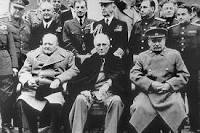
Rather than dispensing with spheres of influence the wartime leaders of the U.S., UK, and the USSR in World War II recognized even during their common cause against Naziism that an anticipated post-war rivalry between the winners to pursue their distinct national interests by extending their ideological, political, and economic influence, especially in Europe could turn dangerous. These leaders, although espousing hostile ideologies, sought agreements to avoid postwar confrontations in Europe at a series of conferences. The leaders of the U.S., USSR, and the UK reached agreements, most notably in 1945 at Yalta and Potsdam, that might have done more to prevent a slide into World War III than certainly the UN Charter and maybe even the much invoked doctrine of Mutual Assured Destruction (or MAD as denoting the pathology of genocidal peacemaking in the nuclear age).


These wartime agreements did not explicitly use the cynical language of spheres of influence but rather stressed the divisions relating to the occupation of European countries previously controlled by the defeated fascist states, with a particular attention given to Germany that was seen as the most culpable and dangerous actor among the Axis Powers. In this regard, alone among European states, Germany was divided into East  Germany and West Germany, and its capital city of Berlin was notoriously divided into West Berlin and East Berlin. For the rest of Europe, the Soviet Union was given responsibility for occupation and state building in East Europe while the victors assumed a comparable responsibility in Western Europe.

This language of division did not inhibit both ‘superpowers’ from engaged in propaganda wars with one another throughout the Cold War. Yet what it did do was to induce international prudence in a form that was respectful of these wartime assessments of control. This prudence was in stark contrast to the inflammatory response of the West to the 2023 Russian attack on Ukraine, accentuated by disdaining diplomacy, a political compromise, and openly seeking the Russian defeat so as to confirm post-Cold War unipolarity when it comes to peace and security issues. Undoubtedly, the wartime atmosphere in 1944-45 contributed to the importance of taking preventive measures to guard against the recurrence of a major war fought over the control and future of Europe. The Potsdam Conference took ended less than a week before an atomic bomb was dropped on Hiroshima, Harry Truman informing Stalin that the U.S. possessed a super-weapon that would hasten the unconditional surrender of Japan, as indeed it did.

Although conducted prior to the use of the atomic bomb this wartime diplomacy was fearfully aware that a future war would be far more destructive than two earlier world wars. In this sense, these fault lines in Europe were established in an atmosphere of hope and fear, but also within limits set by state-centrism and geopolitical ambition, giving rise quickly to tensions that extinguished hopes of retaining postwar international harmony, thereby dimming hopes of transcending the high-risk Great Power rivalries of the past. This led to Cold War bipolarity with its complex ideological, military, territorial, and political dimensions of intense conflict. And yet World War III was avoided, despite some close calls, in the ensuing 45 years after the end of World War II.

The idea of ‘geopolitical fault lines’ and even ‘spheres of influence’ are not well established in the practice or theory of international relations, but their existence is profoundly necessary for the maintenance of peace and security among Great Powers, and for the world generally. This relevance of geopolitical fault lines is partly a result of the failure of international law to have the capability to enforce consistently limits on the coercive behavior of the reigning Great Powers, granting them de facto impunity for acting beyond the limits of the law. In this sense, geopolitical fault lines and related agreed territorial divisions offer an improvised substitute for international law by setting formally agreed mutual limits on behavior backed by the specific commitments of Great Powers, which it is known that when transgressed result severe tensions, and possibly catastrophic warfare, between the most heavily armed states in the world might result.

The overriding point is that the Biden/Blinken response to the Ukraine War and the rise of China are contemptuous of the geopolitical prudence and diplomatic techniques that helped save the world from a disastrous conflagration during the Cold War Era. Of course, costly warfare broke out in the divided countries of Korea and Vietnam, but in settings where there was no assent to the temporary division imposed from without and the strategic stakes of challenging these imposed supposedly temporary divisions were peripheral as contrasted with Germany where they were of the highest order. Despite this, in the Korean and Vietnam contexts, the stakes were still high enough for the U.S. to threaten the use of nuclear weapons to maintain the status quo, most menacingly in relation to Korea, and China acting on the basis of border security entered the conflict to prevent the forcible reunification of Korea.

It goes almost out saying that geopolitical fault lines and spheres of influence are second-order restraints whose indispensability reflects the weakness of international law and the UN. Remedying these weaknesses should be accorded the highest priority by governments and peace-minded civil society activists. In the interim, spheres of influence are a recognition of multipolarity, a prelude to a more cooperative world order, and a sign that the distinctive challenges to the global public good posed by climate change and nuclear weaponry do indeed require a ‘new world order’ reflecting imperatives for leading states to act cooperatively rather than in conflictual manner.

However unlikely it now seems, it is possible that the Ukraine War will yet be remembered for producing a transition in outlook and behavior of global rivals in the direction of nonviolent geopolitics, multipolarism, and. multilateral global problem-solving. Arguably, China is currently showcasing the benefits of an increasingly activist form of geopolitics that seems intent on facilitating conflict resolution and peaceful relations, seeking a multipolar structure of world order that is not averse to demilitarizing international relations.


Geopolitical Fault Lines in a World of Sovereign States and a Few Great Powers

29 Apr

[PREFATORY NOTE: A much modified earlier version of his post was published online by Transcend Medea Service (TMS) on April 17 2023; a longer post to address complexities of the Ukraine Crisis and Looming Tensions as to the future of Taiwan. ]

The Ukrainian Point of Departure: Mishandling the Aftermath of the Cold War

The Ukraine War is illustrative. There is no doubt that Russia violated the core prohibition of international law and the UN Charter prohibiting non-defensive recourse to international force when it launched its February 2022 attack on Ukraine. Also, the evidence is overwhelming that the United States irresponsibly and multiply provoked Russia by a series of interferences with the internal politics of Ukraine in the eight years preceding the invasion. Such provocations were expressive of Washington’s post-Cold War orientation of acting internationally as the one and only sovereign state with a geopolitical prerogative that permitted the pursuit of strategic interests without respect for geographical proximity and the restraints of international law, including the sanctity of the international boundaries of sovereign states. It is this post-Cold War circumstance that led the United States to become the first extra-territorial ‘global state,’ filling the temporary geopolitical vacuum of the 1990s with its delusion that such a condition could be permanently maintained. It is this factor that gave the Ukraine War such a high profile from its inception and prolonged its resolution. The made the direct challenge posed by Russia and the implicit one by relating to Taiwan so disquieting, given U.S. hegemonic worldview.

The launch of the Ukraine War became the occasion of a geopolitical war of position in which at stake were the relative alignments of the U.S., Russia, and China, and, contrary to public protestations in the West to contrary, second tier stakes involved effort to uphold the territorial sovereignty of Ukraine. Expressed differently, the to be or not to be question is whether global security remains a traditional preoccupation of several governments managing a multipolar or bipolar world order. The alternative is to act as if this arrangement has been replaced by an existential shift to unipolarity in the aftermath of the 1991 Soviet implosion. In effect, the U.S sought to implement what amounted to a  ‘Monroe Doctrine’ for the world.

This geopolitical proxy war in Ukraine is about the aftermath of the Cold War configurations of authority with regard to global peace and security.  As such, it is about the alignment of the Great Powers in the world for which there are no established guidelines, accompanied by a refusal of political actors with a traditional geopolitical status, namely China and Russia, to leave the global management of power to the United States. As recently as early April 2023 the Russian Foreign Minister, Sergei Lavrov, speaking at the UN Security Council articulated a Russian awareness of the strategic issues at stake when he rejected a ‘unipolar world order by one hegemon’ and proposed a ‘new world order’ along multipolar lines based on principles that needed to be established by agreements reached through the diplomatic efforts of China, U.S. and Russia.

After World War II

Despite the devastating world wars of the 20th century and the widespread fear in 1945 of a future war fought with weapons on mass destruction, the more internationalist approaches to global governance proved insufficient. The ambition of substituting international law as implemented by the UN for a continued reliance on the managerial skills and responsible self-restraint of dominant states turned out to be almost irrelevant to the overriding objective of avoiding World War III. The UN was established in an atmosphere of hope and fear, but also within limits set by state-centrism and geopolitical discretionary habits, giving rise quickly to tensions that extinguished, or at least, greatly limited hopes of transcending dangerous Great Power rivalries of the past. This failure of internationalism led to Cold War bipolarity with its complex ideological, military, territorial, and political dimensions of intense conflict. And yet World War III was avoided, despite close calls and good luck, in the ensuing 45 years after the end of World War II.

It is my contention that this fear of a resumption of major warfare never materialized because principal geopolitical fault lines had been established and respected between the West and the USSR by diplomatic agreements reached at Yalta, Moscow, and Potsdam in the last years of World War II producing a series of prudent political compromises resulting in dividing countries, and even cities and regions between East and West orientations. By far the most important arrangement of this character involved the agreed division of Europe, with special attention accorded Germany, and Berlin. These fault lines were also respected due to an understanding that breeching them could quickly escalate into a mutually disastrous war fought with nuclear weapons, and a reinforcing informal, yet robust, tabu about crossing the nuclear threshold by threatened or actual use of weaponry of mass destruction. To be sure, the credibility of the fault lines was backed up by opposed military capabilities that were at the ready in the event of any serious violation.

The close calls during the Cold War decades occurred when perceptions in Washington or Moscow put the relevant fault lines under challenge, by intention or misunderstanding, perhaps most notably in the Cuban Missile Crisis of 1961. Although dumb luck played a role in avoiding the confrontation, as Martin Sherwin convincingly demonstrating in his masterful Gambling with Armageddon (2020) so did the realization of leaders in Moscow and Washington that there were dangerous ambiguities in the formulation of the fault lines. For the Soviet Union, U.S. deployment of nuclear weapons in its Turkish neighbor was treated as equivalent its decision to deploy nuclear weapons in Cuba, especially given the real threat of a U.S. or U.S. backed intervention being directed at Castro’s Marxist government. For the United States this Soviet challenge was interpreted as an unacceptable encroachment on a vital Caribbean sphere of influence close to the U.S. homeland, purporting also to discourage any American future efforts to replace the Castro government by a regime-changing intervention. 

To avoid victory/defeat scenarios in this encounter led the Soviets to abandon the deployment of nuclear missiles in Cuba and the U.S. to remove discreetly nuclear weapons from Turkey rationalizing the initiative by arguing that they were headed for ‘retirement’ in any event. In other words, a more or less reciprocal backdown from postures of menacing confrontation was achieved largely resulting from the direct communications between the respective leaders in the midst of the crisis. Respecting spheres of influence, thanks to crucial agreements reached by the wartime diplomacy in 1944-45, the U.S. enjoyed a free hand in Western Europe and the Soviets in Eastern Europe, as well as the subdivision of Germany and the sub-sub division of Berlin. It was this recognition of and respect for such traditional spheres of influence that likely prevented World War III, especially in discouraging the kind of coercive responses by NATO countries to the crude and brutal Soviet interventions in East Germany (1953), Hungary (1956), and Czechoslovakia (1968) even in the face of conservative and militarist pressures to do so.

The two most prolonged wars during the Cold War were in Korea and Vietnam where neither side had major strategic interests, nuclear deployments, nor were geopolitical alignments significantly engaged. This runs contrary to Antony Blinken’s contention in the ‘rule-governed’ world that the U.S. respects, but its rivals supposedly do not. Blinken has publicly insisted that spheres of influence were thrown into the dustbin of history as of the end of World War II. The nature of what is Blinken’s source of rule governance, other than the foreign policy of the United States, has never been officially disclosed. What we know is that it is something currently presented by the highest U.S. foreign policy official as something radically different than either international law and the multipolar framing of world politics by Russia and China, countries which obviously give weight and legitimacy to their regional prerogatives and traditional spheres of influence. Perhaps, the spirit of the rule-governed world that Blinken believes has become the ‘new world order’ is best captured by the phrase ‘pax Americana.’  This label is more transparent of intent and effect than is the abstraction of ‘unipolarity.’

Past and Present Diplomatic Limits

Historians agree that World War I arose out of a series of interacting miscalculations by the Great Powers of Europe that resulted in a deadly war costing tens of millions of lives and great devastation, and changing nothing. This conflict exemplified the dangers of managing global power relations without geopolitical fault lines. However, the peace diplomacy at Versailles after combat ended in 1918 failed in its war prevention efforts centering on the establishment of the League of Nations, a punitive peace imposed on Germany, and an acceptance of unregulated international economic rivalry. Fascism and the Great Depression ensued, and new challenges were mounted against world order, abetted by Japan’s rise, which produced World War II. This destructive struggle led to a victory for the liberal democracies but also the onset of the Nuclear Age. A second effort at war prevention was undertaken, and although the UN was marginalized by the two ‘superpowers,’ and ‘world peace’ rested on a combination of prudent self-restraint, mutual deterrence, and the largely effective respect shown geopolitical fault lines established in Europe.

This combination of developments led to the long Cold War of arms races, interventions, and ideological antagonism yet succeeded in avoiding a third world war. Unfortunately, the Cold War ended in the early 1990s with available steps not taken to bolster war prevention capabilities, and the peoples of the world find themselves helpless at the edge of the cliff with the only hopeful sign a belated willingness of both sides to recognize that the Ukraine War would be most likely to end in a stalemate, leaving the post-Cold War geopolitical alignment unresolved. In conformity with my analysis, if this happens, the incentives to achieve a diplomatic recognition acknowledging the relevance of geopolitical fault lines for the 21st Century might occur but only if there is enough pressure by peace forces from below and rationality from above.

Not Forgetting Taiwan

Finally, a brief word on dangers of war in the Pacific arising out of the U.S./China relationship. It risks crossing the invisible line separating competition, which is consistent with peace and even cooperation motivated by mutual interests, from conflict, which teeters on the perilous edges of crisis, confrontation, and ‘warfare,’ hot or cold.

The core present question is whether China intends to coerce Taiwan to achieve existential subordination to China or retains a position of what has been called ‘creative ambiguity’ by former U.S. diplomat, Chas Freeman. The essence of this deliberate ambiguity is to acknowledge simultaneously that Taiwan is part of China while allowing it to enjoy the full benefits of internal independence from China. This distinctive formula of diplomatic accommodation is embodied in the Shanghai Communique signed by the two countries in 1972 and respected for the last 50 years. The nature of the geopolitical fault line is a diplomatic compromise between the exercise of Chinese sovereign control over Taiwan and fulfilling Taiwan’s aspirations for independent statehood.

If either side acts to undermine the Shanghai arrangement it will invite a situation in some ways resembling the situation of provocative uncertainty leading to the Ukraine War. Mutual observance, in contrast, would help sustain an atmosphere of

Geopolitical Fault Lines in a World of Sovereign States and a Few Great Powers

[A much modified earlier version of his post was published in the online listserv Transcend Midea Service (TMS) on April 17 2023; a longer post to address complexities of the Ukraine Crisis and Looming Tensions as to the future of Tawan. ]

The Ukrainian Point of Departure: Mishandling the Aftermath of the Cold War

The Ukraine War is illustrative. There is no doubt that Russia violated the core prohibition of international law and the UN Charter prohibiting non-defensive recourse to international force when it launched its February 24, 2022 attack on Ukraine. Also, the evidence is overwhelming that the United States irresponsibly and multiply provoked Russia by a series of interferences with the internal politics of Ukraine in the eight years preceding the invasion. Such provocations were expressive of Washington’s post-Cold War orientation of acting internationally as the one and only sovereign state with a geopolitical prerogative that permitted the pursuit of strategic interests without respect for geographical proximity and the restraints of international law, including the sanctity of the international boundaries of sovereign states. It is this post-Cold War circumstance that led the United States to become the first extra-territorial ‘global state,’ filling the temporary geopolitical vacuum of the 1990s with its delusion that such a condition could be permanently maintained. It is this factor that gave the Ukraine War such a high profile from its inception and prolonged its resolution. The made the direct challenge posed by Russia and the implicit one by relating to Taiwan so disquieting, given U.S. hegemonic worldview.

The launch of the Ukraine War became the occasion of a geopolitical war of position in which at stake were the relative alignments of the U.S., Russia, and China, and, contrary to public protestations in the West to contrary, second tier stakes involved effort to uphold the territorial sovereignty of Ukraine. Expressed differently, the to be or not to be question is whether global security remains a traditional preoccupation of several governments managing a multipolar or bipolar world order. The alternative is to act as if this arrangement has been replaced by an existential shift to unipolarity in the aftermath of the 1991 Soviet implosion. In effect, the U.S sought to implement what amounted to a  ‘Monroe Doctrine’ for the world.

This geopolitical proxy war in Ukraine is about the aftermath of the Cold War configurations of authority with regard to global peace and security.  As such, it is about the alignment of the Great Powers in the world for which there are no established guidelines, accompanied by a refusal of political actors with a traditional geopolitical status, namely China and Russia, to leave the global management of power to the United States. As recently as early April 2023 the Russian Foreign Minister, Sergei Lavrov, speaking at the UN Security Council articulated a Russian awareness of the strategic issues at stake when he rejected a ‘unipolar world order by one hegemon’ and proposed a ‘new world order’ along multipolar lines based on principles that needed to be established by agreements reached through the diplomatic efforts of China, U.S. and Russia.

After World War II

Despite the devastating world wars of the 20th century and the widespread fear in 1945 of a future war fought with weapons on mass destruction, the more internationalist approaches to global governance proved insufficient. The ambition of substituting international law as implemented by the UN for a continued reliance on the managerial skills and responsible self-restraint of dominant states turned out to be almost irrelevant to the overriding objective of avoiding World War III. The UN was established in an atmosphere of hope and fear, but also within limits set by state-centrism and geopolitical discretionary habits, giving rise quickly to tensions that extinguished, or at least, greatly limited hopes of transcending dangerous Great Power rivalries of the past. This failure of internationalism led to Cold War bipolarity with its complex ideological, military, territorial, and political dimensions of intense conflict. And yet World War III was avoided, despite close calls and good luck, in the ensuing 45 years after the end of World War II.

It is my contention that this fear of a resumption of major warfare never materialized because principal geopolitical fault lines had been established and respected between the West and the USSR by diplomatic agreements reached at Yalta, Moscow, and Potsdam in the last years of World War II producing a series of prudent political compromises resulting in dividing countries, and even cities and regions between East and West orientations. By far the most important arrangement of this character involved the agreed division of Europe, with special attention accorded Germany, and Berlin. These fault lines were also respected due to an understanding that breeching them could quickly escalate into a mutually disastrous war fought with nuclear weapons, and a reinforcing informal, yet robust, tabu about crossing the nuclear threshold by threatened or actual use of weaponry of mass destruction. To be sure, the credibility of the fault lines was backed up by opposed military capabilities that were at the ready in the event of any serious violation.

The close calls during the Cold War decades occurred when perceptions in Washington or Moscow put the relevant fault lines under challenge, by intention or misunderstanding, perhaps most notably in the Cuban Missile Crisis of 1961. Although dumb luck played a role in avoiding the confrontation, as Martin Sherwin convincingly demonstrating in his masterful Gambling with Armageddon (2020) so did the realization of leaders in Moscow and Washington that there were dangerous ambiguities in the formulation of the fault lines. For the Soviet Union, U.S. deployment of nuclear weapons in its Turkish neighbor was treated as equivalent its decision to deploy nuclear weapons in Cuba, especially given the real threat of a U.S. or U.S. backed intervention being directed at Castro’s Marxist government. For the United States this Soviet challenge was interpreted as an unacceptable encroachment on a vital Caribbean sphere of influence close to the U.S. homeland, purporting also to discourage any American future efforts to replace the Castro government by a regime-changing intervention. 

To avoid victory/defeat scenarios in this encounter led the Soviets to abandon the deployment of nuclear missiles in Cuba and the U.S. to remove discreetly nuclear weapons from Turkey rationalizing the initiative by arguing that they were headed for ‘retirement’ in any event. In other words, a more or less reciprocal backdown from postures of menacing confrontation was achieved largely resulting from the direct communications between the respective leaders in the midst of the crisis. Respecting spheres of influence, thanks to crucial agreements reached by the wartime diplomacy in 1944-45, the U.S. enjoyed a free hand in Western Europe and the Soviets in Eastern Europe, as well as the subdivision of Germany and the sub-sub division of Berlin. It was this recognition of and respect for such traditional spheres of influence that likely prevented World War III, especially in discouraging the kind of coercive responses by NATO countries to the crude and brutal Soviet interventions in Hungary (1956), East Germany (1958), and Czechoslovakia (1968) even in the face of conservative and militarist pressures to do so.

The two most prolonged wars during the Cold War were in Korea and Vietnam where neither side had major strategic interests, nuclear deployments, nor were geopolitical alignments significantly engaged. This runs contrary to Antony Blinken’s contention in the ‘rule-governed’ world that the U.S. respects, but its rivals supposedly do not. Blinken has publicly insisted that spheres of influence were thrown into the dustbin of history as of the end of World War II. The nature of what is Blinken’s source of rule governance, other than the foreign policy of the United States, has never been officially disclosed. What we know is that it is something currently presented by the highest U.S. foreign policy official as something radically different than either international law and the multipolar framing of world politics by Russia and China, countries which obviously give weight and legitimacy to their regional prerogatives and traditional spheres of influence. Perhaps, the spirit of the rule-governed world that Blinken believes has become the ‘new world order’ is best captured by the phrase ‘pax Americana.’  This label is more transparent of intent and effect than is the abstraction of ‘unipolarity.’

Past and Present Diplomatic Limits

Historians agree that World War I arose out of a series of interacting miscalculations by the Great Powers of Europe that resulted in a deadly war costing tens of millions of lives and great devastation, and changing nothing. This conflict exemplified the dangers of managing global power relations without geopolitical fault lines. However, the peace diplomacy at Versailles after combat ended in 1918 failed in its war prevention efforts centering on the establishment of the League of Nations, a punitive peace imposed on Germany, and an acceptance of unregulated international economic rivalry. Fascism and the Great Depression ensued, and new challenges were mounted against world order, abetted by Japan’s rise, which produced World War II. This destructive struggle led to a victory for the liberal democracies but also the onset of the Nuclear Age. A second effort at war prevention was undertaken, and although the UN was marginalized by the two ‘superpowers,’ and ‘world peace’ rested on a combination of prudent self-restraint, mutual deterrence, and the largely effective respect shown geopolitical fault lines established in Europe.

This combination of developments led to the long Cold War of arms races, interventions, and ideological antagonism yet succeeded in avoiding a third world war. Unfortunately, the Cold War ended in the early 1990s with available steps not taken to bolster war prevention capabilities, and the peoples of the world find themselves helpless at the edge of the cliff with the only hopeful sign a belated willingness of both sides to recognize that the Ukraine War would be most likely to end in a stalemate, leaving the post-Cold War geopolitical alignment unresolved. In conformity with my analysis, if this happens, the incentives to achieve a diplomatic recognition acknowledging the relevance of geopolitical fault lines for the 21st Century might occur but only if there is enough pressure by peace forces from below and rationality from above.

Not Forgetting Taiwan

Finally, a brief word on dangers of war in the Pacific arising out of the U.S./China relationship. It risks crossing the invisible line separating competition, which is consistent with peace and even cooperation motivated by mutual interests, from conflict, which teeters on the perilous edges of crisis, confrontation, and ‘warfare,’ hot or cold.

The core present question is whether China intends to coerce Taiwan to achieve existential subordination to China or retains a position of what has been called ‘creative ambiguity’ by former U.S. diplomat, Chas Freeman. The essence of this deliberate ambiguity is to acknowledge simultaneously that Taiwan is part of China while allowing it to enjoy the full benefits of internal independence from China. This distinctive formula of diplomatic accommodation is embodied in the Shanghai Communique signed by the two countries in 1972 and respected for the last 50 years. The nature of the geopolitical fault line is a diplomatic compromise between the exercise of Chinese sovereign control over Taiwan and fulfilling Taiwan’s aspirations for independent statehood.

If either side acts to undermine the Shanghai arrangement it will invite a situation in some ways resembling the situation of provocative uncertainty leading to the Ukraine War. Mutual observance, in contrast, would help sustain an atmosphere of peaceful competition between the two countries and demonstrate that geopolitical fault lines can do what neither international law nor the UN are capable of presently doing, setting mutually respected limits in situations of strategic disagreement and tensions between Great Powers. 

competition between the two countries and demonstrate that geopolitical fault lines can do what neither international law nor the UN are capable of presently doing, setting mutually respected limits in situations of strategic disagreement and tensions between Great Powers. 

[Prefatory Note: This is the third iteration of an essay on the evolution of the Ukraine War, the earlier two versions published online in Transcend Media Service (TMS) and CounterPunch. The essential argument remains: war-mongering geopolitics in the nuclear age imperils species survival and suppresses the necessity for emergency action to restore sustainable forms of ecological habitability to planet earth.]

25 Oct

Ukraine War Evolves: Who  Will Awaken Rip Van Winkle?

RIP VAN WINKLE SLEEPS FOR 20 YEARS

Ukraine War Evolves: Who  Will Awaken Rip Van Winkle?

Disdaining Diplomacy, Seeking Victory

Ever since the Ukraine War started on February 24, 2022 the NATO response, mainly articulated and materially implemented by the U.S., has been to pour vast quantities of oil on the flames of conflict, taunting Russia and its leader, increasing the scale of violence, the magnitude of human suffering, and dangerously increasing the risk of a disastrous outcome. Not only did Washington mobilize the world to denounce Russia’s ‘aggression’, but supplied a steady stream of advanced weaponry in great quantities to the Ukrainians to resist the Russian attack and even mount counterattacks. The U.S. did all it could at the UN and elsewhere to build a punitive coalition supportive of international sanction hostile to Russia, and when this failed to gain sufficient support resorted to a range of national sanctions. The American president, Joe Biden, also breached diplomatic protocol by resorting to the demonization of Putin as a notorious war criminal unfit to govern and deserving of indictment and prosecution. This incendiary flow of state propaganda was faithfully conveyed by a self-censoring Western media filter that built public support for a Western posture of war rather than diplomacy. It did this primarily by graphically portraying on a daily basis the horrors of the war endured by the vivid portrayals of the sufferings being by the Ukrainian civilian population, something the media has been advised to avoid when dealing with U.S. regime-changing interventions or Israel’s violence and flagrant practices of collective punishment unlawfully inflicted on the Palestinian people.

This unduly provocative behavior, given the wider issues at stake, is underscored by a newly discovered West-oriented enthusiasm for the International Criminal Court, urging the tribunal to gather as much evidence as quickly as possible of Russian war crimes. This law-oriented posture is contradicted by intense past opposition to ICC efforts to gather evidence for an investigation of war crimes by non-signatories (of which Russia is one) in relation to the U.S. role in Afghanistan or Israel’s role in occupied Palestine. To some degree such one-sidedness of presentation was to be expected, and even justified given Russia’s aggression, which while irresponsibly provoked was still a breach of the most fundamental norm of international law. And yet the intensity of this NATO response in relation to Ukraine has been dangerously interwoven with an irresponsible and amateurishly pursued geopolitical war waged by the U.S. against Russia, and indirectly against China. It is so far a war fought without weapons, yet with a major potential impact on the the structure and processes of world order in the aftermath of the Cold War, further complicated by the ascent of China as a credible regional and even global rival to U.S. dominance. Such a geopolitical war proceeds on uncharted historical conditions. It is being waged in a manner oblivious to wider human security interests, and in a profound and perverse sense, contrary even to the wellbeing and fate of Ukraine and its people.

Despite the presence of these features of the Ukraine War, Western minds continue to view the conflict with one eye closed. Even Stephen Walt, a moderate and sensible self-styled realist commentator on U.S. foreign policy, and currently, a prudent, persuasive critic of the Biden failure to do his best to shift the bloody encounter in Ukraine from the battlefield to diplomatic domains nevertheless joins the war-mongering chorus by misleadingly asserting without qualification that “Russia’s invasion of Ukraine is illegal, immoral, and unjustifiable..” [Walt, “Why Washington Should Take Russian Nuclear Threats Seriously,” Foreign Policy, May 5, 2022] It is not that such a characterization is incorrect as such, but unless supplemented by explanations of context it lends credibility to the war-oriented, self-righteous mentality displayed by the Biden presidency, while shielding its geopolitical war dimensions from scrutiny. Perhaps Walt and others of similar outlook were striking this posture of going along with Washington’s portrayal of the Ukraine Crisis as a tactical concession needed to be in a position to propose a Faustian Bargain of self-righteousness as a prelude to endorsing support for finally adopting a diplomatic stance toward ending the Ukraine War, and abandoning the ultra-hazardous militarist path toward victory for Ukraine and defeat for Russia. Perhaps, Walt frames his argument to gain a seat at the table with influential audiences in Washington. Understandingly believing that even their dire warnings about the rising escalation risks and to improve chances of advocacy of diplomacy will otherwise not even get a hearing from the foreign policy insiders advising Biden/Blinken. 

To be clear, even if it can be argued that Russia/Putin have launched a war that is unlawful, immoral, and unjustified, the wider geopolitical context remains imperative if peace in Ukraine is to be restored and global catastrophe avoided. For one thing, the Russian attack may be as wrong as alleged, and yet conforms to a geopolitical pattern of established  behavior that the U.S. has itself been largely responsible for establishing in a series of wars starting with the Vietnam War, and notably more recently with the Kosovo War, Afghanistan War, and the Iraq War. None of these wars were legal, moral, and justifiable, although each enjoyed a geopolitical rationale that made them seem sufficiently desirable to U.S. foreign policy elites and its closest alliance partners to be worth undertaking despite violating these norms. Of course, two wrongs do not make a right, but in a world where geopolitical actors enjoy a license to pursue vital strategic interests within traditional spheres of influence, it is not objectively defensible to self-righteously condemn Russia without taking some principled account of what the U.S. has been doing around the world for several decades. Antony Blinken may tell the media that spheres of influence became a thing of the past after World War II, but he must have been asleep for decades not to notice that the Yalta Agreement on the future of Europe reached in 1945 by the Soviet Union, United States, and the United Kingdom was premised on precisely the explicit affirmation of such spheres, which in retrospect, however distasteful in application, deserve some credit for keeping the Cold War from becoming the disaster of all disasters, World War III fought with nuclear weapons far more potent than the atomic bombs that so apocalyptically devastated the people and cities of Hiroshima and Nagasaki. Such compromised sovereignty of these borderland countries is descriptive of the often tragic prerogatives claimed by so-called Great Powers throughout the history of international relations, not least by the United States through the Monroe Doctrine and its extensions. In this sense, Ukraine finds itself in the long unenviable position of Mexico, and indeed all of Latin America. Many years ago the famous Mexican cultural figure, Octavio Paz, proclaimed the tragedy of his country ‘to be so far from God and yet so close to the United States.’

The UN  Itself a Vehicle of Geopolitics more the International Law

In a somewhat insightful fit of frustration, George W. Bush after a failure to gain UN Security Council authorization in 2003 for the use of non-defensive regime-changing force against Iraq, declared that the UN would lose its ‘relevance’ if it failed to go along with the American imperial plan of action, and so it has. The ambiguity as to international law arises from the UN Charter own equivocation, asserting that all non-defensive uses of force are prohibited, a position reinforced by the amended Rome Statute governing the International Criminal Court by declaring ‘aggression’ as a crime against the peace, while conferring a conferring a right of veto on the five permanent members of the UN Security Council. How can this right of veto be conferred on these five states, which has the effect of precluding any Security Council decision that clashes with their strategic interests, be reconciled with the Charter and international law prohibition on aggression? Of course, Bush’s frustration was more extreme in the sense that he was expecting the Security Council to sanitize a proposed unlawful war of aggression against Iraq, that is, in a fit of unipolar arrogance, this American president expected that even the veto powers would fall in line, and offer the US/UK attacking coalition the legitimacy of UN authorization. When this was not forthcoming the U.S. did not adjust its war plans, but resorted to this dismissal of the UN.

The right of exception as embodied in the constitutional framework of the UN is not some peculiar anomaly, and the failed Bush override was an unusual rebuff of imperial geopolitics that flourished after the Cold War. It was seldom notice that such developments were indirectly anticipated by post-1945 experience of international criminal law, which from Nuremberg to the present has exempted from accountability dominant geopolitical actors, even for such incredible acts as the dropping of atomic bombs on overwhelmingly civilian targets at the end of World War II. This gray zone separating law from power continues to be the accepted playground of geopolitical actors, never so dangerous as when its prerogatives, alignments, and constraints are in flux. The Russian and Chinese challenges can be best interpreted as seeking to restore the framework of geopolitical bipolarity (or modified to accommodate tripolarity) that collapsed after the disintegration of the Soviet Union. This situation led the U.S. to fill the resulting vacuum with a militarist/neoliberal form of geopolitical management consisting of full spectrum dominance of the instruments of warfare and an ideological insistence that the legitimacy of the internal political order of a sovereign state depended on its adherence to a market-driven logic of private sector dominance at home and internationally, the s0-called ‘Washington consensus.’ The momentous open question, aside from worrying about how and when the war in Ukraine will end, is whether the geopolitical world order resting on U.S. primacy will be confirmed or modified. If confirmed it will extend the period of unipolarity that followed the end of the Cold War. If modified, it will usher in a new era of geopolitics requiring a new framework of meta-legal accommodation. In either case, there exists the additional uncertainty as to whether post-Ukraine world order will be oriented toward cooperation and the production of global common goods or with hegemonic and conflictual priorities.

Geopolitical Practice: Prudent or Irresponsible

These considerations are mentioned here not to defend, much less exonerate Russia, but to show that the world order context of the Ukraine War is deeply problematic in relation to U.S./NATO claims of normative authority, especially when invoked in such a partisan manner. In contemporary geopolitical relations, as distinct from normal state-to-state or international relations, precedent and Great Power experience generally act as substitutes for norms and rule-governed behavior, at least on matters of peace, national security, and public economic policy. What the U.S. claims the right to do and does, can be generally done subsequently by other sovereign states, especially those with some level of geopolitical entitlement. Blinken has again muddied the waters of international discourse by falsely claiming that the U.S., unlike adversaries China and Russia, is as observant of rule-governed behavior in a similar manner to that regulating the behavior of ‘normal states’ in relation to matters of vital strategic interests

To gain a clearer and more objective perspective on aspects of Russian behavior in Ukraine it seems appropriate to look back at NATO’s clearly unlawful war of 1999. This non-defensive war, unauthorized by the UN, fragmented Serbia by coercively supporting Kosovo’s claimed right of secession, including political independence and territorial sovereignty. Account should be taken of this Kosovo precedent before uncritically condemning the Russian annexation of four parts of eastern Ukraine, rationalized as the exercise of rights of self-determination in the light of alleged Serbian abuse, and supposedly validated by after administering widely condemned referenda. Yet even here an understanding of past geopolitical behavior is instructive. The NATO military victory didn’t even bother with a referendum before implementing Kosovo’s secession.

The point is not to condemn all such undertakings without legal authority by recognizing that there may be extreme cases where the fragmentation of existing states is justifiable on humanitarian grounds and others where it is not, but to claim that Russia overstepped the limits of law in a context where power has been consistently shaping behavior and political outcomes in similar cases is to prepare the public for a wider war rather than leading it to seek and be pragmatically receptive to a diplomatic compromise. In effect, I am arguing for the wisdom and virtue of what might be described as geopolitical humility and self-restraint: do not require of others, what you have yourself done, or at the very least explain non-polemically what is the difference between say Dombas and Kosovo that makes the former unlawful and illegitimate and the latter lawful and legitimate. In the complexity of internal struggles of a beleaguered ethnic or religious minority it is along the same lines helpful to acknowledge that Moscow and Washington ‘see’ the same realities of the Dombas and Kosovo in contradictory ways.

This contextual understanding of the Ukraine War is in my judgment highly relevant as it makes the current fashion of mounting legal, moral, and political arguments of condemnation distract attention and energies from following otherwise rational, prudent, and pragmatic courses of action, which from day one of the attack on Ukraine strongly supported the wisdom of making an all-out effort to achieve an immediate ceasefire followed by negotiations aiming at durable political compromises not only between Russia and Ukraine, but also between Europe/U.S. and Russia. That the U.S. Government never to this day has publicly manifested any such interest, much less setting forth a commitment to stopping the killing and devastation by encouraging diplomacy, in the face of mounting costs and escalation risks associated with prolonging the warfare in Ukraine. Such geopolitical recklessness should be shocking to the conscience of peace-minded persons and patriots of humanity everywhere.

Beyond the immediate zones of combat, catastrophic costs are presently being borne by many vulnerable societies throughout the world from the spillover effects of the war, magnified by anti-Russian sanctions and their major impact on food and energy supplies and pricing. Such a deplorable situation, likely to get worse as the war goes on and likely intensified in the coming Winter months. Beyond this it is now also bringing closer to reality the growing danger of the use of nuclear weapons as Putin’s alternatives may be narrowing to a personal willingness to accept responsibility for a Russian defeat or to give up his status as autocratic leader. While not relenting a bit on implementing an aggressive approach to gaining Ukraine’s ambitions of victory, Biden himself incredibly acknowledges that any use of even a tactical nuclear weapon in Ukraine would with near certitude lead to Armageddon. This paradoxical duality (combining escalating the war and anxiety as to where it might lead) seems more like a mindless embrace of geopolitical insanity than a sobering balancing of the contradictory somber realities at stake in Ukraine. We can ask when will this Rip Van Winkle of our time awaken to the realities of the nuclear age?

As always actions speak louder than words. Blinken facing a rising public clamor for negotiations, especially in Europe, responds with his usual feckless evasions. In this instance, contending that since Ukraine is the victim of Russian aggression it alone has the authority to seek a diplomatic resolution and the U.S. will continue to support Ukraine’s maximal war aims, supposedly, for as long as and for whatever it takes, including recently even the extension of Ukraine war aims to the recovery of Crimea, which has been widely accepted internationally as reabsorbed by Russia since 2014.

Context also matters in relation to the conduct of the war. Its major escalation within the month of the sabotage of Nord Stream1 & 2 gas pipelines to Europe, which Blinken once more confounded by this act of sabotage outside the war zone by calling it ‘a tremendous opportunity’ to make weaken Russia and force Europe to intensify their efforts to gain energy independence. Such an operation initially implausibly attributed to Russia by the U.S., yet later more or less acknowledged as part of the expansion of the war by reliance on ‘terrorist’ tactics of combat. This latest expression of state terrorism is the suicide bombing of the strategic Kerch Straight Bridge on October 7th, connecting Crimea and Russia, a major infrastructure achievement of the Putin period of Russian leadership, as well as a symbolic expression of relinking Crimea to Russia serving as a supply line for Russian troops operating in the Southern parts of Ukraine. These extensions of the combat zone and tactics beyond the territory of Ukraine contain the fingerprints of the CIA and seems designed as encouragement of Ukrainian resolve to go all out for a decisive victory, sending Putin unmistakable signals that the U.S. remains as unreceptive as ever to a responsible geopolitics of compromise. Biden reportedly refuses even to respond favorably to Putin’s apparent initiative that the two leaders discuss their differences at the G-20 meeting in Indonesia. Biden’s characteristic response was a defiant refusal, subject only to reconsideration if the meeting was limited to negotiating the release of an American female pro basketball player being held in Russia on drug charges. The U.S. anger directed at Saudi Arabia for cutting its oil production is an additional sign of a commitment to a victory scenario in Ukraine as well as a reaction against the Saudi resistance to U.S. hegemonic geopolitics in its co-management of OPEC+ with Russia. With such provocations, it is hardly surprising, although highly unlawful and immoral, for Russia to retaliate by unleashing its version of ‘shock and awe’ against the civilian centers of ten Ukrainian cities. Such is the course of these vicious cycles of escalation characteristic of the lawlessness of major warfare! The neglect of the relevant and shameful American precedents in Iraq and Afghanistan is also integral to sustaining a war mentality under siege.

Concluding Observations

Always lurking in the background, and at Ukraine’s and the world’s expense, is Washington’s geopolitical opportunism, that is, seeking to defeat Russia and deter China from daring to challenge the hegemonic unipolarity achieved after the Soviet disintegration in 1992. This huge investment in its militarist identity as the sole ‘global state’ that best explains such a cowboy approach to nuclear risk-taking and the tens of billions expended to empower Ukraine at a time of internal suffering in the U.S. and elsewhere coexisting with such a costly expression and dangerous expression of international overreach.

Such a tragic political drama unfolds as the peoples of the world and their governments, along with the United Nations, watch this horrendous spectacle unfold, seemingly helpless witnesses not only to stop the carnage, but also to do their best to curtail the spillover and Armageddon dangers, and even to react meaningfully against the potential supreme damage to their own national destinies.

Ukraine: War, Statecraft, and Geopolitical Conflict —the nuclear danger

14 Sep

[Prefatory NoteThe following interview was previously published in September by the online Global Governance Forum. My responses to the questions posed by Aslı Bâli have been somewhat updated to take account of intervening developments. Aslı was my last PhD student at Princeton, has emerged as a star of the UCLA School of Law in recent years, and just now has joined the faculty of Yale Law School. Although her brilliance as a Princeton student both stimulated and challenged me, it as a cherished friend that Aslı has most impacted my life.]

Ukraine: War, Statecraft, and Geopolitical Conflict — a focus on the return of the nuclear question

Introduction: The risk of nuclear escalation in the context of Russia’s invasion of Ukraine has been a subject of considerable debate in the United States among scholars, policy analysts and media commentators. These debates reveal a broad spectrum of views from those who dismiss Russian references to nuclear capabilities as mere saber rattling to those who worry that if Russian President Vladimir Putin finds his back to the wall in Ukraine, he may resort to tactical nuclear strikes. Whatever the assessment of the risks in Ukraine, it is clear that questions of nuclear deterrence are back on the table after nearly a generation in which most American analysts viewed non-proliferation as the sole U.S. foreign policy objective regarding nuclear arsenals. 

For those who have continued to press concerns about nuclear disarmament since the end of the Cold War, the return of the nuclear question may raise awareness among new audiences about the existential threat posed by existing nuclear arsenals. Richard Falk has for decades been an outspoken authority calling for denuclearization. In this interview, Aslı Bâli invites Richard to reflect on whether the Ukraine conflict risks becoming a military confrontation that tips the world into further nuclear escalation or whether there remains an opportunity to move the world away from the nuclear precipice.

Richard Falk is the Albert G. Milbank Professor of International Law and Practice Emeritus at Princeton University and Chair of Global Law at Queen Mary University London, Faculty of Law. He is the author or co-author of over twenty books, and editor or co-editor of numerous others. A collection of his selected writings on nuclear disarmament was published in an edited volume from Cambridge University Press titled On Nuclear Weapons: Denuclearization, Demilitarization and Disarmament (2019). Aslı Bâli is Professor of Law at UCLA School of Law and Founding Faculty Director of the Promise Institute for Human Rights. She interviewed Falk in May 2022.

Aslı Bâli: To begin our conversation, it would be useful to provide some context as to why nuclear disarmament was largely sidelined as an urgent international question in the post-Cold War period. How might we think about the last two decades in particular, during which the possibility of the development of an Iranian nuclear arsenal was deemed so much more threatening than the existence of extensive nuclear arsenals in the hands of other states? 

Richard Falk: I think the last two decades since the Soviet collapse reflect a period in which the nuclear weapons states, particularly the US, have felt comfortable with the nuclear status quo. Their preference was to organize this arrangement—in which they maintain nuclear arsenals and other states forego that option—as a permanent regime anchored in the non-proliferation treaty (NPT) interpreted in such a way as to drop the disarmament requirements of that treaty. Article VI of the NPT contains the good faith nuclear disarmament obligation, which was supposedly the bargain offered to induce non-nuclear states to become parties to the treaty. The attempt by nuclear weapons states to drop this element from the treaty arrangement creates an interesting international law situation: There’s a breach of an essential provision of the NPT, yet this treaty regime is regarded by the US and NATO countries as a great achievement of international law in relation to nuclear threat reduction. The existential scope of the NPT is reduced to a hegemonic arrangement that imposes limits on the proliferation of nuclear weapons, while keeping the development and control of the weapons restricted to a small group of nuclear weapons states. This includes the discretion to develop and threaten their use, as well as determining how and whether they would be used, and to what extent, in crisis or combat situations. This is a regulatory framework that neither reflects the NPT as a negotiated text, nor is prudent and equitable, and it certainly violates the major premise of the rule of law—treating equals equally.

I participated in a Council on Foreign Relations webinar event a year or so ago about the future of national security, and one of the participants introduced the idea that Article VI of the NPT is best understood as ‘a useful fiction.’ That is, Article VI was included in the treaty as a way of satisfying non-nuclear countries that they were being offered an equitable bargaining framework by becoming parties to the NPT. Whereas in fact there was a tacit understanding from the beginning that disarmament, despite the treaty language of commitment, was not viewed by political elites of the nuclear weapons states as a realistic, or even a desirable goal, to be pursued by the nuclear weapons states, and most especially it was so viewed by the United States.

In considering the broader context that has, as you put it, sidelined the issues of nuclear disarmament, the other thing to be emphasized is that there had crept in a kind of complacency about this weaponry. There are thousands of nuclear weapons, preponderately in the US and Russia, and very little public understanding of existing constraints on their threat or use or under what circumstances these arsenals might be introduced into diplomacy or even combat situations. The U.S. in particular, and some other countries like Israel, have been developing combat roles for certain types nuclear weapons—styled as tactical nuclear arms or so-called “mini-nukes”—that strongly implied that such weapons might actually be introduced into local or regional conflicts. Given the array of bilateral conflicts that have the risk of nuclear escalation including in Ukraine, if confrontation escalates in relation to Taiwan, on the Korean peninsula, in India/Pakistan, perhaps if Israel’s security is under pressure in the Middle East. Despite these possibilities being widely feared, there has been so far no concerted or consistent international response exhibiting opposition or even anxiety. 

The risks of the overall situation are well-reflected for those who follow the nuclear issue by the fact that the Doomsday clock—maintained by the Bulletin of Atomic Scientists and often relied upon as a reliable assessment of nuclear danger at a given time—has moved ever closer in this period to midnight. Prior to the Ukraine crisis I think it was already only one hundred seconds away from midnight. In the words of the editors, “the Clock remains the closest it has ever been to civilization-ending apocalypse.” The UN Secretary General has recently warned that the world is but ‘one miscalculation’ away from nuclear catastrophe.

There is another worrisome aspect of the manner in which the three NATO nuclear weapons states have assumed the authority to enforce the NPT regime as it applies to non-nuclear states. There is nothing about enforcement in the treaty, and Article X grants non-nuclear states a right of withdrawal if facing severe security threats. And yet the U.S. and Israel have made unlawful claims to use force if they believe Iran intends or achieves a nuclear weapons capability. This is hegemonic geopolitics, which not be confused with the implementation of international law.

The complacency toward this weaponry and the satisfaction with the NPT regime that has allowed powerful states to retain a hierarchical and hegemonic relationship to non-nuclear states are important dimensions of this doomsday risk. Thus, the situation prior to Ukraine, Taiwan, and Iran require urgent action to avoid existential dangers, but global complacency and the diversionary priority given to containing proliferation threats posed by non-nuclear states rather than addressing the risks of existing arsenals has kept the nuclear agenda from any serious engagement with disarmament and war threats for many decades. This must stop or disaster is virtually assured.

Aslı Bâli: Your response raises one further question: why, in your view, have the non-nuclear states acquiesced in the violation of the core bargained-for agreement they had negotiated in the NPT?  

Richard Falk: I think the non-nuclear weapons states, too, have adapted to this complacent atmosphere when it comes to nuclear weapons, although this may be changing, and not primarily because of Ukraine. It may reflect a sense of a lack of leverage over global nuclear policy in a post-Cold War context. During the Cold War, there had been some willingness on the part of the Soviet Union and then China to engage in a disarmament process on negotiating arsenal reductions, and this seemed realistic to the rest of the world. But in the post-Cold War period, the U.S. shifted away from even the pretense of disarmament priorities and there has been an absence of powerful states pushing back against this trajectory. That said, I do think there is now emerging a critical outlook on the part of the Global South that may alter course back in manner more supportive of the views of disarmament advocates. This ‘new look’ of the Global South has been most clearly expressed in the negotiation and adoption a new treaty, the Treaty on the Prohibition of Nuclear Weapons (TPNW), signed in 2017 and coming into force with over sixty ratifications in 2021. The treaty itself was originally supported by as many as 120 countries, though it has only garnered signatures from about two-thirds of that number and been ratified so far by half. 

Another indication of renewed Global South resistance to overlooking the nuclear weapons states disarmament obligations is evident in the twice delayed review conference called for by the NPT. Such a review conference is supposed to take place every five years and the pivotal Tenth Review Conference was scheduled for 2020. Originally postponed due to the COVID-19 pandemic, it was supposed to be rescheduled for 2021 and was postponed again to 2022 and finally took place in August 2022. But in addition to pandemic-related reasons, it is understood that the deferrals have been prompted by the concern among nuclear weapons states that there may encounter friction with the Global South over disarmament. Although the failure to produce a consensus outcome document was blamed on Russia, there were also present signs of resentment about the continuing refusal of the nuclear weapons states to implement their Article VI obligations.

In short, even prior to Ukraine and Taiwan there was reason to think that there is a new international mood at the intergovernmental level concerning the threat posed by existing nuclear arsenals. I think the Ukraine and Taiwan encounters have now added momentum to this shift by a reawakening at the civil society level of palpable apprehensions over the threat or use of nuclear weapons, and in Ukraine the additional risk that nuclear power facilities will be accidentally, or even deliberately, attacked. I believe this is a time when I am hoping for a revival of pressure from below to put nuclear disarmament back on the global policy agenda, and this time with greatly increased participation of non-Western civil society and governments. 

Aslı Bâli: Some have characterized the Ukraine conflict as illustrating the degree to which global powers might stumble blindly into a nuclear confrontation. Is it your sense that there are opportunities to contain this risk today whether through intergovernmental diplomacy or global civil society mobilization?

Richard Falk: Well, I think at the civil society level there is a definite concern though it is not too well-focused at this point. There is sort of a free-floating anxiety about the possibility that nuclear weapons use might occur on the European continent and this may have a galvanizing effect that leads to forms of domestic pressure in some European states to take action to offset such a risk. I also think that some high officials in the Biden inner circle have changed their views of the Ukraine conflict as the potential nuclear dimensions of the conflict have come into clearer focus. At an earlier stage of the Ukraine war, it seemed as if the Biden administration didn’t consider very seriously the nuclear risk, though they were always present fortunately to some degree wider war dangers of escalation. This sensitivity was evident, for example, in Biden’s early resistance to calls, especially from Congress and right-wing think tanks, to establish a no-fly zone in Ukraine, and in his original hesitancy to supply offensive weaponry to the Ukrainians. Similarly, the early posture of not interfering with Ukrainian President Volodomir Zelensky’s efforts at seeking some sort of negotiated compromise further confirmed that the Biden administration was wary of escalation, and willing to allow Ukraine to control its own future. But in a second phase of the conflict, when the Ukrainian resistance turned out to be more successful than anticipated, and strategic defeat or weakening of Russia seemed possible and strategically attractive, the Biden administration’s priorities visibly shifted and they manifestly treated the Ukraine war as an opportunity to teach Russia a lesson and at the same time, and perhaps of greater significance, to signal China that if they tried anything similar with Taiwan, they would face an even worse outcome. This latter point was provocatively underscored by Biden during his recent trip to Asia that featured a strong public statement committing the US to the defense of Taiwan, followed by an irresponsibly provocative visit to Taiwan by Nancy Pelosi that violated the spirit of the One China Policy that represented the core of the 1972 Shanghai Communique, which has kept peace and stability for 50 years. 

With respect to the Ukraine conflict, I have drawn a distinction between two levels. First, there is the Russia-Ukraine confrontation over issues that pertain to their bilateral conflict. But secondly, there is the geopolitical level of interaction between the US and Russia, which entails a confrontation whose stakes exceed the question of Ukraine. Here, escalation was stimulated by what I view as the quite irresponsible rhetoric from the Biden administration that demonized Putin from the outset of the crisis in February 2022. To be sure, Putin is not an attractive political leader, but even during the Cold War American leaders sensibly refrained from demonizing Stalin or other Soviet leaders, and vice versa. Some public officials, congresspeople, did demonize Soviet officials and policies but leaders in the executive branch refrained from such behavior because it would create such an evident obstacle to keeping open necessary diplomatic channels between the US and the Soviets, and significantly the Soviets did the same even during such encroachments on sovereign rights as in the Vietnam War. 

Regrettably, in the second phase of the current conflict in Ukraine, the U.S. became a source of escalation. American influence was directed also at more or less discouraging President Zelensky from further seeking a negotiated ending of the war on the ground. Instead, the U.S. position seemed to harden around pursuit of strategic victory. This was made explicit by Secretary of State Antony Blinken and Defense Secretary Lloyd Austin who commented on the opportunity to weaken Russia after a visit to Ukraine in which they pledged increased economic and military support. I think that now we have passed a third phase of the Ukraine conflict where there was some recognition in Washington and elsewhere that the Biden administration went too far in an escalatory direction from the perspective of prudence and with regard to the spillover harm from prolonged warfare. Now in a fourth phase where once more a Ukrainian victory together with a Russian/Putin defeat has changed Washington tactics once more, with such favorable results seemingly within reach at what are viewed as acceptable costs. The tragic result, already partly consummated, will be a prolonged war in Ukraine, with terrible adverse consequences for the world economy  and the wellbeing of poorer people in a series of countries in the Global South. It will hardest those countries most dependent on affordable access to food and energy, and this includes European countries. It is not only the continuation of Ukraine warfare and China tensions, but the unintended consequences of anti-Russian sanctions that will result in harmful impacts in many parts of the planet. 

Aslı Bâli: Given your analysis of the U.S. role in escalating the conflict in Ukraine, what in your view is the current risk of either nuclear confrontation or further erosions of the possibility of promoting U.S.-Russian arms control and nuclear disarmament?

Richard Falk: The discouraging thing about the third phase is that the Biden administration still hasn’t clearly opened wide the door to a diplomatic resolution or emphasized the importance of a cease fire that might stop the immediate killing and enable de-escalation, and now in the midst of the fourth stage it seems too late. What this suggests is that there will be either of two bad scenarios unfolding as the Ukraine Crisis continues: the first is that the risk and costs of a long war in Ukraine results in the U.S. further escalating in order to try to bring the war to a faster conclusion by making Moscow give in, or withdraw, or do something that allows Ukraine and the U.S. to claim victory. That approach really would put maximum pressure on Putin who, in turn, might determine that facing such a serious existential danger to Russian security justifies a robust response that includes the threat and possibly even the use of tactical nuclear weapons as a way, and maybe the only way, to avoid impression of strategic defeat to be the beginning of the end of his leadership. 

The second scenario is that the U.S. might be prepared to live with a prolonged war and hope that it at some point Moscow will tire of the experience, the way the Soviets did in Afghanistan and that the US did in Vietnam. But recent experience suggests just how destructive this course would be for Ukraine and the world. It took the U.S. twenty years to extricate itself from Afghanistan, leaving that country as receptive to the Taliban as was twenty years earlier before driven from power, millions permanently displaced and millions more wandering the world as refugees, while those who stay home face famine and extreme gender discrimination, and untold hundreds of thousands of Afghanis have been maimed or worse. Equally depressing, as others have pointed out, the likely outcome from the Ukrainian point of view will not change very much because of what happens on the bloody battlefields, whether the war is ended next week or ten years from now except that a longer war will result in more casualties, greater devastation, and enduring embitterment.

Aslı Bâli: Could you say more about what you would expect at the end of the Ukraine conflict whether it happens through early negotiations or at the end of a protracted war?

Richard Falk: Well, I expect that the most likely scenario for an end to the conflict will entail some concessions by Ukraine in relation to the Donbas region of Eastern Ukraine, together with a pledge of neutrality for the country as a whole, and non-membership in NATO. In exchange for such concessions, Russia would likely be expected to pledge in turn that it would heretofore respect the sovereign rights and political independence of the Ukraine. In all likelihood the question of Crimea will not be addressed in the course of ending the current conflict. The contours of such a negotiated end to the conflict had already emerged in talks between the Russian and Ukrainian sides in March of 2022 and there is little reason to think these parameters will change substantially, although if the Ukrainian battlefield successes in the fourth phase hold up, it may alter a future peace process. Yet the probability still remains that such a compromised political outcome could have been achieved earlier, certainly in the first phase of the conflict if not prior to the Russian attack, before early Ukrainian victories led to the second, and then, a fourth geopolitical phase of escalation. It has become clearer as the conflict has persisted that the U.S. is prepared to go to extreme lengths, if necessary to retain its post-Cold War status as sole manager of a unipolar configuration of power in the world.

Asli Bali: Given this assessment, what opportunities, if any, do you see for reviving calls for nuclear disarmament in response to the nuclear risks made evident by the Ukraine conflict?

Richard Falk: Of course, there is a very dark form of opportunity that might emerge if there is indeed a nuclear confrontation and the use of tactical or other nuclear weapons. Such a development would undoubtedly generate a widespread call for disarmament—one hopes that doesn’t occur, of course. Beyond this apocalyptic scenario, it is a little unpredictable whether there will emerge a recognition that the pursuit of permanent stability via the non-proliferation approach should be superseded by a new effort at nuclear disarmament. I think it would be very globally popular to explore that possibility, and I would imagine the Chinese at least would be quite open to that. 

In the background of such speculation is the question of whether the US is prepared to live in a multipolar world. Certainly, the post-Cold War period afforded the U.S. the opportunity to nurture illusions that the collapse of the Soviet Union might usher in a durable era in which it was the only global geopolitical actor. In a sense this is what Secretary Blinken presumably meant when he says in speeches that the idea of spheres of influence should have been discarded after World War II.[1] The thought is that after WWII, or at the very least following the Cold War, the U.S. prefers to preside over a system in which its own influence is confined by no sphere and extends in a truly global fashion. Of course, had the US adopted this posture in the immediate aftermath of WWII, as Secretary Blinken suggests, it would have amounted to a declaration of a third world war. This is because ruling out spheres of influence would have mean blocking Soviet intervention in Eastern Europe, whether in Hungary in 1956 or Czechoslovakia in 1968. Moreover, what Blinken is suggesting today is not a world without spheres of influence but rather an adaptation of a Monroe Doctrine for the world in which the US regards the global order as its singular sphere of influence. And, of course, the Monroe Doctrine in its narrower hemispheric form is also alive and well as the US continues to assert its prerogative to dictate policies and interfere with internal politics in countries throughout Latin America from Cuba to Venezuela to Nicaragua and beyond. We can hardly imagine the bellicosity of the U.S. response if Russia had dared meddle in Mexico for a decade in the manner that Washington did in Ukraine.


Against this backdrop, it is worth noting that the ongoing US effort at global supremacy does put it at a massive asymmetric advantage over all other actors in exerting influence without geographic bounds. With some 800 foreign bases—and a context in which 97% of all foreign bases globally are American—and troops stationed in every continent the US has spread its influence globally, on land, in the air, on the sea, and is investing heavily to be sure it will control space. Meanwhile, of course, alongside this enormous investment in militarism is profound disinvestment in the infrastructure and social services needed to sustain its own population domestically. In short, the US effort to prevent a multipolar order from challenging its own claim to global supremacy is coming at an enormous cost at home and is currently faltering abroad. The risk is that this strategy is increasingly tied to an investment in ensuring strategic weakness for the Russians in Ukraine, which, in turn, raises temptations to engage in nuclear brinksmanship.

*************

Aslı Bâli: There is something distressing about the way in which the Ukraine conflict has reset the domestic debate, which at the end of the Trump years and in the 2020 presidential election had begun to converge around the idea of restraining American militarism and ending endless wars. Today, bipartisan consensus around an enhanced defense budget and massive military aid to Ukraine may be eclipsing those earlier commitments. Do you consider the Ukraine conflict as providing a new lease on life for the project of American primacy?

Richard Falk: I’m afraid that might be right. Biden was so committed to unifying the country as part of his presidential campaign—the image of projecting himself as someone who is able to “cross the aisle” and generate bipartisan consensus, profoundly believing that a unified America remains a country capable of doing unlimited good at home and internationally. In fact, however, this unity project failed miserably with the Republican side converging around Trump’s constituencies. The Ukraine war has somewhat reshuffled the deck and Biden seems keen to embrace this opportunity to forge bipartisan consensus around war, but with a belated recognition that currently seeking unity at home is not only a lost cause but exhibits his lost sense of the realities of the country. His popularity level remains surprisingly low, but the surge of Cold War bipartisanship in relation to appropriating billions of dollars for Ukraine is undeniable. From a global perspective, however, this great show of empathy for Ukrainian suffering and civilian damage and refugees, and so on, sets a stark contrast to the ways in which the US and the West responded to other humanitarian crises. Thus one price of this partial unity at home may be an increasingly divided world in which US standing declines further. The specific comparisons between the Western response to Ukraine and their indifference and callous disregard for the plight of Palestinians, the consequences of the Iraq War, and the displacement generated by the Syrian conflict is difficult to explain without taking into account an element of racism. This reality has hardly escaped the attention of governments and communities in the Global South.

Aslı Bâli: Returning to the nuclear question, you have suggested that the Ukraine war has awakened a new generation to the real risks of the nuclear arsenals retained by global powers. Do you believe that this awareness alongside concerns about the double standards attached to American hegemony might mobilize new global social movements calling for disarmament and a more equitable international order?

Richard Falk: I certainly hope that might be the case. I think it would be premature to expect the Ukraine conflict alone to rekindle a vibrant anti-nuclear movement at this point. But there may be further developments that do have such a galvanizing effect, something that unfortunately cannot be discounted as the Russians engage in nuclear drills to remind Western states of the risks of escalation in Ukraine. There are also other nuclear dangers that are looming in the world. I think the Israel-Iran relationship is very unstable and may produce some renewed awareness of nuclear risk; the same is also true of the conflicts in India-Pakistan, the Korean peninsula, and above all the looming conflict involving Taiwan. In the latter instance Pentagon war games have achieved results showing that unless the U.S. is prepared itself to abandon the nuclear taboo it loses in the event of a naval confrontation in the Taiwan Straights. So new generations may come to understand that the idea of achieving stability with nuclear weapons is a dangerous and unstable illusion. This brings me back to the cynical idea that I encountered at the Council on Foreign Relations about disarmament being a useful fiction to appease publics in the Global South. At the time, and there was no pushback against such an assertion at the meeting. The response of the audience was to simply acknowledge that this is how realist elites talks about national security. It is this kind of acquiescence and complacency that poses the greatest obstacle to global social organizing around disarmament and, thus, the greatest risk that we may stumble into crises where one side is prepared to risk nuclear war to avoid a strategic defeat. I hope that the threats that are now manifest in Ukraine, Taiwan, Iran, and beyond might spark new forms of awareness among the now more mobilized younger generations leading social movements for environmental and racial justice. Nuclear arsenals pose an existential threat to our planet alongside the reckless climate policies, massive wealth disparities, and the virulent structural racism that plague the global order. There is much work to do if we are to address all of these challenges, and there might be no better place to launch a new phase of transformative global politics by championing nuclear abolition.


[1]           

A European Call for an end to the Ukraine War

5 Jul

[Prefatory Note The following letter appeared in the prominent German weekly, ZEIT, last week. It is written from a European perspective, calling for a ceasefire followed by bilateral negotiations between Ukraine and Russia. The organizers and the signers are almost totally drawn from the higher echelons of German intellectual and academic life. The letter does not directly address the geopolitical dimensions of the Ukraine War. As a result, it fails to cast blame on the United States or NATO for seeking a Ukraine battlefield victory or on Russia for threatening to unleash nuclear warfare. Nevertheless, the urgent call for an end to the killing and diplomacy is a welcome and valuable alternative to the idea, seemingly endorsed by leading NATO governments, of a prolonged Ukraine War even if it keeps escalation tensions at a heightened level, diverts attention and resources from climate change, and subjects especially countries in the Global South to multiple forms of severe hardship and dangerous forms of instability.]

Ceasefire Now. Negotiations as soon as possible.

Jakob Augstein (journalist), Richard A. Falk (professor of international law), Svenja Flaßpöhler (philosopher), Thomas Glauben (professor of agricultural economics), Josef Haslinger (novelist), Elisa Hoven (professor of criminal law), Alexander Kluge (filmmaker and author), Christoph Menke (professor of philosophy), Wolfgang Merkel (professor of political science), Julian Nida-Rümelin (philosopher), Robert Pfaller (philosopher), Richard D. Precht (philosopher), Jeffrey Sachs (professor of economics), Michael von der Schulenburg (former UN diplomat), Edgar Selge (novelist), Ilija Trojanow (novelist), Erich Vad (retired general, former military advisor to Angela Merkel), Johannes Varwick (professor of international politics), Harald Welzer (social psychologist), Ranga Yogeshwar (science journalist), Juli Zeh (novelist)

Europe faces the task of restoring and securing peace on the continent. This requires the development of a strategy to end the Russian war in Ukraine as soon as possible.

Ukraine has been able to defend itself against Russia’s brutal war of aggression for three and a half months now, partially thanks to massive economic sanctions and military support from Europe and the United States. However, the longer this support continues, the less clear it becomes which goals are being pursued with it. A Ukrainian victory with the recapture of all occupied territories, including the Donezk and Luhansk oblasts and Crimea, is considered unrealistic by most military experts, given Russia’s military superiority and ability to further escalate militarily.

All western countries that provide military support to Ukraine must therefore ask themselves what their precise goal is and whether (and for how long) arms deliveries continue to be the right course of action. Continuing the war with the aim of Ukraine’s complete victory over Russia means that thousands more victims will die for a purpose that does not seem realistic. 

Moreover, the consequences of the war are no longer limited to Ukraine. Its continuation is causing massive humanitarian, economic, and environmental distress around the world. Rapidly rising prices, energy and food shortages have already led to unrest in many countries. Fertilizer shortages will have a global impact if the war lasts beyond the fall. High casualty rates, many deaths from hunger and disease and destabilization of the global situation are to be expected. Warnings of these dramatic consequences are also being issued at the international political level (G7, UN). 

All western countries must stand united against Russia’s aggression in Ukraine and further revanchist claims. However, prolonging the war in Ukraine is not the solution. The current developments surrounding rail transit to the Russian exclave of Kaliningrad and Putin’s announcement to deliver nuclear-capable missile systems to Belarus, show that the danger of escalation is increasing. The western countries must do anything they can to ensure that the war parties reach a negotiated settlement as soon as possible. This alone can prevent years of a war of attrition with its fatal local and global consequences, as well as a military escalation that could lead to the use of nuclear weapons.

Negotiations does not mean a surrender of Ukraine, as is sometimes assumed. A dictated peace by Putin is not an option. The international community must do everything it can to create conditions under which negotiations are possible at all. This includes a declaration that the Western actors have no interest in continuing the war and will adjust their strategies accordingly. It also entails a willingness to secure the terms of a truce as well as the results of peace negotiations internationally, which may require a high level of commitment. The longer the war continues, the more international pressure will be necessary to get both sides back into negotiations. The West must make every effort to persuade the governments of Russia and Ukraine to suspend combat actions. Economic sanctions and military support have to be integrated into a political strategy aimed at gradual de-escalation until a ceasefire is fully implemented.

So far, there has not been a joint and concentrated effort by the international community, the major Western players in particular, to seek negotiations. As long as this is not the case, it cannot be assumed that an understanding is impossible and that Putin in particular does not want to negotiate. In a deadlocked conflict, it is a standard practice that war parties have maximum demands or explicitly reject peace talks. The course of the negotiation attempts so far has shown some initial willingness on both sides to come to an understanding by a flexible approach to the attainment of their goals. At this point, only a major diplomatic offensive can lead out of the current impasse.

The opening of negotiations is not a justification for war crimes. We share the desire for justice. Negotiations, however, are first and foremost a necessary means to prevent further suffering in Ukraine and adverse consequences of the war around the world. Considering the threat of humanitarian catastrophes and the manifest risks of escalation, stability must be restored as quickly as possible. Only a suspension of combat actions will create the time and opportunity necessary to do this. The supreme importance of this goal demands that we rise to the challenge and do everything in our power to make an early ceasefire and the start of peace negotiations possible – and refrain from doing anything that contradicts this goal.

Westphalian Logic and Geopolitical Prudence in the Nuclear Age

24 May

[Prefatory Note: The following post was published in a somewhat modified form in COUTERPUNCH, May 20, 2022. Its main theme is the contrasting normative logics derived from law (Westphalian logic)  on one side, and power politics (geopolitical logic) on the other side. The regulatory guidance of law derives from agreement and interpretation, and that of power politics, from what the Quincy Institute calls ‘responsible statecraft’ and I refer to as ‘responsible statecraft’ that under contemporary circumstances should involve voluntary compliance with international law, that is, in the nuclear age law and geopolitics often converge in their commitments to regulatory rationality.] 

Westphalian Logic and Geopolitical Prudence in the Nuclear Age

The Ukraine War, its complexities and global spillover effects, have not been adequately

depicted by either political leaders or the more influential media. Most commonly, the Ukraine War has been narrowly and reductively depicted as a simple matter of defending Ukraine against Russian aggression. Sometimes this standard portrayal is somewhat enlarged by demonizing Putin as criminally committed to the grandiose project of restoring the full spectrum of Soviet boundaries of post-1994 Russia by force as necessary. What tends to be excluded from almost all presentations of the Ukrainian struggle is the rather distinct U.S. Government policy  agenda of inflicting a humiliating defeat on Russia which purports to be related to the defense and in the interests of Ukraine yet is unfolding in a quite separate manner that seems to depart from the best interest of Ukraine and the wellbeing of its people. 

This geopolitical agenda replicates Cold War confrontations, and in the global setting, seeks to remind China as well as Russia, that only the United States possesses the will, authority, and capabilities to act as the guardian of global security with respect to the maintenance or modification of international boundaries of sovereign states anywhere on the planet. Illustratively, Israel has been given a tacit green light by Washington to annex the Golan Heights, an integral part of Syria until the 1967 War, while Russia remains sanctioned for its annexation of Crimea and its current claims to incorporate parts of the Dombas region of Ukraine have been met with harsh punitive sanctions and allegations of war crimes by the U.S. president, Joe Biden. Additionally, Biden has officially and publicly committed the United States to the military defense of Taiwan in the event of an attack by China.

The most influential Western media platforms, including CNN, BBC, NY Times, The Economist, with few exceptions, have largely supported one-dimensional governmental narrative accounts of the Ukraine War, which leaves the misleading impression that U.S./NATO involvement is strictly responsive to the Russian attack on Ukraine with no broader policy objective in play. The views of progressive and anti-war critics of the manner that American foreign policy has handled the Ukraine crisis are almost totally unrepresented. At the same time, some elements of the extremist right is castigated for daring to oppose the national consensus as if only the only dissenters are conspiracy inclined fascists or those motivated by treasonous sentiments. Almost no attention given by these powerful media outlets to understanding either the buildup of tensions relating to Ukraine in the years preceding the Russian attack or the wider security rationale that could partially explain (although not justify) Putin’s resolve to reassert its former authority in the Ukraine. Similarly, there was virtually no mainstream discussion of or support for ceasefire/diplomatic options, favored by many peace and religious groups, that sought to give priority to ending the killing, coupled with a search for possible reconciling formulas that combined Ukrainian sovereign entitlements with some adjustments taking account of Russian security concerns. 

The most trusted and influential media in the West functioned largely as a war-mongering propaganda machine that was only slightly more nuanced in its support for the official line of the government than what one would expect from unambiguously autocratic regimes. Coverage highlighted visual portrayals of the daily brutalities of the war coupled with a steady stream of condemnations of Russian behavior, detailed reportage on the devastation and civilian suffering endured by Ukrainians in the combat zone, and a tactical overview of how the fighting was proceeding in various parts of the country. These bellicose narratives were repeatedly reinforced by expert commentary from retired generals and intelligence officials, and never subjected to challenge from peace advocates, much less political dissenters and critics. I have yet to hear the voice or read texts on these mainstream media platforms from the most celebrated public intellectuals, Noam Chomsky or Daniel Ellsberg, or even from independent minded high-level former diplomats like Chas Freeman. Of course, these individuals are talking and writing but to learn their views you generally have

to navigate the internet in search of such online websites as COUNTERPUNCH and Common Dreams.

The fog of war has been replaced by a war fever while making the transition from helping Ukraine defend itself against aggression to pursuing a victory over Russia increasingly heedless of nuclear dangers and worldwide economic dislocations that threatened many millions with famine, acute insecurity, and destitution. The shrill assured voices of generals and think tank security gurus dominated commentary, while pleas for peace from the UN Secretary General, the Dalai Lama, and Pope Francis, if reported ed at all, were confined to the outer margins of public awareness.

This unfortunate absence of reasoned and responsible debate was further distorted by dangerously misleading statements made by the highest public official responsible for the formation and explanation of American foreign policy, the Secretary of State, Antony Blinken. Whether out of ignorance or the convenience of the moment, Secretary Blinken has been widely quoted as explaining to the public here and abroad in prime time that the U.S. does not recognize ‘spheres of influence,’ an idea “that should have been retired after World War II.” Really! Without mutual respect for spheres of influence throughout the Cold War it is probable that World War III would have been ignited by Soviet interventions in East Europe, most notoriously in Hungary (1956) and Czechoslovakia (1968). Similar deference was exhibited by Moscow. U.S. interferences in Western Europe as well as the Soviet Bloc defection of Yugoslavia were tolerated by the Kremlin. Some of the most dangerous armed confrontations occurred during the Cold War Era were revealingly located  in the three divided country of Germany, Korea, and Vietnam where norms of self-determination exerted continuous pressures on boundaries artificially imposed on these countries for reasons of geopolitical convenience. 

Since the end of the Cold War, Blinken should be embarrassed about telling the peoples of Cuba, Nicaragua, and Venezuela that the idea of spheres of influence is no longer descriptive of how the U.S. shapes its policy in the Western Hemisphere. Decades age Octavio Paz, the Mexican author found vivid words to express the reality of such spheres: “The tragedy of Mexico is to be so far from God and so near to the United States.”  As has been observed, the Russian assertion of a traditional spheres of influence has more continuity with the past than does respect for territorial sovereignty of the countries that have regained statehood within such spheres after the Soviet collapse. This recognition is not meant to express approval of such spheres, serving only as a realization of geopolitical practice that has persisted through the whole of modernity and a further sense that mounting a challenge in light of this practice is almost certain to produce friction and heighten risks of major warfare., which in relations among states armed with nuclear weapons should induce extreme caution on the part of prudent actors. To pretend that spheres of influence are a thing of the past, as Blinken seems to be doing in relation to Ukraine, is doubly unfortunate—it is mindless about the relevance of geopolitical prudence in the nuclear age and it either ignorantly or maliciously condemns behavior of others while overlooking the analogous behavior of his own country, thereby adopting a U.S. posture of geopolitical hubris ill-suited to human survival in the nuclear age.

In the months before it became politically convenient to throw spheres of influence into the dustbin of history, Blinken was lecturing the Chinese about adhering to a ‘rule-governed’ international order that he contended was descriptive of U.S. behavior. Such an invidious comparison was a cover for confronting the quite different Chinese challenge to unipolarity being mounted as a result of China’s growing competitive edge in economic and diplomatic influence and technological breakthroughs. A puzzle for Washington arose because it could not complain that the Chinese ascent was due to posing a security threat due to its military capabilities and its aggressive uses of force (except, interestingly, within its traditional coastal and territorial spheres of influence). And so, the claim centered on the rather original allegation that China was not playing the game of power with respect to intellectual property rights by the ‘rules,’ but what are these rules and where does their authority derive from? Blinken was careful in his complaints about Chinese violations not to identify the rules with international law or decisions of the United Nations. Wherefrom then? Most probably Blinken has in mind a self-serving interpretation of the Breton Woods neoliberal framework associated with the operations of the World Bank and IMF, but refrained from saying so.

There is, to be sure, a subtle complexity about rules of order in international relations, especially on matters bearing on the use of force in international relations. A normative dividing line can be identified as 1928 when many leading governments, including the U.S., signed on to the Pact of Paris outlawing war as an instrument of national policy, [see Oona A. Hathaway & Scott Shapiro, The Internationalists: How a Radical Plan to Outlaw War Remade the World (2017)]. This ambitious norm, was then turned into the formulation of a Crime Against Peace in the London Agreement of 1945 by the victorious powers in World War II that set forth the War Crimes Charter that provided the jurisprudential foundation for the Nuremberg and Tokyo criminal prosecutions of surviving German and Japanese political leaders and military commanders. These legal innovations, although treated as major milestones in the development of international law, were never meant to constitute new rules of order and accountability that would bind sovereign states enjoying geopolitical stature as made plain in the UN Charter. Probably that should have been evident given the supreme irony of the London Agreement being formally signed by these governments on August 8, 1945, two days after the first atomic bomb was dropped on the city of Hiroshima and one day prior to the second atomic bomb was dropped on Nagasaki.

Otherwise, how could one explain the conferral of a right of veto on the five permanent members of the UN Security Council, which can only be viewed as a geopolitical right of exception, at the very least within the UN context. Apologists for this seeming repudiation of a law-oriented approach when it came to the most dangerous states at the time point to the need to give the Soviet Union assurances that it would not be outvoted by the West, or otherwise it would be unwilling to participate in the UN, and the Organization would wither on the vine in the manner of the League of Nations. But if this was truly the dominant reason for the veto, a less obtrusive could have been chosen as the way of providing reassurance, such as requiring decisions of the Security Council opposed by the Soviet Union to be supported by all non-permanent members. There would be no comparable need to give the four other states the veto unless there was an overriding motive to entrench in the UN Charter the prerogatives of geopolitical leverage as measured by being on the winning side in World War II.

Such an observation makes us aware that there exists more than one source of normative authority in the sphere of international relations. and at least two. There is the fundamental idea deriving from the origins of the modern states system identified with the Peace of Westphalia in 1648, which accorded equality to sovereign states. And then there is a second source of largely unwritten and rarely spoken about normative authority that regulates those few states that are freed from the constraints of international law and enjoy impunity for their actions. These are the states given the veto power, and among these states are those that seek the added discretion of being non-accountable for their acts. This deference to power and national supremacy, undermines fidelity to law where it seems most needed, and has long been a fundamental deficiency of sustaining peace in a nuclear-armed world. Yet geopolitics, like international law itself, possesses a normative order that is designed to impose certain limits on these geopolitical actors that if responsibly applied serves the public good. The Quincy Institute recognizes this vital feature of international relations by its positive emphasis on ‘responsible statecraft,’ which is roughly equivalent to my call for ‘geopolitical prudence.’

A crucial geopolitical prescription along these lines was the appreciation of spheres of influence as delimiting extraterritorial zones of exclusive influence, which might include ‘unlawful’ interventions and exploitations of weaker states (e.g. ‘banana republics’). As abusive as the diplomacy of spheres has been for targeted societies it has also been a way of discouraging competitive interventions that might otherwise lead to intensive wars between the Great Powers, and as mentioned, plays an indispensable role in reducing the prospect of dangerous escalations in the nuclear age. How Blinken can be so myopic in addressing this essential feature of world order is stunning, and is paralleled by the failure of the media to expose such dangerous and self-serving nonsense.

To be sure international law is itself subject to geopolitical influence in the formation and interpretation of its rules and their unequal implementation, and is far from serving justice or even public order in many critical circumstances, including its validation of settler colonialism. [See Noura Erakat, Justice for Some: Law and the Question of Palestine(2019)] Yet when it comes to upholding the prohibition on non-defensive uses of force and accountability for war crimes, it has sought to uphold the norms unless violated by major geopolitical actors and their special friends. The ad hoc International Criminal Tribunal for Former Yugoslavia, established by the UN, did not distinguish between winners and losers in the manner of the Nuremberg and Tokyo Tribunals or for that matter the Supreme Iraqi Criminal Tribunal (2005-06), which imposed a death sentence on Saddam Hussein while ignoring the U.S./UK crimes of aggression in the Iraq War of 2003.

In conclusion, it is important to recognize the interplay of international law and the geopolitical normative order. The former rests on agreement of juridically equal states as to norms and customary practice. International law also increasingly rests on voluntary compliance as illustrated by the World Court being confined in its law-declaring role to issuing ‘Advisory Opinion’ that states and international institution are permitted to disregard. Or more substantively, in relation to compliance with carbon emission pledges of parties to the Paris Climate Change Agreement of 2015.

The geopolitical normative order depends on prudence along the lines of the precautionary principle, its norms being self-interpreted, best guided by past experience, tradition, mutuality, and common sense. It should be understood that geopolitical status of the Permanent Members of the Security Council is not reflective of their de facto role in international relations. At present, only the United States, China, and Russia enjoy an existential geopolitical status; France and the UK do not, and perhaps, India, Nigeria/South Africa, Brazil possess some de facto geopolitical attributes, but lack a corresponding de jure recognition.

In the context of the Ukraine War Russia is to be faulted for its flagrant violation of the prohibition of aggressive war and its war crimes in Ukrainian combat zones, and for intimating

a willingness to have recourse to nuclear weapons if its vital interests are threatened. The United States is to be faulted for irresponsible statecraft or imprudent geopolitics by its replacement of a defensive role of support for Ukrainian resistance by more recently pushing for the defeat of Russia through the massive increases of aid, encouragement of enlarged Ukrainian goals, supplying offensive weaponry, continuation of demonizing Putin, absence of advocacy of ceasefire and peace diplomacy, inattentiveness to escalation risks especially in relation to nuclear dangers, and overall manipulation of Ukraine Crisis as part of its strategic commitment to the sort of unipolar geopolitics that has emerged during the aftermath of the Cold War. Unipolarity entails a repudiation of Chinese and Russian efforts to achieve a multipolar management of global governance. It is this latter tension that if not addressed points to a second Cold War more dangerous than its predecessor, feverish arms races, periodic crises, and the diversion of resources and energies from such urgent global challenges as climate change, food security, and humane migration policies.  

The Second Level Geopolitical War in Ukraine Takes Over

30 Apr

[Prefatory Note: A slightly modified version was published in CounterPunch, 4/29/2022; the recent acknowledgement that U.S. goals are, at best, secondarily related to the wellbeing of Ukraine, and primarily by the dangerously regressive goals of taking on challengers to the major premise of unipolarity, which has guided U.S. grand strategy since the end of the Cold War. First China, and now Russia, are strategic rivals, with the proclaimed goals of multipolarity. In the Cold War the battlelines were drawn between the U.S. and the Soviet Union, giving rise to the practice of bipolarity, which was epitomized by two features: mutual assured destruction (or MAD) identifying the nuclear dimension of the rivalry and respect for offsetting spheres of influence in Europe between the two ‘superpowers.’]

The Second Level Geopolitical War in Ukraine Takes Over

It has become increasingly clear to the world that there is not one, but two, actually three, distinct levels of conflict embedded in what the world’s media and political leadership deceptively insist on calling the ‘Ukraine War.’ The first level was initiated on February 24, 2022 when Russia launched an aggressive war against Ukraine imperiling the country’s most basic sovereign rights as well as its territorial integrity. The second level was difficult to discern in the first weeks of the war, but became soon evident as the NATO countries led by the United States placed an increasing emphasis on lending escalating support to Ukraine’s adopted goals of achieving an unexpected military victory. This support took various forms including the steady supply of heavy weaponry, robust financial assistance, punitive sanctions, and a drumbeat of ‘official’ demonization of Russia and its leadership. In the beginning it seemed appropriate to lend support to Ukraine as the target of aggression, and hail the resistance efforts led by President Volodymyr Zelensky, in defense of a relatively small country being overrun by a large neighbor. 

Even this widely endorsed narrative was deceptive and one-sided as it overlooked the provocative nature of NATO expansion, abetted in Ukraine’s case by American interference in the internal politics of the country to help turn the political tide against Russia. It is in this internal setting that on which the third level of the war persists as there is no doubt that anti-Russian elements in Western Ukraine were deeply abusive toward the majority Russian speaking population in Eastern Ukraine known as the Donbas region. The non-implementation of the Minsk Agreements negotiated in 2014-15 to protect the Ukrainians in the East and accept a high degree of autonomy led to oppressive policies by the Kyiv government giving added strength to separatist aspirations. It remains uncertain as whether the Russia/Ukraine level of combat can be resolved without serious addressing Russian and Dombas concerns at the core of this third level of conflict.

What has been apparent to critics for some time is that Western diplomacy has increasingly become primarily committed to the second level Geopolitical War even at the cost of greatly prolonging and aggravating the Ukrainian war on the ground and producing growing risks of a wider war. Only in the past few days has this priority been more or less acknowledged by high officials in the U.S. Government, most dramatically in the visit of Antony Blinken, Secretary of State, and Austin, Secretary of Defense to Ukraine and later in their meeting with NATO counterparts in Europe. What was revealed was that the number one policy goal of the U.S. was ‘the weakening of Russia’ made to military planners a credible undertaking by the unexpected resistance capabilities of Ukrainian armed forces bolstered by a show unified nationalist resolve. In keeping with this line of thinking, arms shipments to Ukraine were steadily increased in quantity and quality. More tellingly, so-called heavy armaments with offensive capabilities began to be supplied to Ukraine, with militarists in NATO countries even proposing attacking targets in Russia. As this dynamic unfolded, Germany joined in by dramatically reversed its proclaimed policy of not providing heavy weaponry. The whole tenor of assistance from NATO countries shifted from helping Ukraine resist to addressing the geopolitical agenda with its two goals: inflicting a humiliating defeat on Russia and signaling China not to indulge any doubts about Western resolve to defend Taiwan. 

Despite this shift in emphasis, earlier concerns with escalating the Geopolitical War with Russia have not been entirely abandoned. Efforts continue to be made to ensure that U.S. and Russia to not engage in direct combat with opposing weapons system and to not produce situations that push Russian toward a reliance on nuclear weapons to avoid battlefield defeat. White House perceptions of what will cause such recourse to nuclear weaponry at this point seems dangerous divergent. It is widely reported that the Biden presidency continues to resist pressures to establish No Fly Zone in Ukraine because it would greatly heighten prospects for direct combat encounters between the NATO and Russia, and with it risks of this new species of cold war turning uncontrollably hot. But what of Biden’s demonization of Russia as guilty of genocide and Putin as a war criminal who should be driven from power? And what of the continuous increases of political, financial, and military assistance to Ukraine coupled with the absence of any hint that a diplomatic alternative exists that would stop the killing. This has been missing all along. There have been no indications by Washington of receptivity to a diplomacy emphasizing the primary humanitarian imperative of an immediate ceasefire and a political process of compromise and mutual security between Russia and Ukraine the overt international antagonists. It is missing because the U.S. on prosecuting the Geopolitical War as long as necessary, and this  takes precedence over the wellbeing of the Ukrainian people, or even the rationally conceived self-interest of the NATO powers.  

Zelensky early in the war indicated receptivity to a ceasefire and political compromise, including an acceptance of permanent neutrality for Ukraine, signaled his willingness to meet with Putin to agree upon a process. As time passes, however, Zelensky has pulled back from this dual stance of armed resistance and peace diplomacy, and come to adopt a position that appears seamless with that of the U.S. as if his priority had also shifted to the level 2 Geopolitical War.

My conjecture is that Zelensky, although displaying great talents as a wartime resistance leader has very little sophistication about international relations in general, and seems susceptible to this more militarist line bolstered by promises of decisive support from Washington and possible pressures from his own supposedly hawkish general staff. After all, Zelensky’s background is in theater, until recently he was a performing comedian without any signs of awareness of the wider risks to Ukraine if it subordinates its national interests to the logic of going on with the Geopolitical War wherever it might lead. 

As expected, Moscow has already reacted to this escalation of this second level war by warning that it will not back down, but will take all necessary steps to protect its national security interests, intimating if it comes to that, a readiness to have recourse to nuclear weapons. Such inflamed atmospherics can easily produce accidental or preemptive acts that accelerate escalation, which is especially serious in the current context that lacks crisis management links of the sort established between Moscow and Washington in the aftermath of the Cuban Missile Crisis. It took that close encounter back in 1962 with its apocalyptic war scenario that led these superpower antagonists to understand that they had averted a monumental mutual catastrophe by sheer luck, and must take steps to avoid future drifts toward nuclear war however great the crisis in their relationship.

While most attention is focused on the inter-governmental play of forces it is helpful to take account of other perspectives: civil society peace initiatives, the views of the Global South, and the initiatives of the UN Secretary General. These perspectives call attention to the startling fact that alternatives to aggressive war and geopolitical ambition exist. The Western media blithely hides the awkward fact that Russia is more globally supported in the Geopolitical War than is the United States, preferring the balances of multipolarity to the hegemonies of unipolarity. The Global North controls the discourse prevailing on the most influential media platforms, creating the misleading impression that the whole world, except the outliers, are content with U.S. leadership.

Civil Society Initiatives

Almost from the day the Russian attack began, peace activists and NGOs concerned in some way with peace, security, and humanitarianism urged an end to the killing by way of a ceasefire and some political process that dealt with the level 1 and 3 grievances. This is not to say there were not sharp tensions within civil society, especially surrounding how to interpret the pre-war NATO maneuvers  or the Russian manipulation of the strife in Dombas. By and large the liberal and left liberal mainstream supported outright condemnation of Russian aggression, but favored an immediate ceasefire and diplomacy to ending the war and mitigating the humanitarian emergency of death, devastation, and displacement. Those who can be crudely identified as the anti-imperial left tended to excuse or at least place major responsibility for the outbreak of war on the context largely fashioned by Western provocations (especially NATO expansion) and interference in Ukraine’s internal politics since 2014 as did some on the extreme right who identified with Putin’s authoritarianism as future wave of world politics.

What contrasted the civil society perspectives in spite of their diversity, with NATO/mainstream media postures, was their shared stress on stopping the killing, the relevance of diplomacy, and their implicit or explicit refusal to condone recourse to the Level 2 Geopolitical War. Typical examples of civil society proposals can be found in the Pugwash Peace Proposal and the Just World Education booklet distributed under the title “Ukraine: Stop the Carnage, Build the Peace”(available from Amazon or from www.justworldeducational.org, containing eight policy recommendations). 

The Voice of the Global South

Given little notice in the Global North was the refusal of the greater part of the Global South to support the mobilization of coercive and punitive sanctions diplomacy directed at Russia and its leader. This split from the West first became evident in the two votes on Ukraine in the UN General Assembly. The entire world including the most of the main countries in the Global South supported the condemnation of the Level 1 Russian aggression, but either abstained or opposed support for the Level 2 Geopolitical War Initiated by the U.S. against Russia in the early stages of the attack on Ukraine. As Trita Parti of the Washington-based think tank, Quincy Institute, pointed out much of the Global South actually supported Russia in the Geopolitical War context, which was interpreted as the U.S. commitment to extending the mandate contained in a unipolar world order of the sort it had acted upon since the Soviet collapse and the end of the Cold War. The Global South greatly preferred the dynamics of a multipolar world, and regarded Russia as seeking in Ukraine to reassert its traditional geopolitical suzerainty over its ‘near abroad,’ a stand against the U.S. as the unopposed guardian of security throughout the planet. It should be appreciated that the U.S. has 97% of overseas military bases and accounts for 40% of the world’s military expenditures, greater than that of the next 11 countries. 

The U.S. position is no way renounces traditional geopolitics but seeks to monopolize its implementation. In that spirit it views the attempted reassertion by China and Russia of traditional spheres of influence as an intrusion on international law, while the U.S. at the same time defends its practice of managing the first global sphere of influence in world history. Blinken has said as much, declaring spheres of influence as contrary to international law ever since World War II while simultaneously upholding the sole prerogative of the U.S. when it comes to managing security throughout such a rule-governed world (not to be confused with international law, and its efforts at rule- governance). The UN or international law are marginalized with respect to peace and security in the face of this assumption of geopolitical dominance resting on a mixture of political ambition and military capabilities.

The UN Secretary General

Throughout the Ukraine crisis Antonio Guterres, the UN Secretary General, has articulated a point of view toward the Ukraine Crisis that contrasts in fundamental ways from the positions taken by the political actors on the three levels of conflict. His words and proposals are much closer in spirit to the calls emanating from civil society and the Global South. He expressed the spirit of his endeavors concisely shortly after Russia attacked: “End the hostilities now. Silence the guns now. Open the door to dialogue and diplomacy.” “The ticking clock is a time bomb.” 

Traveling in Moscow to meet with Putin and the Foreign Minister, Sergei Lavrov, the SG’s message was more in keeping with diplomatic style, yet similar in content: Focus on ways to end war, and desist from carrying the fight against Russia a day longer. He told Lavrov that “We are extremely interested in finding ways to create the conditions for effective dialogue, create conditions for a ceasefire as soon as possible, create conditions for a peaceful solution.” Putin in the one-on-one meeting with Guterres given the aggressiveness of his counterpart in Washington seemed guardedly receptive to allowing the UN and Red Cross to play a humanitarian role in Ukraine and seemed cautiously receptive to seeking a negotiated end to the conflict on the ground. Of course, it would be premature to have much confidence in any assessment until deeds follow words. At the same time we seem entitled to lament the failure to hear a comparable level of peace-mindedness in Biden’s public statements, which so far seem calculated to stir anti-Russian fury and war-mindedness rather than to set the stage for ending this frightening multi-level conflict.

The stark difference between the UN SG’s approach and that of the geopolitical leadership of the world, should make many persons dedicated to a better future initiate a campaign to set the UN free from its Charter framework that accords primacy explicit primacy to its geopolitical actors.

Concluding Observation

Unraveling the intertwined nature of these three levels of conflict bound up in the ambiguities of the Ukraine War is crucial for an understanding of its complexity and to analyze whether responses and proposals are of service to the general betterment of humanity. It also facilitates the identification of unresponsive policies and proposals that hearken back to the days when matters of war and peace could be left to the discretion of politicians guided by neither ethics nor prudence, but rather have risen to power because they serve the material interests of elites in the private sector. On this basis, I believe that two overriding assessments emerge from an examination of the current interplay of forces in these Ukraine wars: stop the killing by all means available and unconditionally repudiate the Geopolitical War.   

Renounce the Geopolitical War between the U.S. and Russia

18 Apr

[Prefatory Note: I post once more on the Ukraine War, emphasizing its geopolitical manipulation at the expense of Ukraine and the Ukrainian people, and all around the world who are suffering from its spillover effect of higher prices and scarcer supplies of food, energy, fertilizer, and other goods and services. Stopping the Geopolitical War being waged by the United States against Russia is a precondition for ending the aggressive war initiated by Russia against Ukraine and also a return to semi-responsible statecraft, which is the most we can expect or hope for in the present world atmosphere. Diplomacy seeking a ceasefire and a political compromise is the only sane path with a decent chance of avoiding not only prolonging this ravaging of Ukraine but also the escalation risks being driven by irresponsible hostile propaganda emanating from the White House that is hypocritically denouncing Russia and its leader for what the U.S. has repeated done in the course of the last half century, and risking a Russian violent pushback threatening the use of nuclear weaponry. A modified version of this post was published by CounterPunch, April 15, 2022, with a slightly different title.]

Stop the Geopolitical War Now by Declaring a Unilateral Ceasefire in Ukraine

I have been arguing that it is impossible to understand the Ukraine Crisis without an appreciation that it is a two-level war with regional and global implications. The surprising strength of Ukrainian resistance has dramatized the magnitude of Moscow’s miscalculation in having anticipating quickly subduing resisting to its aggression and apparent intended regime-changing occupation. Russia has already been ‘defeated’ in the Russia-Ukrainian War on the ground by Ukrainian resistance and the degree of international solidarity with the Ukrainian defense of its sovereign rights. The similarities with the U.S. miscalculations in the Iraq War of 2003 (‘mission accomplished’) are rather startling if a careful comparison is made, the most important difference being that the U.S. was acting outside its traditional sphere of influence and was unchallenged geopolitically; nevertheless, its military superiority was significantly neutralized by internal Iraqi resistance, a formidable rebalancing reality in the post-colonial world.

The U.S./Europe is guilty of an offsetting miscalculation in Ukraine by its initiation of a second level war—the Geopolitical War—taking the form of strong expressions of solidarity with the sovereign rights of Ukraine mainly by way of a heavy-handed emphasis on a punitive anti-Russian approach consisting of hostile propaganda, comprehensive sanctions, and official provocative demonizations of Putin and Russia abetted by hypocritical calls on the International Criminal Court for action. Such postures, especially if struck by respective leaders, seem calculated to prolong the war on the ground, express no interest in stopping thee carnage, and appear to accept the costs of doing as being worth the price in Ukrainian lives and devastation, as well as the suffering being caused beyond Ukrainian borders. It is notable that amid the many extravagant expressions of support for Ukraine from American leaders there has been hardly a hint that a diplomatic alternative to the daily devastations of war in the form of a ceasefire accompanied by negotiations on Ukraine’s future within an impartial framework that addresses security issues of Russia and Ukraine, as well as the infrequently discussed third level of the war, the human rights of the residents of Dombas region of East Ukraine. The Biden unwavering posture of exerting pressure on Putin and Russia somewhat contrasts with Zelensky’s on and off approach to direct negotiations with Russia, which seems difficult to evaluate because of its inconsistency. A more constructive approach has been cautiously advocated by the French President, Emanuel Macron: “I want to continue to try as much as I can, to stop this war and rebuild peace. I am not sure that an escalation of rhetoric serves that cause.” To date, Biden has not shown a comparable sensitivity, and if intent on prosecuting the Geopolitical War, we are likely to witness further escalations of Russo-phobic and anti-Putting rhetoric emanating from the White House. International criminal law does not prohibit ‘geopolitical crimes,’ but their commission should be subject to exposure and prosecution by civil society tribunals dedicated to world peace and justice.

To its credit the Biden presidency has so far resisted strong ultra-hawkish pressures to escalate this geopolitical war by fusing its prosecution with that of Ukrainian resistance forces by taking such steps as establishing a no-fly-zone in Ukraine, supplying offensive weaponry, and deploying NATO forces and weaponry. However, non-escalation is not enough because the tendency of the inflammatory tactics relied upon in the Geopolitical War prolongs the ground war at the expense not only of the Ukrainian people, but of millions on non-Ukrainians already suffering from the spillover effects of the war and sanctions on food and energy supplies and prices, and worse will come to Ukraine and internationally, the longer the fighting in Ukraine goes on. It is important to grasp the extent of these spillover risks: Russia and Ukraine together produce 30% of the world’s wheat supply, 75% of sunflower oil exports. At present, 30 metric tons of grain are available for export from Ukraine but cannot be currently shipped because of the war. David Beasley, head of the World Food Program, recently declared that Ukrainians face starvation in the entrapped city of Mariupal and that food shortages are already inducing hunger in many parts of Africa, and elsewhere in Global South, due to supply shortages and price rises. 

It has become obvious that the priority in the Geopolitical War is weakening Russia as a political actor on the world stage rather than saving Ukraine from the ravages of war and ending the encroachment on its rights as a sovereign state. The longer this geopolitical war continues the greater the harm done to Ukraine and its people, while simultaneously raising the risk of a violent encounter between Russia and NATO. This encounter has already given rise to heightened nuclear dangers, included threats to cross the nuclear threshold, and these concerns are increasing with the passage of time. There is also the previously mentioned growing concern about damage being done to many countries dependent to various degrees on exports of Russian/Ukrainian wheat, energy, and fertilizer. In other words, even without direct violence, the effects of pursuing geopolitical objectives by the U.S. is causing intense suffering around the world, disproportionately harmful to the most vulnerable societies and its poorest members due to the impacts of inflated prices on basic necessities, supply shortages, and disruption, which leads to political uprisings and chaos (already evident in several countries as remote from the Ukrainian combat zones as Sri Lanka and Indonesia ). 

There is reason to suspect that the Geopolitical War is being waged by the United States for strategic reasons that extend beyond even picking a fight with Russia that are likely, unless managed in a manner sensitive to the precarities of the 21st century, to produce a high-intensity new cold war. Part of this strategic agenda evidently guiding the planners of the geopolitical war is to signal China that it will pay a high or higher price if it should attack and occupy Taiwan. In that sense, the old idea of ‘extended deterrence’ is being revived under much more stressed historical circumstances than even existed during the Cold War. Also, in the fog of war the exceptionally complex circumstances generated by the two-level war creates a further risk of a World War I scenario of the conflict spiraling out of the control of the main political actors, culminating in a massive mutual disaster.

The intensified hostile propaganda, intensified supply of advanced weaponry, and punitive initiatives taken by the West and directed at Russia are justified and rationalized by their backers as imposing increasing costs on Russia that will eventually compel Putin to back down and tacitly admit  ‘enough is enough’ even though it means being shamed into withdrawing its troops. Volodymyr Zelensky, Ukraine’s President, has taken advantage of widespread empathy for the Ukrainian plight to plead his case in many venues including the UN, European Parliament, U.S. Congress, and the Israeli Knesset. As with Washington there is a predominant focus on the criminalization of Russia and Putin with little attention given to whether there is a better way to end the war on the ground. We must ask whether Zelensky has become insufficiently attentive to the impacts on Ukraine of this ongoing Geopolitical War or has disastrously bought into its flimsy rationale, whether knowingly or not, abandoning an earlier more promising willingness to engage in pre-negotiations in the impartial setting of Istanbul, as well as a declared openness to direct talks with Putin.

There is a final point that has been made persuasively by Anatol Lieven of the Quincy Institute in Washington: Whether the war ends tomorrow or goes on for years, some say it could last for at least five and maybe even ten years, the outcome in terms of Ukraine’s sovereignty and security arrangements will be the same: ceasefire, withdrawal of foreign military forces, neutrality, mutual non-aggression arrangements, UN peacekeeping border controls, guaranteed autonomy and human rights for East Ukraine (Dombas). If this logic is correct, then it is a primary humanitarian and global human security interest for Ukraine to give Moscow immediate back channel and public signals that it is ready and eager for a ceasefire and peace talks.

The play of forces in Washington may inhibit the adoption of this favored course of action. Calling off the geopolitical war will be alleged to embolden Putin’s expansionist ambitions as well as convey to China that it can successfully challenge Taiwan’s independence if it shows sufficient resolve. Biden will be viciously attacked by Republicans as a weak leader who is relinquishing U.S. responsibility for upholding global security throughout the world, given the weakness of the UN, irrelevance of international law, and the alien values of China and Russia. To some extent Biden constructed his own trap by without tangible political results with respect to its security concerns arising from Ukraine’s willingness to identify so ardently with NATO and the U.S. There are various conjectures that such a strategy might prolong the Ukraine War by four years, or even longer, with a high cost in casualties and devastation. What would undoubtedly be portrayed as a victory for the geopolitical masterminds in Washington would amount to a bloody sacrifice for the people of Ukraine, somewhat disguised and papered over by massive programs of post-conflict reconstruction aid to Ukraine. Further trouble may result even after a ceasefire in and withdrawal of Russian troops from Ukraine due to the unpredictable but potentially major destabilizing effects of sanctions on the world economy, especially trade relations and inflation.

A diplomatic path to a ceasefire followed by efforts at conflict resolution is currently has almost completely disappeared from Washington’s policy agenda, in effect even negated, given the increasing reliance on the political language of demonization relied upon by Biden from the outset of the Russian aggression on February 24th. To accuse Russia and its leaders of war crimes, including genocide, that should be prosecuted by the International Criminal Court in The Hague is both awkwardly hypocritical given the past U.S. repudiation of the tribunal’s authority and an irresponsible attempt to politicize a fragile international institution struggling for legitimacy since it was established more than 20 years ago. To suggest, even to demand, regime change in Moscow, as Biden has done both directly and indirectly, is something the West wisely refrained from doing even with respect to Stalin and Stalinism at the height of the Cold War. These sentiments of Biden unless discounted as emotional outbursts by an unstable leader is a form of political behavior at the highest levels that a nuclear armed world can ill afford. Victoria Nuland, Under Secretary of State for Political Affairs, tried to excuse Biden’s outburst by observing that “President Biden spoke from his heart when he called what we are seeing in Ukraine genocide.” The use of such wild rhetoric seems calculated to enrage Putin and his entourage, and thus inhibit whatever willingness exists in Moscow to explore prospects for ending the violence in Ukraine in a manner that does not shame Putin and Russia. To be sure, Russian forces in Ukraine seem guilty of atrocities in Ukraine that qualify as war crimes, but to allege genocide, which refers to massive killlings directed at an ethnicity with the well-evidenced intention of its elimination. Genocide is not occurring in Ukraine, and to suggest otherwise should be repudiated by the UN and elsewhere. 

There seems little doubt that by conviction or reflecting leverage, Zelensky, has not reacted publicly to the cross-purposes resulting from the geopolitical level of encounter. On the contrary, Zelensky seems to be striking a posture of opting in favor of this untenable Geopolitical War being waged with inflammatory rhetoric and further inflated military budgets, backed by a largely fictitious encounter between allied democracies and united autocracies as well as the ahistorical belief that military superiority controls political outcomes in contemporary wars and gives shape to the history of our times. If this ideological division of the world were even mildly sincere and the excessive reliance on militarism justified, then why are the Philippines, India, and Brazil considered as belonging to the world’s democracies and why has every sustained war since 1945 has been won by the weaker side militarily.

It is time for those who want peace, justice, and ecological balance to demand a unilateral decision to renounce the Geopolitical War and encourage the Ukrainian government to protect its national future and that of its citizens by proposing an immediate ceasefire and an impartial framework for diplomacy to do the work of extricating all engaged political actors from a series of unfolding disastrous lose/lose scenarios.  Political leaders and diplomats who further such a Geopolitical War, given the realities of Ukraine, are potentially subject to civil society indictment on charges of geopolitical crimes.