THE ORDEAL OF HANA SHALABI: Medical Urgency and Spiritual Defiance

22 Mar


            The respected human rights NGOs, Addameer-Palestine and Physicians for Human Rights-Israel, have expressed their deep concern for the mortal danger facing Hana Shalabi who continues her historic hunger strike to protest abuse that she experienced and her objections to the Israeli practice of prolonged detention without charges, without trial. There are reported to be currently as many as 24 other Palestinians in administrative detention that have declared their own hunger strike in solidarity with Hana Shalabi’s protest.


            There are signs of growing expressions of global awareness and solidarity, including a vigil in Trafalgar Square on 23 March at 6:30 pm and Day of Action in Glascow, Scotland on the following day. There are new allegations that even in her present circumstances of clinging to life, she has been abused by prison authorities, and her family has been denied visitation rights.  Her father, Yahya Shalabi, is quoted as saying, “My daughter sticks to her words and promises. She has committed to do this for herself and Palestine.” And Hana Shalabi has herself said of this sacrificial commitment, “[i]t is true that our lives are very precious, but our freedom is even more precious and more powerful than their cells.” Although Israeli newspapers refer to Hana Shalabi in the dehumanizing rhetoric of  ‘a terrorist suspect’ without even acknowledging that a hunger strike is the absolute opposite of terrorism: it turns violence against the innocent self so as to illuminate the wrongs of the guilty other who is rendered exempted from physical harm, and to the extent that others are targets at all, it is in the form of extraordinary appeals to their consciousness and conscience. We all must not allow these acts of spiritual defiance be in vain. I am posting below the statement released by PHR-I two days ago and a revised version of an earlier post of mine that was published a few  days earlier by Al Jazeera.


***************


Full text of Physicians for Human Rights – Israel statement

On the 33rd day of her hunger strike, administrative detainee Hana Shalabi is in danger of imminent death

On the 33rd day of her hunger strike, administrative detainee Hana Shalabi is in danger of imminent death. An independent physician from Physicians for Human Rights – Israel (PHR-Israel) examined her today and determined that she must be hospitalized immediately

Physicians for Human Rights: the Prison Service treatment of Shalabi violates medical ethics

Hana Shalabi, an administrative detainee held at the Sharon Prison, has been on hunger strike for more than a month, in protest of her violent detention, the humiliating and hurtful search that was conducted on her upon her detention, and also in protest of being held in administrative detention. A hearing on her case is expected to be held at the military court.

This morning (March 19th) an independent physician visited Hana Shalabi on behalf of PHR-Israel, and she states that there has been a significant deterioration in her condition, and that she risks death. The deterioration is expressed in a process of muscle breakdown, with a weight loss of 14 kg (31 lb.) since the onset of the hunger strike, a very slow pulse, and a drop in blood sodium levels. These symptoms could indicate grave damage to the heart and the beginning of the breakdown of the heart muscle, which could lead to heart failure at any moment.

Additionally, her body temperature is low (hypothermia), recorded at 35.05C (95.09F), with Shalabi reporting that she feels cold. This finding indicates that the energy production in her body is mostly directed at the essential organs, which also indicates possible damage to the heart, which could be expressed in arrhythmia, systemic deterioration, or sudden death. The attending physician adds that Shalabi is not taking medications, has gone from ambulatory independence to being dependent on others for locomotion, and suffers from significant weakness, low blood pressure, serious pain throughout her body, significant sensitivity in her upper abdominal region, and serious dizziness.

The results of the blood test taken on March 14th indicate a drop in the levels of blood glucose and sodium, and damage to the thyroid functions. The thyroid plays a critical role in maintaining body temperature, as well as heart, liver, and brain function. Significant damage to the thyroid gland could lead to a coma, and this possibility is clearly present with regard to Shalabi. Additionally, blood work done today indicates disruption of the clotting functionality, and a significant lack of iron and vitamins.

Following her examination, the physician has determined that Shalabi is in immediate danger to her life, and recommended that she be transported to a hospital with no delay, for close supervision and follow-up. The Prison Service has announced that it has transported Shalabi to the Meir Hospital in Kfar Saba pursuant to the recommendation of the physician.

Physicians For Human Rights Israel today calls out the problematic conduct by the Israeli Prison Service in its treatment of Hana Shalabi:

  • Great pressure is being exerted on Shalabi to stop the hunger strike, both by the Prison Service Ethics Committee and the Muslim cleric who is a member of that committee.
  • The Chief Medical Officer for the Prison Service communicated with the PHR-I physician, asking that she persuade Shalabi to stop her strike. This clearly violates the principles of medical ethics.
  • Hana’s communication with the PHR-I physician who is supposed to follow up closely on her health – is very limited. For example, when Shalabi asked to see the PHR-I physician last week, the Prison Service did not inform the physician of this request.
  • The results of Shalabi’s blood tests, as communicated to the PHR-I physician last week, over a phone call with the Chief Medical Officer for the Prison Service, were found to be different from the printed results, which were sent from the lab and given to the PHR physician to review physically today. The results conveyed presented a different medical picture than that which actually existed in reality.
  • It seems that the question of force-feeding has not been ruled out, and that the discussion of this matter continues in the Prison Service Ethics Committee.
  • It appears that an attempt is being made to undermine Shalabi’s faith in the independent physician by presenting her with incorrect information. In the course of the physician’s examination today, Shalabi indicated that she had been told by the Prison Service representatives that the PHR independent physician had given the blood tests to the Prison Service, and that she did not wish to take them herself.

Physicians For Human Rights again expresses extreme concern for Hana Shalabi’s life. The organization expresses its dismay at the fact that medical teams are still considering the possibility of force-feeding her, despite the fact that international treaties prohibit this.

The organization calls upon the local and the international community to act immediately and intervene for the release of Shalabi, and to act to end Israel’s use of administrative detention.

For reports of prior examinations by the PHR physician see: March 13th.

Background:

On 23 February 2012 an administrative detention order for six months was issued for Ms. Hana Shalabi. On 29 February there was a hearing regarding her detention in Ofer military court. On 4 March the military court decided to reduce the detention period from six to four months, but without promising to extend or renew it. As a result, Ms. Hana Shalabi announced she would continue to hunger strike until her release. On 7 March, an appeal hearing regarding the court’s decision was held at Ofer, and the military judge ordered the parties to try and reach a compromise by Sunday 11 March, but no agreement has yet been reached.

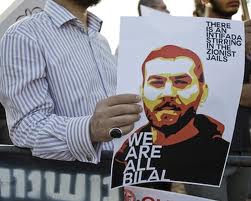
Administrative detainees’ protests are growing. Two additional administrative detainees, Bilal Diab and Thair Halahleh declared hunger strikes on 1 March, which they claim will continue until their release from administrative detention. On 3 March, two other administrative detainees declared hunger strikes until their release. Since the beginning of March, a number of administrative detainees have refused to acknowledge the military court and refused to participate in legal hearings of their cases. Due to Israel’s use of administrative detention, and the unwillingness of the military court to interfere in this practice, a hunger strike serves as a non-violent and the sole tool available to administrative detainees to protest and fight for their basic human rights.

Approximately 309 Palestinians are currently held in administrative detention in Israeli prisons. Administrative detention allows Israel to hold detainees for indefinitely renewable six-month periods. The arrest is granted on the basis of “secret information” and without a public indictment. Therefore, administrative detainees and their lawyers cannot defend against these allegations in court.

********************


Hana Shalabi: The Challenge of Palestinian Nonviolence


            No sooner had Khader Adnan ended his 66-day, life threatening hunger strike than new urgent concerns are being voiced for Hana Shalabi, another West Bank hunger striker now without food for more than 34 days.  With a grim irony there is continuity between these acts of spiritual defiance as both Khader Adnan and Hana Shalabi have been held in the same room at the Ramleh Prison Hospital.


            Both strikes are directed against the abusive use of administrative detention by Israeli West Bank occupying military forces, protesting both the colonial practice of internment without charges or trial and the degrading and physically harsh treatment administered during the arrest, interrogation, and detention process.


            The case of Hana Shalabi should move even the hardhearted. She seems a sensitive and caring young woman of 29 who is a member of Islamic Jihad, and appears dedicated to her family, hopes for marriage, and such simple pleasures as shopping for clothes and home furnishings. She had previously been held in administrative detention at the HaSharon prison in Israel for a 30 month period between 2009 and 2011, being released in the prisoner exchange of four months ago that freed 1027 Palestinians and the lone Israeli soldier captive, Gilad Shalit. After her release, according to her mother, she spent weeks recovering from the deep sense of estrangement she experienced in prison, and rarely left her home or the company of her family. As she was returning to normalcy she was re-arrested in a highly abusive manner, which allegedly included a strip-search by a male soldier at the interrogation center and other behavior intended to humiliate and intimidate.


            On February 16, 2012, the day of this renewal of her administrative detention, Hana Shalabi announced her resolve to start a hunger strike to protest her own treatment and to demand an end of administrative detention now relied upon by Israel to hold at least 309 Palestinian in prison. Her family has been denied visitation rights even in her present critical condition, Hana Shalabi was placed in solitary confinement at the outset of her detention, and her health has deteriorated to the point of severe concern for her health, even her life. According to her lawyer, Raed Mahameed, Hana Shalabi was examined by a doctor from Physicians for Human Rights and the doctor said that “she suffers from low heart beat rate, low blood sugar, loss of weight, weakness in muscles, yellowing of the eyes and high levels of salt in the blood which affected her kidneys causing her pain in her sides specially the left side as well as pain in chest bones. Physicians for Human Rights said that Shalabi cannot sleep because of pain, she also suffers dizziness and blurred and occasional loss of vision. Ms. Shalabi told Mahameed that she took salt last week but refused to take any salt since then and is living on two litres of water a day.”

            Impressively, her parents have committed themselves to a sympathy hunger strike for as long as their daughter remains under administrative detention. Her mother, Badia Shalabi, has made a video in which she says that even to see food makes her cry considering the suffering of her daughter. Her father has likewise made a global appeal to save the life of his child.


            Despite frequent mentoring to Palestinians from liberals in the West to rely on nonviolent tactics of resistance, these extraordinary hunger strikes have met with silence or indifference in both Israel and the West. Israeli authorities cynically declare that undertaking a hunger strike is a voluntary action and a publicity stunt for which they take no responsibility and that the striker is alone responsible if any harm results. There is also not a hint that Palestinian grievances about administrative detention are well founded and will even be considered much less acted upon. Such hardheartedness in the face of such sacrificial bravery is a sure sign that Israel is not ready for a sustainable and just peace with Palestine.


            The UN also disappoints those who believe in its ideals. It has not raised its voice even to take notice of Hana Shalabi’s plight or Israeli accountability. I share the view of Khitam Saafin, Chairwoman of The Union of Palestinian Women’s Committees: “The UN must be responsible for the whole violation that are going on against our people. These prisoners are war prisoners, not security prisoners, not criminals. They are freedom fighters for their rights.” The sad yet inspiring spiritual defiance of Hana Shalabi is also well expressed by Yael Maron, a spokesperson for the NGO, Physicians for Human Rights- Israel: “The story of Hana Shalabi, like that of Khader Adnan before, is in my opinion a remarkable example of a struggle that’s completely nonviolent towards one’s surroundings..It is the last protest a prisoner can make, and I find it brave and inspiring.”


            To engage in an open ended hunger strike, especially for a person who is not in a leadership role, requires a deep and abiding dedication to right a perceived wrong of the greatest gravity. It is physically exceedingly painful and dangerous to bodily health, as well as being psychologically demanding in the extreme. It presupposes the strongest of wills, and usually arises, as in these instances, from a sense that any lesser form of resistance has proved futile, exhibiting a long record of failure. In the end, this unconditional hunger strike is an appeal to the conscience and humanity of the other, and a desperate call to all of us, to understand better the cartography of abuse that abusive imprisonment and occupation entails, which can only be pervasively humiliating for a religiously oriented young Islamic woman. To risk life and health in this way without harming or even threatening the oppressor is to turn terrorism against the innocent on its head. It is potentially to sacrifice one’s life to make an appeal of last resort, an appeal that transcends normal law and politics, and demands our response.


            We can only fervently hope and pray that Hana Shalabi’s heroic path of resistance will end with her release and the complete restoration of her health. For Israel’s own moral wellbeing it is time, really long past time, to renounce reliance on administrative detention and to do more than this, to end forthwith its varied crimes of occupation. At this point the only possible way to do this is to withdraw unconditionally behind the 1967 borders, and to start peace negotiations from such an altered position of acknowledged wrongdoing without asking or expecting any reciprocal gesture from the Palestinian side. In the present atmosphere, it is politically unimaginable that Israeli leaders will heed such a call, but it is morally unimaginable that Israel will survive an impending spiritual collapse if it does not quickly learn to do so.


            In the meantime, we who are beyond these zones of occupation, abuse, and imprisonment, must do more than stand and watch as this tragic drama plays itself out.  We need to do all we can to strengthen the demands of Khader Adnan, Hana Shalabi, and all are refusing food in solidarity for the immediate release of all Palestinians currently held in administrative detention, for an end to detention without charges, to abusive arrests in the middle of the night, and beyond this, and to an end to an occupation that has lasted for 45 years with no end in sight.

Afghanistan: The War Turns Pathological—Withdraw!

14 Mar


            The latest occupation crime in Afghanistan is a shooting spree on March 11 by a lone American soldier in the village of Balandi in the Panjwai District of Kandahar Province of Afghanistan. 16 Afghan civilians, including women and children, were shot in their homes in the middle of the night without any pretense of combat activity in the area. Such an atrocity is one more expression of a pathological reaction by one soldier to an incomprehensible military reality that seems to be driving crazy American military personnel on the ground in Afghanistan. The main criminal here is not the shooter, but the political leader who insists on continuing a mission in face of the evidence that it is turning its own citizens into pathological killers.


            American soldiers urinating on dead Taliban fighters, Koran burning, and countryside patrols whose members were convicted by an American military tribunal of killing Afghan civilians for sport or routinely invading the privacy of Afghan homes in the middle of the night: whatever the U.S. military commanders in Kabul might sincerely say in regret and Washington might repeat by way of formal apology has become essentially irrelevant.


            These so-called ‘incidents’ or ‘aberrations’ are nothing of the sort. These happenings are pathological reactions of men and women caught up in a death trap not of their making, an alien environment that collides lethally with their sense of normalcy and decency. Besides the desecration of foreign lands and their cultural identities, American political leaders have unforgivably for more than a decade placed young American’s in intolerable situations of risk, uncertainty, and enmity to wage essentially meaningless wars. Also signaling a kind of cultural implosion are recent studies documenting historically high suicide rates among the lower ranks of the American military.


            Senseless and morbid wars produce senseless and morbid behavior. Afghanistan, as Vietnam 40 years earlier, has become an atrocity-generating killing field where the ‘enemy’ is frequently indistinguishable from the ‘friend,’ and the battlefield is everywhere and nowhere. In Vietnam the White House finally speeded up the American exit when it became evident that soldiers were murdering their own officers, a pattern exhibiting ultimate alienation that became so widespread it give birth to a new word ‘fragging.’


            Whatever the defensive pretext in the immediacy of the post-9/11 attacks, the Afghanistan War was misconceived from its inception, although deceptively so. (to my lasting regret I supported the war initially as an instance of self-defense validated by the credible fear of future attacks emanating from Afghanistan) Air warfare was relied upon in 2002 to decimate the leadership ranks of Al Qaeda, but instead its top political and military commanders slipped across the border. Regime change in Kabul, with a leader flown in from Washington to help coordinate the foreign occupation of his country, reverted to an old counterinsurgency formula that had failed over and over again, but with the militarist mindset prevailing in the U.S. Government, failure was once again reinterpreted as an opportunity to do it right the next time! Despite the efficiency of the radical innovative tactic of target killing by drones, the latest form of state terror in Afghanistan yields an outcome that is no different from earlier defeats.


            What more needs to be said? It is long past time for the United States and its NATO allies to withdraw with all deliberate speed from Afghanistan rather than proceed on its present course: negotiating a long-term ‘memorandum of understanding’ that transfers the formalities of the occupation to the Afghans while leaving private American military contractors—mercenaries of the 21st century—as the outlaw governance structure of this war torn country after most combat forces withdraw by the end of 2014, although incredibly Washington and Kabul, despite the devastation and futility, are presently negotiating a ten-year arrangement to maintain an American military presence in the country, a dynamic that might be labeled ‘re-colonization by consent,’ a geopolitical malady of the early 21st century.


            As in Iraq, what has been ‘achieved’ in Afghanistan is the very opposite of the goals set by Pentagon planners and State Department diplomacy: the country is decimated rather than reconstructed, the regional balance shifts in favor of Iran, of Islamic extremism, and the United States is ever more widely feared and resented, solidifying its geopolitical role as the great malefactor of our era.


            America seems incapable of grasping the pathologies it has inflicted on its own citizenry, let alone the physical and psychological wreckage it leaves behind in the countries it attacks and occupies. The disgusting 2004 pictures of American soldiers getting their kicks from torturing and humiliating naked Iraqi prisoners at Abu Ghraib should have made clear once and for all to the leaders and the public that it was time to bring American troops home, and keep them there if we cared for their welfare.  Instead punishments were inflicted on these hapless young citizens who were both perpetrators and victims, and their commanders resumed their militarist misadventures as if nothing had happened except an unwelcome ‘leak’ (Donald Rumsfeld said as much) What this pattern of descretation exhibits is not only a criminal indifference to the wellbeing of ‘others’ but a shameful disregard of the welfare of our collective selves. The current bellicose Republican presidential candidates calling for attacks on Iran amounts to taking another giant step along the road that is taking American over the cliff. And the Obama presidency is only a half step behind, counseling patience, but itself indulging war-mongering, whether for its own sake or on behalf of Israel is unclear.


            President Obama recently was quoted as saying of Afghanistan “now is the time for us to transition.”  No, it isn’t. “Now is the time to leave.”  And not only for the sake of the Afghan people, and surely for that, but also for the benefit of the American people Obama was elected to serve. 

Hana Shalabi: A Brave Act of Palestinian Nonviolence

10 Mar

                                                                (photo by Joe Catron)

            No sooner had Khader Adnan ended his 66 day life threatening hunger strike than new urgent concerns are being voiced for Hana Shalabi, another West Bank hunger striker now without food for more than 24 days. Both strikes were directed by Palestinian activists against the abusive use of administrative detention by Israeli West Bank occupying military forces, protesting both the practice of internment without charges or trial and the degrading and physically harsh treatment administered during the arrest, interrogation, and detention process.


            The case of Hana Shalabi should move even the most hardhearted. She seems a young tender and normal woman who is a member of Islamic Jihad, and is dedicated to her family, hopes for marriage, and simple pleasures of shopping.

She had previously been held in administrative detention at the HaSharon prison in Israel for a 30 month period between 2009 and 2011, being released in the prisoner exchange of four months ago that freed 1027 Palestinians and the lone Israeli soldier captive, Gilad Shalit. Since her release she has been trying to recover from the deep sense of estrangement she experienced in prison, and rarely left her home or the company of her family. As she was returning to normalcy she was re-arrested in an abusive manner, which allegedly included a strip-search by a male soldier. On February 16, 2012, the day of this renewal of her administrative detention, Hana Shalabi indicated her resolve to start a hunger strike to protest her own treatment and to demand an end of administrative detention now relied upon by Israel to hold at least 309 Palestinian in prison. Her parents have been denied visitation rights, Hana Shalabi has been placed in solitary confinement, and her health has deteriorated to the point of concern for her life. Impressively, her parents have committed themselves to a hunger strike for as long as their daughter remains under administrative detention. Her mother, Badia Shalabi, has made a video in which she says that even to see food makes her cry considering the suffering of her daughter.


            Despite the calls to Palestinian from liberals in the West these extraordinary hunger strikes have met with silence or indifference in both Israel and the West. Israeli authorities declare that such a posture is a voluntary action for which they have no responsibility. The UN has not raised its voice, as well. I share the view of Khitam Saafin, Chairwoman of Union of Palestinian Woman’s Committee: “The UN must be responsible for the whole violation that are going on against our people. These prisoners are war prisoners, not security prisoners, not criminals. They are freedom fighters for their rights.” The plight of Hana Shalabi is also well expressed by Yael Maron, a spokesperson for the Israeli NGO, Physicians for Human Rights- Israel: “The story of Hana Shalabi, like that of Khader Adnan, before is in my opinion a remarkable example of a struggle that’s completely nonviolent towards one’s surroundings..It is the last protest a prisoner can make, and I find it brave and inspiring.”


            To engage in an open ended hunger strike, especially for a person who is not in a leadership role, requires a deep and abiding dedication to right a perceived wrong of the greatest gravity. It is physically painful and dangerous to bodily health, as well as being psychologically demanding in the extreme. It presupposes the strongest of wills, and usually arises, as in these instances, from a sense that any lesser form of resistance is futile, and has a long record of failure. In the end, it is an appeal to the conscience and humanity of the other, and a desperate call to all of us, to understand better the cartography of abuse that abusive imprisonment entails, which I would imagine is pervasively humiliating for a religiously oriented young Islamic woman. To risk life this way without harming or even threatening the oppressor is to turn terrorism against the innocent on its head. It is potentially to sacrifice one’s life to make an appeal of last resort, an appeal that transcends normal law and politics.


            We can only fervently hope and pray that Hana Shalabi’s heroic path of resistance will end with her release and the restoration of her health. For Israel’s own moral wellbeing it is time, really long past time, to renounce reliance on administrative detention and to do more than this, to end forthwith its varied crimes of occupation. At this point the only possible way to do this is to withdraw unconditionally behind the 1967 borders, and to start peace negotiations from that altered position. It is politically unimaginable that Israeli leaders will heed such a call, but it is morally unimaginable that Israel will survive its impending spiritual collapse if it does not do so.


(photo by Joe Catron)

            In the meantime, we who are beyond these zones of occupation, abuse, and imprisonment must not only stand and watch as this tragic drama plays itself out. Wherever we are, whatever we can do, we need to act, to appeal, to shout, and to denounce the inhumanity of allowing such cruelty to be enacted before our watching eyes. 

Koran Burning in Afghanistan: Mistake, Crime, and Metaphor

9 Mar


On February 20, 2012 several American soldiers, five having been identified as responsible at this point, took some Islamic writings including several copies of the Koran to a landfill on Bagram Air Base in Afghanistan where they were burned. As soon as Afghan workers on the scene realized that Korans were being burned, they recognized what was happening as an act of desecration, and launched an immediate protest. The protest spread rapidly throughout the country, and turned violent, producing at least 30 Afghan deaths, as well as five dead American soldiers that also produced many non-lethal casualties. The incident is under formal investigation by three distinct boards of inquiry: a U.S. military investigation with authority to recommend disciplinary action against the soldiers; a joint U.S./Afghan undertaking; and an Afghan investigation leading to recommendations by a council of religious figures.


The American governmental response has been apologetic in tone, but unconvincingly so. President Obama sent a letter of formal apology to the Afghan president, Hamid Karzai, expressing regret and explaining that the incident occurred due to carelessness rather than as a deliberate expression of Islamophobic desecration. Refusing to adopt even a mildly apologetic posture, a reactionary American backlash powerfully surfaced, complaining about Obama’s stance by an insistence that it was the Afghan government that owed the United States an apology given the loss of American lives and an outburst of violence that was totally inappropriate given the accidental nature of the provocation. The reactionary presidential candidate, Rick Santorum, expressed the more or less typical Republican reaction to the incident:  “I think the response need to be apologized for, by Mr. Karzai and the Afghan people, for attacking our men and women in uniform and reacting to this inadvertent mistake.” He added, “This is the real crime, not what our soldiers did.”


Obama, as usual in such situations seemed caught in the headlights of controversy, publicly justifying the apology as necessary “to save lives..and to make sure that our troops who are there right now are not placed in further danger.” Such a backhanded rationale leads to an ironic query: when does an ‘apology’ cease being an apology? Obama obviously wants to appease foreign anger while at the same time affirming his patriotic credentials. He is addressing contradictory audiences, and can only hope that Afghans are not listening when he offers his pragmatic reasons for sending the letter to Karzai. Yet to claim that an apology was necessary to save American lives is hardly a genuine way to express regret, which was the least that should have been done, and could have been properly joined with sentiments of bereavement associated with the American soldiers who were also victims of a misguided military intervention and occupation. In my view Obama needlessly lost ground with all constituencies. Maybe Hilary Clinton had a point during the 2008 campaign for the presidential nomination when she famously taunted Obama: “if you can’t stand the heat get out of the kitchen.”


What is baffling is Washington’s unlearning evident, which flies in the face of its claim that it had redesigned counterinsurgency warfare after the Vietnam experience, above all else, to exhibit sensitivity to a foreign culture that is the site of armed struggle for political ascendancy. Here the cultural insensitivity was monumental, especially if proper account is taken of earlier similar incidents. There were earlier fully publicized desecrations of the Koran that vividly demonstrated how intense a reaction would likely result from a repetition of such behavior. There was a huge outcry following disclosure that a Koran had flushed down a toilet at the Guantánamo Bay prison a few years ago. Somewhat later an American soldier in Iraq was found to have used a Koran for target practice, which provoked a storm of angry denunciations of the American role in the country.


And then there was the shocking spectacle of Rev. Terry Jones of the Dove World Outreach Center in Gainesville, Florida announcing to his tiny congregation that he would burn 200 Korans on the anniversary of 9/11 in 2010, an outrage despite its non-governmental character, which was finally successfully discouraged, at least temporarily. But on March 20, 2011 the determined Rev. Jones held a ‘trial of the Koran’ and found it guilty of crimes against humanity, and burned a Koran in the church sanctuary. The result in the Afghan city of Mazar-i-Sharif was an attack on the UN Assistance Mission, killing at least 30, including 7 UN workers, and injuring 150. Our man in Kabul, Hamid Karzai, called for the arrest of Jones, but such a request was ignored as perhaps it had to be under American law; the conduct of Rev. Jones was explained (away) as an expression of American freedom of religion that did not reflect official views.

One would have supposed that a halfway vigilant imperialism would have understood that any show of disrespect toward the Koran, whether public or private, and especially by occupying American soldiers, would strike a severe blow against the American role in Afghanistan. At least with American troops, such experience would have led to introducing the most rigorous means to train and discipline occupation forces accordingly. It is not an exaggeration to say that such displays of disrespect for the Koran are more serious setbacks for Washington than would be even dramatic defeats on the battlefield. Why? Because it so clearly discredits the American claim to be present in the country as a humanitarian benefactor respectful of Afghan cultural and religious values.


There is something deeply disturbing, and revealing, about this compulsive inability to show respect for the most sacred artifacts of a foreign civilization. The Koran is the holiest of scripture not only for Islam as the dominant religion of the country but also underpins the unity embedded in the wider cultural identity of the Afghan people. It is a far more potent symbol of Afghan unity than is the national flag or constitution of this otherwise most fragmented of countries, and possibly it is the only source of unity other than opposition to foreign occupation. Americans would themselves react furiously, and likely violently, were the Bible to be burned by foreign military personnel somehow present on national territory, but the truth is that the imperial mindset is utterly incapable of comprehending such a logic of reciprocity, or its ethical analogue, the golden rule. The opposed imperial logic has a different ethic: the wrongs that we do to others we occasionally will excuse as accidental, while being incapable of even imagining that others might dare to do them to us, and if they were stupid enough to do so, a righteous fury of vengeance would be appropriately unleashed.


Tom Friedman, whose arrogance is as boundless as the globalization he blandly celebrates, mimics Republicans by telling his readers that Afghan political and religious leaders have made themselves primarily at fault for their failure to protest strongly against “the killing of innocent Americans,” especially given the accidental nature of the Koran desecration and Obama apology. The liberal interpretation of the incident is only softer in tone than is the Santorum reactionary rant, and suggests an uncritical American consensus that is ready to fight war after war in distant countries without having the slightest pang of conscience or the wisdom to stand quietly before mirrors of self-criticism.


In an important sense, these American soldiers, including those who participated in this unfortunate incident, were fundamentally ‘innocent.’ They are themselves both participants and victims of an occupation of a foreign country that they and their leaders do not understand, a military mission that never have been attempted, and is proving as futile as those many previous Western attempts to domesticate Afghanistan by force of arms, a sorry story expertly chronicled in Deepak Tripathi’s illuminating book, Breeding Ground: Afghanistan and the Origins of Islamist Terrorism (Washington, DC; Potomac). Those who are most responsible for this crime, in my judgment, are those who initially mandated such a war a decade ago and now perpetuate it, and this includes the president and those who favored the war policies that have misguidedly led to a ten year military occupation of Afghanistan with little result except this upsurge of vitriolic anti-American sentiment and a severely torn country. The best that United States policy planners can hope for after inflicting such an ordeal is reaching a power-sharing deal negotiated with the Taliban, the original mortal enemy, which portends a political future for Afghanistan not at all to Washington’s liking, nor consoling to the majority of Afghans. After all those billions spent, lives lost, sacrificed, and misshaped, and devastation wrought there is nothing at the end but the slim hope of learning from defeat after the fact not to go abroad in search of foreign monsters. With the Iran war drums beating loudly, it seems like an idle fancy to suppose that the American political elite will seek the intensive rehab it needs to have any chance of recovering from this addictive militarism that brings suffering to others and defeat and decline to itself.


Of course, unleashing violence in response to desecration does make for a sorry spectacle, and reflects badly on the quality of religious leadership in Afghanistan. At the same time the call of the Afghan clerical leadership for an end to the American nighttime raids on Afghan homes and the insistence that Americans turn over the administration of prisons to the Afghan government seem like reasonable demands long overdue. They touch the raw nerve of the American occupation, and its undisguised contempt for the self-determination of the Afghan people. In light of this, such reasonable demands will not be fully accommodated, but maybe partially accepted as the price of retaining the authority of a foreign occupier.  In this vein, there are reports that the American prison authorities will turn over Afghan prisoners, but retain a veto to deny some transfers.


These American tactics of counterinsurgency are consistently perceived by the Afghan people to be principal sources of ‘occupation terror.’ The American response to these demands sounds as though lifted from a colonial handbook: raids in the middle of the night are effective operations and that the Afghan judicial system is not capable of the handling the legal issues associated with dangerous Afghan detainees. Such a response unintentionally poses an awkward question: ‘who is entitled to govern Afghanistan at this time?’ It has long been the awkward truth that the limits of Karzai’s mandate are not set in Kabul, but by distant Pentagon and White House officials, a reality that makes a mockery of American claims of respect for Afghan rights of self-determination.


This inflammable incident touches on the essence of military intervention and foreign occupation, much more so than the secondary question of whether to treat Koran burning as a mistake or crime. The act of burning is of course from differing perspectives both a mistake and a crime, but more than this burning the Koran is a telling metaphor of all the many instances of flawed Western diplomacy consisting of military intervention and foreign occupation. Such diplomacy flies in the face of the collapse of colonialism and the rise of non-West religion and culture, and produces one costly geopolitical failure after another.  To burn the most holy scripture of a culture, whether by inadvertence or calculation, is the most delegitimizing acknowledgement of bad motives and intentions that it is possible to imagine, as well as a dismaying display of cultural insensitivity.


In this regard Koran burning may be as provocative in its assault on Afghan political culture as was the self-immolation of Mohamed Bouazizi with respect to the authoritarian cruelty of the Tunisian regime presided over by the tyrannical rule of Zine El Alindine Ben Ali, who was driven from power as a direct result. The failure of the United States Government even now to appreciate the seriousness of what has happened , despite the several earlier intimations of the great popular significance attached to any show of disrespect toward Islam throughout the Muslim world, altogether discrediting to its claims of benevolence and undermining of its claims to be quelling the global threat of anti-Western terrorism. When the culture screams it is time to leave!

Reciprocity, Lawfare, and Self-Defense: Targeted Killing

6 Mar


This post is a modified, revised, and expanded text of a contribution to a six-part Jadaliyya roundtable on targeted killing, edited by Noura Erakat, and posted on the Jadaliyya website, March 5, 2012; the roundtable responds to an important article by Lisa Hajjar referred to in the opening paragraph.

**********************

There is an emergent Israeli/American controversy on the lawfulness of targeted killing. Although the policy has not yet attained the status of being a national debate, there are signs that it may be about to happen, especially in light of the Attorney General, Eric Holder’s Northwestern Law School speech on March 5, 2012 outlining the Obama’s administration’s controversial approach to targeted killing in some detail. Lisa Hajjar convincingly narrates how the “legalization” of targeted killing has evolved over the course of the last twenty years. [Hajjar, “Lawfare and Targeted Killing:Developments in the Israeli and U.S. Contexts,” Jadaliyya, Jan. 15, 2012] She there calls attention to the analogy to the torture debate that, in many ways, defined the political and moral identity of the Bush presidency in the aftermath of the 9/11 attacks, and even caused moral and legal fissures to develop that divided the American people unto this day.

Hajjar shows that it was Israel that first crossed the threshold of legality in response to a wave of suicide bombings that traumatized Israeli society in the 1990s. In other words, targeted killing became a tactic of choice for both the Israel and the United States as part of the preventive logic of counter-terrorism, that is, placing a premium on eliminating threats before harm is inflicted rather than the reactive logic of striking back and retaliating. The upsurge in targeted killing seems responsive to the belief that neither defensive strategies nor deterrence, nor massive retaliation are appropriate or effective against a terrorist adversary, especially if the violence might accompanied by the readiness of a perpetrator to die while carrying out a mission.

By so doing, it gives up on the struggle to restrict the discretion of states to claim self-defense as an open ended justification for the use of force. This is a major setback for war prevention efforts resting on international law that can be traced back at least to the Kellogg-Briand Pact of 1928 that outlawed recourse to war, and was later reinforced and elaborated at the Nuremberg trials and in the core provisions, Articles 2(4) and 51, of the UN Charter. In other words, from an international law perspective the stakes are higher than they might seem in the context of authorizing target killing by invoking the alleged security necessities of the ‘war’ occasioned by the 9/11 attacks. Holder framed his defense of the tactics, including targeted killing, relied upon by the Obama presidency in the terms initially laid down by George W. Bush in his September 20, 2001 speech to a joint session of Congress: “We are a nation at war.” How different might the last decade have been, and likely for the better, if Bush had opted back then in that feverish atmosphere for a policy of enhanced law enforcement, not a global war on terror. And one can only wonder, and question the failure of Obama to take advantage of the changed climate in 2009 when he moved into the White House, or after the execution of Osama Bin Laden, to indicate that the war was at an end, and from now on the guidelines of law enforcement would prevail. Earlier terrorist organizations operating in Europe poses much greater threats to the security of societies than is posed by the remnants of Al Qaeda, and never insisted on the governmental prerogatives of warmaking.

In considering the victims of targeted killing we are dealing with one aspect of the plight of rightless Palestinians and alleged American enemies scattered around the world, with an inevitable skepticism about the degree to which this unaccountable authority to kill individuals is exercised in a responsible manner as claimed by its apologists, most recently by Eric Holder. Looking at the Israel record with respect to Palestinian prisons or the American treatment of its detainees at Abu Ghraib or Gunatánamo Bay there is every reason to doubt whether the claims of great care exercised in the approval of targets are to be trusted at all. Certainly, those selected for torture were often persons without information and sometimes without any real involvement with terrorist activities. In important respects, target killing is worse than torture due both to its finality which deprives the target of any opportunity to tell his or her story, and because of the collateral damage inflicted on those unlucky innocents who happen to be in the killing zone—or are mistakenly targeted.

        Lawfare: Hajjar draws an instructive distinction between those who regard reliance on law and courts as a positive dimension of political democracy and those who view recourse to law as a means to delegitimize states and their security policies. I would develop this distinction by viewing civil society’s recourse to litigation and legal arguments as “constructive lawfare,” while viewing the denigration of law’s role by governments, specifically, Israel and the US, as nihilistic or regressive, and an effort to free themselves from all forms of legal accountability that they cannot fully control. Such efforts to deplore recourse to law and international standards of legitimacy aim to insulate state security policy from procedures and discipline of accountability, and deprive society of an absolutely necessary check on the abuse of state power undertaken in secrecy and insulated from even post-facto investigation. Constructive lawfare is one of the few means available in a democratic society to redress the new imbalance between state and society in the post-9/11 world, and in relation to the acute vulnerability experienced daily by a people living under occupation for decades.

Instead of seeking to invalidate ‘lawfare,’ governments that took seriously their own insistence on the importance of living according to cherished values would move to allow citizens to have greater access to courts to raise questions of international and constitutional law flowing from governmental security policies.

More specifically, it would be a meaningful gesture in this direction if the U.S. Government were to foreswear procedural copouts from accountability by renouncing the political questions doctrine, executive privilege, and sovereign immunity. Holder quotes Obama several times to the effect that adhering to the rule of law is the right thing to do, but also because it is more effective in upholding security interests. As Obama expressed it as the National Archives in 2009: “[w]e uphold our most cherished values not only because doing so is right, but because it strengthens our country and it keeps it safe. Time and again, our values have been our best national security asset.” If that were genuinely believed, then a different approach would have been long ago adopted both in relation to targeted killing, and more generally, to security: less secrecy, more accountability, and more readiness to recognize and address the legitimate grievances of foreign adversaries.

            Reciprocity: David Cole makes the following cogent observation on his New York Review of Books blog (19 September 2011): “In international law, where reciprocity governs, what is lawful for the goose is lawful for the gander.” He goes further in questioning the approach taken to targeted killing by the Obama administration as being unmindful of setting a precedent that is a prelude to future regret: if we “continue to justify such practices in only the vaguest of terms, we should expect other countries to take them up—and almost certainly in ways we will not find to our liking.” In effect, he is adopting the view that Obama embraces, which is the convenient convergence of virtue and practical benefit.

It is true that international law in many substantive domains, from diplomatic exchange to commerce, substitutes reciprocity for enforcement, and so what is claimed for oneself is granted to others. However, in the domains of national security, the use of armed force, and criminal accountability for gross crime, international law operates more characteristically according to an imperial logic, or at best a hegemonic logic, in which equals are not treated equally. It is obvious that losers in wars with the West and leaders of some Global South countries are being held more and more accountable for crimes against humanity, especially since the establishment of the International Criminal Court a decade ago. But it is equally obvious that leaders of Western countries, including Israel, enjoy de facto impunity despite their evident involvement in crimes against humanity.

The one exception, which irritates geopolitical actors clinging to impunity, is the haphazard efforts to detain and prosecute state officials and agents under the controversial rubric of universal jurisdiction. Hajjar’s article gives a helpful summary of the pull and push pressures associated with attempts to rely on universal jurisdiction in relation to Israeli military and political leaders whose travel carries them to countries in Western Europe that have laws on their books permitting the use of domestic courts to pursue accountability for crimes of state committed beyond normal territorial sovereignty.  What is most notable is that these attempts to extend the reach of international criminal law beyond what is possible at a global level are furiously resisted by the United States and Israel, claiming the potential disruption of diplomatic interaction. True, the imposition of law can be disruptive, but the refusal to apply law is also disruptive in a different way by discrediting fundamental claims about animating values.

Whether the targeted killing precedents being set by the US and Israel will come to haunt these countries is highly uncertain, and they will do what they can to persuade public opinion that such claims made by hostile states are undisguised terrorism. Israel can assassinate Iranian nuclear scientists with impunity, while an alleged Iranian threat to kill a Saudi Arabian diplomat, which never materialized, is treated as a heinous instance of international terrorism is never questioned in the mainstream media. In other words, the language of law will be used in contradictory ways to deal with our acts and theirs’.

The US used atomic bombs against Japanese cities at the end of World War II, escaped any kind of accountability as war crimes prosecutions were limited to the wrongdoing of the Germans and Japanese, the losers in the war, which led critics of such double standards to deride the outcomes at Nuremberg and Tokyo as “victors’ justice.” In the current era, practices of targeted killing are certain to spread. Fifty countries have drones, and some deploy them for surveillance and reconnaissance missions. For example, Turkey, in fighting against Kurdish insurgents, made use of drones to carry out recent cross-border raids against PKK base areas in northern Iraq. The future will almost surely witness a strong effort by the United States to impose geopolitical discipline on attack uses of drone aircraft. Whether such an effort will be successful is uncertain as the relative high accessibility of drone technology as compared to nuclear weaponry may make it impossible to implement a non-proliferation approach.

Surely, Iran would have strong grounds to emulate Israeli and American practice with regard to targeted killing, particularly in view of the alleged Israeli targeting and assassinating of Iranian nuclear scientists in recent years, as well as mounting repeated overt threats of launching an attack designed to disable Iran’s nuclear program. Such threats would appear to be direct violations of Article 2(4) of the UN Charter that categorically prohibits “the threat or use of force” except in situations of self-defense against a prior armed attack (Article 51) or as mandated by a decision of the UN Security Council. But if Iran was to avail itself of the targeted killing precedent to assassinate individuals in Israel or the United States that it deemed to be threatening or responsible for a prior attack on its citizens, such violence would be denounced as “terrorism,” and devastating forms of retaliation would almost certainly follow.

In other words, reciprocity is not likely to shape the future of targeted killing, but rather a regime of double standards tailored to the specific realities of the spread and use of drone weaponry. If such a one sided regime is established it would have the effect of giving a new meaning to military superiority in the 21st century, and widen the opportunities for geopolitical management of international conflict. It is hard to imagine that China or Russia, and perhaps others, would acquiesce in this event, and new dangerous, costly, and unstable rivalries among leading sovereign states might likely ensue.

Human Rights: It is important to introduce the perspectives of human rights into the legal debate on targeting killing, and not limit inquiry to the applicability of international humanitarian law as set forth in the Geneva Conventions of 1949 and the Geneva Protocols of 1977. Targeted killing of a non-combatant involves a challenge to the right to life, as well as constitutes a flagrant form of extra-judicial execution. UN Special Rapporteur on Extra-judicial, Summary or Arbitrary Executions Philip Alston, in his influential 2010 report to the UN Human Rights Council, legally condemns targeted killing by drones on these bases, especially those taking place outside the combat zone, or as the Obama presidency puts it, far from “the hot battlefield.”

These human rights objections to targeted killing take on added force when extended to individuals who are suspected of inciting terrorist acts, as was the case with Anwar al-Awlaki, but without any disclosure of evidence of either the case against the target or a credible demonstration that such an individual posed an imminent security threat and could not be captured. As Hajjar points out, the difficulties posed by detention constraints and questionable evidence that would hold up in court exert pressure to avoid these complexities by killing the person in question.

Self-defense: The most serious encroachment on relatively settled conceptions of the self-defense exception to the international law prohibition on the use of force is the US reliance on a unilaterally expanded definition of self-defense to validate targeted killing in countries remote from existing combat zones. This expansion of the right to use force is a virtual abandonment without legal and political argument of the animating undertaking of the UN Charter to set forth a legal framework that delimits as carefully as language can, the legal discretion by states to use force without a Security Council mandate. Even conceding some flexibility in construing the right of self-defense with respect to the red lines of Article 51, this kind of globalization of the option to kill terrorist suspects, and by so doing often spread terror in societies that are geographically unrelated to active battlefields, stretches self-defense beyond the breaking point in a manner resembling Yoo/Gonzales insistence that water boarding was not a form of torture. Implicit in Holder’s approach is the uncomfortable question of whether there are any limits on hegemonic lawmaking left in the 21st century? The question is not really deflected by Holder’s bland and meaningless assurance: “Of course, any such use of lethal force by the United States will comply with the four fundamental law of war principles governing the use of force.” (that is, necessity, discrimination, proportionality, humanity). These abstract guidelines, legal descendants of the Just War Doctrine are meaningless without being coupled to some mechanism of accountability, and here where the evidence surrounding a targeted killing is shrouded in secrecy it is not even possible to mount an informal argument of abuse.

To view the execution of individuals in Yemen or Somalia on the ground that their activities are to be assimilated to the claim of self-defense associated with a continuing urgent response to the al-Qaeda 9/11 attacks is to unilaterally expand the option of recourse to international force beyond what international law had attempted to impose on states after 1945. True, over the years state practice has nibbled away at the red lines written into Article 51, sometimes reasonably, sometimes not, especially weakened in the name of flexibility has been the insistence that a valid claim of self-defense could only be made in response to a prior armed attack, but the Obama administration’s legal rationale for targeted killing cuts the use of force off from any testable legal mooring, including the procedural requirement in the Charter that a claimant state must submit its use of force to the Security Council for review. What becomes clear, and without any indication of forethought, is the abandonment of that effort memorialized in the words of the Preamble to the UN Charter “to save succeeding generations from the scourge of war.”  Additionally, Obama has done nothing to restore the constitutional balance when it comes to war, failing to seek a declaration of war before its involvement in the NATO War against Libya. The Legal Advisor, Harold Koh, sought to justify this failure by claiming that the hostilities didn’t rise to the level of war mainly because there was little prospect of American casualties or troops on the ground. Apparently, the devastation wrought by thousands of bombing sorties does not count in Koh’s thinking as ‘war.’ Whether such a sensibility should be described as Orwellian or imperialist is mainly a matter of taste.

The most comprehensive legal justifications for targeted killing have been made by Eric Holder and John Brennan, Obama’s official chief counterterrorist advisor, in his speech at the Harvard Law School a few months ago. For devastating critique of the due process issues raised by targeted killing as rationalized by Holder see David Cole’s blog post
http://www.nybooks.com/blogs/nyrblog/2012/mar/06/targeted-killings-holder-speech/ The irony here is that, just as John Yoo shocked the conscience of liberal America by insisting that practices long assumed to be torture (most notably water boarding) were not torture (i.e., flagrantly illegal) when employed by the US government, now the Obama administration asserts a similar position that America loves the rule of law, except of course when it might inhibit recourse to a preferred tactic. If such a bump in the road, then the lawyers are sent in with their shovels to remove any appearance of an obstacle, making it clear to the world that whatever America wants to do is “legal” so are as its leading legal technicians are concerned even when the policy in question flaunts generally accepted understandings of a rule of international law. In this instance, self-defense is stretched way beyond the accepted consensus among international law specialists as most authoritatively expressed by the majority of the International Court of Justice in its Nicaragua decision of 1986. Claiming that self-defense entitles the United States to convert the entire world into a global battlefield is certainly bad law, but it is also likely to be bad policy, generating support for extremist expressions of anti-Americanism and creating tensions with such other states as China and Russia, and maybe Brazil, India, and Turkey. And it is scant consolation for Mr. Holder, Mr. Brennan and other Obama officials to reassure the public that this broad legal authority is being used prudently and sparingly, and with a maximum effort to avoid harm to others than those targeted. Unfortunately, the facts as more impartially assessed do not lend credence to such self-serving packaging of targeted killing without even taking considerationthe spread of terror to communities that might be struck day or night by a drone missile aimed at a suspect. This indiscriminate form of state terrorism embedded in targeted killing does not even get the benefit of an acknowledgement.

 A Word in Conclusion

We now have the materials we need to launch a much overdue debate on targeted killing. Unlike torture, which has vividness and immediacy that existentially assaults our sense of decency and dignity, the relative novelty and remoteness of targeted killing, a technologically facilitated innovation in the tactics of state violence, seems more abstract and numbing, and less in conflict with civilizational values. In some respects, this distinction identifies some real differences. Most legal commentators do not challenge targeted killing if confined to the combat zone, say Afghanistan, but focus their criticisms on its cross-border uses, which in the US case, can be anywhere in the non-Western world. In this regard, while torture is primarily of concern as a crime against humanity, targeted killing raises the most fundamental issues of world order, sovereignty, the scope of warfare, the crime of aggression, and extra-judicial executions.

Saving Khader Adnan’s Life and Legacy

21 Feb


            It is a great relief to those millions around the world who were moved to prayer and action by Khader Adnan’s extraordinary hunger strike of 66 days that has ended due to Israel’s agreement to release him on April 17. We who were inspired by such a heroic refusal to accept humiliation and arbitrary arrest can only hope that for the sake of his family, for the cause of Palestinian resistance, and for the struggle to achieve a just peace that Mr. Adnan will fully recover to resume his personal and political life. We can not take for granted that there will be a full recovery given Mr. Adnan’s critical condition confirmed by examining doctors, just prior to his decision on February 21 to resume eating in a normal manner.


            While it is appropriate to celebrate this ending of the strike as ‘a victory’ there are several disturbing features that deserve comment. To call an arrangement that saved someone’s life a ‘deal,’ as the media consistently put it, is itself demeaning, and reveals at the very least a failure to appreciate the gravity and deep dedication of purpose that is bound up with such a nonviolent form of resistance. Similarly, the carelessness of the initial reactions was notable, often referring to Mr. Adnan’s ‘release’ when in fact he will be still held in administrate detention for several more weeks, and could conceivably be confined much longer, should Israeli military authorities unilaterally decide that ‘substantial evidence’ against him emerges in this period immediately ahead.


            It should also be noted that on matters of policy and principle Israel did not retreat even an inch: in relation to Mr. Adnan, he will be remain in captivity and will be subject to the ‘legal’ possibility that his period of imprisonment could still be extended indefinitely; beyond this, Israeli authorities express no willingness whatsoever to review the cases of the 309 other Palestinians who are presently being held under the administrative detention procedure.


            These Palestinians being held include one prisoner detained for more than 5 years, and 17 others for periods of 2-4 years. Israel did not even agree to a review of their misapplications of this administrative procedure within their own frameworks of claims about addressing imminent security threats. The general justification of administrative procedures by governments that rely upon it is to insist that its use is reserved for true and credible emergency situations. But as Mustafa Barghouti points out in the New York Times (February 22, 2012) such a claim strains credulity past the breaking point in the Israeli case. Barghouti writes tellingly that it is worth observing “that among..[those] Palestinians now held in ‘administrative detention’ are 21 of the 120 elected members of the Palestinian Legislative Council, most of whom have  been held for years for no apparent crime other than being democratically elected in 2006, in an election universally regarded as free and fair, as candidates of the party which won a clear majority of seats but which Israel does not like.” In other words, the Israeli claims of exceptional circumstances taking precedence over due process protections do not exist in many of the evident political uses of administrative detention as a means of weakening all forms of Palestinian resistance, including nonviolent opposition politics.


            It should also be noted that Israeli commentary treated the arrangement ending the standoff produced by the hunger strike with measured cynicism if not disdain. Even those Israeli who supported the agreement justified it as a practical way of avoiding trouble down the road should Khader Adnan have died while held by Israelis, given the breadth and depth of support his extended hunger strike was receiving among Palestinians and sympathizers from around the world. Keeping Mr. Adnan alive was also seen by Israelis as a means to avoid a wider scrutiny of the institution and practice of administrative detention as it has been used by the Israeli military ‘justice’ system.


            Also the timing of the announcement of the arrangement is significant. It was made an hour before an emergency session of the Israeli Supreme Court that was scheduled to hear Mr. Adnan’s petition for release, and there is speculation that although this highest judicial body in Israel has in the past consistently supported the military position in such instances, the situation was so extreme that it might prove embarrassing for Israeli military authorities. There were even some worries on the Israeli side that the extremities of this case could produce an adverse result and even a repudiation of the manner in which Israeli authorities used administrative detention as a procedure allegedly for security, but seemingly for the harassment and intimidation of militant opponents of an oppressive occupation that has continued for 45 years and is aggravated by continuously appropriating Palestinian land and water for the benefit of settlement expansion while disrupting and cleansing long-term Palestinian residency.


            What was entirely absent from the Israeli public discourse was some expression of compassion, even if only for the family of Mr. Adnan, which consists of two daughters of four years or less and his articulate pregnant wife, Randa. There was not even the slightest show of respect for the dignity of Mr. Adnan’s long hunger strike or sympathy for the acute suffering that accompanies such a determined foregoing of food and speech for an extended period. Instead, the Israeli commentary that was supportive of the arrangement stressed only pragmatic considerations from the perspective of Israel’s interests. It was one more lost opportunity for Israelis of all shades of opinion to reach across the abyss of political conflict to affirm a common humanity.


            But in a contrary spirit, the spokesperson for the Netanyahu government, Mark Regev, seemed only interested in deflecting criticism directed at Israel. He parried criticism by cynically observing that other governments rely on administrative dentention in the name of security, including the United States, so why shouldn’t Israel. He also added that the legality of Israel’s use of administrative detention should not be questioned since it depended not on an Israeli law, but on a 1946 law enacted when Britain was controlling Palestine, unintentionally conceding that Israel was the ‘colonial’ successor to the British! If the legal veil is lifted from administrative detention its character is one of ‘internment,’ a standard practice of colonial powers in dealing with unruly natives.


            Of course, Israeli ultra hardliners went further in this direction, referring to Mr. Adnan as ‘a terrorist’ despite the vagueness of official allegations that didn’t ever make such a claim, but only mysteriously contended that he constituted what an official in Tel Aviv described as ‘a threat to regional security,’ whatever that might mean. As might be expected, the notorious Israeli Foreign Minister, Avigdor Lieberman, was characteristically forthright, calling his ‘release’ ‘a wrong decision’ yet accepting the outcome because it is ‘our duty to honor and respect every Supreme Court decision even when we don’t agree with it.” As we know, Mr. Adnan was not released nor did the Israeli Supreme Court make a decision.  This comedy of errors by a leading government official should raise questions about Lieberman’s competence, not to mention his questionable political judgment as to policy. Lieberman’s mean spiritedness extended to attacks on Arab members of the Knesset who visited Mr. Adnan as somehow an indication that  by so doing they were ‘representing terrorists.’ Similarly, MK Danny Danon ignored the context and scorned the agreement ending the hunger strike by calling it reprehensible, an instance of a ‘[capitulation] to terrorism.’


            The issues directly raised by this hunger strike are ones of human rights and humane treatment, as well as reliance on administrative detention, and are quite independent of whether or not we endorse Mr. Adnan’s past and present tactics of resistance, which are not at all clear. Some apologists for Israel have tried to deflect these ethical and legal concerns by emphasizing Mr. Adnan’s association with Islamic Jihad and its record of violent attacks and extremist politics. Israelis casually refer to Mr. Adnan as a ‘terrorist’ without charges or proof. He has, in fact, been most often described in recent years more neutrally by those knowledgeable about his role and activities as a spokesperson for Islamic Jihad, but not engaged beyond this. There is no indication in his past or present that he was directly involved in violence, although an undated and unverified YouTube video has surfaced somewhat suspiciously in which Mr. Adnan is depicted as advocating violent resistance and an active recruiter of suicide bombers. Although Islamic Jihad has been responsible in the past for suicide bombings it has seemingly abandoned the practice, which is in line with the repudiation of such forms of violent resistance by Hamas more than ten years ago. Mr. Adnan’s prior arrests  stemmed from militant peaceful demonstrations that landed him in Israeli jails seven times, a Palestinian Authority prison once, and induced him to undertake shorter hunger strikes on three previous occasions, one as recently as 2010.  From what is known, Mr. Adnan is definitely a committed activist who has associated himself with Islamic Jihad, but works on a daily basis as a village baker and maintains a strong family role and popular community presence in his small West Bank town of Arraba.


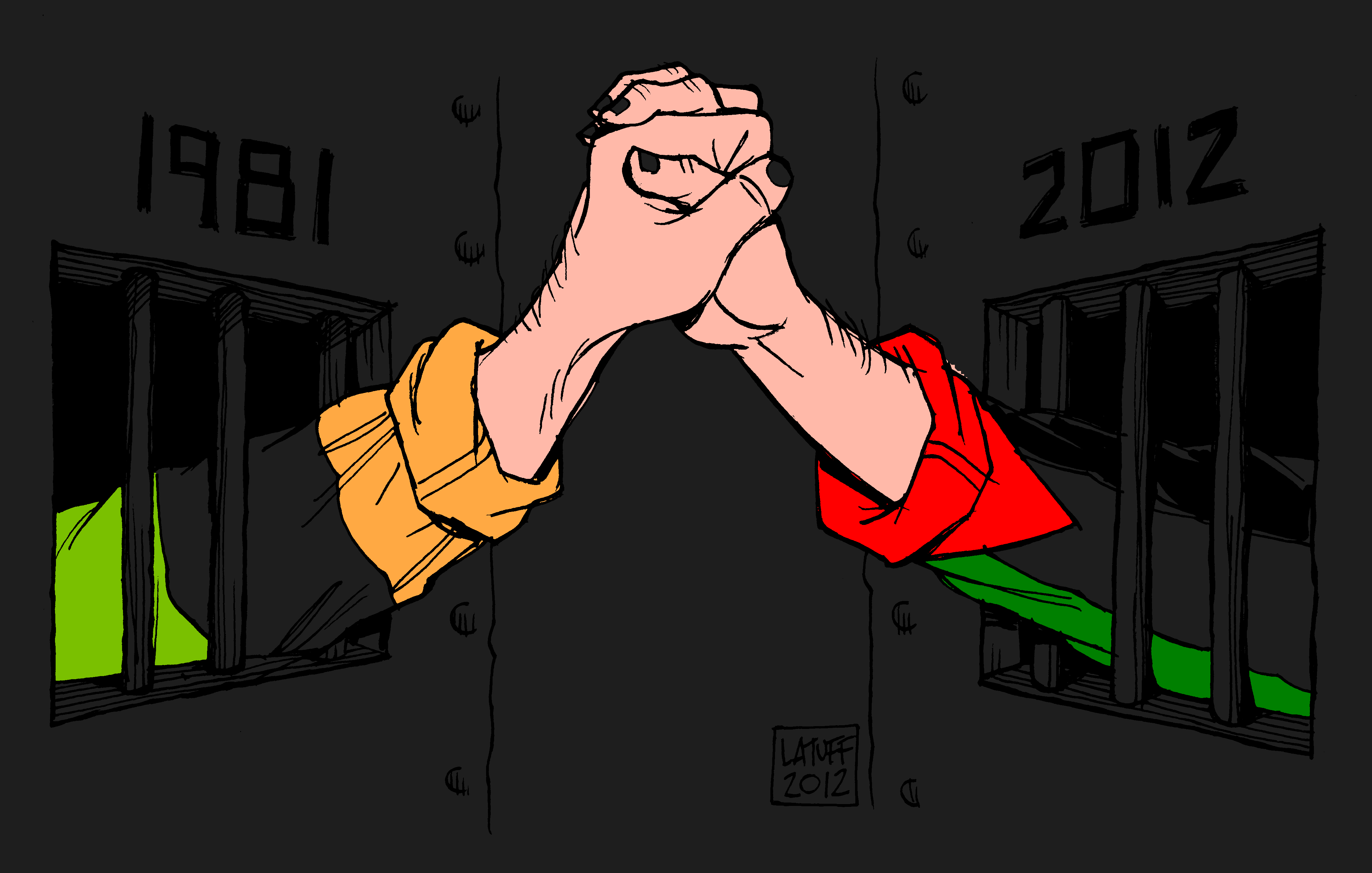
            It is important to pause long enough to take account of Khader Adnan’s achievement, symbolically, substantively, and with respect to future possibilities. We should note that Mr. Adnan’s hunger strike of 66 days is the exact length of Bobby Sands’ hunger strike in 1981 strengthening the bond between the two men, a bond that has been movingly confirmed by a number of Irish family members of their strikers. What is more, the date of Bobby Sands’ death, May 5, 1981, is generally viewed as the turning point in the Irish struggle, the time when the British Government finally started treating the IRA as a political actor with genuine grievances rather than as a terrorist organization that must be run into the ground and exterminated. We can only hope that Febuary 21, 2012 will live in history as a turning point in the Palestinian struggle. Only the future will reveal whether this is a pious wish on my part or becomes over time a historical reality.


            Substantively, it is crucial to support a campaign to free the other several hundred Palestinians currently being held in administrative detention and to exert enough pressure to end reliance on the practice altogether. Mr. Adnan’s brave stand will have been mostly without effect if his compelling exposure of the cruelty and arbitrariness of Israeli reliance on administrative detention is allowed to slip from view now that his strike is over. Instead, knowing what we have come to know, it is the responsibility of all of us to do all we can to discredit and force the abandonment of administrative detention by Israel, and as well, challenge its role in the United States and elsewhere. A fitting tribute to Mr. Adnan’s hunger strike would be to put opposition to administrative detention on the top of the human rights agenda throughout the world. We should begin by refusing to use the phrase ‘administrative detention,’ rechristening it as ‘administrative torture’ or ‘lawless captivity,’ and associate with past colonial and present authoritarian tendencies of ‘democratic’ governments.


            And finally, we will know the enduring significance of Mr. Adnan’s self-sacrifice by what takes place in the future. Will this event, possibly along with other influences, inspire a greater commitment to the Palestinian struggle for peace, justice, and liberation in occupied Palestine and throughout the world? Maybe ‘the regional threat’ that was being referred to by the Israeli official justifying Mr. Adnan’s detention was an indirect, and hopefully accurate reference to the growing impact of the positive sides of the Arab Spring, that is, as an occasion prompting a further awakening of self-empowerment among Palestinians both in relation to their struggle and in their renewed quest for unity among themselves. In effect, let us hope that Khader Adnan’s bravery becomes contagious and will be remembered as a charismatic event in the long narrative of the Palestinian struggle for self-determination.


Saving Khader Adnan’s Life Saves Our Own Soul

18 Feb


             The world watches as tragedy unfolds beneath its gaze as Khader Asnan enters his 63rd day as a hunger striker in an Israeli prison being held under an administrative detention order without trial, without charges, and without any indication of the evidence against him. From the outset of his brutal arrest by scores of soldiers, featuring blindfolding, cuffing, and physical roughness in the middle of the night, a gratuitous ritual enacted the presence of his wife and young daughters Khader Adnan has been subject to the sort of inhumane and degrading treatment that is totally unlawful and inexcusable, and an assault on our moral justification. At present, approximately 300 other Palestinians are being held in administrative detention, and Mr. Adnan has indicated that his protest is also on their behalf, and indeed against the practice of administrative detention itself.


            The only plausible explanation of such Israeli behavior is to intimidate by terrifying all Palestinians who have lived for almost 45 years under the yoke of an oppressive occupation that continuously whittles away at Palestinian rights under international humanitarian law, especially their right to self-determination, which is encroached upon every time a new housing unit is added to the colonizing settlements that dot the hilltops surrounding Jerusalem and throughout the West Bank. While Palestinian prospects of a viable political future are continuously diminished by Israeli expansionism the world politely watches in stunned silence. Only resistance from within and solidarity worldwide can provide the Palestinians with hope about their future. They have been failed over and over again by the UN, by the EU, by their Arab neighbors, and above all by that global leader beholden to Israel whose capital is in Washinton, D.C.! It is only against this broader background that the importance of Khader Adnan’s resistance to the continuing struggle of Palestinians everywhere can begin to be appreciated as a political act as well as an insistence on the sacred dignity of the human person.


            The case of Khader Adnan is a revealing microcosm of the unbearable cruelty of prolonged occupation, and the contrast that is drawn in the West between the dignity of a single Israeli prisoner held in captivity and the steadfast refusal to be attentive to the abuse of thousands of Palestinians languishing in Israeli jails through court sentence or administrative order.  Mr. Adnan’s father poignantly highlighted this contrast a few days ago by reference to Gilad Shalit, the Israeli soldier held by Hamas in captivity for several years and recently released in good health: “Where are the mother and father of Gilad Shalit? Do they not feel for me in this humanitarian case? Where are they?” The comparison pointedly suggests that it is Mr. Adnan who is the more deserving of such a global outpouring of concern: “My son was arrested from his house, from among his wife and children, was taken prisoner. He was not carrying any weapon. Whereas Shalit was fighting against the people of Gaza, and destroying their homes, and firing upon, and Shalit was released.” In fact, Shalit has not been personally associated with violence against the Palestinians and their property, but he was operating as a member of the IDF that has been consistently engaged in such activity, frequently in stark violation of international humanitarian law. While Shalit was being held foreign authority figures, from the UN Secretary General on down, displayed their empathy not only for Shalit but for the intense anxiety experienced by Israelis concerned for the wellbeing of Shalit, but these same personalities are notably silent in the much more compelling ordeal taking place before our eyes in the form of Mr. Adnan’s captivity seemingly unto death. It should not be surprising that surviving family members of IRA hunger strikers should step forward to express solidarity with Mr. Adnan and the compare the Irish transforming acts of resistance in 1981 (ten hunger strikers died, and Britain shifted from counterterrorism to a politics of reconciliation) to that of the Palesinians, increasingly referring to Khader Adnan as the West Bank Bobby Sands.


            And who is Khader Adnan? We do not know very much about him except that he is a member of the Islamic Jihad Party, a 33-year old father of two young daughters, a baker by profession, and viewed with respect and affection by his neighbors. There are no accusations against him that implicate him in violence against civilians, although he has a history of imprisonment associated with his past activism. A fellow prisoner from an earlier period of confinement in Ashkelon Prison, Abu Maria, recalls Mr. Adnan’s normalcy, humanity, and academic demeanor while sharing a cell, emphasizing his passionate dedication to informing other imprisoned Palestinians about the history and nature of the conflict: “Prison was like a university in those times and he was one of the professors.” Commenting on his hunger strike that has brought him extreme pain, Abu Maria says he is convinced that Khader Asnan wants to live, but will not at the price of enduring humiliation for himself and others held in administrative detention: “He is showing his commitment and resistance in the only way he can right now, with his body.”


            Addameer, the respected Palestinian NGO concerned with prisoner issues, “holds Israel accountable for the life of Khader Adnan, whose health has entered an alarmingly critical stage that will now have irreversible consequences and could lead to his fatal collapse at any moment.” Physicians who have observed his current condition conclude that, at most, Mr. Adnan could live a few more days, saying that such a hunger strike cannot be sustained beyond 70 days in any event. Any attempt at this stage to keep Mr. Adnan alive by forced feeding would be widely viewed as a violation of his right to life and is generally regarded as a type of torture.


            Finally, the reliance by Israel on administrative detention in cases of this sort is totally unacceptable from the perspective of international law, including the Geneva Conventions, especially so with no disclosure of the exceptional circumstances or evidence that might warrant for reasons of imminent security the use of such an extra-legal form of imprisonment for a few days. Given the number of Palestinians being held in a manner similar to that of Mr. Adnan, it is no wonder that sympathy hunger strikes among many Palestinians in and out of Israeli jails are underway as expressions of solidarity. Have we not reached a stage in our appreciation of human rights that we should outlaw such barbarism by state authorities, which is cunningly shielded from critical scrutiny by the anonymity and bureaucratic neutrality of the term ‘administrative detention’? Let us hope and make sure that the awful experience of Khader Adnan does not end with his death, and let us hope and do everything in our power to encourage a worldwide protest against both administrative detention and prisoner abuse and by the government of Israel, and in due course elsewhere. The Palestinian people have suffered more than enough already, and passivity in the face of such state crimes is an appalling form of complicity. We should expect more from our governments, the UN, human rights NGOs, and ourselves!


Help End the Hunger Strike of Khader Adnan

15 Feb

I am publishing here my press release of today expressing urgent concern about the fate of Khader Adnan, a Palestinian activist, who is near death resulting from his continuing hunger strike that expresses his refusal to accept the humiliating conditions of imprisonment without charges and accompanied by an Israeli court approved denial of visitation rights to his wife. Please do whatever you can to exert pressure to obtain the immediate release of Mr. Adnan, and to make the world aware that Israel is responsible for respecting his rights and protecting his wellbeing.  The text below is released under the auspices of the UN Office of the High Commissioner of Human Rights, and prepared in my role as Special Rapporteur for Occcupied Palestine of the Human Rights Council.

*****

> Israel: UN rights expert appeals for international help for a Palestinian
> prisoner on hunger strike
>
> CAIRO / GENEVA (15 February 2012) – The United Nations Special Rapporteur
> on the situation of human rights in the Palestinian territories occupied
> since 1967, Richard Falk, expressed his urgent and extreme concern
> regarding the situation of Palestinian prisoner Khader Adnan, and urged
> the international community to intervene on his behalf.
>
> “I call on the international community, especially States with close
> relations with Israel, to urge the Israeli Government to fulfill its
> responsibilities under international law, most urgently with regard to Mr.
> Adnan,” the human rights expert said. Mr. Adnan, whose life is reportedly
> in jeopardy, has maintained a hunger strike for 60 days in response to the
> humiliating circumstances of his imprisonment without charges by the
> Government of Israel.
>
> “In view of the emergency of his situation, the Government of Israel must
> take immediate and effective action to safeguard Mr. Adnan’s life, while
> upholding his rights,” stressed the Special Rapporteur, who is currently
> undertaking a fact-finding mission to the region.
>
> Mr. Falk also called on the Government of Israel to respect its legal
> obligations pertaining to the several thousand Palestinians it has
> imprisoned. “The improper treatment of thousands of Palestinian prisoners
> by the Government of Israel should be of great concern to the
> international community, and it is a problem that I am paying close
> attention to in the context of my ongoing visit to the region.”
>
> The Special Rapporteur will convene a press conference at the end of his
> regional visit, on 20 February in Amman, and will submit a full report on
> his mission to the Human Rights Council in June 2012.
>
> ENDS
>
> In 2008, the UN Human Rights Council designated Richard Falk (United
> States of America) as the fifth Special Rapporteur on the situation of
> human rights on Palestinian territories occupied since 1967. The mandate
> was originally established in 1993 by the UN Commission on Human Rights.
>
> Learn more about the mandate and work of the Special Rapporteur:
> http://www2.ohchr.org/english/countries/ps/mandate/index.htm
>
> OHCHR Country Page – Occupied Palestinian Territories:
> http://www.ohchr.org/EN/countries/MENARegion/Pages/PSIndex.aspx
>
> OHCHR Country Page – Israel:
> http://www.ohchr.org/EN/Countries/MENARegion/Pages/ILIndex.aspx
>
> For more information and media requests, please contact Kevin Turner (+41
> (0)79 509 0557 / kturner@ohchr.org) or write to sropt@ohchr.org.
>
> For media inquiries related to other UN independent experts:
> Xabier Celaya, OHCHR Media Unit (+ 41 22 917 9383 / xcelaya@ohchr.org)
>
> UN Human Rights, follow us on social media:
> Facebook: https://www.facebook.com/unitednationshumanrights
> Twitter: http://twitter.com/UNrightswire
> YouTube: http://www.youtube.com/UNOHCHR
>
> Check the Universal Human Rights Index: http://uhri.ohchr.org/en
>

When is an ‘NGO’ not an NGO? Twists and Turns Beneath the Cairo Skies

14 Feb


             A confusing controversy between the United States and Egypt is unfolding. It has already raised tensions in the relationship between the two countries to a level that has not existed for decades. It results from moves by the military government in Cairo to go forward with the criminal prosecution of 43 foreigners, including 19 Americans, for unlawfully carrying on the work of unlicensed public interest organizations that improperly, according to Egyptian law, depend for their budget on foreign funding. Much has been made in American press coverage that one of the Americans charged happens to be Sam LaHood, son of the present American Secretary of Transportation, adopting a tone that seems to imply that at least one connected by blood to an important government official deserves immunity from prosecution.


            Washington has responded with high minded and high profile expressions of consternation, including a warning from Hilary Clinton that the annual aid package for Egypt of $1.5 billion (of which $1.3 billion goes to the military) is in jeopardy unless the case against these NGO workers is dropped and their challenged organizations are allowed to carry on with their work of promoting democracy in Egypt. And indeed the U.S. Congress may yet refuse to authorize the release of these funds unless the State Department is willing to certify that Egypt is progressing toward greater democratization. President Obama has indicated his intention to continue with the aid at past levels, given the importance of Egypt in relation to American Middle Eastern interests, but as in so many other instances, he may give way if the pressure mounts. The outcome is not yet clear as an ultra-nationalistic Congress may yet thwart Obama’s seemingly more sensible response to what should have been treated as a tempest in a teapot, but for reasons to be discussed, has instead become a cause celebre.


            The Americans charged are on the payroll of three organizations: International Republican Institute (IRI), Democratic National Institute (DNI), and Freedom House. The first two organizations get all of their funding from the U.S. Government, and were originally founded in 1983 after Ronald Reagan’s speech to the British Parliament in which he urged that help be given to build the democratic infrastructure of newly independent countries in the non-Western world put forward as a Cold War counter-measure to the continuing appeal of Marxist ideologies. From the moment of their founding IRI and DNI were abundantly funded by annual multi-million grants from Congress, either directly or by way of such governmental entities as the U.S. Assistance for International Development  (USAID) and the National Endowment for Democracy. IRI and DNI claim to be non-partisan yet both are explicitly affiliated with each of the two political parties dominant in the United States, with boards, staffs, and consultants drawn overwhelmingly from former government workers and officials who are associated with these two American political parties. The ideological and governmental character of the two organizations is epitomized by the nature of their leadership. Madeline Albright, Secretary of State during the Clinton presidency, is chair of the DNI Board, while former Republican presidential candidate and currently a prominent senator, John McCain, holds the same position in the IRI. Freedom House, the third main organization that is the target of the Egyptian crackdown also depends for more than 80% of its funding from the National Endowment for Democracy and is similarly rooted in American party politics. It was founded in 1941 as a bipartisan initiative during the Cold War by two stalwarts of their respective political parties, Wendell Wilkie and Eleanor Roosevelt.


            Against this background the protests from Washington and the media assessments of the controversy seem willfully misleading. Since when does Washington become so agitated on behalf of NGOs under attack in a foreign country? Even mainstream eyebrows should have been raised sky high when Martin Demsey, currently the Chairman of the Joint Chiefs, while visiting Cairo was reported to have interceded with his military counterparts on behalf of these Americans made subject to a travel ban and faced with the threat of prosecution. When was the last time you can recall an American military commander interceding on behalf of a genuine NGO? To paraphrase Bob Dylan, ‘the answer my friends, is never.’ So even the most naïve among us should be asking ‘what is really going on here?’


            The spokespersons for the organizations treat the allegations as a simple case of interference with the activities of apolitical and benevolent NGOs innocently engaged in helping Egyptians receive needed training and guidance with respect to democratic practices, especially those relating to elections and the rule of law. Substantively such claims seem more or less true at present, at least here in Egypt. Sometimes these entities are even referred to by the media as ‘civil society institutions,’ which reflects, at best, a woeful state of unknowing, or worse, deliberate deception. Whatever one thinks of the activities of these actors, it is simply false to conceive of them as ‘nongovernmental’ or as emanations of civil society. It would be more responsive to their nature if such entities were described as ‘informal governmental organizations.’ (IGOs)


            It is hardly surprising that a more honest label is avoided as its use would call attention to the problematic character of the undertakings: namely, disguised intrusions by a foreign government in the internal politics of a foreign country with fragile domestic institutions of government by way of behavior that poses at the very least a potential threat to its political independence. With such an altered interpretation of the controversy assumes a different character. It becomes quite understandable for the Egyptian government seeking to move beyond its authoritarian past to feel the need to tame these Trojan Horses outfitted by Washington. It would seem sensible and prudent for Egypt to insist that such organizations, and especially those associated with the U.S. Government, be registered and properly licensed in Egypt as a minimum precondition for receiving permission to carry on their activities in the country, especially on matters as sensitive as are elections, political parties, and the shaping of the legal system. Surely the United States, despite its long uninterrupted stable record of constitutional governance, would not even consider allowing such ‘assistance’ from abroad.  If it had been proposed by, say, Sweden, an offer of help with democracy would have been immediately rebuffed, and rudely dismissed as an insult to the sovereignty of the United States  despite Sweden being a geopolitical midget and U.S. being the gorilla on the global stage.


            And these Washington shrieks of wounded innocence, as if Cairo had no grounds whatsoever for concern, are either the memory lapses of a senile bureaucracy or totally disingenuous. In the past it has been well documented that IRI and DNI were active in promoting the destabilization of foreign governments that were deemed to be hostile to the then American foreign policy agenda. The Reagan presidency made no secret of its commitment to lend all means of support to political movements dedicated to the overthrow of left-leaning governments in Latin America and Asia. The most notorious instances involving the use of IRI to destabilize a foreign government is well known among students of American interventionist diplomacy. For instance IRI funds were extensively distributes to anti-regime forces to get rid of the Aristide government in Haiti, part of a dynamic that did lead to a coup in 2004 that brought to power reactionary political forces that were welcomed and seemed far more congenial to Washington’s ideas of ‘good governance’ at the time. IRI was openly self-congratulatory about its role in engineering a successful effort to strengthen ‘center and center/right’ political parties in Poland several years ago, which amounts to a virtual confession of interference with the dynamics of Polish self-determination.


            Although spokespersons for these organizations piously claim in their responses to these recent Egyptian moves against them to respect the sovereignty of the countries within which they operate, and especially so in Egypt. Even if these claims are generally true, ample grounds remain for suspicion and regulation, if not exclusion, on the part of a territorial government. An insistence upon proper regulation seems entirely reasonable if due account is taken of the numerous instances of covert and overt intervention by the United States in the political life of non-Western countries.


            Against such a background, several conclusions follow: first, the individuals being charged by Egypt are not working for genuine NGOs or civil society institutions, but are acting on behalf of informal government organizations or IGOs; secondly, the specific organizations being targeted, especially the DNI and IRI are overtly ideological in their makeup, funding base, and orientation; and thirdly, there exist compelling grounds for a non-Western government to regulate or exclude such political actors when due account is taken of a long American record of interventionary diplomacy. Thus the Washington posture of outrage seems entirely inappropriate once the actions of the Egyptian government are contextually interpreted.


            Yet the full story is not so simple or one-sided. It needs to be remembered that the Egyptian governing process in the year since the uprising that led to the collapse of the Mubarak regime has been controlled by the Supreme Council of the Armed Forces (SCAP), which is widely believed by the Egyptian public to be responsible for a wave of repressive violence associated with its fears that some democratic demands are threatening their position and interests in the country. A variety of severe abuses of civilian society have been convincingly attributed to the military.  As well the military is responsible for a series of harsh moves against dissenters who blog or otherwise act in a manner deemed critical of military rule. In effect, the Egyptian government, although admittedly long concerned about these spurious NGOs operating within its territory even during the period of Mubarak rule, is itself seemingly disingenuous, using the licensing and funding technicalities as a pretext for a wholesale crackdown on dissent and human rights so as to discipline and intimidate a resurgent civil society and a radical opposition movement that remains committed to realizing the democratic promise of the Arab Spring.


            There is another seemingly strange part of the puzzle. Would we not expect the United States to side the Egyptian military with which it worked in close harmony during the Mubarak period. Why would Washington not welcome this apparent slide toward Mubarakism without Mubarak? Was this not America’s preferred outcome in Egypt all along, being the only outcome that would allow Washington to be confident that the new Egypt would not rock the Israeli boat or otherwise disturb American interests in the region. There is no disclosure of U.S. motives at this time for its present seemingly pro-democracy approach, but there are grounds for thinking Washington may be reacting to the success of the Muslim Brotherhood and the Nour (Salafi) Party in the Egyptian parliamentary elections and even more so to the apparent collaboration between these parties and the SCAF in planning Egypt’s immediate political future. In such a setting it seems plausible that sharpening state/society tensions in Egypt by siding with the democratic opposition would keep alive the possibility of a secular governing process less threatening to U.S./Israeli interests, as well as inducing Egypt itself to adopt a cautious approach to democratic reform. Maybe there are different explanations more hidden from view, but what seems clear is that both governmental in this kafuffle have dirty hands and are fencing in the dark at this point, that is, mounting arguments and counter-arguments that obscure rather than reveal their true motivations.


            In the end, Egypt, along with other countries, is likely to be far better off if it prohibits American IGOs from operating freely within its national territorial space, especially if their supposed mandate is to promote democracy as defined and funded by Washington. This is not to say that Egyptians would not be far better off if the SCAF allowed civilian rule to emerge in the country and acted in a manner respectful of human rights and democratic values. In other words what is at stake in this seemingly trivial controversy lies hidden by the smokescreens relied upon by both sides in the dispute: weighty matters of governance and democracy that could determine whether the remarkable glories of the Arab Spring mutate in the direction of a dreary Egyptian Autumn, or even Winter. 

The Menace of Present & Future Drone Warfare

12 Feb


            After the atomic bombs were dropped on Hiroshima and Nagasaki, and the colossal scale of devastation disclosed, there was a momentary embrace of sanity and rationality by world leaders and cultural commentators. There was a realization that living with such weaponry was at best a precarious journey into the future, and far more likely, an appointment with unprecedented human catastrophe if not apocalypse. This dark mood of foreboding did produce some gestures toward nuclear disarmament tabled initially by the U.S. Government, but in a form that reasonably struck others at the time, especially the Soviet Union, as a bad bargain—the U.S. was proposing getting rid of the weapons for the present, but retaining the materials, the technology, and the experience needed to win handily any nuclear rearmament race. In other words, the United States offered the world a Faustian Bargain that rested on bestowing trust upon the dominant geopolitical actor on the global stage, and depended crucially on Soviet willingness to go along on such a basis, an option that never seriously tempted the Stalinist approach to world order.


            It should not seem surprising then or now that given the political consciousness of those running the strongest and richest modern states, that this kind of one-sided deal was not an attractive response to nuclear weaponry. Even the governments most closely allied with the United States in World War II, the United Kingdom and France, were unwilling to forego the status and claimed security benefits of becoming second tier nuclear weapons state. And of course, America’s rivals, first, the Soviet Union and later China, never hesitated to develop their own nuclear weapons capability, interpreting security and global stature through the universal geopolitical optic of countervailing hard power, that is, maximizing military capabilities to defend and attack. Thus disarmament faded into the obscurity of wishful thinking, and in its place a costly and unstable nuclear arms race ensued during the whole of the Cold War, with an array of situations that came close to subjecting humanity to the specter of a nuclear war. That this worst of all nightmares never materialized provides little reassurance about the future, especially if public and elite complacency about the risk of nuclear warfare persists.


            What is less appreciated than this failure to eliminate the weaponry in the immediate aftermath of World War II was the adoption and implementation of a Plan B.  The United States pushed hard for the negotiations that led in 1968 to the Nuclear Nonproliferation Treaty, which was successfully marketed to most states in the world. The NPT represented a one-sided bargain in which non-weapons states agreed to give up their weapons option in exchange for two commitments by nuclear weapons states: to share fully the non-military benefits of nuclear technology, especially relating to producing energy that was early on expected to be both clean and cheap; and to undertake in good faith efforts to achieve nuclear disarmament as the earliest possible time, and even to go further, and to work toward the negotiation of general and complete disarmament. This nonproliferation agreement over the years, although a success in Western realist circles, has experienced a number of discrediting setbacks: a few countries with nuclear weapons ambitions stayed outside the treaty and managed to acquire the weaponry without adverse consequences to themselves (India, Pakistan, Israel), while others (Iraq, Iran) have been attacked or threatened because they were suspected of seeking nuclear weapons; there has been a virtual failure of will to seek nuclear disarmament despite a unanimous World Court reaffirmation of the NPT obligations in its 1996 Advisory Opinion on The Legality of Nuclear Weapons; and there has been a discriminatory pattern of geopolitical management of the NPT, most notably ignoring Israel’s nuclear weapons program while treating Iran’s alleged pursuit of a breakout capability as justifying recourse to war.


            This nonproliferation approach has been accompanying by three massive forms of deception that continues to mislead public opinion and discourage serious debate about the benefits of nuclear disarmament even at this late stage: First, the fallacious implication that the states that do not possess nuclear weapons are currently more dangerous for world peace than the states that possess, develop, and deploy these weapons of mass destruction, and have used them in the past; secondly, that periodic managerial moves among nuclear weapons states, in the name of arms control, are steps in the direction of nuclear disarmament—nothing could be further from the truth as arms control aims to save money and stabilize reliance on nuclear weaponry by way of deterrence, and is generally averse to getting rid of the weaponry; thirdly, the phony claim, endorsed by Barack Obama in his Prague speech of 2009 on the theme, that obtaining a world without nuclear weapons is to be sure an ‘ultimate’ goal to be affirmed, but that it is not a political project that can be achieved in real time by way of a phased and verified nuclear disarmament treaty. In actuality, there is no genuine obstacle to prudently phasing out these weapons over the course of a decade or so. What blocks the elimination of nuclear weapons is only the dysfunctional refusal of the nine nuclear weapons states to give up the weaponry.


            It should be appreciated that this two-tier approach to nuclear weaponry is a departure from the approach taken to other weapons of mass destruction—that is, either prohibiting a weapon altogether or allowing its use in a manner consistent with the principles of customary international law bearing on the conduct of war (proportionality, discrimination, necessity, and humanity). Regimes of unconditional prohibition exist with respect to biological and chemical weapons, and are respected, at least outwardly, by the main global geopolitical actors. Why the difference? The atom bombs dropped on Japan were to a degree, despite the havoc, legitimized because used by the prevailing side in what was claimed to be military necessity and perceived as a just war. The contrast with the prohibition of chemical weapons widely used by the German losing side in World War I illustrates the lawmaking role of geopolitically dominant political actors that impose their will on the evolution of international law, especially in the security domain.


            The U.S. reliance on attack drones to engage in targeted killing, especially in third countries (Yemen, Somalia, Ethiopia, Pakistan) has raised controversial international law issues of sovereign rights in interaction with lethal acts of war, especially those far removed from the zone of live combat. The increasing reliance on drones during the Obama presidency has produced unintended deaths, civilians in the vicinity of the target and attacks directed at the wrong personnel, as with the NATO helicopter attack that killed 24 Pakistani soldiers who had been deployed near the Afghan border on November 25, 2011, provoking a major international incident (although not a drone attack, it was linked by angered Palistani officials to similar mis-targeting by drones). There are also unconfirmed reports of drone follow up raids at sites of targeted killing that seem directed at those who mount rescue operations or arrange funerals for prior victims. As with the Bush torture debate the political leadership in Washington has turned for justifications to government lawyers who have responded by developing drone legal briefs that seem somewhat analogous to the notorious Yoo ‘torture memos.’ There are, however, some differences in the two contexts that work against equating the two controversies about post-9/11 war making.


            For one thing, torture has a long history, having been practiced by governments for centuries, and its relatively recent prohibition is embedded in a clear norm criminalizing torture that is contained in the International Torture Convention of 1984. Torture is also enumerated as one of the Crimes Against Humanity in the statute of the International Criminal Court. Drone technology adapted to serve as a battlefield weapon is, in contrast, of extremely recent origin. Nothing in international law exists that is comparably specific with respect to drone attacks to the legal repudiation of torture. There is some resemblance between efforts by Obama law officials to stretch the conception of self-defense beyond previously understood limits to justify targeted killing and the Bush lawyers who claimed that water boarding was not torture. Expanding the prior understanding of the legal right of self-defense represents a self-serving reinterpretation of this core international legal norm by the U.S. Government. It seems opportunistic and unpersuasive and seems unlikely to be generally accepted as a reframing of the right of self-defense under international law.


            Perhaps, the most important difference between the torture and drone debates has to do with future implications. Although there are some loopholes involving extraordinary rendition and secret CIA operated overseas black sites, torture has been credibly prohibited by President Obama. Beyond this, the repudiation of torture has been understood in a manner that conforms to the general international consensus rather than the narrowed conception insisted upon by the Bush-era legalists. In contrast, drones seem destined to be central to operational planning for future military undertakings of the United States, with sharply escalating appropriations to support both the purchase of increasing numbers and varieties of drone. The government is  engaging in a major research program designed to make drones available for an expanding range of military missions and to serve as the foundation of a revolutionary transformation of the way America will fight future wars. Some of these revolutionary features are already evident: casualty-free military missions; subversion of territorial sovereignty; absence of transparency and accountability; further weakening of political constraints on recourse to war.


            Future war scenarios involve attacks by drones swarms, interactive squadrons of drones re-targeting while in a combat zone without human participation, and covert attacks using mini-drones. A further serious concern is the almost certain access to drone technology by private sectors actors. These musings are not science fiction, but well financed undertakings at  or beyond the development stage. It is in these settings of fhere, especially, where the analogy to nuclear weapons seems most pertinent, and discouraging. Given the amount invested and the anticipated profitability and utility of drones, it may already be too late to interrupt their development, deployment, and expanding sphere of use. Unlike nuclear weaponry, already some 50 countries reportedly possess drones, mainly adapted to surveillance. As with nuclear weaponry, the United States, and other leading political actors, will not agree to comprehensive prohibitions on the use of drones for lethal purposes.


            If this line of reasoning is generally correct, there are two likely futures for attack drones: an unregulated dispersion of the weaponry to public and private actors with likely strategic roles undermining traditional international law limits on war making and public order; or a new non-proliferation regime for drones that permits all states to possess and use surveillance drones within sovereign space and allows some states to make discretionary use of drones globally and for attack purposes until a set on constraining regulations can be agreed upon by a list of designated states. That is, drone military technology will perpetuate the two-tier concept of world order that has taken shape in relation to nuclear weapons, and reflects the consensus that both nuclear disarmament and unrestricted proliferation of nuclear weaponry are unacceptable. In this regard, a counter-proliferation regime for drones is a lesser evil, but still an evil.


            The technological momentum that has built up in relation to drones is probably too strong to be challenged politically. The military applications are too attractive, the technology is of a cutting edge fantasy quality, the political appeal of war fighting that involves minimum human risk is too great. At the same time, for much of the world this kind of unfolding future delivers a somber message of a terrifying unfolding vulnerability. At present, there seems to be no way to insulate societies from either intrusive and perpetual surveillance or the prospect of targeted killing and devastation conducted from a remote location. It may be contended that such an indictment of drones exaggerates their novelty. Has not the world lived for decades with weapons of mass destruction possessed by a small number of non-accountable governments and deliverable anywhere on the planet in a matter of minutes? This is superficially true, and frightening enough, but the catastrophic quality of nuclear weaponry and its release of atmospheric radioactivity operates as an inhibitor of uncertain reliability, while with drone their comparative inexpensiveness and non-apocalyptic character makes it much easier to drift mindlessly until an unanticipated day of reckoning occurs by which time all possibilities of control will have been long lost.


            As with nuclear weaponry, climate change, and respect for the carrying capacity of the earth, we who are alive at present may be the last who have even the possibility of upholding the life prospects of future generations. It seems late, but still not too late to act responsibly, but we will not be able to make such claims very much longer. Part of the challenge is undoubtedly structural. For most purposes, global governance depends on cooperation among sovereign states, but in matters of war and peace the world order system remains resolutely vertical and under the control of geopolitical actors, perhaps as few as one, who are unwilling to restrict their military activities to the confines of territorial boundaries, but insist on their prerogative to manage coercively the planet as a whole. When it comes to drones the fate of humanity is squeezed between the impotence of state-centric logic and the grandiose schemes of the geopolitical mentality.