
[This post is an updated version of an article published in the online English edition of Al Jazeera, 17 Nov 2012, taking account of some further developments in the new horrifying unfolding of violence in Gaza.
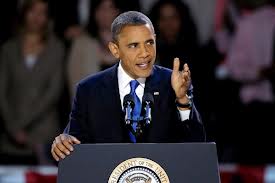
President Obama, upon his arrival today in Bangkok at the start of a state visit to several Asian countries, reminded the world of just how unconditional U.S. support for Israel remains. Obama was quoted as saying, “There is no country on earth that would tolerate missiles raining down on its citizens from outside of its borders. We are fully supportive of Israel’s right to defend itself.” Much is missing from such a sentiment, most glaringly, the absence of any balancing statement along the following line: “and no country would tolerate the periodic assassination of its leaders by missiles fired by a neighboring country, especially during a lull achieved by a mutually agreed truce. It is time for both sides to end the violence, and establish an immediate ceasefire.”
But instead of such statesmanship from this newly elected leader what we hear from Ben Rhodes, his Deputy National Security Advisor, who is traveling with the president in Asia is the following: that the rockets from Gaza are “the precipitating factor for the conflict. We believe Israel has a right to defend itself, and they’ll make their own decisions about the tactics they use in that regard.” Of course, these tactics up to this point have involved attacking a densely urbanized population with advanced weaponry from air and sea, targeting media outlets, striking residential structures, and killing and wounding many civilians, including numerous children. Since when does ‘the right to defend oneself’ amount to a license to kill and wound without limit, without some clear demonstration that the means of violence are connected with the goals being sought, without a requirement that force be exclusively directed against military targets, without at least an expression of concern about the proportionality of the military response? To overlooks such caveats in the present context in which Gaza has no means whatsoever defend itself indicates just how unconditional is the moral/legal blindfold that impairs the political wisdom and the elemental human empathy of the American political establishment.
The statement by Rhodes signals a bright green light to the Netanyahu government to do whatever it wishes as far as Washington is concerned, and omits even a perfunctory mention of the relevance of international law. It presumes American exceptionalism, now generously shared with Israel, that doesn’t even have to bother justifying its behavior, conveying to the world an imperial directive that what would be treated as unspeakable crimes if committed by others are matters of discretion for the United States and its closest governmental associates.
And what Netanyahu proposes is as chilling as it is criminal: to “significantly expand” what he calls Israel’s “Gaza operation” and what I call “the killing fields of Gaza.” This idea that a state defends itself by such an all out attack on an undefended society is humanly unacceptable, as well as being a mandate for future retaliation and festering hatred. Operation Cast Lead was launched in December 2008 to contribute to Israeli security, but instead led Hamas to acquire the kind of longer range rockets that are now posing genuine threats to Israel’s major cities. The unfolding logic of the conflict is that in a few years, Israel will be confronted by more sophisticated rockets capable of eluding the Iron Dome and accurately pinpointing their intended targets. This deadly logic of the war system continues to guide strategists and military planners in Washington and Tel Aviv, and ignores the string of political failures that marks recent American history from Vietnam to Afghanistan. The world has changed since the good old colonial days of gunboat diplomacy, and the history-making reality of military superiority. Will they ever learn?
What should have been clear long ago is that Israeli security is not achieved by guns and missiles, nor incidentally are Hamas’ goals reached by rockets. The only clear path to security is to follow a ceasefire with some mutual assurances of nonviolent coexistence, a lifting of the blockade of Gaza, an acceptance by Israel (and the United States) of both Hamas and the Palestinian Authority as political actors, freezing all settlement construction, and a revival of negotiations on the basis of a commitment to produce a sustainable and just peace in accordance with Palestinian and Israeli rights under international law, above all the Palestinian right of self-determination. Depicting such a moderate approach to security for these two peoples highlights just how pathological present patterns of ‘acceptable’ behavior have become.
Israel’s policies seemed almost calculated to increase future ‘insecurity’ for its people and the region. There is a slow ongoing mobilization of the region in support of Palestinian claims well expressed by the diplomatic re-positioning of Egypt and Turkey. It will be become much more difficult for the United States to insulate Israel from the consequences of its future aggressions against the Palestinians. This is partly because it is likely that the next time, militants hostile to Israel will be better armed, as was true for Hezbollah after the 2006 Lebanon War and for Hamas since the 2008-09 Gaza attacks, and partly because the balance of regional forces is tilting quickly against Israel.
These speculations make such obvious points that most Israeli strategists must be assumed to have appreciated them. It makes one wonder whether it is wrong to think of this latest surge of Israeli violence as primarily motivated by security considerations. Perhaps other motivations have greater weight: diverting attention from annexationist moves in the West Bank; reinforcing the Netanyahu claims to be the gallant protector of the nation; removing any pressure on Israel to uphold Palestinian rights; reminding Iran yet again of the militarized fury of an antagonized Israel assured of U.S. support.]
**************the text of the AJ article is reproduced below—————————
The media double standards in the West on the new and tragic Israeli escalation of violence directed at Gaza were epitomized by an absurdly partisan New York Times front page headline: “Rockets Target Jerusalem; Israel girds for Gaza Invasion.” (NYT, 16 Nov 2012) Decoded somewhat, the message is this: Hamas is the aggressor, and Israel when and if it launches a ground attack on Gaza must expect itself to be further attacked by rockets. This is a stunningly Orwellian re-phrasing of reality. The true situation is, of course, quite the opposite: namely, that the defenseless population of Gaza can be assumed now to be acutely fearful of an all out imminent Israeli assault, while it is also true, without minimizing the reality of a threat, that some rockets fired from Gaza fell harmlessly (although with admittedly menacing implications) on the outskirts of Jerusalem and Tel Aviv. There is such a gross disproportion in the capacity of the two sides to inflict damage and suffering due to Israeli total military dominance as to make perverse this reversal of concerns to what might befall Israeli society if the attack on Gaza further intensifies.
The reliance by Hamas and the various Gaza militias on indiscriminate, even if wildly inaccurate and generally harmless, rockets is a criminal violation of international humanitarian law, but the low number of casualties caused and the minor damage caused, needs to be assessed in the overall context of massive violence inflicted on the Palestinians. The widespread non-Western perception of the new cycle of violence involving Gaza is that it looks like a repetition of Israeli aggression against Gaza in late 2008, early 2009, that similarly fell between the end of American presidential elections and scheduled Israeli parliamentary elections.
There is the usual discussion over where to locate responsibility for the initial act in this renewed upsurge violence. Is it some shots fired from Gaza across the border and aimed at an armored Israeli jeep or was it the targeted killing by an Israeli missile of Ahmed al-Jabani, leader of the military wing of Hamas, a few days later? Or some other act by one side or the other? Or is it the continuous violence against the people of Gaza arising from the blockade that has been imposed since mid-2007? The assassination of al-Jabani came a few days after an informal truce that had been negotiated through the good offices of Egypt, and quite ironically agreed to by none other than al-Jabani acting on behalf of Hamas. Killing him was clearly intended as a major provocation, disrupting a carefully negotiated effort to avoid another tit-for-tat sequence of violence of the sort that has periodically taken place during the last several years. An assassination of such a high profile Palestinian political figure as al-Jahani is not a spontaneous act. It is based on elaborate surveillance over a long period, and is obviously planned well in advance partly with the hope of avoiding collateral damage, and thus limiting unfavorable publicity. Such an extra-judicial killing, although also part and parcel of the new American ethos of drone warfare, remains an unlawful tactic of conflict, denying adversary political leaders separated from combat any opportunity to defend themselves against accusations, and implies a rejection of any disposition to seek a peaceful resolution of a political conflict. It amounts to the imposition of capital punishment without due process, a denial of elementary rights to confront an accuser.
Putting aside the niceties of law, the Israeli leadership knew exactly what it was doing when it broke the truce and assassinated such a prominent Hamas leader, someone generally thought to be second only to the Gaza prime minister, Ismail Haniya. There have been rumors, and veiled threats, for months that the Netanyahu government plans a major assault of Gaza, and the timing of the ongoing attacks seems to coincide with the dynamics of Israeli internal politics, especially the traditional Israeli practice of shoring up the image of toughness of the existing leadership in Tel Aviv as a way of inducing Israeli citizens to feel fearful, yet protected, before casting their ballots.
Beneath the horrific violence, which exposes the utter vulnerability, of all those living as captives in Gaza, which is one of the most crowded and impoverished communities on the planet, is a frightful structure of human abuse that the international community continues to turn its back upon, while preaching elsewhere adherence to the norm of ‘responsibility to protect’ whenever it suits NATO. More than half of the 1.6 million Gazans are refugees living in a total area of just over twice the size of the city of Washington, D.C.. The population has endured a punitive blockade since mid-2007 that makes daily life intolerable, and Gaza has been harshly occupied ever since 1967.
Israel has tried to fool the world by setting forth its narrative of a good faith withdrawal from Gaza in 2005, which was exploited by Palestinian militants as the time as an opportunity to launch deadly rocket attacks. The counter-narrative, accepted by most independent observers, is that the Israeli removal of troops and settlements was little more than a mere redeployment to the borders of Gaza, with absolute control over what goes in and what leaves, maintaining an open season of a license to kill at will, with no accountability and no adverse consequences, backed without question by the U.S. Government. From an international law point of view, Israel’s purported ‘disengagement’ from Gaza didn’t end its responsibility as an Occupying Power under the Geneva Conventions, and thus its master plan of subjecting the entire population of Gaza to severe forms of collective punishment amounts to a continuing crime against humanity, as well as a flagrant violation of Article 33 of Geneva IV. It is not surprising that so many who have observed the plight of Gaza at close range have described it as ‘the largest open air prison in the world.’
The Netanyahu government pursues a policy that is best understood from the perspective of settler colonialism. What distinguishes settler colonialism from other forms of colonialism is the resolve of the colonialists not only to exploit and dominate, but to make the land their own and superimpose their own culture on that of indigenous population. In this respect, Israel is well served by the Hamas/Fatah split, and seeks to induce the oppressed Palestinian to give up their identity along with their resistance struggle even to the extent of asking Palestinians in Israel to take an oath of loyalty to Israel as ‘a Jewish state.’ Actually, unlike the West Bank and East Jerusalem, Israel has no long-term territorial ambitions in Gaza. Israel’s short-term solution to its so-called ‘demographic problem’ (that is, worries about the increase in the population of Palestinians relative to Jews) could be greatly eased if Egypt would absorb Gaza, or if Gaza would become a permanently separate entity, provided it could be reliably demilitarized. What makes Gaza presently useful to the Israelis is their capacity to manage the level of violence, both as a distraction from other concerns (e.g. backing down in relation to Iran; accelerated expansion of the settlements) and as a way of convincing their own people that dangerous enemies remain and must be dealt with by the iron fist of Israeli militarism.
In the background, but not very far removed from the understanding of observers, are two closely related developments. The first is the degree to which the continuing expansion of Israeli settlements has made it unrealistic to suppose that a viable Palestinian state will ever emerge from direct negotiations. The second, underscored by the recent merger of Netanyahu and Lieberman forces, is the extent to which the Israeli governing process has indirectly itself irreversibly embraced the vision of Greater Israel encompassing all of Jerusalem and most of the West Bank. The fact that world leaders in the West keep repeating the mantra of peace through direct negotiations is either an expression of the grossest incompetence or totally bad faith. At minimum, Washington and the others calling for the resumption of direct negotiations owe it to all of us to explain how it will be possible to establish a Palestinian state within 1967 borders when it means the displacement of most of the 600,000 armed settlers now defended by the Israeli Defense Forces, and spread throughout occupied Palestine. Such an explanation would also have to show why Israel is being allowed to quietly legalize the 100 or so ‘outposts,’ settlements spread around the West Bank that had been previously unlawful even under Israeli law. Such moves toward legalization deserve the urgent attention of all those who continue to proclaim their faith in a two-state solution, but instead are ignored.
This brings us back to Gaza and Hamas. The top Hamas leaders have made it abundantly clear over and over again that they are open to permanent peace with Israel if there is a total withdrawal to the 1967 borders (22% of historic Palestine) and the arrangement is supported by a referendum of all Palestinians living under occupation. Israel, with the backing of Washington, takes the position that Hamas as ‘a terrorist organization’ that must be permanently excluded from the procedures of diplomacy, except of course when it is serves Israel’s purposes to negotiate with Hamas. It did this in 2011 when it negotiated the prisoner exchange in which several hundred Palestinians were released from Israeli prisons in exchange for the release of the Israel soldier captive, Gilad Shalit, or when it seems convenient to take advantage of Egyptian mediation to establish temporary ceasefires. As the celebrated Israeli peace activist and former Knesset member, Uri Avnery, reminds us a cease-fire in Arab culture, hudna in Arabic, is considered to be sanctified by Allah, has tended to be in use and faithfully observed ever since the time of the Crusades. Avnery also reports that up to the time be was assassinated al-Jabari was in contact with Gershon Baskin of Israel, seeking to explore prospects for a long-term ceasefire that was reported to Israeli leaders, who unsurprisingly showed no interest.
There is a further feature of this renewal of conflict involving attacks on Gaza. Israel sometimes insists that since it is no longer, according to its claims, an occupying power, it is in a state of war with a Hamas governed Gaza. But if this were to be taken as the proper legal description of the relationship between the two sides, then Gaza would have the rights of a combatant, including the option to use proportionate force against Israeli military targets. As earlier argued, such a legal description of the relationship between Israel and Gaza is unacceptable. Gaza remains occupied and essentially helpless, and Israel as occupier has no legal or ethical right to engage in war against the people and government of Gaza, which incidentally was elected in internationally monitored free elections in early 2006. On the contrary, its overriding obligation as Occupier is to protect the civilian population of Gaza. Even if casualty figures in the present violence are so far low as compared with Operation Cast Lead, the intensity of air and sea strikes against the helpless people of Gaza strikes terror in the hearts and minds of every person living in the strip, a form of indiscriminate violence against the spirit and mental health of an entire people that cannot be measured in blood and flesh, but by reference to the traumatizing fear that has been generated.
We hear many claims in the West as to a supposed decline in international warfare since the collapse of the Soviet Union 20 years ago. Such claims are This is to some extent a welcome development, but the people of the Middle East have yet to benefit from this trend, least of all the people of Occupied Palestine, and of these, the people of Gaza are suffering the most acutely. This spectacle of one-sided war in which Israel decides how much violence to unleash, and Gaza waits to be struck, firing off militarily meaningless salvos of rockets as a gesture of resistance, represents a shameful breakdown of civilization values. These rockets do spread fear and cause trauma among Israeli civilians even when no targets are struck, and represent an unacceptable tactic. Yet such unacceptability must be weighed against the unacceptable tactics of Israel that holds all the cards in the conflict. It is truly alarming that now even the holiest of cities, Jerusalem, is threatened with attacks, but the continuation of oppressive conditions for the people of Gaza, inevitably leads to increasing levels of frustration, in effect, cries of help that world has ignored at its peril for decades. These are survival screams! To realize this is not to exaggerate! To gain perspective, it is only necessary to read a recent UN Report that concludes that the deterioration of services and conditions will make Gaza uninhabitable by 2020.
That is, completely aside from the merits of the grievances on the two sides, for one side to be militarily omnipotent and the other side to be crouching helplessly in fear. Such a grotesque reality passes under the radar screens of world conscience because of the geopolitical shield behind which Israel is given a free pass to do whatever it wishes. Such a circumstance is morally unendurable, and should be politically unacceptable. It needs to be actively opposed globally by every person, government, and institution of good will.





 Global Justice in the 21st Century
An Open Letter on my 82nd Birthday
13 NovExactly two years ago I wrote my first blog. Throughout this period it has been a bittersweet experience consisting of work, play, challenge, and occasional consternation. Many warm and generous responses have given me an appreciation of the distinctive satisfactions of cyber connectivity. Such pleasures have been somewhat offset by hostile commentary and related monitoring, not mainly for disagreements as to substance, but to find discrediting material, usually torn from context, that might induce me to resign or be dismissed from my unpaid UN position as Special Rapporteur for Occupied Palestine on behalf of the Human Rights Council. What is most distressing is not the attacks that are well known to come with this territory, but the degree to which important government officials in the United States and at the UN so easily become willing accomplices in such malicious campaigns of defamation, and do so without ‘due diligence.’
Of course, someone more prudent than I, would have long ago abandoned the blogosphere, and more fully enjoyed the many serene satisfactions of southern California and the stimulating challenges of summers in Turkey. The magnetic appeal of this risky, still uncertain, medium of communication that was born in this century is both to reach others everywhere on the planet and to engage in a form of self-exploration and self-discovery that demonstrates almost daily that one is never too old to learn anew. These posts of mine have been mostly reflections of my experience around the world, interpretations of current global issues, and suggestions for a more peaceful, just, and sustainable world.
I have deeply appreciated the support and most of the reactions I have received from known and unknown persons throughout the planet. At the deepest level, it makes me realize that there exists a large invisible and informal community of shared faith in the healing power of love, and less grandly, of the gratifications of dialogue. It is as a charter member of this community that makes me feel that it is valuable to remain an active participant so long as my muse permits, perhaps at a reduced rate.
At the start of this experience I felt that it was best to allow all comments to appear, including the most unsavory. Yet as the months went by I realized that there is a cyber analogue to Gresham’s Law: ‘bad comments drive out good!’ I received many personal messages outside the blogosphere decrying the toxic atmosphere. This prompted me to try my best to monitor comments, excluding those that were uncivil in tone, as well as those that consisted of personal. It was not easy. It is a fine line. I was criticized for straying across it, or using my discretion in a biased manner. I listened, and have tried to be sensitive to diverse viewpoints without denying my own passions.
I realize that many online media outlets allow comments to appear with only minimal filtering, but I have come to feel that this diminishes the quality and benefits of the dialogic potential of a blog, especially one devoted often to issues being debated in public space. It has taught me that while freedom of expression is a vital human right, and integral to democracy, it must be limited by context. The world is now a crowded theater. Koran burning and bible burning are the 21st century equivalent of shouting ‘fire!’ and inducing panic and causing mayhem in distant places. The problem of a blog is, of course, different. The justification for limiting expression to establish the kind of decorum that facilitates dialogue and conversation.
Among the side effects of my blog has been an opportunity to publish more widely. It was encouraging to be invited to become a regular contributor to Al Jazeera’s English online opinion section. I find this brilliantly edited source of news and commentary to be far more cosmopolitan in its orientation toward events of the day than the most authoritative mainstream Western media outlets. This post-colonial de-Westernization of information and interpretative assessment is integral to building a multi-civilizational world community dedicated to the principles of humane and sustainable governance at all levels of social interaction.
As time passes, the political circumstances of the peoples of the world are undergoing a variety of severe stresses, some local, others global, some presently experienced, others threatened in the near and medium future. There are extremely dangerous underlying patterns of behavior emerging: Among the most disturbing is the deterritorialization of conflict epitomized by kill lists and drone technology that ignores the sovereignty of others and defies the moral and legal limits embodied in international humanitarian law.
There are also some latent opportunities that will come as surprises if acted upon. Perhaps, the reelected Barack Obama might surprise us by being willing to take steps to convince the world that he deserved the Nobel Peace Price that had been prematurely, and somewhat perversely, awarded to him in 2009. One sure way to do this would be to revive his Prague vision of a world without nuclear weapons. There will never be a better time in world politics to convene the nine governments whose states possess nuclear weapons. There is no raging geopolitical conflict, a mounting risk of a dangerous surge in the proliferation, and the many countries beset by financial crisis would welcome uplifting moves toward denuclearization. Nothing would more quickly restore America’s tarnished reputation as a benevolent force in the world than tabling a detailed proposal for phased and verified nuclear disarmament to be implemented within a decade. It is commonplace to applaud the vision but then immediately defer its realization to the distant future, which is to take back with one hand what was given with the other, raising expectations of those who are dedicated to abolishing the weaponry, and then reassuring nuclearists that they have nothing to worry about as nothing will actually happen. Now is the time for a genuine presidential initiative that is launched in Washington but negotiated under UN auspices to rid the world of the menace of nuclear weaponry, and to belatedly clear the conscience of humanity for its reliance on ‘security’ ever since1945 that rests on a genocidal doctrine of deterrence. Of course, the main responsibility for this reliance is not that of humanity, but of the governments that possess the weaponry and their supportive bureaucratic and economicmilitarized infrastructures. Even if the initiative should not succeed in achieving agreement, the effort would assure the Obama presidency of a memorable legacy.
The other global challenge that presents the White House with an extraordinary opportunity for action is climate change. The world, including the United States, has ignored a multitude of wakeup calls, most recently super storm Sandy. It has also refused to take seriously the scientific consensus warning the world of the dire consequences of failing to curtail carbon emissions. Further delay is not neutral, causing a variety of effects that cumulatively disrupt the ecological balances that moderate weather, rainfall, and ocean levels to accommodate humans, plants, and animals. Inaction and denial is lavishly funded by the fossil fuel industries that have made climate skepticism so influential in the United States, and elsewhere. Nothing could do more to build the legacy of Obama’s second term than to tear down the high wall of silence that has been built to keep the dangers of global warming out of sight.
It is in this spirit of concern, struggle, hope, and love that I commit myself to carry on with this journey of a still aspiring citizen pilgrim journeying ever so slowly toward that unseen yet real promised land.
Tags: Barack Obama, California, Nobel Peace Prize, Obama, United Nations Human Rights Council, United States, Washington, White House