 I visited North Vietnam in 1968, and had meetings with its leaders in the midst of the ongoing war, which resulted in receiving the outlines of a proposal for ending the conflict on a basis more favorable to the United States than what was finally negotiated by Henry Kissinger seven years and many deaths later. Because I was among the early anti-war visitors to Hanoi and may have been the first with a combination of academic credentials and some access to American decision-makers there was great journalistic interest inmy experience. I was approached on my return by mainstream journalists from major newspapers and TV networks, especially those who harbored growing doubts about the war, resulting in a series of interviews given prominent media attention for several days.
Yet I was deeply disappointed and disturbed by the experience, and the journalistic ethos that it revealed. The mainstream interest was totally focused on what I had been told by the North Vietnamese leadership about their receptivity to a peaceful resolution of the conflict. This preoccupation was, of course, understandable, but what I found so distressing at the time was a total disinterest in my accounts of the total vulnerability of the Vietnamese people to the onslaught of high tech weaponry, the resulting suffering and devastation, as well as the absence of military targets in the Vietnamese countryside where the only structures were churches and hospitals. I was deeply affected by this exposure to the human fabric of warfare, as well as by the Vietnamese spirit of resilience and perseverance coupled with an absence of bitterness toward the American people in part a reflection of the way Vietnam was governed at the time. School children were taught that it is not contradictory to view the government of the United States as an enemy and yet maintain friendship with American people and the best of their national traditions. Throughout the war, I found it remarkable that Vietnamese school children were taught to regard the American Declaration of Independence as a step toward human liberation that deserved universal affirmation.
What I encountered in Europe and the United States when I tried to convey these impressions to journalists, especially those who were unashamedly liberal in their critical outlook toward the war, was a total disinterest in the (in)human face of the Vietnam War. Their concerns were confined to the realist agenda about how the war was going and whether the Vietnamese were serious about their posture of seeking peace via diplomacy on the basis of a political compromise rather than through victory on a battlefield outcome. The more I reflected on this, the more I came to realize that the journalistic ethos as applied to foreign policy was indifferent to the wartime suffering of the enemy population and a humanitarian catastrophe of massive proportions.
This deep seated indifference had several components. Above all, it reflected the nationalistic limits of empathy, which highlights sufferings of our side, and essentially ignores the losses of the other side, an extension of the friends/enemies dichotomy that underlies the realist paradigm. At most, the losses of the enemy other will be reported as statistics, but except in rare circumstances, without much human context to exhibit the terrible impact of war on the civilian population of a country that is subject to the sort of one-sided onslaught that afflicted Vietnam for so long. A second explanation had to do with the imperial mentality that dominated Western journalism whether liberally inclined or not, which dissented from the war not because it violated the UN Charter or international law or was an affront to fundamental morality, but either because it was not producing a victory or was not worth the cost in American lives and resources. It is this realist calculus that is filtered through a nationalist optic that helps understand the peculiar form of liberalism that prevails in the United States and endorses the pernicious postulates of ‘American exceptionalism.’
A third explanation had to do with the overt commitment of Western mainstream journalism to a style of reportage based on facts, nor feelings or opinions, both of which are distrusted because of their supposedly subjective character. The primary journalistic claim in this tradition of professionalism is ‘the news without spin.’ In this respect, my post-Vietnam interviewers were acting ‘professionally’ given this canon as any display of empathy for Vietnamese suffering would be discrediting to their claims to stand outside the circle of controversy when reporting the news. Not that such disengagement was unbiased, hiding rather than acknowledging its nationalist and realist framings.

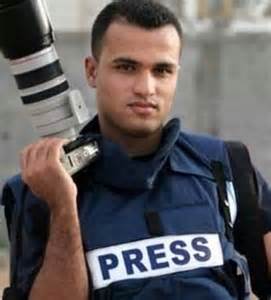
All of which brings me to Mohammed Omer’s extraordinary Shell-Shocked: On the Ground under Israel’s Gaza Assault, published by Or Books (New York & London) in 2015. The book consists of dispatches from the war zone by a young prize-winning journalist who has been telling the world about the Gaza ordeal for almost ten years, since his early 20s. Omer’s prior reporting earned him the Martha Gellhorn Prize for Journalism in 2007, recognizing the excellence of his reportage on Gaza (‘a voice for the voicelss’). After receiving the award in The Netherlands, Omer on his return home received a brutal reception at the Gaza border by Israeli security guards being beaten so severely as to endure serious injury that required specialized surgery. With the help of a Dutch diplomat and medical treatment Omer restored his health while studying in overseas universities, yet opting to return to Gaza rather than to enjoy a life abroad as an honored exile. Omer wrote this book while doing his best during the 51 day war of 2014, what Israelis called Operation Protective Edge, to tell the world about the war from the perspective of those enduring it, that is, the civilian population of Gaza. Shell-Shocked raises many issues worthy of commentary but here I will limit myself to issues bearing on the style and ethics of professional journalism.
In essence, Omer does not have the option of detachment from the ordeal of war in the manner of the liberal journalists who I describe above as covering the Vietnam War as an instance of failure for American foreign policy. Omer by choice and circumstances refused to be detached, but that does not mean that he cannot be trusted. On the contrary. As Omer explains, “..I’m a journalist, and I owe it to my people and the Israeli people to get to the truth. I choose to stay in Palestine, my beloved home, with my wife, son, mother, father, siblings. I am not willing to let Israel or Zionism exterminate me.” (28) He has a Dutch passport, and could leave, and lament the fate of Gaza from afar, and who could blame him for doing so. Obviously, the choice is not an easy or simple one. He observes at one point, “I wish I could airlift my wife and son (3 months) out of here. But this is my ancestral home; what else can I do?” (26) In describing the effects of the war, minimizes his own struggle to stay alive, courageously confronting life-threatening dangers on an hourly basis so as to fulfill his role as the eyes and voice of the Palestinian people enduring the ultimate horrors of war.
Part of what separates Omer from even the most empathetic of foreign journalists, for instance Max Blumenthal, is his embeddedness in the history and realities of life in Gaza. Even if he were to leave, his family would be surviving under the heavy weight of the Israeli assault. He can never escape emotionally from his deep attachment to Gaza. Again his words are the best evidence of the authenticity and importance of his journalistic witnessing: “..I am offended, not only as a human, as a Palestinian in Gaza and as a father, but also as a journalist in Gaza. To get a story, I navigate a sea of body parts and blood each day, much it the remnants of people I know: my neighbors, friends and community. Unlike international reporters, those of us from Gaza don’t simply report. We live and die here.” (23) Of course, the last part of this passage is not entirely fair. Many brave international correspondents have risked their lives and paid the highest price on some occasions. I recall the great French reporter, Bernard Fall, being blown up by a mine while walking on a Vietnam beach, or more recently, the grisly 2014 TV beheading of the American journalist, James Foley, but Omer’s distinction still generally holds. The outsider who enters such a cauldron of political violence puts his life at risk, yet in almost all circumstances, can after awhile withdraw from the combat zone, resuming normalcy, although some journalists are subject to a kind of ‘fever of war,’ and only feel truly human when in the close vicinity of mortal danger. I remember Peter Arnett telling me in Hanoi on my second trip there in 1972 that after covering many major wars he only felt fully alive when doing first-hand war journalism, but the New Zealand born Peter, although animated and brave, never allowed the suffering of the civilian population to get to him, managing a detachment in the Western style, supposedly letting the facts do all the talking.
In important respects, this is also what Omer does, but with an undisguised sharp normative edge. The book consists of describing the daily ordeal experienced by the citizens of Gaza living under the fury of the Israeli attacks with no way of finding secure sanctuary, often relying on their own words to give the details of their struggles for survival and to recount their harrowing loss of loved ones. In this spirit Omer makes the reader almost feel what it must be like not to find food on the shelves of the neighborhood store or not to afford the spike in prices that follows from growing scarcities or not to have safe drinking water for growing children or not to be able to escape the confines of one’s house, which is itself never out of the danger zone. And most of all, what it feels like to cope with the unspeakable death and maiming of family members and neighbors as a result of Israeli military tactics. These graphic descriptions of what the 51-day war meant for specific residents of Gaza constitutes the basic reportage of Shell-Shocked.
One expects that within this frame of witnessing Omer reports as accurately as possible, without exaggeration or invention. From what I know of Omer (he is a friend who I have known and admired for seven years) and of the situation in Gaza from other sources, I am utterly convinced that Omer is adhering to the highest standards of accuracy in reportage, relying heavily on descriptions of the scene and the witness of those who have endured the worst losses of loved ones, homes, livelihood. As well, his local affiliations are neutral. Omer does not belong to or identify with any political party or association. He is embedded in Gaza by life circumstances, being a member of the victimized society with deep family and community affinities, and by this identity disposed toward ending the occupation of Gaza, achieving self-determination for the Palestinian people, and the achieving a durable and just peace for both peoples.
Omer never pretends that he has no personal stake in this conflict. In introducing his book Omer gives the reader a sense of his outlook: “As for myself, I try to remain optimistic, no small feat in ruined shell of what was once a beautiful and self-sufficient coastal enclave. Our reality is predicated upon Israel’s determination to drive us from our homes for good.” (7) More than this, Omer observes critically that “[v]ery few in the mainstream media ever talk about the right of the people of Gaza to defend ourselves, or even just to exist.” (10) Note in the tangled syntax of this sentence that Omer gets trapped between describing the right that pertains to the people and a right that belongs to himself as one of the people. Making his political viewpoint even clearer, and from the Western journalistic ethos unacceptable, Omer acknowledges his support for BDS as raising the costs of occupation for Israel, and besides being a tactic that is lawful and nonviolent. Omer also affirms the inclusiveness of his hopes: “Speaking personally I would like to see a single state where equity and tolerance are the only way forward for Israelis and Palestinians.” (11)
Omer also makes it clear that Israel understands that from its perspective that such journalistic depictions of the effects of the war both complicate and even undermine their propagandistic portrayals of good versus evil. Omer quotes a Beirut-based TV camera man, Abed Afifi, who reacts to the intentional targeting of a journalistic colleague with these words: “Such [an] attack is meant to intimidate us. Israel has no bank of targets, except civilians and journalists.” (55) He goes on to insist that “[A]ll these attacks on civilians should not stop us from working—the world has to see what Israel is doing in Gaza.” (55) And so it has to some degree, thanks to the efforts of Omer, Afifi, and many others.
Given the Israeli use of precision missiles against clearly marked TV vans, the inference of deliberate targeting seems hard to avoid. Israel has half acknowledged this by claiming that the journalists targeted are not ‘legitimate journalists,’ a claim refuted by Sarah Leah Whitson of Human Rights Watch, pointing out that such an attack is a violation of international humanitarian law even if the journalists can be shown to be partisan. In effect, the subjectively motivated journalist is by choice and hostile perception a kind of warrior, seeking to help win that part of the war, often the decisive part, waged for control of the psychological terrain governing ‘hearts and minds,’ and hence ‘illegitimate’ in the eyes of the side relying on a military onslaught to impose its will.
Finally, I return to my central comparison between objectively styled journalism that prevails in the West and the subjectively styled approach taken by Mohammed Omer and other journalists who work from a vantage point within the orbit of extreme victimization. I recall my friend, Walden Bello, the noted author and political figure from the Philippines, saying that he didn’t have to determine whether imperialism was real or not as he experiences its reality on a daily basis, which shaped and conditioned his observational standpoint. For Omer, the reality of violent oppression does not have to be determined as it is experienced in the most intense possible ways.
Some years ago, in collaboration with Howard Friel, I was the junior co-author of two books highly critical of the manner in which the New York Times handled foreign policy debates and reported on Middle East issues, especially the Israel/Palestine conflict. [The Record of the Paper: How the New York Times Misreports U.S. Foreign Policy (2004) and Israel-Palestine on Record: How the New York Times Misrepresents Conflict in the Middle East (2007). We reached two main conclusions: (1) the Times systematically excluded the relevance of international law whenever it was seen as impinging on American choices in the pursuit of foreign policy goals; (2) the selective presentation of evidence sought to maintain a pro-Israeli consensus and to minimize the actualities of Palestinian victimization, a pattern very evident in the news coverage, but also in the type of opinion writers who were published and those who were excluded. In this regard, the claim of objectivity and detachment were sham, and devices used to manipulate and indoctrinate the reader, a phenomenon brilliantly depicted by Noam Chomsky in his studies of ‘indoctrination in a liberal society. I remember telling my students during the height of the Cold War that if you were a Russian in Moscow you learned how to discern realities by reading between the lines but if you were an American in Washington it required much greater sophistication to gain a comparable appreciation of the news from the New York Times or Washington Post, despite their widely accepted claims of being ‘papers of record.’
In this sense, I learn more about the news and the infrastructure of opinions that are shaping its editorial assessments from the avowedly conservative Wall Street Journal than I do from reading these liberal, more sympathetic, papers of record. And without doubt I learn more from Mohammed Omer about the realities of what happened during those 51 days in Gaza than I do from the mainstream media with its hidden biases and posture of apolitical detachment. That this learning corresponds with my political and ethical inclinations makes the experience moving and congenial as well as informative, and I encourage all with concern for Palestine’s present and future to read Omer’s brave book that can also be appreciated as a documentary compilation of testimony by the residents of Gaza caught in the maelstrom of a particularly cruel military onslaught and who yet manifest that quality of sumud that has made Palestinian resilience such an inspiring human reality amid the doldrums of the early 21st century. Mohammed Omer deserves the last word: “I have written this book as a way of preserving and passing on stories that need to be told.” (11)
Normal
0
false
false
false
EN-US
JA
X-NONE
/* Style Definitions */
table.MsoNormalTable
{mso-style-name:”Table Normal”;
mso-tstyle-rowband-size:0;
mso-tstyle-colband-size:0;
mso-style-noshow:yes;
mso-style-priority:99;
mso-style-parent:””;
mso-padding-alt:0in 5.4pt 0in 5.4pt;
mso-para-margin:0in;
mso-para-margin-bottom:.0001pt;
mso-pagination:widow-orphan;
font-size:12.0pt;
font-family:Cambria;
mso-ascii-font-family:Cambria;
mso-ascii-theme-font:minor-latin;
mso-hansi-font-family:Cambria;
mso-hansi-theme-font:minor-latin;}
Tags: Gaza, Gaza 51 day war, Journalism, Mohammed Omer, Operation Protective Edge, Peace journalism, War Journalism




 Global Justice in the 21st Century
The Nuclear Challenge 70 Years after Hiroshima and Nagasaki (7): Nuclear Civil Disobedience
4 SepIn the years after World War II there was a widespread belief that rational minds would prevail, and that nuclear weapons would not be further developed, and their possession as well as their threat or use prohibited. The onset of the Cold War, the Soviet acquisition of the bomb, and the Eisenhower threat to use nuclear weapons if necessary to end the Korean War basically extinguished any real prospect of nuclear disarmament. Of course, the diplomacy of peace advocacy and of nuclear nonproliferation made it expedient to continue to affirm nuclear disarmament as a goal of foreign policy. And indeed up through the 1960s both Washington and Moscow tabled disarmament proposals with some fanfare, yet clearly lacked the political will to confront what had already become the powerful nuclear establishment that was a principal component of the military-industrial-complex that was so memorably depicted in Eisenhower’s still relevant Farewell Address.
It is against this background that it became increasingly clear that nuclear weapons would remain part of the geopolitical scene so long as their role was left to governments and normal statecraft. Before long all five permanent members of the UN Security Council opted for possession of nuclear weapons, which as a result seemed to connect great power status on a global level with entry into the nuclear club. Its expansion beyond this circle of World War II victors was more problematic as the further spread of the weaponry collided with the geopolitical priority of nonproliferation and with the oligopolistic mentality that was shared by the nuclear weapons states, and belied the central claim of the West that nuclear weapons were needed and effective in a deterrent posture, keeping the peace by discouraging attacks and provocative international initiatives. The strategic rationale for nuclear weaponry relied upon by the United States and Europe stressed the need to offset Soviet superiority in conventional weaponry and territorial access from their base in the Asian landmass.
Ever since the 1980s peace activists, especially those with deep religious convictions, have mounted civil society campaigns centered on the immorality of threatening or using nuclear weapons, and even on possessing and contemplating possible use. Those activists with the deepest convictions have repeatedly resorted to nonviolence civil disobedience, sometimes in provocative forms (spilling their own blood at nuclear facilities, damaging warheads, blocking trains carrying missiles), to communicate the depth of their opposition, and their own willingness to accept prison sentences to get their message better heard. I was deeply moved and influenced by the purity of several of the leading personalities who followed this line of thought and action, and participated in a supportive role by being an expert witness in several high profile legal cases. Among those I came to know through this contact, and particularly admired, were the Berrigan brothers, Daniel and Philip, Elizabeth McAlister, and James Douglass. They were and remain for me among the most charismatic and inspirational figures in my life experience, not only for their anti-nuclear clarity (accompanied by strong earlier stands against the Vietnam War and wider commitments of service to the poor), but for the ways they connected such strong spiritual identities with their daily life styles and citizen engagements that harmoniously fused religious values with deeply felt and reflected upon moral/political understanding of how to live in the world.
I was particularly drawn to the work and outlook of the Ground Zero Center for Nonviolent Protest founded by James and Shelley Douglass in Bangor, Washington and reaching out to many in the greater Seattle area with their uncompromising and sustained opposition to nuclearism, with a focus on so-called first-strike weapons. There worldview combined their embrace of pre-Constantine Christianity, the early pacifist Christian communities that were persecuted and yet adhered to their beliefs and practices, and Gandhi whose life, work, and thought established the radical transformative potentiality of militant nonviolence. I was impressed during my years of contact with the people of Ground Zero by their deep belief that the point of confrontation is always conversion to truth and right action, and not passing judgment as to evil. By virtue of such efforts they managed to generate widespread sympathy with their work, eventually persuading the formerly apolitical Archbishop of Seattle, Raymond Hunthausen, to join them in nonviolent civil disobedience and gaining the respect and even the support of some local prosecutors.
An important element in their dedicated lives was the strong belief in living up to the Nuremberg ethos, including respect for the UN Charter and for international law generally. It was my role to show that their beliefs in what I called ‘the Nuremberg obligation’ created a civic, if not a legal, duty to oppose within reasonable bounds policies and behavior by a government if it directly violated international law, and the more so, if the context involved warmaking. I also gave my opinion that it was reasonable for individuals to believe that all activities associated with nuclear weapons involved or were leading to the commission of the most severe of war crimes, and that these persons being prosecuted did so believe.
From a somewhat more secular point of view, Daniel Ellsberg, followed in these footsteps, taking a journey that has led him from the pinnacles of state power in Washington as a top level strategic advisor to his brave and precedent-setting decision to release the Pentagon Papers that divulged the secrets wrongly withheld from the American public, a shocking documentary record of the policies and conduct of the U.S. Government in relation to the Vietnam War.
I have known Ellsberg since we were both students at Harvard in the 1950s, and were originally at opposite ends of the political spectrum. Dan was a starstudent of Cold War strategy within the reigning realist paradigm and I was an obscure and alienated critic, but we managed to keep some contact in subsequent years, and I was one of those who Dan entrusted with the cache of top secret documents that constituted the Pentagon Papers, and was later called to testify before the Boston Grand Jury (convened to investigate the criminality of the release) and later as an expert in the criminal trial that the government started and lost with respect to Ellsberg and the NY Times.
Ellsberg also has worked while at the Pentagon on nuclear war plans, the secret of secrets, irresponsibly sharable over the years with such reckless military adventurers as Curtis LeMay and Dick Cheney, and their less extremist colleagues. It is a wonder that with this kind of incubated knowledge of the most deadly reality the human species has ever confronted, that species endangering catastrophes have not yet darkened the horizon.
Ellsberg’s perseverance with respect to nuclear weaponry has become iconic. Besides, lucidly lecturing throughout the world he has committed civil disobedience about 100 times, engaged in long vigils and fasts devoted to dramatizing the failures of the UN and U.S. Government to achieve nuclear disarmament. Most recently, at an event on August 7th observing the 70th anniversary of the nuclear attacks, Ellsberg joined with 50 other protesters in a ‘die-in,’ outside of Lawrence Livermore Labs where nuclear warheads have for decades being continuously developed to attain ever higher levels of annihilating perfection. It is worth observing that the Livermore Labs are located in Livermore, California, which is in the Bay Area, and that the large budget for work on weapons, often more than $1 billion is federally funded by Department of Energy, and the operation is carried on as a partnership between the University of California and several large corporations, an alliance suggestive of the bondings between the government, universities, and the private sector. Ellsberg’s words at Livermore deserve contemplating and heeding as best we can however we are situated:
“The killing at Hiroshima was mass murder.… In the target plans that I worked on, and ones I worked on in Russia, the smoke will go into the stratosphere as it did in Hiroshima by higher firestorm. But simultaneously, thousands of cities, with pillars of smoke, will join around the globe blotting out the sunlight sufficiently to kill harvests around the world, and condemn nearly the entire population of the world to death. It’s the Doomsday Machine, The End. We’ve known that, not at the time of the Cuban Missile Crisis, but for the last twenty-five years, and yet these threats go on; the threats go on. They are threats of ending nearly all life. It’s never a good day to die, but it is a good day to get arrested.”
It is a somber message, but an informed recognition of where we are as a nation, and what this portends for species vulnerability, but also what it means culturally when national security is unethically conflated with a latent threat to commit a massive genocide, even omnicide.
70 years after Hiroshima and Nagasaki it is lamentable that more than ever it is the voices in the wilderness that speak most clearly to those who are the global managers of security for the peoples of the world. We can be thankful for those who have put their bodies on the line in this unbroken tradition of anti-nuclear civil obedience. An aspect of the problem has followed from the fact that the media puts almost all of its weight on the side of the nuclear militarists, and refuses to give attention or space to those who for decades selflessly seek to awaken us from this lengthy, hazardous, and immoral ‘nuclear sleep.’
Tags: civil disobedience, Daniel Berrigan, Daniel Ellsberg, deterrence, Eisenhower, James Doughlass, nuclear civil disobedience, Nuclear disarmament, nuclear weapons, Philip Berrigan