Archive | Commentary RSS feed for this section

Global Leadership: American Retreat, BRIC Ambivalence, and Turkey’s Rise

19 May

As the American president, Barack Obama, sets forth his views on the future of the Middle East it seems a good time to take stock of the leadership vacuum in world affairs, and whether there are alternatives to the role the United States has played ever since World War II. While Obama welcomed the regional moves toward democracy and deplored those regimes that hold onto power by using violence against their own people, there was little cause given in the speech for either American balance with respect to the Israel/Palestine conflict or commitment to a more equitable world economy. In other words, the speech was mainly a courtly exercise in cheerleading for democracy in North Africa and the Middle East but not an attempt to be a creative and innovative global leader with respect to regional problem-solving.

A disturbing feature of the present global setting is the absence of constructive global leadership, especially in relation to peacemaking and addressing issues of economic distress and environmental danger. True, the election of Barack Obama as the American president in late 2008 temporarily gave rise to widespread enthusiasm around the world that the United States could again do what it did after World War II, generally promote global wellbeing. Obama was viewed as offering the world a vision of peace and justice anchored in the promise of a new approach to both the Israel/Palestine conflict and troubled interactions between the West and the Muslim world. It was hoped that Obama would certainly allow the Bush era global war on terror or GWOT to subside, if not altogether end.

It was always doubtful in my mind that Obama would satisfy these high expectations that he further encouraged by carefully crafted visionary speeches in Cairo and Istanbul delivered early in his presidency. Although the language used by Obama on those occasions was a welcome change from the belligerent rhetoric that emanated from the White House during the Bush presidency, it seemed unlikely in my mind that Obama would be able to satisfy these promises, and that even if he did, I doubted that his policies as distinct from his words would be transformative. There was too much pressure exerted on any elected president in the United States to defer to the Pentagon, to please the Israeli Lobby along with its Congressional mouthpiece, and to cozy up Wall Street. Such pre-existing structural constraints were intensified in Obama’s case because these interest groups seemed somewhat worried that he might really mean what he says, and take the determined action on behalf of change that his presidential campaign so well articulated.

There was no need for these pressures groups to worry. Obama turned out to get the message before it was even delivered. From the outset of his presidency he was eager to please the Pentagon, Israel, and Wall Street, often going the extra mile, disappointing his political base but never earning the trust of these entrenched interests no matter how hard he tried. Obama has turned out to be conformist beyond what even skeptics such as myself expected. In fairness, he did inherit a broken economy at home and a radicalized Republican Party opposition that was intent on making his life as difficult as possible no matter what he did. At the same time he did not have to cave in so abjectly, and abandon those most afflicted by the economic downturn while giving the banks and corporations most everything requested without any strings attached: too big to fail, too small to save.

On critical issues of foreign policy nothing fundamental has improved during these past three years. The United States continues to back Israel unconditionally even in the face of acute Palestinian suffering and Israeli defiance toward international law and its refusal to support Washington’s wishes to keep a nominal peace process going. On economic policy the White House allowed the boys from Goldman Sachs to have their way, allowing scandalous gains to be pocketed and setting the stage for a future even deeper recession. In the area of peace and security, the war in Afghanistan was imprudently escalated, withdrawal from Iraq remains inconclusive, and more recently supported a politically dubious intervention in Libya’s internal conflict by NATO. At the same time, the United States continues to spend more on its military than the rest of the world combined, while seeming to be obsessed about its escalating fiscal deficit that it seems to be addressing with measures that impact negatively on the wellbeing of workers and welfare recipients.

The United States is also faltering in its role as champion of the global public good, a role that it did often seem to play effectively in the aftermath of World War II and periodically during the Cold War. However, if we look at the what the United States has done globally in relation to such serious challenges as climate change and extreme poverty, the results are practically nil. At this point, the United States seems disinclined and incapable to provide the kind of leadership the world needs or wants in the early 21st century, which partly is a result of a domestic refusal to expend substantial resources on behalf of global public goal. It is true that the Obama administration is ready to forgive Egyptian debts up to $1 billion and to extend a line of credit for another $1 billion, but this does not seem a sufficient show of support to qualify as leadership on the scale that seems warranted by the regional developments encapsulated by the phrase ‘the Arab spring.’

A secondary source of potential global leadership are the BRIC countries of Brazil, Russia, India, and China, the new presences on the geopolitical world map, robust economies with an independent approach to global policy, countries never implicated in colonialism, and possessing obvious ambitions to be given a more prominent place in the geopolitical pantheon. Again mostly disappointment, although Lula’s Brazil did make some extra-regional gestures in the direction of asserting a non-American approach on some global issues, but its impact has been far too marginal to be taken seriously. These BRIC governments, each a regional powerhouse, seem to lack the vision, will, or the diplomatic capabilities at this stage to provide a global alternative, or even a serious challenge, to faltering American leadership. At the same time, maybe it is a matter of waiting, enabling more accumulation of relevant experience that might give these governments, singly and collectively, the confidence and the understanding to provide the kind of leadership that would allow the world to meet its mounting challenges in more effective ways. For now these countries are domestically preoccupied, seeking to achieve as rapid economic growth as possible, overcome poverty at home, and content to be front row spectators of the geopolitical drama unless it impinges directly on their territorial reality (as does Georgia for Russia, Taiwan and the South China Sea Islands for China, Kashmir and Afghanistan for India).

This BRIC posture of geopolitical ambivalence was manifest in the recent UN Security Council debate on what to do about the unfolding political situation in Libya. In the end the Security Council in Resolution 1973 authorized a No Fly Zone designed to protect Libyan civilians that were claimed to be at grave risk of slaughter due to the aggressive tactics and bloody language of the Qaddafi regime, especially in and around the city of Benghazi. In the vote the four BRICs plus Germany abstained, despite having essentially expressed in the debate preceding the vote their sharp reservations about the feasibility and desirability of the proposed military operations, which were repeated after authorization was granted. As the situation has further developed these concerns turned out to be well-founded, and maybe in retrospect the political leaders of these governments have had second thoughts about whether it was wise and correct to go along with the American and European advocacy of a military intervention. China and Russia had the option to veto the decision, which would at least have removed the UN imprimatur from the military operation, possibly leading NATO to embark upon the intervention on their own authority (a meta-legal coalition of the willing) in the manner of the Kosovo War of 1999. Undoubtedly, a motive for BRIC passivity in the Security Council was anxiety about how their ‘no’ vote would be viewed if indeed Qaddafi forces were to occupy Benghazi and carry out the vengeful threats of the ruler.

As it has turned out, what was a distinct possibility all along, this undertaking seems far less linked to a humanitarian intervention prompted by the alleged need to avoid mass atrocities against civilians by the Qaddafi regime than a thinly disguised effort to tip the balance in an internal Libyan struggle for control of the state. The ‘rebels’ that form the anti-Qaddafi opposition remain a shadowy coalition, which seems regional and tribal in its essential character, but does feature urban and middle class advocates of democracy and human rights, projects its political goals as secular, inclusive, and constitutional. Nevertheless, this uprising is a violent insurrectional challenge to the established, if oppressive, political order in Libya, and constitutes an unresolved power struggle that should not be confused with the Jasmine Revolution in Tunisia or the spectacular populist nonviolent challenge to the Mubarak regime mounted in Tahrir Square and throughout the whole of Egypt. Due to this Libyan reality of civil warfare, external involvement has been sought and present, most recently in a series of international initiatives designed to test whether a negotiated compromise between the warring parties can be found to bring the fighting in Libya to an end, which would seem to depend on agreeing about a procedure for achieving democratic reform and power sharing. As has so often been the case in recent times, military intervention as the solution has proved to be a costly failure, even if, as here, it proceeds with the legalizing blessings of the United Nations, and even if it should eventually rid the country of the Qaddafi regime.  The UN should never support such violent geopolitics except to offer protection to a beleaguered civilian population facing imminent catastrophe.

Despite the disappointing failure of the BRIC countries to stand up to the West on Libya, we should not ignore the overall benefits for the peoples of the world of this diffusion of power to non-Western countries. This prospect of greater multipolarity with respect to economic and political global police remains an attractive one for the future. A more activist global role for the BRIC countries is desirable because of their seeming disposition toward greater reliance on diplomatic approaches to conflict resolution, which might serve as an effective check on recourse to violent geopolitics that continues to find favor in Washington as the preferred mode of conflict resolution. These countries have not risen to prominence because of their military prowess and do not seem to harbor ambitions to greatness by way of militarism. This is not to say that their diplomacy renounces military options on all occasions. But generally the BRIC countries, aside from internal issues or on their borders, seek peaceful alternatives to satisfy their national goals rather than relying on the military leverage that remains so beloved by hard power realists who continue to dominate the foreign offices of most Western powers. In this regard, a strong BRIC presence is to be welcomed in many global policy arenas as a way of demilitarizing geopolitics.  Brazil (along with Turkey) has prefigured such an approach in a persisting effort to find ways to defuse regional tensions in the Middle East arising from allegations that Iran’s nuclear program is covertly seeking nuclear weaponry. Such a diplomatic initiative aims to avoid a dangerous regional war with global implications that is likely if the United States/Israel reliance on coercive diplomacy (sanctions and military threats) should escalate in the future.

It is against this background, that the emergence of Turkey from its accustomed shadow land of subordination to the United States is one of the most encouraging dimensions of the global setting in this second decade of the 21st century, and offers the world a secondary model of diplomatic leadership that is already exerting a major influence within its region and beyond. The credit for this extraordinary development belongs to the top echelons of the AKP, the political party that has governed Turkey since 2002 with increasing populist backing from the citizenry. The priority of this new leadership when first elected was to push as hard as possible on the closed doors of the European Union with the goal of Turkish accession to membership within a few years. This was a natural issue to concentrate upon as it bridged the basic divide in Turkish society, enlisting even the grudging support of the strict secularists who did little to hide their hostility and suspicions about the AKP and of military commanders who had previously resisted elected leaders that seemed to cross the red lines of Republican Turkey. The Turkish military periodically intruded upon the governing process whenever their leading generals perceived departures from the vision for modern Turkey fashioned by Kemal Ataturk, whether these departures were attributed to the Marxist left or more recently to conservative Islam. The unifying effort to satisfy the EU gatekeepers also allowed the AKP to explain and justify its reformist initiatives within Turkey, allowing the government to take some major steps to improve the protection of human rights and even to set limits on the former degree of military control exercised over the civilian governing process. This disciplining of the notorious Turkish ‘deep state’ should not be underestimated in the continuing struggle to deepen constitutional democracy in the country.

As time passed two developments dampened Turkish eagerness to pursue the EU track: first, an eruption of Islamophobia in several crucial European countries (France and Germany), which meant that Turkish membership in the EU would not come about soon, if ever, no matter how many policy gymnastics demanded by the Europeans were acceded to by Ankara in its futile effort to satisfy EU admission criteria; and secondly, in light of these locked EU gates, it seemed increasingly sensible for the Turkish government to let go of national hopes and expectations of soon becoming part of Europe, while not altogether abandoning the Turkish goal of eventually being accepted by the EU. With this understanding, Turkish foreign policy began to pay increasing attention to an attractive array of non-European diplomatic options.

The principal architect of Turkish foreign policy throughout this exploratory period was Ahmet Davutoglu, first as Chief Advisor to the Prime Minister and Foreign Minister, and for the last two years as Foreign Minister. Turkey has been extremely fortunate to have the benefit of Davutoglu’s deep historical, political, and cultural understanding of the challenges and opportunities that lie on the country’s horizons, and the main political leaders of the AKP, especially Prime Minister Recip Teyyip Erdogan and President Abdullah Gul, deserve credit for appreciating and supporting Davutoglu’s diplomatic vision, which inevitably has given rise to domestic controversy and is not without risks. It is rare for a major government to put its trust in such an outstanding intellectual and morally upright personality as Davutoglu, someone who did not emerge from either the corridors of power or the enclaves of economic privilege, was not beholden to any special interests, and seemingly harbored no political ambitions beyond a professed interest in returning to academic life at the earliest possible time to fulfill his dream of establishing and shaping a world class university as a learning community responsive to his vision of humane politics and ecumenical culture. Davutoglu combines a brilliant political mind with astounding energy. He is endowed with the skills of a seasoned diplomat, which is rather amazing considering his prior absence of government service. Beyond these capabilities, what is most impressive about this Davutoglu phenomenon is the innovative diplomatic orientation that is daring and  extraordinarily attuned to the times. So far it has taken full advantage of opportunities for expanding Turkish influence and beneficial economic relations. Davutoglu also appreciates the importance of skilled institutional support for Turkish foreign policy, and exhibits an administrative resolve to build an energetic and competent Turkish Foreign Ministry that understands the role of soft power in the pursuit of peace and justice in the region and the world.

In some respects, Davutoglu’s arrival on the scene was timed perfectly for the enactment of such a vision. The Cold War alliance rigidities no longer made sense in the altered conditions of the new century. This freed countries in the Middle East from the constraints of bipolarity, thereby clearing space for diplomatic maneuvers. Davutoglu also realized that the Middle East due to its oil reserves, the dangers of further nuclear proliferation, the persistence of the Israel/Palestine conflict, and the challenge to Western interests by a resurgent Islam was becoming the new strategic fulcrum of struggle with respect to the unfolding of world history. In this role, the region was superseding Europe that had been the scene of both world wars in the 20th century and remained the prime strategic site of struggle throughout the Cold War. There was also the widespread appreciation that festering regional tensions posed dangers for Turkey and others, and harmed with prospects for trade,  investment, and stability. Davutoglu’s style and approach seemed designed to work wonders in such a regional setting. First of all, Davutoglu made clear that his goal was not victory, but accommodation and reconciliation based on respect and mutual benefit, expressed vividly by the phrases ‘zero conflict with neighbors’ and ‘zero-problems foreign policy.’ This approach was dramatically put into practice in relation to Syria, replacing border and policy tensions during prior decades with open borders, an outcome that could not have been anticipated before it happened. Of course, the brutal repression of the Syrian uprising in recent weeks has posed unanticipated and awkward difficulties for Turkey, showing that turbulence of regional politics can nullify seemingly successful conflict-resolving initiatives.

Similarly with Iran, rather than hide behind a wall of fear and hostility, Turkey has refused to be dragged into the confrontational approach insisted upon by Washington and Tel Aviv, seeking along with Brazil to find a pathway to mutual acceptance on the hot button issue of Iran’s contested nuclear program. In reaction, there was much annoyance voiced by those governments that wanted to lend credibility to the military option. Turkey was harshly criticized for moving out of ‘its lane’ by an arrogant foreign policy commentator in the United States. The imperial pretension here is embarrassingly manifest: Turkey’s lane is supposed to be subservience to the hegemonic role of the United States (and Israel) even in the region where it is located, and even taking into account that if war breaks out Turkey’s political and economic interests will be greatly harmed. While avoiding an abrasive response to a steady stream of criticism from Washington, Turkey has made it clear that it will continue to act as an independent state pursuing its goals on the basis of its values and interests, and is no longer prepared to defer automatically to the United States in the manner that had been the practice during the Cold War. To be a geopolitical poodle seemed somewhat more justifiable in that context as there did exist a shared fear of Soviet expansion that needed American military capabilities to deter and contain.

Of course this litany of praise does not mean that everything Davutoglu tried has succeeded, or that there are not still unmet challenges. To attempt as much as he has in such a short time is remarkable, and has been recognized even by the mainstream magazine Foreign Policy, that listed Davutoglu as seventh on the list of the 100 top world thinkers in all fields, placing him immediately behind Celso Amorim, Brazil’s much admired foreign minister. It was appropriate that these two individuals should be rated as the two most highly rated statesmen in the world, and far ahead of such geopolitical heavyweights as those making foreign policy on behalf United States and China. I am not enamored of such evaluations overall, but the acknowledgement of Davutoglu’s and Amorim’s achievements as compared to the foreign ministers representing every other country seems to me to be deserved, and is a revealing acceptance of the dramatic Turkish (and Brazilian) rise to prominence  on the global stage of diplomacy.

If we consider the unmet challenges, probably the foremost one remains the Israel/Palestine conflict. Davutoglu made a determined effort to engage Israel constructively in several respects. Davutoglu offered Turkey’s services as a truly credible broker to help negotiate a sustainable peace between Syria and Israel, including Israeli withdrawal from the Golan Heights. There was progress for a while, even some hope of an agreement for a brief period, but the process was a casualty of Israel’s aggressive attacks on Gaza at the end of 2008, and some bitterness between the two countries ensued as a result of Erdogan’s dramatic condemnation of Israel’s conduct at the World Economic Forum. It was also never clear that Israel was prepared to withdraw from the Golan Heights, removing its settlements and settlers, as well as the economic infrastructure that has evolved over the more than forty years of occupation.

Daringly, in the aftermath of the Hamas electoral victory in Gaza at the start of 2006, Turkey at the urging of Davutoglu explored the possibilities of treating Hamas as a political actor rather than leaving them out in the cold being branded as ‘terrorist.’ Although these initiatives were widely endorsed throughout the world as constructive, Israel was not ready to move in either of these directions, and so neither was the United States (despite having previously urged Hamas to compete in the Gaza elections, and thereby shift their resistance to Israeli occupation from a violent track to a political one) but who could say it was not worth the effort to try. If it had succeeded, the most acute Palestinian misery in Gaza would almost certainly have been lessened, and some kind of wider reconciliation between the two peoples might not seem as remote as it now appears to be. Davutoglu’s attempts with regard to Syria and Hamas had they succeeded would have unquestionably been beneficial for the region, and were well worth the attempt.

Less controversial and not as salient, but equally impressive as a departure from the earlier Turkish norm for diplomatic engagement, have been Davutoglu’s initiatives in the Balkans and Caucasus, seeking to overcome hostile relations in these troubled regions. Perhaps, his most notable success in these settings was to host an amicable meeting between Bosnia and Serbia, two states formed from the carcass of the former Yugoslavia that had treated each other as enemies ever since the struggles of the 1990s when Serbia promoted secession of the Serb minority and supported systematic ethnic cleansing of genocidal proportions in Bosnia. Not only was the meeting a surprising success, but also an agreement was reached to have annual gatherings in the spirit of confidence-building between these previously hostile neighbors.

This diplomatic outreach has produced mainly benefits for Turkey. I believe it has contributed to a growing sense of Turkish self-esteem that reaches backwards in time to the Ottoman glory days and forward to establish Turkey as a major regional presence with significant global standing and respect. This status was reflected in Turkey’s election to the Security Council for the first time. Turkish hard- core secularists have given this diplomacy a mixed reception, registering complaints about alienating Turkey previously closest allies, United States and Israel, without achieving offsetting gains. Secularists have also objected to what they view as an overly friendly relationship forged with Iran, which is regarded as an anti-secular theocracy. But over time, Turkey’s rising regional stature and domestic economic success has diluted such opposition.

The personal achievements of the Davutoglu’s diplomacy has been reinforced by the wider impacts on the region of Turkey’s domestic stability and pragmatic adaptation to the world economic recession. Turkey has become a trusted diplomatic partner throughout the region. In this period of upheaval in the Arab world, Turkey offers a model worth learning from, if not emulating, while of course affirming the autonomy and distinctiveness of each national experience. Turkey is especially admired for the way it has blended a democratizing leadership with Islamic leanings with respect for the societal pluralism and secular principles. In this regard, Turkey offers a positive example of accommodating Muslim values and national and cultural traditions that contrast with negative models of repression, rigidity, and abject submission to neoliberal globalization. Turkey has avoided the fate that has befallen Iran as a consequence of its outright subordination of politics to religious authoritarianism, as well as overcoming the anti-religious suppression of fundamentalist secular regimes.

In the end, the future for Turkey remains uncertain. There are still unresolved problems that could create internal conflict and crisis, including the issue of Kurdish rights and the unresolved conflict over the future of Cyprus, as well as the struggle between the regime and its domestic enemies that has led to disturbing large-scale roundups of opponents charged with political crimes and to the harassment of critical journalists. Relations with Israel remain tense in the stalemated efforts to restore normalcy between the two countries in the aftermath of the Mavi Marmara incident of 31 May 2010 when a Turkish ship carrying humanitarian supplies to beleaguered Gaza was attacked in international waters and nine of the political activists and humanitarian workers on board were killed by Israeli commandos. Perhaps, most threatening of all to this Turkish vision of a politically friendly and economically prosperous region is a continuing fear that the encounter with Iran might yet lead to a most destructive war. Finally, the spillover from the Arab tumult could produce a variety of negative effects due to Euro-American military intrusions as the ongoing intervention in Libya suggests, and while this situation presented Turkey with opportunities to serve as a peacemaker, its main effect so far has been to generate dangerous geopolitical tensions within and beyond the region.

All in all, Turkey has emerged from the first decade of the 21st century as a pivotal country in world affairs, often spoken of in the exalted terms as deserving to be now regarded as a junior BRIC, and operating regionally and globally in a manner that is exemplary in many respects. Turkey cannot alone overcome the continuing global leadership deficit, but its diplomacy during the last decade casts a bright glow on a darkening sky. Turkey more than any other country in this period is providing the world with a set of blueprints that depicts the contours of what benign global leadership could become in this period. As argued here such leadership is urgently needed to cope with the destructive sides of a heightened globalization and with the unmet challenges of a series of environmental, ethical, and political threats to the present and future wellbeing of the peoples of the region and the world.


Observing the 63rd Nakba

15 May

The latest news reports that at least 14 were Palestinians killed and scores more than that number injured by Israeli soldiers using live ammunition against Nakba demonstrators at confrontations near the Israeli borders with Lebanon (Ras Maroun), Syria (Golan Heights), Gaza, and West Bank. An immediate reaction is to contrast sophisticated Israeli non-lethal crowd control when dealing with settler violence and the lethal responses to Palestinian resistance politics in these four distinct settings. All in all, what is exhibited by these encounters is an upsurge of Palestinian militancy, perhaps a prelude to a third intifada, and the continuity of Israeli reliance on excessive force designed to punish and intimidate, which is a characteristic severe violation of Israel’s duties as an occupying power as defined by international humanitarian law. 

One of the many signs of the growing worldwide movement in support of the Palestinian struggle for their rights under international law and elemental morality is the increased international awareness of the Nakba. On this 63rd anniversary of the catastrophic Palestinian experience since 1948 when an escaping and expelled 760,000 Palestinians (now this dispossessed population has grown to 4.7 million; the 160,000 Palestinians who managed to stay behind in what became Israel now number 1.3 million) there is an encouraging sense that the destiny of the Palestinian people has entered a more hopeful phase: the Arab Spring, combined with earlier political developments in Turkey and Lebanon, have shifted the regional balance toward a greater identification with the Palestinian people and their just claims under international law and morality; the growing BDS worldwide campaign has extended the symbolic battlefield in the Legitimacy War against Israeli occupation, and related policies of apartheid, ethnic cleansing, barrier wall, blockade, settlements; the decision by the recently unified Palestinian leadership to seek acknowledgement of Palestinian statehood in the United Nations this September opening possibilities for further motivating the international community to live up to its responsibilities to address Palestinian grievances that have gone unanswered for these 63 years of UN endorsement of the valid establishment of Israel,  despite it being a colonial settler state imposed on and carved out of  historic Palestine; new signs of activism among the Palestinians living under occupation and in exile; the manifest and deplorable double standards involved in supporting the violent imposition of a No Fly Zone on Libya, which is in reality an effort to achieve regime change on behalf of a rebel insurgency of unknown character, while refusing to protect the people of Gaza who have severely victimized by a total blockade that has lasted almost four years, a massive case of deliberate and criminal collective punishment outlawed by Article 33 of the Fourth Geneva Convention. Against such a background the ongoing mobilization of public engagement on behalf of Palestinian rights should enlist all persons of conscience throughout the world, a populist dynamic that is happening and should intensify in the coming year. From this perspective it may soon be the case that the annual observance of the Nakba will be treated as the first truly global holiday the world has known.

Despite these developments there is no indication whatsoever that the Israeli leadership or public has any interest in achieving a sustainable peace or that it is prepared to desist from its expansionist and annexationist approach to the occupation of the West Bank and East Jerusalem. There are a few lonely Israeli voices calling for justice to the Palestinian people. For instance, Gideon Levy calling on Israel to teach ‘a different heritage lesson,’ that of the Nabka. Writing in Haaretz (15.5.2011) Levy writes, “Not only is it possible to permit the Israeli Palestinians to commemorate the day of their heritage and express their national and personal pain, something that should be self-evident, but also to teach us, the Jews, the other narrative..Only on the day that the pupils in Israel also learn about the Nabka, will we know that the earth is no longer burning under our feet..”

The Nakba is of course a day of grievance and resolve for all Palestinians including the several million living in refugee camps for decades in the countries surrounding Palestine and other millions in exile throughout the region and the world. A sustainable peace must realize the rights of all Palestinians, and must be broader and deeper than ending the occupation or establishing a Palestinian state. Palestinian representation to be legitimate and effective must keep faith with this wider Palestinian reality, and not confine its political program to a territorial imaginary. Just as the Palestinian solidarity movement is without boundaries so must be the campaign to achieve full realization of all of the rights of the dispossessed Palestinian people.

To live under Israeli occupation or as refugees for a day is difficult, for a week is unendurable, but to do so for decades is intolerable beyond words of outrage and empathy. We cannot grasp the enormity of this ordeal merely by underscoring the fact that Nakba occurred 63 years ago and that the added cruelty of the occupation started in 1967. Only the existential experience of being on the ground in occupied Palestine or visiting refugee camps in Lebanon, Jordan, or Syria can begin in a modest way to impart an understanding of the suffering and insecurity that is a daily reality of all those so confined, and even this can give rise to a false consciousness of ‘knowing.’ Those that visit can leave, those subject to regimen cannot, and that makes all the difference!

Below is the text of a press release issued in my capacity as Special Rapporteur for the Palestinian Territories Occupied since 1967, and released under the auspices of the Office of the High Commission for Human Rights in Geneva.

***********

                                                                                          16 May 2011


The UN human rights expert on the 63th anniversary of the Palestinian Nakba


16 May 2011
UN human rights expert on the 63th anniversary of the Palestinian Nakba

GENEVA – The Special Rapporteur on the situation of human rights in the occupied Palestinian territories, Mr. Richard Falk, marks the 63rd anniversary of the Nakba, the catastrophic beginning of the Palestinian tragedy of dispossession and occupation, with the following statement: 

“I commemorate Nakba this year dismayed by the killing of demonstrators observing the day in the occupied Palestinian territory and elsewhere in the region.

Since the Nakba on 15 May 1948 Israel has continuously confiscated Palestinian land in order to build illegal settlements and populate them with Israeli citizens. It is astonishing that no one in the international community has stepped forward, after 63 years, to coerce Israel to comply with international law. Israel’s legacy of ethnic cleansing persists, and manifests itself in an array of challenges to the security of residency for Palestinians living under occupation.

“The construction of the Wall inside the West Bank results in an additional 12% of land confiscation and demolition of Palestinian homes, in flagrant defiance of the Advisory Opinion of the International Court of Justice.

“This past week seven Palestinian families in the West Bank village of al-Walaja received demolition orders. This is a reminder that the Nakba continues. Israel’s pursuit of what it calls ‘facts on the ground’ consistently forces Palestinians to abandon their homes, lands, and lives, creating a reality better understood as virtual annexation. 

“This is a particularly notable Nakba anniversary, as it coincides with the release of information confirming that Israel secretly revoked as many as 140,000 residency permits of Palestinians between 1967 and 1994. This is not only another violation of Israel’s obligations as the Occupying Power under the Fourth Geneva Convention.  It is also a glaring example of several sinister schemes that Israel has employed over the years to rid historic Palestine of its original inhabitants, in order to make space for Israeli citizens.

“The international community needs to take urgent action to compel Israel to end its confiscation and occupation of Palestinian land.” 

ENDS

In 2008, the UN Human Rights Council designated Richard Falk (United States of America) as the fifth Special Rapporteur on the situation of human rights on Palestinian territories occupied since 1967. The mandate was originally established in 1993 by the UN Commission on Human Rights.

Learn more about the mandate and work of the Special Rapporteur:http://www2.ohchr.org/english/countries/ps/mandate/index.htm

OHCHR Country Page – Occupied Palestinian Territories:http://www.ohchr.org/EN/countries/MENARegion/Pages/PSIndex.aspx

OHCHR Country Page – Israel: http://www.ohchr.org/EN/Countries/MENARegion/Pages/ILIndex.aspx

For more information and media requests, please contact Nikki Siahpoush (Tel.: + 41 22 928 9430 / email:nsiahpoush@ohchr.org) or write to sropt@ohchr.org. 


Is the Arab Spring a Black Swan?

6 May

             Understanding the Western response to the Arab Spring, a colorful designation of the democratizing movements of varying character that have rocked the foundations of the Arab world, is an ongoing process.  These movements are also seen as posing possibly serious threats to the structure of economic and strategic interests associated with long standing American and European influence in the region.  On the surface after some obvious hesitation, even ambivalence, the liberal democratic governments of the West, headed by the United States, declared their support for the Arab Spring, and even mounted a ‘humanitarian intervention’ (disguised as a No Fly Zone to protect the Libyan civilian population so as to discourage Russian and Chinese vetoes in the UN Security Council) to help the rebels prevail in their civil war against the Qaddafi regime. Everywhere in the region the political outcome of these unfinished uprisings remain shrouded in multiple doubts.


Having just visited Egypt for a week I came away with this dual sense that the revolutionary dynamics have produced remarkable results that form a glorious chapter of Egyptian history, but also that there are a variety of dark forces that are working under the radar to contain if not reverse this exhilirating democratizing momentum. In the foreground was the widespread acknowledgement by all sectors of public opinion in Cairo that the more reflective governing policy is of popular sentiments the more likely is a definite adjustment of diplomatic stance with regard to the Israel/Palestine conflict. This stance is already evident in the opening of the Rafah Crossing and in the robust Egyptian encouragement of Palestine Authority/Hamas reconciliation.


Looking from outside, I encountered one brief insight into real American thinking about the Arab Spring that was for me particularly revealing. It was published in the comment section of the May/June 2011 online website of Foreign Affairs, the most influential voice on foreign policy in the United States. It was written by Nassim Nicholas Taleb and Mark Blyth, and opened with this rather startling sentence: “The upheavals in the Middle East had much in common with the recent financial crisis: both were plausible worst-case scenarios whose probability was dramatically underestimated.” What an odd comparison! The equivalence was premised on the negative character of both occurrences, which led the authors to identify the emancipatory movements in the Middle East with the perjorative label of “upheavals,” thereby ignoring the manifest revolutionary and reformist challenges being directed at the established repressive political order. At their worst, these movements could be downgraded to ‘uprisings,’ rather than the image of ‘upheavals’ that mainly suggests purposeless disorder.


The most remarkable aspect, by far, of the Taleb/Blyth comment was to treat these Middle Eastern events as illustrative of unanticipated “worst-case scenarios.” Worst-case? Such a perception only makes sense if it unintentionally reflects the undisclosed underlying strategic consensus that the Arab Winter was far better for the West than the Arab Spring. In effect, that authoritarian government in the region was a necessary correlate of Western grand strategy long built around petropolitics, and more recently extended to the containment of political Islam and sustaining Israeli

regional security goals. Netanyahu and other political leaders in Israel acknowledged as much by their outspoken admission that they were sorry to see the Mubarak regime collapse.


             Nissam Nicholas Taleb is a financial risk analyst who made a wider stir when he published his book Black Swan  a couple of years ago. It has as its central and compelling thesis that there is a pervasive tendency for history to be shaped by unpredicted events, and especially by occurrences that have not taken place in the past. His vivid central metaphor is the assumption that all swans are white because no other color had been seen until the black swan variety was discovered in Australia. This is an interesting alternative approach to what I have been calling ‘the politics of impossibility,’ a phrase meant to suggest that the impossible repeatedly happens, making future studies based on past trends and statistical projections almost certain to be wrong.


            I am not contesting the idea that implausible happenings should be taken into far greater account when contemplating the future. What I am remarking critically upon is the bland classification of the Arab Spring as ‘a worst-case scenario,’ and the fact that such a comment could survive scrutiny from the normally very adept gatekeepers at Foreign Affairs. Is it to be explained as an accidental political oversight or more darkly as a revelation of the mindset so ingrained within the American foreign policy establishment as to be unnoticeable? If the latter, then, it is not surprising that such a phrasing would not even be noticed because it was accurately expressive of the private discourse among foreign policy elites on the impact of these developments. Supportive of this latter interpretation is the fact that this Black Swan comment has remained featured on the Foreign Affairs website.


            It is possible that I am exaggerating a flourish that is nothing more than a slip of the pen! At the very least, however, it should serve as a reminder, if not a warning, that there is not only pro-democracy cheering going on in the Washington situation rooms that shape the foreign policy of Western countries, especially the United States, with respect to what to hope for in the Middle East. As the Chinese supposedly believe: “two persons sleep in the same bed but they have different dreams.”


Hazards and Hopes of Limitless Freedom of Expression

4 May

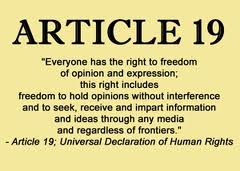
             One of the glories of the Western Enlightenment, especially as embodied in the lifeblood of political democracies is freedom of expression, the right to give voice in public spaces to unpopular, tasteless, provocative, and even outrageous ideas, and especially those critical of the prevailing political order without fear of retaliation. In the United States particularly the right to express ideas and opinions are extended to symbolic acts such as burning the American flag as a way of dramatizing the repudiation of official policies, or more broadly, the right to challenge the symbolic ascendancy of nationalism and patriotism. The U.S. Supreme Court has generally takes a very broad view of freedom of expression but finds some outer limits. It indicated famously that it would validate laws prohibiting members of an audience from falsely shouting ‘fire!’ in a crowded theater. It explained that the likely result is panic and a stampede that can hurt of kill. Even at the height of the Cold War, with McCarthyism creating waves of conformity, the endorsement of Communist ideas were generally allowed, although loyalty oaths for certain types of employment were imposed and actual, and even suspected, Communist Party affiliations were punished both formally and informally. The dividing line in wartime and during periods of national tension is very thin as exemplified in the United States by past laws on seditious speech and required loyalty oaths, which when the crisis expires are often in retrospect disowned as mistakes.


The Rushdie Fatwa


            These issues are often more easily be balanced by delicate legal and politics acrobatics within national political space, but finding a comparable balance globally has become far more precarious, if it is possible at all. The exceedingly difficult nature of the problem became evident to many after Salmon Rushdie in 1988 published Satantic Verses to Western critical acclaim and widespread Eastern censure, climaxing in the issuance of a fatwa by Ayatollah Ruhollah Khomeini on February 14, 1989 that declared it a duty of Muslims to kill Rushdie and to hold mortally accountable anyone anywhere who was associated with the publication of the book. Demonstrating that such words have deadly consequences, a Japanese translator, Hitoshi Igarishi was stabbed to death in 1991, as was an Italian translator of Satanic Verses. In addition, a Norwegian publisher of the book was violently attacked and barely survived. Rushdie himself went into hiding for about a decade with Britain effectively providing twenty-four hour police protection. In most countries with large Muslim populations the book was banned, with the notable exception of Turkey, and bookstores in the West that carried the book were threatened, and several were burned. Obviously, the fatwa had severe harmful effects on a variety of ‘innocent’ persons that carried far beyond Iran, the country of utterance by its supreme leader, that is, if innocence is assessed by Western liberal norms.


In 1998 Iran’s President Mohamed Khatami appeared to withdraw support for the fatwa, and seemed eager to bring to an end the anti-Rushdie worldwide campaign, but the fatwa remains formally in effect as it can only be withdrawn by the person who issued it, and Khomeini had died long before Khatami spoke out even assuming, which is highly unlikely, that the author of the fatwa might have been later inclined to back away from the harshness of the original condemnation. Had Khomeini been alive in 1998 he would have almost certainly reaffirmed the fatwa, and might likely have gone on to challenge Khatami’s qualifications to provide secular leadership for the country. With respect to the treatment of the Rushdie book there exists a definite clash of values and rights. In most countries in the West this publication was immediately treated as an important work of literature by a renowned author whose publication was initially not thought as posing any challenge to freedom of expression, while in many Islamic societies the book was immediately viewed as offensive to deeply held community and religious beliefs as to make its availability and distribution arguably unacceptable, and regarded by public authorities as such a grave threat to public order to lead several governments to ban its publication. This diversity about matters of cultural and religious propriety and the fixing of some limits on free expressions seems inevitable in a state-centric and multi-civilizational world that contains contradictory assessments of the balance between individual freedom and community values. This diversity is an accurate reflection of the world order that currently exists, and is incapable of being persuasively resolved by resort to claimed universal principle. Despite the worldwide rise of human rights, universal norms cannot resolve difficult controversies about rights and values, although almost everywhere except Iran the Khomeini fatwa was treated as a deeply troubling precedent. The fatwa claimed an unreviewable authority to mandate death by unreviewable decree to the author of a book and those who facilitated publication even though in their political space no law was broken or widely endorsed moral position was affronted. This fatwa was indeed a bridge too far!


How to prevent such abuses in the future is a daunting challenge. It is difficult to propose a better response than the ancient encouragement of comity among countries, but this reliance on reciprocal courtesy and respect among sovereign states can hardly be expected to exert much influence on those who act on the basis of genuinely held fundamentalist beliefs about good and evil. It is inevitable that there will at some point arise somewhere on the planet behavior that will give rise elsewhere to the formulation and implementation of efforts to punish or react to controversial ideas that are found offensive within and beyond territory.


The Danish Cartoon Controversy                                                     


            In many ways as insulting to Muslim sensibilities around the world as Satanic Verses, was the Danish newspaper’s publication in 2005 of twelve cartoons depicting the prophet Mohamed in a derogatory manner. In response, riots leading to several deaths took place in Asian countries. The Danish official defensive response to criticism after the event was to call attention to the existence of national penal laws that prohibited blasphemy or discriminatory statements. It was a curious gesture because at the same time the Danish prosecutor declared the inapplicability of these laws in this instance because the cartoons addressed matters of ‘public interest’ whose publication was thus entitled to special protection. Here, there was more at stake than the trouble caused overseas. The cartoons also caused intense discomfort to Muslim minorities living in Denmark and elsewhere in Europe. The publication and political debate that followed was properly regarded as confirming the reality of an Islamophobic climate of opinion taking shape in Europe. The Danish response was essentially premised on freedom of expression as insulating even deliberately insulting remarks and images associated with religions and their sanctified leadership. In this respect, Copenhagen was arguing that Islam was not being singled out. Every religion, including Christianity, it was said had been at various times attacked in a manner that could be construed as blasphemous. But what here of the predictable impact of the cartoons, causing violent reactions around the world and intensifying hostility to Muslims within Denmark? Is this not analogous to shouting fire in a crowded theater? That is, the publisher and editor of the Danish newspaper should have anticipated these harmful effects, although some observers have argued that the riots were not the foreseen, and were primarily caused by the cartoons. Seen in this manner, the ensuing violence was mainly the result of opportunistic and irresponsible mainstream religious figures in several Muslim countries seizing the inflamed moment by agitating mobs to bolster their own personal influence. Unlike Rushdie, who acted perfectly reasonably, given his British residence and citizenship, the Danish provocation should arguably have been avoided by self-censorship, and the violent responses in Asia were exaggerated reactions that also should never have happened. It is generally desirable to encourage free expression without the state administering the limits, but in that case it is up to the state to prevent riots and societal violence.


            The challenge is a difficult one. It could be argued that a stronger civic tradition on Rushdie’s part, but even more so in relation to Khomeini, would have produced self-censorship. Long after the event, Rushdie expressed surprise, and even a tinge of remorse, that his novel had become an occasion for such a violent and enraged backlash. Long after the fact he gave the impression on occasion that he might not have written such a book had he anticipated the consequences for himself and others. In contrast, the Danish newspaper was forewarned of inflammatory effects but went ahead without any hesitation. In effect, self-censorship does not currently protect against the harmful effects of incendiary forms of expression in the hostile and commercially driven, even hateful, environment that exists, and even promotes a culture war against or on behalf of the Muslim world.


Burning the Koran


            The case of Terry Jones, the fundamentalist pastor of a small Christian church in Gainesville, Florida called the Dove World Outreach Center, founded in 1996 and serving 50 families, is a dramatic illustration of the dilemmas posed by hateful and irresponsible speech, not by a supreme leader as with Khomeini but by an obscure religious figure who would have remained forever unknown except for his outrageous provocation. The actions of Rev. Jones illustrate the ethical and political challenge in its most vivid form. Jones proclaimed his intention to burn the Koran on the anniversary of September 11 in 2010, even proposing the establishment of an “International Burn a Koran Day.” He had earlier published a booklet entitled “Islam is of the Devil,” and in August 2009 two children from his church were sent home from a local school because of ‘inappropriate dress,’ T-shirts with “Islam is of the Devil” emblazoned in bright letters. The Florida community did what it could to rein Jones in by informal action, denying Jones a burn permit and seeking to cancel the mortgage outstanding on his church. When asked to explain the recent shrinkage in his church membership by 50% Jones cunningly replied, “I think mainly just because the things we’re involved in are just really too hot for your normal Christian and your normal person.” Prior to the burning last month, many urged Jones to refrain, including even General David Petraeus who correctly warned that such anti-Islamic acts would endanger the lives of American troops under his command. And indeed two American soldiers were killed in distant Afghanistan apparently to avenge the Koran burning. Of course, such an incident should be appreciated as a personal tragedy for those singled out, although the American military presence in Afghanistan was likely a contributing cause, and in its own way an unlawful and irresponsible provocation. Should the state step in and impose a punishment or forbid such speech? On what authority? Should the idea of hate speech be associated with hostility to a book (as distinct from a person) that is treated as sacred by more than a billion persons? Is its denigration an intolerable incitement to public disorder? Does the answer depend on the national or civilizational setting at a particular historical, or are we now living in such a globalized and networked world as to make geographic boundaries of acceptable expression meaningless?


The Manning Case


            This brings me, finally, to the sad and illuminating case of Bradley Manning, a young intelligence analyst serving in the military. While Terry Jones is a free man despite deliberately generating violent reactions to speech and symbolic deeds known to be deeply offensive to many people, Manning seemingly acted out of conscience and belief facilitating the release of thousands of documents that had been classified by the U.S. Government, Iraq and Afghanistan war logs, confidential State Department cables, and other classified materials. As with Daniel Ellsberg’s release of the Pentagon Papers almost 40 years earlier, the evident intention of Manning was to inform people about the realities of government policies that were producing death and destruction in foreign countries. It seems that Ellsberg, also a government security specialist with privileged access and status, wanted the American people to know some core truths about the planning and perpetration of the Vietnam War that were dramatically at variance with what the public was being told about the war by the government. With Manning his range of motivations is not fully known, but he seems also to have become deeply disenchanted with the unlawful and immoral manner with which the United States was using its military power around the world, and the extent to which it was hiding war crimes behind heavy curtains of unwarranted secrecy. Manning has not yet been prosecuted, but has been held in demeaning and cruel conditions for many months. Without alluding to any extenuating circumstances, President Obama has not only said in response to a question from a journalist in the face of protests by human rights groups and others about Manning’s treatment in military prison that it was “appropriate and meets our basic standards,” but also was later caught on tape prejudging the case by saying in a private conversation at a fundraising dinner that Manning “broke the law,” and should be prosecuted.


The Manning case is a further stain on the moral reputation of the United States. It exhibits a vindictiveness toward a citizen, and a low ranking member of the armed forces, who steps out of line, seeking to allow a wider public of a democratic society to know a series of ‘inconvenient truths.’ Perhaps, there is some justification for some secrecy in diplomatic communication, and thus for laws that punish improper disclosures, or leaks. But each case needs to be judged in relation to its specific context. This case has many extenuating circumstances, and calls for leniency and empathy, taking account of Manning’s motivation and the improprieties exposed, rather than the vindictive approach so far taken by American officialdom. Let us remember that high government officials often leak classified information for their own purposes, including the exertion of influence on the media treatment of controversial policy issues. They almost never suffer any adverse consequences, enjoying what amounts to de facto impunity. What is striking about the Ellsberg/Manning disclosures is the whistle blowing character of their actions, that is, essentially a contribution to public wellbeing. In Manning’s case the documents given to WikiLeaks, including a classified video of a military incident in Afghanistan (an Apache helicopter attack that killed two Reuters News employees and several civilians without any indication of a military target), as well as many documents confirming U.S. association with war crimes, government lawbreaking, and serious corruption. Such behavior deserves to be known by the American public and should never have been allowed to happen in the first place. Rather than condemning the disclosures, the behavior disclosed is what should have produced presidential anger and appropriate action.


In a healthy democratic society such behavior would be protected if the intentions of ‘unlawful’ were shown to be positive and reasonable, and no unwarranted harm could come to named individuals. According to reports, the documents released by WikiLeaks were carefully screened in advance to avoid targeting individuals. Complex modern societies are rendered more secure by the safety valve of whistle blowing, and at the very least, benign leadership should moderate the implementation of secrecy laws by an acknowledgement of the huge public benefits of and needs for governmental transparency. In this instance President Obama’s inappropriate assertion of Manning’s guilt prior to a criminal trial under the auspices of a military tribunal further highlights the degree to which statist interests outweigh both justice to an individual charged with serious crimes (remember that innocence until proven guilty by a court of law operating according to due process is a fundamental right) and disregards the interest of the citizenry in the greatest possible transparency on the part of their government. If due process prevails even a military tribunal should conclude that Obama’s statements have been sufficiently prejudicial, after all he is commander in chief whose views are not likely to be contradicted in a military venue venerating hierarchy and chains of command, to have the case against Manning thrown out. Such an outcome is also justified as a result of severe and sustained pre-trial abuse that cumulatively amounts to ‘torture,’ or what the Bush presidency chillingly called the techniques of ‘enhanced interrogation.’


            The German philosopher, Friedrich Nietzsche, wrote in 1885: “The state is the coldest of all cold monsters. Coldly it lies, too; and this lie creeps from its mouth: ‘I, the state, am the people.’” [Thus Spake Zarathustra, ‘Of the New Idol’]

In the Manning case this coldness is exemplified, as is the lie that because the state is the people, the people have no needs to know beyond what the state is prepared to disclose, however incriminating the information. This coldness of the state is expressed by criminalizing truth telling, branding it as virtually a form of treason, whereas a humane political community would seek to learn from those in their midst who are brave and dedicated enough to reveal to their citizen comrades what is hidden because it should never have been allowed to take place.  To punish righteousness is the seminal sin of organized power that the Bible warns about over and over again, and yet the ears of the modern cold state remain are plugged on principle, with the help of laws that stifle those forms of freedom of expression needed to ensure a lawful government. The same state that will go to great lengths to claim virtue for itself because it tolerates criticism will spare no effort to punish those who dare to expose its criminality. This punitive reflex must be curbed if democracy is to flourish in the 21st century.


V..4…2011


What Future for the Goldstone Report? Beyond the Name

20 Apr


            Ever since it first struck the raw nerve of Israeli political consciousness I thought it misleading to associate the Goldstone Report so exclusively with its chair, Judge Richard Goldstone. After all, despite his deserved prominence as an international jurist, he was the least qualified substantively of the four members of the mission. Undoubtedly, part of the intensely hostile Israeli reaction of their highest political leaders had to do with the sense that Goldstone as a devoted Zionist had been guilty of betrayal, even of ‘a blood libel’ against the Jewish people, because he seemed to be elevating his fidelity to the ‘law’ above that of tribal loyalties, and according to Tel Aviv he should never have been mixed up with such a suspect entity as the UN Human Rights Council in the first place.  


What should be observed, and stands out over time, is the degree of importance that even the extremist Israeli leadership attaches to the avoidance of further stains on their reputation as a law abiding political actor. This seems true for the Israeli leadership even when the assessing organization is the UN Human Rights Council that Israel, as well as the U.S. Government, never misses the chance to denounce and defame. Implicit in this Israeli search for vindication is their implicit acknowledgement that the UN is after all a major site of struggle in the ongoing legitimacy war being fought against Palestinian claims of self-determination. This acknowledgement of importance has been expressed more recently by Netanyahu’s inappropriate insistence that in view of the Goldstone retreat the UN retract the report in its totality.


This assessment was embarrassingly confirmed by the reaction of the U.S. Senate to Goldstone’s Washington Post op/ed of April 1st when two weeks lateron it unanimously passed a resolution calling on the UN “to reflect the author’s repudiation of the Goldstone report’s central findings, rescind the report and reconsider further Council actions with respect to its findings.” It also asked the UN Secretary General, Ban Ki Moon, “to do all in his power to redress the damage to Israel’s repuation.” This ill-informed and inflammatory wording is quite extraordinary, starting with the reference to Goldstone as ‘the author’ of the report, thereby completely overlooking the reality that it was a joint effort, that his input was probably the smallest, and the other authors have reaffirmed their support for the entire report subsequent to the Goldstone retreat. What is mostly revealed by this Senate initiative is the blatant partisanship that is now unquestioned in official Washington. This unsubtle disregard for international law and the authority of the UN should at the very least encourage the Palestine Authority to seek other auspices for any future negotiations with Israel than what is provided by the U.S. Government.


            It is probably true that if Goldstone had not been so vilified for his association with the report it would have likely experienced the same fate as  thousands of other well documented UN reports on controversial issues. By lending his name to the fact-finding mission and its outcome Goldstone became an unwilling lightning rod, the target of vicious attacks but also heralded at the time by fair-minded persons around the world for his fidelity to the law even in the face of such hostile fire. In this regard Goldstone became a sacrificial scarecrow that failed in his appointed role of keeping the birds of prey at a safe distance. In effect, how could Israel attack one of their own if the assessment of their behavior produced findings of severe violations of international humanitarian law? How could such findings be avoided given the widely known characteristics of Operation Cast Lead? There is a double irony present: Goldstone was partly selected to head this sensitive undertaking because as a known supporter of Israel he would make it harder for Israel to complain about UN bias so as to deflect attention away from the message; but precisely because of the difficulty posed for Israel’s propaganda machine by Goldstone’s credibility the level of attack on him reached hysterical heights and evidently exerted such intense pressure that he was eventually led to make an awkward and unprecedented partial repudiation of the report that pleases neither side.


            Two other aspects of the situation are often neglected or misstated. First of all, several other respected international studies had already confirmed most of the conclusions reached by the time the Goldstone  Report was released in September 2009. Other prior noteworthy reports on the international law issues including Human Rights Watch, Amnesty International, B’Tselem, Al Haq, and especially the comprehensive report of an earlier detailed and authoritative fact-finding team composed of internationally respected international law experts under the leadership of John Dugard, a leading South African jurist and former UN Special Rapporteur for Occupied Palestine carried out on behalf of the Arab League. Against such a background, in a substantive sense the Goldstone Report did not say anything that was not already well established by a highly credible accountability community of NGOs, journalists, and an array of UN humanitarian workers and civilians who were on the scene during the attacks. Such an overwhelming informed consensus is what makes such a mockery of this effort by the U.S. State Department and the Senate to seize on the Goldstone retreat as a new occasion to repudiate the report as a whole, and throw once more a blanket of impunity over Israeli defiance of international law.


            The second element that should be kept in mind, but is rarely ever acknowledged even by those who stand 100% behind the report is that it was not, as the media mostly claimed, unduly critical of Israel. On the contrary, in my view, the report was one-sided, but to the benefit of Israel. Let me mention several evidences of leaning toward Israel: the report proceeds on the basis of Israel’s right of self-defense without bothering to decide whether in a situation of continuing occupation a claim of self-defense is ever available under international humanitarian law, although Israel was entitled to rely on force to the extent necessary to uphold specific security interests arising from the rocket attacks. Furthermore, the report did not examine whether the factual conditions prior to the attacks supported any security claim considering the success of the truce to cut rocket fire to almost zero in the months preceding the attacks, a truce that had held until Israel provocatively broke it on 4 November 2008 by conducting a lethal raid within Gaza. Beyond this the claimed security justification seemed artificially fashioned to serve as a rationalization for the Israeli aggressive and unlawful all out military assault against Gaza that was mostly motivated by a series of Israeli claims that were quite independent of security in Gaza. The real goals were as follows: to destroy Hamas; to  induce the return of the captured Israeli soldier Gilad Shalit, to punish Gazans  for voting in favor of Hamas back in 2006. In addition, it was clear that the IDF had been planning Operation Cast Lead for six months prior to launching the attack on 27 December 2008, and for a variety of reasons other than securing southern Israel against rockets: striking hard at Gaza before Obama took office, influencing in Kadima’s favor the Israeli domestic elections that were about to take place, restoring confidence in the IDF after its failures in the Lebanon War of 2006, and sending a message to Iran that Israel would not hesitate to use overwhelming force whenever its interests dictated and without restraint.  


            The Goldstone Report did appropriately emphasize the severe Israeli departures from the law of war by attacking with disproportionate and indiscriminate force against a crowded, mainly urbanized society. But it failed to emphasize a distinctive feature of the attacks—the denial to the civilian population of Gaza of the option to leave the war zone and become refugees, at least temporarily. To keep civilians, especially children, the aged, and the disabled, so confined leaves permanent psychic wounds as has been reported by many post-attack studies and residents of Gaza, but is not disclosed by the casualty figures that count only the dead and the wounded. Part of the public horror of Operation Cast Lead resulted from the 100:1 ratio of war dead, which is a vivid confirmation of the defenseless plight of the Gazan population and the helplessness of Hamas protectors when confronted by the Israeli war machine. Despite this indicator of one-sidedness, the casualty comparison dramatically understated the real losses to the Palestinians. If the psychologically damaged are added to the Palestinian total and the friendly fire victims are subtracted from the Israeli side, reducing their total deaths from 13 to 6 or 7 the ratio of losses is gigantically uneven. In view of this one-sidedness, together with Israel’s initiation of the attacks and its role as occupying power, the report gave excessive emphasis to Hamas violations of international humanitarian law, which should have been noted, but not treated, as was the case, as virtually symmetrical with those of Israel. To treat as balanced that which is so manifestly unbalanced is to falsify the relevant reality.


            As has been pointed out in the media, including by Goldstone, his retraction was limited to the admittedly important issue of whether Israel intentionally targeted civilians as a matter of policy. Even this limited retraction is unconvincing because it rests so heavily on Israel’s self-investigations, which the post-Goldstone UN fact-finding mission jointly headed by an American judge, Mary McGowan Davis and the Swedish judge, Lennart Aspergen, found in their recent report failed to meet international standards. As mentioned previously, the retraction by Goldstone was also seriously undermined by the joint statement of the three other members of the Goldstone mission who publically reaffirmed the report in its totality, which never made the sweeping accusation of Israel that Goldstone retracted!


            Only half satirically, I would think that the Goldstone Report might be time to rechristen the Goldstone Report as the Chinkin Report or blandly let it be henceforth be known as the ‘Report on Israeli and Hamas War Crimes and Crimes Against Humanity during Operation Cast Lead.’ Whatever the name, the main allegations have been confirmed over and over again, and it is now up to the governments making up the UN General Assembly and Security Council to show the world whether international criminal accountability and the International Criminal Court is exclusively reserved for sub-Saharan African wrongdoing!


            Many have asked whether the Goldstone retraction will doom the future of the report. In my view rather than performing a funeral rite Goldstone miscalculated, and has given the report a second life. It may still languish in the UN System, thanks to the geopolitical leverage being exerted by the United States to ensure that Israeli impunity is safeguarded once more, but this new controversy surrounding the report has provided civil society with renewed energy to push harder on the legitimacy agenda that has been animating the growing Palestinian global solidarity movement. Never before has the Goldstone Report received such sympathetic attention even from American mainstream sources. Astonishingly, even the NY Times columnist, Roger Cohen, chided Goldstone for trying belatedly to distance himself from the report, going so far as to suggest that his behavior has contributed a new verb ‘to Goldstone’ to the language of politics. “Its meaning: to make a finding, and then partially retract it for uncertain motive.” Cohen’s formal definition—“to ‘Goldstone’: (Colloq.) To sow confusion, hide a secret, create havoc.”


            History has funny ways of reversing expectations. Just as most of the world was ready to forget the allegations against Israel from the ghastly 2008-09 attacks on Gaza and move on, Richard Goldstone inadvertently wakes us all up to a remembrance of those morbid events, and in the process, does irreparable damage to his own reputation while trying to redeem himself in certain circles.


It is up to persons of conscience to seize this opportunity, and press hard for a more even handed approach to the application of the rule of law in world politics. There is much righteous talk these days at the UN and elsewhere about the ‘responsibility to protect,’ contending that the Qaddafi threats directed at Libyans civilians justified a No Fly Zone and a full fledged military intervention from the air undertaken with UN blessings and NATO bombs and missiles, but not even a whisper of support for providing the still beleaguered people of Gaza with a No Fly Zone despite frequent violent incursions by Israel and a debilitating unlawful blockade that has lasted almost four years, a severe form of collective punishment that directly violates Article 33 of the Fourth Geneva Convention. This blockade continues to block the entry of building materials needed in Gaza to recover from the devastation caused more than two years ago.


IV..20…2011


Rethinking Germany

13 Apr


Not only the unforgettable Nazi past, but also the hard power materialism and reactionary politics of the German success story, made Germany in many respects the least lovable country in the Western world.

Despite the rise of the European Union, and Germany’s dominant role as the economic engine pulling the European train, the culture and politics of the country remained unpleasantly nationalist, unwelcoming to foreign minorities even after several generations of residence, an assessment that the three million Turks will confirm. If anyone doubts this harsh depiction of German reality, I recommend watching the acclaimed Christian Petzold film, Jerichow, that depicts the tragic plight of a Turkish ‘success’ story in Germany, or for that matter, a reading of almost any novel by Gunter Grass, especially, The Tin Drum and The Rat.

Of course, national stereotypes should always be skeptically viewed, if not altogether avoided, but if invoked, at least balanced by an acknowledgement of contradictory evidence, which in this case would call attention to a litany of German achievements through the ages. Germany has given the world far more than its share of great music and literature, and its engineering skills produce a range of superior products. And philosophically, German thinkers have exerted a profound influence on modern thought, perhaps none more than the enigmatic Nietzsche whose metaphysical nihilism induced a still not fully acknowledged or understood courageous humanism.

Personally, I had the good fortune to have a friendship with two extraordinary Germans, Petra Kelly and Rudolph Barro, who represented the opposed factions of the Green Party during its early period of formation and prominence in the heartland of the Cold War. It was this green questioning of modern industrial society in Germany that raised the most serious post-Marxist challenge in the West. It was a challenge directed at what later became known as the ‘Washington Consensus,’ the label used to draw attention to the regressive neoliberal ideology that continues to generate market behavior that exploits the peoples of the world and destroys our natural habitat. In the last several years this ideology of contemporary capitalism proved itself resistant to correction despite a deep recession, and expectations of worse to come in the near future. These two German public intellectuals disagreed sharply as to the proper depth and breadth of the green vision. Kelly thought that a responsible reformation of capitalism was possible while Barro was convinced that nothing less than the rollback of industrialism could ensure ecological and spiritual survival for the human species. Especially in the aftermath of the Sendai/Fukushima ordeal these issues are again becoming integral to the political and moral imagination for all those of us who see the future through a glass darkly.

My emphasis here is on the recent bashing of Germany because of its stands on nuclear energy and the Libyan intervention. With respect to nuclear energy, German public opinion exhibited more of a reaction to the Fukushima problems than anywhere else on the planet, probably in part because of the strong Green political presence, memories of the devastation of World War II, fears generated by the 1986 Chernobyl meltdown and radioactivity carried to the West by wind currents, and because 25% of German power comes from nuclear reactors. With the Fukushima disaster intensifying day by day, Chancellor Angela Merkel found herself in an anxious political atmosphere relating to domestically crucial upcoming elections at the sub-federal or länder level. Merkel retreated from an earlier embrace of nuclear energy, imposing a moratorium on extending the life of existing reactors and temporarily shutting down seven reactors that were of the same design as those in trouble at the Fukushima Daiichi reactor complex. German voters were not persuaded by this switch, apparently regarding it as a tactical ploy, and in the key conservative länder of Baden-Württemberg the electorate gave the Green Party a stunning surprise victory. It was the first time that the Greens won political control of a German länder, one that was known to be the most conservative in all of Germany where the Christian Democratic Union (CDU) had exercised uninterrupted dominance during the past six decades.

The mainstream media has both derided Merkel for her failed cheap political trick to assume an anti-nuclear pose and attacked the Greens as unfit to govern or to devise an economically responsible energy policy for the future. In effect, Green insistence on ending German dependence on nuclear power has been accompanied by the belief that the accelerated development of wind and solar can supply energy needs without hurting the economy. In their bid for greater political influence the Greens now accept capitalism as their policy framework, and believe that markets can be made to function humanely and in a manner that is environmentally sustainable. Whatever else, this Green upsurge in Germany brings to the fore some alternative thinking that is desperately needed throughout the world, and is currently absent in most major societies, perhaps most dramatically here in the United States. This Green thinking has great appeal for German youth, especially women, as a way of forging a brighter future.  Instead of considering the Green success in Germany as an anomaly in secular politics because it focuses less on jobs and Eurozone difficulties, it should be regarded as a challenge to the sterile and historically irrelevant political parties that continue to dominate the scene in Euro-American elections, and help explain the alienation of the young and the embitterment of the old, as well as the rise of the mean spirited and totally dysfunctional Tea Party in America. What strange plants manage to flourish in this political desert of American political life should make all Americans, and for that matter everyone everywhere, tremble.  We not only are damaging ourselves by this politics of evasion, but also due to our heavy global footprint, putting others throughout the world at severe risk.

The growing oppostion of the German public to nuclear energy is equally justifiable. Rather than being dismissed by the pundits as an over-reaction (Germany is not prone to earthquakes or tsunamis) or economically quixotic (renewable energy will not be able to supply sufficient energy to dispense with nuclear), it should be praised as taking weighing carefully risks that have been thoughtlessly assumed elsewhere. It is not only the events in Japan that should give us pause. The explosion of the oilrig engaged in deep sea drilling by British Petroleum in the Gulf of Mexico and the oil-driven interventions in Iraq and elsewhere in the Middle East are kindred events that should be introduced into the societal calculus of gains and losses. These various developments, including a variety of geo-engineering schemes under consideration to gain access to deep pockets of natural gas and oil shale deposits are suggestive of the overall pressure to rely on these economically seductive frontier technologies despite the massive environmental risks posed. In effect, the compulsion of modern civilization to grow beyond the carrying capacity of the earth is pushing human endeavor up against a series of limits, which if not respected enter domains of catastrophic risk that can and will only be appreciated fully in retrospect. It seems self-evident beyond discussion that now that the Fukushima reactor accidents have taken place, the future of nuclear energy will be scrutinized in a manner that was inconceivable only two months earlier.

Will it be enough to prevent future disasters? Just as Hiroshima was a warning ignored with respect to nuclear weaponry, there is every indication that Fukushima will become another unheeded warning. Reassurances from influential members of the governing elites are likely to take the form of promising higher safety and monitoring standards and more care when deciding in the future upon where to locate reactors. These gestures will be reinforced by a variety of arguments put forward by formidable private interests to the effect that soft coal is far more dangerous to human health and societal wellbeing than is nuclear energy even if full account is taken of the periodic occurrences that generate public fear of the sort now present in Japan. Conventional wisdom is claiming that such a catastrophic accident temporarily disrupts social reason, and that in due course there will be a return to rational decision that will restore confidence that nuclear energy is comparatively benign, and in any event, is necessary to prevent economic collapse. Germany, whatever its motivations, has reminded the world that these issues, however resolved, should engage both the leadership and citizenry of a robust democracy, and in this sense, represents a display of public reason at its best, rather than a foolish detour into the underbrush of romantic politics derisively associated with this unexpected Green upsurge. Of course, it is not clear that the rest of the world, or even the rest of Europe, will take any significant note of this German response to Fukushima and the threat of nuclear energy beyond cynical commentary.

Germany has also been widely criticized for its refusal to back the Security Council Resolution 1973 of March 17, 2011 authorizing the establishment of a No Fly Zone for the protection of civilians in Libya. The widely voiced opinion in Europe and the United States was that the German vote to abstain was a stab in the back from the perspective of European unity and loyalty to NATO, and some went so far as to call it as an inappropriate expression of ingratitude for the protection given to Germany by NATO throughout the Cold War. It was also suggested that the German abstention was an irresponsible refusal to stand up for the humanitarian values that the intervening governments were insisting to be at stake in Libya. No matter that the concerns that Germany expressed prior to the vote have all been proven correct: a No Fly Zone is a clumsy instrument of intervention, essentially incapable of either altering the outcome of the struggle for power that was underway in Libya or achieving regime change, and to the extent this political goal was being pursued it would involve ignoring the limits and purpose set forth by the UN resolution. As the military operation unfolded, it has decreasingly been devoted to protecting Libyan civilians in cities under attack by Qaddafi forces, and mostly dedicated to helping the rebels somehow prevail, despite their meager military capabilities and shadowy political identity. By refusing to endorse such a venture it would seem to me that Germany deserves the thanks of the world, not a lecture about alliance loyalty. Should not a democratic government be reluctant to commit its resources and risk the lives of its citizens in foreign military undertakings?

In the instance of Libya, Germany had urged that diplomacy and sanctions be tried prior to any serious consideration of military intervention. Is not this what the UN Charter mandates, seeking to make recourse to force the last option after all efforts at peaceful resolution have been tried and failed? Unfortunately this is not the first time that the UN has succumbed to American-led geopolitics in the aftermath of the Cold War. It authorized without any ongoing supervision the first Gulf War (1991) when a diplomatic solution could probably have avoided mass killing and the destruction of Iraq’s civilian infrastructure, and now this new authorization in relation to Libya issued twenty years later. True, the Security Council did not endorse the Kosovo War (1999) (thanks to the prospect of a Russian veto) or the Iraq War (2003), but it did acquiesce afterwards in the results produced by the unlawful uses of forces in both instances, thereby making its refusal to mandate the attacks in the first place little more than a nominal obstacle that could be circumvented by ‘a coalition of the willing’ acting independently of UN blessings. For Germany to stand alone among its Western allies while being in solidarity with the BRIC countries should be a moment of national pride, not a time for solemn soul searching as the German mainstream media has been encouraging. It may even be, if the EU cannot manage its sequence of sovereign debt and banking crises that Germany in the future base its security and wellbeing by moving toward a closer alignment with an emergent global multipolarism and giving up altogether an outmoded adherence to an American led unipolarity that has existed in the aftermath of the Cold War era. Admittedly, this remains but a glint in the eye at present, although attractive from the perspective of constituting a genuine ‘new world order,’ which is long overdue. In the face of continuing American decline as a responsible global leader, Germany can seize the day by withdrawing from the anachronistic behavior of violent geopolitics, and put to rest once and for all its own disastrous heritage of failed militarism.

In concluding, where others raise eyebrows over these controversial recent German developments, I find them deserving of admiration and reflection. Just as Turkey has been recently chastised by American neoconservatives and Israeli warmongers for getting out of its lane, that is, seeking a peaceful resolution of the conflict with Iran in relation to its nuclear program, so Germany is being told to get back in its NATO lane, which is tantamount to doing what the United States wants done on the global stage. It is true that here in response to domestic pressures that it was France and Britain that were most ardent champions of intervention, seeming having most to gain (above all, oil and the avoidance of an influx of Libyan immigrants) by getting rid of the Qaddafi regime. But unfortunately, for these former senior partners of the colonial era, a major NATO undertaking cannot be made credible without American leadership. The Libyan operations seem to have demonstrated this, and may inhibit future European adventurism. In effect, in matters of war and peace, each country is ethically sovereign given the way the world is organized even if many countries often act as if they were politically subservient, that is, by being more deferential to the geopolitical hierarchy than respectful of international law or even of its own selfish calculus of values and interests. With this background in mind, let us hope that these German initiatives are not merely episodes soon to be forgotten, but rather represent the first steps along a new pathway to a global future that others should reflect upon rather than dismiss or ignore.


Obama’s Libyan Folly: To be or not to be..

5 Apr

The outcome in Libya remains uncertain, but what seems clear beyond reasonable doubt is that military intervention has not saved the day for either the shadowy opposition known as ‘the rebels,’ and certainly not for the people of the country. It has seemingly plunged Libya into a protracted violent conflict with the domestic balance of forces tipping decisively in favor of the Qaddafi regime despite a major military onslaught managed by the American-led coalition, which in recent days has been supposedly outsourced to NATO. But since when is NATO not an American dominated alliance? The best that can be hoped for at this stage is a face-saving ceasefire that commits the Libyan leadership to a vague power-sharing scheme, but leaves the governing process more or less as it is, possibly replacing Qaddafi with his son who may offer the West the cosmetic trappings of liberal modernity, which may exhibit a genuine interest in reform.

President Barack Obama has chosen Libya as the place to draw a line in the sand, although it is a rather wavering and fuzzy line. It was finally drawn in response to what was being called two weeks ago an imminent atrocity about to be inflicted upon the people of Benghazi, although the evidence of this prospect of dire bloodletting was never present much beyond the bombast of the dictator. Obama stopped what the more ardent interventionist in his camp were derisively calling his ‘dithering.’ Heeding these criticisms Obama on March 28 came out clearly in support of military action, although carefully circumscribed in scope and nature by reference to its supposedly narrow humanitarian undertaking of protecting Libyan civilian.  The futility of preventing a Qaddafi victory on the ground by establishing a No Fly Zone, even as inappropriately expanded to become a No Drive Zone, should have been obvious to anyone conversant with the course of numerous political struggles of recent times being waged for the political control of a sovereign state. What the world actually witnessed was mainly something far different than an effort to protect Libyan civilians. It was rather a an unauthorized attempt to turn the tide of the conflict in favor of the insurrectionary campaign by destroying as many of the military assets possessed by Libya’s armed forces as possible, clearing the path for a rebel advance.

The campaign and character of the opposition has never been clearly established. It is still most accurately described as a motley gathering of opposition forces mysteriously referred to as ‘the rebels.’ In contrast to the seeming failure and ineptness of its military challenge, the public relations campaign of the rebels worked brilliantly. Most of all it mobilized the humanitarian hawks inhabiting the Obama presidential bird nest, most prominently Samantha Power, Hilary Clinton, and Susan Rice, as well as the recently departed former State Department Head of Policy Planning, Anne-Marie Slaughter. Samantha Power particularly has long called upon the United States Government to use its might wherever on the globe severe human rights abuses should occur (unless in a large country beyond interventionary ambitions), apparently analogizing every humanitarian crisis to the totally different circumstances of Rwanda (1994) where a small effort to mitigate major genocide was inappropriately blocked by the Clinton White House. And in the media the celebrants of this intervention have been led by the NY Times pious stalwarts, Nicholas Kristof and Thomas Friedman.  At least Friedman, the patron saint of ‘wars of choice’ was sensible enough on this occasion to acknowledge that Obama would need major help from Lady Luck if his Libyan policy would have any chance of a happy ending, which is welcome contrast with his cheerleading of the Iraq intervention. If lives were not at stake, it might be amusing to note the new cosmic humility of this most arrogant of journalists, who in the past was forever fond of addressing world leaders by their first names in his columns while dishing out his unsolicited guidance, now being reduced to treating the Libyan intervention as the equivalent to a night out in Las Vegas!

The PR full court press by the rebels, aided by that high flying French publicity seeking French enthusiast for intervention Bernard-Henri Lévy, also misleadingly convinced world public opinion and several Western political leaders that the Qaddafi regime was opposed and hated by the entire population of Libya making him extremely vulnerable to intervention. This encouraged the belief that the only alternative to military intervention was for the Western world to sit back and bear witness to genocide against the Libyan people on a massive scale. This entire portrayal of the conflict was at best premature, and likely misleadingly intended to make it appear that the only choices available to the UN and the global community was to intervene militarily or sit back and take the consequences. Among other options, diplomacy and the search for a ceasefire was never seriously embarked upon.

Even without the spurious wisdom of hindsight, the international undertaking could be criticized from another angle as having been designed to fail: a questionable intervention in what appeared increasingly to be an armed insurrection against the established government, yet falling far short of what would be needed to secure the only outcome proclaimed as just and necessary—the fall of the Qaddafi government. How can such a struggle, involving one more paternalistic challenge to the dynamics of self-determination, be won by relying on the bombs and missiles of colonial powers, undertaken without even the willingness to follow the attack with a willingness to engage in peacekeeping on the ground? Had this willingness been present it would have at least connected the dots between the interventionary means adopted and the political mission being proclaimed. Even with this more credible posture the odds of success would still remain small. If we consider the record of the past sixty years very few interventions by colonial or hegemonic actors were successful despite their overwhelming military superiority. The only ‘success’ stories of interventionary politics involve very minor countries such as Grenada and Panama where organized resistance was absent, while the failures were in the big and prolonged struggles that took place in Indochina, Algeria, Indonesia, elsewhere.

In Libya the prospects were further worsened by the incoherence, inexperience, and lack of discipline exhibited by rebel forces. This effort of a weak and unorganized opposition to induce foreign forces to secure for themselves an otherwise unattainable victory is reminiscent of the bill of goods that wily Iraqi exiles sold to neoconservative operatives such as Richard Perle and Paul Wolfowitz during the lead up to the Iraq War (2003). Remember those promises of flowers greeting the American troops arriving in Baghdad or regime change being ‘a cakewalk’ that would be achieved without notable American casualties or costs. As in Libya the case for intervention rested on the false assumption that the foreign occupiers would be welcomed as liberators and that the Saddam Hussein regime lacked any popular base of support. Obama sang this interventionists’ lullaby when he lauded the villager

who thanked an American pilot whose plane crashed accidentally over some rebel held territory.

Such a negative assessment of the Libyan intervention seems clear enough. Such an assessment was offered at the outset of the crisis by the most qualified high official in the Obama inner circle, Robert Gates, the Secretary of Defense. Why did Obama not heed this sensible advice? Unfortunately, every Democratic president, and none more than Obama, struggle to maintain their image as willing to use force in the pursuit of national interests whenever the occasion arises. We must pause to give credit as Obama has pursued a generally militarist foreign policy while still managing to collect a Nobel Peace Prize, something that W’s handlers could never have achieved, and likely didn’t seek. And here in Libya, the risks of inaction must have seemed too great to bear. Instead Obama attempted to have it both ways: lead the diplomatic effort to obtain a mandate from the UN Security Council and then provide most of the military muscle for the initial phase of the operation, and then hastily withdraw to the background while NATO supposedly takes over. This middle path is littered with contradictions: to convince the Security Council, and avoid a Russian or Chinese veto, it was necessary to portray the mission in the most narrow humanitarian terms as being only for the protection of civilians, while to protect the rebels (who are not ‘civilians’ as legally understood) required a much more ambitious scale of attack than is implied by establishing a No Fly Zone; beyond this, if the unconditional goal was the elimination of the Qaddafi regime, then the intervention would have to go far beyond the boundary set by the Security Council decision. It would have to tip the balance in the conflict. As has become clear, the approved military objectives have been dramatically exceeded in the flawed effort to protect the rebels and help them win, but seemingly to no avail.

Of course, the abstainers also have blood on their hands, and share some of the responsibility for what has gone wrong. These abstaining members of the Security Council went along with a mandate to use force that seemed inconsistent with the Charter assurances of refraining from UN intervention in matters essentially within domestic jurisdiction, as this struggle surely was and is. They also allowed the backers of the Securitry Council to twist enough arms to get their mission creep hopes raised by inserting the permissive clause ‘by all necessary means.’ China, Russia, India, Brazil, and South Africa should be ashamed of their posture, criticizing before the vote, abstaining so as to assure that authorization would be provided, and then resuming criticism afterwards to undertakings that should have been anticipated and precluded by much more constricted language in 1973. The vote was 10 in favor, none opposed, and five abstaining.

Such disregard of the limits of the UN Security Council authorization, awkwardly reinforced by the failure of the Security Council to play any subsequent supervisory role to ensure that its approval of force did not go beyond what had been agreed, has once again weakened the UN as a body operating within the constitutional framework of the UN Charter. It makes the UN in the peace and security area appear to be more an agent of geopolitical and neoimperial forces in the West than an objective body seeking to implement the rule of law in relation to the strong and weak alike. We all should remember that when the UN was established in the aftermath of World War II it was assigned the primary responsibility of minimizing the role of war in human affairs.  The inspirational opening words of the Preamble to the UN Charter should be recalled and solemnly reaffirmed: “We the peoples of the United Nations determined to save succeeding generations from the scourge of war.” To allow these words to be selectively overridden by the recently endorsed norm of ‘responsibility to protect’ or R2P is to provide a selective tool that shamelessly exhibits double standards. Where were those humanitarian and paternalistic voices when the civilian population of Gaza was subjected to a murderous attack from land, air, and sea for three weeks by the Israeli Defense Forces (Dec. 27, 2008-January 19, 2009)

Throughout this period of revolutionary ferment in the Arab world, Obama’s paternalism has been pronounced. While intermittingly celebrating these popular risings, Obama has unblushingly felt entitled to pronounce on which leaders should stay and which should go as if he is indeed the first designated global chief executive. And these pronouncements lack even the pretense of coherence and consistency unless measured from an exclusively geopolitical standpoint. The White House was fine with Mubarak until the popular movement made his continued presence untenable, and then he was instructed to leave. In Yemen the leader is told to step down after he failed to quiet the protests, while in Bahrain the Al Khalifa royal family is supported by Washington although governed as an absolute monarchy, which has not only recently relied on extremely violent means to quell unarmed demonstrators, but has even inviting its stronger neighbor, Saudi Arabia, to send military forces across the border to help restore order. Restoring order in Bahrain  is a matter of making further repressive moves to thwart robust popular calls for a new political order based on democracy and human rights.

Obama’s maneuvers in and out of the limelight during the unfolding of events in the Arab world reveals the two sides of the current American dilemma: it is not yet ready to shed the mantle of imperial overseer in the post-colonial regions of the world, but it is faced with the contradictory pressures of imperial decline and overstretch.  This fledgling patriarch can lecture the world, and even manage a military thrust or two, but nothing is sustained, and little achieved. Obama seems to be auditioning to play Hamlet in this unfolding global tragedy.

IV..5…2011

Donate for the Sake of Japan, for the sake of our shared humanity

1 Apr

I will rarely use my blog to encourage donations even to good causes, but today I am making an exception. The horrifying combination of a monumental earthquake followed by a huge tsunami producing damage to the Fukushima reactor complex at the Daiichi plant makes me feel that we all have a historic stake in expressing solidarity with the Japanese people. Friends in Japan have shared with me their experiences of coping with the disaster/tragedy in an atmosphere where the full effects are not yet known or knowable and where the government and private sector actor (Tokyo Electric Power Co TEPCO) are not trustworthy, and have a past record of downplaying past nuclear mishaps. The magnitude of the catastrophe is for older Japanese comparable to the situation in Japan after the end of World War II when the country was devastated by bombardment, including the two atomic attacks, and was without food or needed consumer goods. The remarkable recovery that included the development of an extraordinary ‘economic miracle’ is reminder of the strength of the Japanese will and spirit as well as their capacity to overcome adversity.

One further overarching thought: the world cannot consider an incident of this sort as befalling only the country where the locus of the harm is being now experienced. There is every possibility, especially if the worst scenarios about the release of radioactivity and other toxic substances happen, that societies other than Japan will be negatively affected. Even here in the United States there are conjectures about sushi no longer being safe, along with other anxieties, which are real even if exaggerated. A similar issue is present in the climate change context. Global warming is widely thought to be responsible for higher temperatures and resulting droughts in SubSaharan Africa, while the main emitters of greenhouse gasses producing this added heat arises from outside of Africa ever since the industrial revolution. What is being suggested is that matters as diverse as nuclear safety and climate change, as well as recourse to war, can no longer be entrusted to the governments of sovereign states. We no longer live in a state-centric world, and yet this is the way global policy is formed and implemented. Unless the human species finds ways to overcome political fragmentation, reinforced by anachronistic nationalist ideologies, there is almost no prospect that we will find ways to live well together on this lonely, lovely, endangered planet.

So take a small step in the direction of global solidarity by donating today to:

http://www.mercycorps.org/fundraising/peacewings


Qaddafi, Moral Interventionism, Libya, and the Arab Revolutionary Moment

20 Mar

Qaddafi, Moral Interventionism, Libya, and the Arab Revolutionary Moment

Long ago Qaddafi forfeited the domestic legitimacy of his rule, creating the moral and political conditions for an appropriate revolutionary challenge. Recently he has confirmed this assessment by referring to the disaffected portion of his own citizenry as ‘rats and dogs’ or ‘cockroaches,’ employing the bloodthirsty and vengeful language of a demented tyrant. Such a tragically criminal imposition of political abuse on the Libyan experience is a painful reality that exists beyond any reasonable doubt, but does it validate a UN authorized military intervention carried out by a revived partnership of those old colonial partners, France and Britain, and their post-colonial American imperial overseer?

From a personal perspective, my hopes are with the Libyan rebels, despite their reliance on violence and the opaqueness  of their political identity.  As many credible exile Libyan voices attest, it would seem highly likely that a rebel victory would benefit the people of Libya and would be a step in the right direction for the region, especially the Arab world, but does this entail supporting Western-led military intervention even if it is backed by the United Nations? I believe not.

Let us begin with some unknowns and uncertainties. There is no coherent political identity that can be confidently ascribed to the various anti-Qaddafi

forces, loosely referred to as ‘rebels.’ Just who are they, whom do they represent, and what are their political aspirations? It is worth observing that unlike the other regional events of 2011 the Libyan rising did not last long as a popular movement of a spontaneous character, or unfold as a specific reaction to some horrific incident as in Tunisia. It seemed, although there is some ambiguity in the media reports, that the Libyan oppositional movement was armed and reliant on military force almost from the start, and that its political character seems more in the nature of a traditional insurrection against the established order than a popular revolution in the manner of Tahrir Square inspired by democratic values. This violent political reaction to Qaddafi’s regime seems fully justified as an expression of Libyan self-determination, and as suggested deserves encouragement from world public opinion, including support from such soft power instruments as boycott, divestment, and maybe sanctions. By and large, the international community did not resort to interventionary threats and actions in Libya until the domestic tide turned in favor of Tripoli, which means that the intervention was called upon to overcome the apparent growing likelihood that Qaddafi would reestablish order in his favor, and therefore this international intrusion on the conflict represents a coercive effort to restructure a country’s governing process from without.

The main pretext given for the intervention was the vulnerability of Libyan civilians to the wrath of the Qaddafi regime. But there was little evidence that such wrath extends beyond the regime’s expected defense of the established order, although admittedly being here undertaken in a brutal manner, which itself is not unusual in such situation where a government and its leadership is fighting for their survival. How is this Libyan response different in character than the tactics relied upon by the regimes in Yemen and Bahrain, and in the face of far less of a threat to the status quo, and even that taking the form of political resistance, not military action. In Libya the opposition forces relied on heavy weapons, while elsewhere in the region the people were in the streets in massive numbers, and mostly with no weapons, although in a few instances, with very primitive ones (stones, simple guns) that mainly were used in retaliation for regime violence.

It may have been the case that the immediate Libyan governmental response was predictably brutal and militarist, and that the rebel opposition felt that it had no choice. But it should have been clear from the experiences in Iraq and Afghanistan that military intervention against a hated and brutal regime is not the end of the story, and before the ending is reached violence cascades to heights far beyond what would have likely resulted had there been no intervention. In the process heavy casualties are inflicted and massive displacements occur causing immense suffering for the entrapped and innocent population. In effect, overall historical trends vindicate trust in the dynamics of self-determination despite the fact that short-term disillusioning disasters may and do occur from time to time. These trends similarly underscore the inherently problematic character of intervention, even given the purest of motivations, which rarely, if ever, exists in world politics on the side of intervening parties.

But it can be asked, what about Rwanda, Bosnia (especially, the massacre at Srebrenica)? Are not these instances where humanitarian intervention should have been undertaken and was not? And didn’t the NATO War in Kosovo demonstrate that humanitarian intervention does sometimes spare a vulnerable population from the ordeal of genocidal ethnic cleansing? With respect to Rwanda and Bosnia, the threat of genocidal behavior was clearly established, and could likely have been prevented by a relatively small-scale intervention, and should have been undertaken despite the uncertainties. The facts surrounding the alleged genocidal threat in Kosovo remain contested, but there was a plausible basis for taking it seriously given what had happened a few years earlier in Bosnia. But just as the Libyan rebels raise some suspicion by seeking Euro-American military intervention, so did the KLA in Kosovo engage in terrorist provocations that led to violent Serb responses, allegedly setting the stage in 1999 for NATO’s ‘coalition of the willing.’ NATO went ahead in Kosovo without the benefit of a Security Council mandate, as here, for military action ‘by all necessary means.’ But with respect to Libya there is no firm evidence of a genocidal intention on Qaddafi’s, no humanitarian catastrophe in the making, and not even clear indications of the extent of civilian casualties resulting from the fighting. We should be asking why did Russia signal its intention to veto such authorization in relation to Kosovo, but not with respect to Libya. Perhaps, the Russian sense of identification with Serb interests goes a long way to explain its opportunistic pattern of standing in the way on the earlier occasion when interventionary forces gathered a head of steam in the late 1990s, while standing aside in 2011 in deference to the Euro-American juggernaut.

One of the mysteries surrounding UN support for the Libyan intervention is why China and Russia expressed their opposition by abstaining rather than using their veto, why South Africa voted with the majority, and why Germany, India, and Brazil were content to abstain, yet seeming to express reservations sufficient to produce ‘no’ votes, which would have deprived the interventionist side of the nine affirmative votes that they needed to obtain authorization. Often the veto is used promiscuously, as recently by the United States, to shield Israel from condemnation for their settlement policy, but here the veto was not used when it could have served positive purposes, preventing a non-defensive and destructive military action that seems imprudent and almost certain in the future to be regarded as an unfortunate precedent.

The internal American debate on the use of force was more complex than usual, and cut across party lines. Three positions are worth distinguishing: realists, moral interventionists, moral and legal anti-interventionists. The realists, who usually carry the day when controversial military issues arise in foreign policy debates, on this occasion warned against the intervention, saying it was too uncertain in its effects and costs, that the U.S. was already overstretched in its overseas commitments, and that there were few American strategic interests involved. The moral interventionists, who were in control during the Bush II years, triumphantly reemerged in the company of hawkish Democrats such as Hilary Clinton and Joseph Biden, prevailing in the shaping of policy partly thanks to the push from London and Paris, the acquiescence of the Arab neighbors, and the loss of will on the part of Moscow and Beijing. It is hard to find a war that Republicans will not endorse, especially if the enemy can be personalized as anti-American and demonized as Qaddafi has been, and it always helps to have some oil in the ground! The anti-interventionists, who are generally reluctant about reliance on force in foreign policy except for self-defense, and additionally have doubts about the effectiveness of hard power tactics, especially under Western auspices. These opponents of intervention against Qaddafi were outmaneuvered, especially at the United Nations and in the sensationalist media that confused the Qaddafi horror show for no brainer/slam dunk reasoning on the question of intervention, treating it almost exclusively as a question of ‘how,’ rather than ‘whether,’ and once again failing to fulfill their role in a democratic society by giving no attention to the full spectrum of viewpoints, including the anti-intervention position.

Finally, there arises the question of the UN authorization itself by way of Security Council Resolution 1373. The way international law is generally understood, there is no doubt that the Security Council vote, however questionable on moral and political grounds and in relation to the Charter text and values, resolves the legal issue within the UN system. An earlier World Court decision, ironically involving Libya, concluded that even when the UN Security Council contravenes relevant norms of international law, its decisions are binding and authoritative. Here, the Security Council has reached a decision supportive of military intervention that is legal, but in my judgment not legitimate, being neither politically prudent nor morally acceptable. The states that abstained acted irresponsibly, or put differently, did not uphold either the spirit or letter of the Charter. The Charter in Article 2(7) establishes a prohibition on UN authority to intervene in matters ‘essentially within the domestic jurisdiction’ of member states unless there is a genuine issue of international peace and security present.  Here there was not the basis for an exception to non-intervention as even the claim was supposedly motivated solely to protect the civilian population of eastern Libya, and hence was squarely within the domestic jurisdiction of Libya.

Besides, the claim to intervene as stated was patently misleading and disingenuous as the obvious goals, as became manifest from the scale and nature of military action as soon as the operation commenced. The actual goals of the intervention were minimally to protect the armed rebels from being defeated, and possibly destroyed, and maximally, to achieve a regime change resulting in a new governing leadership for Libya that was friendly to the West, including buying fully into its liberal economic geopolitical policy compass. The missile attacks in the vicinity of Tripoli, especially the early missile hits on the Qaddafi compound are unmistakable signatures of this wider intention. As the Gulf War in 1991 demonstrated, once the Security Council authorizes military action of an unspecified character, it gives up any further responsibility for or effort to maintain operational control and accountability.

Using a slightly altered language, the UN Charter embedded a social contract with its membership that privileged the politics of self-determination and was heavily weighted against the politics of intervention. Neither position is absolute, but what seems to have happened with respect to Libya is that intervention was privileged and self-determination cast aside. It is an instance of normatively dubious practice trumping the legal/moral ethos of containing geopolitical discretion in relation to obligatory rules governing the use of force and the duty of non-intervention.  We do not know yet what will happen in Libya, but we already know enough to oppose such a precedent that exhibits so many unfortunate characteristics.  It is time to restore the global social contract between territorial sovereign states and the organized international community, which not only corresponds with the outlawry of aggressive war but also reflects the movement of history in support of the soft power struggles of the non-Western peoples of the world.

If ordinary citizens were allowed to have foreign policy doctrines mine would be this: without high levels of confidence in a proposed course of military action, the UN should never agree to allow states to engage in violent action that kills people. And if this cautionary principle is ignored, governments should expect that their behavior would be widely viewed in the public as a species of international criminality, and the UN is likely to be regarded as more of a creature of politics than law and morality. For these reasons it would have been my preference to have had the abstainers in the Security Council voting against Resolution 1973. It is likely that the coalition of the willing would have gone forward in any event, but at least without the apparent UN seal of approval.


Learning from Disaster? After Sendai

15 Mar

Learning from Disaster? After Sendai

After atomic bombs were dropped on Hiroshima and Nagasaki there was in the West, especially the United States, a short triumphal moment, crediting American science and military prowess with bringing victory over Japan and the avoidance of what was anticipated at the time to be a long and bloody conquest of the Japanese homeland. This official narrative of the devastating attacks on these Japanese cities has been contested by numerous reputable historians who argued that Japan had conveyed its readiness to surrender well before the bombs had been dropped, that the U.S. Government needed to launch the attacks to demonstrate to the Soviet Union that it had this super-weapon at its disposal, and that the attacks would help establish American supremacy in the Pacific without any need to share power with Moscow. But whatever historical interpretation is believed, the horror and indecency of the attacks is beyond controversy. This use of atomic bombs against defenseless densely populated cities remains the greatest single act of state terror in human history, and had it been committed by the losers in World War II surely the perpetrators would have been held criminally accountable and the weaponry forever prohibited. But history gives the winners in big wars considerable latitude to shape the future according to their own wishes, sometimes for the better, often for the worse.

Not only were these two cities of little military significance devastated beyond recognition, but additionally, inhabitants in a wide surrounding area were exposed to lethal doses of radioactivity causing for decades death, disease, acute anxiety, and birth defects. Beyond this, it was clear that such a technology would change the face of war and power, and would either be eliminated from the planet or others than the United States would insist on possession of the weaponry, and in fact, the five permanent member of the UN Security Council became the first five states to develop and possess nuclear weapons, and in later years, Israel, India, Pakistan, and North Korea have developed nuclear warheads of their own. As well, the technology was constantly improved at great cost, allowing long-distance delivery of nuclear warheads by guided missiles and payloads hundreds times greater than those primitive bombs used against Japan.

After Hiroshima and Nagasaki there were widespread expressions of concern about the future issued by political leaders and an array of moral authority figures.  Statesmen in the West talked about the necessity of nuclear disarmament as the only alternative to a future war that would destroy industrial civilization. Scientists and others in society spoke in apocalyptic terms about the future. It was a mood of ‘utopia or else,’ and ‘on the beach,’  a sense that unless a new form of governance emerged rapidly there would be no way to avoid a catastrophic future for the human species and for the earth itself.

But what happened? The bellicose realists prevailed, warning of the distrust of ‘the other,’ insisting that it would be ‘better to be dead than red,’ and that nothing fundamental changed, that as in the past, only a balance of power could prevent war and catastrophe. The new name for balance in the nuclear age was ‘deterrence,’ and it evolved into an innovative, yet dangerous, semi-cooperative security posture that was given the formal doctrinal label of ‘mutual assured destruction.’ This reality was more popularly, and sanely, known by its expressive acronym, MAD, or sometimes this reality was identified as ‘a balance of terror,’ both a precursor of 9/11 language and a reminded that states have always been the supreme terrorist actors.  The main form of learning that took place after the disasters of Hiroshima and Nagasaki was to normalize the weaponry, banish the memories, hope for the best, and try to prevent other states from acquiring it. The same realists, perhaps most prominently, John Mearsheimer, have even gone so far as to give their thanks to nuclear weaponry as ‘keepers of the peace’ during the Cold War.  With some plausibility these nuclearists insisted that best explanation for why the Soviet Union-United States rivalry did not result in World War III was their shared fear of nuclear devastation.  Such nuclear complacency was again in evidence when in the 1990s after the Soviet Union collapsed, there was a refusal to propose at that time the elimination of nuclear weaponry, and there were reliable reports that the U.S. Government actually used its diplomatic leverage to discourage any Russian disarmament initiatives that might expose the embarrassing extent of this post-deterrence, post-Cold War American attachment to nuclearism. This attachment has persisted, enjoys wide and deep bipartisan support in the United States, is shared with the leadership and citizenry of the other nuclear weapons states to varying degrees, and is joined at the hip to an anti-proliferation regime that hypocritically treats most states (Israel was a notable exception, and India a partial one) that aspire to have nuclear weapons of their own as criminal outlaws subject to military intervention. The counter-proliferation geopolitical regime has been superimposed upon the legal regime, and currently being used to threaten and coerce Iran in a manner that violates fundamental postulates of international law and the UN Charter.

Here is the lesson that applies to the present: the shock of the atomic attacks wears off in a few years, is unequivocally superseded by a restoration of normalcy surrounding the role of hard power whether nuclear or not. Because of evolving technology, this meant creating the conditions for repetition of the potential use of such weaponry at greater magnitudes of death and destruction. Such a pattern is accentuated, as here, if the subject-matter of disaster is clouded by the politics of the day that obscured the gross immorality and criminality of the historical use of the weapon, that ignored the fact that there are governmental forces associated with the military establishment that seek maximal hard power as an unconditional goal, and overlooked the extent to which these professional militarists are reinforced by paid cadres of scientists, defense intellectuals, and bureaucrats who build careers around the weaponry. This structure is, in turn, strongly reinforced in various ways by private sector profit-making opportunities, including a globally influential corporatized media. These conditions also apply with even less restraint across, undergirding the dirty business of international arms sales. At least with nuclear weapons the main political actors are much more prudent in their relations with one another than was the case in the pre-nuclear era of international relations, and have a shared and high priority incentive to keep the weaponry from falling into hostile hands.

We should also take account of the incredible ‘Faustian Bargain’ sold to the non-nuclear world: give up a nuclear weapons option and in exchange get an unlimited ‘pass’ to the ‘benefits’ of nuclear energy, and besides, the nuclear weapons states, while furtively winking to one another when negotiating the notorious Nonproliferation Treaty (1963) promised in good faith to pursue nuclear disarmament, and indeed general and complete disarmament. Of course, the bad half of the bargain has been fulfilled, although selectively, even in the face of the dire experiences of Three Mile Island (1979) and Chernobyl (1986), while the good half of the bargain (getting rid of the weaponry) never gave rise to even halfhearted nuclear disarmament proposals and negotiations (and instead the world settled irresponsibly for managerial fixes from time to time, negotiated arrangements known as ‘arms control’ measures that were designed to stabilize the nuclear rivalry of the U.S. and Soviet Union (now Russia) in mutually beneficial ways relating to financial burdens and risks. Such a contention has been recently confirmed by the presidential commitment to devote an additional $80 billion for the development of nuclear weapons before the U.S.  Senate could be persuaded to ratify the New START Treaty in late 2010, the latest arms control ruse that was falsely promoted by Washington as a step toward disarmament and denuclearization. There is nothing intrinsically wrong with arms control, it may usefully reduce risks and costs under certain circumstances, but it is definitely not disarmament, and should not presented as if it is.

It is with this background in mind that the unfolding Japanese multidimensional mega-tragedy must be understood and its effects on future policy discussed in a preliminary manner. This extraordinary disaster originated in a natural event that was itself beyond human reckoning and control. An earthquake of unimaginable fury, measuring an unprecedented 9.0 on the Richter Scale, unleashing a deadly tsunami that reached a height of 30 feet, and swept inland in the Sendai area of northern Japan to an incredible distance up to 6 kilometers. It is still too early to count finally the number of the dead, the injured, the property damage, and the overall human costs, but we know enough by now to realize that the impact is already colossal, and will continue to grow, that this is a terrible happening that will be permanently seared into the collective imagination of humanity, perhaps the more so, because it is the most visually recorded epic occurrence in all of history, with real time video recordings of its catastrophic  ‘moments of truth’ and sensationalist media reportage, especially via TV.

But this natural disaster that has been responsible for massive human suffering has been compounded by its nuclear dimension, the full measure of which remains uncertain at this point, although generating a deepening foreboding that is perhaps magnified by calming reassurances by the corporate managers of nuclear power in Japan (Tokyo Electric Power Company or TEPCO) who already had many blemishes on their safety record, as well as by political leaders, including Prime Minister Naoto Kan who understandably wants to avoid causing the Japanese public to shift from its impressive posture of traumatized, yet composed, witnessing to one of outright panic. There is also a lack of credibility based, especially, on a long record of false reassurances and cover ups by the Japanese nuclear industry, hiding and minimizing the effects of a 2007 earthquake in Japan, and actually lying about the extent of damage to a reactor at that time and on other occasions. What we need to understand is that the vulnerabilities of modern industrial society accentuate vulnerabilities that arise from extreme events in nature. There is no doubt that the huge earthquake/tsunami constellation of forces was responsible for great damage and societal distress, but the overall impact has been geometrically increased by this buying into the Faustian Bargain of nuclear energy, whose risks, if objectively assessed, were widely known for many years, yet effectively put to one side. It is the greedy profit-seekers, who minimize and suppress these risks, whether in the Gulf of Mexico or Fukushima or on Wall Street, and then scurry madly at the time of disaster to shift responsibilities to the victims that make me tremble as I contemplate the human future. These predatory forces are made more formidable because they have cajoled most politicians into complicity and have many allies in the media that overwhelm the publics of the world with steady doses of misinformation and tranquilizing promises of greater future care and protestations of societal need.

The reality of current nuclear dangers in Japan are far stronger than these words of reassurance that claim the risks to health are minimal because the radioactivity can even now be contained to avoid dangerous levels of contamination, although the latest reports indicate that already in nearby regions milk and spinach have tested as containing radiation above safe levels. A more trustworthy measure of the perceived rising dangers can be gathered from the continual official expansions of the evacuation zone around the six Fukushima Daiichi reactors from 3 km to 10 km, and more recently to 18 km, and more, coupled with the instructions to everyone caught in the region to stay indoors indefinitely, with windows and doors sealed. We can hope and pray that the four explosions that have so far taken place in the Fukushima Daiichi complex of reactors will not lead to further explosions or fires, and that a full meltdown in one or more of the reactors will not occur. Even without a meltdown the near certain venting of highly toxic radioactive steam to prevent unmanageable pressure from building up due to the boiling water in the reactor cores and spent fuel rods is likely to spread risks and harmful effects.  It is a policy dilemma that has become a living nightmare: either allow the heat to rise and confront the high probability of reactor meltdowns or vent the steam and subject large numbers of persons in the vicinity and beyond to radioactivity, especially should the wind shift southwards carrying the steam toward Tokyo or westward toward northern Japan or Korea.  In reactors 1, 2, and 3 are at risk of meltdowns, while with the shutdown reactors 4,5, and 6 pose the threat of fire releasing radioactive steam from the spent fuel rods.

We know that throughout Asia alone some 500 new reactors are either being built or have been planned and approved in the pre-Fukushima mood of energy worries, with as many as 150 destined for China alone. We know that nuclear power has been touted in the last several years as a major source of energy that is needed to deal with future energy requirements, a way of overcoming the challenge of ‘peak oil’ and of combating global warming by some decrease in carbon emissions. We know that the nuclear industry will contend that it knows how to build safe reactors in the future that will withstand even such ‘impossible’ events that have wrought such havoc in the Sendai region of Japan, while at the same time lobbying for insurance schemes to avoid such risks. Some critics of nuclear energy facilities in Japan and elsewhere had warned that these Fukushima reactors some built more than 40 years ago had become accident-prone and should no longer have been kept operational. Similar reactors are still operating around the world, including in the United States, with several near earthquake zones and close to large cities.And we know that governments will be under great pressure to renew the Faustian Bargain despite what should have been clear from the moment the bombs fell in 1945: This technology is far too unforgiving and lethal to be managed safely over time by human institutions, even if they were operated responsibly, which they are not. It is folly to persist, but it is foolhardy to expect the elites of the world to change course, despite this dramatic delivery of vivid reminders of human fallibility and culpability. We cannot hope to control the savageries of nature, although even these are being intensified by our refusal to take responsible steps to reduce greenhouse gas emissions, but we can, if the will existed, learn to live within prudent limits even if this comes to mean a less materially abundant and an altered and less consumerist life style. The failure to take seriously the precautionary principle as a guide to social planning is a gathering dark cloud menacing all of our futures. Some specialists, including Amory Lovins and Jeremy Rifkin have argued that a blend of conservation, energy efficiency, and safe energy sources would satisfy the energy cravings of modern society without life style adjustments. Others, including Thomas Homer-Dixon, advocate the development of new major energy sources, in his case, deep geothermal drilling to tap into the heated core deep below the surface of the earth. [Globe and Mail, March 17, 2011, Canada]

Let us fervently hope that this Sendai disaster will not take further turns for the worse, but that the warnings already embedded in such happenings, will awaken enough people to the dangers on this path of hyper-modernity so that a politics of limits can arise to challenge the prevailing politics of limitless growth and consumerist profligacy. Such a challenge must include the repudiation of a neoliberal worldview, insisting without compromise on an economics and a human-centered vision of development based on needs and people rather than on profit margins, capital efficiency, and macro-economic indicators. Advocacy of such a course is admittedly a long shot, but so is the deadly collectivized utopian realism of staying on the nuclear course, whether it be with weapons or reactors. This is what Sendai should teach all of us!  But will it?

III..15…2011 (updated III..20…2011)