

No public figure was more convincing and determined to pursue the ideal of a world without nuclear weaponry than Mikhail Gorbachev while he was the transformative General Secretary of the Communist Party of the Soviet Union between the years of 1985 and 1991. Of course, Gorbachev is appreciated in the West mainly as having presided over a political process that led to the nonviolent ending of the Cold War, the peaceful liberation of Eastern Europe, and the collapse of the Soviet Union. Yet he was also perhaps the only head of an important sovereign state during the nuclear era whose commitment to nuclear disarmament and the conditions of a peaceful world reflected a deep realization that the existing world order was not sustainable and not serving the interests of the Russian people. His speeches at the United Nations and elsewhere exhibited ethical and political concerns that recognized that national interests could no longer be separated from the promotion of global and human interests.
Gorbachev believed then, and continues to believe, that nuclear war becomes more likely, a virtual certainty, with each passing year; as more governments continue to possess and others over time gain access to the weaponry the risk of nuclear war rises. Gorbachev believes that it is inevitable that the nuclear club will grow gradually larger, as it has, although more slowly than some had feared. He also believed, reflecting the Cold War context within which he governed, that the illusionary search for a winnable combination of weaponry and doctrine could produce an unwanted nuclear conflict between rival superpowers either by one side seeking a victory or by the other preempting an opponent it perceived as dangerous so as to lessen vulnerability and avoid defeat. In the mid 1980s the Soviet system was experiencing a complex and deep crisis of economic stagnation and bureaucratic rigidity, which meant that the nuclear arms race burdened an already acutely stressed Soviet reality.
In an August 16th interview with the German magazine, Spiegel, Gorbachev strongly reaffirms his anti-nuclear outlook, and recalls the successes and disappointments of his efforts to rid the world of nuclear weapons. His skepticism about disarmament negotiations back in the 1980s is even disheartening today than when Gorbachev was in power. The approach then prevalent he regarded as a hypocritical blend of posturing and useless meetings, a pathetic wordplay in which “diplomats pored over mountains of paper, drank wine, and even harder stuff..and it was all for nothing.”
More helpful in Gorbachev’s view were unilateral steps taken in Moscow that acknowledged a growing danger of catastrophe that could only be removed by the “complete destruction of nuclear weapons and a permanent ban on them.” As significant as this serious affirmation of nuclear disarmament as a necessary and highly practical goal of state policy represented a shift in Soviet thinking and strategy that gave the highest priority to minimizing risks of war until a safer future could be brought into being by eliminating weaponry of mass destruction (including chemical weapons). This meant, in Gorbachev words, that instead of planning “for coming war” or seeking military advantages, the central policy effort was devoted to the prevention of “military confrontation with the West.” That is, war avoidance as an interim approach that depended on a Soviet foreign policy that consciously reduced international tensions rejected threat diplomacy and provocative policy moves.

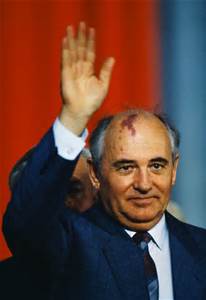
Gorbachev surprisingly found that Ronald Reagan, his American right-wing counterpart, shared his nuclear anxieties, and was ready to be a partner in joint denuclearization efforts. Already in 1985 they jointly declared that “nuclear war cannot be won and must never be fought.” Gorbachev interprets this declaration as a commitment by the two governments not to seek a position of superiority based on developing new types of nuclear weapons (for instance, defensive shields that made an attack seem more plausible, and thus might tempt a potential target state to consider preemption), but claims that the United States never acted as if it understood this Reagan/Gorbachev declaration in this manner. Gorbachev does take appropriate note of Reagan’s deep attachment to SDI (Strategic Defense Initiative) as limiting the progress that the two leaders could make in relation to denuclearization, and incompatible with his recognition of what a horror nuclear war would be.
In this regard, Gorbachev considers United States militarism then and now to constitute the “insurmountable obstacle to a nuclear-free world.” As this unfortunately seems to be a correct assessment, it entails a gridlocked nuclear future with no escape route. Gorbachev expresses his almost fatalistic view of human destiny if nuclear weaponry is retained: “The alternative is clear: Either we move toward a nuclear-free world or we have to accept that nuclear weapons will continue to spread step by step across the world.” In effect, the only effective long-term nonproliferation regime is dependent upon a parallel regime of complete nuclear disarmament, and without such a regime nuclear war will occur at some point due to the sheer multiplication of nuclear actors.
As others have noticed, the highpoint in Gorbachev era nuclear diplomacy occurred at the Reyjkavik summit in 1986 when Reagan and Gorbachev seemed to be on the historic verge of agreeing on the obligatory elimination of all nuclear strategic weaponry, only to have the potential breakthrough immediately undermined on the home front in the United States by the bipartisan realist guardians of the nuclear status quo. This very robust move in Iceland that briefly ‘threatened’ to achieve nuclear disarmament was unnerving for militarists in the West. Always skilled at summarizing the hawkish mood of governing elites, Margaret Thatcher sounded the collective alarm: “We won’t be able to handle a second Reyjkavik.” And indeed, her words were heeded at the pinnacles of government, and there has not been another Reyjkavik, or anything approaching a high profile inter-governmental occasion at which ideas about nuclear disarmament were being seriously discussed and contemplated by the governments of the respective leading nuclear weapons states.
What has received scant notice is the missed opportunity of the period after the fall of the Berlin Wall in 1989 when the Cold War came to an end. It was then George H.W. Bush who was the American president, supposedly moderate, sensible, and knowledgeable about foreign affairs. And this is the depressing point. It was just his establishment realism that led Bush derisively to dismiss any ambition to take advantage of the new situation in the world to abandon the Cold War doctrines of deterrence and seize the opportunity to initiate a global nuclear disarmament process. Instead of exploring what could have been probably negotiated with Gorbachev, Bush notoriously rejected on principle fundamental reform as ‘the vision thing,’ which he happily admitted was not his cup of tea. And so this unprecedented moment of opportunity was tragically wasted, and instead the 1990s became a decade devoted to servicing neoliberal economic globalization being fashioned in a manner that produced a post-colonial predatory set of relations among the peoples of the world. This ‘new world order’ was driven by the logic of capital efficiency, which has led to steadily widening disparities between rich and poor within countries and regions and in their interplay as well as launched multiple threats to environmental sustainability.
In effect, after the Cold War even the fatuous nuclear disarmament diplomacy that Gorbachev decried disappeared, and a period of self-satisfied nuclear complacency ensued. Governments are more or less content with obscure ritual review conferences within the framework of the Nuclear Nonproliferation Treaty Regime. This failure of political imagination by Bush Sr. may be seen in retrospect as a most disastrous lapse in American global leadership, far worse than was the American refusal to join the League of Nations after World War I, and give that first experiment in war prevention on a global scale some slight chance of success. For these reasons I would not be astonished if a revisionist historian concludes that the Bush Sr. presidency was more harmful to the United States and the world than was the failed presidency of Bush Jr..
There is a final vital point that Gorbachev develops in response to skeptical questions from the Spiegel interviewer about the feasibility of nuclear disarmament. Gorbachev responds by posing a question of his own that is meant to answer itself by an implicit appeal to common sense: “And can we really imagine a world without nuclear weapons if a single country amasses so many conventional weapons that its military budget nearly tops that of all other countries combined?” He goes on to point out the obvious: “[t]his country would enjoy total military supremacy if nuclear weapons were abolished,” and by implication, other countries will never be so foolish as to submit their societies to such hegemonic arrangements. In effect, Gorbachev is imagining that nuclear weaponry should be linked, not as in most liberal speculation to an affirmation of the nonproliferation regime, but rather to undoing geopolitical militarism, which means that if the United States ever embraces nuclear disarmament as policy rather than sentiment, it will have to terminate its global domination project. Gorbachev delivers here a powerful and persuasive message: if the United States ever becomes truly serious about wanting to implement the visionary conceptions of nuclear disarmament that Obama affirmed in his Prague speech with lofty generalizations, then it must simultaneously embark on a program of unilateral demilitarization.
With this concluding bit of insight from Gorbachev, which I find compelling, we should also acknowledge that it has been an odd deficiency in strategic thought in the West that most forms of strong advocacy of nuclear disarmament have not been organically connected with an overall demand for American demilitarization. Unless nuclear disarmament is implemented in a policy context that includes the demilitarization of geopolitics, it would give the United States the kind of political environment in which its massive military machine would be far more usable, less inhibited, and in all probability more menacing to the rest of the world. From this perspective one wonders why the realist cadres at the Pentagon, State Department, CIA, and the Beltway think tanks do not endorse nuclear disarmament as a prime strategic goal fully consistent with achieving the kind of global securitization administered from Washington that militarists have long favored as the keystone of American grand strategy since 1945.
Gorbachev doesn’t venture onto this speculative terrain. His current belief is that unless American demilitarization becomes part of the nuclear disarmament package “talks toward a nuclear-free world will be little more than empty words.” Although Obama is not mentioned, his Prague speech thus qualifies as ‘empty words,’ not only because of the absence of follow up, but more pointedly due to Obama’s silence about the relevance of diminishing America’s non-nuclear military capabilities as an essential aspect of making credible and beneficial the endorsement of a world without nuclear weapons.
It is also probably the case that when an American president possesses a determined commitment to a world without nuclear weapons he will make initiate a campaign to win over public opinion in Omaha, Denver, or Phoenix, and not Prague. What is said in the Czech Republic may play well in Oslo, but it is not going to shake the ideological and bureaucratic foundations of nuclearism in the United States.
In this short essay, it has been my principal intention to appreciate the humane wisdom of Mikhail Gorbachev, and to hope that even 70 years after Hiroshima and Nagasaki an American leader will emerge in the dark of night to carry forward the struggle for a viable human future by championing nuclear disarmament to be accompanied by substantial American demilitarization. She will think and act against the grain of this delusional quest for absolute geopolitical control, and maybe rest long enough to thank
Gorbachev for showing the way, both as political leader and as engaged citizen, an exemplary instance of what I call ‘citizen pilgrim.’
Normal
0
false
false
false
EN-US
JA
X-NONE
/* Style Definitions */
table.MsoNormalTable
{mso-style-name:”Table Normal”;
mso-tstyle-rowband-size:0;
mso-tstyle-colband-size:0;
mso-style-noshow:yes;
mso-style-priority:99;
mso-style-parent:””;
mso-padding-alt:0in 5.4pt 0in 5.4pt;
mso-para-margin:0in;
mso-para-margin-bottom:.0001pt;
mso-pagination:widow-orphan;
font-size:12.0pt;
font-family:Cambria;
mso-ascii-font-family:Cambria;
mso-ascii-theme-font:minor-latin;
mso-hansi-font-family:Cambria;
mso-hansi-theme-font:minor-latin;}






 Global Justice in the 21st Century
Why Congress Must Support the Nuclear Agreement With Iran
22 Aug[Prefatory Note: this post republishes an article appearing in the Huffinton Post on Aug. 21, 2015. It is jointly written with Akbar Ganji, an important human rights defender who spent several years for his efforts in an Iranian jail. Ganji is a leading commentator on Iranian affairs and world issues, and recipient of an International Press Association World Press Hero award. Our articles stresses the critical importance of obtaining American approval of the nuclear agreement.]
Why Congress Must Support the Nuclear Agreement With Iran
Akbar Ganji & Richard Falk
What should have been an occasion of diplomatic rejoicing has turned into an ugly partisan struggle over whether or not the international agreement negotiated with Iran will or will not be approved by the United States Government. The extremely troublesome obstruction to the agreement is centered in the U.S. Congress where anti-Obama Republicans are teaming up with pro-Netanyahu Democrats to create uncertainty as to whether the arrangments negotiated with such persistence by the five permanent members of the UN Security Council together with Germany will be undermined by this unprecedented leverage being exerted by Israel on the internal governmental processes in America. It should be appreciated that the agreement has been unanimously endorsed by a positive vote of all 15 members of the Security Council, a rarity in UN politics for an issue of this geopolitical magnitude.
In the end this debate raises some fundamental questions about American domestic politics along with its leadership in the Middle East and indeed, the credibility of its global role. Here is an agreement, restricting Iran’s freedom of action with regard to its nuclear program beyond that imposed on any other country ever, clearly serving the national interest of the United States in Middle Eastern stability, an outcome of dedicated efforts by the President and Secretary of State to find a way to avoid both another war in the region and a dangerous nuclear arms race.
That such a diplomatic breakthrough is being so furiously opposed posts a warning that irrationality is mounting a serious challenge to common sense and self-interest. As Obama has noted on several occasions he knows of no other leader that interferes so directly in the national policy debates of a foreign country than deos Netanyahu( 1 and 2 ) . Britain’s Foreign Secretary Philip Hammond observed: “Israel wants a permanent state of stand-off and I don’t believe that’s in the interests of the region. I don’t believe it’s in our interest.”
Israel has used all the influence at its disposal to block approval, mobilizing rich ultra-Zionist donors in the U.S. to create a war chest of $20 milion and relying on AIPAC (American-Israel Public Affairs Committee) to twist enough legislative arms to override an expected Obama veto if the agreement is turned down by a majority in the two houses of Congress. This drive has been led by the ever belligerent Israeli Prime Minister, Benjamin Netanyahu, but it is disturbing to realize that all the leading political parties in Israel are united in their opposition to the agreement. This alone tells us the degree to which political attitudes in Israel are out of sinc with those prevailing in the rest of the Middle East, and indeed the world.
As such, there is a moment of truth for the relationship between the United States and Israel. A rejection of the agreement will raise serious questions about the capacity of this country to pursue a foreign policy that reflects its best interests and dominant values. It will also raise doubts about whether it is capable of constructive leadership in the Middle East and the world. If the agreement is approved, as we firmly believe it should be, it will not only confirm the autonomy of national institutions in the United States but show that the alliance relationship with Israel can withstand disagreement when vital issues are at stake.
The Iran Problem
The Islamic Republic of Iran is a religious dictatorship that systematically violates the rights of its citizens, and has demonstrated enmity toward the United States since the 1979 Revolution. Despite this, compared with other Islamic countries of the Middle East and North Africa, it is far better situated to realize democracy and respect human rights.
Iran is a stable nation that has not invaded another country for nearly 300 years. Its population has nearly more than doubled since the 1979 Revolution, but its number of university students has increased by a factor of 27, with more than 60 percent of them female. The most important international writings of Western liberal, feminist, and secular thinkers have been translated into Farsi, including the work of some of the most important Jewish thinkers. Iran has a large middle class, and is the only country in the region, aside from Turkey, that has the prerequisites for a transition to democracy despite problematic features of the relations between state and society.
For over 22 years Netanyahu has been “making” nuclear bombs for Iran, continuously claiming that Iran is only a short time away from having the bomb. The predictions have turned out to be false and inflammatory, but his desire and appetite for war with Iran seems only to have increased over time. The nuclear agreement with Iran, which has imposed severe restrictions on its peaceful nuclear program despite going well beyond what the 1968 Nonproliferation Treaty requires, has agitated Netanyahu and the political mainstream in Israel. There are several explanations of this irrational Israeli response to an agreement that help all in the region. Netanyahu has engaged in fear-mongering that has mobilized Israeli society. Beyond this, a focus on Iran’s nuclear program draws attention away from other difficult problems confronting Israel,, including the Palestinian problem and its own covertly acquired arsenal of nuclear weapons.
National interests of the United States or Netanyahu’s political interests?
As President Obama has repeatedly said, the only alternative to the nuclear agreement with Iran is war. But, this would be a war that Israel wants the United States to fight on its behalf. Military attacks on Iran will almost certainly produce an extremely strong reaction by Iran and other nations in that region, a process likely to set the entire Middle East on fire. Iran with its population of 78 million will likely degenerate into another Iraq and Syria, and extremists from throughout the world will stream across its borders to join the struggle. How can risking such an outcome possibly be in the interests of the United States?
Approving the nuclear agreement with Iran is by far the least costly solution to whatever problems can be associated with Iran’s nuclear program, and approval will also promote peace and stability in the Middle East. With this background in mind Congress should clearly approve the agreement, and it is also why the citizenry of the United States should welcome it. After approval,, the United States would find itself in an excellent position, perhaps in coopeation with other governments to help address other problems on the Middle East agenda by proposing an ambitious diplomatic package with the following essential elements:
Guaranteeing present national borders through resolutions backed by the United Nations Security Council
Elimination of all weapons of mass destruction from the region through the establishment of a nuclear free zone in the whole of the Middle East
Resolving the Palestinian problem encouraging two-state diplomacy premised on the right of the Palestinian people to form their own independent, viable and contiguous state on all territories occupied since 1967, and if diplomacy fails, then more coercive measures should be imposed by action of the United Nations
A collective security and mutual non-aggression treaty signed by all the Middle Eastern nations
Investment in the economic and political development of the region combined with the regulation of arms sales
Moving forward from the agreement it is important to appreciate that peace is a common value envisioned and shared by Jews, Muslims, and Christians:
“They will beat their swords into plowshares and their spears into pruning hooks. Nation will not take up sword against nation, nor will they train for war anymore” (Isaiah 2:4).
“Blessed are the peacemakers, for they will be called children of God”(Matthew 5:9).
“Making peace is the best” (an-Nissa 128) and “O, you who believe! Fulfill the promises and covenants made [by you]” (al-Maidah 1).
For too long these shared values, deeply embedded in the worldviews of these civilizational perspectives, have been ignored, even repudiated. The nuclear agreement with Iran creates the opportunity to move the flow of history in better directions. Such an opportunity must not be lost. If lost, the United States and Israel would be morally, politically, and legally responsible for whatever harm befalls the region and the world.
Tags: Iran, Israel, Middle East Peace, Netanyahu, Nuclear Agreement, US Congress