Archive | Israel/Palestine RSS feed for this section
22 Jun

The U.S. Withdrawal from the UN Human Rights Council


Explicitly focusing on alleged anti-Israel bias the U.S. withdrew from further participation in the UN Human Rights Council. The only internationally credible basis for criticizing the HRC is its regrettable tendency to put some countries with the worst human rights records in leading roles, creating genuine issues of credibility and hypocrisy. Of course, such a criticism would never be made by the U.S. as it could only embarrass Washington to admit that many of its closest allies in the Middle East, and elsewhere have lamentable human rights records, and, if fairly judged, the U.S. has itself reversed roles since the year 2000, itself slipping into the category of the most serious human rights offenders. In this regard, its ‘withdrawal’ can be viewed as a self-imposed ‘suspension’ for falling short when it comes to the promotion and protection of human rights.


Undoubtedly, the U.S. was frustrated by its efforts to ‘reform’ the HRC according to its views  of the UN agency should function, and blamed its traditional adversaries, Russia, China, Venezuela, Cuba, along with Egypt, with blocking its initiative. It also must not have welcome the HRC High Commissioner, Zeid Ra’ad al-Hussein, for describing the separation of children from their immigrant parents at the Mexican border as an ‘unconsciounable’ policy.


In evaluating this latest sign of American retreat from its prior role as global leader, there are several considerations that help us understand such a move that situates the United States in the same strange rejectionist corner it now shares with North Korea and Eritrea:


            –the fact that the U.S. withdrawal from the HRC occurred immediately after the Israeli border massacre, insulated from Security Council censure and investigation by a U.S. veto, is certainly part of political foreground. This consideration was undoubtedly reinforced by the HRC approval of a fact-finding investigation of Israel’s behavior over prior weeks in responding to the Great Return March border demonstrations met with widespread lethal sniper violence;


            –in evaluating the UN connection to Palestine it needs to be recalled that the organized international community has a distinctive responsibility for Palestine that can be traced all the way back to the peace diplomacy after World War I when Britain was given the role of Mandatory, which according to the League of Nations Covenant should be carried out as a ‘sacred trust of civilization.’ This special relationship was extended and deepened when Britain gave up this role after World War II, transferring responsibility for the future of Palestine to the UN. This newly established world organization was given the task of finding a sustainable solution in the face of sharply contested claims between the majority Palestinian population and the Jewish, mainly settler population.


This UN role was started beneath and deeply influenced by the long shadow of grief and guilt cast by the Holocaust. The UN, borrowing from the British colonial playbook, proposed a division of Palestine between Jewish and Palestinian political communities, which eventuated in the UN partition plan contained in General Assembly Resolution 181. This plan was developed and adopted without the participation of the majority resident population, 70% non-Jewish at the time, and was opposed by the independent countries in the Arab world. Such a plan seemed oblivious to the evolving anti-colonial mood of the time, failing to take any account of the guiding normative principle of self-determination. The Partition War that followed in 1947 did produce a de factor partition of Palestine more favorable to the Zionist Project than what was proposed, and rejected, in 181. One feature of the original plan was to internationalize the governance of the city of Jerusalem with both peoples given an equal status.


This proposed treatment of Jerusalem was never endorsed by Israel, and was formally, if indirectly, repudiated after the 1967 War when Israel declared (in violation of international law) that Jerusalem was the eternal capital of the Jewish people never to be divided or internationalized, and Israel has so administered Jerusalem with this intent operationalized in defiance of the UN. What this sketch of the UN connection with Palestine clearly shows is that from the very beginning of Israeli state-building, the role of the international community was direct and the discharge of its responsibilities was not satisfactory in that it proved incapable of protecting Palestinian moral, legal, and political rights. As a result, the majority of Palestinian people have been effectively excluded from their own country and as a people exist in a fragmented ethnic reality. This series of events constitutes one of the worst geopolitical crimes of the past century. Rather than do too much by way of criticizing the behavior of Israel, the UN has done far too little, not because of a failure of will, but as an expression of the behavioral primacy of geopolitics and naked militarism;


            –the revealing stress of Ambassador Haley’s explanation of the U.S. withdrawal from the HRC gives almost total attention to quantitative factors such as the ‘disproportionate’ number of resolutions compared with those given to other human rights offenders, making no attempt whatsoever to refute the substantiveallegations of Israeli wrongdoing. This is not surprising as any attempt to justify Israeli policies and practices toward the Palestinian people would only expose the severity of Israel’s criminality and the acuteness of Palestinian victimization. The U.S. has also long struggled to be rid of so-called Item 7 of the Human Rights Council devoted to human rights violations of Israel associated with the occupation of Palestinian territories, which overlooks the prior main point that the UN is derelict in its failure to produce a just peace for the peoples inhabiting Mandate Palestine.


            –withdrawing from international institutional arrangements, especially those positively associated with peace, human rights, and environmental protection has become the hallmark of what be identified as the negative internationalismof the Trump presidency. The most egregious instances, prior to this move with regard to the HRC, involved the repudiation of the Nuclear Program Agreement with Iran (also known as the JCPOA or P5 +1 Agreement) and the Paris Climate Change Agreement. Unlike these other instances of negative internationalism this departure from the HRC is likely to hurt the U.S. more than the HRC, reinforcing its myopic willingness to do whatever it takes to please Netanyahu and the lead American Zionist donor to the Trump campaign, Sheldon Adelson. Only the provocative announcement of the planned unilateral move of the American Embassy to Jerusalem last December was as explicitly responsive to Israel’s policy agenda as is this rejection of the HRC, both initiatives stand out as being contrary to a fair rendering of American national interests, and hence a show of deference to Israel’s preferences. Despite this unabashed one-sidedness the Trump presidency still puts itself forward as a peacemaker, and promised to produce ‘the deal of the century’ at the proper moment, even enjoying the backing of Saudi Arabia, which seems to be telling the Palestinians to take what is offered or shut up forever. Knowing the weakness and shallow ambitions of the Palestinian Authority, there is no telling what further catastrophe, this one of a diplomatic character, may further darken the Palestinian future. A diplomatic nakbamight be the worst disaster of all for the Palestinian people and their century-long struggle for elemental rights.


 It should also be observed that the U.S. human rights record has been in steady decline, whether the focus is placed on the morally catastrophic present policies of separating families at the Mexican border or on the failure to achieve acceptable progress at home in the area of economic and social rights despite American affluence (as documented in the recent report of Philip Alston, UNHRC Special Rapporteur on Extreme Poverty) or in the various violations of human rights committed in the course of the War on Terror, including operation of black sites in foreign countries to carry on torture of terror suspects, or denials of the tenets of international humanitarian law (Geneva Conventions) in the administration of Guantanamo and other prison facilities;


            –it is also worth noting that Israel’s defiance of internatonal law and international institutions is pervasive, flagrant, and directly related to maintaining an oppressive regime of occupation that is complemented by apartheid structures victimizing Palestinian refugees, residents of Jerusalem, the Palestinian minority in Israel, and imprisoned population of Gaza. Israel refused the authority of the International Court of Justice with respect to the ‘separation wall’ that back in 2004 declared by a near unanimous vote of 14-1 (U.S. as the lone dissent) that building the wall on occupied Palestinian territory was unlawful, that the wall should be dismantled, and Palestinians compensated for harm endured. There are many other instances concerning such issues as settlements, collective punishment, excessive force, prison conditions, and a variety of abuse of children.


In conclusion, by purporting to punish the Human Rights Council, the Trump presidency, representing the U.S. Government, is much more punishing itself, as well as the peoples of the world. We all benefit from a robust and legitimated institutional framework for the promotion and protection of vital human rights. The claim of an anti-Israeli bias in the HRC, or UN, is bogus, the daily violation of the most basis rights of the Palestinian people is a tragic reality. This is all we need to know.

The Great March of Return: The Gaza Sniper Massacre  

10 Jun

The Great March of Return: The Gaza Sniper Massacre


“No country would act with greater restraint than Israel.”

NIKKI HALEY, U.S. Ambassador to the UN
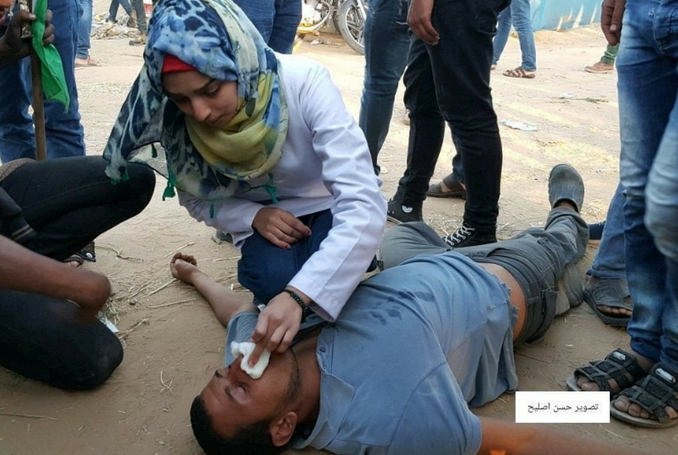


[Prefatory Note: The Gaza Sniper Massacre in response to the Great Return March is one more  milestone in Palestinian resistance and yet another frightening episode in the Israeli apartheid narrative of cruel and excessive violence, a shameful sequel of crimes for which there exists no adjudicative tribunal available to the victimized party to pursue justice. The post that follows consists of juxtaposing news items, a searing opinion piece by the courageously uncompromising Israeli journalist Gideon Levy and a wide-ranging brilliant commentary by my friend, Jim Kavanaugh. The post and is dedicated to the memory of Razan al-Najjar, the brave 21year old paramedic mortally shot while tending Palestinian demonstrators wounded at or near the Gaza fence. This young woman epitomized the purity of nonviolent yet heroic resistance, an identity given historical depth by her joy for life and her supreme sacrifice imposed by sniper brutality.


The Israeli political leadership and military commanders must be presumed to have chosen such a display of excessive and vindictive violence for a clear political objective, which will remain undisclosed. It would seem to be taking advantage of having unlimited support from the Trump presidency and the most favorable regional political situation of their history, but we may still ask ‘to what end?’ My best guess is that the effort was designed to convince the people of Gaza, more than Hamas, that resistance, and especially unarmed resistance was futile. Without a diplomatic path and with the annexationist path wide open, Israel would benefit from a Palestinian acknowledgement that the struggle is over, and they have lost. The Great March of Return was a defiant refusal to concede defeat, no doubt angering Israel, and inflicting a major defeat in the other war—the Legitimacy War being fought for hearts and minds on the basis of seizing the high moral and political ground.


Finally, we need to understand that the problem of winning the Legitimacy War is mostly a struggle to have the truth heard, to have it understood on all the major issues in dispute, law and morality are aligned with the Palestinian demands, but this has so far proved politically irrelevant as geopolitics and military capabilities strongly lean in an Israeli direction. Can Palestinian resistance as reinforced by a growing global solidarity movement overcome these Israeli

advantages? Time will tell. So far the corporatized media has sided with Israel, which is a battlefield in the Legitimacy War where the Palestinians have mainly fared badly.]


(1) The Free Gaza Movement


Please share this news with everyone you can think of. The only way we have a hope that these brave sailors will be safe is if the news gets out. There has been very little coverage so far. This is what we have found in the past day.


Quds News Network·

For the first time, #Gaza will attempt to break the 12-year-long siege by sea

On Tuesday morning, ships will set sail with a number of injured Gazans and patients abroad, carrying the hopes and dreams of the Palestinian people for freedom.

Tuesday’s Gaza flotilla will coincide with the 8th anniversary of an Israeli attack on the Turkish “Mavi Marmara” flotilla, in which nine Turkish activists were killed when the Israeli navy attacked the vessel in international waters. A tenth activist died nearly four years later, succumbing to injuries sustained during the raid.


https://www.middleeastmonitor.com/20180527-gaza-boats-will-attempt-to-break-israel-navy-siege-on-tuesday/


https://www.reuters.com/article/us-israel-palestinians-violence/israeli-air-strikes-target-boat-moored-in-gaza-residents-idUSKCN1IO06T


https://www.aljazeera.com/news/2018/05/boats-carrying-gaza-patients-set-bid-break-israel-blockade-180527150238689.html


Greta Berlin, Co-Founder, the Free Gaza movement


**************************************************************************************************************************

(2) Jonathan COOK ‘LETTER FROM NAZARETH”

The flames that killed Fathi Harb should make us all burn with guilt and shame

27 May 2018

The National – 27 May 2018

Fathi Harb should have had something to live for, not least the imminent arrival of a new baby. But last week the 21-year-old extinguished his life in an inferno of flames in central Gaza.

It is believed to be the first example of a public act of self-immolation in the enclave. Harb doused himself in petrol and set himself alight on a street in Gaza City shortly before dawn prayers during the holy month of Ramadan.

In part, Harb was driven to this terrible act of self-destruction out of despair.

After a savage, decade-long Israeli blockade by land, sea and air, Gaza is like a car running on fumes. The United Nations has repeatedly warned that the enclave will be uninhabitable within a few years.

Over that same decade, Israel has intermittently pounded Gaza into ruins, in line with the Israeli army’s Dahiya doctrine. The goal is to decimate the targeted area, turning life back to the Stone Age so that the population is too preoccupied with making ends meet to care about the struggle for freedom.

Both of these kinds of assault have had a devastating impact on inhabitants’ psychological health.

Harb would have barely remembered a time before Gaza was an open-air prison and one where a 1,000kg Israeli bomb might land near his home.

In an enclave where two-thirds of young men are unemployed, he had no hope of finding work. He could not afford a home for his young family and he was about to have another mouth to feed.

Doubtless, all of this contributed to his decision to burn himself to death.

But self-immolation is more than suicide. That can be done quietly, out of sight, less gruesomely. In fact, figures suggest that suicide rates in Gaza have rocketed in recent years.

But public self-immolation is associated with protest.

A Buddhist monk famously turned himself into a human fireball in Vietnam in 1963 in protest at the persecution of his co-religionists. Tibetans have used self-immolation to highlight Chinese oppression, Indians to decry the caste system, and Poles, Ukrainians and Czechs once used it to protest Soviet rule.

But more likely for Harb, the model was Mohamed Bouazizi, the Tunisian street vendor who set himself on fire in late 2010 after officials humiliated him once too often. His public death triggered a wave of protests across the Middle East that became the Arab Spring.

Bouazizi’s self-immolation suggests its power to set our consciences on fire. It is the ultimate act of individual self-sacrifice, one that is entirely non-violent except to the victim himself, performed altruistically in a greater, collective cause.

Who did Harb hope to speak to with his shocking act?

In part, according to his family, he was angry with the Palestinian leadership. His family was trapped in the unresolved feud between Gaza’s rulers, Hamas, and the Palestinian Authority (PA) in the West Bank. That dispute has led the PA to cut the salaries of its workers in Gaza, including Harb’s father.

But Harb undoubtedly had a larger audience in mind too.

Until a few years ago, Hamas regularly fired rockets out of the enclave in a struggle both to end Israel’s continuing colonisation of Palestinian land and to liberate the people of Gaza from their Israeli-made prison.

But the world rejected the Palestinians’ right to resist violently and condemned Hamas as “terrorists”. Israel’s series of military rampages in Gaza to silence Hamas were meekly criticised in the West as “disproportionate”.

The Palestinians of the West Bank and East Jerusalem, where there is still direct contact with Israeli Jews, usually as settlers or soldiers, watched as Gaza’s armed resistance failed to prick the world’s conscience.

So some took up the struggle as individuals, targeting Israelis or soldiers at checkpoints. They grabbed a kitchen knife to attack Israelis or soldiers at checkpoints, or rammed them with a car, bus or bulldozer.

Again, the world sided with Israel. Resistance was not only futile, it was denounced as illegitimate.

Since late March, the struggle for liberation has shifted back to Gaza. Tens of thousands of unarmed Palestinians have massed weekly close to Israel’s fence encaging them.

The protests are intended as confrontational civil disobedience, a cry to the world for help and a reminder that Palestinians are being slowly choked to death.

Israel has responded repeatedly by spraying the demonstrators with live ammunition, seriously wounding many thousands and killing more than 100. Yet again, the world has remained largely impassive.

In fact, worse still, the demonstrators have been cast as Hamas stooges. The United States ambassador to the UN, Nikki Haley, blamed the victims under occupation, saying Israel had a right to “defend its border”, while the British government claimed the protests were “hijacked by terrorists”.

None of this can have passed Harb by.

When Palestinians are told they can “protest peacefully”, western governments mean quietly, in ways that Israel can ignore, in ways that will not trouble consciences or require any action.

In Gaza, the Israeli army is renewing the Dahiya doctrine, this time by shattering thousands of Palestinian bodies rather than infrastructure.

Harb understood only too well the West’s hypocrisy in denying Palestinians any right to meaningfully resist Israel’s campaign of destruction.

The flames that engulfed him were intended also to consume us with guilt and shame. And doubtless more in Gaza will follow his example.

Will Harb be proved right? Can the West be shamed into action?

Or will we continue blaming the victims to excuse our complicity in seven decades of outrages committed against the Palestinian people?


(3) The Israel Massacre Forces


The shooting on the Gaza border shows once again that the killing of Palestinians is accepted in Israel more lightly than the killing of mosquitoes


Gideon Levy

https://www.haaretz.com/opinion/.premium-the-israel-massacre-forces-1.5962852


The death counter ticked away wildly. One death every 30 minutes. Again. Another one. One more. Israel was busy preparing for the seder night. TV stations continued broadcasting their nonsense.


It’s not hard to imagine what would have happened if a settler had been stabbed – on-site broadcasts, throw open the studios. But in Gaza the Israel Defense Forces continued to massacre mercilessly, with a horrific rhythm, as Israel celebrated Passover.


If there was any concern, it was because soldiers couldn’t celebrate the seder. By nightfallthe body count had reached at least 15, all of them by live fire, with more than 750 wounded. Tanks and sharpshooters against unarmed civilians. That’s called a massacre. There’s no other word for it.


Comic relief was provided by the army spokesman, who announced in the evening: “A shooting attack was foiled. Two terrorists approached the fence and fired at our soldiers.” This came after the 12th Palestinian fatality and who knows how many wounded.


Sharpshooters fired at hundreds of civilians but two Palestinians who dared return fire at the soldiers who were massacring them are “terrorists,” their actions labeled “terror attacks” and their sentence – death. The lack of self-awareness has never sunk to such depths in the IDF.


As usual, the media lent its appalling support. After 15 deaths Or Heller on Channel 10 News declared that the most serious incident of the day had been the firing by the two Palestinians. Dan Margalit “saluted” the army. Israel was brainwashed again and sat down to a festive meal in a spirit of self-satisfaction. And then people recited “Pour out Thy wrath upon the nations that know Thee not,” impressed by the spread of plagues and enthusing at the mass murder of babies (the killing of the first-born Egyptians, the 10th plague).


Christian Good Friday and the Jewish seder night became a day of blood for the Palestinians in Gaza. You can’t even call it a war crime because there was no war there.

The test by which the IDF and the pathological indifference of public opinion should be judged is the following: What would happen if Jewish Israeli demonstrators, ultra-Orthodox or others, threatened to invade the Knesset? Would such insane live fire by tanks or sharpshooters be understood by the public? Would the murder of 15 Jewish demonstrators pass with silence? And if several dozen Palestinians managed to enter Israel, would that justify a massacre? The killing of Palestinians is accepted in Israel more lightly than the killing ofmosquitoes. There’s nothing cheaper in Israel than Palestinian blood.If there were a hundred or even a thousand deaths Israel would still “salute” the IDF. This is the army whose commander, the good and moderate Gadi Eisenkot, is received with such pride by Israelis. Of course, in the holiday media interviews, no one asked him about the anticipated massacre and no one will ask him now either.

But an army that prides itself on shooting a farmer on his land, showing the video on its website in order to intimidate Gazans; an army that pits tanks against civilians and boasts of one hundred snipers waiting for the demonstrators is an army that has lost all restraint. As if there weren’t other measures. As if the IDF had the authority or right to prevent demonstrations in Gaza, threatening bus drivers not to transport protesters in territory where the occupation has long ended, as everyone knows.


Despairing young men sneak in from Gaza, armed with ridiculous weapons, marching dozens of kilometers without hurting anyone, only waiting to be caught so as to escape Gaza’s poverty in an Israeli jail. This doesn’t touch anyone’s conscience either. The main thing is that the IDF proudly presents its catch. Palestinian President Mahmous Abbasis responsible for the situation in Gaza. And Hamas, of course. And Egypt. And the Arab world and the whole world. Just not Israel. It left Gaza and Israeli soldiers never commit massacres. The names were published in the evening. One man was rising from his prayers, another was shot while fleeing. The names won’t move anyone. Mohammed al-Najar, Omar Abu Samur, Ahmed Odeh, Sari Odeh, Bader al-Sabag. This space is too small, to our horror, to list all their names.


(4)Sacrificing Gaza: The Great March of Zionist Hypocrisy


By Jim KavanaghOn June 4, 2018


Photo by Jordi Bernabeu Farrús | CC BY 2.0

The Great March of Return is a startling, powerful expression of Palestinian identity and resistance. Thousands of Palestinians have come out, bravely and unapologetically, to say: “We refuse to remain invisible. We reject any attempt to assign us to the discard pile of history. We will exercise our fundamental right to go home.” They have done this unarmed, in the face of Israel’s use of deadly armed force against targets (children, press, medics) deliberately chosen to demonstrate the Jewish state’s unapologetic determination to force them back into submissive exile by any means necessary. By doing this repeatedly over the last few weeks, these incredibly brave men, women, and children have done more than decades of essays and books to strip the aura of virtue from Zionism that’s befogged Western liberals’ eyes for 70 years.


What the Israelis have done over the past few weeks—killingat least 112and wounding over 13,000people (332 with life-threatening injuries and 27 requiring amputation)—is a historical crime that stands alongside the Sharpeville Massacre(69 killed), Bloody Sunday(14 killed), and the Birmingham Fire Hoses and Police Dog Repressionas a defining moment in an ongoing struggle for justice and freedom. Like those events, this month’s slaughter may become a turning point for what John Pilger correctly calls“the longest occupation and resistance in modern times”—the continuing, unfinished subjugation of the Palestinian people, which, like apartheid and Jim Crow, requires constant armed repression and at least occasional episodes of extermination.


The American government, political parties, and media, which support and make possible this crime are disgraceful, criminal accomplices. American politicians, media, and people, who feel all aglow about professing their back-in-the-day support (actual, for some; retrospectively-imagined, for most) of the Civil-Rights movement in the American South and the anti-apartheid struggle in South Africa but continue to ignore the Palestinian struggle for justice against Zionism, because saying peep one about it might cost them some discomfort, are disgraceful, cowardly hypocrites.

You know, the millions of ant-racist #Resistors who are waiting for a quorum of Natalie Portmans and cool elite, preferably Jewish, personalities to make criticism of Israel acceptable before finding the courage to express the solidarity with the Palestinian people they’ve always had in their hearts. Back in the day, they’d be waiting for Elvis to denounce Jim Crow before deciding that it’s the right time to side with MLK, Malcolm, and Fred Hampton against Bull Connor, George Wallace, and William F. Buckley.


Dis/Ingenuity


The bankruptcy of purportedly anti-racist and humanitarian liberal-Zionist ideology and ideological institutions reached an apogee with the eruption of various apologia for Israel in the wake of this crime, not-so-subtly embedded in mealy-mouthed “regret the tragic loss of life” bleats across the mediascape. All the usual rhetorical subjects were rounded up and thrown into ideological battle: “Israel has every right to defend its borders” (NYT Editorial Board);  the “misogynists and homophobes of Hamas” orchestrated the whole thing (Bret Stephens); the protestors are either Hamas “terrorists” or Hamas-manipulated robots, to be considered “nominal civilians” (WaPo). And, of course, the recurring pièce de résistance: Human Shields!


Somewhere in his or her discourse, virtually every American pundit is dutifully echoing the Israeli talking pointlaid down by Benjamin Netanyahu during the Israeli attack on Gaza in 2014: that Hamas uses the “telegenically dead” to further “their cause.” The whole March of Return action is “reckless endangerment, bottomlessly cynical” (Stephens). Women and children were “dispatched” to “lead the charges” although they had been “amply forewarned…of the mortal risk.” It’s a “politics of human sacrifice” (Jonathan S. Tobinand Tom Friedman), staged by Hamas, “the terrorist group that controls [Gazans’] lives,” to “get people killed on camera.” (Matt Friedman, NYT Op-Ed). The White House, via spokesman, Raj Shah, adopts this line as its official response“The responsibility for these tragic deaths rests squarely with Hamas,” which “intentionally and cynically provoke[ed] this response” in “a gruesome… propaganda attempt.”

Shmuel Rosner takes this “human shields” trope to its ultimate “no apologies” conclusion in his notorious op-edin the NYT, “Israel Needs to Protect Its Borders. By Whatever Means Necessary.” Feeling “no need to engage in ingénue mourning,” Rosner forthrightly asserts that “Guarding the border [or whatever it is] was more important than avoiding killing.” They want human sacrifice, we’ll give ‘em human sacrifice!


He acknowledges that Gazans “marched because they are desperate and frustrated. Because living in Gaza is not much better than living in hell,” and that “the people of Gaza … deserve sympathy and pity.” But the Palestinians were seeking“to violate [Israel’s] territorial integrity,”so “Israel had no choice” but to “draw a line that cannot be crossed,” and kill people trying to leave that hell. It was “the only way to ultimately persuade the Palestinians to abandon the futile battle for things they cannot get (“return,” control of Jerusalem, the elimination of Israel).”The alternative ismore demonstrations — and therefore more bloodshed, mostly Palestinian.”


Though he acknowledges that “the interests of Palestinians are [not] at the top of the list of my priorities,” Shmuel nonetheless feels comfortable speaking on their behalf. He sincerely “believe[s] Israel’s current policy toward Gaza ultimately benefits not only Israel but also the Palestinians.”Following the wisdom of “the Jewish sages” (featuring Nick Lowe?) he opines: “Those who are kind to the cruel end up being cruel to the kind.”


Fear not, Shmuel, for the pitiable people of Gaza: Knesset member Avi Dichter reassuresus that the Israeli army has enough bullets for everyone. If every man, woman and child in Gaza gathers at the gate, in other words, there is a bullet for every one of them. They can all be killed, no problem.”For their ultimate benefit. Zionist tough love.

There is nothing new here. Israel has always understood the ghetto it created in Gaza. In 2004, Arnon Soffer, a Haifa University demographer and advisor to Ariel Sharon, said: “when 2.5 million people live in a closed-off Gaza, it’s going to be a human catastrophe. … The pressure at the border will be awful. … So, if we want to remain alive, we will have to kill and kill and kill. All day, every day….If we don’t kill, we will cease to exist.” And when challenged again in 2007about “Israel’s willingness to do what he prescribes… – i.e., put a bullet in the head of anyone who tries to climb over the security fence,” Soffer replied with a shrug:. “If we don’t, we’ll cease to exist.”


Soffer’s only plaint: “The only thing that concerns me is how to ensure that the boys and men who are going to have to do the killing will be able to return home to their families and be normal human beings.” A reprise of Golda Meir’s “shooting and crying” lament; “We can never forgive [the Arabs] for forcing us to kill their children.” Ingénue mourning, anyone?


We can point out the factual errors and concrete cruelties that all these apologias rely on.

We can point out that Hamas did not “orchestrate” these demonstrations, and that the thousands of Gazans who are risking their lives are not instruments. “You people always looked down at us,” one Gazan toldAmira Hass, “so it’s hard for you to understand that no one demonstrates in anyone else’s name.”


We can point out that the fence the Israelis are defending is not a “border” (What country are the Gazans in?), but the boundary of a ghetto, what Conservative British PM David Cameron calleda giant “prison camp” and Israeli scholar Baruch Kimmerling called“the largest concentration camp ever to exist.” It’s a camp that tens of thousands of Palestinians were forced into by the Zionist army. The right of those families (80% of Gaza’s population) to leave that confinement and go home is a basic human right and black-letter international law.


We can point out that Gazans aren’t just trying to cross a line in the sand, they are trying to break a siege,and that: “The blockade is by definition an act of war, imposed and enforced through armed violence. Never in history have blockade and peace existed side by side. …There is no difference in civil law between murdering a man by slow strangulation or killing him by a shot in the head.” Those were, after all, thewords ofIsraeli Foreign Minister Abba Eban, when he was justifying Israel’s attack on Egypt in 1967. And they are confirmed today by New York judge Mary McGowan Davis, who says: “The blockade of Gaza has to be lifted immediately and unconditionally.”


We can point out that there can be no excuse in terms of modern international law or human rights principles for Israel’s weeks-long “calculated, unlawful” (HRW) mass killing and crippling or unarmed protestors who were standing quietly, kneeling and praying, walking away, and tending to the wounded hundreds of meters from any “fence”—shootings carried out not in any “fog of war” confusion, but with precise, targeted sniper fire (which, per standard military practice, would be from two-manteams).

As the IDF bragged, in a quickly deleted tweet:  “Nothing was carried out uncontrolled; everything was accurate and measured, and we know where every bullet landed.” Indeed, as Human Rights Watch reports, senior Israeli officialsorderedsnipers to shoot demonstrators who posed no imminent threat to life, and many demonstrators were shot hundreds of meters, and walking away, from the fence.


We can point out that the IDF’s quick deletion of that tweet indicates its consciousness of guilt awareness, in the face of proliferating images of gruesome, unsupportable casualties, of how bad a Rosner-like “no apology, no regrets” discourse sounds. After all, it’s hard, since they “know where every bullet landed,” not to conclude the Israelis deliberately targeted journalists and medical personnel, who were never threatening to “violate [Israel’s] territorial integrity.” There have been at least 66 journalists wounded and 2 killedwearing clearly marked blue “PRESS” flak jackets. And everyone should see the powerful interviewwith Canadian doctor, Tarek Loubani, who was shot in the leg, describing how, after six weeks with no paramedic casualties, suddenly:

“in one day, 19 paramedics—18 wounded plus one killed—and myself were all injured, so—or were all shot with live ammunition. We were all… away during a lull, without smoke, without any chaos at all, and we were targeted…So, it’s very, very hard to believe that the Israelis who shot me and the Israelis who shot my other colleagues… It’s very hard to believe that they didn’t know who we were, they didn’t know what we were doing, and that they were aiming at anything else.”


It was on another day that this 21-year-old “nominal civilian” nurse, Razan al-Najjar, was killedby an Israeli sniper while tending to the wounded.


Of course, pointing all this out won’t mean anything to these apologists or to those who give them a platform. Everybody knows the ethico-political double standard at work here. No other country in the world would get away with such blatant crimes against humanity without suffering a torrent of criticism from Western politicians and media pundits, including every liberal and conservative Zionist apologist cited above. Razan’s face would be shining from every page and screen of every Western media outlet, day after day, for weeks. Even an “allied” nation would get at least a public statement or diplomatic protest; any disfavored countries would face calls for punishment ranging from economic sanctions to “humanitarian intervention.” Israel gets unconditional praisefrom America’s UN Ambassador.

Indeed, if the American government “defended” its own actual international border in this way, liberal Zionists would be on the highest of moral saddles excoriating the Trump administration for its crime against humanity. And—forgetting, as is obligatory, the thousands of heavily-armed Jewish Zionists who regularly force their way across actual international borders with impunity—if  some Arab country’s snipers killed hundreds and wounded tens of thousands of similarly unarmed Jewish Zionist men, women, children, and paraplegics who were demonstrating at an actual international border for the right to return to their biblical homeland, we all know the howling and gnashing of morally outraged teeth that would ensue from every corner of the Western political and media universe. No “Guarding the border was more important than avoiding killing” would be published in the NYT,or tolerated in polite company, for that scenario.


Nathan J. Robinson got to the bottom line in his wonderful shreddingof Rosner’s argument, it comes down to: “Any amount of Palestinian death, however large, was justified to prevent any amount of risk to Israelis, however small.” Western governments and media have fashioned, and are doing their utmost to sustain, an ethico-political universe where Israel canlay siege to a million people, ‘bomb them occasionally,’ and then kill them when they show up at the wall to throw rocks.”


Is there a way anymore of not seeing the racism of Zionism? Can we just say, once and for all, that the interests of Palestinians—not as pitiable creatures but as active, fully, enfranchised human beings—are not anywhere on the list of Soffer’s or Dichter’s or Rosner’s (or the Western media’s or governments’) priorities, and refuse any of their pitifully disingenuous expressions of concern for the Palestinians’ benefit? Nobody gets to put “For your own benefit,” in front of “Surrender or I’ll put a bullet in your head.” The onlyconcern any of these commentators have for the people of Gaza is that they submissively accept their forced displacement and imprisonment in “the largest concentration camp ever to exist.”


Does the vulgarity of it shock you?


The “human shields, human sacrifice” trope, which all these apologias hang on, is particularly mendacious and hypocritical as used by Zionists. It’s also a classic example of projection.

This is a “human shield”:

It is Israel which has repeatedly used the specific, prohibitedtactic of using children as “human shields” to protect its military forces. According tothe U.N. Committee on the Rights of the Child, Israel is guilty of the “continuous use of Palestinian children as human shields and informants.” Besides this namby-pamby UN Committee that no red-blooded American/Zionist would pay any attention to, the High Court of Justice in Israel identified and denounced the “human shield” procedures the IDF acknowledged and defended using 1,200 times. These include “the ‘neighbor procedure,’ whereby neighbors of wanted Palestinians are forced to go into the wanted man’s house ahead of troops, in case it is booby-trapped,” andIsraeli “soldiers forcibly position[ing] members of [a] family, including the children, at the windows of [a] home and proceed[ing] to fire from behind them.”

So, when Zionists use a “human shields” argument as a moral cudgel against unarmed civilian protestors, and a moral justification for a powerful army, which brazenly uses children to shield its own soldiers, killing scores of those protestors by the day—well, it’s not a stretch to see this charge is a projection of Zionists’ own pattern of thought and behavior.


Besides being an ongoing tactic of today’s Israeli army, “human shields” and the “human sacrifice” they imply were an integral element of the Zionist narrative—expressly articulated and embraced, with no apology, as a necessity for the establishment of a Jewish State.


Take a look at what Edward Said in 2001 called: “the main narrative model that [still] dominates American thinking” about Israel, and David Ben-Gurion called“as a piece of propaganda, the best thing ever written about Israel.” It’s the “’Zionist epic’…identified by many commentators as having been enormously influential in stimulating Zionismand support for Israelin the United States.” In this piece of iconic American culture, an American cultural icon—more sympathetically liberal than whom there is not—explains why he, as a Zionist, is not bluffing in his threat to blow up his ship and its 600 Jewish refugees if they are not allowed to enter the territory they want:


–You mean you’d still set it [200 lbs. of dynamite] off, knowing you’ve lost?…Without any regard for the lives you’d be destroying?…

Every person on this ship is a soldier. The only weapon we have to fight with is our willingness to die.

–But for what purpose?”

Call it publicity.

Publicity?

Yes, publicity. A stunt to attract attention….Does the vulgarity of it shock you?

More Zionist tough love.


In the face of the scurrilous “human shield” accusation against Palestinians now being used to denigrate the killed, maimed, and still-fighting protestors in Gaza, we would do well to recall Paul Newman’s Zionist-warrior, “no apology,” argument for 600 telegenically deadJewish men, women, and children as a publicity stunt to gain the sympathy of the world.


Lest we dismiss this as a fiction, remember that Paul Newman’s fictional boat, Exodus, is based on a real ship, the SS Patria. In 1940, the Patriawas carrying 1800 Jewish refugees from Nazi-occupied Europe whom the British authorities refused entry into Palestine. While the Patria was in the port of Haifa, it was blown up and sunk by Munya Mardoron the orders of the Haganah, which did not want Jewish refugees going anywhere but Palestine. At least 267 people were killed. The Haganah put out the story that the passengers had blown up the ship themselves – a story that lasted 17 years, nourishing the imagination of Leon Uris, author of the Exodus fiction. This wasn’t a commander or leading organization urging people to knowingly take a deadly risk in confronting a powerful enemy; it was “their” self-proclaimed army blowing its people up with no warning—and then falsely claiming they did it to themselves! Nobody who wouldn’t use “bottomlessly cynical” to denigrate the Haganah should be using it to denigrate Gazans.


At a crucial moment in history, it was Zionists who practiced a foundational “human shield” strategy, holding the victims of Nazism “hostage” to the Zionist “statehood” project – as none other than the publisher of the New York Times, Arthur Hays Sulzberger, recognized and criticized:

I cannot rid myself of the feeling that the unfortunate Jews of Europe’s D. P. [Displaced Persons] camps are helpless hostages for whom statehood has been made the only ransom. …[W]hy in God’s name should the fate of all these unhappy people be subordinated to the single cry of Statehood?


The Exodus/Patria/Paul Newman/Haganah willingness to blow up hundreds of Jewish refugees in order to force their way into a desired territory was an attitude endemic to the Zionist movement, and enunciated quite clearly by its leader, David Ben-Gurion, as early as 1938: “If I knew it was possible to save all [Jewish] children of Germany by their transfer to England and only half of them by transferring them to Eretz-Yisrael, I would choose the latter.” You want human sacrifice?…


(Sulzberger, by the way, “opposed political Zionism not solely because of the fate of Jewish refugees because he disliked the ‘coercive methods’ of Zionists in this country who use economic means to silence those with differing views.” Yes, the NYT!  So change is possible.)


What’s Right Is Wrong


And here’s the thing: You want to call what the Gazans did—coming out unarmed by the thousands, knowing many of them would be killed by a heavily-armed adversary determined to put them down by whatever means necessary—a “politics of human sacrifice”? You are right.

Just as you’d be right to say that of the Zionist movement, when it was weak and faced with much stronger adversaries. And just as you’d be right to say it of the unarmed, non-violent Civil Rights Movement, when it faced the rageful determination of the immensely more powerful American South, to preserve the century-old Jim Crow apartheid that wasits identity, by whatever means necessary.


Princeon Professor Eddie Glaude, Jr. nailed it when, to the visible discomfort of his MSNBC co-panelists, he respondedto the invocation of the White House line that it’s “all Hamas’ fault and that they’re using them as tools for propaganda,” with: “That’s like saying to the children in the Children’s March of Birmingham it was their fault that Bull Connor attacked them.”


Civil-rights activists did put children on the front lines, and put their own and those children’s lives in danger to fight and defeat Jim Crow. They knew there were a lot of people armed and willing to kill them. And children, as well as activists, were killed. And those actions weresupported (but by no means “orchestrated”) by “extremist” organizations—i.e., the Communist Party. At the time, conservatives attacked Freedom Riders with the same arguments that Zionists are now using to attack Gaza Return Marchers.

All unarmed, non-violent but disruptive, Gandhian strategies to eliminate entrenched systems of colonial-apartheid rule will knowingly sacrifice many lives to attain their victory. Call it a politics of human sacrifice if you want. I won’t make any ingénue objections. But it’s not a sign of the subjugated people’s cynicism; it’s a result of their predicament.

“Human sacrifice” defines the kind of choices a desperate and subjugated people are forced to make in the face of armed power they cannot yet overcome. A militarily-weak insurgent/liberation movement must use an effectively self-sacrificing strategy of moral suasion. That is now a standard and powerful weapon in political struggle. (Though moral suasion alone will not win their rights. Never has. Never will.)


For Gazans, it’s the choice between living in a hell of frustration, misery, insult, confinement, and slow death, or resisting and taking the high risk of instant death. It’s the choice faced by people whose “dreams are killed” by Israel’s siege and forced expulsion, and who are willing to risk their lives  “for the world’s attention.” Young men like Saber al-Gerim, for whom, “It doesn’t matter to me if they shoot me or not. Death or life — it’s the same thing.” Or the one who told Amira Hass: “We die anyway, so let it be in front of the cameras.” Or 21-year-old Fathi Harb, who burned himself to death last Sunday. Or Jihadi al-Najjar, who had to make the choice between continuing to care for his blind father (“He was my sight. He helped me in everything, from going to the bathroom to taking a shower to providing for me…I saw life through Jihadi’s eyes.”) or being killed by an Israeli sniper while, as his mother Tahani says “defending the rights of his family and his people.”


Tough choices, to get the world’s attention. This is the kind of choice imposed on the untermenschen of colonial-apartheid regimes. The only weapon they have is their willingness to die. But Gazans won’t get the sympathetically-anguished Paul Newman treatment. Just “bottomlessly cynical.”


Paul’s choice, Sophie’s choice, is now Saber’s and Jihad’s and Fathi’s, and it’s all bad. Maybe some people—comrades and allies in their struggle—have a right to say something about how to deal with that choice. But the one who doesn’t, the one who has no place to say or judge anything about that choice, is the one who is forcing it. Those who are trying to fight their way out of a living hell are not to be lectured to by the devil and his minions.

So, yes, in a very real sense, for the Palestinians, it is a politics of human sacrifice—to American liberals, the gods who control their fate.


By choosing unarmed, death-defying resistance, Palestinians are sacrificing their lives to assuage the faux-pacifist conscience of Americans and Europeans (particularly, I think, liberals), who have decreed from their Olympian moral heights that any other kind of resistance by these people will be struck down with devastating lightning and thunder.


Funny, that these are the same gods the Zionists appealed to to seize their desired homeland, and the same gods the civil-rights activists appealed to to wrest their freedom from local demons of lesser strength. Because, in their need to feel “sympathy and pity,” the sacrifice of human lives seems the only offering to which these gods might respond.


The Nakba Is Now


The Israelis and their defenders are right about something else: They cannot allow a single Gazan to cross the boundary. They know it would be a fatal blow to their colonial-supremacist hubris, and the beginning of the end of Zionism—just as Southern segregationists knew that allowing a single black child into the school was going to be the beginning of the end of Jim Crow. Palestinians gaining their basic human rights means Israeli Jews losing their special colonial privileges.


As Ali Abunimah points out, Arnon Soffer was right, when he said: “If we don’t kill, we will cease to exist,” and Rosner, when he said the Gazans threatened the “elimination of Israel.” To continue to exist as the colonial-apartheid polity it is, Israel must maintain strict exclusionist, “noright of return,” policies. Per Abunimah: “the price of a ‘Jewish state’ is the permanent and irrevocable violation of Palestinians’ rights…If you support Israel’s “right to exist as a Jewish state” in a country whose indigenous Palestinian people today form half the population, then you… must come to terms with the inevitability of massacres.”


What’s happening in Gaza is not only, as Abunimahsays, a “reminder… of the original sin of the ethnic cleansing of Palestine and the creation of a so-called Jewish state,” it is a continuation of that unfinished work of the devil. The Nakba is now.


I’m all for everybody on both sides of the issue to be aware of the stakes and risks in this struggle, without any disingenuous denials.


Whether you sympathize with, or denigrate, the choices of people who put their own, their comrades’, and even their children’s, lives at risk is not determined by whether some tactical choices can be characterized as “human shields, human sacrifice”; it’s determined by what they’re fighting for, and what and whom they are fighting against, anwhere your solidarity lies.


Stage Left


Here’s the core of the disagreement about Gaza (and Palestine in general): There are those—they call themselves Zionists—who think the Palestinians deserve to have been put in that concentration camp, and who stand in solidarity with the soldiers who, by whatever means necessary, are forcing them to stay there. And there are those—the growing numbers who reject Zionism—who stand in solidarity with every human being trying to get out of that camp by whatever means necessary.


There’s a fight—between those breaking out of the prison and those keeping them in; between those seeking equality and those enforcing ethno-religious supremacism; between the colonized and the colonizer. Pick a side. Bret Stephens, Shmuel Rosner, and Tom Friedman have. The New York Times, The Washington Post, and Breitbart have. ABC, CBS, (MS)NBC, and Fox have. The Democrats and Republicans and the Congress and the White House have. And they are not shy about it.


It’s past time for American progressives to clearly and unequivocally decide and declare which side they are on. It’s time for professedly humanitarian, egalitarian, pro-human rights, anti-racist, and free-speech progressives to express their support of the Palestinian struggle—on social media, in real-life conversation, and on the street.


It’s time to firmly reject the hypocritical discourse of those who would have been belittling any expression ofsorrow and outrage over Emmet Till, Chaney, Schwerner and Goodman, and the four black schoolgirls killed in Birmingham, while “ingénue mourning” the terrible moral quandary in which those disrupters had put Bull Connor’s boys. Don’t shrink from it, talk back to it—every time.Make them ashamed to be defending colonialism and apartheid with such patently phony arguments.


Politically? At a minimum, demand of any politician who seeks your vote: End the blockade of Gaza, immediately and unconditionally. Support BDS. Refuse any attempt to criminalize BDS and anti-Zionism. Stop blocking UN and ICC actions against Israeli crimes. Restrict arms sales to Israel. Reject the hypocritical Zionist apologetics. Refuse any attempt to censor or restrict the internet. (This last is very important. Nothing has threatened Zionist impunity more than the information available on the internet, and nothing is driving the demand to censor the internet more than the Zionists’ need to shut that off.)


This is a real, concrete, important resistance. What’ll it cost? Some social discomfort? It’s not sniper fire. Not human sacrifice. Not Saber’s choice.


Are we at a turning point? Some people think this year’s massacre in Gaza will finally attract a sympathetic gaze from the gods and goddesses of the Imperial City. Deliberately and methodically killing, maiming, and wounding thousands of unarmed people over weeks—well, the cruelty, the injustice, the colonialism is just too obvious to ignore any longer. And I hope that turns out to be so. And I know, Natalie Portman and Roger Waters and Shakira, and—the most serious and hopeful—the young American Jews in groups like Students for Justice in Palestine and IfNotNow. There are harbingers of change, and we must try.

I also know there is nothing new here. Thirty years ago, a doctor in Gaza said: “We will sacrifice one or two kids to the struggle — every family. What can we do? This is a generation of struggle.” It was obvious thirty years ago, and forty years before that. TheNakbawas then. The Nakbais now. Was it ever not too obvious to ignore?

My mother was an actress on Broadway, who once came to Princeton University to share the stage, and her professional skills, with Jimmy Stewart and other amateur thespians. She played the ingénue. Me, I’m not so good at that.

By all means, regarding Palestine-Israel and the sacrifices and solidarity demanded: No more ingénue politics.


Article printed from http://www.counterpunch.org: ‪https://www.counterpunch.org

URL to article: ‪https://www.counterpunch.org/2018/06/04/sacrificing-gaza-the-great-march-of-zionist-hypocrisy/


************************************************************************************


(5) Israeli army frames slain medic Razan al-Najjar as ‘Hamas human shield’



Mondoweiss7 June 2018 by Jonathan Ofir –


Just when you thought Israel couldn’t get any lower… The Israeli army has just released an incitement video, titled “Hamas’ use of human shields must stop”, in which it frames the slain medic Razan al-Najjar as a “Hamas human shield”– a day after it claimed she was killed by accident. This is more than adding insult to injury. This is adding malice to crime. The propaganda effort is based on twisting al-Najjar’s own words. I have consulted with three Arabic experts, who have looked at the original Arabic interview from which the IDF took the “human shield” text, and it is clear to them beyond a doubt that the IDF was knowingly and cynically manipulating Razan’s words to mean something other than what she said. Bear with me, this requires close analysis: First the video features Razan throwing away a gas grenade in the field.  Obviously, this is one of the tear gas grenades fired by the Israeli army, which she is taking up and throwing to a safe distance. By this visual, the IDF is trying to create the impression that Razan is a kind of ‘combatant’. Then comes the short clip from an interview. The original interview has been found to be from Al Mayadeen News, a channel based in Beirut. The IDF video runs subtitles, saying: “I am Razan al-Najjar, I am here on the frontlines and I act as a human shield…” That’s all the IDF needs. Now, with the ominous music in the background, the IDF text states: “Hamas uses paramedics as human shields”. But the IDF cut out a very significant part of the sentence. Razan actually says: “I the Paramedic Razan al-Najjar, I am here on the Front Line acting as a human shield of safety to protect the injured at the Front Line. No one encouraged me on being a Paramedic, I encouraged myself. I wanted to take chances and help people…” (my emphasis)….

http://mondoweiss.net/2018/06/israeli-frames-najjar/

########


__._,_.___



Once More: Blog Gatekeeping Dilemmas

22 May


Whenever Palestinian grievances become prominent, as they have recently due to the U.S. embassy move and defiant opening in Jerusalem, which coincided in time and outrage with the massacre at the Gaza border, Zionist nerves grow frayed, insults fly, and nasty moves are made to shift the conversation as far away from both the grievances and Israeli brutality as possible. In the humble setting of my blog apologists for Israel’s war crimes and crimes against humanity invite us to read their comments that blame Hamas for the shooting of unarmed Palestinian demonstrators. Since Hamas, as everyone knows, is ‘a terrorist organization’ and that alone is supposed to end discussion. Of course, such tactics of closure take no notice of the fact that Hamas was encouraged by Washington to participate in the 2006 elections by Washington, and then was punished for winning internationally supervised elections.


After that Hamas quietly tried to urge Washington to take steps to avoid violence in and surrounding Gaza by diplomatic initiatives that would promote co-existence. Hamas put forward in subsequent years a number of long-term ceasefire proposals that Israel left unanswered. If Hamas ignored comparable Israeli initiatives it would be severely denigrated by governments and the media. When violence involving Gaza has erupted, it has usually been Israel that has not only initiated major attacks, but has done so in a one-sided manner inflicting massive death and devastation on the Palestinian civilian population by taking full advantage of their military dominance. For Israel it has obviously been useful to keep Hamas in a terrorist box, which has kept a bright green light shining in the IDF direction.


The second argument made by Israeli apologists is to contend that every country has a right to defend itself, and when Israel repeatedly shoots, kills, and maims large numbers of unarmed demonstrators with live ammunition it is within its rights–acting in lawful self-defense. Such an abstract argument is only possible by either ignoring the true nature of the conflict or pretending that Israel, with its vast experience in controlling hostile demonstrations, has no alternative better way to address these unruly Palestinians who have been locked in captivity for decades and denied the most elemental human rights. Such a line of argument should be shameful, yet isn’t treated as such by mainstream media. Imagine the public outcry if East German border guards has used IDF sniper tactics at the Berlin Wall to repel enraged West German demonstrators (with far less justification for desperate anger than the Palestinians), it could have meant war, and certainly would have produced widespread denunciations of Communist barbarism.


With reluctance I have blocked such comments, as unhelpfully detached from reality. My actions have elicited especially the anger of Fred Skolnik, Mike71, and some others who have left the website. Fred and Mike have been more persistent, hiding their contempt for me long enough from time to time so as to regain temporary access to the blog, pleading free speech and with comedic absurdity, claiming that I block or filter their comments because I fear that the truth that they have to tell will expose the lies I tell or to avoid their arguments that are so convincing to the objective mind as to make mincemeat of mine.


There are some well funded major websites that serve loyally as strident voices for the Zionist right, such as Gatestone Institute, a regular outlet for Alan Dershowitz, and the Middle East Forum, featuring the views of Daniel Pipes. These websites would no more dream of publishing my comments than would Nikki Haley invite me over for dinner. I should point out, in a burst of liberal self-righteousness, that I have also mostly excluded comments that do express extreme anti-Zionist, anti-Israel views that appear to me to cross the line of political criticism and enter with their language the domain of ‘killing fields.’ Exactly where that line should be drawn is not easy for me, although it is obvious for my critics who claim I am easy on those that hate Israel while harsh on its defenders. I can only respond by saying “not true.”


It is never congenial for me to play this filtering role. I would make a terrible censor. I waver from time to time, which lead to inconsistent decisions, and sometimes disappoint friends as much as other times I anger my worst adversaries. My liberal, Habermasian inclinations are toward discourse and dialogue, and I am aware that restrictions, even if taken responsibly are a slippery slope. I confess also that I resent spending time reaching decisions about whether comments that stray close to the line of what I would call ‘inhumane apologetics’ (as in defending Israel’s shoot to kill or maim policies at the Gaza border) or involve defamatory attacks on my character, competence, motivations. Except in the most extreme cases it strikes me as a Hobson’s Choice: respond and futile engage or ignore and leave behind a trail of suspicion.  This same dilemma applies to invective directed at comment writers that express views similar to mine.


I know I have written along these lines in the past, dueling with my frustration, with some anger, and the debilitating feeling of being trapped in a fruitless exercise, and yet when the volume of blocked comments pile up from time to time, silence does not seem a good option. I am tempted at such intervals to stop comments altogether, thereby sidestepping the issue. I have so far resisted this temptation because despite some acute discomfort, on balance, I find most of the comments supportive and of great interest, containing independent insights, and offering constructive criticisms that I do my best to take into account in the future.


There is no conversation possible, especially as those who disagree are branded as showing their alleged hatred for Israel. As the principal target of such defamatory comments, I am particularly sensitive to the issue.

GAZA: Grief, Horror, Outrage, Remembering

15 May

[Prefatory Note: Slightly revised at the end.]


GAZA: Grief, Horror, Outrage, Remembering


GRIEF


How can one not feel intense grief for the young Palestinians who out of despair and fury joined the Great March of Return, and so often found death and severe injury awaiting them as they approached the border unarmed!!?


This was not a gratuitous event, or something that happened spontaneously on eitherside. After 70 years of Palestinian suffering, with no end of torment in sight, to show the world and each other their passion was what would be seen as normal, even admirable, demonstrating a spirit of resistance that endured after decades of repression, violence, humiliation, and denial of the most fundamental of rights. After 70 years of Israeli statehood, this violent confirmation of our worst fears and perceptions, seals a negative destiny for Israel as far as the moral eye can see.


HORROR


When exposed to such visual images of resistance and sniper violence the scene expresses the horror of burning steel rubbing against raw flesh. There is no way to grasp this particular cartography of risk, vulnerability, and security than to have recourse the language and imagery of horror. Such a sad narrative of horror will linger on both sides to haunt both collective and individual memories, but one with tragic pride, the other with repressed shame.


The horror was magnified by coinciding with obscene celebratory events in Jerusalem where Americans representing the Trump presidency, including Ivanka Trump, Jared Kushner, and the American Ambassador, David Friedman, brought infamy to the United States by this unseemly display of indifference to crimes against humanity being unabashedly committed as they spoke. Such moral and political insensitivity will not and should not be forgotten.


OUTRAGE


Words are all we have, but they will do. As Thomas Merton taught some crimes

are situated in the domain of the unspeakable.


The occasions for outrage about the treatment of the Palestinian people are many, but the Israeli reaction to this Palestinian march reaches a new level of moral, political, and legal wretchedness. It recalls the cry of religious leaders of conscience in the last stage of the Vietnam War, expressed by their dutiful compilation of criminal acts of American violence committed in relatively defenseless Vietnam bearing the telling title—NOT IN OUR NAME.


As Jews, as Americans, as human beings, isn’t it about time to take a similar stand, and at least create symbolic distance between the perpetrators of these crimes and ourselves?


The feeble Israeli claims of its right of self-defense or attributing Palestinian martyrdom to Hamas are so shallow and lacking in credibility as to discredit further rather than provide justifications for this exhibition of homicidal violence on a massive scale not as isolated incident but as a series of arrogant reenactments.


REMEMERING


Not with words or argument, but with tears, and tears will not do.


Certainly as the Martyrdom of Gaza, and quite possibly seen as a kind of silent bonding by the Palestinian people with the African victims of the Sharpeville Massacre (1960) or the civil rights marchers at Selma (1965) but far worse!


From this darkness will come an as yet undisclosed inspiration.  

Interview: Middle East Turmoil: Israeli Massacre, Palestinian Grievances

3 Apr

The Middle East is Heating Up — Again: An Interview with Richard Falk (with C.J. Polychroniou)


[Prefatory Note: This is a somewhat modified text of an interview of two weeks ago conducted by the Greek journalist and author, C.J Polychroniou. Since then several developments have occurred, none more significant than the Return Home Land Day demonstrations of March 30, 2018. The original interview appeared in several online publications. The format is altered to make somewhat more reader friendly.]


CJP: Richard, let’s start with Donald Trump’s decision to officially recognize Jerusalem as Israel’s capital and to move the US embassy there by May of this year. First, is this legal from the standpoint of international law, and, second, what are likely to be the long-term effects of the US recognition of Jerusalem as Israel’s capital on the region as a whole?


RF: There is no question, Chronis, that Trump’s Jerusalem policy relating to recognition and the move of the American embassy is regionally and religiously provocative and disruptive, underscoring the abandonment by Washington of even the pretense of being a trustworthy intermediary that can be relied upon by both sides to work for a sustainable peace between the two peoples. Some critics of the initiative are saying that the U.S. is free to situate its embassy in Jerusalem, but the whole of Jerusalem isn’t Israel. The status of this holy city remains to be determined and East Jerusalem, where the Old City is located, which for the present is considered to be an ‘occupied territory’ in international humanitarian law.


Recognition of Jerusalem as the capital of Israel is a clear violation of international humanitarian law, which rests on the central proposition that an occupied territory should not be altered in any way that changes its status and character without the consent of the occupied society. It also is a unilateral rejection of a near unanimous international consensus, endorsed by the United Nations, that the future of Jerusalem should be settled by negotiations between the parties as a part of a broader peacemaking process. Israel had much earlier violated both international law and breached this international consensus by unilaterally annexing an enlarged Jerusalem, and declared that the whole city, within expanded boundaries, would be the ‘undivided, eternal capital’ of Israel. It is notable that the General Assembly on December 21, 2017 approved by an overwhelming majority of 128-8 (35 abstentions) a strong condemnation of the U.S. move on Jerusalem, with even America’s closest allies joining in this vote of censure.


It is difficult to predict the long-term consequences of this diplomatic rupture. It depends, above all, on whether the U.S. Government acts convincily to restore its claim to act as a conflict-resolving intermediary. The Trump administration continues to insist that it is working on a peace plan that will require painful compromises by both Palestine and Israel. Of course, given the unconditional alignment of Washington with Netanyahu’s views of Israel and the Palestinian future, as well as the orientation of those entrusted with drafting the plan, it is highly unlikely that even Mahmoud Abbas and the Palestinian Authority, generally accommodationist will be inclined to enter a diplomatic process that is virtually certain to be weighted so heavily in favor of Israel. Yet as many have come to appreciate, nothing is harder to predict than the future of Middle Eastern politics.

At the same time, Jerusalem has an abiding significance for both Islam and Christianity that makes it almost certain for the indefinite future that there will be formidable regional and civilizational resistance to subsuming Jerusalem under Israeli sovereign control.


******************


CJP: Israel appears bent on restricting Iran’s rising influence as a regional power in the Middle East. How far do you think the US can go in assisting Israel to contain Tehran’s strategy for empowering Shia’s?


Richard Falk: Israel and Saudi Arabia are both for different reasons determined to confront Iran, and quite possibly, initiate a military encounter with potentially widespread ramifications for the entire region, if not the world. A quick glance at the Syrian conflict suggests how complex and dangerous is this effort to destabilize the Iranian governing process, with the dual objectives of destabilizing the governing process mixed with the more ambitious goal of causing civil strife of sufficient magnitude as to produce a civil war, and ideally from the perspectives of Iran’s adversaries, regime change.


The Israeli adherence to this recklessness seems partly motivated by its overall security policy of seeking to weaken any country in the region that is hostile to its presence and has the potential military capability to threaten Israeli security and regional role in a serious manner. Israel has been so far successful in neutralizing each of its credible adversaries in the region (Saudi Arabia, Iraq, Egypt, Syria) with the exception of Iran. In this sense, Iran stands out as the last large unfinished item on Israel’s post-1967 geopolitical agenda. Israel’s real intentions are difficult to pin down, shifting with context and perceived opportunity. Netanyahu and other Israeli leaders frequently manipulate the alleged Iranian threat to cause fear among Israelis. Their goal seems to be the mobilization of domestic support for adhering to an aggressive foreign policy. This manipulation panics many Israeli security specialists who express are more alert to the risks of an actual military confrontation with Iran than are political leaders.


Saudi motivations are quite different, associated with a fierce regional rivalry that is articulated in terms of a sectarian clash between Shia and Sunni Islam, aggravated by a concern that Iran’s influence increased as a result of the Iraq and Syrian Wars, which both seem to have outcomes favorable to Tehran. The sectarian rationale of the conflict seems intended to disguise the more fundamental explanation, which is that there is a power struggle between these two sovereign states to determine which one will achieve regional ascendancy. The sectarian explanation was also somewhat undermined by the intensity with which the Saudis and other Gulf monarchies used their financial and diplomatic resources to crush the Muslim Brotherhood in Egypt despite its strong Sunni identity. From the time of the Iranian Revolution in 1979 Tehran looked upon the monarchy governing Saudi Arabia as corrupt and decadent in the same manner as it regarded the Shah’s dynastic rule in Iran as politically illegitimate.


Your focus on how far the U.S. can go in restricting Iran’s influence is difficult to assess at this point. Trump’s virtual repudiation of the agreement on Iran’s Nuclear Program seems to express a commitment to join with Israel and Saudi Arabia to engage in coercive diplomacy, consisting of intensifying sanctions, covert operations to encourage internal opposition, and a variety of military threats. Where this will lead, if indeed it goes forward in defiance of the other parties to the agreement and almost all UN members, is anybody’s guess, but it is a highly irresponsible diplomatic gambit that risks a deadly ‘war of choice.’


Trump’s regional diplomacy, such as it is, has been most notable for giving even greater emphasis to the ‘special relationships’ with Israel and Saudi Arabia than earlier American leaders. Even previously, under Obama, George W. Bush, and prior presidents, the subordination of American strategic interests and national values to this posture of unquestioning support, which is the operational significance of designating these links as special relationships.


CJP: Syria’s civil war not only continues unabated but the country has become a battlefield for the spread of the influence of various powers in the region, including Turkey and Russia. Do you see a way out of this mess?


Richard Falk: The Syrian War is among the most complex conflict patterns in the history of warfare. Not only is there an internal struggle for control of the Syrian state that has been waged by not one, but by several insurgent movements that are not even compatible with one another. There is also a regional proxy war pitting Saudi Arabia, UAE, and Qatar against Iran, with Turkey playing a confusing role that sometimes seems guided by anti-Damascus goals but at other times is preoccupied with curtailing the Kurdish challenge. The various national struggles of the Kurds for autonomous rights, possibly independent political communities, threatens the territorial integrity of several Middle Eastern states, as well as Syria. In addition to all of this there are major multi-faceted and fluid Russian and American involvements on opposite sides, although not even this opposition is clear cut and consistent. For a time there was an almost collaborative effort to defeat ISIS and obtain a Syrian ceasefire, although the basic involvement has been to put Russia on the side of the Damascus government and the U.S. as aligned with the insurgencies.


Because the anti-ISIS dimension of the conflict is at odds with the anti-Damascus dimension, depending on the priority accorded to one rather than the other, alignments are contradictory and shifted over time. Sometimes precedence has been given to achieving regime-change in Damascus by removing Assad from power, and in such contexts, it was acknowledged silently that ISIS was the most effective military challenge on the ground being mounted against the Syrian government. At other times, the counterterrorist campaign against ISIS was given uppermost prominence, and there was even high-level indications that Washington was willing to live with the Assad regime, a position given added credence recently due to the success of the Syrian government in quelling its opposition, making continued opposition futile politically and irresponsible ethically. Whenever pragmatism gained the upper hand, Russia and Iran were accepted as partners in these efforts to defeat and destroy ISIS.


All wars eventually come to an end, and I am sure Syria will not be an exception. Yet it difficult at present to project a solution that brings about more than a ceasefire, and even this kind of ending of what has become an orgy of senseless killing is highly elusive, as each of the many parties to the conflict jockeys violently for minor positional advantages to improve its bargaining leverage when the conflict enters some kind of negotiating phase. Although all wars end eventually, internal wars of this kind, especially with such complex regional and international aspects, can simmer for decades with no clear winner or loser as has been the case in the Philippines and Colombia. It seems as if at present the Syrian government believes it is on the verge of victory, and is pressing for an outcome in East Ghouta and Idlib such that it will not be expected to make significant concessions.


The best hope, which has been the case for several years, is that the various parties will recognize that the situation is indeed a mess that is causing mass suffering and widespread devastation without producing political gains. Yet translating that recognition into a formula that produces an end to the violence has so far proved futile and frustrating as each party sees the conflict from its partisan perspective of gain and loss.


 CJP: With the two-state solution having ceased long ago being a viable alternative, what are the most likely prospects for the future of Israeli-Palestinian relations?


Richard Falk: The safest response is to anticipate a persistence of the present status quo, which involves continuing Israeli expansionism by way of the settlements and the persistence of the Palestinian ordeal, with some resistance in the occupied West Bank, Gaza, and East Jerusalem and a growing global solidarity movement exerting pressure on Israel in the form of the BDS campaign. There may be some attention given to a variety of proposals to end the conflict by revived diplomacy. The Trump blustery promise of ‘a deal of the century’ has received skeptical attention, but its likely one-sidedness makes it almost certain to be a non-starter, especially as the Israeli government feels insufficient pressure to produce a peaceful solution based on a genuine political compromise and the Palestinian Authority remains unwilling to accept a demilitarized statelet as a token Palestine state, or even to participate in negotiations that are so obviously stacked against it. For public relations reasons, the international consensus clings to the two-state solution even though, as your question suggests, its viability has long been superseded by Israeli expansionist policies intended to fulfill the Zionist goal of making the boundaries of Israel coterminous with the whole of the Jewish biblical conception of the ‘promised land.’


There are other outcomes that are possible. Daniel Pipes has been promoting what he dubbed ‘the victory caucus,’ which posits Israel as the victor in the struggle to establish a Jewish state and Palestine the loser. Pipes argues that diplomacy has failed to resolve the conflict after years of effort, and hence that the only alternative is for one side to win and the other to lose if peace is to be established. He encourages Israel to escalate pressure on the Palestinians to make them see the light, accept the reality of a Jewish state, and move on. Such an initiative is distasteful to those who support the Palestinian struggle, and it seems oblivious to the claims of international law and international morality as these are generally understood in the 21st century when colonialism and ethnic nationalism are illegitimate forms of political control and the right of self-determination has become universally accepted as an inalienable right of an oppressed people in the circumstances of the Palestinians.


In my view, neither the two-state nor a consensual one-state outcome of the struggle is currently within the realm of political feasibility. We are necessarily speculating about future political scenarios within the domain of ‘political impossibility.’ Yet the impossible sometimes happens. Colonialism was successfully challenged, the Soviet Union collapsed, South Africa renounced apartheid, the Arab Spring erupted. In none of these cases did such occurrences seem possible except in retrospect. After the events, as expected, experts appeared who explained why these impossible developments were, if closely considered, inevitable.


In this spirit, I think it useful to acknowledge the limits of rational assessment, and either remain silent, or offer for consideration, a solution that is ‘impossible,’ yet ‘desirable’ from the perspective of humane values, which in this case involves a secure, equitable, and sustainable peace for both peoples that is, above all, sensitive to their equality and to their distinct, yet legitimate, claims to self-determination. I find it unimaginable to realize such a peace within the current structure of the Middle East, which consists of a group of artificial and autocratic states held together by varying mixtures of coercion, corruption, and external military assistance. Israel/Palestine peace cannot unfold in a benevolent manner without a structural return to the Ottoman framework of regional unity and ethnic community, and possibly Islamic caliphate, adapted to post-colonial realities. Such a stateless Middle East would reverse the harm inflicted on the region by the imposition of European territorial states through the infamous Sykes-Picot diplomacy.


 CJP: South Africa’s former apartheid system has been employed analytically by many to describe the current status of the state of Israel with regard to it’s treatment towards Palestinians. Indeed, it is from such a comparison that the Boycott, Divestment and Sactions (BDS) movement was borne, but to what extent are the two cases compatible? South Africa was pretty much isolated by the early 1980s, but the same cannot be said about Israel today. In fact, Israel has even managed to expand recently it’s network of allies with Greece and the Sunni states. So, what are your thoughts on the comparison between the former South African apartheid regime and Israel and the effectiveness of the strategy of BDS?


RF: Your question raises two distinct issues: Is Israel responsibly regarded as an ‘apartheid state’? If so, is Israeli apartheid similar to South African apartheid?


Prior to responding to these questions, it seems helpful to clarify the status of the international crime of apartheid as it has evolved in international law, taking particular note of the fact that although the name and core idea is based on the specific condemnation of South African racism, the international crime is detached from this precedent. The essence of the international crime is any form of discriminatory domination by one race over another that relies on ‘inhuman acts’ to sustain its purposes. In this important sense, Israeli forms of domination over the Palestinian people may be quite different than the domination of whites over blacks in South Africa and yet constitute the international crime of apartheid. Treating apartheid as an international crime is based both on the 1973 International Convention on the Suppression and Punishment of the Crime of Apartheid and on the 2002 Rome Statute governing the operations of the International Criminal Court that categorizes ‘apartheid’ in Article 7 as one of eleven types of Crime Against Humanity.


In a study commissioned by the UN Economic and Social Commission, Virginia Tilley and I concluded that the policies and practices of Israel toward the Palestinian people as a whole satisfy the requirements of the international crime of apartheid. Our conclusion is based on the view that Israel, to maintain an expanding Jewish state has subjected the Palestinian people to structures of subjugation and victimization that are sustained by excessive violence and other inhuman means. It was our judgment that Jews and Palestinians are distinct ‘races’ as the term is understood in international law. The scope of Israeli apartheid is based on coherent strategies designed to subjugate the Palestinian people whether they are living under occupation, the most obvious case, or as a discriminated minority within Israel or as residents in refugee camps in neighboring countries or living is a global diaspora as involuntary exiles. Each of these domains is connected with the Israeli efforts to ensure not only the prevalence of a Jewish state, but also a secure Jewish majority population that could only be achieved by a process of dispossession, dispersion, and fragmentation, as well as by the denial of any right of return.


South African apartheid was very different in its operation as compared to Israeli apartheid. For one thing, white South Africa was a minority demographic in the country and critically dependent on black labor. For another, the South African concept of law, citizenship, and democracy was delineated along racial lines, while Israel claims to be an inclusive democracy, although is more accurately understood to be an ethnocracy. Despite these fundamental differences, the core reality of ‘inhuman acts’ and ‘discriminatory structures of domination’ are present, although distinctly enacted, in both national settings.


Finally, it should be understood that such allegations of Israeli apartheid are made on the basis of academic study, and while they may be persuasive morally and politically, it is also true that until a valid tribunal passes judgment on such allegations, the legal status of the allegations remains unresolved, and is of course feverishly contested by Israel and its supporters.


CJP: Overall, what are the prospects for restored stability and a positive future for the countries in the Middle East?


RF: Without the intervention of unanticipated developments, the prospects are poor. On one level, the extreme turmoil in countries such as Syria, Yemen, Iraq, and neighboring Libya are likely to continue and could spread to additional states. On a second level, the regional rivalries between Iran and a Saudi led coalition on the one side and Israel on the other, seem likely to intensify. On a third level, there is no plausible scenario for establishing a sustainable peace between Israel and the Palestinian people. On a fourth level, with the reassertion of Russian engagement and the U.S. pursuit of a strategic agenda related to Israel, oil, political Islam, Iran, and nuclear nonproliferation, the region has as in the Cold War become a site of dangerous geopolitical maneuver and confrontation. On a fifth level, perhaps less serious than the others, is the sort of intra-regional tensions that have given rise to the Gulf Crisis centered upon the relations of Qatar to other Gulf countries, and to the role of Turkey as partner and antagonist, especially in relation to the continuing search of the Kurdish peoples for self-determination. Finally, on a sixth level, there is almost certain to be new expressions of internal strife and various extremisms that strike against the West, inviting retaliation, which will probably be accompanied by further migratory flows that aggravate relations between the Middle East and Europe.


The drastic and prolonged victimization of the Middle East also exhibits the failure of the West to understand, much less address, the root causes of conflict and chaos that have produced mass suffering and material deprivations throughout the region. These root causes can be traced back at least a century to the imposition of European style states on the region, reflecting colonial ambitions, in the aftermath of World War I and by way of a colonial pledge to the world Zionist movement to support the establishment of a Jewish homeland in Palestine, then inhabited by a Jewish minority not larger than 6%. The other principal root cause related to the abundance of oil in several parts of the Middle East, which created rentier mentalities in development contexts and provided strong strategic motivations for intervention and control by global political actors.


In the end, this complexity joining the historical past to the tormented past creates a dismal set of prospects for the future of the Middle East. At this point, only paradoxical, although unrealistic, hopes for prudence and moderation can make the portrayal of the situation less gloomy than the evidence and trajectory suggest.


**********************************************************************************


After the Interview: A Postscript on the Land Day Massacre (‘Great March of Return’)


The precise statistics remain inconclusive, although there exists general agreement that more than 15 Palestinians were killed by live ammunition fired by Israeli snipers stationed at the border with Gaza, another estimated 750 Palestinians were injured by ammo and rubber bullets resulting in an estimated total of 1,500 injuries, including from tear gas dropped on the largely unarmed demonstration. Whether the Israeli behavior should be viewed as ‘excessive force’ or ‘collective punishment,’ or both, is a matter for debate, but there is no question that the killings and firepower were in direct conflict with Israel’s obligations as an Occupying Power as specified in the Fourth Geneva Convention. Israel’s ‘disengagement’ in 2005 did not end the occupation from the perspective of international humanitarian law, but rather rearranged its management, with control and deployments being concentrated on the borders rather than throughout Gaza, and reinforced by periodic massive military incursions causing large numbers of civilian casualties and widespread devastation.


This latest interaction returned the Palestinian litany of grievances to the front pages of the world’s media often accompanied by gruesome pictures, but also revealed two kinds of gaps: between the Western and non-Western media and between the mainstream media response and that of civil society. The mainstream media worries that this is a public relations setback for Israel and urges restraint on both sides. In contrast, the activist segment of civil society condemns the Israeli tactics as constituting a massacre, and calls for an arms embargo. This distinction at the level of response is revealing, with the mainstream and almost every Western government pinning their public hopes on reviving negotiations aiming at a political solution based on the establishment of a sovereign and independent Palestine. Engaged civil society has lost all faith in diplomacy under current conditions, believes only escalating nonviolent pressure can change the political climate sufficiently to make negotiations sufficiently promising to undertake, and then only if the two-state mantra is abandoned once and for all.


The Banality of Evil: Diverting the Palestinian Struggle

28 Mar

The Banality of Evil: Language Entrapment or Political Malevolence?


It seems a language game is being played. Or is it better understood as a political maneuver suffused with bad intentions?


Governments and international institutions with the wonders of modern information-gathering technology at their disposal continue to endorse the ‘two-state solution’ while civil society observers on all sides of the conflict mostly realize that as matters now stand Israel is adamant in its refusal to allow an independent Palestinian state to emerge and feels no pressure from the Trump White House to feel otherwise. Regardless of feelings, with an estimated 700,000 Israeli settlers living in unlawful settlements, the obstacles to creating the sort of Palestinian sovereign state that was supposed to emerge from Oslo diplomacy, the Arab Peace Initiative, and the Quartet Roadmap has long ago evaporated into thin air with hardly a whimper of outrage, or even disappointment, from even the Palestinian official representatives at the UN or the PLO directorate in Ramallah.


Daniel Pipes, always at the service of Zionist ambitions, has been beating the drums for an iron-fisted end game that resolves the conflict with the clarity of an acknowledged Israeli victory and a Palestinian defeat. As for the two-state solution, it is ironic that Pipes words ring truer than those that emanate from the capitals of the world, Speaking plainly, Pipes says “(t)he two-state solution, an absurdity at present (it means asking Israel to strengthen its mortal enemy) will make good sense after a Palestinian defeat.” One can only imagine the paltry reality of what Israeli ‘good sense’ will produce after a Palestinian surrender! But the question that interests me here is why Pipes can be clear eyed about a reality that the UN and inter-governmental discourse are unwilling to admit. Trump, forever the outlier, is so far forthright enough to refuse to endorse the two-state solution, thus breaking, at least implicitly, with the inter-governmental/UN consensus that other recent American presidents have all pledged to their utmost to implement. Of course, Trump’s defection is best explained as his docile readiness to take his marching orders from domestic Zionist maximalists who helped bankroll his campaign for the presidency.


On a recent visit to Israel for a meeting with Mahmoud Abbas, the German Foreign Minister, Heiko Maas, reaffirmed the zombie international consensus as if was an alive political option, declaring that the new German government remains committed to a two-state solution to the Israeli-Palestinian conflict. Such an assertion can be better understood if decoded—the German government has no intention of exerting any pressure on Israel to reach a political compromise, and he seems to be urging the Palestinian leadership to adopt a similar line.


At the UN the harshest criticisms of Israel continue to be its tendency to hamper progress toward a two-state solution, which would be notable if anyone in the know believed it to be a viable political option. For instance, in the important Security Council censure of Israeli settlement behavior (SC 2334. 23 December 2016) the Preamble wrote these words of explanation: “Expressing grave concern that continuing Israeli settlement activities are dangerously imperiling the viability of the two-state solution based on the 1967 lines.” “Dangerously imperiling,” as if the solution was not long since defunct. On what planet are these governmental representatives living? Or do these governments know better, but have secondary reasons for pretending differently?


In operative paragraph 3 of the General Assembly resolution (21 Deember 2017, A/ES-10/L.22) overwhelmingly condemning (128-9, with 35 abstentions) the provocative Trump move to recognize Jerusalem as the capital of Israel, and to so relocate the American embassy, a similarly misleading assertion is made: the GA “Reiterates its call for reversal of the negative trends on the ground that are imperiling the two-state solution.” I would be rude enough to say, ‘wake up, world,’ the two-state solution is not in the peace picture any longer, and maybe never really was.


The new call for peace that has real potential political traction, and is increasingly endorsed throughout civil society is ‘End Apartheid,” superseding the earlier effort to achieve by direct action an outcome that could be converted into a de facto Palestinian state: ‘End the Occupation.” For several reasons, this emphasis on withdrawal from occupied Palestine was always insufficiently responsive to the full reality of Palestinian suffering and struggle. It failed to emphasize the long-term plight of Palestinian refugees and involuntary exiles, and omitted mention of the discriminatory and in many ways worsening daily reality of the Palestinian minority in Israel.


In some respects the most dismaying statement of all along these lines was issued by the Inter-Parliamentary Union (IPU) in their rebuke of Trump’s Jerusalem initiative that was just now disseminated with the evident approval of the Palestinian National Council:  “The IPU noted that the resolution undermines the legal and political status of a peaceful settlement between Israel and Palestine and any hopes for a two-state solution. The IPU stressed that it would continue to pursue its efforts to promote dialogue and peace between the two parties, Israel and Palestine, and in the Middle East region. What is distressing about such a statement is that it seems to suppose that Israel is in the slightest degree interested in participating in a dialogue on the conditions of peace if that means walking a path leading to the emergence of a Palestinian state. The minimum requirement for dialogue is some degree of mutuality, which has not existed on the Israeli side for some years, and to pretend that it does is a way of sidestepping the real challenge—do nothing but watch while Israel moves ahead with its unilateral end game or join the struggle to prevent a culminating Palestinian tragedy by moving out of the diplomatic shadows and into the political arena of coercive politics.

This is not the time for dialogue and displays of good will. That time has long passed. Now is the time for engagement, for pressure, for boycott, and for sanctions. When governments are serious about pursuing elusive goals, whether these are benevolent or not, they choose sanctions, coercive diplomacy, and leave the military option on the table. I am only too glad to leave the military option off the table, while insisting upon a post-diplomatic posture of militant nonviolence. The Palestinian people have suffered long enough! They should not be further enticed to rely on tactics of futility. Not only is silence in the face of evil and suffering unacceptable, so is passivity, and even more, false consciousness.

Finally, we should ponder why the civil society focus on the BDS Campaign is so much more attuned to the Palestinian ordeal than is this nonsesnsical inter-governmental and UN two-state discourse. My reference to Hannah Arendt’s influential, if controversial, treatment of the Eichmann trial, was not lacking in forethought. Governments, and the UN as a global network of governments, is not inclined to confront seriously the suffering of others unless vital national interests and geopolitical priorities of its principal members so decree. Here, considering that Israel has become a regional powerhouse, backed unconditionally by the United States, conditionally by the West as a whole, and now opportunistically even by most Arab governments, the geopolitical realities favor an international posture of hands, given deceptive twists by moralizing rhetoric, occasional slaps on the Israeli wrist, and a garland of illusions in the ritual form of pledging a meaningless allegiance to the continuing vitality of the two-state solution. We need to muster clarity of will to declare that affirming the two-state solution under present conditions is proof that the banality of evil lives on in our time.


Renaming the 1948 War: Partition, Dispossession, and Fragmentation

24 Mar

Renaming the 1948 War: Partition, Dispossession, and Fragmentation- On the Politics of Language


Controlling the Discourse


Israel has been brilliant over the years in shaping and misdirecting the public discourse on the future of Palestine. Among its earliest achievement along these lines was the crucial propaganda victory by having the 1948 War known internationally as the ‘War of Independence.’ Such a designation erases the Palestinians from political consciousness, and distorts the deeper human and political consequences of the war. Language matters, especially in vital circumstances where there are winners and losers, a reality that applies above all to a war of displacement.


It took decades for the Palestinians to elevate their experience of the 1948 war to even the consciousness of those on an international level who supported the Palestinian national struggle for self-determination. Even now more than 50 years after the war, the ‘Nakba’ by which the 1948 war is known to Palestinians remains internationally obscure. The word signifies ‘catastrophe,’ which is associated principally with the dispossession of at least 700,000 non-Jewish residents of Palestine, what became the state of Israel after 1948, and subsequently, with the denial by Israel of any right of return for those Palestinians who abandoned their homes and villages out of fear or as a result of Israeli coercion. This double process of dispossession and erasure was reinforced powerfully by the bulldozing and utter destruction of 400-600 Palestinian villages in the new state of Israel.


Even those who have this revisionist awareness rarely convey a sense of the Nakba as a process, not just a calamitous event. For those Palestinians dispossessed of home, property, community, employment, and dignity, their life, that of their families, and that of subsequent generations has been generally ‘a living hell’ as a consequence of either enduring the misery and humiliation of long-term residence in refugee camps or experiencing the various vulnerabilities and rootlessness of involuntary and permanent exile. In other words, the tragedy of the Nakba began and did not end with the traumas of dispossession, but rather continued in the ordeals that followed, which must be considered as inseparable from the originating catastrophe.


The UN Partition Resolution


For many reflective Palestinians, the decades since 1948 have intensified the ordeal that followed from the struggle for control of territory and elemental rights that followed from GA Resolution 181 adopted by a vote of 33-13 (with ten abstentions, one absent), in November 29, 1947. The Israeli mastery of the public international discourse was expressed by dramatizing the Zionist acceptance (as represented by the Jewish Agency for Palestine) of the proposed partition of historic Palestine while the Palestinians, their Arab neighbors, as well as India and Pakistan, rejected it declaring above all that partition without the consent of the inhabitants of Palestine was a flagrant violation of the UN Charter promise of the right of self-determination, entailing peoples choosing their own political destiny.


This clash of attitudes was then interpreted in the West as demonstrating the reasonableness of the Zionist approach to the complexities associated with two contradictory claims of right regarding self-determination and territorial sovereignty. The Zionist/Israeli spin claimed a readiness to resolve the conflict by way of political compromise while contrasting and denigrating the Palestinian approach to the future of the country as exclusivist and rejectionist, even as genocidal, implying an alleged Arab resolve to throw Jews into the sea, a contention that naturally agitated an extremely sensitive post-Holocaust Western liberal political consciousness. A more objective rendering of the opposed viewpoints of the two sides supports a set of conclusions almost totally the opposite of what has been sold to the world by an Israeli narrative of the UN partition initiative and its aftermath that despite these contrary considerations remains dominant.


After an understandable initial Palestinian reflex to repel Jewish intruders intent on occupying and dividing their homeland of centuries, it has been the Palestinians, not the Israelis, who have been proposing a comprensive compromise and it is the Israelis who, by and large, subscribe to the view that the Jewish ‘promised land’ incorporates the West Bank and the unified city of Jerusalem, and any dilution of these goals would be a fundamental betrayal of the Zionist project to restore fully a mythic ‘biblical Israel’ in the form of a sovereign state. The more ideological Israelis, including Menachem Begin, (commander of the Zvai Leumi Irgun, 6th prime minister of Israel, 1977-83) were outspoken critics of partition in 1947, anticipating correctly that it would produce violence, and believing that Israel would only achieve its security and complete the Zionist Project by engaging in military operations with the object of territorial expansion. David Ben-Gurion, the master Zionist tactician and the first and foremost Israeli leader, shared Begin’s skepticism about partition, but favored it for pragmatic reasons as a step toward the fulfillment of the Zionist Project, but not the end of it. Partition was provisional, to be followed by seeking to complete the Zionist agenda, which is precisely what unfolded ever since 1947.


Partition was a familiar British colonial tactic that complemented their ‘divide and rule’ strategy of occupation was proposed for Palestine as early as 1937 in the report of the Peel Commission, but in view of the desire for Arab cooperation in World War II, the UK uncharacteristically backed away from their advocacy of partition for Palestine. In a later white paper the British declared partition to be ‘impractical’ as applied to Palestine, and somewhat surprisingly abstained from the vote on GA Res. 181.


Prolonging the Palestinian Ordeal

 At least since the PLO decision in 1988 to accept Israel as a legitimate state and offer normalization of relations if Israel followed the prescriptive provisions of UN Security Council Resolution 242, that is, withdrawing to the 1967 green line borders and agreeing on arrangements for an effective resolution of the refugee issue. The Arab Peace Initiative of 2002 added regional inducements to the PLO offer of political compromise, and this too was met by Israeli silence and a lackluster response in the West. The Oslo diplomacy was a one-sided failure. It never produced proposals on the disputed issues in ways that contained any reasonable prospect of bringing the conflict to a sustainable end while allowing Israel valuable time to keep expanding their network of unlawful settlements, a form of creeping annexation that served, as well, to make the two-state mantra more and more of a cruel chimera, useful to pacify international public opinion that sought a sustainable peace for both peoples and an end to the conflict..


More objectively considered, these dual reactions to the partition solution can be deconstructed. The Zionist movement at every stage took what it could get, and then went about creating conditions on the ground and diplomatically for getting more, by expanding their political demands and expectations, or as sometimes observed, ‘shifting the goalposts.’ Reliance on such ‘salami tactics’ can be traced back at least as far as the Balfour Declaration when Zionists accepted the terminology of ’national home’ despite their aspirations from the outset to establish a Jewish state that disregarded Palestinian moral, legal, and political rights. Recent archival research has made it increasingly clear that the real Zionist goal all along was the imagined Israel of biblical tradition, ‘the promised land’ that deemed to encompass all of the city of Jerusalem, as well as the area known internationally as ‘the West Bank’ and in Israel as ‘Judea and Samaria.’


And with respect to the Palestinian response, initially ardently supported by the entire Arab world, as well as most countries with majority Muslim populations, rejection of the UN approach was based on the extent to which partition bisected Palestine without any process of consent by, or even consultation with, the majority resident population. It was an arrogant effort by the UN, then under Western control, to dictate a solution that was not sensitive to Palestinian concerns or in keeping with the spirit or letter of its own Charter. To treat Palestinian rejection of GA Res. 181 as indicative of anti-Semitism or even rejectionism is to accept an explanation of the disastrous legacy of partition that conforms to the Israeli narrative that misses the real dynamic at work that has kept the conflict alive all these decades. To this day Israel continues to create conditions that diminish Palestinian prospects while subtly depicting the Zionist Project as in reasonable pursuit of previously undisclosed ambitions with greater clarity.


This leads to the central question that also includes reasons why the Israelis did also not want partition, but felt correctly that its provisional and temporary acceptance was a way of gaining more political space both for maneuvering and for showing the world its reasonable face that included a commitment to peace. In contract, the Palestinians felt shut out and humiliated by the way the future of their society was treated by the UN and the West, and yet didn’t want to alienate the international community, especially Washington. This kind of attitude meant lending credence to the 1993 Oslo Framework of Principles, and acting as if the ‘peace process’ had something to do with ‘peace.’ This accommodationist mode of diplomacy practiced by the Palestinian Authority over the course of the last 25 years while Israel annexed and Judaized East Jerusalem and penetrated more and deeply into the West Bank created the impression in many circles, including Palestinian and others, that the Palestinian Authority was not nearly rejectionist enough, and either naively playing a losing hand or completely failing to understand the real Zionist game plan.


‘The Partition War’


To circle back to the contention that language is itself a site of struggle, it become desirable, even now, more than 70 years later, to call the 1948 War by a name that reveals more clearly its essential and flawed character, and this name is The Partition War. Only by such a linguistic move can we begin to understand the extent to which the international community, as embodied in the UN, was guilty of original sin with respect to the Palestinian people, and their natural rights, as well as their legal entitlements and reasonable political expectations. Endorsing the partition of Palestine was what I would describe as a ‘geopolitical crime.’


A Debate on Peacemaking: Ending Occupation or Apartheid

9 Mar

A Debate on Peacemaking: Ending Occupation or Apartheid


[Prefatory Note: This post consists of an exchange of views prompted by my talk at a United Methodist Church in Culver City (Los Angeles) published by Tikkun’s online magazine, March 6, 2018. The core disagreement is whether to retain the emphasis on ending occupation as still the best, and some say, the only path to peace, and my view that a sustainable peace can only be obtained by a process of eliminating the apartheid structure by which Israel currently subjugates the Palestinian people as a whole (that is, including those living as a minority in pre-1967 Israel or in refugee camps spread across neighboring countries or as involuntary exiles in the Palestinian global diaspora). I regard this difference of views as of analytical, political, and normative importance, but as always, defer to authoritative Palestinian views as to the attainment of peace and self-determination.]


Ending the Occupation is the Path to Peace

By Jeff Warner and Yossi Khen, Feb. 27, 2017, Revised & submitted to Tikkun

Peace has alluded the parties in Israel-Palestine for decades. Israel, the stronger party economically, militarily, and diplomatically, has effectively prevented peace from emerging. That sad fact has not changed, even though Palestinian nationalism is stronger than ever and the Palestinian cause is gaining international recognition. In frustration, some Palestinian solidarity advocates are pursuing desperate but futile paths.

An example was promulgated by Richard Falk in a public speech in Los Angeles on February 7, 2018, while discussing his well-researched U.N. report on Israeli apartheid. Falk said that to end the occupation is not good enough; the proper goal should be to end the structure of apartheid.

The Falk-Tilley Report

“Israeli Practices towards the Palestinian People and the Question of Apartheid” by Richard Falk and Virginia Tilley was published by the U.N. Economic and Social Commission for Western Asia in 2017. The report examines the lives of Palestinians who live under four legal domains, and shows that each constitutes apartheid, a crime against humanity, according to the 1973 United Nations Convention on the Suppression and Punishment of the Crime of Apartheid and the 2002 Rome Statute of the International Criminal Court.

In summarizing the report in The Nation, Falk wrote (https://www.thenation.com/article/the-inside-story-on-our-un-report-calling-israel-an-apartheid-state/), “that Israel has deliberately fragmented the Palestinian people in relation to these four demographic domains, relying on systematic discrimination, including ‘inhuman acts,’ to maintain its control, while continuing to expand territorially at the expense of the Palestinian people.”

In discussing the report in the above cited speech, Falk went beyond the report’s conclusion that Israel has imposed apartheid on the Palestinian people to discus how, in light of the report’s conclusion, peace must be pursued. He said that the Palestinian side could not fairly negotiate with Israel [when] it was under apartheid. He said that the path to peace starts with ending the structure of apartheid.

That is an idealistic goal, but it is impossible. The only path to end apartheid is through negotiations between Israel and the Palestinians. Falk did not suggest how to end apartheid without negotiations. South Africa provides a counter example—the ANC and the government negotiated while the blacks, who the ANC represented, were still under apartheid [clarify the reference to ending apartheid in SA; it was the signal sent by the release of Mandela from prison that indicated the readiness of the SA elite to give up racist political rule, while receiving reassurances as to rights, including property rights]

When questioned, Falk said that just ending the occupation is not good enough because we (civil society) cannot allow Israel to fragment the Palestinian people.[as Israel divided the Palestinians to impose a structure of subjugation, it must reverse this reality to establish a lasting peace] To understand what Falk meant, we turn to the Falk-Tilley report that examines the condition of the Palestinian people in four demographic groups, each living under a different legal domain: The domains are:

  1. [Israeli] civil law with special restrictions [discrimination] applies to (~1.8 million) Palestinian Israelis.
  2. Permanent residency laws apply to (~320 thousand) Palestinians living in East Jerusalem.
  3. Military law applies to (~4.5 million) Palestinian living under belligerent occupation in the West Bank and Gaza Strip, including those living in refugee camps in those areas.
  4. [Israeli] policy to preclude the return of Palestinians, whether refugees or exiles, living outside of Israel control applies to (~3 million) Palestinians mostly in refugee camps in Jordan, Lebanon, and Syria, and others in the world-wide diaspora.

Falk seems to worry that ending the occupation will focus solely on Palestinians living under direct occupation (domain 3), while abandoning the majority of the Palestinians people living under other domains. [‘seems to worry’ it is a near certainty that Israel will deem its security and promised land requirements as limiting its ‘concessions’ to w/drawal from parts of the WB]

The Way Forward

By advocating that position, Falk is rejecting the stated positions of almost all major Palestinian political organizations which is to end the occupation and seek a Palestinian state alongside Israel. These include the PLO (the sole legal representative of the Palestinian people), the Palestinian Authority, the Palestinian Israeli Joint List (representing 87% of Palestinian Israelis in the Knesset), and likely even Hamas (https://www.ynetnews.com/articles/1,7340,L-3972646,00.html) if supported by a consensus of the Palestinian people (https://www.ynetnews.com/articles/1,7340,L-3972646,00.html). Falk is abandoning the international consensus to end the occupation which includes almost every state in the United Nations and international organizations including the Arab league, the United Nations, and the European Union. Even after Trump’s Jerusalem decision, the United States is still part of this international consensus.

While the international consensus has not stopped Israel from deepening its apartheid control over the Palestinian people, it has stopped Israel from annexing large sections of the West Bank. More important, the international consensus, through government sanctions, will surely be the agent that eventually pressures Israel to make peace.

Falk did not specify or even hint at what is required to end the structure of apartheid. Maybe because it is fairly obvious. For Palestinian Israelis (domain 1), it means ending the de jure and de facto discrimination. For Palestinian residents of Jerusalem (domain 2), it means citizenship. For Palestinians under direct occupation (domain 3), it means ending the occupation. And for diaspora Palestinians, mostly refugees in Lebanon, Syria, and Jordan (domain 4), it means the right of return.

The most straightforward of the above is ending the occupation. We suggest that ending the occupation is key to bringing relief to the groups of Palestinians not under direct occupation. [not at all clear, probably the reverse is true]

When the occupation eventually ends, it will be via a formal, bilateral agreement between Israel and the PLO that creates a Palestinian state alongside Israel (2SS). The agreement will be based on the 1967 Green line likely modified by land-swaps. It will specify the pace and extent of the withdrawal of the Israeli army and police, and the future of the Israeli settlements and settlers that will end up in the Palestinian state.

Proponents of a single democratic or bi-nation state (1SS) suggest the occupation would end with an agreement that specifies the characteristics of the unitary government and the pace and character of a transition from separate to unified security and other civic services.

If we thought any of these 1SS were possible, we would work hard to make it happen because they will promote Jewish-Arab cooperation. But considering the strong nationalism of Israelis and Palestinians, the lack of any significant political support for a single democratic state among Palestinians (except in the far diaspora), and the fierce opposition of Israelis (likely even with a guaranteed Jewish homeland rule), a 1SS seems less likely to emerge than a viable Palestinian state.

Michael Lerner proposed (https://www.tikkun.org/nextgen/still-immoral-still-stupid-lets-end-50-years-of-israels-occupation-of-the-west-bank-one-personone-vote) a type of 1SS he calls the One Person/One Vote strategy (1P/1V). He sees it as a temporary transition from the present intransigent Israel to a 2SS. 1P/1V is similar to the Scottish situation in which Scots are voting citizens of the United Kingdom, up to the time they vote for separation. This has been discussed in the Israel-Palestine context by Tony Klug (https://read.dukeupress.edu/tikkun/article-abstract/32/2/41/129722/It-s-the-Occupation-Stupid-If-that-is-the-answer). Lerner’s version is based on a constitution that that guarantees the 1P/1V state will be a homeland for any Jew who is under anti-Semitic threat.

1P/1V would require a Knesset vote to grant citizenship to Palestinians in the occupied territory, and that seems impossible given the political positions of the several parties. The Jewish parties, from Meretz on the left to Jewish Home and Yisrael Beiteinu on the right, are Zionist and committed to a Jewish state; the Joint List Arab coalition opposes anything that would promote the occupation of annexation. [what is ‘impossible’ now is not a guide to what is ‘necessary’ for real peace to result; without a fundamental recalculation of Israeli mainstream interests, there will only be frustration]

The 2001 Israel-PLO Taba summit (http://www.pij.org/details.php?id=32) is instructive in anticipating that an end of occupation agreement will include all aspects of the Israel-Palestine issue, including:

  • Creation of a Palestinian state that will end the structure of apartheid for Palestinians living under direct occupation in the West Bank and Gaza Strip.
  • Right of return for Palestinian refugees (who constitute the bulk of the Palestinian diaspora) to the Palestinian state or generous monetary compensation, with a modest to symbolic qualifying for return to their original land now in Israel.
  • Citizenship for Palestinian residents of Jerusalem by incorporating much of East Jerusalem into the Palestinian state.

Such an end of occupation agreement would end apartheid for all Palestinians except Palestinian Israelis. [true, if implemented]

Palestinian Israelis will still have their lives constrained by tens of laws that discriminate against them—what Falk calls apartheid. But the Palestinian Israelis are not abandoned. The Joint List (the united Palestinian political parties that were supported by about 87% of the Palestinian Israeli electorate in the last election) support a 2SS as the first step to a more egalitarian Israeli society. They believe that once there is peace, Palestinian Israelis will no longer be seen as a potential fifth column that is sympathetic to the enemy. They believe that peace will create a different environment in Israel where reforms will be easier to enact. [yes, if real peace, no if a peace that is one-sided in Israel’s favor, including settlers and Jerusalem]

We understand that eliminating the 50 plus Israeli laws that discriminate against Palestinian Israelis will take many years. That said, we note that Palestinian Israelis, even under discrimination, are integrating themselves into Israeli’s academic, medical, commercial, technical, and entertainment life, and anticipate that as integration expands, repealing discrimination laws will be easier. [adapting to second-class status is not an assurance that deep discrimination will ever happen]

Can it Happen?

Some might say that assuming that an agreement will be as comprehensive as outlined here is unrealistic. They would say that Palestinian leaders will capitulate to Israeli dictates under pressure from the United States. But the history of Palestinian-Israeli negotiations is that Palestinian leaders have not agreed to sub-standard agreements. Two examples are the 2000 Camp David and the 2008 Olmert-Abbas talks. In neither case, or any other, has a Palestinian leader sold-out the Palestinian people.

Others might say that Israel will act unilaterally, withdrawing its army and police with no coordination with the Palestinians. This is what happened during the 2005 disengagement from Gaza when Israel removed its settlers and army and essentially threw the keys on the ground. [not really; borders hardened, incursions frequent]

But Israel will not unilateral withdraw from the West Bank and East Jerusalem without making arrangements for its 550,000 settlers. Even if Israel annexes the land between the 1967 Green Line and the separation wall, it must still make arrangements for 100,000 settlers living east of the wall, many of whom may want to remain living in the biblical West Bank. [legalizing the settlements is incompatible with real peace; settlements unlawful, and their persistence must not intrude on a Palestinian state]

Another factor is that even though many Israelis blame the post disengagement unrest with Gaza completely on Hamas, there are key Israelis who understand that it was withdrawing from Gaza without coordination, opened the door for Hamas’ takeover. [written from a very Israeli point of view; the corruption & collaboration of Fatah is closer to the explanation of the rise of Hamas  

We think Richard Falk created a strawman when he said that ending the occupation is not enough. In fact, ending the occupation goes a long way to ending the structure of apartheid. By saying ending the occupation is not enough, Falk is destroying the international political movement that unifies world-wide opinion to end Israeli oppression of Palestinians by ending the occupation and promoting a Palestinian state alongside Israel. [we can debate who has created ‘a strawman’; I believe the kind of ss2 that the authors propose is as remote from present credibility as is the kind of integrated dismantling of apartheid that I believe to be the necessary and desirable prelude to a sustainable peace] [I welcome this exchange of views as it helps clarifies the obstacles to real peace and how to overcome them]


Author bios:

Jeff Warner is the Action Coordinator for LA Jews for Peace; he visited the West Bank and Gaza Strip as part of four humanitarian missions, most recently the 2017 Jewish Center for Nonviolence 9-day mission to Bethlehem and Hebron.

Yossi Khen is an Israeli-born, long-time citizen of the United States. He was a Refusenik in the 1970s to avoid serving in the occupied territories and has consistently worked for a Palestinian state alongside Israel, first in Israel and for almost 35 years in the United States.


Response to “Ending the Occupation is the Path to Peace” by Jeff Warner and Yossi Khen” (5 March 2018)


Richard Falk


Jeff Warner and Yossi Khen have written a sharp critique of a talk that I gave at a United Methodist Church in Los Angeles on February 7, 2018, sponsored by several groups including the LA Branch of The Jewish Voice for Peace. They object most strongly to my insistence that the only path to peace between Israel and Palestine involved ‘ending apartheid’ as imposed upon the Palestinian people as a whole. It particularly disturbed Warner and Khen that an acceptance of my line of advocacy meant abandoning the international consensus to the effect that the only key to peace remains ending the occupation as the essential feature of any realistic prospect of peace, consisting of establishing a Palestinian state alongside Israel.


Let me say at the outset of my response that debate and discussion of these fundamental issues of peacemaking is constructive, even vital, considering that the Palestinian search for some kind of just and sustainable peace has been stymied for decades, and in fact has lost ground due to settlement expansion, construction of the separation wall, the consolidation of Israeli control over Jerusalem, adverse shifts in regional politics, and the advent of Trump and Trumpism. Despite these developments, Warner and Khen continue to believe that the international two-state consensus on peace diplomacy remains the only realistic approach, offering cogent criticisms of my support for an alternative understanding of a peaceful future based on ending apartheid.


As I read their critique, it does not challenge the allegations of apartheid contained in our controversial ESCWA Report to the effect that the policies and practices of Israel toward the Palestinian people appear to be a criminal violation of the International Convention on the Suppression and Punishment of the Crime of Apartheid (1973) and an instance of a Crime Against Humanity as delimited in the Rome Statute governing the International Criminal Court. Their main contention is rather that my views are politically impossible to implement, and for this reason alone, are irrelevant, and hence, an irresponsible from any serious effort to end the conflict.


Warner/Khen believe it fanciful to think that Israel would ever dismantle its apartheid regime prior to engaging in a comprehensive diplomatic process that established peace between these long embattled peoples. In their view, if I understand them correctly, the gradual elimination of apartheid by Israel will occur, if at all, in the aftermath of a carefully coordinated process of ending Israel’s occupation of Palestine in a manner that raises Israeli confidence in their future security as well as their trust in the good faith of Palestine in following through on their acceptance of Israeli sovereignty and legitimacy. Their criticism of my approach also suggests that I misinterpret the way in which apartheid was ended in South Africa, not as a precondition preceding diplomacy, but as the core of what was being negotiated between the two sides.


Acknowledging Political Impossibility


On the issues of ‘political impossibility’ I essentially agree with Warner and Khen, but I would also suggest that their analysis applies as strongly to ending the occupation, a position that they endorse as the best way forward. Ever since 1967, despite the existence of UN Security Council Resolution 242, Israel has given every indication of a deeply embedded refusal to follow the central imperative of withdrawal from the territories occupied. It is hardly news that the settlement phenomenon initiated almost at soon as the occupation began 51 years ago sent a clear message of Israel’s intention to pursue expansionist territorial and security goals that could not be convincingly reconciled with 242. Beyond this, the West Bank and Jerusalem were treated in Zionist ideology as forming an essential part of the promised land, a biblical mandate as to the enlarged scope of Israel that took precedence over contemporary international law for many Israelis and in Zionist thought, and was reflected in the internal discourse in Israel that invariably refers to the West Bank as ‘Judea and Samaria.’ Israel’s political will to withdraw even partially has never been really tested, despite some intimations to the contrary in the course of the peace diplomacy associated with the 1993 Oslo Framework of Principles.


My point is this—that political impossibility applies across the board when it comes to peacemaking between Israel and Palestine. But additional to this, I believe that even should conditions drastically change in the future, ending the occupation would not produce peace, but would be much more likely to initiate a new cycle of Palestinian frustration and disappointment. With such a mood, renewed violence and oppositional politics would return, producing a total disillusionment on both sides as to achieving peace. I believe that peace cannot come to either Israelis or Palestinians without dismantling the existing structures of subjugation, and repudiating their ideological infrastructure, that currently affect, and afflict, those Palestinians living in refugee camps, as a minority in Israel, and enduring involuntary exile, as well as those who have endured an oppressive occupation since 1967.


Here, I do have an analytical disagreement with Warner and Khen, assuming that I have understood their position correctly. I read them as arguing that the best way to eliminate the discriminatory structures affecting those Palestinians not living under occupation is to first end the occupation, and then work and hope for a gradual softening of other forms of Israeli control. In their words, “[w]e suggest that ending the occupation is key to bringing relief to the groups of Palestinians not under direct occupation.” Their underlying belief seems to be that as peace between the two peoples becomes more firmly grounded it will dissipate Israeli fears, and create an atmosphere more conducive to creating conditions of equality and peaceful relations between Israelis and Palestinians. I find this line of reasoning to be unconvincing for two major reasons: first, any peace diplomacy that achieves an Israeli withdrawal (even if partial) will almost certainly be accompanied by an unconditional Israeli demand that the Palestinians explicitly pledge to give up any further claims as to grievances or rights, that the peace agreement is the absolute end of the conflict, and no subsequent or unresolved grievances will be admissible; secondly, if Israel retains its identity, as would certainly be the case, of being ‘a Jewish state’ it would, in effect, reaffirm the basis for discriminatory laws designed to ensure a permanent Jewish majority population and a dualist regime that grants Jews an unrestricted ‘right of return’ while denying the Palestinians any such right.


What I am arguing is that given the political impossibility of any path to peace at the present time, it is desirable to opt for a solution that is at least capable of removing fundamental grievances. In this regard, ending the occupation does not even pretend to do this. It basically ignores the plight of those millions of Palestinians who are not living under occupation, and thus almost certainly sows the seeds of future conflict. Ending apartheid is, of course, not a guaranteed solution, but at least it purports to address the entire agenda of Palestinian grievances, and is premised on the resolve to reach political outcomes that give expression to the formal and existential equality of the two peoples.


Warner and Khen criticize me for supposing that Israel would ever agree to eliminating apartheid structures as a precondition to peace, and point to the fact that the even ANC in South Africa was forced to negotiate the dismantling of apartheid in the course of their peace diplomacy. I admit to being unclear on this point in my oral presentation. I agree that ending Israeli apartheid, unless undertaken unilaterally, would almost certainly, require extensive negotiations and a phased plan of implementation. To the extent that I implied that ending apartheid was a precondition for credible peace negotiations, I acknowledge that such a formulation is misleading. Nevertheless, I would assert that the question of ending apartheid must be understood by both parties to be at the center of any future credible diplomatic effort that seeks a sustainable peace, likely constituting the most challenging aspect of such a peacemaking process as undertaken by Israelis and Palestinians.


By unexpectedly releasing Nelson Mandela in 1990, the symbol of the anti-apartheid movement led by the ANC, the white governing elite of South Africa sent a clear signal of their readiness to negotiate the end of legalized racism. This is instructive, suggesting that Israel must also signal its change of heart toward the subjugation of the Palestinian people before a real ‘peace process’ can go forward. In this sense, returning to the Warner/Khen criticism, it is the signal of Israel’s altered outlook on peace, not the dissolution of apartheid, which should be regarded as a precondition for an authentic peace process.


A final question seems to be whether ‘ending apartheid’ is more ‘politically impossible’ than ‘ending occupation.’ I believe the honest answer is that we cannot know. Given this circumstance of radical uncertainty my view is that it is preferable to be committed to a path to peace that both ends the conflict and embodies relevant precepts of international law and morality. As should be obvious, I believe ending the occupation would be, at best, nothing more than a somewhat more politically acceptable and inevitably temporary reframing of subjugation and victimization, while ending apartheid would be a decisive move toward adopting a law-based solution to the conflict responsive to contemporary standards of international human rights and consistent with the expectations of global justice.


Debating Solutions


Warner and Khen suggest their own view of political prospects and preferences by their strong endorsement of a two-state solution, and corresponding rejection of a one-state solution. In effect, Zionism can live, in theory at least, with an independent Palestinian sovereign state as a neighbor, but would lose its ideological birthright as a biblically entitled state beholden to the Jewish people, if it accepted to become a single binational state based on the equality of Jews and non-Jews. I appreciate the coherence of their position, but feel that it inscribes an inherently unjust solution based on an unwarranted deference to the underlying Zionist project. The claim to be a Jewish state, however justly and understandably motivated by the Jewish experience, was flawed from the outset due to its disregard of the rights and wellbeing of the majority non-Jewish population residing in Palestine up to the time of the Partition War in 1947-48.


What kind of polity can we expect to emerge if Israel were to dismantle the apartheid structures that now oppress the Palestinian people? It is here that Warner and Khen assume that the outcome would be a single, secular, binational state, and are critical of my failure to offer a clear idea of what such a post-apartheid Palestine and Israel would be.


While we are in the domain of the impossible, it seems more useful to imagine the unimaginable than to project what seems obvious. In this regard, I would not prejudge the political sequel to a process that effectively dismantled Israeli apartheid structures of control. Such a context would be so different than what seems presently plausible that we should indulge visions of the desirable rather than be confined to what seems from the outlook of the moment to be most plausible, which is a single secular state that reestablished Palestine as a state with the borders possessed before the British mandate, although possibly with a new, neutral name.


What if we are daring enough to envision and propose ‘a stateless Middle East’ that involved a reversal of the Sykes/Picot imposition of Westphalian territorial states on the region a hundred years ago to satisfy the anachronistic colonial ambitions of Britain and France? Instead of European style states with arbitrary and artificial boundaries held together by a strongman, the new political framework of the region would be constructed of political communities that better reflect natural ethnic, religious, and historical affinities, resembling in some ways the Ottoman system of governance based on the millet system, in other ways, the idea of ethnic self-determination as envisioned by Woodrow Wilson, and in still other ways the unified Arab nation that the British misled Arab leaders to believe would be allowed to happen in exchange for their support in opposing the Ottoman Empire in World .


The Ottoman political framework was discarded after World War I, Wilson’s vision overridden by European colonial maneuvers, and the wartime pledge to the Arabs cynically broken. As a result the peoples of the region have endured conflict, corruption, chaos, and coercion over the course of the last century, and have been a site of geopolitical rivalry and neoliberal exploitation since 1945. I realize that it must be strain credulity to place any hope whatsoever in a political process that yielded a stateless Middle East.


In contrast, I would suggest that only the articulation of utopian aspirations offer the only constructive refusal to accept the strictures imposed on creative thought when speculating about the future of the politically impossible. That is, we are trapped in the vortex of the impossible, but to yield to its logic is to give up the quest for true peace altogether.


Why the Experience of Ahed Tamimi Matters

13 Feb


It is now known by virtually everyone who follows the Palestinian struggle that a 16 year old girl, now 17, named Ahed Tamimi, confronted Israeli soldiers on her family’s land shortly after her cousin, Mohammed, was shot in the face with a rubber bullet, causing a coma. The video of her actions has gone viral, showing the world a courageous young woman engaging in nonviolent acts of resistance, and then a day later in the middle of the night being arrested in her home and then charged with a series of crimes; as is standard Israeli practice in the arrest of children, Ahen was hauled off to an Israeli prison facility out of reach of her family and then denied bail.


As has been widely noted, Ahed Tamimi is a heroic victim for those in Palestine and elsewhere who approve of the Palestinian national struggle, and commend such symbolic acts of nonviolent resistance. Ahed has also been often called ‘iconic’ because her story, now and before, is so emblematic of the extraordinary perseverance of the Palestinian people who having endured fifty years of occupation, and seventy years since the mass dispossession of 1948 known to Palestinians as the Nakba. This prolonged ordeal continues to unfold without a decent ending in sight. The fact that Ahed is a child and a girl reinforces the double image of courage, stubborn resistance, and victimization. It is also notable that as early as 2013 Ahed gained prominence when given The Handala Courage Award by a Turkish municipality in Istanbul, an occurrence given great attention due to a breakfast in her honor arranged by then Prime Minister Recep Tayyip Erdoğan. While only 13, Ahed opened an art exhibit in Istanbul aptly titled “Being a Child in Palestine.”


The Israeli reaction, as might be expected, was as negative and denigrating as the Palestinian response was affirmative, maybe more so. Israel’s Minister of Culture, no less, Mira Regev referred to Ahed this way: “She is not a little girl, she is a terrorist. It about time they will understand that people like her have to be in jail and not allowed to incite racism and subversion against the state of Israel.” The internationally known Minister of Education, Naftali Bennett, was more precise in describing the punishment that fit Ahed’s supposed crime: “Ahed Tamimi should serve a life sentence for her crime.” More luridly, Ben Caspit, a prominent journalist, made a rather shocking assertion of how Ahed’s type of defiant behavior shockingly deserves to be addressed outside the framework of law: “In the case of girls, we should exact a price at some other opportunity, in the dark without witnesses or cameras.” Some critics have read this statement as advocacy of sexual abuse, even rape, but whatever its intention, the fact that such language can be used openly at the higher levels of Israeli discourse, without arousing an Israeli backlash is suggestive of a terroristic style of governance relied upon to break the will of Palestinian resistance.


Mira Regev’s reaction to the Tamimi video clip situates the Israeli reaction to Ahed Tamimi’s in ways that seem to reflect the dominant mood in the country that perversely reverses the realities of oppressor and oppressed, victimizers and victims: “When I watched that I felt humiliated. I felt crushed,” finding the incident “damaging to the honor of the military and the state of Israel.” It is this strange sense that it is Israelis, not Palestinians, that experience humiliation in the current situation, despite Israel being in total control of every aspect of the Palestinian life experience, which for Palestinians involves a daily encounter with oppressive policies designed to frighten, humiliate, and subjugate. In contrast, Israelis enjoy the benefit of urban freedom and prosperity in an atmosphere of normalcy with relatively high levels of security in recent years that has greatly diminished the security threat, and in the process, effectively erased Palestinian grievances and aspirations from public consciousness. When Palestinians are noticed, as in this incident, it tends to be with derision, and expressions of a domineering Israeli political will that considers it entirely fitting to impose punishments on Palestinian children of a severity totally disproportionate to the gravity of the supposed crime. It is this disparity between the reality of Palestinian resistance and the rhetoric of Israeli oppressive options that gives Ahed Tamimi’s story such symbolic poignancy.


Of course, there are more sophisticated Israeli responses to Ahed’s challenge. Some commentators claim that what is disproportionate is the global attention devoted to the incident, even suggesting that it was a cynical ploy meant to distract world public opinion due to the failure of Hamas to deliver on its call for a third intifada in response to Trump’s decision to recognize Jerusalem as the capital of Israel and so move the U.S. Embassy.


Other critics insist that the incident was staged by the Palestinians, with cameras at the ready, and not as spontaneous as the video wants us to believe. Such a contention seems irrelevant, even if correct, as Ahed’s defiance was prompted by the shooting and wounding of her cousin a short time before, which was certainly not staged, but rather a reflection of oppressive and violent Israeli responses to Palestinian demonstrations of resistance. To belittle her acts as instruments of ‘infowar’ is also to ignore the uncertainty she faced when so strongly confronting Israeli soldiers and challenging their authority. She could not have known that these soldiers would not violently retaliate, as indeed some Israelis wished had happened to avoid ‘humiliation’ on the Israeli side. Ahed’s bravery and dignified reaction seem to be authentic given the wider context, as does the resistance of the Tamimi family in the town of Nabi Saleh that undoubtedly socialized Ahed into a culture of nonviolent practice.


I think these polarized responses to the incident offer a defining metaphor for the current phase of Israel/Palestine relations. The metaphor is given a special vividness because Ahed Tamimi as a child epitomizes the mentality and tactics of an oppressive state. The prospect of Ahed’s case being heard by a military court that finds that more than 99% of defendants are guilty of the crimes of which they are accused. This is reminiscent of South African administration of criminal justice at the height of apartheid racism.

Beyond the legal fate of Ahed’s case is the unspeakable inhumanity of holding a civilian population captive generation after generation. Ahed Tamimi’s act and fate should matter greatly to all of us, and inspire increased commitment to solidarity with the Palestinian national struggle.   

Israel’s Claim tol be a Jewish State and a Democratic State: Legalism versus Justice

11 Feb

Israel Claim to be a Jewish State and a Democratic State: Legalism versus Justice


[Prefatory Note: This post is a somewhat revised version of a book review that was published by the Journal of Palestine Studies, Vol. XLVII, No. 2 (Winter 2018), p. 81. The book is an important contribution to an understanding of two dimensions of the Palestinian experience within the state of Israel: first, the reliance on law to ‘legalize’ discrimination, and the accompanying denial of fundamental rights that has resulted; secondly, to develop a distinct Israeli jurisprudence that seeks to legitimize ‘ethnocracy,’ yet disguise this reality by claiming that the nationality laws and regulations distinguishing Jews and non-Jews do not invalidate Israeli claims to be a democracy.]


The Dynamic of Exclusionary Constitutionalism: Israel as a Jewish and Democratic State, by Mazen Masri. Oxford, UK & Portland, OR: Hart Publishing, 2017. 256 pages. $99.00 cloth.


This book is an odd scholarly achievement. It relies on a sophisticated analysis to reach conclusions long obvious to close observers of the manner in which Israeli judges and jurists manipulate law to maintain the Zionist claim that Israel is both a Jewish and a democratic state. The author explores the various ways by which Israel has kept this delicate balance between core goals in obvious tension, if not outright conflict. What makes Mazen Masri’s scholarship worthwhile is his scrupulous analysis of precisely how Israeli scholars and jurists have squared this legal circle. Mazri, a Senior Lecturer in Law at the City Law School, University of London, also demonstrates how members of the Knesset, jurists, and judges have adapted the rule of law so that it has become a sharp instrument of pervasive injustice at the expense of the Palestinian people.


Masri is more cautious than I would be in drawing broader policy conclusions. He asserts “[p]rimie facie, the Jewish and democratic elements are at odds, or at least at tension, with each other” (p.4). I would not hesitate to conclude these elements flagrantly contradict one another throughout the evolving Israeli narrative in practice as well as in theory. I would argue that the ideological role of Israeli law is to camouflage this contradiction to soothe the conscience of liberal Zionists and project an international image of democratic legitimacy. Up until recently, this Zionist enterprise has been largely successful, highlighted by the uncritical recitation of the mantra that ‘Israel is the only democracy in the Middle East.’


Although Masri acknowledges the relevance of the settler colonial origins of Israel, the focus of his book is limited to the internal workings of the Israeli legal system as a complex operational reality. The scope of Masri’s critique makes no effort to encompass the Palestinian national movement. It is confined to the juridical treatment of the Palestinian minority within the Israeli state. The book is at its best when depicting the legalistic acrobatics of Arahon Barak, former chief justice of the Israeli Supreme Court, and Ruth Gavison, an influential professor, who do their utmost to resolve the contradictions in practice between sustaining the Jewish identity of the state and its central legitimating claim to be a democracy.’ This is not to say that the democratic torch should be handed to one of Israel’s Arab neighbors, but rather that it has become increasingly clear to anyone willing to look closely at the Israeli reality that it has long forfeited the democratic side of its defining identity, except as a figment of the public-relations imagination of the Zionist movement and its geopolitical support structure.


What the author skillfully shows, with an impressive exposition of Israeli legal rationalizations, is how Israeli demographic concerns exerted a structural influence on lawmaking, especially, with respect to the differential rights of return enjoyed by Jews and Palestinians, as expressed in immigration laws and interpretations of citizen rights. For instance, Masri shows how Gavison cleverly argues, and the courts follow along, that it is permissible for a democratic state to sustain the ethnographic identity of its existing political community by favoring one ethnicity over another. In practical terms this meant it was legally acceptable for the Knesset to discriminate between Jews and others in the context of immigration so as to maintain the Jewish identity of Israel. There is an Orwellian trope here. In order to preserve the Jewish state as ‘democratic’ it was necessary, and hence permissible, to discriminate against the Palestinian minority, thereby violating ‘the spirit of equality’ that has been understood as vital for true democracies since the time of the French Revolution.


This green light given to ethnic discrimination included a legal endorsement of an unlimited right of return for Jews anywhere in the world no matter how tenuous their connection with the land and its history of Israel. The demographic impacts of this dual treatment of immigration rights as between Jews and non-Jews was accentuated by intense efforts to induce Jewish immigration through a reliance on a variety of economic incentives and subsidies, as well as on appeals to diaspora Jews to fulfill their identity as Jews by emigrating to Israel. In contrast, Palestinians, even those with the deepest conceivable roots in the territory, now occupied by the Israeli state could be and were legally excluded, even if exclusion resulted in permanent family separation or other hardships. As Masri persuasively shows, it was vitally important to the Zionist Project that their discriminatory treatment of Palestinians be made to seem consistent with Israeli applications of the rule of law. It was also important to rely on law to identify who was entitled to be considered ‘a Jew.’ In effect, law was useful in implementing ethnocracy, especially its features that discriminated against non-Jews.


Masri has written an admirably scholarly account of the way Israeli legal thought and governmental institutions have produced this outcome by his meticulous examination of the internal workings of the Israeli legal system. He labels the overall phenomenon as “exclusionary constitutionalism.” This emphasis on constitutional foundational verities of Israel is important and persuasive, and is most authoritatively set forth in the Declaration of the Establishment of the State of Israel (14 May 1948), which not only prefigures the Jewish/democratic problematique that is the concern of Masri, but also helps us understand that an apartheid future for Israel seemed inevitable from the moment of its inception as a state. As Masri notes, “the logic of elimination” (p.125) virtually compels a settler colonial political community, which aspires to achieve sovereign statehood and international legitimacy, to suppress and discredit resistance challenges mounted by the natives. Although the point is not directly made, I finished Masri’s book with the realization from its Zionist origins in the late 19th century that the goal of a Jewish state in Palestine could never be credibly reconciled with achieving a democracy based on the substantive equality of its citizens unless their ethnicity were to be disregarded. An ethnocracy was within the realm of the Zionist attainability, and that is what Israel has always been from the day of its establishment, however much elaborate legal cosmetics were applied to hide the blemishes and nurture more benign visions of the Israeli reality.


Masri’s contribution extends beyond its immediate relevance to the Palestinian experience in Israel. It offers a frightening template for how law can serve the purposes of injustice if deployed even by individuals endowed with subjectivities of good will yet pursued for the sake of unworthy goals. In this regard, the creativity of the jurist becomes the subservient handmaiden of an oppressive state, and likely unknowingly assists in the dirty work of fashioning an apartheid state. Of course, the problems of the Palestinian minority is but the tip of the bloodied iceberg of Israeli subjugation of the Palestinian people as a whole, an apartheid structure of ethnic victimization that extends to those living under occupation, in refugee camps and involuntary exile, as well as Gazan captivity. In effect, the torments of Palestinians in Israel, which Masri so usefully depicts, is a relatively small piece in the larger Israeli matrix of control that comprises the entire Palestinian ordeal.


In this respect, those that rally for peace beneath the slogan ‘End the Occupation’ are missing the point that the Zionist bottom line has always required the fragmentation and subjugation of the Palestinian people as a whole. To achieve peace, a precondition for constructive negotiations, must be a clear commitment by Israel to ‘End Apartheid’ as it now applied to the Palestinian people, whether they live under occupation, in refugee camps, in exile, or as a subordinated minority in Israel. When Israel produced the Nabka in 1948, it dispossessed Palestinians so as to ensure a Jewish majority population in Israel, a coherent catastrophe afflicting all Palestinians. It has been a destructive tactic by Israel and its supporters to treat the Palestinian struggle as primarily about territory rather than about people. Shifting the discourse on peace and struggle to apartheid corrects this fundamental mistake of perception and peace strategy.